

A Citation Latitude typically charters for **$4,700 to $5,200 per hour, and some market guides place the broader range up to $5,500 per hour. The primary opportunity isn't the advertised rate. It's the 20% to 40% you can avoid losing when a booking is structured without unnecessary repositioning fees.
Most buyers and charter clients search for citation latitude price and get one clean number. That's the wrong way to evaluate this aircraft. The Citation Latitude is one of those jets where the sticker price, the hourly charter rate, and the all-in trip cost can point in three very different directions.
That matters because the Latitude sits in a sweet spot. It offers the cabin feel many clients want, and it does it without pushing them into ultra-long-range ownership economics. But if you rely on generic broker quotes, you'll often pay for aircraft movement you never asked for, routing inefficiency you didn't create, and margin layered on top of a perfectly reasonable owner-operator cost base.
A smart client should look at three things instead. First, the actual charter range. Second, the all-in trip mechanics. Third, the ownership economics that drive what a fair charter quote should look like in the first place.
The True Cost of Flying a Citation Latitude in 2026

A Citation Latitude quote can look competitive on paper and still finish 20% to 40% higher by the time repositioning, crew logistics, and schedule inefficiency hit the invoice. That gap is where clients overpay.
The Latitude earns its reputation because it gives you a stand-up cabin, strong coast-to-coast utility for many missions, and a comfort level that feels closer to a super-midsize jet than a typical midsize charter. But the aircraft is only part of the purchase. The trip structure determines whether the price is fair.
If you are chartering, ignore the marketing number first. Focus on the total trip number and ask how it was built. A quote that starts with an attractive hourly rate can still be inflated if the aircraft has to ferry in from another market or sit on your itinerary longer than necessary.
That is why smart buyers and charter clients evaluate Citation Latitude price in layers. Acquisition cost matters for ownership. Hourly rate matters for charter. All-in trip cost matters most when you are deciding whether the quote reflects aircraft economics or broker markup.
Price visibility matters more than the starting quote
Many charter listings make the Latitude look simple to price. It is not. The advertised rate is usually just the opening figure, and it rarely captures what you will wire.
A clean quote should separate aircraft time from the add-ons that change the final bill. If it does not, assume margin has been buried somewhere in the structure.
Use three filters immediately:
- Aircraft location: A nearby aircraft usually produces a better total than a cheaper-looking jet positioned in another city.
- Routing logic: Your trip should be built around your schedule, not around an operator's empty-leg problem.
- Market access: Wholesale sourcing from local operators usually produces a tighter quote than retail brokering through multiple layers.
Clients save serious money with Haute Jets. Their advantage is not a flashy posted rate, but rather getting closer to local operator inventory, cutting unnecessary repositioning, and reducing the spread between the advertised charter rate and the all-in price you pay.
For most first-time Latitude clients, the key question is simple: does this quote reflect the aircraft you need, in the market you are flying, with no extra movement and no padded middleman margin? If the answer is no, the hourly rate does not matter.
Understanding the Citation Latitude Charter Price
Roughly speaking, the number that gets advertised for a Citation Latitude is often only part of what you will pay. The useful question is not the hourly rate. The useful question is how far the final wire lands above it, and why.
The Citation Latitude is frequently marketed with an appealing starting price because that is the easiest number to sell. Clients then assume the quote is competitive. Sometimes it is. Often it is incomplete.
What the hourly rate actually tells you
The hourly charter rate gives you a starting point for aircraft time. It does not tell you whether the trip was sourced well, whether the airplane is nearby, or whether extra cost has been buried inside the total.
That is the gap smart clients need to watch. A quote can show a reasonable hourly figure and still be overpriced once positioning, schedule inefficiency, and broker spread are folded in.
The best way to read a Latitude quote is to separate three things. Flight hours. Aircraft access. Avoidable overhead.
Why two Latitude quotes can end up far apart
First-time charter buyers often compare airplanes by category and posted rate, then assume the lower number wins. That is how people overpay.
Two Citation Latitude quotes can start in the same range and finish far apart because one was built around local operator availability and the other was built around whatever inventory a broker could grab. The airplane matters. The sourcing matters more.
Haute Jets closes that gap by sourcing wholesale and prioritizing local lift before unnecessary repositioning gets added to the trip. That approach cuts waste where it usually starts, before it shows up as a bigger all-in number.
How to judge whether a quote is actually fair
Use this screen before you approve any Citation Latitude charter quote:
- Start with the trip total: Judge the all-in number first, not the teaser hourly rate.
- Ask where the aircraft is based: Nearby aircraft usually produce cleaner economics.
- Check what is included: Aircraft time alone is not the same thing as a complete trip price.
- Look for extra movement: If the airplane has to travel to pick you up, you may be paying for flying that does nothing for your itinerary.
- Test the broker's explanation: If the quote cannot be explained line by line in plain English, the margin is probably too wide.
A strong Citation Latitude quote is easy to explain. A weak one hides behind the hourly rate.
The practical rule
Do not ask, "What does a Citation Latitude cost per hour?" Ask, "What is my real trip cost, where is the aircraft coming from, and how much of this invoice is avoidable?"
That is the standard serious buyers use. It is also where Haute Jets creates savings. The advantage is not a flashy posted rate. The advantage is getting closer to local operator inventory so the spread between the advertised charter price and the all-in price stays tight.
Key Factors That Drive Your Final Charter Cost

A Citation Latitude quote gets expensive fast when the aircraft is in the wrong place. That is the first thing I check, because it is often the difference between an efficient charter and a padded one.
Repositioning drives more waste than any other line item. If the aircraft has to fly in empty to pick you up, or fly somewhere else after dropping you off, you can end up paying for flight time that does nothing for your itinerary. That is how a respectable advertised rate turns into a disappointing all-in number.
Haute Jets cuts that gap by sourcing closer to the mission and working from wholesale operator access instead of starting with a retail quote and layering margin on top. Clients care about the trip total. They should.
The cost drivers that actually change your invoice
After aircraft location, the rest of the bill comes down to trip mechanics.
- Airport fees: Landing, ramp, and handling charges vary by airport and FBO.
- Crew expenses: Multi-day trips, late returns, and overnights can add hotel, meals, and transport.
- Fuel exposure: Routing, traffic flow, and operating conditions can shift fuel-related charges.
- Schedule design: Last-minute changes, extended waiting time, and inefficient timing often raise the total.
- Passenger requests: Catering, ground transfers, deicing, and other special arrangements add cost when requested.
None of these charges are a problem by themselves. The problem is vague quoting.
A good advisor tells you which costs are fixed, which are trip-specific, and which ones could disappear if the aircraft were sourced better. That is where buyers save real money.
What to ask before you approve a quote
Use this screen every time:
| Quote question | Why it matters |
|---|---|
| Where is the aircraft right now? | It shows whether empty repositioning is inflating the total |
| Are these charges tied to my trip or the operator's positioning needs? | It separates actual mission cost from avoidable overhead |
| Which fees are airport-specific? | It helps you identify charges that are legitimate and charges that deserve scrutiny |
If you fly common East Coast routes, compare your quote against live market context such as these private jet options from New York to Miami. It is one of the fastest ways to spot whether the aircraft being offered is economically sensible for your mission.
Here's a useful explainer if you want to see how the moving parts of jet pricing are discussed visually:
Ask where the aircraft is coming from before you ask for a better rate. That answer usually tells you where the savings are.
Sample Route Costs New York to Miami and LA to Vegas
Route examples are where charter pricing finally becomes real. You can debate hourly rates all day, but actual trip scenarios expose whether a quote is efficient or padded.
For a typical 2-hour flight like New York to Miami, standard brokers may quote $10,000 to $13,000, while direct sourcing through a local aircraft network can reduce that to $8,000 to $10,000 by eliminating empty-leg costs, according to the route pricing example cited in this YouTube market discussion on Citation Latitude charter costs.
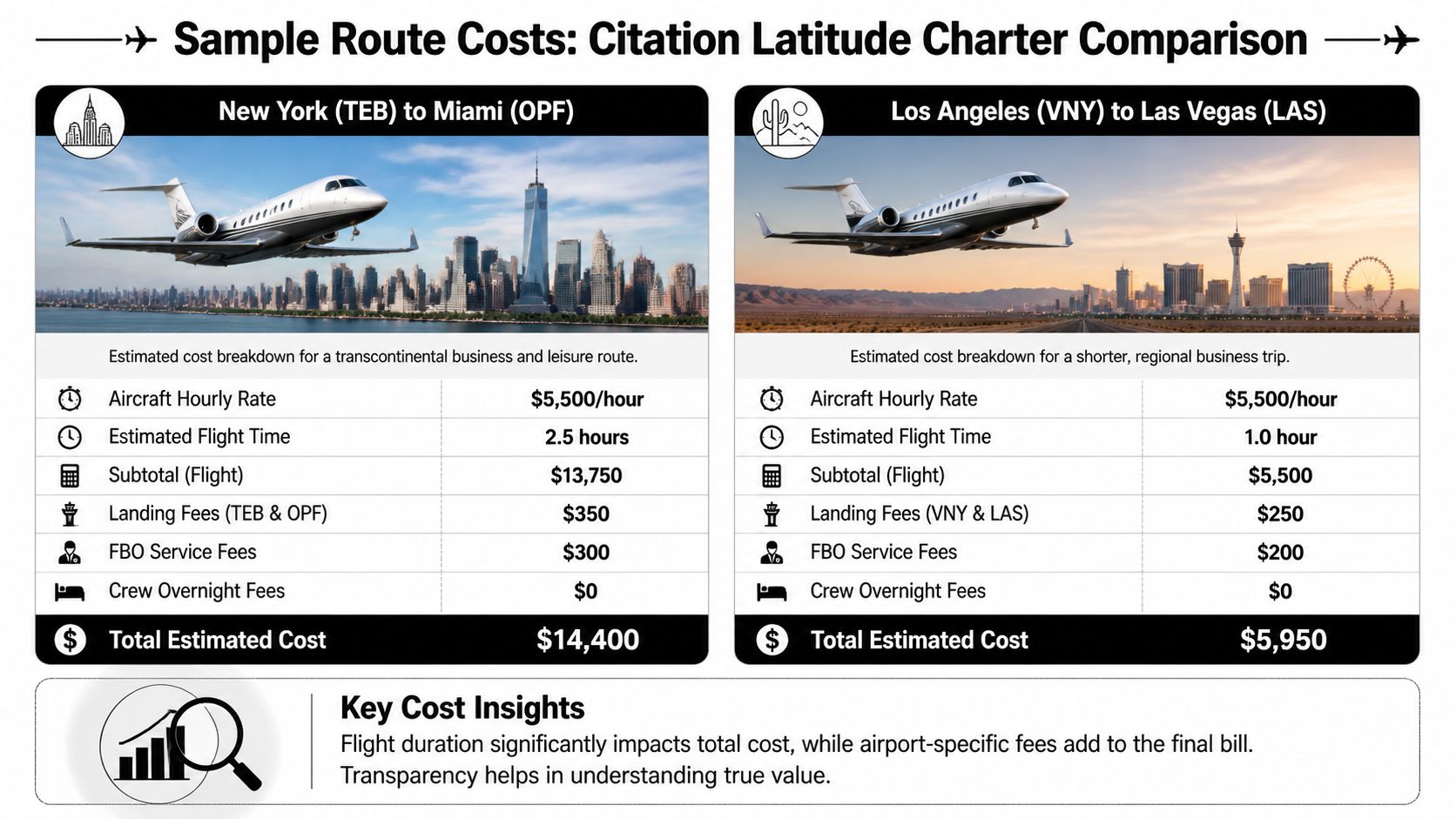
New York to Miami
New York to Miami is one of the easiest places to spot quote inflation because the route is common, demand is steady, and there are usually several aircraft positioning possibilities.
If a broker quote lands near the top of that $10,000 to $13,000 range, don't assume that's just the cost of premium lift. It may mean the aircraft wasn't local. Clients flying this corridor regularly should compare their quote against route-specific context such as private jet options from New York to Miami.
Los Angeles to Las Vegas
LA to Vegas is shorter, which makes inefficiency even easier to detect. On a short mission, excess repositioning or bloated ground charges become harder to hide because the actual flight time is limited.
The infographic below illustrates how short-route billing can still climb once airport and service charges are added, even when crew overnight costs don't apply.
| Route | What to watch |
|---|---|
| New York to Miami | Whether the quote includes hidden repositioning movement |
| Los Angeles to Las Vegas | Whether short flight time is being overshadowed by non-flight charges |
What these route examples actually tell you
They don't tell you that every broker quote is wrong. They tell you that citation latitude price should always be judged at the trip level.
A fair charter conversation starts with the route, the actual aircraft position, and whether your quote is built around local availability. If those details aren't clear, the hourly rate is just decoration.
The Economics of Owning a Citation Latitude
Ownership is the cleanest reality check on charter pricing. If a charter quote sits far above what the aircraft costs to carry and operate, someone in the chain is protecting margin, not your budget.
The Citation Latitude acquisition cost ranges from $14.985 million to $18.315 million, while 2020 to 2024 models generally sit around $17.5 million to $19.5 million, according to AvBuyer's Citation Latitude price guide. AvBuyer also notes that factory discounting has created meaningful variation in what different owners paid, which matters because owner basis influences resale flexibility and charter behavior.
The monthly and annual burden
A financed Latitude can run about $100,000 per month. Annual fixed costs typically fall between $500,000 and $600,000. Direct operating costs are about $2,700 per hour, and total hourly ownership cost lands around $6,262 to $7,508, depending on annual utilization, as noted earlier.
Those figures matter because they set the outer boundary for rational pricing. They also explain why advertised hourly charter rates can look reasonable while the all-in quote still comes back inflated. The spread usually comes from repositioning, sourcing inefficiency, and layers of broker markup. Haute Jets closes much of that gap by sourcing closer to the trip and buying at wholesale, which keeps your final number nearer to the aircraft's real operating economics.
Why resale and utilization drive the decision
The Latitude is an asset as much as a cabin. A buyer with predictable annual usage, strong schedule sensitivity, and a clear exit plan can make ownership work. A buyer without those three things usually overpays for control.
If you're weighing ownership against charter, use this framework:
- Lower annual utilization: Chartering is usually the better financial decision because you avoid fixed carry.
- Heavy, repeat flying: Ownership starts to make sense when schedule control and aircraft access justify the monthly burn.
- Mixed travel profile: A charter-first strategy often wins, especially if you source aircraft efficiently instead of paying retail broker pricing on every trip.
That last point gets missed. Many first-time buyers compare ownership to headline charter rates, not to what disciplined charter buying should cost. If you want more context on where the Latitude sits against nearby alternatives, review this Legacy 500 vs Citation Latitude midsize jet comparison.
For companies setting travel policy, ownership should also fit a broader system for managing corporate travel expenses. One aircraft decision rarely breaks the budget. Poor trip-by-trip controls do.
My recommendation on ownership
Buy a Citation Latitude only if your flight volume, scheduling demands, and balance sheet all support it. Otherwise, charter the aircraft and insist on local, wholesale-oriented sourcing. That approach gives you Latitude capability without absorbing the full fixed-cost burden year-round.
How the Latitude Compares to Other Midsize Jets
Clients often compare the Citation Latitude to other midsize or super-midsize options and focus too much on category labels. That's backward. The primary question is whether the aircraft gives you the cabin experience and trip economics you need.
The Latitude's operating costs remain competitive. Hourly variable costs are around $4,030, and total ownership costs are roughly $990,000 annually across 200 flight hours, according to The Jet Agent's Citation Latitude market update. That's why it keeps showing up in serious shortlist conversations.
Where the Latitude earns its place
The Latitude is compelling because it delivers a roomy cabin feel and strong comfort value without automatically pushing the client into a more expensive large-cabin mission profile.
If you're comparing aircraft from a charter perspective, use these filters:
- Cabin comfort: The Latitude is often the better choice when passengers care about standing room and longer-leg comfort.
- Mission efficiency: It fits travelers who want more than a light jet but don't need the cost profile of larger transcontinental platforms.
- Economic balance: It often lands in a practical middle ground where the cabin upgrade feels justified.
Where another jet may win
Not every mission belongs on a Citation Latitude.
A smaller jet may make more sense if cost sensitivity dominates and the route is short. A larger jet may win if you need more space, longer range, or a different cabin configuration. If you're weighing aircraft in this segment, this side-by-side analysis of the Legacy 500 vs Citation Latitude midsize jet comparison is a useful next read.
My view as an advisor
For a client who wants comfort without getting reckless on spend, the Latitude is one of the strongest answers in private aviation. It isn't the cheapest midsize option, and it shouldn't be. But it often gives you the point where the upgrade feels tangible rather than cosmetic.
That's why it stays relevant. It solves a real travel problem instead of selling a status premium alone.
Booking a Citation Latitude Smarter with Haute Jets
The smartest way to approach citation latitude price is to stop treating the hourly rate as the decision point. The better question is whether the quote reflects the aircraft you need, in the place you need it, without charging you for avoidable movement.
That matters even more with an aircraft like the Citation Latitude because the underlying asset has held value unusually well. The market has shown strong stability, with only about 3% of the fleet available for sale at any given time, supporting resilient resale dynamics, according to this Citation Latitude market overview from Simple Flying.
What smart booking looks like
A disciplined charter client should insist on four things:
- Exact aircraft clarity: Know the specific jet, not just the category.
- Local availability: The closer the aircraft is to your departure point, the cleaner the economics usually are.
- Transparent trip pricing: The total should be easy to explain line by line.
- No prepaid complexity: You shouldn't need a membership structure just to get a fair market quote.
The recommendation
If you fly on demand, skip the glossy abstractions. Ask for the true trip total and compare it against realistic aircraft economics. That's how experienced buyers and repeat charter clients keep control of spend.
If you're evaluating options, review Haute Jets pricing with the same discipline you'd apply to any aviation provider. Look for transparency, local sourcing logic, and whether the quote is built around your trip rather than someone else's repositioning problem.
If you want a Citation Latitude quote that reflects actual trip economics instead of broker fluff, talk to Haute Jets. Their model is built around direct, on-demand aircraft sourcing, which is exactly how smart clients should buy charter lift in 2026.