
You're standing on the ramp at a 2026 FBO, watching a Gulfstream G650 being prepared for a long private flight. The cabin is quiet, the catering is already moving aboard, and the crew has disappeared forward through the aircraft door. From the passenger seat, the trip may feel effortless. Behind that experience is a flight deck designed to help two pilots manage a fast, ultra-long-range aircraft with clear information, electronic flight controls, and carefully layered redundancy.
The phrase cockpit Gulfstream G650 describes more than a collection of screens. It describes the operational center that influences departure readiness, workload, approach awareness, and the crew's ability to manage a demanding mission. Gulfstream's PlaneView II avionics, fly-by-wire controls, head-up display, and synthetic vision are most useful when understood as a connected working environment, not as isolated luxury features.
Step Inside the G650 Cockpit Before You Fly
The cabin door is still open as the crew prepares the aircraft. Two pilots take their seats behind a broad glass flight deck, with side-stick controllers instead of a traditional control column between them. That layout leaves the center area open, while the pedestal keeps thrust controls, radios, trim, and other frequently used functions within reach.

For a charter client, the cockpit is where schedule reliability starts. Before the cabin door closes, the pilots inspect the aircraft, load the route, review weather and notices, and complete performance calculations. The flight deck then brings those inputs together so the crew can scan, confirm, and act on them during departure, cruise, and arrival.
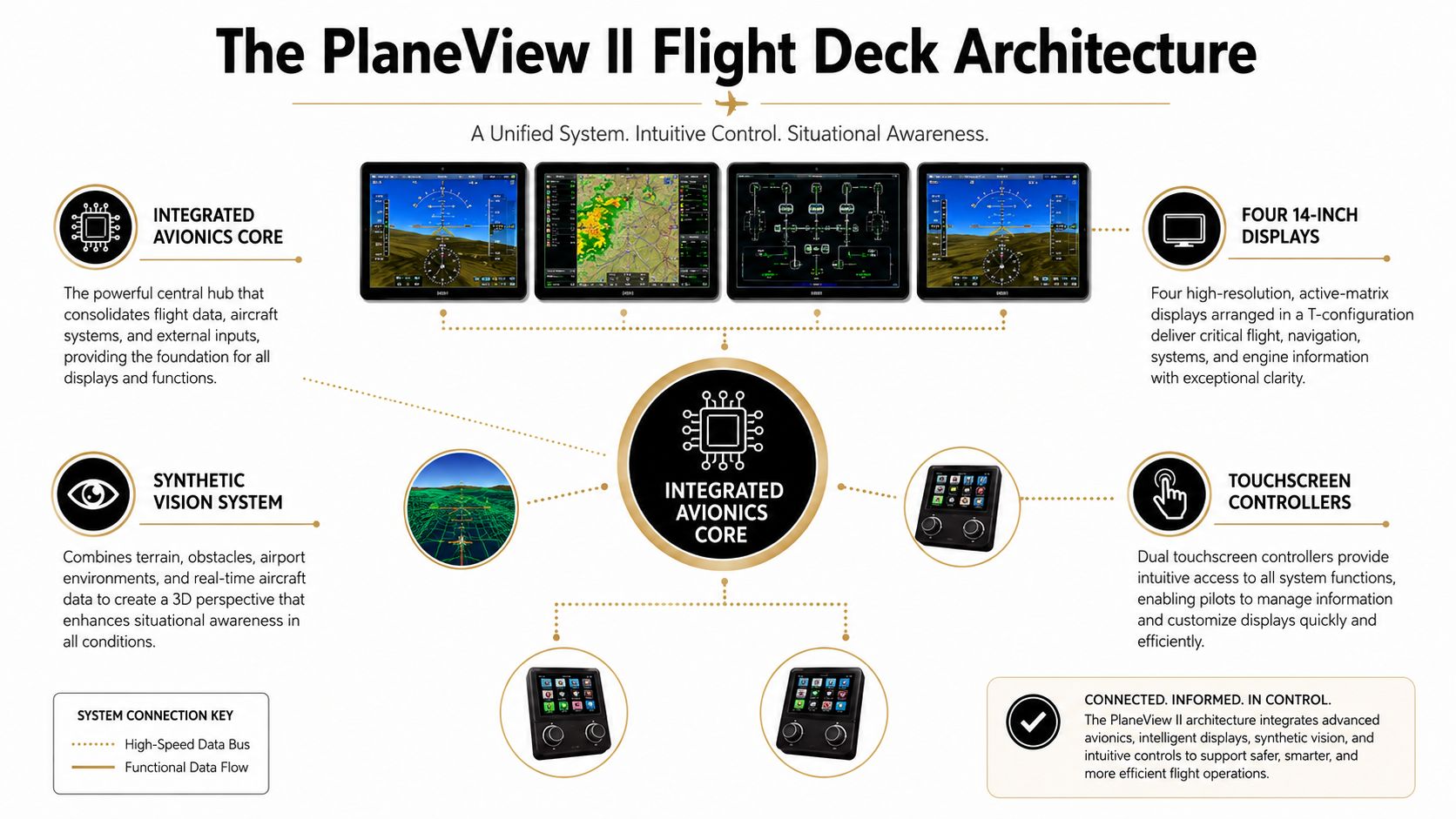
The most noticeable feature is the bank of four large liquid-crystal displays, each measuring 14 inches. They organize flight, navigation, engine, and systems information across the pilots' field of view. A head-up display adds another reference by projecting selected flight information into the forward view, allowing a pilot to retain outside visual awareness while monitoring key guidance.
The G650 is certified for a two-pilot crew, as recorded in aircraft reference data and type-certificate material. The certification information is published by EASA. Two pilots do not split a checklist between them. The captain and first officer cross-check decisions, manage separate controls and displays, and follow procedures built for a complex, long-range aircraft.
Before the passengers board
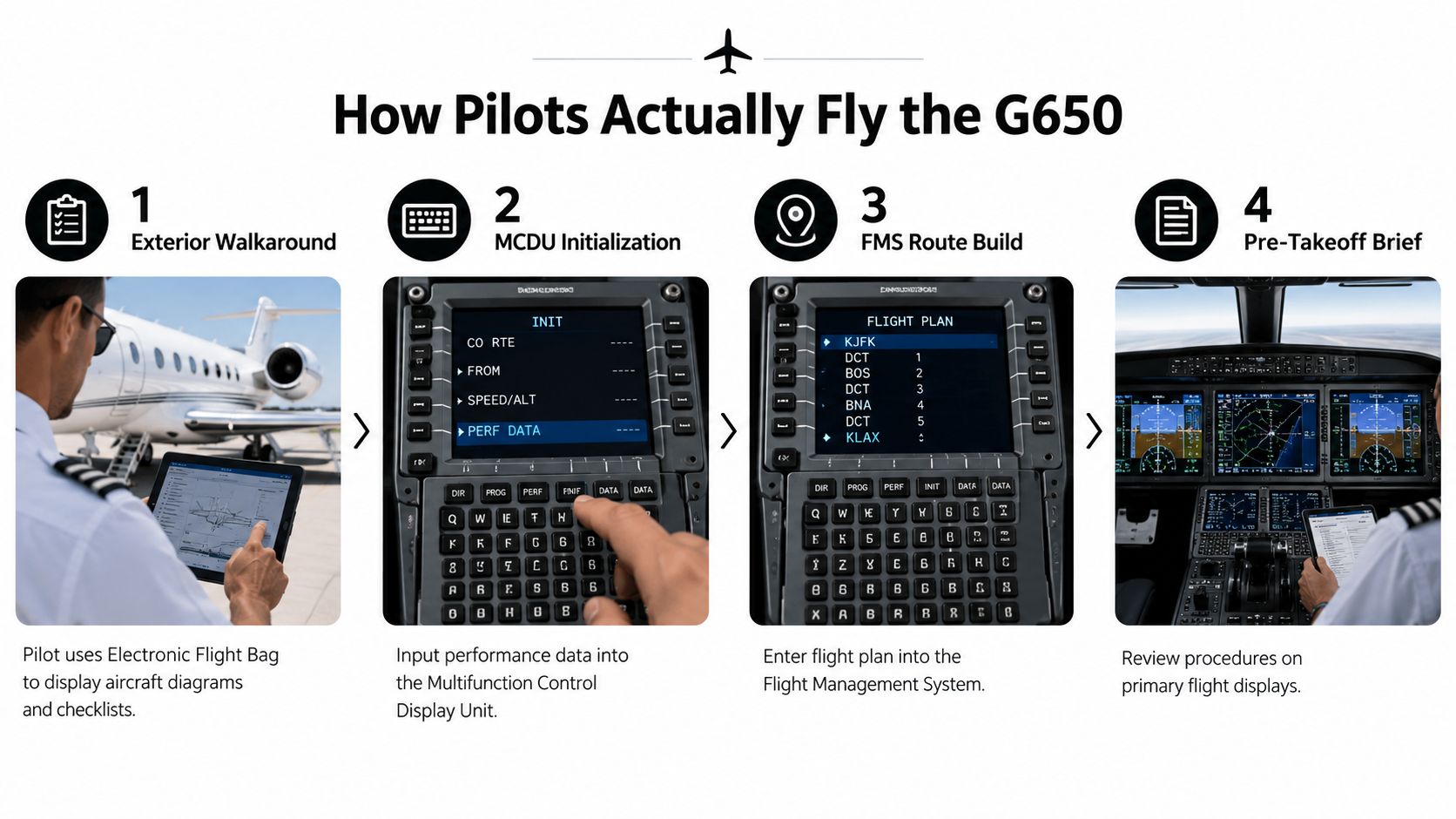
Preparation begins outside the aircraft. During the walkaround, the crew checks the landing gear, control surfaces, engines, doors, tires, and visible sensors. Inside, they power the aircraft, initialize the flight-management equipment, enter the route, and calculate takeoff data.
A Gulfstream type rating and aircraft-specific training are required because the G650's systems and operating logic differ from those of an older business jet. Operator procedures, manuals, dispatch practices, and crew coordination all affect how the aircraft is prepared and flown. Those details support more than a polished departure. They help the crew manage workload and fatigue during an ultra-long-range mission.
Understanding PlaneView II is easier against the wider shift from steam gauges to glass cockpits. Older panels required pilots to assemble the aircraft's condition from many separate instruments. The G650 presents related information in a coordinated format, much like a well-organized operations desk, while still requiring trained pilots to verify each source and respond to changing conditions.
For clients comparing aircraft for a long charter, the useful question is how the operator uses this equipment. Ask how the crew prepares the airplane, how its systems are verified before departure, and how the flight plan is handled when weather or air-traffic restrictions change. The Gulfstream G650ER charter aircraft page provides an overview of the aircraft family.
The passenger benefit is practical. A well-managed flight deck supports a quiet departure, a stable climb, and an arrival adjusted to the conditions, helping the cabin experience feel straightforward even when the mission is demanding.
The PlaneView II Flight Deck Explained
PlaneView II is Gulfstream's integrated flight deck, built around Honeywell Primus Epic avionics. Gulfstream publicly described the G650 cockpit in 2008, before certification, with four large 14-inch adaptive liquid-crystal displays and a smaller pedestal in the period release covered by Airframer. The layout was designed around situational awareness from the beginning, so pilots could build one coordinated picture of the aircraft instead of collecting separate clues from scattered gauges.
Four screens, different jobs
Large displays help, but their practical value comes from how the system organizes information for the crew.
- The Primary Flight Display shows attitude, speed, altitude, heading, and flight guidance.
- The Multi-Function Display presents navigation, route, weather, and other mission information.
- The Engine Instrument and Crew Alerting System, commonly called EICAS, shows engine indications and alerts requiring attention.
- The remaining display supports the integrated presentation and lets the crew arrange information for the current phase of flight.
The arrangement works like a well-organized operations desk. During climb, pilots can keep flight guidance and engine performance readily visible. In cruise, route progress, weather, fuel management, and system status may take priority. On approach, navigation guidance, terrain information, runway alignment, and visual references become more prominent.
The change from conventional instruments to glass displays also changes the pilot's scan. This DuBois Aviation cockpit guide provides background on how integrated electronic displays affect information priorities. For a charter operator, that organization can support consistent crew coordination and reduce unnecessary searching during a long duty period.
The HUD and synthetic vision
The G650 combines its main displays with a Rockwell Collins head-up display and a synthetic vision primary flight display. The HUD places selected guidance and flight references in front of the pilot's outside view. Synthetic vision creates a computer-generated view of terrain and the surrounding environment, giving the crew another organized reference when the natural visual scene is limited.
These tools supplement instrument procedures and pilot judgment. They do not replace either one. On an ultra-long-range sector, keeping key references available with less head movement can help pilots preserve attention for weather decisions, route changes, and other tasks that require judgment.
PlaneView II also integrates flight management, radio and navigation control, and graphical flight planning. The result is a layered cockpit. The crew does not need every detail visible at once. Information can match the immediate task while deeper system data remains available when required, supporting dispatch decisions and a more controlled cabin experience on a 2026 charter flight.
Fly by Wire Controls and Redundant Avionics
The G650 was a milestone for Gulfstream because it introduced the company's first fly-by-wire flight control system. Instead of using a direct mechanical linkage from the pilot's control input to the aircraft's control surfaces, the system interprets electronic commands through flight-control computers.
The architecture is fully digital and provides three-axis control. Public aircraft descriptions also identify quadruplex dissimilar redundancy, meaning the system uses multiple independent paths and dissimilar elements to support fault isolation and continued control as described by Air Charter Service. The same source identifies fly-by-wire-related functions such as automatic descent mode and windshear protection within the integrated avionics environment.
That technical language has a practical meaning. If a sensor, computer, or part of a control path develops a fault, the aircraft's architecture is designed to identify and isolate the problem while preserving the required handling capability. It doesn't guarantee that every flight continues exactly as planned, but it gives pilots and operators a more resilient platform for managing faults.
The cockpit's wider equipment supports the same philosophy. A later G650 specification sheet lists dual Honeywell TR-865A VHF receivers, dual Honeywell DM-855 DME modules, a Universal CVR-120R solid-state cockpit voice recorder, and a dual automatic flight guidance system in the published aircraft specification. Those systems support communication, navigation, recording, and guidance without depending on a single component.
| System | Redundancy Level | Operational Role |
|---|---|---|
| Flight controls | Quadruplex dissimilar architecture | Provides electronic command paths, fault isolation, and continued handling capability |
| Flight guidance | Dual automatic flight guidance system | Supports managed guidance and crew cross-checking |
| VHF communication | Dual receivers | Helps maintain communication capability when one receiver is unavailable |
| Distance measuring equipment | Dual DME modules | Provides independent navigation-distance information |
| Cockpit voice recording | Solid-state recorder | Records cockpit communications and sounds for operational and safety purposes |
Why operators care
For an operator, redundancy isn't only a safety concept. It also affects dispatch planning, maintenance decisions, and the ability to evaluate a defect before a flight. A resilient system can help the crew manage an abnormal indication without turning every fault into an immediate loss of mission capability.
The FAA draft flight-standardization report also records a specific avionics configuration boundary. PlaneView II software Block Point I was installed in GVI G650 aircraft with serial numbers 6001 through 6093 according to the FAA draft FSB report. That detail illustrates why aircraft configuration matters. Two G650s may share the same model name while requiring operators to track software, equipment, and manual differences carefully.
How Pilots Fly the G650
A G650 charter flight starts before engine start. The pilots review the aircraft's condition, inspection items, route, weather, airport constraints, and performance requirements. Electronic flight materials and aircraft manuals turn those inputs into a sequence of checks, much like a flight plan becomes a series of managed decisions rather than a single panel setting.
From power-up to taxi
After the aircraft is powered, the crew initializes the multifunction control display units and enters the route into the flight-management system. They confirm the departure procedure, runway, performance data, navigation information, and expected altitude profile. The captain and first officer independently check key entries, because reliable automation still depends on accurate inputs.
During engine start, the pilots monitor engine indications and system alerts rather than selecting a start switch and waiting. Taxi introduces another set of tasks: thrust, steering, braking, flight-control checks, and before-takeoff configuration. Flap and slat settings, speed-brake position, autobrake selection, and trim all support a stable departure profile.
The HUD becomes especially useful as the crew moves from taxi to takeoff and climb. Guidance appears in the pilot's forward view, while the primary displays provide the conventional instrument cross-check. Each pilot verifies the other's selections, reducing the chance that a route or configuration error reaches the runway.
For readers comparing Gulfstream generations and mission profiles, the Haute Jets Journal comparison of the Gulfstream G550 and G650 provides useful context.
Cruise and arrival
In cruise, the crew monitors EICAS indications, route progress, weather, aircraft systems, and fuel status. The autothrottle helps manage engine thrust, and the autopilot follows the selected or managed flight path. Public descriptions place G650 cruise operation within a high-speed range of Mach 0.85 to 0.925, although aircraft weight, weather, restrictions, and clearance shape the operating point on a particular flight.
Synthetic vision and the enhanced flight-vision system support different tasks. Synthetic vision creates a computer-generated view from aircraft data and terrain databases. EVS uses an infrared image to help the crew identify visual features when the natural view is limited. Pilots compare both tools with the primary flight displays, navigation guidance, outside references, and published procedures.
For passengers, those outcomes translate into a smoother climb, fewer abrupt configuration changes, and a controlled descent. They also help the crew manage workload across a long charter sector, supporting consistent handling and operational reliability without making one display responsible for the flight.
G650 vs G650ER Cockpit Experience
A traveler stepping aboard either variant sees a familiar flight deck. The G650 and G650ER share the same broad cockpit philosophy, including PlaneView II, Honeywell Primus Epic avionics, large electronic displays, a HUD, synthetic vision, and automated flight-guidance functions. For pilots moving between the two aircraft, the visual environment and basic control concept remain familiar. That commonality supports smoother crew transitions and leaves more attention for the particular route, weather, and fuel plan.
The important difference appears in how the crew prepares and manages the longer mission. The G650ER received its type-certificate date on October 7, 2014, while the G650 received FAA type certification on September 7, 2012, dates listed in type-certificate records published by EASA. Certification identifies the approved aircraft and variant configuration. Day-to-day preparation still depends on the operator's manuals, training program, and aircraft-specific performance data.
Shared cockpit foundation
The two variants give pilots a common working environment:
- PlaneView II avionics organize flight, navigation, engine, and systems information.
- Four 14-inch displays provide a broad electronic scan area.
- Fly-by-wire controls replace direct mechanical control-surface linkage with computer-mediated commands.
- HUD and synthetic vision add forward-view guidance and terrain awareness.
- Autopilot and autothrottle functions reduce repetitive workload during long periods of managed flight.
Passengers may not perceive these similarities directly, but they matter because crew familiarity with the basic layout leaves more attention available for mission-specific decisions. On a 2026 charter flight, that can support consistent cockpit coordination and reduce the adjustment burden when pilots operate different members of the same aircraft family.
Where the ER changes the work
The ER's extended-range mission requires more detailed fuel and performance planning. Pilots use the applicable weight and performance data, review fuel quantity and reserves, and build step-climb or alternate plans around the actual route. The cockpit looks familiar, yet the questions behind each entry change as the aircraft carries more fuel and remains airborne longer. Those decisions affect dispatch preparation, reserve protection, and fatigue management across an ultra-long-range sector.
| Cockpit Element | G650 | G650ER |
|---|---|---|
| Primary avionics environment | PlaneView II integrated flight deck | PlaneView II integrated flight deck |
| Mission planning emphasis | Standard aircraft performance and fuel planning | Extended-range fuel, weight, reserve, and step-climb planning |
| Crew workload | Long-range route management | Greater attention to fuel quantity, alternate strategy, and changing aircraft weight |
| Type-certificate context | Certified September 7, 2012 | Certified October 7, 2014 |
| Pilot preparation | G650 aircraft procedures and performance data | G650ER-specific procedures and performance data |
The distinction is operational rather than visual. A charter client should not treat the G650ER as a G650 with more fuel and identical planning. The operator must provide crews trained and authorized for the aircraft configuration in use, supported by current manuals and performance data for the actual tail.
What the Cockpit Means for Charter Clients
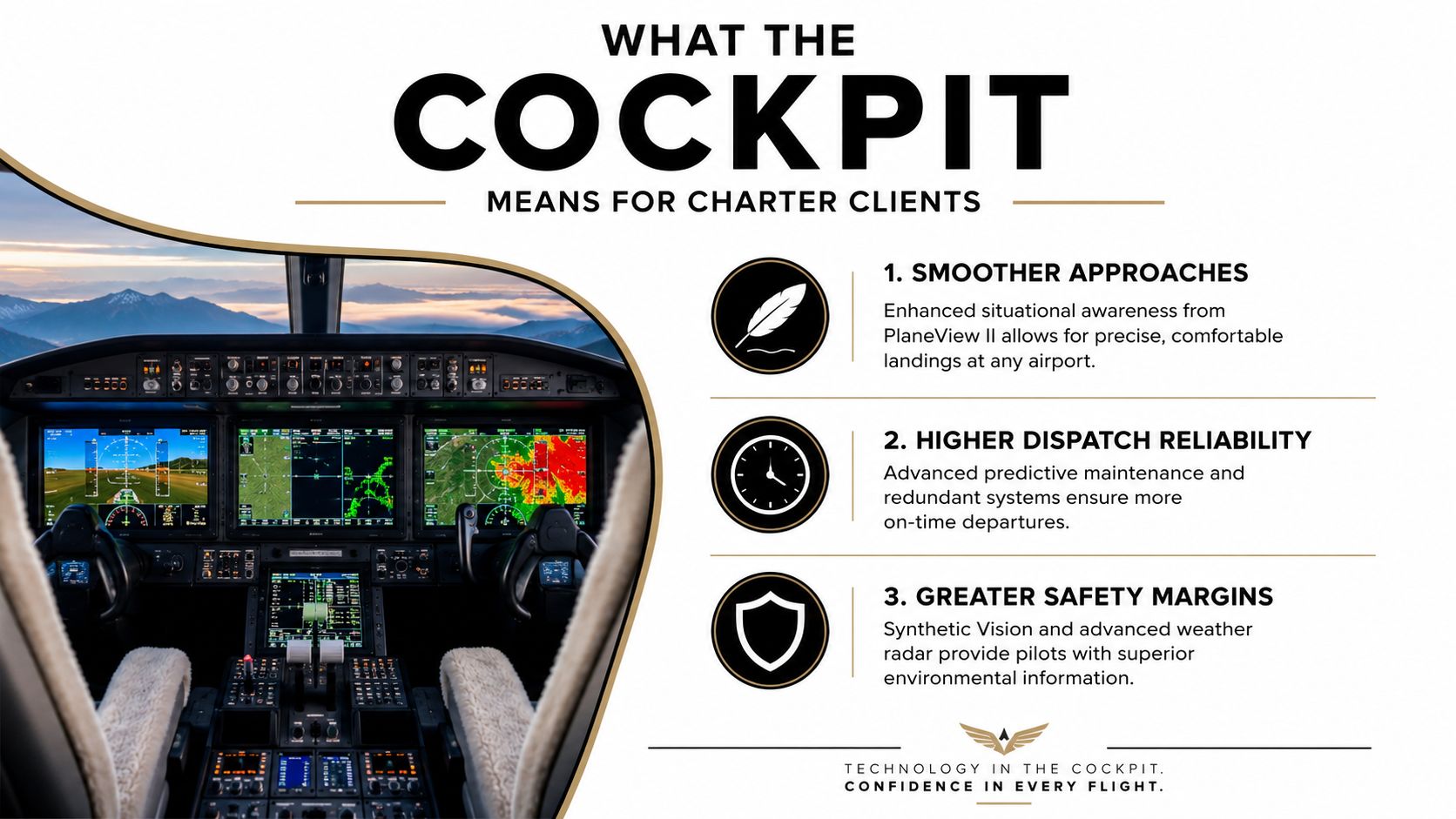
A advanced cockpit only matters to a passenger through the outcomes it supports. PlaneView II can help the crew organize navigation, flight guidance, terrain information, engine indications, and alerts during a complex arrival. That doesn't promise a particular landing time or eliminate weather disruptions, but it gives the pilots a structured information environment when the airport, routing, or conditions are unfamiliar.
Translating systems into the cabin
The HUD and synthetic vision can support the crew's situational picture during approach. The fly-by-wire system helps translate pilot inputs into controlled aircraft responses while the flight-control computers monitor and manage the command architecture. The passenger experiences that indirectly through a cockpit team that can concentrate on path control, energy management, and coordination rather than manually moving every control surface through a mechanical linkage.
Automation also changes the rhythm of a long flight. Autopilot and autothrottle systems manage repetitive tasks, while pilots supervise the aircraft, evaluate weather, monitor systems, and prepare for the next phase. That division of labor can help preserve attention during a long mission, though the crew remains responsible for selecting, monitoring, and disengaging automation when conditions require it.
For charter clients: A modern flight deck is valuable when it supports good crew decisions. The screen count matters less than the operator's training, procedures, maintenance control, and discipline.
A buyer should also distinguish between equipment installed on an aircraft and equipment available for a specific mission. Ask whether the aircraft has the expected HUD, EVS, communication capability, cabin connectivity, and configuration. Ask how the operator confirms those items before departure, rather than relying only on a generic model description.
Choosing the operator, not just the aircraft
The strongest booking conversation includes questions about the crew and the aircraft's operational status:
- Crew qualification: Confirm that both pilots hold the appropriate G650 or G650ER type qualification and operate as a trained crew pair.
- Training currency: Ask when the pilots last completed recurrent simulator training and whether it covered the specific variant and avionics configuration.
- Maintenance control: Request a clear explanation of how the operator reviews aircraft status, deferred items, and dispatch decisions.
- Mission planning: Ask how the team handles weather changes, alternates, fuel planning, and route revisions on ultra-long-range sectors.
- Audit status: If safety credentials matter to your selection, ask for current third-party audit information and verify what the credential covers.
For aircraft-specific charter context, Haute Jets' Gulfstream G650ER long-range journal guide can help frame the aircraft choice. The final decision should still rest on the actual aircraft, crew, operator, route, and confirmation details for your flight.
G650 Cockpit Questions Charter Clients Ask
Does the G650 require a type-rated crew?
Yes, the G650 is designed for operation by a two-pilot crew, and pilots require the appropriate aircraft qualification and operator training. The aircraft's integrated avionics and fly-by-wire controls create a specific operating environment, so a charter client should ask whether both pilots are current on the exact G650 or G650ER variant being offered.
Does PlaneView II training cover more than the screens?
It should. Recurrent training needs to address flight guidance, electronic flight controls, alerting philosophy, abnormal procedures, crew coordination, and the way pilots manage automation. A pilot who knows where a function appears on a display still needs to understand when to use it, how to cross-check it, and what to do if the system changes mode.
Can a broker promise a particular dispatch reliability rate?
A generic model-level promise isn't enough. Dispatch performance depends on the aircraft's maintenance program, operator control, crew availability, airport conditions, weather, and the specific mission. Ask the operator how it defines mission completion, how it handles technical delays, and what support is available if the aircraft requires a change.
Can I confirm HUD and synthetic vision before booking?
You can ask for confirmation in the aircraft's equipment list and final trip documentation. The G650 is publicly described with a Rockwell Collins head-up display and synthetic vision, but charter inventory can include aircraft-specific configurations, so the operator should verify the equipment on the actual tail.
How does fly-by-wire affect turbulence?
Fly-by-wire doesn't make turbulence disappear. It gives the flight-control system a digital command architecture that can support consistent handling and control-law protections while the crew manages speed, altitude, routing, and weather avoidance. Passenger comfort still depends on atmospheric conditions, aircraft loading, pilot technique, and the decision to change altitude or route.
What do ADS-B, FANS, and CPDLC mean to a client?
They relate to how the aircraft is identified, tracked, and communicated with in controlled airspace. Their practical value depends on the aircraft's installed equipment, route requirements, approvals, and the service available along the planned crossing. Ask the operator to confirm that the aircraft is properly equipped and approved for the intended oceanic or remote route.
Which operator credentials should I review?
Request current information about the operator's safety oversight, crew training, maintenance program, and third-party audits. Credentials such as IS-BAO Stage 3 or Wyvern Wingman may be relevant to a buyer's evaluation, but you should confirm their current status and understand which operating entity and aircraft they cover.
A good pre-booking conversation should leave you with the aircraft identity, crew qualification, equipment confirmation, operator details, and a clear plan for handling changes. Those answers tell you more about the cockpit experience than a list of display names alone.
Haute Jets can arrange access to Gulfstream G650 and G650ER charter aircraft through its network of owner-operators, with aircraft, crew, equipment, and trip details confirmed for the proposed mission. Visit Haute Jets to request a flight evaluation and compare the aircraft and operator information before booking.