Haute Jets Journal exists for moments like this. Your CEO wants to visit three cities in two days, commercial schedules don't line up, a charter quote lands with vague aircraft details, and finance wants to know why any of this should cost more than business class. You're stuck between urgency, cost scrutiny, and executive expectations.
That's where most companies get private travel wrong. They treat aircraft access as a last-minute booking problem. It isn't. It's an operating model decision.
Introduction From Cost Center to Strategic Asset
If you manage travel for senior leadership, you already know the pattern. A roadshow gets extended. A board meeting moves. A client dinner turns into a same-day site visit. Commercial travel breaks under that kind of pressure because airline schedules are built for mass demand, not executive timing.

Corporate flight management solves that problem when it's handled as a discipline, not as a collection of one-off charter calls. It gives the travel manager a framework for deciding when private aviation creates business value, how to control risk, and how to keep executive mobility aligned with company priorities.
This isn't a niche side topic anymore. The corporate aviation market has grown at a compound annual rate of 4.2% from 2019 to 2024, with approximately 21,000 corporate jets in active service worldwide, reflecting a strategic shift toward on-demand travel solutions, according to IATA world air transport statistics.
That scale matters because it changes the job in front of you. You're no longer deciding whether private travel is an occasional exception. You're deciding whether your company will manage executive mobility intentionally or keep paying for chaos.
What a strategic approach looks like
A sound program starts with three simple moves:
- Separate urgency from importance. Not every executive trip needs private aviation. The right trips are the ones where schedule control, multi-stop efficiency, privacy, or access to less-served airports changes the business outcome.
- Standardize decision criteria. Build a repeatable rule set so your team isn't renegotiating every trip from zero.
- Report value in business terms. Time recovered, meetings enabled, and opportunities preserved matter more than generic usage counts.
If your current process is reactive, start by tightening the decision logic behind each flight request. That's where private travel shifts from a budget headache to a strategic lever. For a broader look at why companies make that shift, Haute Jets Journal also covered the strategic advantages of private charter for corporate travelers.
Practical rule: If a trip saves leadership time but the process to approve it is chaotic, you don't have a travel solution. You have a procurement bottleneck.
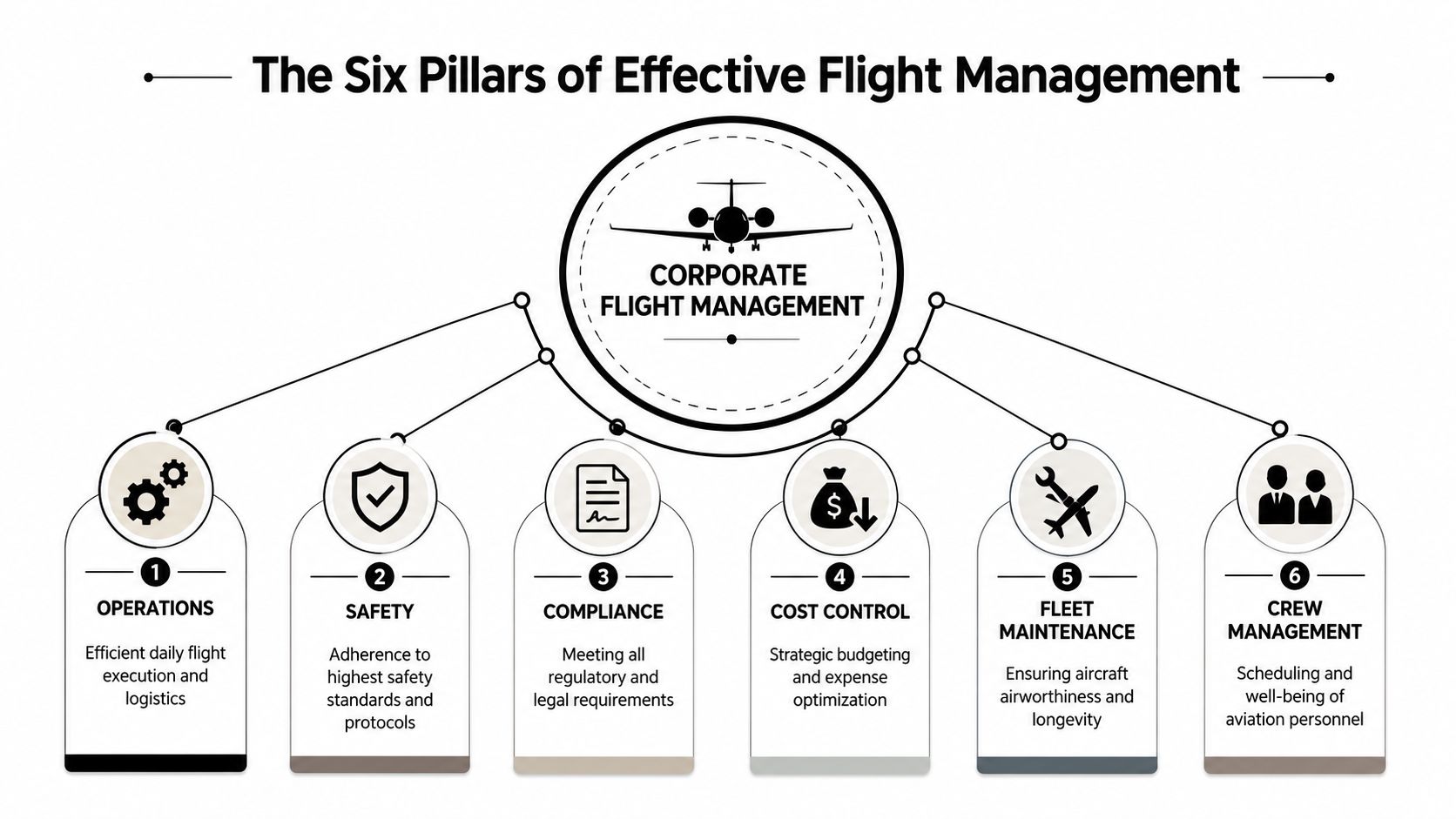
The Six Pillars of Effective Flight Management
Most travel managers overcomplicate corporate flight management because they treat every aircraft decision as unique. It's easier to run it like a high-performance team. Every flight depends on a few essential systems working together.
Operations and safety
Operations is daily execution. It covers trip intake, schedule building, airport selection, handling changes, and making sure passengers, aircraft, and ground support line up without friction. If this pillar is weak, the whole program feels unreliable.
Safety is where many companies pretend to be rigorous while relying on surface-level comfort. Don't do that. If you're using charter providers, insist on serious third-party safety standards and clear operator transparency. A polished quote isn't a safety system.
Compliance and cost control
Compliance is less glamorous and more important than most executives realize. It includes crew qualifications, documentation, duty limitations, international permissions, and internal policy alignment. Miss here, and your “convenient” flight option turns into operational exposure.
Cost control doesn't mean choosing the cheapest trip. It means understanding the underlying cost drivers behind private travel, then reducing waste before finance forces blunt cuts. That includes scheduling discipline, matching aircraft size to mission, and reducing unnecessary complexity in approvals and billing.
One of the clearest operational gains comes from software. Corporate flight management software is proven to reduce operational costs by 15–25% through features like automated scheduling, real-time fuel optimization, and integrated compliance tracking, as summarized by ZipDo's review of corporate flight department software.
Fleet maintenance and crew management
Fleet maintenance applies whether you own aircraft or rely on external lift. Someone still needs to track airworthiness, maintenance downtime, service intervals, and substitution planning. Travel managers who ignore maintenance realities often promise availability the operation can't support.
Crew management is where experienced operators separate themselves from spreadsheet planners. Pilot and cabin crew scheduling, qualification checks, rest requirements, and service consistency all live here. If you don't respect the crew side of the operation, delays and safety issues follow.
Use the pillars as an audit tool
Run your current process against this checklist:
- Operations: Can your team approve and arrange complex trips without rebuilding the process each time?
- Safety: Do you verify operator standards beyond marketing language?
- Compliance: Is someone accountable for documentation and policy adherence?
- Cost control: Can you explain what drives spend?
- Fleet maintenance: Do you know what could affect aircraft availability before the day of travel?
- Crew management: Is crew readiness planned, or assumed?
The best flight program isn't the one with the flashiest aircraft options. It's the one that can execute repeatably when the schedule gets ugly.
Choosing Your Private Aviation Model
Don't choose an aviation model by status. Choose it by trip pattern, internal tolerance for administrative work, and how much control the business needs. Most mistakes happen because companies jump to ownership logic before they've even measured demand properly.
The four models in plain terms
On-demand charter works best when your travel volume is variable, your routes change often, and you want flexibility without long-term commitment. It gives travel managers room to match aircraft to mission instead of forcing every trip into a prepaid structure.
Jet cards appeal to companies that want simplified booking and fixed commercial rules. The tradeoff is that convenience can come with rigidity, especially when the actual trip profile doesn't match the card's assumptions.
Fractional ownership sits in the middle. It offers more structured access and some ownership economics, but it also adds planning, legal, and program complexity that many companies underestimate.
Full ownership gives maximum control and maximum responsibility. It can make sense for organizations with predictable, heavy usage and a clear internal commitment to running an aviation asset like a business unit.
Private Aviation Models Compared
| Attribute | On-Demand Charter | Jet Card | Fractional Ownership | Full Ownership |
|---|---|---|---|---|
| Access model | Book as needed | Prepaid hours or program access | Share of an aircraft program | Company owns aircraft |
| Upfront commitment | Low | Moderate | High | Very high |
| Pricing style | Trip-based | Locked or program-based hourly structure | Program fees plus operating commitments | Full fixed and variable ownership costs |
| Flexibility | High | Moderate | Moderate | High operational control |
| Aircraft choice | Often broad | Usually program limited | Program fleet dependent | Limited to owned aircraft unless supplemented |
| Administrative burden | Lower | Lower to moderate | Moderate to high | Highest |
| Best fit | Variable demand | Repeated usage with preference for predictability | Ongoing need with ownership appetite | Frequent use and desire for direct control |
Where the money leaks
The biggest hidden issue in many private travel programs isn't the headline charter rate. It's repositioning. On-demand charter brokers that source aircraft locally can eliminate repositioning fees, which traditionally inflate charter prices by 20–40% in standard broker and jet card programs, as explained in this Haute Jets Journal piece on executive travel solutions.
That matters because travel managers often compare quotes without separating flight cost from positioning cost. You should. A cheaper-looking model can become expensive fast if the aircraft isn't already near your departure point.
My recommendation by company profile
- Use on-demand charter if your travel needs shift by quarter, by leadership team, or by market opportunity.
- Use a jet card only if your company flies often enough to value a locked structure and you've tested whether the program rules fit your actual mission pattern.
- Consider fractional ownership if leadership wants consistency and semi-dedicated access, but isn't ready to own the full burden.
- Choose full ownership only if your company wants a true flight department, not just private lift.
If you're weighing commitment against control, review a more detailed corporate jet leasing guide before you lock into a structure that finance will question six months later.
Implementing Your Corporate Flight Program
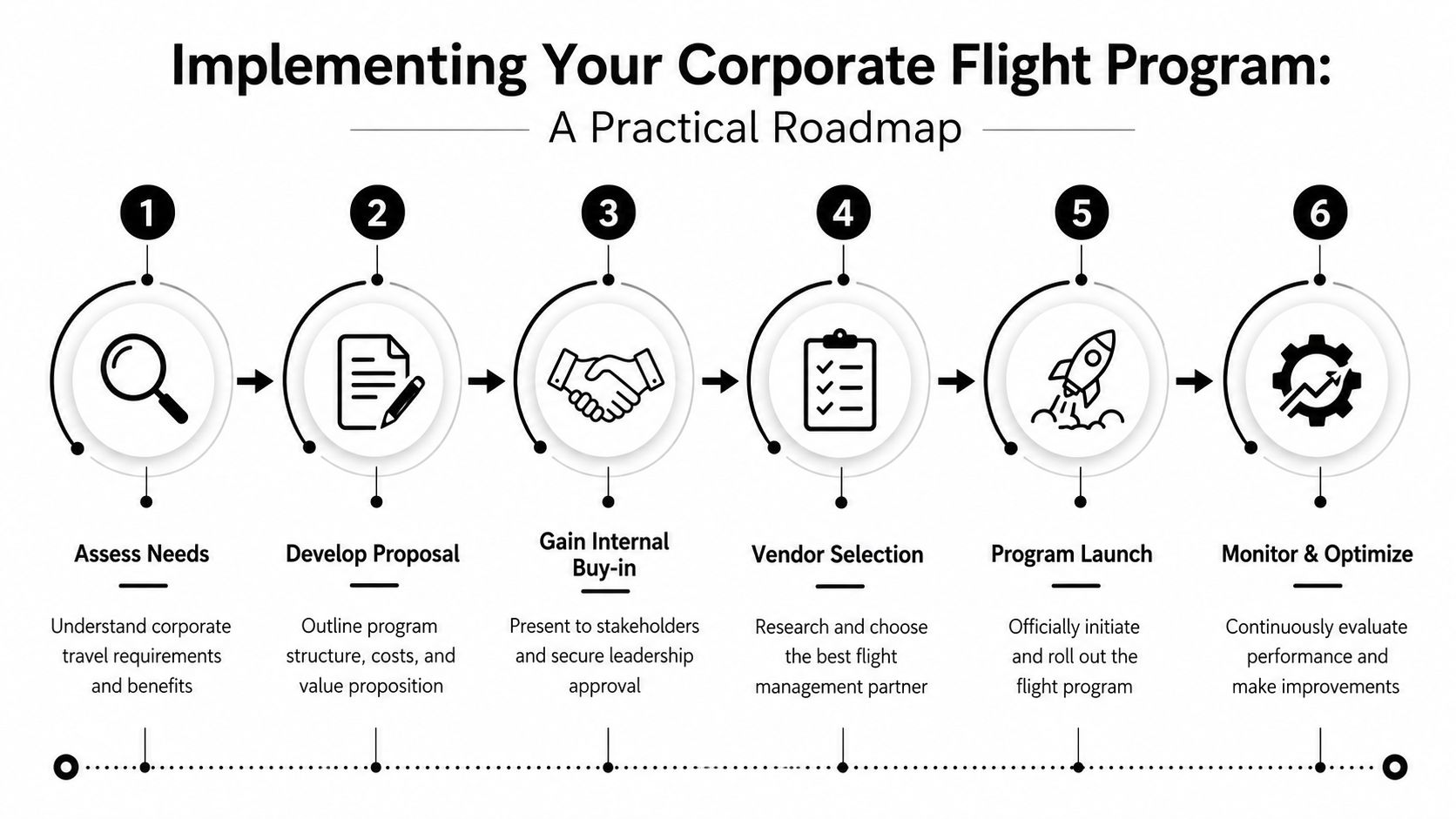
Most corporate flight programs fail before launch for one reason. The travel manager presents them as a transportation upgrade instead of a business tool. Finance hears “premium travel.” Leadership hears “convenience.” Neither is enough.
Start with demand, not aircraft
Pull your recent executive and team travel patterns. Look for the trips that repeatedly break commercial logic: multi-city days, remote plants, short-notice client meetings, board travel, and routes where overnighting adds friction without value.
Then build a short list of use cases. Not broad categories. Specific trip types. “Investor meetings across two markets in one day” is useful. “Executive travel” is lazy.
Build the business case in the language executives use
Your proposal should answer four questions:
- Which business activities need faster mobility?
- What happens when those trips rely on commercial schedules?
- Which private aviation model best matches the demand pattern?
- How will you prove the program created business value?
This point matters more than any aircraft discussion. Flight leaders must “document the deals that were made or saved because the company's aircraft was available” and align the flight department's mission with corporate goals outlined in public filings, according to the NBAA guidance on managing your flight department like a business.
Boardroom test: If your proposal doesn't connect aircraft access to revenue protection, deal support, or executive productivity, it will be treated like discretionary spend.
A strong program also connects the air segment to the ground segment. If your travelers are moving between private terminals, board sites, and client properties, coordinated local transfer matters. In markets where executives need discreet, reliable last-mile service, a resource like secure Hamptons corporate travel helps illustrate how the full door-to-door plan should be built.
A short briefing can help leadership understand how this works in practice:
Launch small and report fast
Don't wait for a perfect, enterprise-wide aviation policy. Pilot the program with a defined executive group or a narrow set of trip categories. That gives you real usage data, real stakeholder feedback, and a faster path to policy refinement.
Use a launch checklist:
- Stakeholders: Include finance, legal, executive assistants, security, and leadership sponsors.
- Policy: Define who can approve flights, what qualifies, and when commercial remains the right choice.
- Vendor standards: Set expectations for safety documentation, service transparency, and reporting.
- Review cadence: Report early wins and friction points quickly, while leadership still remembers why the program was approved.
Measuring Success with Strategic KPIs
If you report only hours flown, occupied legs, or total spend, you're making your own program look smaller than it is. Those are operating stats. They don't tell the company whether private aviation helped leadership move faster, close business, or protect time.
The KPIs that actually matter
Use a balanced scorecard with both efficiency and outcome measures:
- Value of time saved: Compare the executive's real door-to-door commercial alternative against the private itinerary. Then assign internal value using your company's own view of leadership time.
- Mission completion rate: Track whether the planned business objective was completed as scheduled. This is a better reliability metric than raw departure counts.
- Cost per occupied seat mile: Use this to compare trip efficiency across mission types, not as a blunt argument against all private flights.
- Schedule gain: Record whether the aircraft enabled same-day multi-stop travel, reduced overnights, or avoided trip abandonment.
- Opportunity log: Capture qualitative notes from business units when travel access directly enabled negotiations, site decisions, or client retention.
Report outcomes, not aviation trivia
A monthly update should fit on one page. Include what was flown, why it qualified, what business activity it supported, and what changed because the flight was available. If a trip prevented a delay in a deal process, say that plainly. If a flight replaced an overnight and preserved executive availability the next morning, say that too.
A good KPI report makes non-aviation leaders care. If your dashboard reads like dispatch software, you're reporting to the wrong audience.
Keep the framework simple
Don't force fake precision where your company doesn't have it. Some value is numeric. Some is narrative. Both matter. The test is whether your reporting helps leadership decide when private travel is justified and whether the program is getting sharper over time.
The Human Element in Aviation Management
Most corporate flight management content treats people as a staffing line. That's a mistake. Crew wellness isn't a soft HR topic. It affects safety, readiness, retention, and service quality.

The industry has a blind spot here. Over 60% of aviation professionals report significant stress levels, yet many flight management guides focus exclusively on safety audits, ignoring human factors like burnout which directly impact operational safety and aircraft availability, as noted in this article on aviation mental health and wellness priorities.
What travel managers should do
You may not supervise pilots directly, but your decisions still shape the operating environment. Last-minute changes, unrealistic passenger expectations, and poor communication create pressure downstream.
Use low-friction practices that help:
- Set realistic trip change rules: Not every itinerary revision should be treated as operationally harmless.
- Ask about resilience, not just coverage: A staffed schedule isn't the same thing as a sustainable one.
- Normalize support resources: EAP access, supervisor awareness, and routine wellness check-ins should be treated as operating safeguards.
- Include crew feedback: If the people flying the mission see recurring friction points, listen before those become reliability problems.
Burnout shows up in operations first
Fatigue rarely announces itself in neat HR language. It appears as slower response times, scheduling strain, avoidable errors, and reduced flexibility when a trip changes late. Travel managers who ignore that pattern end up blaming vendors for problems that were predictable.
For companies trying to understand the talent pipeline behind business aviation roles, this guide to your 2026 corporate jet pilot roadmap gives useful context on what the profession demands. Haute Jets Journal also has a practical look at private jet pilot careers if you want to better understand the operational realities behind the cockpit door.
The crew is not a support function sitting outside your travel strategy. The crew is part of the strategy.
Conclusion Your Partner in Strategic Aviation
Corporate flight management works when you stop treating it like premium transportation and start running it like a business capability. The right program is built on clear operating pillars, the right access model, disciplined internal implementation, meaningful KPI reporting, and respect for the people who deliver the mission. Get those pieces right, and private travel stops looking like a cost center. It becomes a tool for speed, control, and better executive decision-making.
If your company needs flexible private aviation without the drag of memberships or prepaid commitments, Haute Jets is worth a serious look. Their on-demand model is built for companies that want exact aircraft selection, strong safety standards, and better cost control through local sourcing. That's the kind of structure that gives a travel manager room to act quickly without losing strategic control.