
Your CEO leaves New York tonight, needs to be in London for a board session at 8 a.m., in Frankfurt by late afternoon for lender meetings, and back in time to work the next morning. A commercial itinerary can look efficient in a booking tool and still fail the business case once delays, handoff errors, and rebooking labor hit the trip.
Senior travel should be managed as an operating decision. A key question is whether the itinerary protects executive time, keeps work moving, preserves confidentiality, and gives the company control when plans change.
That matters because executive travel spend is rarely contained in one line item. It shows up across air, ground, after-hours support, change fees, and the internal labor required to keep a trip on track. The larger cost sits off the travel ledger. Missed prep time before a board meeting, a lost negotiation window, or an exhausted executive walking into an investor session is an execution problem, not a comfort issue.
Finance and travel leaders should evaluate executive travel solutions the same way they evaluate any other business system. Measure reliability, response speed, policy fit, and the cost of disruption. On Haute Jets Journal, the practical standard is simple: optimize for total trip efficiency and return on executive time, not the lowest visible fare.
Introduction Beyond First Class
A trip can clear policy, stay inside budget, and still fail the business objective. The executive arrives on time but depleted. The car service misses the terminal change. The assistant spends an hour repairing the handoff. Sensitive calls happen in public spaces. None of that shows up cleanly on the airfare line, yet all of it hits productivity, decision quality, and control.

Executive travel deserves a stricter standard than premium cabin access. The right solution reduces transfer risk, protects working time, limits exposure around high-value travelers, and gives the company a faster recovery path when plans change. CFOs and Heads of Travel should judge it like any other operating system. Does it preserve executive output? Does it reduce failure points? Does it cut internal coordination costs?
The expensive mistake is treating senior travel as a fare-shopping exercise. Ticket price is only one input. The harder cost sits in fragmented booking, after-hours trip repair, missed preparation windows, and inconsistent duty-of-care coverage across air and ground.
What finance teams should evaluate instead
Use a total-trip lens. Start with the points that drive business performance:
- Time protection: How many productive hours does the itinerary preserve before and after the meeting?
- Operational control: How many vendors, handoffs, and rebooking points can you remove?
- Risk exposure: Where can delays, missed pickups, privacy lapses, or compliance gaps derail the trip?
- Administrative load: How much coordinator time does the trip require when schedules shift?
This is the difference between buying comfort and buying reliability. A better seat helps. A better travel design produces a better business outcome.
For private aviation decisions, the key question is fit, not prestige. A jet card may simplify repeat travel, while charter may be the smarter choice for variable demand. Our guide to private jet cards versus on-demand charter options breaks down that tradeoff in practical terms.
If your current approach upgrades the cabin but leaves airport queues, disjointed transfers, and reactive problem-solving in place, you are still absorbing preventable friction. An executive travel program should remove friction at the trip level, not disguise it with a nicer seat.
The Spectrum of Executive Travel Solutions
At 4:30 p.m., your CEO needs to be in Chicago tomorrow morning, stop in Columbus that afternoon, and return the same night for a board dinner. A premium airline seat may look acceptable on a booking screen. It fails the moment the itinerary depends on fixed airline schedules, connection reliability, airport dwell time, and separate ground transfers. Executive travel decisions should start with mission fit, not cabin category.
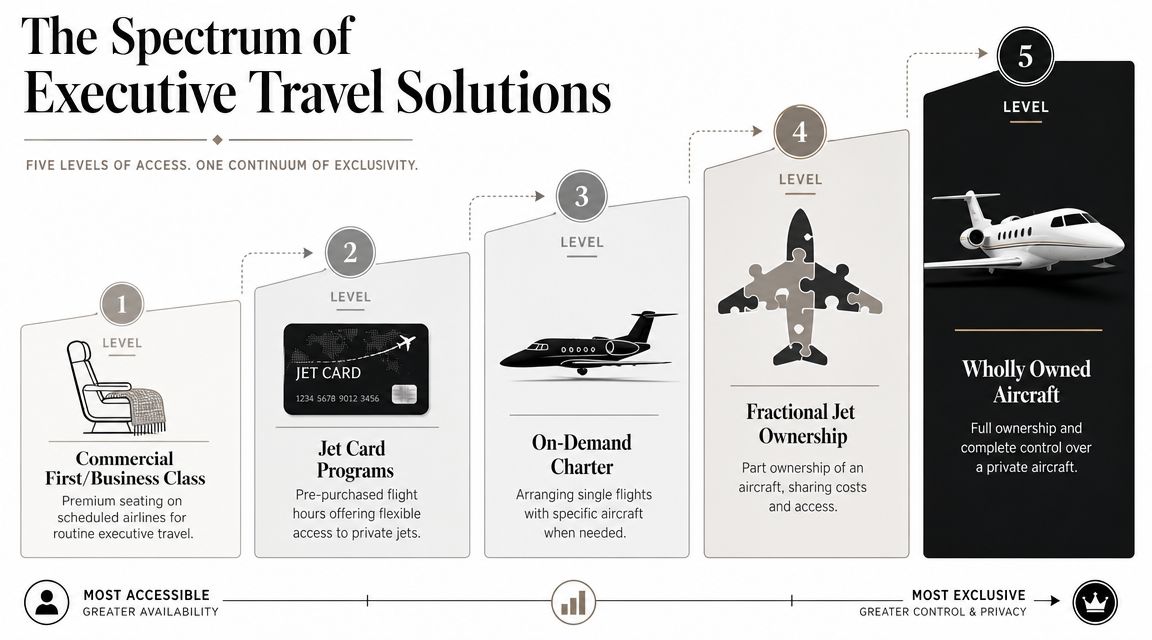
The market offers five distinct models. Each solves a different operational problem. The mistake is treating them as status tiers instead of procurement options with different control levels, commitments, and failure points.
Five models you need to understand
| Model | What it is | Best use case | Main tradeoff |
|---|---|---|---|
| Commercial first or business class | Premium seating on scheduled airlines | Routine city-pair travel with good nonstop coverage | Least control over schedule and disruption recovery |
| Jet card programs | Prepaid access to private aircraft hours | Frequent private users wanting simplified booking and fixed program terms | Upfront commitment and usage restrictions |
| On-demand charter | Trip-by-trip aircraft booking | Variable travel patterns and specific mission requirements | Pricing and aircraft availability change by trip |
| Fractional ownership | Partial ownership stake in an aircraft program | High private-flight volume with recurring need | Long-term capital, contracts, and management complexity |
| Wholly owned aircraft | Full ownership and direct control | Constant executive mobility with highly specific operational needs | Highest fixed cost and oversight burden |
Commercial first and business class
Use commercial when the route is strong, timing works, and the executive can absorb normal airport friction without putting the business objective at risk. For many domestic trunk routes, that is still the correct answer.
Problems start when the trip requires precision. Same-day out-and-back travel, secondary airports, multi-stop schedules, tight confidentiality requirements, or a meeting that cannot slide by two hours all push commercial toward the wrong side of the equation.
Jet cards and on-demand charter
These are often grouped together. They should be evaluated separately because they solve different procurement problems.
A jet card buys future access under a preset structure. Finance gets a cleaner approval path and travelers get a more standardized booking process. In exchange, the company accepts prepaid exposure, program rules, peak-day limitations, and aircraft-category constraints.
On-demand charter buys the mission in front of you. You can match aircraft size, range, cabin layout, and departure timing to the actual trip instead of using hours already committed to a program. If you need a practical framework for that choice, review this comparison of private jet cards versus on-demand charter options.
For many finance teams, the choice is not between private and commercial. It is between commitment and flexibility.
Fractional ownership and wholly owned aircraft
Fractional ownership fits companies with sustained private-flight demand and a recurring pattern of use. It can improve access and planning discipline, but it belongs in the same conversation as other long-term operating commitments. Treat it like an asset-backed mobility program, not a faster way to book trips.
Wholly owned aircraft sit in a different category altogether. This model makes sense when schedule control, cabin configuration, security protocol, route pattern, and availability justify carrying the full cost and oversight responsibility internally.
Ground integration matters more than many travel programs admit
Air is only part of the operating design. Ground execution determines whether the itinerary holds together. If your executives arrive on time but lose twenty minutes to split vehicles, driver misalignment, or separate vendor handoffs, the trip still underperforms.
That is why the strongest programs evaluate executive travel as one coordinated movement plan. Choose the air model that fits the mission, then build ground transport, pickup timing, and traveler handling around it. This is how you reduce friction across the full trip instead of upgrading one segment and hoping the rest works out.
Comparing Cost Models and Hidden Fees
Your VP Sales needs to be in Frankfurt for a client meeting, then in Dublin that night for a board dinner. Procurement compares the commercial fare to a charter quote and declares the airline cheaper. That is the wrong comparison. The pertinent question is which option gets the objective done at the lowest total cost, with the least operational risk and the fewest failure points.
Invoice price is only one line item. Executive travel cost sits across lost executive time, trip failure risk, change penalties, sourcing inefficiency, internal admin labor, and ground execution. If your team reviews only the flight charge, you are not controlling spend. You are ignoring it.
What each model really costs
Commercial air looks cheapest because the pricing is visible. Fare, cabin class, change fee, lounge access. The hidden cost is schedule dependency. One missed connection, one last-minute fare rule, or one overnight delay can wipe out any apparent savings once you account for executive hours, missed meetings, and downstream rebooking work.
Jet cards appeal to finance teams because prepaid hours create budget clarity. They also shift risk to the buyer. Once capital is committed, blackout dates, peak day surcharges, taxi time rules, fuel adjustments, interchange terms, and hour expiration policies decide whether the program performs or bleeds value.
On-demand charter is usually the cleanest model for buyers who want pricing discipline and flexibility. Each trip can be sourced against the mission, the schedule, and the current market. That only works if your team evaluates the full trip economics, not just whether the quote fits an arbitrary travel threshold.
Hidden costs that change the answer
A CFO or Head of Travel should challenge every quote with the questions below before approving it:
- Prepaid commitment risk: Unused hours, expiration rules, and restrictive redemption terms turn predictable budgeting into stranded spend.
- Aircraft mismatch: Paying for cabin size, range, or baggage capacity you do not need is one of the easiest ways to overspend.
- Repositioning charges: If the aircraft starts far from your departure point, you may be funding empty legs that add no business value.
- Peak and short-leg penalties: Some programs look competitive until high-demand days or short sectors trigger disproportionate pricing.
- Ground handoff failures: Split arrivals, late drivers, and poor vehicle allocation create delays that rarely appear on an air invoice.
- Internal process cost: Manual approvals, traveler updates, manifest changes, and after-hours coordination consume staff time that finance almost never assigns back to the trip.
Use this table to pressure-test the model, not just the quote:
| Cost question | Why it matters |
|---|---|
| Am I committing funds before I know actual usage? | Prepayment can trap budget in low-value flying |
| Am I buying a specific aircraft or a category promise? | Category pricing often hides mismatch and substitution risk |
| Who absorbs repositioning and recovery costs? | Poor sourcing inflates total trip cost fast |
| How does pricing change on peak days or after itinerary changes? | Flexibility determines real operating value |
| What internal work does this booking model create for my team? | Admin burden is a real operating cost |
Ground transport belongs in the same cost model
Do not separate air and ground just because different vendors invoice them. The traveler experiences one itinerary. Your finance team should cost it the same way.
If one executive needs a city transfer, a sedan is enough. If the CFO, legal lead, and investor relations head are traveling together with tight timing, vehicle count and passenger distribution matter. Too few seats create split arrivals. Too many vehicles create idle cost and coordination risk. The same asset-matching discipline used in aviation applies on the ground, and it becomes even more important if the itinerary includes protective movement planning or selecting professional executive security services.
For buyers who want a sharper view of what should appear in a charter quote, review this breakdown of private jet charter pricing and cost structure. It is a useful benchmark for spotting line items that providers present differently.
One factual example from the market is Haute Jets, which uses a pay-per-flight model instead of memberships or prepaid jet cards. That structure is easier to audit because each trip stands on its own. For companies with variable demand, that makes cost attribution, exception review, and policy enforcement much easier.
Vetting for Safety and Compliance
Price matters until something goes wrong. Then safety documentation, operator oversight, and insurance clarity become the only things that matter.

Too many buyers stop at “the aircraft is available.” That's procurement, not risk management. Your company's duty of care requires more.
Broker versus operator is not a small distinction
A broker arranges the trip. The operator flies the aircraft. Those are different roles, with different responsibilities. If your team can't identify the actual operator, verify its safety standing, and confirm insurance and operational control, you're not vetting the flight. You're outsourcing trust.
Third-party audits matter because they add independent scrutiny. In private aviation, Wyvern Wingman and Argus Gold or Platinum are the benchmarks most corporate buyers look for. If you need a practical overview of what those ratings mean, start with this explanation of Wyvern and Argus safety ratings.
The aircraft cabin may look identical across providers. The operator standards behind it may not.
Questions your team should ask every time
Use a short diligence checklist, even for repeat trips:
- Who is the certificated operator? Don't settle for the broker brand name alone.
- Which third-party audit standard applies? Ask for current verification, not generic assurances.
- What documentation will you receive before departure? Tail number, crew details, manifest, and weather briefing should not be a scramble.
- How are itinerary details protected? Senior-travel security failures often start with casual over-sharing.
- What's the escalation path if the trip changes? Safety and continuity depend on fast, accountable response.
Executive travel isn't just aviation risk. It can involve physical protection at the destination, secure transfers, and restricted information flow. If you're pairing transportation with close protection, this guide on selecting professional executive security services is a useful companion checklist.
A quick explainer helps when you're training internal stakeholders on what “safe enough” should mean:
My recommendation
Set a mandatory baseline. Require independent operator verification, documented pre-flight details, and clear chain of responsibility. Anything softer invites inconsistency, and inconsistency is where risk enters executive travel programs.
Mastering Booking Workflows and Duty of Care
The best workflow starts from the meeting, not from the flight search bar. That single change fixes a surprising amount of executive travel failure.
Expert guidance from Navan recommends building itineraries by working backward from fixed meeting times, creating flight windows and ground transport with realistic buffers for delays and traffic, and preparing alternate itineraries for complex trips, as described in Navan's executive booking guidance.
Work backward from the business objective
If the meeting starts at 9:00 a.m., the traveler doesn't need an 8:10 arrival. The traveler needs enough margin to land, transfer, reset, review, and walk in ready. That's how assistants plan. Finance should expect the same logic from any travel partner.
A workable booking sequence looks like this:
- Confirm the mission: What has to happen, where, and what time can't move?
- Build the time envelope: Include arrival margin, transfer time, and fallback options.
- Book the ground plan with the air plan: Separate bookings create fragile handoffs.
- Prepare one mobile itinerary: Include confirmation numbers, driver contacts, and emergency details.
- Create alternates before disruption occurs: Backup options are cheaper to think through before the day goes sideways.
What duty of care looks like in practice
Duty of care isn't a policy PDF. It's operational visibility.
That means the company should know where the executive is supposed to be, who's moving them, how updates get communicated, and who is authorized to change the plan. It also means the traveler shouldn't have to solve rebooking problems alone from an airport lounge or roadside pickup point.
A good executive itinerary answers three questions instantly: what's next, who owns it, and what's the fallback?
Deliverables that separate managed travel from improvised travel
A serious executive travel workflow should produce the following every time:
- A complete itinerary: One document, mobile-friendly, with flight, hotel, meeting, and ground details.
- Named contacts: Driver numbers, support contacts, and internal escalation points.
- Preference continuity: Stored traveler details so each trip doesn't begin from scratch.
- Pre-departure confirmation: A final check before wheels-up or hotel departure.
- Live support: Someone accountable when flights move or meetings slide.
If your current process still depends on email threads, forwarded screenshots, and assistant memory, you don't have resilience. You have heroics. Heroics don't scale.
Calculating ROI and Building Your Travel Policy
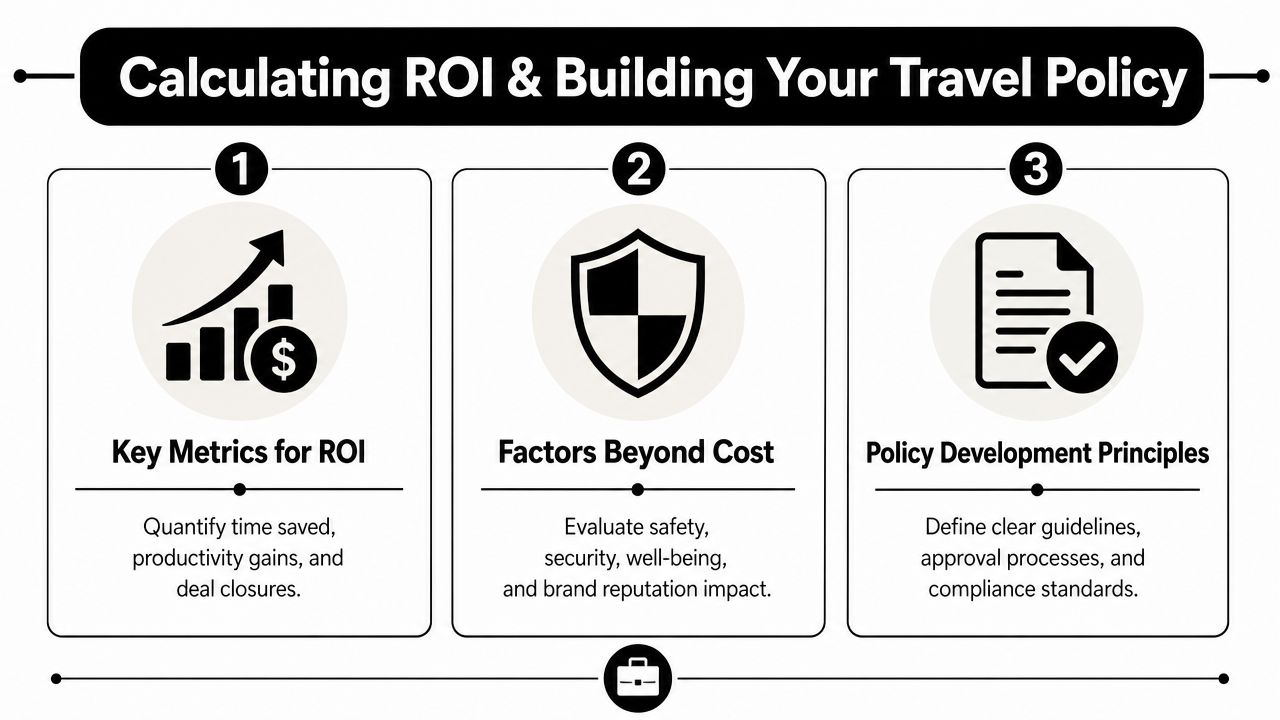
Most executive travel content still talks like the purchase decision is about mode. It isn't. As noted by Executive Travel's market positioning, the core consideration is reducing total trip friction across timing, privacy, and reliability, because buyers are weighing schedule control, access, and continuity of work, not just how the executive gets from point A to point B.
The ROI lens that actually works
Don't ask, “Was private travel more expensive than a commercial ticket?” That's too narrow to be useful.
Ask these instead:
- Did the chosen mode preserve the executive's working day?
- Did it protect a revenue-critical or risk-sensitive outcome?
- Did it reduce coordination burden on internal staff?
- Did it lower the chance of trip failure?
That framework produces better decisions than raw fare comparison because it values what senior travel is supposed to protect: time, confidentiality, and execution quality.
When premium solutions tend to justify themselves
Private or tightly managed executive travel usually makes the strongest business case in situations like these:
| Scenario | Why the ROI case strengthens |
|---|---|
| Multi-city same-day roadshow | Scheduled air often can't support the sequence cleanly |
| Confidential negotiation | Private environment protects information flow |
| Board or investor meetings with fixed timing | Schedule control matters more than nominal fare savings |
| Senior-team movement to one event | Coordinated arrivals reduce operational drag |
This doesn't mean “book private whenever the calendar looks hard.” It means assign value to the business consequence of failure.
Board-level test: If a disrupted trip would jeopardize timing, confidentiality, or executive output, evaluate the itinerary as a business continuity decision.
Build policy around triggers, not status
A weak travel policy says executives may book premium options based on title. A strong policy says premium options may be used when certain conditions are present.
Use policy triggers such as:
- Trip complexity: Multiple cities, poor commercial connectivity, or same-day returns
- Business criticality: Board meetings, financing events, M&A activity, investor sessions
- Confidentiality needs: Sensitive discussions, restricted itinerary visibility, security concerns
- Traveler concentration: Several leaders moving together with synchronized arrival needs
That policy is easier to defend because it ties spend to business logic, not hierarchy.
Your Next Steps to Optimize Executive Travel
Don't start by asking which provider to use. Start by diagnosing where your current process wastes money and exposes risk.
A practical three-step plan
First, audit the last year of executive travel. Pull the trips that created the most friction. Look for missed meetings, heavy change activity, split transfer errors, after-hours interventions, and itineraries that consumed unusual assistant time. The invoice won't show the full cost, so talk to the people who had to rescue the trip.
Second, model your recurring mission types. Don't model every trip. Focus on the routes and scenarios that repeat: board travel, investor roadshows, plant visits, and multi-stop deal work. Compare commercial, tightly managed premium travel, and on-demand charter on schedule control, internal workload, and likelihood of execution failure.
Third, write or tighten policy. Approval rules should match business triggers, not titles. If you need a broader framework for managing business travel expenses and strengthening policy discipline, that resource is a practical complement to executive-travel planning.
The companies that handle executive travel well aren't buying luxury more often. They're buying disruption less often.
If you're reviewing executive travel solutions and want a cleaner charter workflow, Haute Jets is one option to evaluate for on-demand private aviation. Start with a live trip brief, compare the aircraft and operator details against your policy, and see whether the economics hold up for the missions that matter.