

So, who is actually flying the plane?
When you book a private jet, it's easy to focus on the aircraft itself. But the real key to a safe and successful flight is the corporate jet operator—the certified company responsible for everything that happens from the hangar to your destination.
Think of them as the unsung heroes of private aviation. They're the ones with the pilots, the maintenance crews, and the complex operational know-how to make it all happen.
Understanding Corporate Jet Operators
Let's clear up a common point of confusion. A corporate jet operator is not the same as a charter broker. A broker is like a travel agent for private jets; they help you find the right aircraft and operator for your trip. The operator, however, is the company that actually holds the Air Carrier Certificate from the Federal Aviation Administration (FAA).
This certificate is the government's stamp of approval, giving them the legal authority to fly passengers for compensation. It’s a big deal. It means they are the ones on the hook for the safety, legality, and execution of your flight.
At its core, the corporate jet operator is the entity legally and financially responsible for the aircraft, the crew, and the safety of every single flight. They own the operational risk.
Why Top-Tier Operators Are in Such High Demand
In recent years, the appetite for private aviation has exploded. People are looking for more efficient and private ways to travel, and the numbers back it up.
In 2025, the industry saw a staggering 3.9 million business jet departures worldwide, a solid 5% jump from the year before. A huge piece of that pie—a full 72%—was right here in North America, with hubs in Florida, Texas, and California leading the charge. This growth reflects a major shift in how people view travel, a trend you can see in more detail in market analyses of the preowned jet market on JetNet.
What's behind this surge? It boils down to a few key advantages:
- Time is Money: For executives, a private jet is a flying office. It eliminates wasted hours in airport terminals and allows for productive, confidential work.
- Unmatched Privacy: For high-profile individuals or sensitive business trips, the ability to bypass public spaces is invaluable.
- Total Convenience: Forget rigid airline schedules. Private charter offers direct routes to smaller airports and the flexibility to fly on your own timeline.
Getting a handle on what a corporate jet operator does—and what separates the great ones from the rest—is the most important first step for anyone entering the world of private aviation. It's the foundation for making smart decisions, ensuring your safety, and avoiding costly mistakes down the line.
Comparing the Three Types of Jet Operators
When you're stepping into the world of private aviation, one of the most important things to get right is choosing your operator. It's a decision that will shape everything from cost and flexibility to the kind of service you receive on board. Not all operators are built the same, and knowing the difference is the key to a good experience.
Think of it like this: you could rent a one-of-a-kind vacation home directly from its owner, book a room with a five-star hotel chain, or use a marketplace to find the perfect stay. Each path offers a different blend of personality, consistency, and price. Private aviation works in a similar way, with three main models: Owner-Operators, Managed Fleets, and Third-Party Charter Operators.
Owner-Operators
An Owner-Operator is exactly what it sounds like—an individual or a small company that owns and operates its own aircraft. When you book with them, you’re often dealing directly with the people who know that specific jet inside and out. It’s a very personal experience.
The upside is you get access to a unique aircraft, often meticulously cared for by an owner who is passionate about it. The downside? Limited availability. If that one jet is booked or down for maintenance, you’re back to square one. This model works best if your travel is flexible and you happen to find an operator based right where you need them.
Managed Fleets
Next up are Managed Fleets. These are large companies that manage a collection of aircraft on behalf of the individual owners. Think of them as the Four Seasons or Ritz-Carlton of the skies. They bring a consistent, predictable standard of service and operational excellence across their entire fleet.
You get reliability and professionally trained crews, which is a huge plus. However, that consistency can come with a higher price tag and less flexibility. You might book a "midsize jet" and be assigned any aircraft in that category, rather than getting to pick the specific make and model. They also have higher overhead, which can sometimes translate to added costs for things like repositioning the aircraft for your flight.
The relationship between these core operators and other players in the industry, like brokers, is often misunderstood. This chart helps clarify where everyone fits.
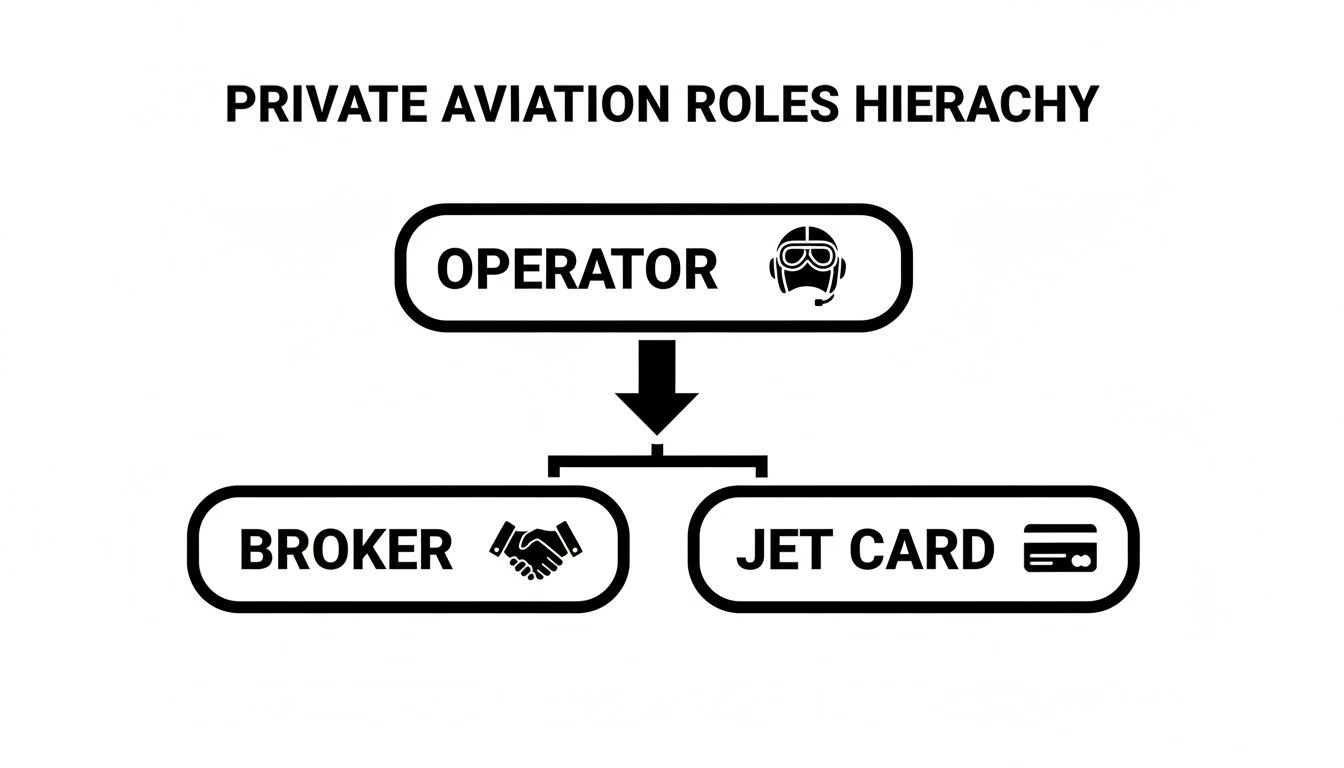
As you can see, operators are the foundation—they are the ones with the FAA certificate to actually fly the planes. Brokers and jet card programs are essentially different ways to access the services these operators provide.
Third-Party Charter Networks
The third model gives you access to a massive, aggregated network of both owner-operators and managed fleets through a single point of contact. This approach functions like a sophisticated marketplace, blending the scale of a large fleet with the variety and unique access of individual owner-operators.
The sheer size of this market is staggering. In 2025, the top 30 operators accounted for 30.84% of the 5.4 million flight hours flown. Industry giants like NetJets logged over 719,000 hours by themselves. By working with a modern charter provider that taps into a network of over 3,500 aircraft, you can effectively bypass the limits of any single operator.
This gives you the power to find the perfect aircraft for any given trip, anywhere in the world, often at more competitive, wholesale-style pricing. For a deeper dive into the numbers, you can review the 2025 charter and fractional market report on Private Jet Card Comparisons.
To help you decide which model fits your needs, the table below breaks down the key differences at a glance.
Comparing Corporate Jet Operator Models
| Operator Type | Typical Client | Cost Structure | Key Advantage | Key Disadvantage |
|---|---|---|---|---|
| Owner-Operator | Flexible traveler, values unique aircraft | Direct charter, often lower cost | Highly personalized service | Limited aircraft availability |
| Managed Fleet | Corporate, values consistency | Higher base rates, potential fixed costs | High service standards, reliability | Less flexibility, potential for extra fees |
| Charter Network | Frequent flyer, needs flexibility | Market-based, dynamic pricing | Maximum choice and availability | Service quality can vary between operators |
Ultimately, there's no single "best" type of operator—it all comes down to what you value most. Whether it's the personal touch of an owner, the polished consistency of a managed fleet, or the sheer choice offered by a network, understanding these models is the first step toward smarter private travel.
How to Verify an Operator's Safety Rating
When you’re chartering a private jet, safety should be your top priority. But how do you really know if an operator is safe? You can't just take their word for it. After all, every operator will tell you they’re safe. You need unbiased, third-party proof.
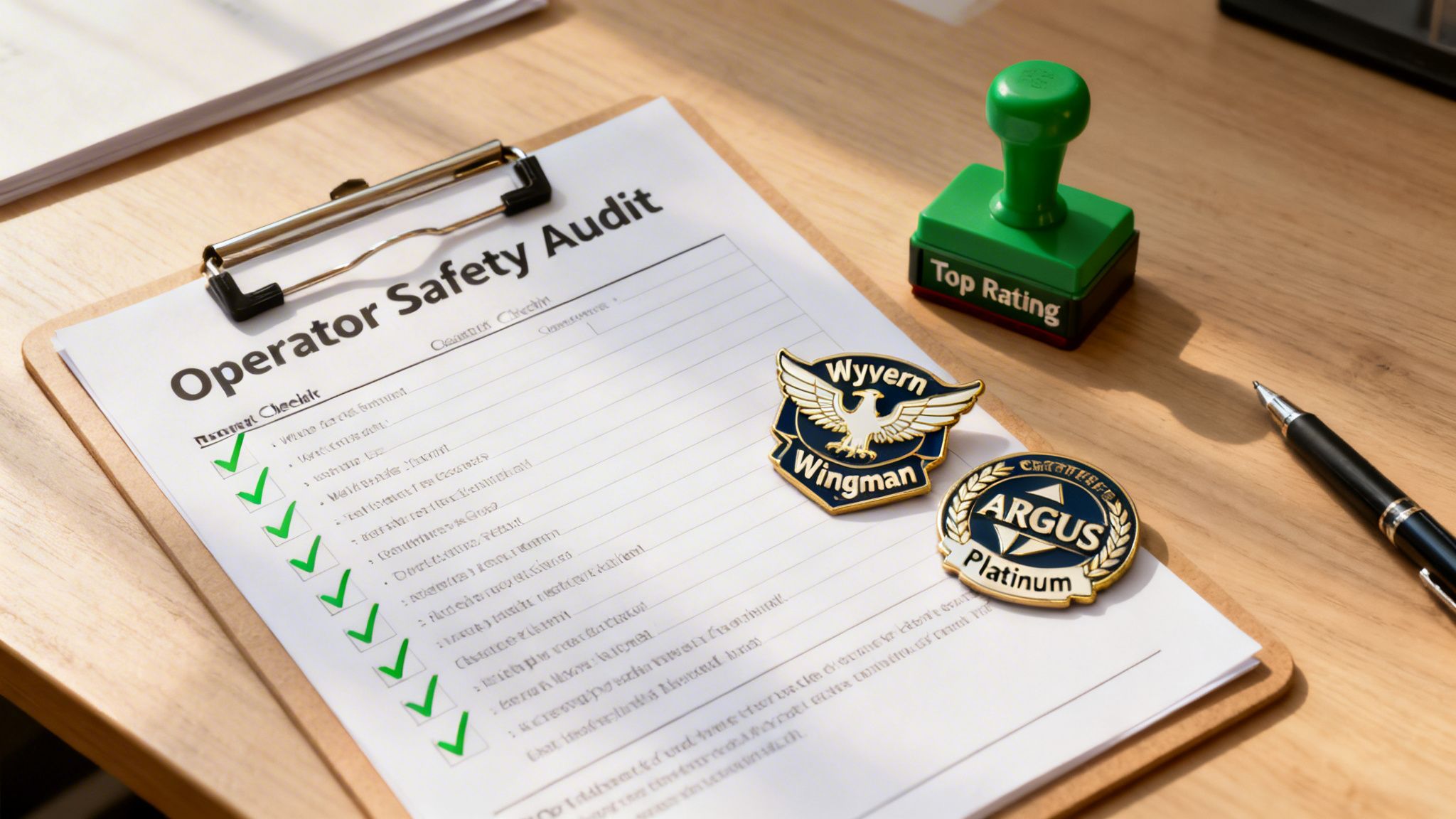
That’s where independent safety auditors come in. Think of them like a home inspector for an airline. Before you buy a house, you hire an expert to check the foundation, wiring, and plumbing. In private aviation, you rely on auditors to inspect an operator’s safety culture, maintenance history, and pilot training records.
The Gold Standards of Safety Audits
In the world of private aviation, two names stand above the rest: Wyvern and the Aviation Research Group/US (ARGUS). These organizations are the most respected auditors in the business, and their ratings are earned, not bought.
Passing one of their audits is a serious undertaking. These aren't just simple paperwork checks. Auditors conduct deep dives into an operator's entire business, going far beyond the minimum FAA requirements. They scrutinize everything, including:
- The company's accident and incident history.
- Detailed maintenance logs for every single aircraft.
- Pilot experience, training currency, and background checks.
- The maturity and effectiveness of their internal Safety Management System (SMS).
When an operator voluntarily opens their doors to this level of scrutiny, it speaks volumes. It shows they are confident in their procedures and committed to a proactive safety culture. For a more detailed comparison, you can read our guide that offers a deep dive into Wyvern and ARGUS safety ratings.
Decoding the Top-Tier Ratings
While both Wyvern and ARGUS offer different levels of certification, the most discerning travelers should only consider operators who hold the highest ratings. These represent the pinnacle of operational safety.
The top ratings, like Wyvern Wingman and ARGUS Platinum, are not one-time awards. They require operators to maintain their high standards through ongoing data reporting and frequent re-audits.
Here’s what you should be looking for:
Wyvern Wingman: This is Wyvern's highest certification. It's only awarded after an operator passes a rigorous on-site audit that confirms they meet "The Wingman Standard," which represents a firm adherence to industry best practices.
ARGUS Platinum: As the premier rating from ARGUS, Platinum status is a true mark of distinction. It signifies that an operator has not only passed an intensive on-site audit but also maintains a highly developed and functioning Safety Management System.
Insisting on a Wyvern Wingman or ARGUS Platinum-rated operator is the most reliable way to ensure you're flying with the best of the best. It’s a simple filter that immediately separates the elite operators from those who are just doing the bare minimum.
Understanding Charter Costs and Avoiding Hidden Fees
Let's be honest—the promise of private aviation is simplicity, but that illusion can shatter the moment you get a charter quote filled with confusing line items and unexpected charges. I've seen it happen time and again: a traveler gets sticker shock when the final bill doesn't match the initial price. The key to getting a fair deal is knowing exactly what you're paying for.
A charter quote isn't just a simple hourly rate. It’s built from several standard costs that are essential for operating the aircraft safely and legally. When you first see a price, it typically rolls a few things together.
The Standard Cost Components
Think of these as the basic, transparent parts of your bill. You should always see these broken down, and any reputable operator will explain them.
- Hourly Rate: This is the core price for every hour the jet is in the air, carrying you to your destination.
- Fuel Surcharge: Fuel prices are constantly in flux, so this charge adjusts your total based on the market rate for jet fuel at the time of your flight.
- Landing and Handling Fees: Airports charge operators for using their runways, tarmac space (parking), and ground services. These fees can vary dramatically from a small private airfield to a major international hub.
- Crew Expenses: For any trip that requires an overnight stay, this covers the pilots' accommodations, meals, and ground transport.
While these costs are standard, the real trouble often comes from fees that aren't so clearly explained.

Exposing The #1 Hidden Fee: Repositioning
Beyond those predictable charges lurks the most notorious and costly surprise in the industry: the repositioning fee.
Here’s what that means. You're paying for the empty flight the jet has to make from its home base to pick you up. Then, after it drops you off, you're also paying for it to fly empty back to its base. It’s like paying a taxi driver for their commute to your house and their drive home after your trip. These "empty legs" have nothing to do with your travel, yet they can inflate your total charter cost by a staggering 20-40%.
A repositioning fee is essentially a penalty for logistical inefficiency. You are paying for the operator's need to move an aircraft, a cost that has nothing to do with your actual travel.
This is a common issue with traditional charter brokers or jet card programs that rely on a limited network of aircraft. If they don't have a plane nearby, you foot the bill to bring one in.
The modern, smarter approach flips this model on its head. By accessing a massive, real-time network of over 3,500 locally-based aircraft, a provider can find a jet already positioned at or near your departure airport. This strategy completely eliminates repositioning fees, ensuring the price you're quoted is for your flight, and your flight alone.
This approach is central to effective mastering corporate travel expense management, as it directly attacks one of the largest sources of waste in private aviation.
Common Private Jet Charter Cost Components
To help you spot these costs in the wild, here’s a breakdown of what you might see on a charter quote. Knowing what to look for is the first step in protecting your budget.
| Cost Component | Description | Typical Price Impact | How to Mitigate |
|---|---|---|---|
| Hourly Rate | The base cost for flight time, from wheels-up to wheels-down. | 50-70% of total cost | Compare rates between different aircraft classes and operators. |
| Repositioning Fee | The cost to fly the jet empty to your departure city and/or back to its base. | Can add 20-40% or more | Work with a provider that sources locally-based aircraft to eliminate this fee entirely. |
| Fuel Surcharge | An adjustment based on current jet fuel market prices. | 15-25% of total cost | Ask if the surcharge is capped or included in a fixed-rate quote. |
| Landing/Ramp/Handling Fees | Fees charged by the airport (FBO) for using their facilities. | Varies from hundreds to thousands of dollars per stop | Choose smaller, less congested airports when possible, as their fees are often lower. |
| Crew Overnight & Per Diem | Covers hotels, meals, and expenses for the flight crew on multi-day trips. | $1,500 - $3,000+ per day | Plan same-day round trips to avoid overnight costs. |
| Federal Excise Tax (FET) | A 7.5% tax on domestic air transportation in the U.S. | 7.5% of the flight cost | This is a mandatory government tax and cannot be avoided on applicable flights. |
| De-Icing Fee | A charge for removing ice/snow from the wings in cold weather. Can be very expensive. | $2,000 - $20,000+ | Fly from a heated hangar or ask if the operator includes a de-icing waiver/allowance. |
Understanding these components empowers you to analyze a quote like an expert and challenge any line item that seems out of place.
Ultimately, demanding transparency is your best tool. By working with a provider committed to wholesale pricing, you avoid subsidizing an operator's logistical problems. For a deeper dive, you can check out our guide on unraveling private jet charter pricing. This knowledge will help you ask the right questions and find a charter where the price you see is the price you actually pay.
How to Source and Book Your Private Jet
Gone are the days when booking a private flight felt like a gamble. The old model of restrictive memberships often left you with whatever aircraft was available in a generic category, forcing you to accept crucial details on faith. Today, the on-demand charter market puts you squarely in the pilot's seat.
This modern approach gives you the power to choose the exact aircraft you want. Instead of settling for a vague "midsize jet," you can now specify the make, model, and even the year of manufacture. This precision ensures the jet perfectly suits your mission, whether you need a newer cabin to impress clients or a specific seating arrangement for your team.
From Vague Promises to Verified Details
The new standard is all about transparency and eliminating guesswork before you even leave for the airport. A high-quality booking experience means getting firm, upfront answers on the details that truly matter for your trip.
This includes confirming the specific amenities that can make or break a flight. You should always be able to verify critical features like:
- High-speed Wi-Fi: Is it available, and what are its real-world capabilities?
- Pet Policies: Can your pets fly in the cabin with you?
- Catering Options: What menus are offered, and can they handle specific dietary needs?
This push for clarity is happening as the market itself expands. With business jet deliveries expected to reach 695 new aircraft worldwide in 2025—an 11% jump from the year before—there are more top-tier, safety-rated options than ever. As you can see in the full 2025 business jet delivery outlook from FlyAPG, operators are modernizing their fleets, which directly translates to better choices for you.
The modern charter process should be built on choice and absolute transparency. You should never have to guess about your aircraft or its amenities—every single detail needs to be confirmed in writing before you commit.
What a Final Confirmation Should Include
This client-focused process all comes together in the comprehensive pre-flight confirmation, which should land in your inbox about 24 hours before departure. This document is far more than a simple itinerary; it's a complete dossier designed to give you total peace of mind. For a great example of this, you can see the process of booking a private jet with Haute Jets.
At a minimum, your final confirmation document must contain:
- The specific aircraft tail number
- Biographies of your flight crew
- A current weather briefing for your route
- The final passenger manifest
Receiving this level of detail ensures there are no surprises when you arrive at the FBO. It turns the booking from a mere transaction into a personalized service, confirming that the aircraft and crew waiting for you are exactly what you expected.
Your Pre-Flight Operator Selection Checklist
Alright, now that you have a solid grasp of how the private aviation world works, let's put it to use. Choosing the right operator shouldn't feel like a shot in the dark. Think of this checklist as your step-by-step guide to follow every single time you book a flight.
These are the exact questions you should be asking. They'll help you cut through the noise and ensure you're getting the best in safety, transparency, and overall value.
Safety and Certification
This is the absolute deal-breaker. Safety is the foundation of every flight, and it's where your vetting process must begin. Don't even think about discussing price or aircraft type until you've locked this down.
- Is the operator Wyvern Wingman or ARGUS Platinum rated? These aren't just fancy titles. They're top-tier safety ratings from independent auditors, signaling a deep, proactive safety culture that goes well beyond the bare minimum FAA requirements.
- Can you provide the PASS Report for my specific crew and aircraft? A trustworthy operator will never hesitate to share this. This report is your proof that the exact jet and the specific pilots assigned to your trip meet the highest safety standards.
Aircraft and Amenities
Once you've confirmed the operator meets your safety standards, you can move on to the fun part—the aircraft itself. A modern charter experience means you get to pick the plane you want, not just settle for whatever is available in a general category.
The ability to select a specific aircraft—right down to its tail number and year of manufacture—is what separates a client-focused booking from an old-school, opaque process.
For those looking for a truly seamless journey, many top operators can also arrange for premium VIP concierge services, handling everything from your ground transportation to specific in-flight requests.
Cost and Transparency
Finally, it's time to look at the numbers. A clear and transparent quote is the mark of an operator you can trust. This is where you need to be vigilant to avoid surprise charges later on.
- Is this price all-inclusive? You need to ask directly about potential extras like de-icing, crew overnight fees, and international handling charges.
- Have all repositioning fees been eliminated? Getting a "yes" here is huge. It confirms you aren't on the hook for the operator's logistics of flying an empty plane to pick you up.
- Will I receive a full pre-flight confirmation? This isn't just a simple itinerary. It should include the crew's names and the aircraft's tail number at least 24 hours before departure, so there are absolutely no last-minute surprises.
By consistently running through this checklist, you're not just booking a flight. You're becoming a smarter, more confident private flyer who demands and receives a firm commitment to safety, quality, and value from any operator you choose to work with.
Frequently Asked Questions
When you're new to private aviation, a few questions always come up. Let's clear the air on some of the most common topics we discuss with clients, especially when it comes to the nitty-gritty of corporate jet operators.
What Is the Difference Between a Part 135 and a Part 91 Operator?
You'll hear these terms a lot, and the distinction is critical for your safety and legal protection. Think of a Part 135 operator as the commercial airline equivalent for the private jet world. They're certified by the FAA to fly you for hire and are held to the highest standards for pilot training, crew rest requirements, and aircraft maintenance.
A Part 91 operator, on the other hand, operates flights privately for the aircraft's owner. They aren't legally allowed to sell seats or charter their plane to the public. For any trip you pay for, you absolutely must be flying with a Part 135 certified operator.
How Far in Advance Do I Need to Book a Flight?
This is one of the best parts of on-demand charter: flexibility. If you're in a major city, we can often have a jet ready for you in just a few hours. A large, connected network of aircraft makes last-minute travel not just possible, but routine.
That said, if you're planning a trip around a major holiday, a big sporting event, or need a very specific type of aircraft, it's always smart to book several days or even weeks ahead. This gives you the best selection and helps lock in better pricing.
A common misconception is that on-demand charter is less reliable than a jet card. In reality, a large network provides more backup options and greater flexibility than being tied to a single fleet.
Can I Bring My Pet on a Private Jet?
Absolutely! For most of our clients, having a pet travel stress-free in the cabin is a huge reason they fly private.
However, the final say always comes down to the individual owner of the aircraft. Pet policies can vary from one jet to the next, so it's something we confirm right at the start of the booking process. A good broker will double-check the rules for you, ensuring your four-legged companion is just as welcome as you are.
Are Jet Cards a Better Value Than On-Demand Charter?
Jet cards and memberships sound convenient, but they often come with significant downsides. You're typically required to make a large upfront payment, which locks you into one provider's fleet and pricing—and often hides costs like repositioning fees in the fine print.
On-demand charter gives you the freedom to choose the best aircraft for each individual trip, with no membership fees, annual costs, or blackout dates. You simply pay for the flight you need at a fair market rate, ensuring you get the most value every time you fly.
Ready to experience a new standard in private aviation? At Haute Jets, we connect you to a network of 3,500+ safety-rated aircraft, ensuring you get the exact jet you want at transparent, wholesale pricing. Learn more and book your next flight with Haute Jets.