

Your CEO needs to be in Manhattan for a 9 a.m. board meeting, at a plant that afternoon, and across the table from investors that night. On paper, it looks manageable. In practice, commercial schedules force bad compromises, itinerary changes trigger expensive rework, and no one has a clean answer on the aircraft, operator, or safety standards behind the trip.
That is how corporate travel loses money and control. The core problem is not just airfare. It is the gap between booking, compliance, aircraft sourcing, duty limits, and executive expectations. Business travel remains a major spending category. It represented a meaningful share of global tourism expenditure in 2023, according to World Travel & Tourism Council data cited by Spendesk's business travel statistics roundup. In a category this large, weak process gets expensive fast.
Generic corporate travel advice does not solve that problem. Senior teams and the people who manage their travel need better standards for charter buying: clear pricing, verified safety, exact aircraft disclosure, and operating discipline that holds up when plans change.
Private aviation should be used selectively and strategically. For time-critical trips, multi-stop days, client-facing schedules, and markets with poor airline coverage, on-demand charter gives executives back control of time while helping travel managers control cost, safety, and accountability. The eight recommendations that follow focus on the parts of charter that determine value: avoiding hidden repositioning charges, confirming aircraft and operator details before departure, rejecting vague safety claims, and paying only for the lift you need.
1. Eliminate Repositioning Fees by Sourcing Locally

Most charter overspend starts before the passengers even arrive at the airport. An aircraft may need to fly in empty from another city just to pick up your team. That repositioning leg gets folded into your quote, and many buyers don't notice it until they compare trips after the fact.
Source aircraft that are already near your departure airport. If your executive is leaving from Miami, start with Miami-based lift. If your team regularly flies from Teterboro, Van Nuys, Dallas Love Field, or Opa-locka, build your sourcing logic around those airports first. Local lift usually gives you cleaner pricing and fewer moving parts on the day of departure.
A straightforward example: a recurring executive shuttle between South Florida and New York becomes much easier to control when the aircraft is already working in that corridor. The same principle applies to winter traffic into mountain airports. If your team knows it will be moving in and out of Aspen during a peak period, source aircraft already operating in that region instead of dragging lift in from a distant base.
How to make local sourcing work
The window matters. Give your charter desk enough lead time to search local availability before the market tightens.
- Book with a short planning cushion: Aim for a booking window that gives your provider time to identify aircraft already positioned nearby.
- Stay flexible on departure time: Moving by a few hours can secure a better-positioned aircraft and avoid an empty ferry leg.
- Standardize recurring city pairs: If your company flies the same routes often, document those routes and preferred departure airports.
- Use actual operating airports: Don't default to the largest airport if a business aviation airport is more practical for your executives.
Practical rule: Ask one question before approving any charter quote: “Where is the aircraft coming from?”
That single question changes how buyers review every proposal. It forces transparency on positioning, protects against padded pricing, and helps travel managers compare options on an operational basis instead of just accepting the first available jet.
2. Book with Transparency Using 24-Hour Pre-Flight Confirmation
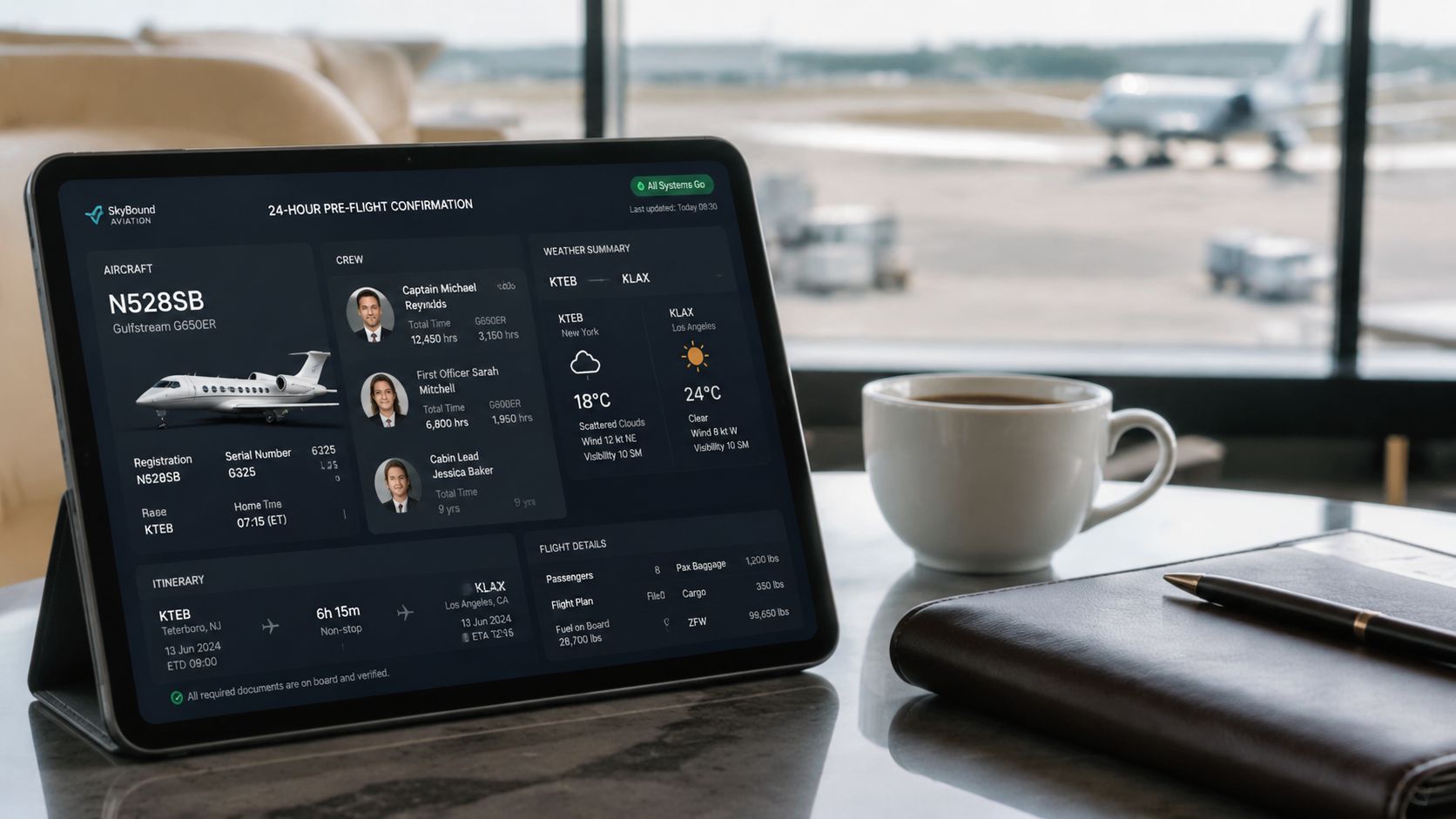
If you don't have the tail number, crew information, manifest, and weather outlook before departure, you don't have control. You have a placeholder. That may be acceptable for casual leisure travel. It isn't acceptable for executive movement, investor roadshows, deal travel, or sensitive client transport.
Require a full pre-flight confirmation package no later than the day before departure. Your travel manager should receive the aircraft identification, departure details, crew bios or qualifications, passenger manifest, and service notes for catering, Wi-Fi, and ground transport. This gives the office time to verify names, coordinate security, alert destination teams, and solve issues before they become disruptions at the FBO.
This step also reduces executive anxiety. Senior travelers don't like surprises, especially when they're boarding an aircraft booked through a third party. M&A teams, legal departments, and family offices all benefit from a tighter confirmation workflow because everyone knows exactly who is operating the flight and what the aircraft can support.
What to confirm before wheels up
A solid 24-hour confirmation isn't just a courtesy email. It's an operational checkpoint.
- Verify connectivity needs: If the CEO plans to join calls in flight, confirm Wi-Fi capability and expected performance in writing.
- Lock service requests: Dietary requirements, car transfers, and cabin preferences should be documented before the travel day.
- Check the manifest carefully: Names, passport details for international legs, and passenger changes need review by one accountable person.
- Request the weather picture: For longer or more complex routes, ask for operational context, not just a generic forecast.
A clean pre-flight packet prevents small errors from becoming expensive delays.
For a production company moving talent, or a board office managing multiple principals, that packet becomes the command center for the trip. It also creates a record. If service slips or the aircraft changes unexpectedly, your team can compare what was promised against what was delivered.
3. Choose the Exact Aircraft Instead of Generic Categories

“Super-midsize” isn't a travel strategy. It's a rough label. In private aviation, category shopping creates mistakes because two aircraft in the same broad class can have very different cabin dimensions, baggage access, runway performance, and onboard connectivity.
Book the exact aircraft. That means year, make, model, and cabin layout. If the mission is New York to London with senior leadership and work expected in flight, the team should approve a specific long-range aircraft, not a vague promise of something comparable. If the route is Los Angeles to Las Vegas for a short executive hop, a smaller and more efficient aircraft may be the sharper choice.
This approach also protects client experience. A team flying from Miami to Turks and Caicos for a relationship-building trip may care as much about cabin configuration and social seating as raw range. The wrong aircraft can still complete the route, but it can undermine the purpose of the trip.
Match the aircraft to the mission
Private aviation works best when the mission profile drives the decision.
- Use route-based preferences: Keep an internal list of preferred aircraft for your company's most common trips.
- Review cabin images: Ask for photos of the actual cabin, not stock imagery from a manufacturer brochure.
- Check airport limitations: Runway length and local operating conditions can eliminate otherwise attractive aircraft options.
- Confirm onboard systems: If your team needs specific entertainment, power, or connectivity features, verify those before signing.
A good charter buyer doesn't just ask, “How many seats?” They ask whether the aircraft supports the meeting, the people, the baggage, the schedule, and the arrival airport. That's how you move from booking flights to managing outcomes.
4. Prioritize Wyvern and ARGUS Safety Certifications Over Unrated Operators
Safety isn't the place to improvise. If your company is moving C-suite executives, board members, clients, or legal teams, your charter standard should start with independently audited operators. Anything less creates unnecessary liability.
Set a hard procurement rule: charter only from operators holding Wyvern Wingman or ARGUS Gold or Platinum status. Those are the third-party benchmarks most serious buyers recognize when they evaluate private aviation risk. If your team needs background, Haute Jets Journal published a useful overview in this guide to Wyvern and ARGUS safety ratings.
This isn't just about optics. It's governance. Legal departments, procurement teams, and executive assistants need a screening standard that can be documented, repeated, and audited. If the company is ever asked why a specific aircraft or operator was approved, “the broker said it was fine” won't hold up. Verified third-party safety status will.
Build certification into policy
A strong travel policy should force this decision before trip requests even reach the booking stage.
- Require approved ratings in writing: Put Wyvern Wingman or ARGUS Gold/Platinum language into every charter policy and service agreement.
- Verify the operator directly: Don't rely on a verbal assurance. Ask for documentation and confirm status independently.
- Train travel coordinators: They should know why ratings matter and how to identify gaps during booking.
- Keep the record: Store operator credentials with trip files for audit and risk review.
For teams reviewing broader pilot safety information, the principle is simple. Independent oversight matters more than sales language.
Safety documentation should be standard booking paperwork, not a special request.
If an operator or broker hesitates when you ask for certification records, move on. The market is large enough that you don't need to compromise.
5. Avoid Jet Card Lock-In and Pay Per Flight
Jet cards can look convenient because they simplify the buying decision. In practice, many companies don't need the commitment. Prepaid hours, annual fees, fixed program rules, and limited flexibility can become expensive when travel volume shifts, litigation calendars move, or deal flow slows down.
Buy charter the same way you buy other variable business services. Pay for what you use. This is especially important for startups, private equity teams, law firms, and founders whose travel patterns change quarter to quarter. If your company has irregular demand, locking capital into a membership product can weaken both cost control and scheduling flexibility.
This matters in a market that's still growing. One independent forecast cited by Technavio's business travel market analysis projects the global corporate travel market at USD 1,619.5 billion in 2025 and USD 2,467.45 billion by 2032. As spend expands, disciplined buying matters more, not less.
When on-demand buying is smarter
A pay-per-flight approach keeps your team close to actual usage.
- Audit your true flight pattern: Review how often your executives charter, not how often they think they do.
- Compare annual cost structures: Include prepaid exposure, rollover rules, service fees, and restrictions.
- Negotiate after usage is proven: A provider is more likely to extend account advantages once your demand profile is visible.
- Preserve routing freedom: On-demand models let you choose aircraft and operators trip by trip.
A biotech founder flying heavily during fundraising may charter often for one stretch and barely at all the next. A litigation team may spike around trial dates and go quiet after. Those organizations need flexibility more than they need a branded membership card.
6. Plan Around Empty Leg Flights for Maximum Savings

Your CEO needs to be in Miami on Tuesday afternoon, but could leave Tuesday morning or even Monday evening. That kind of flexibility creates real savings. In private aviation, empty legs are one of the few situations where timing discipline can cut charter cost without lowering service standards.
An empty leg is a repositioning flight already scheduled by the operator. You are buying unused capacity, not commissioning a fully bespoke trip. That distinction matters. The price can be materially lower, but the schedule exists to serve the aircraft's next assignment, not yours.
Use empty legs for travel that can absorb change. Internal meetings, site visits with a broad arrival window, leisure add-ons after a business trip, and low-stakes one-way segments fit well. Fixed investor presentations, court appearances, and board meetings do not.
This is a procurement tactic, not a travel policy.
Use empty legs selectively
Travel managers who get value from empty legs treat them as opportunistic inventory and build process around that reality.
- Track repeat corridors: Ask your broker or charter desk to monitor city pairs your executives use often, especially high-volume event and resort routes where repositioning traffic is common.
- Approve a flexible window in advance: Savings disappear if every request needs a fresh round of executive approvals while the aircraft is still available.
- Price the full mission, not the headline deal: A cheap one-way leg can become an expensive trip if the return, ground transport, or overnight stay erases the savings.
- Confirm change and cancellation exposure: Empty legs can move or disappear if the underlying primary charter changes. Your team should know that before the trip is booked.
- Pair them with service planning: If the flight includes special meal requests or cabin preferences, align those details early with your private jet catering and in-flight dining plan.
A smart assistant or travel manager also checks traveler fit. If the trip includes a family extension or an executive traveling with an animal, review documentation and handling requirements against this ultimate guide for pet owners before committing to a repositioning itinerary.
For executives who want a clearer view of the mechanics, Haute Jets Journal explains the booking logic in this guide to booking empty leg flights.
Empty legs reward flexibility and fast decision-making. Companies that can move quickly get the discount. Companies with rigid calendars usually do not.
7. Coordinate Pet-Friendly and Catering Policies in Advance
Private aviation solves many comfort problems, but only if the operator knows what your travelers need. Pets, religious dietary requirements, premium client catering, allergy considerations, and ground-service coordination all break down when they're treated as last-minute notes.
Document these preferences in the traveler profile and reconfirm them before every trip. If an executive travels with a dog, ask the operator directly about cabin rules, documentation, and airport handling. If the trip includes a client lunch in flight, confirm what can be catered from the departure airport and whether the cabin setup supports the service level expected.
These details matter more now because traveler expectations have broadened. A recent SAP Concur survey found that 70% of Americans believe business travel opportunities should be available to employees at all levels, according to SAP Concur's survey on the business travel opportunity gap. As access expands, travel policies have to account for different needs, not just executive defaults.
Build service preferences into the booking file
Good service comes from repeatable process, not heroic last-minute calls.
- Store dietary and pet details centrally: Don't rely on memory or scattered email threads.
- Confirm directly with the operator: Broker assumptions create avoidable mistakes.
- Order premium catering early: Important client flights need lead time for menu quality and special requests.
- Coordinate ground handling: Relief areas, pet carriers, and car timing should line up with the FBO schedule.
If catering is part of the impression you're making, use a provider that can describe exactly what is and isn't possible. Haute Jets Journal offers useful context in this private jet catering guide, and travelers comparing animal-transport expectations may also find this ultimate guide for pet owners helpful for baseline planning.
A relationship-driven trip can be improved by thoughtful service, or weakened by sloppy execution. The difference usually comes down to how early the office confirms the details.
8. Optimize Flight Scheduling for Crew Rest and Regulatory Compliance
A beautiful itinerary on paper can still fail if the crew can't legally or safely operate it. Multi-leg days, international turns, event-heavy schedules, and late revisions all put pressure on duty limits and rest requirements. If your travel office ignores that reality, delays become inevitable.
Ask your provider to build the trip around compliant crew scheduling from the start. Don't wait until the final brief to discover that the crew can't extend, that a repositioning segment changed the duty day, or that an international overnight requires a different operating plan. Such proactive planning distinguishes experienced aviation coordination from transactional booking.
Corporate travel analytics also support a more disciplined approach. A 2026 analysis cited by Safe Harbors' article on corporate travel data analytics reports a median 23% reduction in total travel costs across 50 enterprise programs, with AI-powered policy enforcement improving compliance from 62% to 89%. In practice, that means stronger process controls matter. Scheduling discipline, approval discipline, and documentation discipline all reduce avoidable waste.
Protect the schedule by respecting the operation
The easiest way to avoid disruption is to accept operational constraints early.
- Build realistic day plans: Leave room for crew legality, airport slots, and ground transfer buffers.
- Review multi-stop trips carefully: Every added leg increases complexity.
- Ask about crew qualifications: The right aircraft also needs the right crew profile for the route.
- Document compliance decisions: Keep records for internal audit and duty-of-care review.
A common example is the executive who wants multiple European stops after an overnight crossing. That may be feasible, but only if the schedule is designed around crew readiness and local operating limitations. The office should know that before promising arrival times to external stakeholders.
8-Point Corporate Travel Tips Comparison
| Item | Implementation complexity | Resource requirements | Expected outcomes | Ideal use cases | Key advantages |
|---|---|---|---|---|---|
| Eliminate Repositioning Fees by Sourcing Locally | Low–Moderate (requires planning & regional sourcing) | Local operator network access, 48–72 hr lead time | 20–40% cost savings, no repositioning charges | Regular routes, major metros, recurring corporate travel | Eliminates deadhead fees; transparent wholesale pricing |
| Book with Transparency Using 24‑Hour Pre‑Flight Confirmation | Low (process/policy enforcement) | Real‑time communications, operator cooperation, documentation systems | Reduced surprises, better ground logistics, documented liability protection | High‑risk travel (M&A), client entertainment, complex logistics | Full crew/aircraft info; facilitates compliance and planning |
| Choose the Exact Aircraft Instead of Generic Categories | Moderate–High (requires technical selection) | Access to specific aircraft data, maintenance and cabin specs | Predictable comfort/amenities, mission‑appropriate range and cost | Long‑range routes, specific cabin or runway requirements | Ensures mission fit and amenity certainty; cost optimization |
| Prioritize Wyvern & ARGUS Safety Certifications Over Unrated Operators | Low (policy requirement) | Access to certification registries, verification workflow | Reduced liability risk, insurance/compliance benefits | C‑suite travel, regulated industries, corporate policy enforcement | Independent safety verification; audit trail for governance |
| Avoid Jet Card Lock‑In: Pay Per Flight at Wholesale Rates | Low–Moderate (procurement change) | Wholesale pricing access, transparent invoicing | Eliminates prepaid waste, flexible spend aligned to usage | Variable travel volumes, small/medium users, occasional flyers | No membership/commitment; pay‑as‑you‑fly transparency |
| Plan Around Empty Leg Flights for Maximum Savings | Moderate (requires scheduling flexibility) | Empty‑leg alerts, flexible calendars, booking agility | 50–70% savings when matched, limited‑availability wins | Flexible itineraries, team travel, non‑time‑critical trips | Deep discounts; uses otherwise empty repositioning flights |
| Coordinate Pet‑Friendly and Catering Policies in Advance | Low–Moderate (coordination with operators) | Catering vendors, operator pet policy verification, ground services | Fewer last‑minute rejections, tailored passenger experience | Client entertainment, executives with pets, special dietary needs | Ensures dietary/pet accommodations; professional client service |
| Optimize Flight Scheduling for Crew Rest and Regulatory Compliance | High (complex regulatory planning) | Crew scheduling tools, regulatory expertise, operator coordination | Avoids delays/fines, meets insurance and safety requirements | Multi‑leg and international travel, high‑liability operations | Ensures regulatory compliance, safety, and schedule reliability |
Your Blueprint for Smarter Executive Travel
The best corporate travel tips are the ones that survive contact with real schedules. Executives change meetings. Weather moves. Clients add stops. Deals accelerate. A strong travel program doesn't depend on perfect conditions. It depends on clear standards that hold up when the day gets messy.
That starts with sourcing discipline. When your team prioritizes local aircraft, exact equipment selection, and pay-per-flight buying, it stops accepting inflated quotes and generic solutions. It starts buying charter with the same rigor it applies to legal services, technology vendors, and financial controls. That shift alone improves visibility and reduces waste.
It also requires operational transparency. A full pre-flight confirmation, documented crew and aircraft details, and hard safety screening standards turn private aviation into a controlled business tool instead of a luxury black box. If your office can't identify the operator, the aircraft, the crew profile, and the service commitments before departure, the process still isn't mature enough.
Policy design matters just as much as booking tactics. Companies are modernizing travel programs because they need better compliance without creating traveler friction. That rollout challenge is often ignored in generic travel content, but it's central to whether policy works in practice. A useful perspective on that process appears in Direct Travel's article on change management in business travel. The lesson is simple: clear ownership, strong communication, and orderly implementation determine whether new rules are adopted or bypassed.
There's a larger financial context too. Business travel is still expanding, and projected budget growth means unmanaged habits get more expensive over time. Better lead times, tighter approval logic, preferred operators, and stronger booking records aren't administrative niceties. They're core controls.
Private aviation won't be the answer for every trip. But for senior leadership movement, compressed schedules, confidential travel, difficult city pairs, and high-stakes client engagement, it often delivers more control than the commercial system can. The key is to use it strategically. Choose exact aircraft. Demand audited operators. Respect operational realities. Treat every charter as a procurement decision, not a concierge favor.
If your company wants a more structured on-demand model, Haute Jets is one option in the market built around local sourcing, exact aircraft selection, third-party-rated operators, and pay-per-flight chartering. Whatever provider you use, hold them to those standards. That's how executive travel becomes safer, leaner, and more useful to the business.
If you're ready to tighten your executive travel process, Haute Jets offers on-demand private jet charter built around local aircraft sourcing, exact aircraft selection, and Wyvern or ARGUS-rated operators. For C-suite offices and travel managers who want more transparency and less friction, it's a practical model worth reviewing.