
32% of customers stop buying from a brand after just one negative experience, and 89% are more likely to buy again after a positive one, according to WaveTec's customer experience statistics. In private aviation, that gap isn't just about loyalty. It's about trust under pressure, confidence in the operator, and the difference between a smooth departure and a chain of expensive disruptions.
That's why customer service standards can't be treated as a generic hospitality checklist. In on-demand charter, service is part operations, part risk management, and part executive-level concierge work. A broker can sound polished on the phone and still fail the client where it counts: aircraft accuracy, pre-flight clarity, crew coordination, catering execution, ground timing, and safety transparency.
At Haute Jets Journal, I'd put it plainly. If your service standards would also work for an online retailer, they're too weak for private aviation.
Why Standard Service Is Not Enough in Private Aviation
Generic customer service standards usually focus on being polite, answering quickly, and resolving complaints. That's fine for broad consumer businesses. It's not enough when a traveler is moving family, executives, talent, legal teams, or medical staff on a time-critical itinerary.
A private aviation client isn't buying a seat. They're buying certainty.
The stakes are operational, not just emotional
In mainstream service businesses, a delayed response is frustrating. In charter, a delayed response can affect departure windows, slot timing, ground transport, catering cutoffs, crew duty constraints, and aircraft availability. The service team isn't just handling questions. They're managing a moving operational system where mistakes compound fast.
That changes the standard.
A proper private aviation standard has to cover five things at once:
- Responsiveness: A client should never chase the operator for updates.
- Accuracy: Aircraft details, pricing, timing, and policies must be correct the first time.
- Continuity: The handoff from quote to trip execution must feel like one coordinated experience.
- Discretion: Sensitive passenger details can't be handled casually.
- Safety integration: Service language must align with real operator vetting, not marketing fluff.
Private aviation clients don't reward charm. They reward precision.
Luxury clients expect service that anticipates, not reacts
High-net-worth travelers and corporate flight arrangers don't want “support” in the ordinary sense. They want a team that already knows the friction points and removes them before they appear. That means confirming pet policies before the client asks, flagging airport constraints early, tightening manifest details in advance, and presenting aircraft options that fit the mission.
Most charter providers fall short. They confuse availability with readiness. Having access to aircraft isn't the same as delivering a controlled, reliable client experience.
Generic standards miss the trust layer
Private aviation also carries an unusual burden. The customer often can't directly inspect what matters most. They rely on the charter provider to interpret safety audits, operator quality, crew professionalism, and service consistency. That means customer service standards must do more than improve tone. They must make invisible risks visible and understandable.
If a charter company can't define its standards in operational terms, it doesn't have standards. It has intentions.
The Blueprint for Consistent Excellence
Elite service isn't improvised. It's engineered.
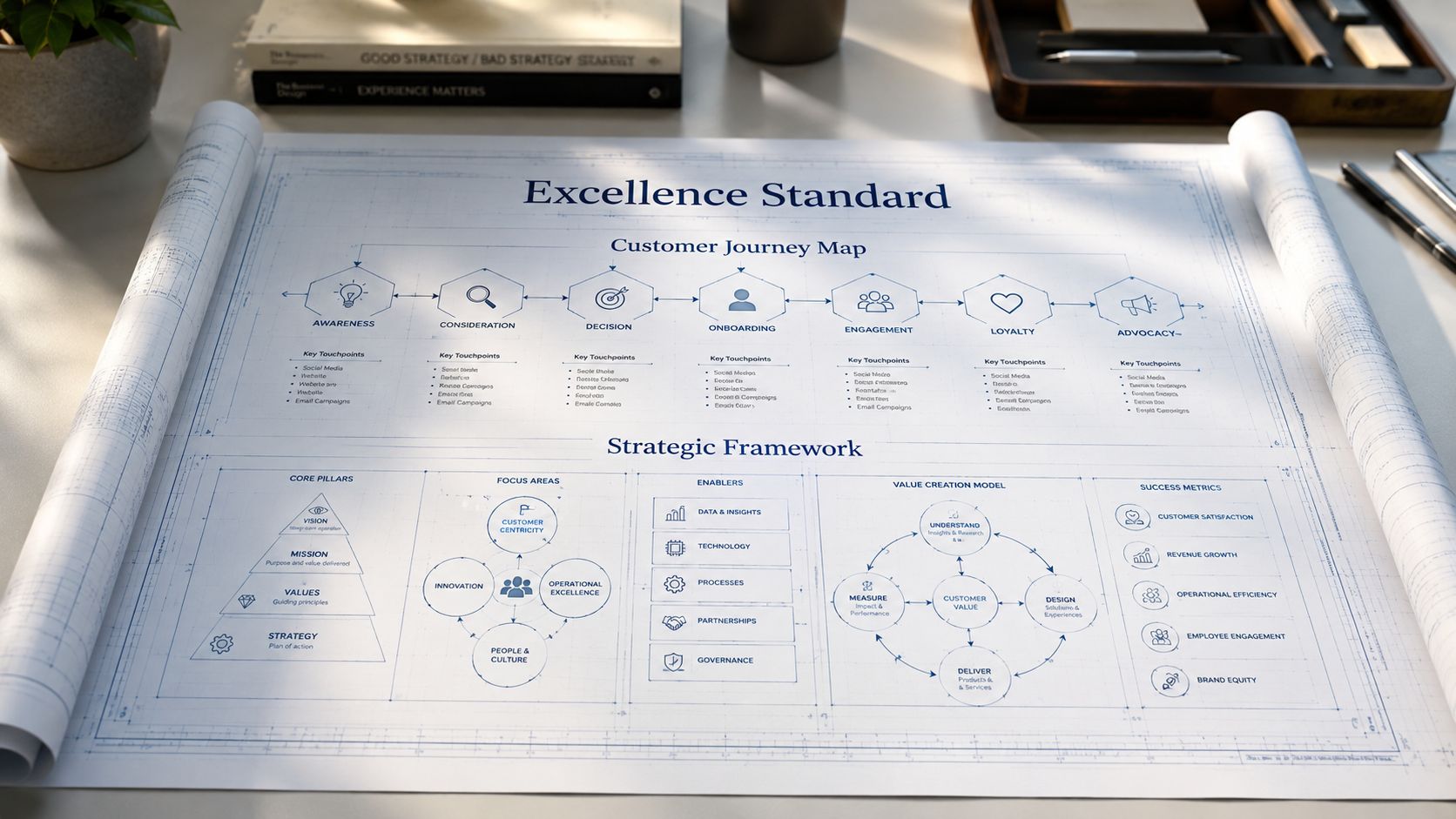
The easiest way to understand customer service standards is to think like an architect. A luxury property doesn't become consistent because the staff is “nice.” It becomes consistent because every touchpoint follows a design. The same applies to private aviation. Without a blueprint, service quality swings from one trip to the next, one agent to the next, and one operator to the next.
Standards prevent failure before the client feels it
Most companies think customer support starts when something goes wrong. That's too late. In charter, strong standards operate upstream. They shape how the quote is built, how the aircraft is presented, how the itinerary is confirmed, how the manifest is handled, and how updates are delivered.
That distinction matters. Reactive support fixes errors. Proactive standards reduce the number of errors a client ever sees.
Here's what a working blueprint includes:
- Defined response rules: Who answers what, in what order, and with what level of detail.
- Escalation paths: What happens when pricing changes, aircraft swaps, weather issues, or airport restrictions appear.
- Client data handling: How preferences, passenger details, and prior trip context are retained.
- Pre-flight confirmation protocols: What must be verified before departure, by whom, and when.
- Post-flight review loops: How service failures, delays, and client friction get captured and corrected.
Consistency beats personality
A lot of charter firms still depend on a few good people carrying the client experience by force of effort. That works until those people are off shift, overloaded, or missing information. Then the cracks show. Standards solve that by turning individual skill into repeatable service.
The benchmark from broader customer service is useful here. Nearly half of companies review support metrics at least weekly, and best practice is to automate reporting on three to five key metrics, according to Databox's customer service statistics. In private aviation, that discipline should be tighter, not looser. If leadership isn't reviewing service performance regularly, they're managing by anecdote.
Practical rule: If a service standard can't be documented, trained, audited, and measured, it won't hold up under pressure.
Standards should be visible inside the business, invisible to the client
Clients shouldn't feel process. They should feel control. The best service operations look effortless because the complexity is handled internally. A well-run charter desk makes the trip feel smooth even when crews, FBOs, caterers, and ground transport are all being coordinated in parallel.
This is also where many brands misunderstand luxury. Luxury isn't the absence of systems. It's the presence of disciplined systems that don't burden the client.
The right blueprint does one more thing. It protects revenue. One negative experience can cost the relationship, while a positive one materially improves the chance of another purchase, as noted earlier from WaveTec. In private aviation, standards aren't a customer care initiative. They're a commercial control system.
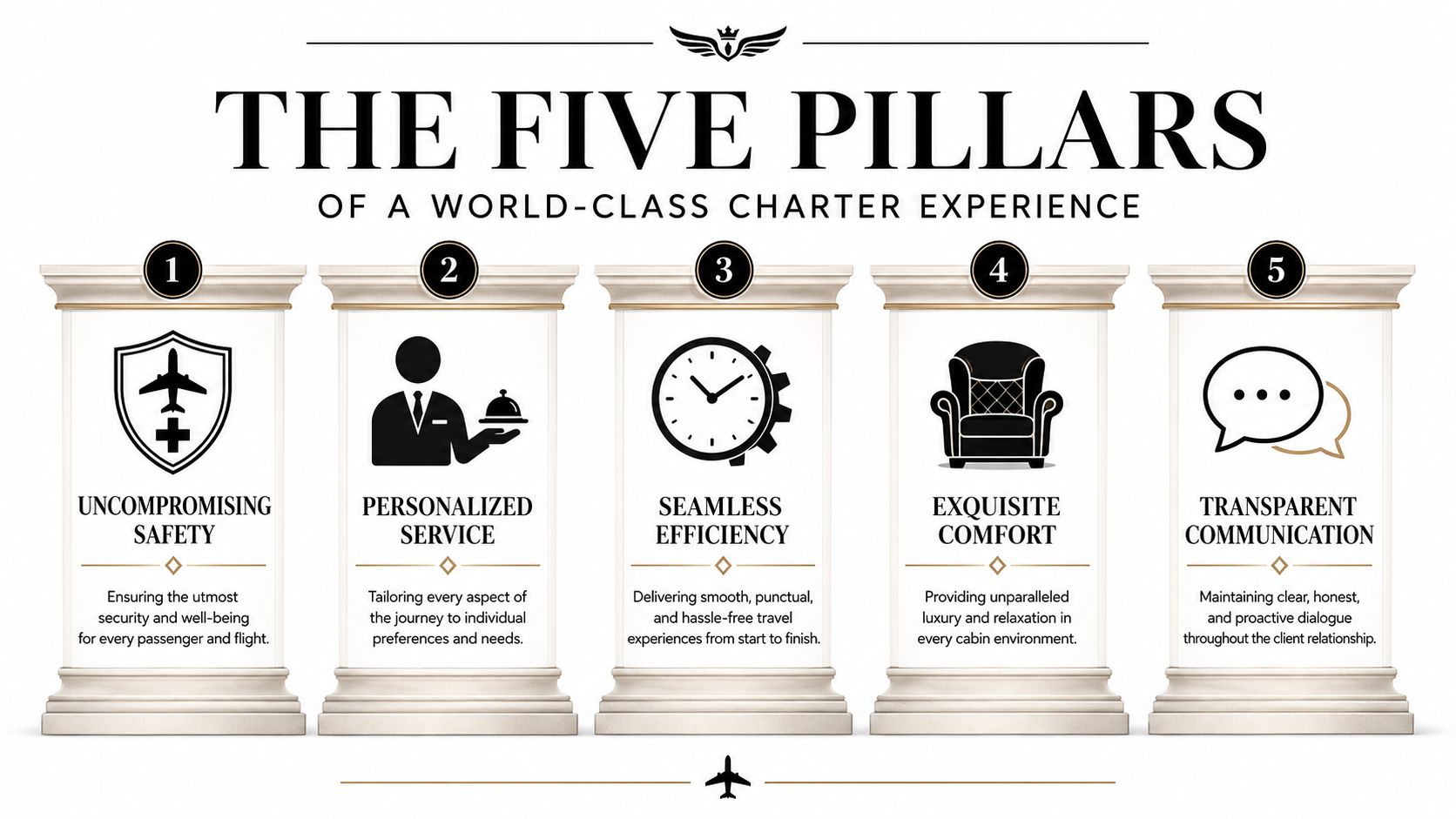
The Five Pillars of a World-Class Charter Experience
The phrase “great service” is too vague to be useful. In private aviation, the standard should be built on five specific pillars. If one is weak, the experience starts to wobble, even when the other four look polished.
Uncompromising Safety
Safety isn't a separate department. It has to be embedded in the service standard itself. The client should never have to dig for operator credentials, audit status, or basic confidence signals.
The most credible private aviation service models integrate third-party safety ratings such as Wyvern Wingman and Argus Gold or Platinum into the actual booking workflow. That matters because operators with certified safety audits achieve a 28% higher Customer Satisfaction Index due to perceived reliability, according to the verified IATA-based benchmark in the brief.
That finding tracks with what experienced buyers already know. Clear safety vetting reduces uncertainty. Reduced uncertainty improves the experience.
Radical Transparency
Charter clients hate one thing almost as much as delays. Surprises.
Transparency means more than sending a quote. It means explaining aircraft sourcing, clarifying whether the client is seeing a specific tail option or a category placeholder, disclosing constraints early, and making catering, pet, Wi-Fi, baggage, and ground transport details explicit. It also means being candid when an option is workable but not ideal.
A provider that buries complexity usually pushes that complexity onto the client later.
For a related look at how details shape the luxury onboard experience, Haute Jets Journal's piece on private jet catering for travelers shows how expectations rise once the flight is treated as a fully managed environment, not just transportation.
Seamless Speed and Efficiency
Speed matters in charter, but not in the shallow sense. A fast answer that creates rework is poor service. What clients want is compressed decision-making with clean execution. They want options that fit the trip, accurate timing, and no unnecessary back-and-forth.
That requires alignment between sales, operations, and suppliers. If the quote team promises what the trip team can't smoothly deliver, the client pays the price in friction.
Speed without operational alignment is just a faster route to disappointment.
Hyper-Personalization
Most companies overstate personalization. They call a saved preference sheet “bespoke.” Real personalization in private aviation starts with mission awareness. Who is flying? Why are they flying? What would make this trip easier, quieter, more private, more efficient, or more comfortable?
That can mean selecting a specific cabin layout, building the timing around a meeting schedule, planning for pets, matching catering to dietary standards, or managing family travel with minimal handoffs. The point isn't to impress the client with flair. The point is to remove effort from the journey.
Absolute Discretion
Discretion is one of the least advertised standards and one of the most important. High-profile clients, executives, and family offices don't tolerate loose handling of manifests, crew details, movement schedules, or personal preferences.
A serious service standard defines who can access sensitive information, how it's communicated, and how context travels across teams without becoming gossip or clutter. Privacy isn't a brand value in this market. It's part of the product.
Measuring What Matters Key Service KPIs
If a charter firm can't measure service quality, it can't control it. And if it only measures speed, it will start gaming speed.
Private aviation needs tighter KPIs than generic customer support because the cost of a sloppy handoff is higher. The useful metrics are the ones that expose whether the team is making the trip easier, more accurate, and more reliable for the client.
The KPIs that actually reveal service quality
The first KPI is First Response Time (FRT). In private aviation, the benchmark is under 15 minutes, and delays beyond that threshold cause a 32% drop in customer satisfaction according to the verified benchmark in the brief. That doesn't mean a superficial acknowledgment counts. The first response has to move the request forward.
The second KPI is First Contact Resolution (FCR). In this context, that means the client gets accurate, actionable information without repeated correction cycles. The benchmark is 98%, and incorrect aircraft availability or pricing data is tied to a 45% immediate churn rate in the verified data.
The third is Customer Effort Score (CES). This is one of the most useful metrics in charter because it exposes friction the operator may not notice internally. A CES below 2.0 is the benchmark for excellent service and is linked in the verified data to a 60% increase in repeat bookings.
A fourth metric worth tracking is Net Sentiment Score (NSS). It matters because private aviation clients often won't complain directly. Their tone changes before their buying behavior does. Sentiment analysis can reveal mounting frustration even when the operational record looks acceptable on paper.
Essential KPIs for private aviation service
| KPI | What It Measures | Elite Benchmark |
|---|---|---|
| First Response Time (FRT) | Time from inquiry to meaningful initial reply | Under 15 minutes |
| First Contact Resolution (FCR) | Whether the client gets accurate, usable resolution without rework | 98% |
| Customer Effort Score (CES) | How easy the booking and coordination process feels to the client | Below 2.0 |
| Net Sentiment Score (NSS) | Emotional direction of client interactions across touchpoints | Track for negative shifts |
| Wrap-up discipline | Quality and speed of post-interaction documentation | Keep documentation controlled and timely |
Segment your metrics or they become useless
One of the biggest mistakes I see is the universal SLA. It sounds clean, but it hides the truth. A catering amendment, an urgent same-day charter request, a tail-specific inquiry, and an international schedule change should not all be measured the same way.
That's why guidance in the verified brief points toward segmentation by issue type, team, channel, and region. That's the right direction. It helps prevent KPI theater, where the business looks fast while clients still repeat themselves, wait through handoffs, or get corrected quotes.
For teams building scorecards, a simple planning framework like SigOS's template for SaaS teams can be useful as a structure, even though private aviation needs stricter operational definitions than most software businesses use.
Track the handoff, not just the reply
Private aviation service often breaks at the seam between departments. The quote is strong, then operations loses context. Or the trip desk executes well, but no one closes the loop on pre-flight details. Those aren't isolated mistakes. They reflect missing service standards around continuity.
A serious operator should measure:
- Handoffs per issue: More handoffs usually mean more effort for the client.
- Replies per ticket or request: Too many replies often signal poor clarity upfront.
- Queue drop-off or stale requests: Unanswered or half-answered work creates silent failure.
- Context retention: Did the next person know the client's trip details without asking again?
For a deeper view of how disciplined execution connects directly to trip quality, Haute Jets Journal's article on ensuring private jet safety and reliability is worth reading.
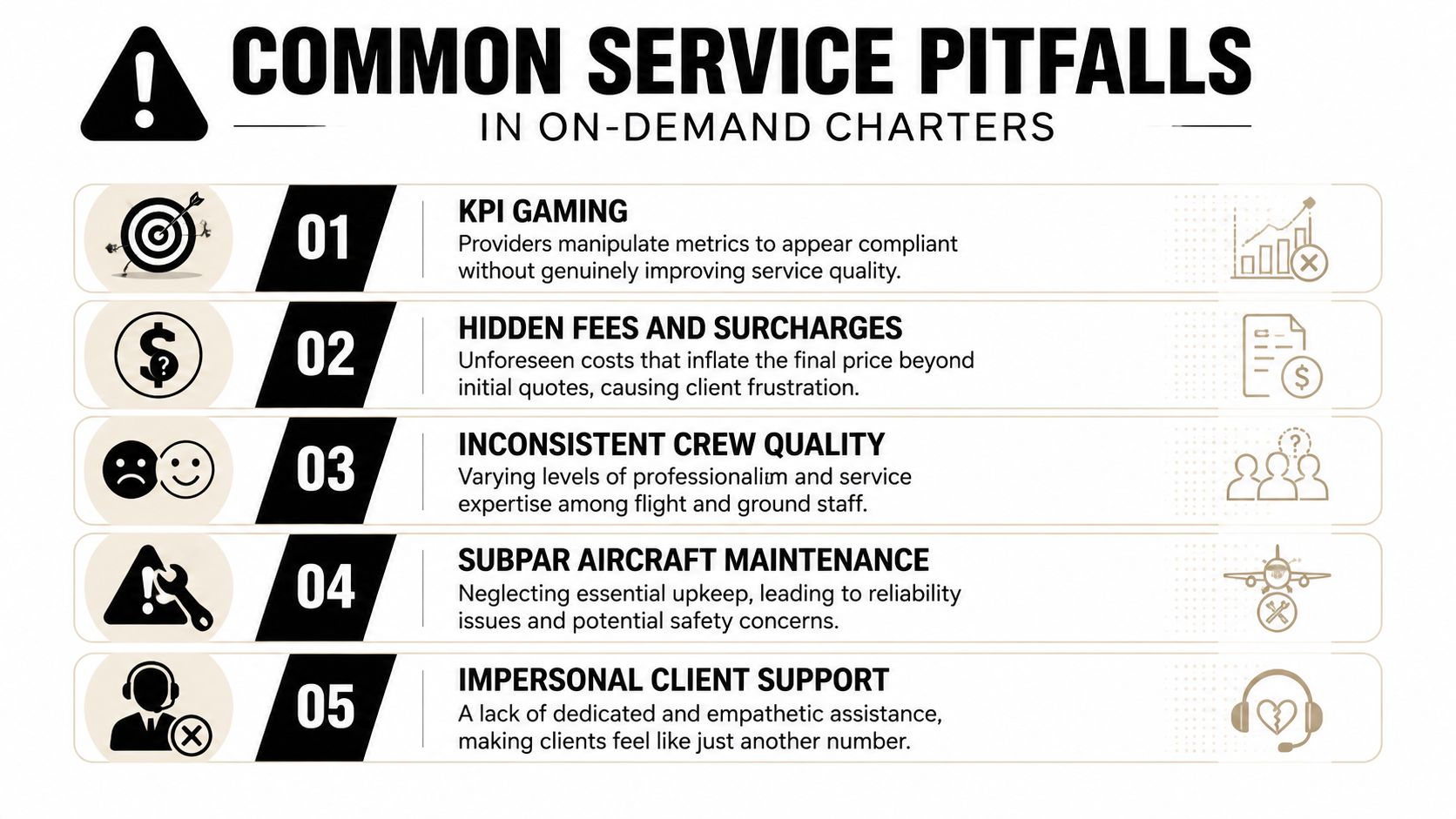
Common Service Pitfalls in On-Demand Charters
The charter market is full of companies that look competent in a brochure and feel chaotic in motion. Most service failures don't come from one dramatic mistake. They come from a pattern of smaller breakdowns that the client ends up stitching together.
Fast replies that create more work
This is the classic KPI gaming problem. A team responds quickly, logs a win, and sends the client into a second or third round of clarification because the answer wasn't complete. That inflates internal performance while degrading the customer experience.
In charter, that usually shows up as partial quotes, unclear aircraft details, vague policy answers, or responses that don't address the mission. The metric says “fast.” The client feels delay.
Pricing that changes shape later
Opaque pricing is still one of the easiest ways to destroy trust. If the first quote doesn't clearly separate core charter cost from add-ons and operational variables, the client starts wondering what else is hidden. Even when the price change is explainable, poor communication makes it feel deceptive.
Radical transparency isn't a branding flourish. It's basic service discipline.
Handoffs that erase context
A client speaks to sales, then repeats everything to operations. Operations updates the itinerary, then catering misses the revision. Ground transport gets arranged, but no one confirms timing against the departure flow. Every one of these failures tells the client the company works in fragments.
The client should experience one team, even when five teams are involved.
Modern customer service standards require updating for omnichannel and distributed workflows. The primary risk isn't only slow service. It's broken continuity.
Weekly review is the bare minimum
A lot of charter businesses claim to care about service but review problems sporadically. That's management by memory, not management by standard. Nearly half of companies review support metrics weekly, and a common best practice is to automate reporting on three to five critical metrics to leadership, according to Databox's benchmark on customer service statistics.
In private aviation, that review cycle should catch patterns such as repeated quote corrections, aircraft change friction, slow confirmations, and unresolved client effort points. If leadership only hears about failures when a major client complains, the operation is already behind.
The most common red flags
Use this as a buyer's filter:
- Inconsistent aircraft detail: The provider speaks confidently but can't confirm specifics cleanly.
- Last-minute surprises: Important trip information appears too late to be useful.
- Scripted communication: The team sounds polished but doesn't answer the actual concern.
- Weak post-booking control: Service feels strong until payment clears, then becomes reactive.
- No measurement culture: Staff talk about “white-glove service” but can't define the standards behind it.
The market doesn't need more polished language. It needs operators who can prove control.
How Haute Jets Exceeds the Standard
The easiest way to judge any charter model is to test it against the standards above. Safety has to be explicit. Pricing has to be transparent. Aircraft selection has to be precise. Pre-flight communication has to reduce uncertainty, not add to it.
Where the operating model matters
The publisher's own model is relevant here because it addresses several of the failure points directly. Haute Jets sources from owner-operators rather than pushing clients into generic inventory buckets, uses Wyvern and Argus-rated operators only, allows clients to choose the exact aircraft, and provides 24-hour pre-flight confirmation with details such as tail number, crew bios, weather briefing, and passenger manifest.
That structure matters for service quality because it tightens the link between what is sold and what is delivered.
Four areas where the standard becomes tangible
- Safety integration: Restricting the network to Wyvern Wingman or Argus Gold and Platinum-rated operators turns safety from a vague promise into a sourcing rule.
- Transparency in pricing: Local sourcing reduces the risk of unnecessary repositioning charges being buried inside the quote.
- Specific aircraft control: Letting the client choose the exact aircraft improves accuracy and reduces the category-switch problem.
- Proactive confirmation: A 24-hour pre-flight package gives the traveler meaningful visibility before departure, when corrections are still possible.
What this says about customer service standards
The strongest service model in private aviation isn't the one that talks most about hospitality. It's the one that builds accuracy, responsiveness, and risk visibility into the booking process itself. That's the standard serious clients should expect.
If you're evaluating any charter provider, ask blunt questions. Which safety audits are required? Can I select the exact aircraft? When do I receive full pre-flight confirmation? How do you prevent hidden repositioning costs? What happens if the aircraft changes? If the answers are soft, the standards are soft.
That's the fundamental dividing line in this market.
If you want a private charter experience built around exact aircraft selection, audited operator safety, transparent sourcing, and proactive trip confirmation, explore Haute Jets.