
If you're booking enough private flights that every trip starts to feel like a mini procurement exercise, you're in the zone where charter alone may no longer be the cleanest answer. You want better aircraft consistency, better schedule control, and a structure that doesn't require wiring the capital for full ownership.
That's where the dry lease of aircraft becomes strategically useful. For the right client, it sits between occasional charter and outright ownership. It can deliver dedicated access to an aircraft without taking on the full acquisition burden, but it only works when the lessee understands exactly what control, risk, and responsibility they are accepting.
For high-net-worth individuals, family offices, and corporate flight departments, the central question is not whether dry leasing exists. It is whether it fits the way you fly, govern risk, and account for aviation costs.
Understanding the Dry Lease of Aircraft
A dry lease makes sense when you're flying often enough to want continuity, but not in a way that on-demand charter solves every problem. That usually means one of two situations. Either your trip volume is increasing and aircraft availability is becoming a planning issue, or your mission profile has become consistent enough that having access to a specific cabin class or tail type matters.
A dry lease is not just an aircraft rental. It is a control structure. The lessor provides the aircraft. The lessee takes over the operating side. That distinction is why this model appeals to discerning users who want more predictability than ad hoc charter, but less capital commitment than purchasing a jet.
The market has already made that preference clear. In 2025, dry leases accounted for 83.92% of the global commercial aircraft leasing market, representing USD 152.5 billion, according to Mordor Intelligence's commercial aircraft leasing market analysis. The same analysis notes that airlines favor the model because standardization reduces training complexity, lowers operating costs, and improves fleet uniformity.
Why the structure matters
That commercial-market dominance matters even for private aviation decision-makers. It shows that dry leasing isn't a niche workaround. It's a mainstream tool used when operators want long-term access, cost discipline, and fleet planning flexibility.
For a private client or corporate user, the strategic logic is similar:
- Preserve capital instead of buying an aircraft outright
- Lock in access to a known asset
- Create operational consistency around a preferred aircraft type
- Avoid paying retail charter economics trip after trip when usage becomes frequent
Practical rule: If you're still choosing aircraft one trip at a time, charter probably remains the cleaner option. If you're solving the same aircraft problem every month, a lease structure deserves serious review.
The legal agreement matters as much as the aircraft itself. Anyone evaluating this route should think about the contract the same way they would think about protecting business capital in any asset-backed lease. The wrong structure can erase the financial advantages that attracted you in the first place.
What a Dry Lease Entails for Lessees

A good way to understand a dry lease is to compare it to real estate. A wet lease is like checking into a fully serviced property where the operator handles the staffing and day-to-day operation. A dry lease is closer to taking possession of an unfurnished property. You get the asset, but you're responsible for making it function.
That responsibility is not cosmetic. In a dry lease of aircraft, the lessee assumes full operational control, including placing the aircraft on their own Air Operator's Certificate and providing all flight and cabin crew, according to this explanation of wet lease vs dry lease aircraft structures. Under FAA guidance referenced there, operational control means the authority for initiating, conducting, or terminating flights.
What moves to the lessee
Once you sign a true dry lease, the following burdens typically move to you as lessee:
- Crew sourcing and control: You must select and contract crew independently.
- Maintenance oversight: You are responsible for managing maintenance planning and airworthiness execution.
- Insurance placement: Hull and liability coverage must align with the lease and your operating profile.
- Operating costs: Fuel, handling, navigation, crew travel, and recurring operating expenses sit on your side.
- Regulatory accountability: The structure has to reflect real operational control, not a paper transfer.
That last point is where many deals fail. A document can say "dry lease" while the conduct of the parties looks like a charter or wet lease. If the lessor is still effectively controlling crew, scheduling, dispatch, or trip execution, you've created regulatory risk.
The safest dry lease is the one that behaves like a dry lease in daily practice, not just in the signature block.
Where clients get surprised
The most common misunderstanding is thinking a dry lease is a cheaper charter. It isn't. It can produce better economics in the right use case, but only because you're accepting work, liability, and management obligations that charter providers normally absorb.
That is why this model tends to fit clients who already have aviation infrastructure, or who are willing to build it with advisers, managers, and counsel who understand the distinction. If you need a broader primer on where leasing fits among private aviation options, this private jet leasing guide is a useful companion read.
A short visual primer helps clarify the operational shift:
What operational control really means
Operational control is the defining issue. If you're the lessee, you are not outsourcing judgment. You are taking legal responsibility for the aircraft's operation.
That means a proper dry lease should answer questions such as:
- Who hires the pilots
- Who decides whether a flight launches
- Who controls scheduling and dispatch
- Who carries the operating compliance burden
- Who bears liability when something goes wrong
If the answer keeps drifting back to the lessor, the structure needs another look.
How Dry Leasing Compares to Other Aircraft Leases
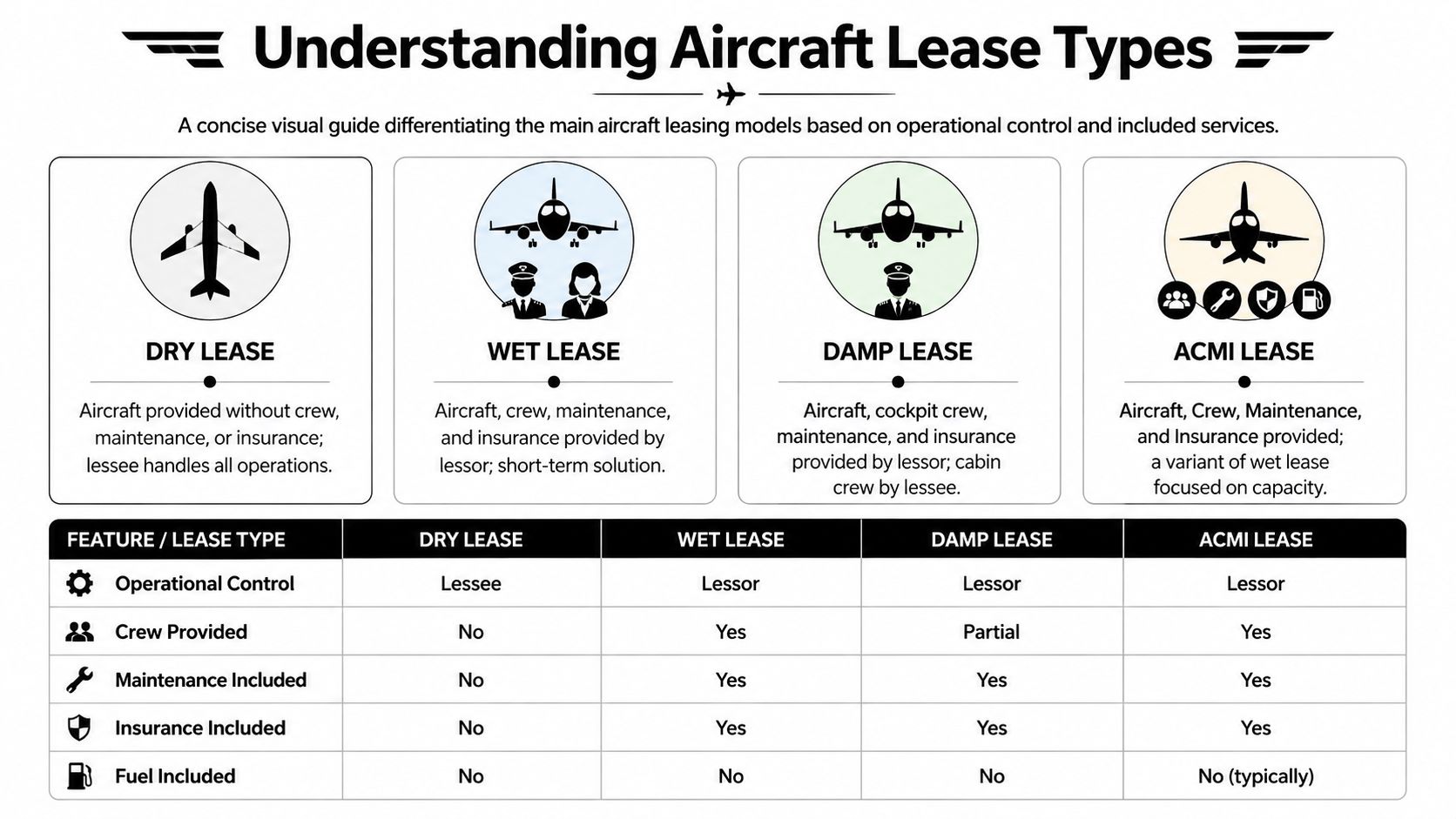
The terms get thrown around loosely, and that creates confusion. In practice, the useful distinction is simple. Start with who controls the operation, then look at what services come with the aircraft.
Aircraft Lease Types Compared
| Responsibility | Dry Lease | Wet Lease | Damp Lease | ACMI Lease |
|---|---|---|---|---|
| Aircraft | Provided by lessor | Provided by lessor | Provided by lessor | Provided by lessor |
| Crew | Lessee provides | Lessor provides | Shared or partial | Lessor provides |
| Maintenance | Lessee manages | Lessor manages | Lessor manages | Lessor manages |
| Insurance | Lessee secures | Lessor secures | Lessor secures | Lessor secures |
| Operational control | Lessee | Lessor | Usually lessor | Lessor |
| Typical use case | Long-term access and control | Short-term operational coverage | Hybrid staffing need | Capacity-focused commercial support |
Dry lease
A dry lease is the most ownership-like structure without purchasing the aircraft. It gives the lessee the most control and the most responsibility. This is the model that best suits organizations that want to shape the operation around their own standards, crew, and scheduling priorities.
Wet lease
A wet lease is the opposite end of the spectrum. The lessor supplies the aircraft together with crew, maintenance, and insurance. It works when the user needs immediate lift capacity without building operating infrastructure.
This is often the cleaner answer for short-term requirements, unusual route demand, or transitional lift needs.
Damp lease
A damp lease sits in the middle. The lessor generally provides the aircraft and cockpit crew, while the lessee may provide cabin crew. It's less common in private aviation discussions, but it appears where service delivery standards need partial customization without full transfer of operational responsibility.
If your main goal is service flexibility, a damp structure can work. If your goal is control, it usually doesn't go far enough.
ACMI lease
ACMI stands for Aircraft, Crew, Maintenance, and Insurance. In functional terms, it is a wet lease variant often used for capacity support. The aircraft comes bundled with the core operating package, while fuel and some trip-specific costs may sit outside the package depending on the agreement.
For a private client or corporate user, the practical takeaway is this:
- Choose dry lease when control and continuity matter more than simplicity
- Choose wet or ACMI when speed of deployment matters more than control
- Choose damp only when the staffing split serves a specific operational purpose
The mistake is picking a lease type based on headline cost alone. The better choice is the one that matches who should be making operating decisions.
Navigating Typical Dry Lease Contract Terms
The aircraft may be the headline item, but the contract determines whether the deal remains workable once the first maintenance event, scheduling dispute, or return-condition argument appears. Most dry lease problems are not caused by the concept. They are caused by loose drafting.
Core commercial clauses
A typical agreement will define the lease term, rent schedule, deposit or security support, permitted use, geographic limits, maintenance obligations, insurance standards, events of default, and return conditions. None of these clauses is boilerplate in practice.
A strong lessee reads the commercial terms through three lenses:
- Can I operate the aircraft the way I intend to use it
- Do the maintenance obligations match the aircraft's real condition
- What happens financially if the relationship ends badly
If the answer to any one of those is unclear, the drafting is unfinished.
Maintenance reserves and major events
Maintenance reserves are one of the most misunderstood parts of a dry lease. They are funds collected to account for future high-cost maintenance events, such as engine work, major inspections, or landing gear events. In theory, reserves smooth risk over time. In practice, they can become a source of serious disagreement if the agreement doesn't define triggers, documentation standards, reimbursement timing, and treatment at redelivery.
A lessee should never treat reserves as an abstract accounting item. Review the maintenance status of the actual aircraft, then compare that status to the reserve formula. An aircraft heading toward expensive scheduled work can change the economics of the lease quickly.
A lease rate that looks attractive on page one can become expensive if the maintenance schedule on page forty tells a different story.
Delivery and redelivery
Delivery and redelivery provisions deserve more attention than they usually get. At delivery, you want a highly specific record of aircraft condition, installed equipment, logbooks, deferred items, cosmetic status, and maintenance positioning. At redelivery, the lessor will compare the aircraft against that baseline.
That comparison drives real money. Disputes often arise over interior wear, paint, missing equipment, records discrepancies, due maintenance items, and interpretation of "ordinary wear and tear."
A practical redelivery review should ask:
- What maintenance status is required at return
- Which records must be complete and in what format
- Who pays for correcting discrepancies found near lease end
- What counts as acceptable cosmetic condition
- How is downtime handled if redelivery takes longer than expected
The clauses that deserve negotiation
Many lessees focus heavily on monthly rent and too lightly on operational language. That's backwards. The most consequential negotiations often involve consent rights, substitution rights, maintenance approval thresholds, casualty provisions, and default cure mechanics.
A disciplined negotiation aims for clarity, not just price. If the parties don't share the same view of who approves maintenance, who selects vendors, and what evidence proves compliance, the lease will become adversarial under pressure.
Evaluating the Pros and Cons for Lessors and Lessees

Dry leasing works best when both sides want different things from the same structure. The lessor wants asset income without operating the aircraft day to day. The lessee wants access and control without buying the aircraft outright. That alignment can be powerful, but it isn't friction-free.
For lessees
The upside for a lessee is straightforward. You gain a level of aircraft access and operational consistency that ordinary charter often can't deliver. That matters for executives with repeat city pairs, family offices that value known cabin configuration, and flight departments trying to standardize the travel experience.
The strategic benefits usually include:
- Control over operations: You decide how the aircraft is crewed and managed.
- Asset-light access: You avoid the capital outlay and ownership exposure of an acquisition.
- Mission consistency: The same aircraft type can support recurring travel patterns more cleanly than ad hoc sourcing.
- Potential structuring flexibility: Legal, tax, and entity planning may be more adaptable than simple retail charter.
The downside is equally real. You inherit complexity. You also inherit the possibility that your team underestimates how much work sits behind safe, compliant, repeatable operations.
Lessee scorecard
| Factor | Upside | Risk |
|---|---|---|
| Control | Direct authority over operations | More legal and regulatory burden |
| Cost structure | Can align well with frequent use | Unexpected maintenance and compliance costs |
| Flexibility | More tailored than jet cards or fixed programs | Less simple than on-demand charter |
| Liability | Clear control chain | Exposure sits with the operating side |
Clients often like the economics of a dry lease before they've priced the management discipline required to run one properly.
For organizations evaluating alternatives, this corporate jet leasing guide gives broader context on how lease structures fit corporate aviation planning.
For lessors
A lessor benefits from recurring income and reduced day-to-day operating involvement. The aircraft remains an owned asset, but the operational tasks shift outward. For some owners, that's the cleanest way to put an aircraft to work without becoming an operating platform themselves.
But lessors accept their own risks:
- Credit risk of the lessee
- Residual value exposure
- Potential wear beyond expectations
- Enforcement risk if the lessee mishandles maintenance or records
- Regulatory exposure if the structure is drafted as dry but behaves otherwise
What works and what doesn't
What works is alignment. A capable lessee with real operating support, a well-documented aircraft, clear maintenance history, and a contract that treats operational control seriously can make the arrangement efficient for both sides.
What doesn't work is using a dry lease to imitate charter while pretending the paperwork solves the distinction. That approach creates compliance problems, insurance tension, and disputes the first time an operational decision gets questioned.
The best dry lease is boring after closing. Everyone knows their role. Everyone follows the paper. The aircraft flies. The records stay clean.
Your Due Diligence and Negotiation Checklist
A dry lease should be diligenced like an acquisition in miniature. You may not be buying title, but you're taking on enough operational and financial exposure that superficial review isn't good enough.

Start with the aircraft, not the term sheet
Inspect the aircraft and its records before you spend too much time negotiating edge language. A bad aircraft won't become a good deal because the rent is attractive.
Review at minimum:
- Logbooks and records: Confirm continuity, completeness, and traceability.
- Maintenance status: Understand what inspections and major events are approaching.
- Configuration reality: Verify that installed equipment and interior condition match the representation.
- Damage history: Ask hard questions and get clear written answers.
Confirm the operating structure
Many private users need experienced counsel. The structure has to reflect a real transfer of operational control. Crew selection, scheduling authority, dispatch responsibility, insurance structure, and management agreements all need to fit together without contradiction.
A practical legal review should test whether the transaction would still look like a dry lease if a regulator examined the actual behavior of the parties.
Negotiation point: If the lessor wants meaningful say over trip decisions, crew deployment, or dispatch, slow down and re-test the structure.
Pressure-test the economics
Don't stop at monthly rent. Build the full operating picture. Include maintenance planning, reserve treatment, management fees if applicable, insurance, crew, training, hangar, and trip-variable cost assumptions. Then compare that all-in profile against the alternatives you already use.
This is also the point where tax planning becomes material. The NBAA dry lease best practices discussion raises a question that many owners miss: how to structure non-exclusive leases to maximize depreciation benefits. It notes that Section 168(k) bonus depreciation is 100% through 2026 and drops to 40% in 2027, and that 60% of US business aircraft owners underutilize dry leasing for tax efficiency, as described in NBAA's business aircraft dry lease best practices resource.
That doesn't mean every client should expect the same tax result. It means tax structuring belongs in the process early, with aviation-savvy advisors, not after the contract is already settled.
Use a deal checklist that reflects reality
Technical review first
Get a records and maintenance review completed before final paper closes.Insurance alignment next
Have an aviation insurance broker test whether the intended structure is insurable as drafted.Operational control audit
Match the lease, management arrangement, and crew arrangement so they don't conflict.Redelivery modeling
Estimate what returning the aircraft in required condition could cost.Tax and entity planning
Confirm the lease sits inside a structure that supports your business and tax objectives.
An experienced lessee doesn't negotiate only for better pricing. They negotiate for fewer surprises.
Market Trends and Guidance for Long-Term Aircraft Use
The dry lease of aircraft is most effective when it is used as part of a broader aviation strategy, not as a stand-alone finance decision. The right structure depends on how often you fly, whether you need a specific cabin or performance profile, and how much operating responsibility you're prepared to own.
For corporate flight departments, dry leasing can be a smart way to supplement a core fleet, cover a transitional period, or test a different aircraft type before making a longer-term capital decision. It gives the department more consistency than pure charter while preserving flexibility that full ownership doesn't always offer.
For high-net-worth individuals and family offices, the model works best when travel patterns are recurring and privacy, predictability, and aircraft-specific preferences matter. It can provide many ownership-style benefits without requiring direct aircraft purchase, but only if the operating side is managed professionally.
For charter-facing users, safety filtering and sourcing discipline matter as much as lease economics. According to this discussion of wet and dry leasing differences, Wyvern Wingman and Argus-rated aircraft represent only 20% of 3,500+ global owner-aircraft, while non-exclusive dry leases under FAR 91.501 can cut repositioning fees 20% to 40%, and dry lease safety incidents dropped 18% year over year among Argus-rated operators.
What that means in practice
Those figures point to a simple conclusion. Access alone isn't enough. Vetted access matters. If your long-term plan includes blending leased access with on-demand flying, pay close attention to operator quality, tail-specific verification, and the actual cost effect of repositioning.
A smart planning exercise should compare dry leasing against all-in charter spend, ownership appetite, and mission consistency. This broader private jet cost breakdown is a useful starting point when framing that decision.
The right aviation strategy isn't the one with the most control. It's the one that gives you the right level of control for the way you actually travel.
If you're evaluating whether a dry lease belongs in your aviation strategy, Haute Jets can help you compare lease-backed access against on-demand charter options, with aircraft-specific sourcing and safety-focused guidance designed for your flight operations.