
You're probably looking at the Eclipse 500 jet because the mission is simple, but the market isn't. You want a private aircraft that can handle a short trip cleanly, keep the cabin private, and avoid the waste that comes from booking the wrong size jet or paying for unnecessary repositioning. That's exactly where the Eclipse 500 earns attention, and where most overviews stop short of telling you the part that matters, the ownership and charter trade-offs.
The Eclipse 500 came out of the early very light jet boom and helped define the category in 2002. It was built around a compact six-seat layout, twin-turbofan power, and a 41,001 ft service ceiling, which made it a serious point-to-point machine instead of a novelty jet. In published performance data, it's listed with a 1,125 nmi maximum range, 370-knot maximum speed, 2,345 ft takeoff distance, and 2,250 ft landing distance, a combination that gave short-runway airports real utility in the light-jet segment (Eclipse 500 performance data).
AOPA reported the launch price was less than $900,000 in 2000, then reached $2.15 million by June 2008 as 260 aircraft entered production (AOPA on the Eclipse 500 price evolution). That's the story in a nutshell. The aircraft was designed to democratize private jet travel, and it still matters in 2026 because the buying and charter decision is less about glamour and more about choosing a niche jet that fits the mission without bloating the bill.
For a broader sizing baseline, compare this aircraft with a typical small private jet guide before you lock in a charter profile. The Eclipse 500 is not the answer for every route, but it's a sharp answer for the right one. See the small private jet guide for context on where it sits in the market.
Understanding the Eclipse 500 Jet
A serious Eclipse 500 charter decision starts with the mission, not the cabin brochure. This jet was built for clients who want private air travel without paying for unused space, and that makes it a very specific tool. The aircraft pairs a compact cabin with 2 × Pratt & Whitney Canada PW610F turbofans, each producing 900 lbf of thrust, which is a direct break from the old habit of equating usefulness with size (Eclipse 500 specifications).
Why it still matters for charter clients
The Eclipse 500 still earns attention because it sits in a narrow but useful part of the market. Its published ceiling of 41,001 ft and cruise speed of 370 kt let it move above a lot of routine traffic and weather, which is useful for quick business trips and weekend travel where time matters more than cabin size (Eclipse 500 performance data). The right framing is simple. If you need the smallest jet that can still do the job cleanly, this aircraft belongs in the conversation.
Practical rule: If your trip is short, direct, and light on luggage, the Eclipse 500 can make better economic sense than moving up a category just for comfort theater.
The production history matters for charter sourcing too. AOPA coverage of production milestones reported that the first production Eclipse 500 flew in 2006 and that 260 aircraft had been produced by the end of 2008 (AOPA coverage of production milestones). That gives the model a meaningful operating footprint, but it is still a niche fleet. For clients, that means availability, maintenance status, and operator quality deserve more attention than they do on a mainstream light jet.
For a broader size comparison, use the small private jet guide before you commit to a charter profile. That context helps you judge whether the Eclipse 500 is the right fit, or whether you are paying for more aircraft than the trip requires.
Cabin Layout and Performance Specs
The Eclipse 500 cabin is best understood as efficient, not generous. It's commonly described as a 5 to 6 seat aircraft, and one source frames it as one pilot plus up to five passengers in a compact layout (Eclipse 500 cabin description). That matters because the cabin was built for quick private mobility, not for long-haul lounging. If you're expecting a wide aisle, oversized sidewalls, and a baggage cavern, you're shopping the wrong class.
What the numbers mean in flight
The aircraft's NBAA IFR range of 1,125 nmi on four passengers is the number charter clients should watch, because it reflects real operational planning rather than brochure optimism (Eclipse 500 performance data). Four people, baggage, reserves, and alternate planning all live in the same envelope. If you add passengers or heavy bags, dispatch has to work harder to keep the trip clean.
The same logic applies to the runway numbers. A 2,345 ft takeoff distance and 2,250 ft landing distance are unusually short for a jet of this class (Eclipse 500 specifications). In plain English, it behaves more like a very capable light aircraft on pavement than a fussy business jet that needs big-airport infrastructure. That opens up more airport choices, which is where charter convenience starts to show up in your schedule.
The right comparison is not luxury SUV versus sports car, it's whether you need the smallest jet that can still do the job cleanly.
For clients, the ride profile is straightforward. You get jet speed and altitude, but the cabin stays compact, so noise, elbow room, and baggage tolerance are the trade-offs. That's not a flaw, it's the design brief. If your priority is efficient private lift between city pairs, the Eclipse 500 gives you a sharper cost-to-utility ratio than many people expect.
Charter Pricing and Route Options
The Eclipse 500 usually lives in a charter band of $1,700 to $2,200 per flight hour, depending on aircraft age, model variant, and positioning (Flycraft Eclipse 500 charter economics). That's the number clients should anchor to before anyone starts talking about “great deals.” The hourly rate is only the base, because the final price changes with where the aircraft starts, how tight the schedule is, and whether the operator has to move the jet empty to reach you.
How to think about route pricing
Short missions reward this aircraft. When the departure and arrival airports are both practical for a small jet, you usually avoid paying for excess aircraft size and excess block time. Longer missions are where the Eclipse 500 becomes less forgiving, because the range can narrow quickly once you account for real payload and reserve management.
| Typical Eclipse 500 Charter Scenarios | Distance (nmi) | Flight Time (h) | Estimated Cost ($) |
|---|---|---|---|
| Los Angeles to Las Vegas | Qualitatively short | Qualitatively short | Use the hourly charter band |
| Miami to the Bahamas | Qualitatively short | Qualitatively short | Use the hourly charter band |
| New York to Miami | Qualitatively long for a VLJ | Qualitatively longer | Often requires careful payload and routing review |
The table above is intentionally qualitative because the only verified pricing data available is the hourly charter band, not route-specific quotes. That's the honest way to evaluate a VLJ. The actual trip invoice depends on flying time, positioning, airport fees, and whether the aircraft can complete the mission without a fuel or payload compromise.
If you want a useful planning shortcut, start with the route, not the aircraft. The Eclipse 500 is smart for city pairs that fit its operational profile, and it becomes a poor buy when clients insist on forcing it into a mission that belongs to a larger jet. For context on how it stacks up in light-jet missions, compare it with the range-focused aircraft in this light-jet comparison guide.
Safety Record and Maintenance Considerations
An Eclipse 500 charter lives or dies on the quality of the aircraft behind the quote. Aviation Consumer described the program as “still a work in progress” after years of development, and its fleet reporting showed an active but limited pool of aircraft, which is exactly the kind of setup that makes sourcing and support less forgiving than on mainstream light jets (Aviation Consumer on the Eclipse 500 program).
What that means for charter clients
A thin fleet creates real friction. Parts are harder to source, support options are narrower, and an aircraft that looks available on paper may still be a poor fit if it is coming out of storage or sitting close to a maintenance event. Aviation Consumer also cited ownership planning around about $1,300 per flight hour, which gives you a clear sense of how quickly support costs matter once utilization starts climbing (Aviation Consumer on the Eclipse 500 program).
That is why operator selection has to be strict. If the jet does not come with clean maintenance records, current inspections, and dependable dispatch history, do not book it. Ask directly about airframe support, parts access, and any upcoming maintenance events that could interfere with availability. If you want a practical primer on why this matters, review what MRO means for flight safety.
Booking rule: A low quote on a niche aircraft is not a deal if the tail is difficult to support or the maintenance clock is close to an expensive event.
For high-net-worth travelers, the primary risk is not just safety on the day of flight, it is schedule reliability. A well-vetted operator with local sourcing can usually find the right aircraft faster, avoid unnecessary repositioning, and keep pricing closer to wholesale levels. That is the booking edge that matters with the Eclipse 500, because the aircraft rewards disciplined sourcing and punishes casual booking.
Passenger Experience and Baggage Limitations
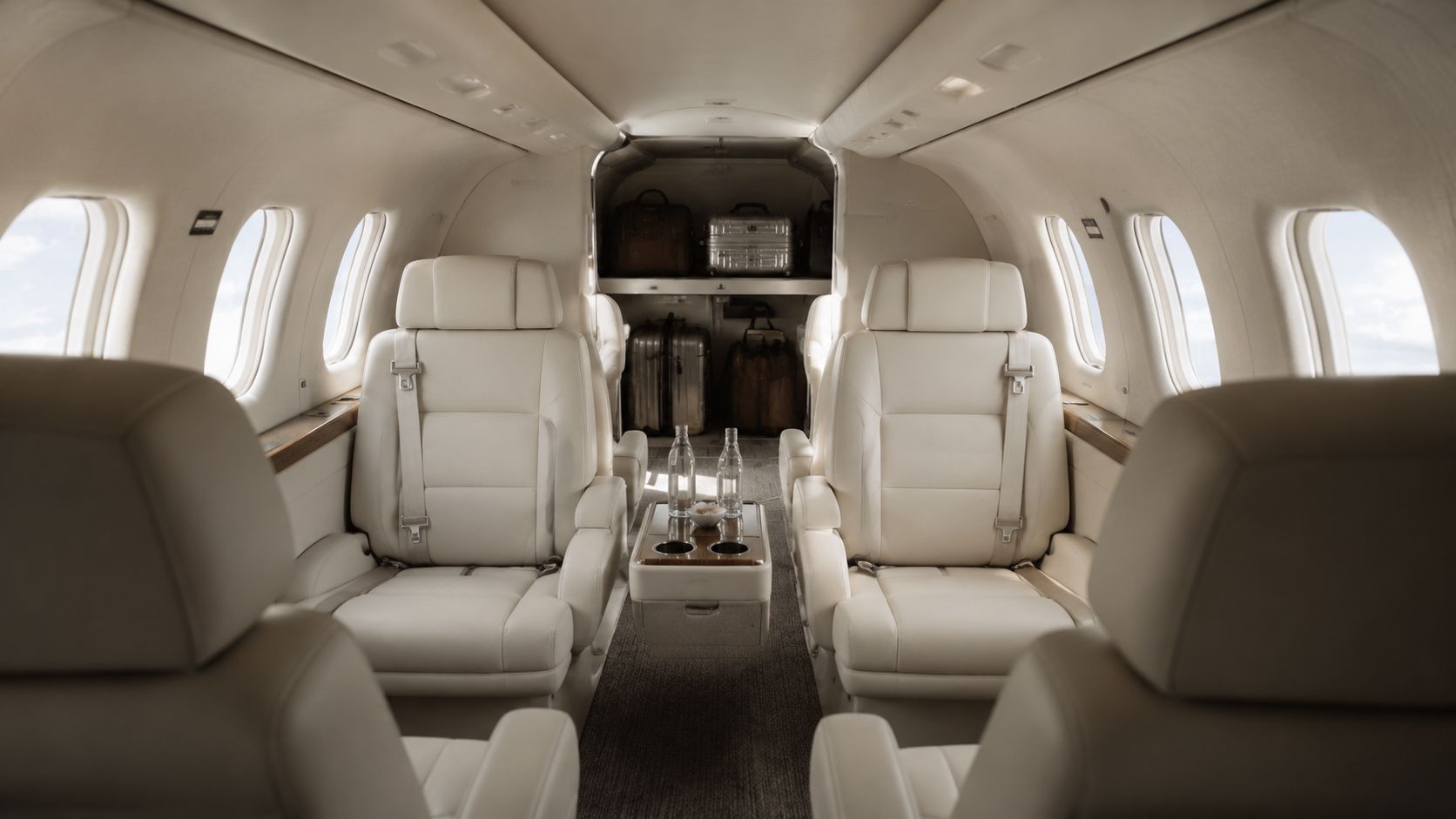
The cabin works best when you pack like a professional, not like a resort guest. The Eclipse 500 accommodates up to six passengers in a compact layout, usually one pilot and five guests, and the limited bay space means baggage planning matters more than it does on larger jets (Blade Eclipse 500 cabin description). If you travel with oversized suitcases, sports equipment, or several hard-shell bags, you need to clear that up before departure day.
Pack for the cabin, not for the destination fantasy
Use soft-sided bags whenever possible. They fit the aircraft better, move faster on the ramp, and reduce the chance that a bag has to be left behind or split between compartments. Keep valuables, medications, and anything you'll need in flight in a smaller personal item, because the cabin is compact and access should stay simple.
Before you confirm the booking, ask three things. First, whether the exact tail has enough room for your bags. Second, whether the operator can confirm catering and any refreshment requests in advance. Third, whether the cabin setup matches your needs, especially if you want a more social seating arrangement instead of a basic transport layout.
For pet travel, don't assume a small jet makes the rules easier. If you're flying with a dog to the islands, use a practical checklist like the one in Hawaii pet travel requirements before you commit to the itinerary. That kind of homework prevents avoidable airport surprises.
If your trip depends on extra luggage, careful catering, or a pet, verify every detail before the aircraft is assigned. The Eclipse 500 is efficient, but it rewards disciplined planning.
Comparing Similar Light Jets
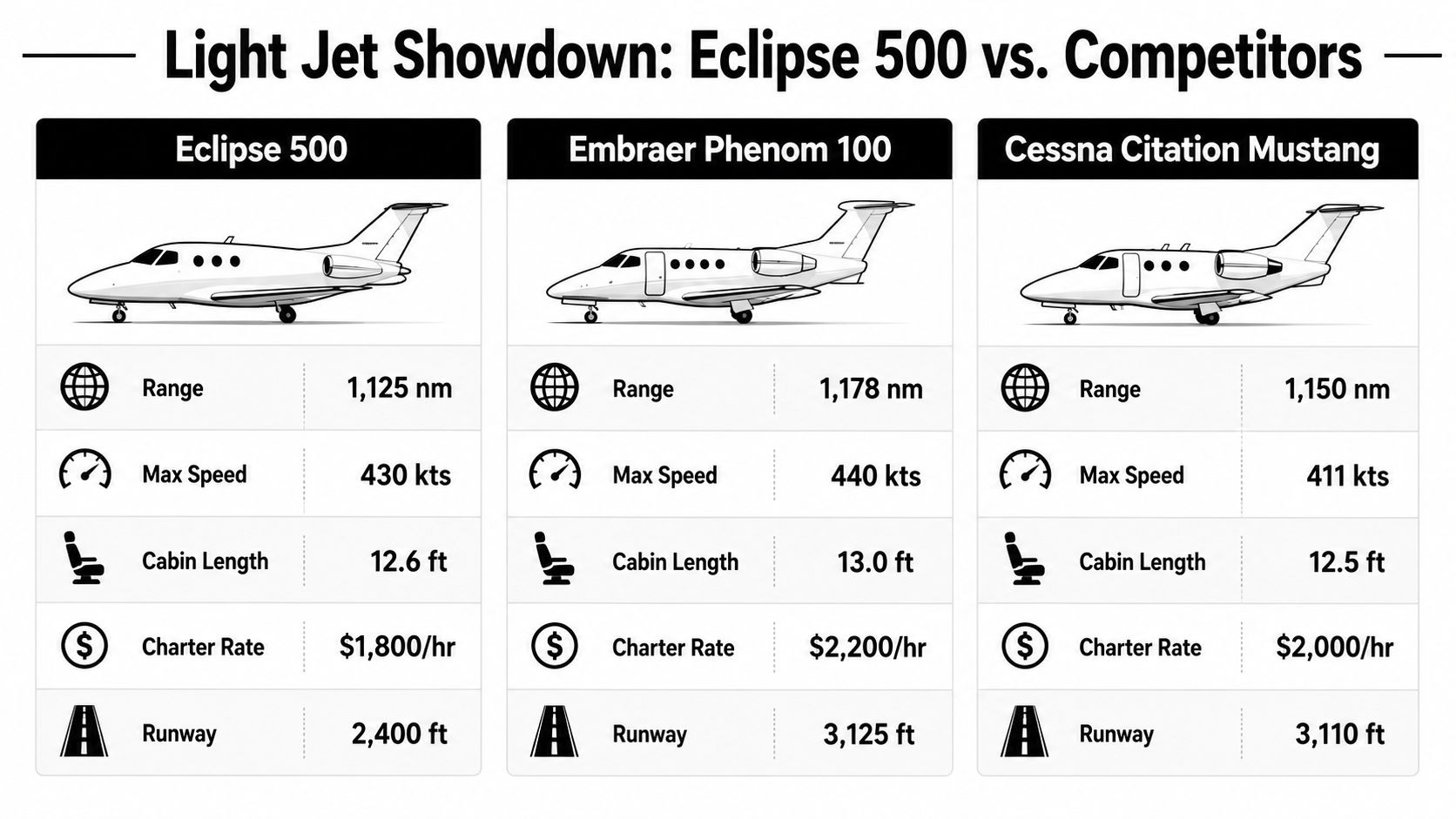
The Eclipse 500 belongs in the same conversation as the Embraer Phenom 100 and Cessna Citation Mustang, but the missions aren't identical. The Eclipse is the leanest of the three in feel, and that can be an advantage when the trip is short and the airport is tight. The others typically give you a little more cabin room, which matters if you care more about comfort than airport flexibility.
Where the Eclipse 500 wins
The Eclipse 500's advantage is simple. It was built to get you into and out of smaller airports with less fuss, and its short-field numbers are part of that story. If the route is efficient and the passenger count is modest, it can be the more economical choice because you're not paying for extra cabin you won't use.
Where the others may be better
The Phenom 100 and Citation Mustang are often better fits when passengers want a bit more breathing room or when the mission leans toward a more conventional light-jet feel. I'd also look harder at them if the itinerary includes more baggage, longer time on board, or a client who dislikes compact cabins. The right jet is the one that matches the trip, not the one with the most compelling headline.
For a market-wide view of longer-range very light jets, use this light-jet range comparison as a reference point. That keeps the decision grounded in actual mission fit instead of brand familiarity.
The right conclusion is not that the Eclipse 500 beats every competitor. It doesn't. The answer is that it can be the best-value aircraft when the route is short, the airport is constrained, and you want private aviation without paying for excess cabin.
Operator Ratings and Booking Tips
If you're booking an Eclipse 500, I'd only use operators with Wyvern Wingman or ARGUS Gold/Platinum credentials. Those ratings don't guarantee perfection, but they do tell you the operator has passed a higher safety and standards bar than the average ad hoc charter source. On a niche aircraft, that matters even more because support quality and maintenance discipline can vary widely.
The smarter booking process is straightforward. Choose the exact tail if possible, confirm the baggage plan before you approve the trip, and get the preflight details well before departure so there are no surprises at the terminal. I'd also insist on knowing whether the aircraft is positioned locally, because sourcing near the departure city helps avoid the kind of repositioning cost that inflates a quote for no good reason.
Best practice: ask for the tail number, cabin configuration, and confirmation of the operator's safety rating before you sign off on the flight.
That approach is how discerning clients avoid paying retail pricing for a jet that should have been sourced more efficiently. If you're comparing options for the Eclipse 500 jet, the winning move is not chasing the lowest advertised hourly rate. It's matching the right aircraft, the right operator, and the right departure location so the whole trip prices cleanly.
If you want a cleaner way to charter the Eclipse 500 jet without the usual markup games, Haute Jets sources from vetted operators and focuses on the exact aircraft that fits your route. That means fewer surprises, tighter pricing discipline, and better control over the details that matter, especially on a niche aircraft like this. Reach out before your next short-haul trip, and book the jet that fits the mission.