
You’re probably looking at an empty leg listing right now and thinking the same thing most first-time charter clients think: Is this real, and what’s the catch?
The deal looks absurd. A private jet route that usually sits in full-charter territory suddenly shows up at a steep discount. For a flexible traveler, that can be a legitimate opportunity. For a time-sensitive traveler, it can also become an expensive distraction.
Empty leg flights deserve the attention they get. The category isn’t fringe. The global empty leg flight market was valued at $1.2 billion in 2024 and is projected to reach $3.7 billion by 2033, with a 13.2% CAGR, while domestic flights accounted for 62% of the market in 2024, according to Market Intelo’s empty leg flight market report. Demand is growing because the value proposition is obvious. You can access private aviation without paying standard charter pricing.
But smart buyers don’t stop at the discount headline. They ask better questions. Who controls the schedule? What happens if the original trip changes? What fees show up after the quote? And, is an empty leg the right tool for this specific trip?
The Allure of the Almost-Free Private Jet
An empty leg flight is private aviation’s open secret. The aircraft has to move anyway, and the operator would rather recover some revenue than fly the route without passengers.

That’s why these offers can look so compelling. You’re not buying a custom charter built around your needs. You’re buying spare inventory attached to someone else’s movement of an aircraft.
Why the offer feels so attractive
Private flyers value three things above almost everything else:
- Time saved: No airline lines, no crowded terminals, no wasted connections.
- Control: Better airports, direct routings, customized cabin experience.
- Privacy: You decide who’s on board.
Empty leg flights can deliver all three. The aircraft is still private. The crew is still operating a private mission. The airport experience is still private aviation. The difference is that you didn’t create the schedule.
Empty legs are compelling when your plans can adapt to the aircraft, not when the aircraft must adapt to you.
That distinction matters more than most listings admit.
What you should assume before booking
If you’re new to charter, use this rule: treat an empty leg like a tactical buy, not a transportation plan you can’t afford to lose. If you need to make a board meeting, a wedding, a closing, a yacht departure, or a medical appointment, don’t build the trip around an empty leg.
Use one when the route already works, the timing is acceptable, and a backup plan won’t ruin your day.
That’s the right mindset. Empty leg flights can be an excellent buy. They can also be the wrong product for clients who need certainty.
How Empty Leg Flights Actually Work
Think of an empty leg like a chauffeured car that drops off a paying client in one city and then has to drive back empty to pick up the next assignment. The car still has fuel, labor, and operating costs on that return. A jet operator faces the same problem, just at a much higher cost base.
Empty leg flights, also called dead-heads, account for 30% to 50% of private jet charter fleet operations, and operators may discount them by up to 75% to recover costs tied to fuel and crew, according to Air Charter Service’s guide to empty legs.
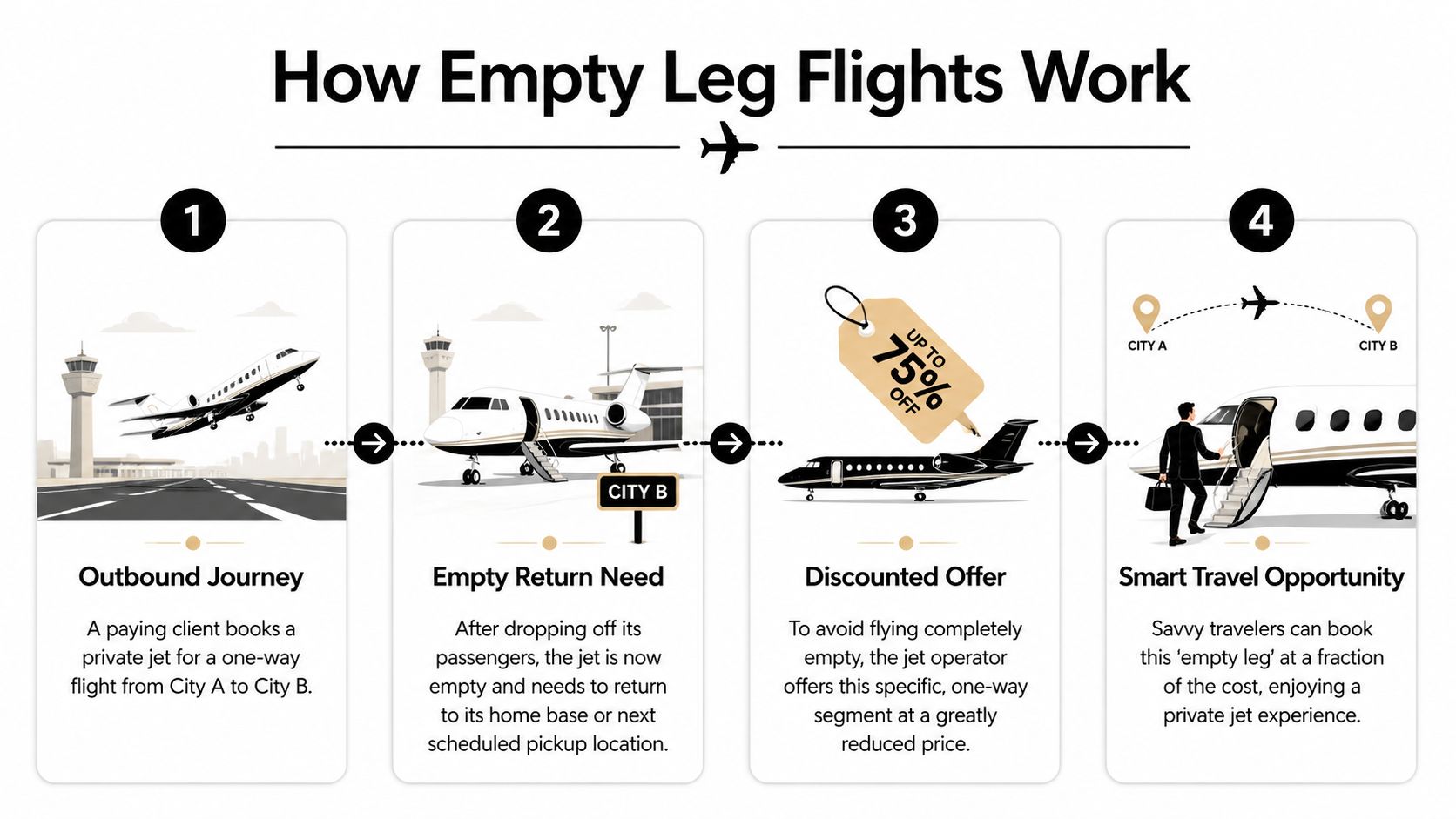
The three main reasons empty legs exist
One-way charter completion
This is the most common setup. A client books a one-way flight, and once the passengers are dropped off, the aircraft must reposition to its home base or next assignment. That repositioning segment becomes sellable inventory.
Maintenance movement
Aircraft also move without passengers for scheduled maintenance or post-maintenance positioning. When an operator needs the aircraft in a different city after service, that routing can produce an empty leg opportunity.
Fleet balancing
Operators constantly shuffle aircraft to meet future demand. If more bookings are likely in one market than another, they may reposition aircraft in advance. Those balancing flights can also be offered for sale.
Why operators discount them
The aircraft is flying anyway. Selling the segment at a lower rate is often better than producing zero revenue on the flight.
Here’s the practical logic:
- Fixed operating costs still apply. Crew, fuel, maintenance exposure, and insurance don’t disappear because the cabin is empty.
- A discounted seat doesn’t change the routing need. The operator already needs the plane in the next location.
- Any recovered revenue helps offset the movement. That’s why deals can be aggressive.
Practical rule: Empty leg pricing exists because the operator is minimizing loss on a required movement, not because private jets suddenly became cheap.
That’s why route, timing, and aircraft type feel random. They are. The inventory follows operational necessity, not consumer demand.
The Trade-Off Benefit Versus Risk
You spot a private jet itinerary that costs far less than a normal charter. The route is close enough. The cabin looks right. For a first-time buyer, that kind of deal feels smart.
Sometimes it is. Often it is only smart if your schedule can absorb failure.
Empty legs are a tactic, not a travel strategy. Use them when the discount is real and the consequence of disruption is low. Avoid them for weddings, investor meetings, cruise departures, major events, and any trip where timing matters more than price.
Where empty legs actually work
The right buyer is flexible, practical, and willing to treat the flight as opportunistic inventory rather than a guaranteed plan.
- Leisure travelers with schedule flexibility: If you can shift departure time, use a nearby airport, and tolerate changes, an empty leg can be a strong value.
- Small groups sharing one cabin: The economics can compare well with buying multiple premium commercial seats, especially on shorter regional trips.
- First-time private flyers testing the market: Empty legs can give you a useful introduction to private aviation before you pay full on-demand charter rates.
That is the upside. The risk sits underneath it.
The risk most first-time buyers underestimate
Control is the issue.
Your trip does not drive the aircraft movement. Another client’s itinerary does. If that primary trip changes, your flight can move or disappear. If you show up late, the operator is far less likely to accommodate you than on a standard charter. Schedule discipline is tighter because the aircraft still has to meet its next assignment, crew limits, and airport operating constraints, as explained in The Points Guy’s analysis of private jet empty legs.
That creates three recurring problems.
Fixed route and fixed timing
You are buying what already exists. You are not designing a trip around your preferences.
A nearby airport instead of your preferred airport may sound minor until it adds a long ground transfer, traffic risk, and more expense. The same goes for departure time. A discounted flight at the wrong hour can become a poor deal once it starts disrupting the rest of your day.
Cancellation exposure
This is the structural weakness of every empty leg.
If the original charter client cancels, reroutes, or departs on a different schedule, your booking may vanish with little notice. That is not bad service. It is how the product works. The operator is servicing the primary revenue flight first.
One-way savings can create round-trip pain
A cheap outbound can tempt buyers into an expensive return.
That is where many empty leg bookings lose their shine. You save on one segment, then pay full charter pricing to get home, accept a commercial return that undercuts the private experience, or spend hours rebuilding the trip. If you want a reliable door-to-door plan, on-demand charter is usually the better decision because you control the schedule, airports, and aircraft selection from the start.
That is the practical difference. Empty legs reward flexibility. On-demand charter rewards planning.
For clients who value certainty, that distinction matters more than a headline discount. Haute Jets’ on-demand model is stronger for business travel, family travel, and any itinerary with fixed commitments because it gives you transparent options built around your trip, not leftover aircraft movement. If you want a better framework for evaluating these listings before you commit, read Haute Jets’ guide to booking empty leg flights.
If the trip matters, buy reliability first and treat discounts as secondary.
That is the right standard. Empty legs can deliver excellent value, but only when you are buying with clear eyes and a backup plan.
How to Find and Book Empty Leg Flights
The common approach to searching for empty legs is flawed. Individuals browse casually, compare headline prices, and assume availability will hold while they think it over. That’s not how this market works.

The right approach is fast, organized, and realistic.
Where to look first
Use multiple channels at the same time. Relying on one app or one broker narrows your odds.
- Marketplace platforms: These aggregate available repositioning segments and make it easy to scan routes quickly.
- Broker alerts: Ask to be added to empty leg notifications. Good brokers will send route alerts when inventory matches your geography.
- Direct operator lists: Many operators publish available empty legs on their own sites or through client email lists.
- Journal resources and route explainers: If you need a practical starting point, Haute Jets Journal’s insider guide to booking empty leg flights is a useful reference for how buyers approach these listings.
How to improve your odds
Success usually comes down to preparation, not luck.
Move fast on fit, not fantasy
If the route, date, aircraft size, and airport pair work, be ready to commit. Good empty legs don’t wait around while you debate whether a better one might appear.
Stay flexible on airports
A nearby alternate airport can make the difference. Clients who insist on one exact departure field often miss otherwise workable opportunities.
Have passenger details ready
Operators need names, baggage expectations, pet details if relevant, and any special handling requirements. Slow paperwork loses flights.
After you’ve narrowed a flight, watch this before you commit to the booking style.
Questions to ask before paying
Don’t stop at the advertised number. Ask these directly:
- Is the quote all-in, or are taxes and handling separate?
- What happens if the primary charter changes?
- How late can passenger details be updated?
- Is catering included, basic, or additional?
- Are pets allowed on this specific aircraft and operator?
Book empty legs only when you’re comfortable with the answer to the cancellation question.
That one answer tells you whether you’re buying a value opportunity or setting yourself up for a problem.
Sample Empty Leg Pricing and Routes
A client sees a one-way private jet listing and assumes the savings make the decision easy. The smarter move is to price the whole trip, then decide whether the discount is still worth the limits.
Use empty leg pricing as a tactical comparison, not a headline bargain. Earlier examples in this article showed that discounts can be substantial, especially on repositioning routes that would otherwise fly empty. The catch is simple. Empty leg inventory appears where the operator needs to move the aircraft, not where you would ideally schedule your trip.
Empty Leg vs Standard Charter Pricing 2026 Estimates
| Route | Aircraft Type | Est. Standard Charter Price | Est. Empty Leg Price |
|---|---|---|---|
| Cross-country repositioning flight | Heavy jet | Around $30,000 | Around $10,000 |
| Domestic high-traffic route | Light jet | Varies by operator, date, and airport pair | Lower than standard charter when matching inventory is available |
These examples are useful, but only if you read them correctly.
A heavy jet empty leg at roughly one-third of the standard charter price can be excellent value for a one-way trip that already fits your schedule. A light jet deal on a busy domestic route can also work well if you are flexible on departure airport and timing. If either flight forces you to buy a separate return, add long ground transfers, or accept schedule risk you cannot absorb, the savings disappear fast.
That is the right way to compare options. Start with mission fit, then price.
If you need a clean benchmark for a trip built around your schedule, aircraft preference, and airport pair, review Haute Jets charter pricing options. That gives you a better baseline than a discounted repositioning segment when you are judging total trip value instead of chasing a low one-way number.
The Haute Jets Advantage Beyond Empty Legs
Empty legs are a tactic. They are not a complete travel strategy.
If you charter often, the primary objective isn’t finding random discounted inventory. It’s controlling aircraft selection, departure timing, routing, and total price without getting trapped by unnecessary repositioning costs or vague fee structures.
The pricing problem most clients discover too late
A major weakness in the empty leg market is transparency. An advertised $9,000 empty leg can carry $2,000 to $3,000 in additional taxes, fuel surcharges, and fees, which cuts into the headline savings, according to evoJets’ discussion of hidden empty leg costs.
That matters because many new charter clients compare the top-line empty leg number to a standard charter quote and assume they’ve found a dramatic bargain. Sometimes they have. Sometimes they’ve only found a partial quote.
What a stronger buying model looks like
For clients who need reliability, I recommend a simple standard:
- Choose the exact aircraft you want
- Set the departure date and time around your schedule
- See the full price structure clearly
- Avoid prepaid programs unless they solve a real usage pattern
- Work with rated operators only
One factual option in that category is Haute Jets membership information, which also explains that their model is built around pay-per-flight access rather than requiring a traditional membership or jet card commitment. According to the publisher’s company information, Haute Jets sources from 3,500+ owner-operators across 175 countries, focuses on locally sourced aircraft to reduce unnecessary repositioning, and works with Wyvern or Argus-rated operators.
My recommendation
Use empty leg flights when the trip is optional, timing is flexible, and you’re comfortable losing the flight.
Use on-demand charter when the trip matters.
That’s the clean dividing line. If the travel outcome is more important than the discount, control beats opportunism every time.
Frequently Asked Questions About Empty Legs
What happens if my empty leg flight is canceled
Usually, the underlying paid charter changed or disappeared. That can eliminate the repositioning need entirely. Before booking, ask what refund or rebooking support applies and decide in advance what your backup plan is. If missing the trip would hurt, book a standard charter instead.
Can I book a round trip using two empty legs
You can, but don’t plan on it. Empty legs are one-way opportunities created by aircraft movement, not round-trip products. Sometimes two workable listings line up. Often they don’t.
Are pets allowed on empty leg flights
Often yes, but it depends on the specific operator and aircraft. Pet policy isn’t universal across private aviation. Confirm approval before payment, and ask about crate expectations, cleaning charges, and any breed or size restrictions.
Can I request specific catering
Sometimes, but don’t assume full customization. Empty leg flights usually support lighter service and tighter timelines than a fully planned charter. If catering matters, ask what’s included and what can still be added before the operator locks the flight details.
Can I choose a different departure time
No. The whole point of the flight is repositioning the aircraft on a fixed schedule. If you need schedule control, you need an on-demand charter.
Are empty leg flights good for business travel
Only when the meeting can absorb disruption. If the trip is discretionary or lightly scheduled, they can work. If the trip has real consequences attached to arrival time, don’t use an empty leg as the backbone of the itinerary.
Should first-time private flyers book one
Yes, if they understand what they’re buying. Empty legs are a smart introduction to private aviation for flexible travelers. They are a bad introduction if you assume they work like a normal charter.
If you want private aviation without the guesswork, explore Haute Jets for on-demand charter options, exact-aircraft selection, and a pay-per-flight model that fits travelers who value clear pricing and schedule control.