If you're sitting in a private jet and watching the flight display climb into the mid-40,000-foot range, the view can feel almost detached from ordinary air travel. The clouds are far below, commercial traffic may be operating at lower flight levels, and the aircraft seems to be moving through an unusually calm layer of sky. That experience raises a practical question: why do private jets fly higher than airliners?
The short answer is that business jets combine lower weight, strong power-to-weight ratios, high-altitude airframes, and pressurization systems designed for thin air. The more useful answer is that higher isn't automatically better. The ideal altitude depends on the aircraft, its weight, the weather, the route, and how much performance margin the crew wants to retain.
"Sitting Above the Weather at 47,000 Feet"
A traveler settles into a Gulfstream G650, checks the cabin display, and watches the altitude pass 47,000 feet. The cloud tops spread below like a white floor. Airline traffic remains farther down in established corridors, while the business jet climbs into air that commercial passengers rarely see. The view is striking, but the altitude has a practical purpose.
Private jets typically cruise between 41,000 and 45,000 feet, while some certified aircraft can reach 51,000 feet, according to an aviation explanation of private jet cruising altitudes. Commercial jets typically cruise between 31,000 and 42,000 feet, as summarized in this aircraft altitude comparison. These ranges overlap, so “private jets fly higher” describes a capability and operating pattern, not a rule that applies to every flight.
At high altitude, the air is less dense. That creates a design challenge because wings need moving air to produce lift and engines need air to produce thrust. It also reduces aerodynamic resistance. A business jet with suitable wings, engines, flight controls, and pressurization can use this thinner air for an efficient cruise, while a heavier airliner may have fewer practical options at the same level.
Altitude changes the aircraft's surroundings much like moving from deep water into a lighter current. Dense air pushes harder against the aircraft. Thin air offers less resistance, but gives the wings and engines less to work with. The aircraft must therefore maintain the right speed and angle of attack, while its systems preserve lift, thrust, cabin pressure, and control authority.
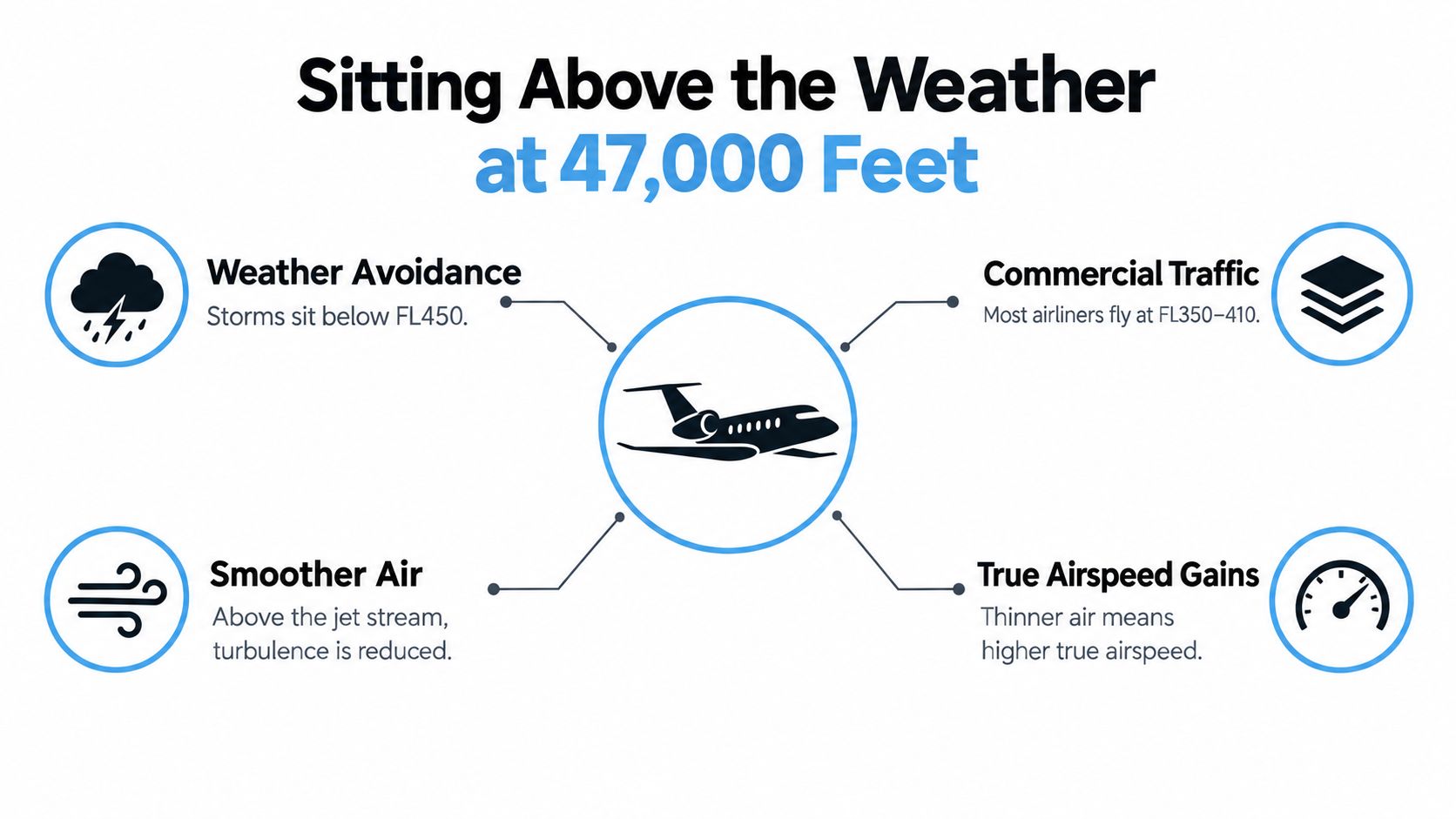
The engineering ceiling is the highest level the aircraft can safely achieve under defined conditions. The practical ceiling is lower when weight, temperature, route length, or required performance margin limits the climb. A suitable cruise level can place the jet above much of the weather, reduce exposure to busy airline corridors, and balance speed with fuel flow. Higher stops helping when thinner air leaves too little engine or climb performance, or when the route is too short to repay the climb.
The practical meaning of “higher” is access to a more favorable operating layer while preserving a useful safety and performance margin.
How Thinner Air Reduces Drag and Saves Fuel
At cruise altitude, a business jet is like a cyclist riding on a smooth, open road instead of pushing through a crowd. The aircraft still needs power, lift, and careful control, but the surrounding air offers less resistance. That difference helps explain why climbing can improve efficiency, up to the point where the climb and thin-air penalties outweigh the gain.
Aircraft designers separate aerodynamic resistance into several forms. Parasite drag comes from the fuselage, wings, antennas, landing-gear doors, and other surfaces moving through the air. Induced drag is linked to producing lift. At lower speeds, the wings must work harder to support the aircraft, which can increase induced drag. At higher speeds, parasite drag becomes the larger concern.
The aircraft therefore has a useful middle range. Pilots and flight planners choose a speed and altitude where the wings can generate the required lift, while the engines provide forward motion without spending excessive thrust on resistance. The best level is an operating compromise, rather than just the highest altitude the aircraft can reach.
The drag advantage
Air density falls as altitude increases. The jet still has to create lift, so it must maintain an appropriate true airspeed and angle of attack. Yet, under a comparable cruise condition, thinner air produces less parasitic resistance.
Simple Flying's technical overview of private jet altitude performance estimates that drag can be 20–30% lower above 40,000 feet than at FL350. That figure describes drag, not total trip fuel. The aircraft must still climb, carry its payload, account for wind, and descend. The saving applies mainly to the cruise portion, where lower drag can reduce the thrust needed to maintain the desired speed.
A Science Insights analysis of high-altitude private jet flight notes that some business jets operating around FL450 may burn 10–15% less fuel per nautical mile than at lower cruise levels. The comparison depends on the aircraft, weight, route, and conditions, so it describes a potential cruise advantage rather than a promise for every charter. The same high-altitude setting can also place the jet above much of the weather, although pilots still plan around storms and changing conditions.
True airspeed creates the apparent paradox
A traveler may see a lower indicated airspeed at altitude and wonder how the aircraft can still cover ground quickly. True airspeed and indicated airspeed describe different things. Indicated airspeed reflects the pressure measured by the aircraft's pitot system. In thinner air, that pressure can be lower even while the jet moves rapidly through the atmosphere.
That is the practical value of high-altitude cruise. The aircraft uses a speed and flight level where reduced drag improves fuel flow without sacrificing its performance margin. As altitude rises further, the air becomes harder for the engines and wings to use, and the benefit eventually narrows. Higher helps only while the cruise saving exceeds the cost of reaching and maintaining that level.
Why Business Jet Engines and Airframes Are Built for Altitude
A private jet approaching a high flight level is relying on more than engine power. The engines, wings, fuselage, fuel system, pressurization system, and flight controls must operate together as the air becomes thinner. Each system contributes to the aircraft's engineering ceiling, while weight, weather, and traffic determine its practical ceiling on a particular flight.
Mass gives business jets an advantage. They generally carry fewer people and less total weight than large airliners, so they often have a stronger power-to-weight ratio. That helps the aircraft climb and retain performance at altitude. As fuel is used and the aircraft becomes lighter, the crew may be able to request a higher level, provided weather and air traffic control allow it.
The airframe has to preserve lift
A wing produces lift by moving through air. At high altitude, the air is less dense, so the wing must be designed to produce enough lift without creating unnecessary drag. Designers balance wing area, aspect ratio, sweep, and the aircraft's overall cruise shape. The result should support stable, efficient flight at the speeds the aircraft is built to maintain.
The fuselage has another demanding job. It must withstand repeated pressurization cycles because the cabin is kept at a higher pressure than the surrounding atmosphere. Structural strength therefore affects the aircraft's service life as well as its altitude capability. A high ceiling is useful only when the airframe can support it safely and repeatedly for passengers and crew.
Engine performance narrows the limits further. A turbofan must continue producing sufficient thrust as each kilogram of outside air contains less oxygen. Aircraft such as the Gulfstream G650, Dassault Falcon 8X, Bombardier Global 7500, and Cessna Citation Longitude are associated with high-altitude operations, although their actual capability depends on configuration, weight, temperature, and operating conditions.
| Aircraft | Altitude Role | Wing Design Consideration |
|---|---|---|
| Gulfstream G650 | Certified for very high-altitude cruise | High-altitude cruise airframe |
| Bombardier Global 7500 | Certified for very high-altitude cruise | High-altitude cruise airframe |
| Dassault Falcon 8X | High-altitude business jet operation | Designed for business jet cruise performance |
| Cessna Citation Longitude | High-altitude business jet operation | Designed for business jet cruise performance |
The G650 and Global 7500 can operate at higher certified levels than the typical cruise range used by commercial jets. That difference reflects design capability, not a promise that every flight will climb to the aircraft's ceiling. A dispatcher and crew still weigh fuel, payload, temperature, route length, turbulence, and available airways.
For travelers comparing altitude with cruise speed, this private jet speed comparison provides useful context. Speed, range, and altitude are connected through the same design trade-offs. The jet with the highest ceiling is not automatically the best choice for every route. In practice, the useful altitude is the level where the aircraft's performance, fuel plan, and passenger needs align.
Cabin Pressure and the Science of Comfort Up High
At cruise altitude, a private jet can be flying through air too thin for passengers to breathe comfortably, while the cabin feels closer to a moderate mountain elevation. The aircraft's outside altitude and cabin altitude are different measurements because the fuselage holds compressed air.
A useful comparison is a sealed room inside a much thinner atmosphere. The environmental control system continually supplies conditioned air, and outflow valves release enough air to hold the selected pressure. Together, they create a pressure schedule that balances passenger comfort, oxygen availability, structural loads, and the aircraft's operating limits.
Consider a Gulfstream G650. Its maximum differential pressure can reach 10.7 psi, compared with about 8 psi for a typical airliner, according to Aerospace Global News' explanation of business jet pressurization. Differential pressure means the difference between the pressure inside the cabin and the pressure outside the aircraft.
The larger the pressure difference an airframe can safely sustain, the more effectively it can keep the cabin at a lower equivalent altitude while the aircraft climbs. For jets operating around FL450 to FL510, cabin altitude may remain roughly 4,500 to 6,000 feet, depending on the aircraft and conditions, as described in the same pressurization discussion.
What passengers notice
Passengers are not breathing oxygen pumped directly into the cabin. They are breathing conditioned air managed by the aircraft's environmental control system. A separate guide to private jet cabin air and ventilation explains how that air is supplied and circulated.
Lower cabin altitude can make a long flight feel less tiring for some travelers. It does not remove every cause of fatigue, and passengers may respond differently. Pressure is only one part of the experience. Air movement and ride quality matter too, and this overview of atmospheric turbulence and business aviation provides broader context for those conditions.
The airframe carries a structural cost for this comfort. Each pressurization cycle loads the fuselage, so engineers must account for repeated pressure changes in both the structure and the maintenance program. High-altitude capability therefore depends on more than engine power. The aircraft also needs a pressure vessel that can protect passengers throughout cruise.
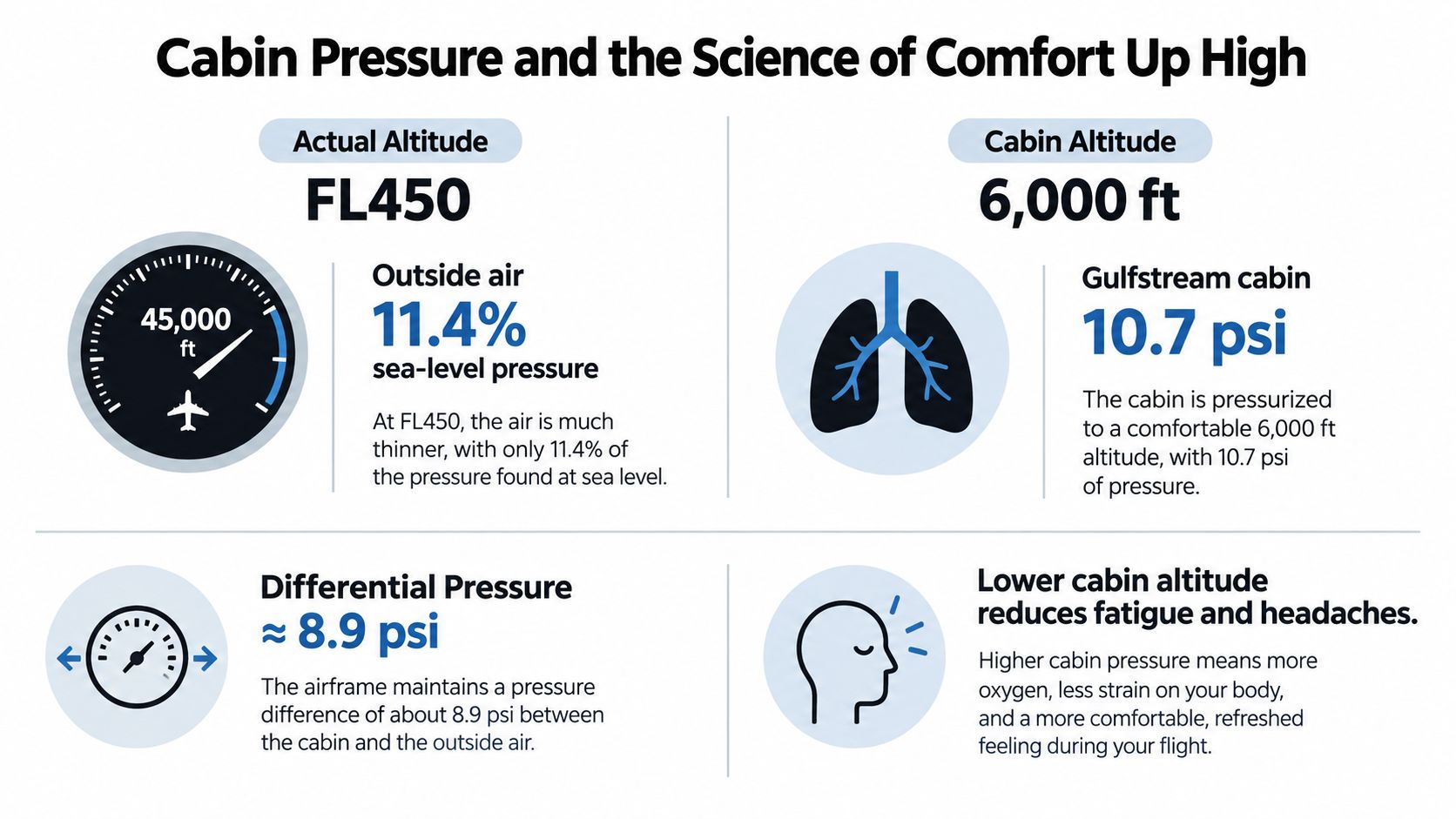
The practical rule is simple: passengers experience a controlled cabin environment, not the raw pressure of the surrounding atmosphere. Higher flight levels help only when the aircraft's pressure system, structure, and operating limits can preserve that advantage.
Comparing Private Jets and Airliners Side by Side
A business jet and an airliner can use the same atmosphere in very different ways. The private jet is closer to a light, high-performance climber, while the airliner is built to carry a much larger payload efficiently. That difference affects the aircraft's wing loading, climb rate, engine performance, cabin structure, and useful cruise altitude.
The Gulfstream G650 and Bombardier Global 7500 represent the upper end of business-jet capability, with a maximum cruise altitude of up to 51,000 feet. Commercial aircraft generally operate within a lower 31,000 to 42,000-foot band. The figures are useful for orientation, but they describe the aircraft's certified or typical limits, not the altitude selected on every flight.
| Aircraft | Maximum or typical cruise altitude | Cabin pressure differential |
|---|---|---|
| Gulfstream G650 | Up to 51,000 feet | Up to 10.7 psi |
| Bombardier Global 7500 | Up to 51,000 feet | About 9.5 psi |
| Boeing 737 | Typically within the commercial range | About 8 psi |
| Airbus A320 | Typically within the commercial range | About 8 psi |
| Boeing 787 | Typically within the commercial range | About 8 psi |
The table makes the comparison clearer. A private jet can be certified for a higher ceiling and may maintain a lower cabin altitude through a greater pressure differential. An airliner's pressure system still provides a controlled cabin, but its design must serve a larger fuselage, more seats, heavier payloads, and established airline schedules.
Maximum certified altitude isn't the same as normal cruise altitude. A jet may have the structural and engine capability to fly high, yet remain lower because of its weight, fuel load, temperature, winds, traffic restrictions, or route requirements. The practical ceiling is the altitude at which the aircraft can climb, cruise, and descend with useful margins while meeting the flight's operational goals.
A simple rule helps: the smaller and lighter aircraft gains more from climbing above dense air, especially on a long, lightly loaded mission. The airliner gives up some altitude flexibility in exchange for carrying many passengers and cargo efficiently. Higher flight is therefore an advantage, not a guarantee. It pays off only when the aircraft's engineering ceiling and the flight's practical conditions allow the climb to produce a real benefit.
Air Traffic Control and Weather Avoidance at Altitude
At cruise altitude, controllers organize aircraft by flight level, a shared reference based on pressure altitude. This system works like numbered shelves in the sky. It separates aircraft using the same airspace and helps ATC manage traffic without treating each aircraft as though it were at an identical height above the ground.
Airliners often follow established corridors and schedules. Business jets can use those routes, yet stronger climb performance may give them access to flight levels above some of the busiest airline traffic. The crew can request a different level when winds, weather, route design, or surrounding traffic makes a change useful. ATC must approve it, and the request may be delayed or refused if the airspace is busy.
Weather avoidance is an operational advantage
A higher cruise level can place an aircraft above many cloud layers and lower weather systems. One aviation analysis states that business jets at FL450 may fly above 90% of weather and use 10–15% less fuel per nautical mile than at lower cruise levels, as described in this high-altitude private jet analysis.
That advantage has limits. Thunderstorms can grow to high altitudes, and a crew will not climb over a hazardous cell. Weather radar, forecasts, dispatch information, pilot reports, and ATC coordination all help the crew choose a route that protects safety and cabin comfort. Weather planning shapes the itinerary from the start, as explained in this guide to how weather impacts private jet travel.
A private flight may have more room to request a climb, descent, or sideways deviation than an airline flight operating inside a tightly scheduled network. The aircraft still needs clearance, and traffic capacity can determine whether the preferred option is available.
Smooth air has a qualification
Higher altitude does not guarantee a smooth ride. Clear-air turbulence can develop near the tropopause, where strong winds and wind shear concentrate energy. The aviation discussion of atmospheric turbulence explains why an upper cruise level may avoid some rough air while still exposing the aircraft to turbulence near high-altitude wind boundaries.
A higher ceiling gives the crew more choices. It does not remove the need to make those choices.
That flexibility is the practical benefit. A high-performance business jet may move above a traffic layer, around a weather area, or into a more favorable wind band. The final altitude remains a flight-planning decision shaped by conditions, not a setting selected by the passenger after departure.
When Flying Higher Stops Helping
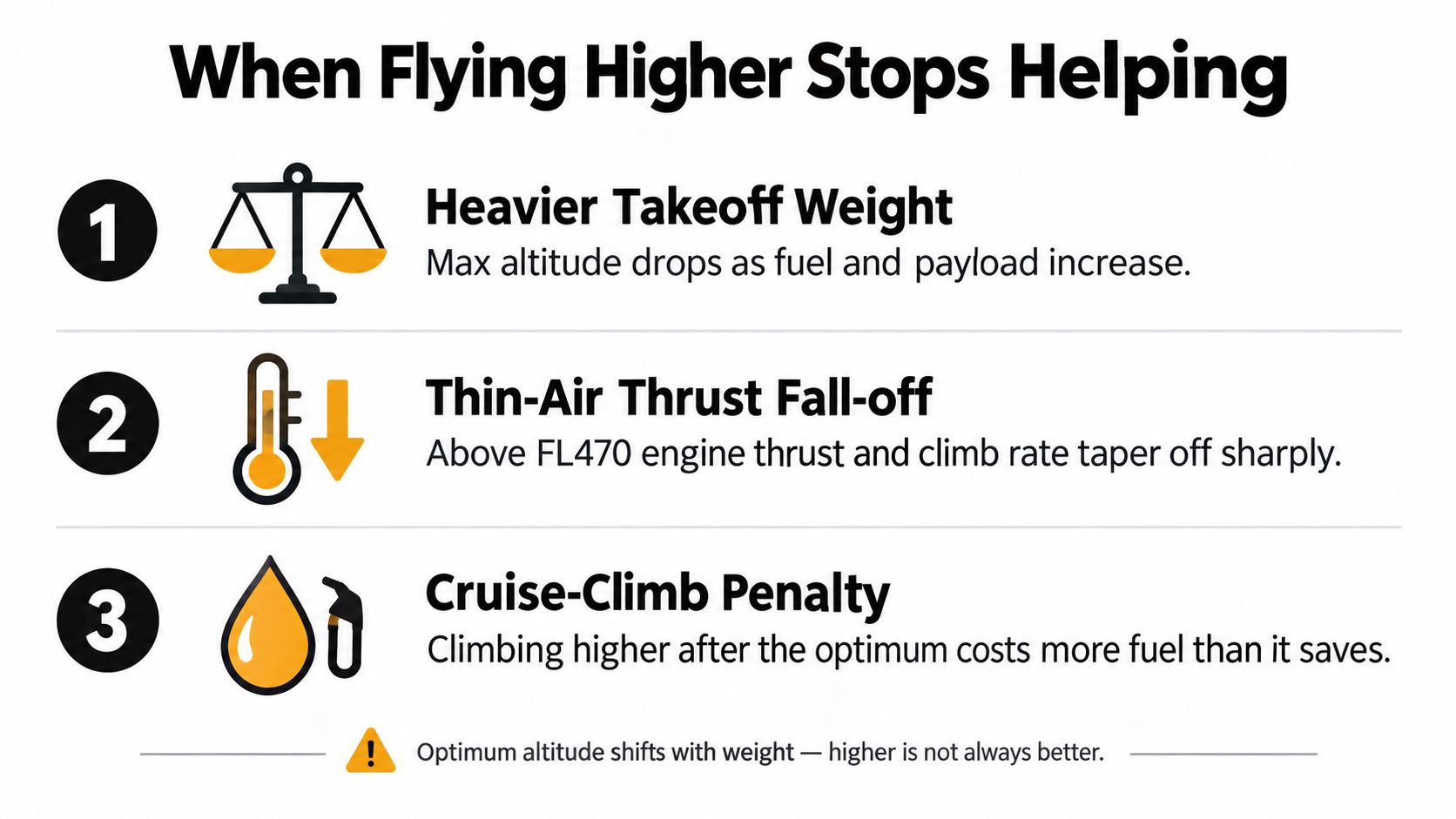
The phrase “private jets fly higher” can create the wrong mental model. The aircraft doesn't climb as high as possible and stay there. The optimum altitude changes with weight, temperature, route length, winds, and ATC restrictions.
A fully loaded Gulfstream G550 on a 400-nautical-mile leg may not benefit from immediately pursuing the same altitude used on a long transcontinental mission. The short route gives the crew less cruise time in which to recover the fuel and time spent climbing. A G550 carrying half the payload on a 3,000-nautical-mile mission has a different problem. The longer cruise segment can make a higher level more useful, while fuel burn gradually reduces weight and may permit step climbs.
These examples use route and payload to illustrate the decision, not to promise a fixed altitude. The crew and flight planner still evaluate the actual aircraft, weather, runway, fuel load, and operating limitations.
Three reasons the ceiling moves
Weight reduces climb performance. Fuel and passengers add mass. A heavier aircraft needs more lift and may have less excess thrust available for climbing. As the flight progresses and fuel burns, the crew may gain access to higher flight levels.
Temperature changes the result. Warm air reduces density. On a hot day, the engine and wing may have less performance margin at an extreme cruise level, so the best altitude can be lower than the aircraft's advertised ceiling.
Short routes punish unnecessary climbs. A climb takes time and fuel, followed by a descent. If the aircraft spends only a brief period at the higher level, the cruise benefit may not offset the climb and descent profile.
Cost index also affects the choice. A crew balancing time and fuel may select a different speed and altitude from one optimized only for minimum fuel. ATC may impose another limitation, and winds can make a lower level more attractive than a higher one.
The useful rule of thumb is that optimum altitude generally rises with trip distance and falls as weight and temperature increase. A service ceiling tells you what the aircraft may be certified to reach. It doesn't tell you what the crew will choose for your specific flight.
What Altitude Means for Your Next Charter Flight
A charter quote may show a proposed flight level, but that figure is a planning target, not a guarantee. A quoted FL430 can change because of payload, fuel requirements, winds, turbulence, weather cells, aircraft performance, or ATC instructions.
The aircraft comparison matters too. A Gulfstream G700 operating around FL480 and a Challenger 350 operating around FL410 can provide different performance and cabin experiences, but the higher number alone doesn't decide which aircraft is right. The route length, passenger count, baggage, airport elevation, and weather may make the Challenger the more practical choice for one mission and the long-range Gulfstream the better fit for another.
Read the altitude information in context
Ask the operator whether the quoted altitude is an expected cruise level, a maximum capability, or a number taken from a generic aircraft specification. Then ask what assumptions support it.
| Question to Ask | What the Answer Reveals |
|---|---|
| What cruise altitude do you expect for this route? | Whether the figure is a realistic plan or a brochure maximum |
| How will passenger and baggage weight affect the profile? | Whether the aircraft may need a lower initial level or later step climb |
| What weather could change the altitude? | Whether turbulence, storms, or wind may alter the route |
| Can the aircraft climb higher as fuel burns? | Whether the crew expects a step-climb profile |
| What cabin altitude does this aircraft maintain? | How the exterior flight level may translate into passenger comfort |
| Which exact aircraft and configuration are being proposed? | Whether the quoted performance belongs to the aircraft you'll actually board |
If you're evaluating aviation as a career as well as a travel experience, a private jet pilot salary guide offers a separate look at the professionals who operate these aircraft. For charter customers, the more relevant question is how those pilots and dispatchers apply the aircraft's performance envelope to the specific itinerary.
Use altitude as one part of a broader checklist:
- Smoothness: Can the aircraft adjust levels to avoid suitable weather and turbulence?
- Fuel efficiency: Does the route provide enough cruise time to benefit from a higher level?
- Time en route: Will the aircraft's speed and climb profile support the schedule?
- Cabin comfort: What cabin altitude and pressure system does the model provide?
- Operational flexibility: Can the operator explain how payload, wind, and ATC may change the plan?
Altitude is valuable because it connects aerodynamics, engine performance, comfort, and routing flexibility. It isn't valuable just because the number is larger.
Haute Jets matches charter customers with specific aircraft based on route, passenger count, cabin requirements, and performance characteristics, including jets suited to different high-altitude operating profiles. Visit Haute Jets to compare on-demand charter options and ask which aircraft best fits your route, payload, weather concerns, and preferred cabin experience.