

A corporate executive has a board meeting in another city, a narrow travel window, and little interest in a crowded terminal. While checking last-minute options, they spot an empty-leg private jet flight at a surprisingly low fare. The immediate question is reasonable: how can a private aircraft be available at such a deep discount, and can the itinerary be trusted?
Empty leg flights can offer genuine value, but they aren't ordinary tickets with a cheaper price. The route, aircraft, departure time, and availability are tied to another charter's operating requirements. This guide explains the mechanics behind empty leg flights private jet travelers often see, how operators price them, where listings appear, and how to decide whether the flexibility is worth the risk. For a broader introduction, see this guide to what an empty leg flight is.
Introduction to Empty Leg Flights Private Jet
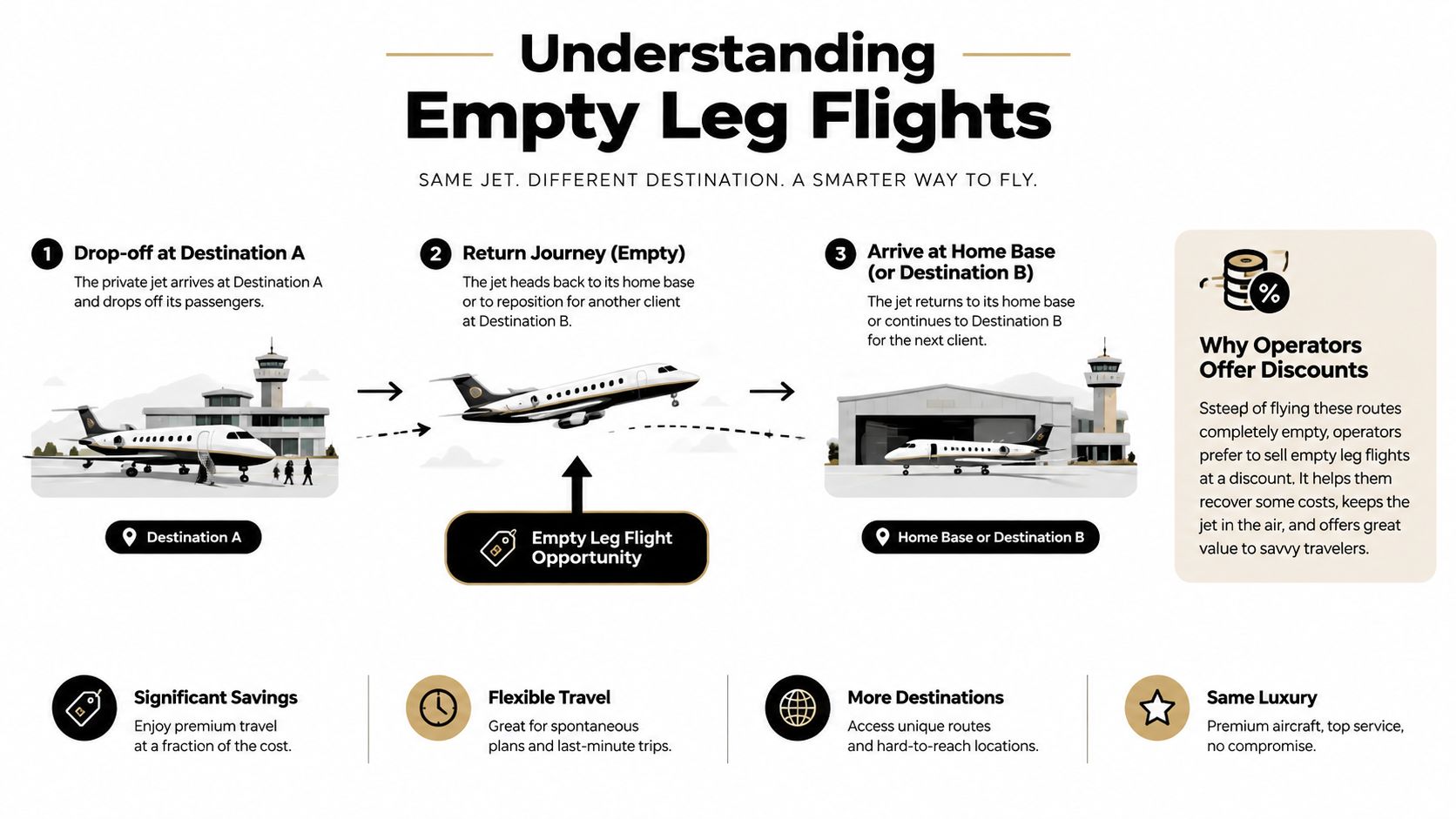
An empty leg begins with a normal private charter. An aircraft carries passengers from one city to another, then needs to move elsewhere for its next assignment. If no passengers have booked that repositioning sector, the operator may publish it as an empty leg rather than fly the aircraft without customers.
That distinction explains both the attractive fare and the uncertainty. The operator isn't creating a new schedule around your preferences. It's offering space on a flight that already exists for operational reasons, often with limited notice and a fixed itinerary.
The central trade-off: empty legs can reduce the cost of private aviation, but they exchange schedule control for price.
The rest of the decision follows from that trade-off. You need to understand why the flight exists, how the discount is calculated, where live inventory appears, and what confirmation steps protect a time-sensitive trip. A flexible leisure journey may suit an empty leg perfectly. A board meeting, wedding, or international connection may require the certainty of an on-demand charter instead.
Understanding Empty Leg Flights
The simplest analogy is an empty taxi returning to its garage. A passenger hires the taxi to travel from one neighborhood to another. Once the passenger exits, the driver still needs to return to the garage or reach the next pickup area. If another passenger is willing to travel along that route, the driver can earn money on a journey that was already going to happen.
Private aircraft reposition in much the same way. An operator may need to return an aircraft to its home base, position it near a later client, or move it after dropping off passengers. That return or positioning sector becomes an empty leg when it's available without the original charter passengers. A neutral explanation of this operating model appears in this overview of private jet repositioning flights.
The process is easier to understand in three steps:
- A primary charter creates the movement. A client books the aircraft for a one-way journey.
- The operator identifies the next requirement. The aircraft must reach its base or another pickup airport.
- The operator offers unused capacity. If passengers can use that fixed movement, the company collects revenue instead of flying the sector without passengers.
The supply is structural, not accidental. Industry references commonly estimate that roughly 30% to 40% of private jet flight hours are repositioning flights, which makes empty legs a recurring feature of business aviation rather than a rare anomaly, as outlined in this empty-leg market report.
Why timing matters
Empty-leg inventory often appears close to departure, commonly within a 48 to 72 hour booking window, according to industry guidance in the empty-leg flight guide. The exact timing depends on when the original charter is confirmed and when the operator finalizes its aircraft schedule.
That short window creates the defining limitation. You usually can't choose any departure time, airport, or aircraft and ask an operator to make an empty leg fit. You search the available movement, then decide whether your plans can fit around it. If you need complete control, you're no longer evaluating an empty leg. You're comparing a standard one-way charter.
How Empty Leg Flight Pricing Works
An empty-leg fare reflects a different economic calculation from a normal private charter. In a standard charter, the customer generally funds the aircraft's planned trip as a complete service. With an empty leg, the operator has already committed to moving the aircraft, so the fare collected from additional passengers can focus on the costs created by carrying them.
The fixed portion may include aircraft ownership expenses, recurring maintenance arrangements, insurance, hangar requirements, depreciation, and regular crew costs. Those obligations don't disappear when a repositioning sector flies without passengers. The remaining trip-specific expenses can include fuel, airport charges, catering, and expenses connected with operating that particular flight.
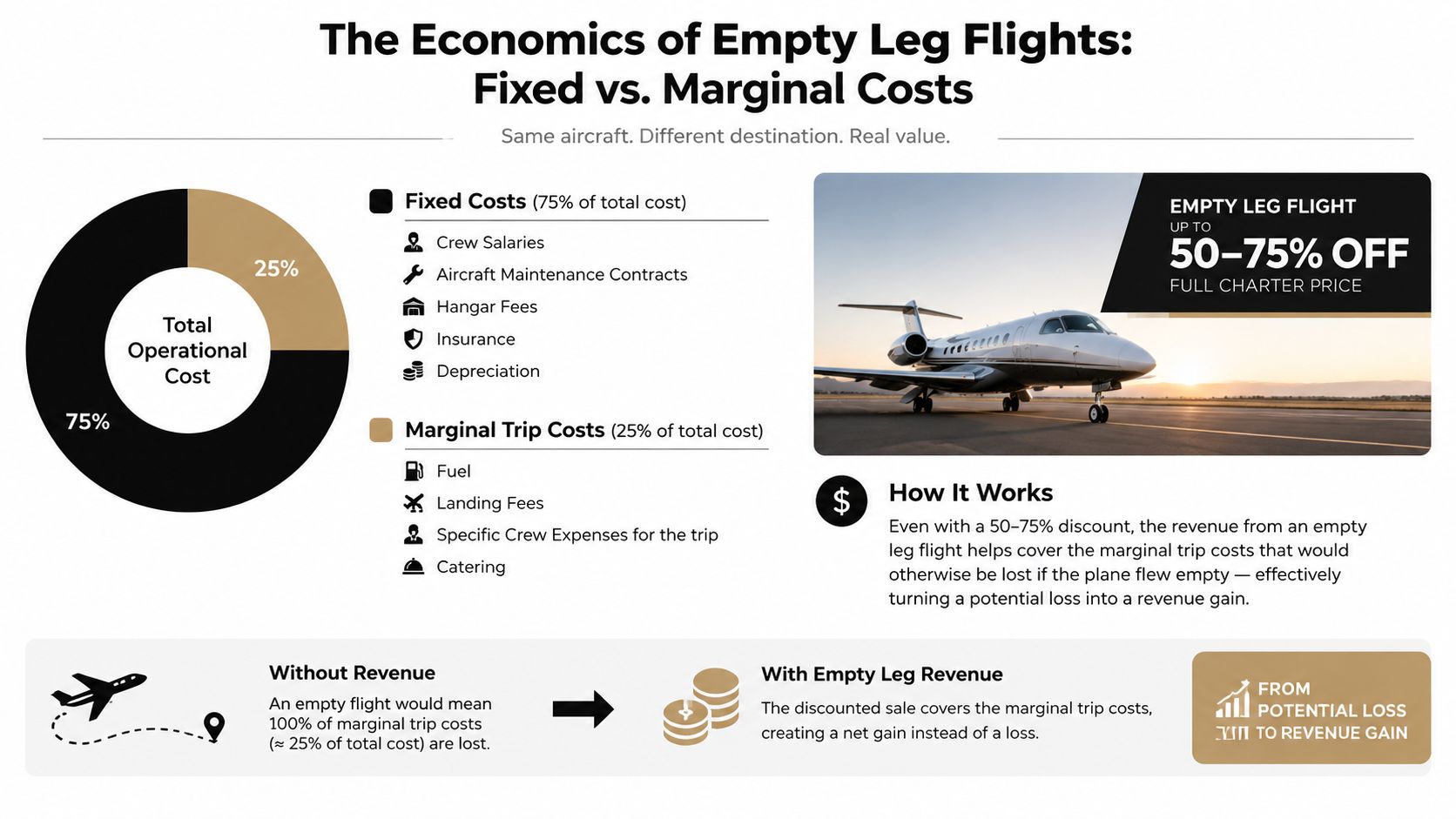
The operator therefore has a practical choice. It can fly the aircraft empty and absorb the entire operating burden, or accept a discounted fare that offsets some of the trip-related expense. The deeper the discount, the closer the departure usually is and the less useful the aircraft would be to the operator without passengers.
What determines the fare
The advertised discount isn't the only pricing variable. Ask about:
- Route and distance: A longer repositioning sector carries more operating expense than a short one.
- Aircraft category: Cabin size, range, and operating characteristics affect the comparable charter price.
- Departure urgency: An imminent flight may receive a sharper reduction because the operator has little time to fill it.
- Airport requirements: Landing, handling, and related airport charges can affect the final quote.
- Passenger needs: Catering, ground transportation, pets, and special service requests may change the total.
Industry summaries commonly cite 25% to 75% discounts compared with a comparable one-way charter because the fixed trip cost is already committed, as explained in this empty-leg pricing guide. That range isn't a promise for every route. Treat it as a description of commonly reported pricing behavior, then request a complete quote with taxes, fees, and service items included.
For broader context on private aviation pricing, consult this guide to private jet charter cost.
A visual explanation can help clarify why a discounted seat still benefits the operator:
Benefits and Risks of Empty Leg Flights
Empty legs work best when the traveler values access and price more than complete control. A leisure traveler heading to a resort, a family traveling for an event, or an executive with a movable schedule may accept a fixed departure because the alternative is less convenient or more expensive. The private aircraft can still provide a quieter cabin, direct routing, and access to airports that may be more convenient than a major commercial hub.
The problem appears when a traveler treats the empty leg like a guaranteed appointment. The operator's schedule can change because the primary charter changes, the aircraft becomes unavailable, weather affects positioning, or the aircraft needs to serve another operational requirement. A return flight also isn't automatically available. You may find a convenient outbound leg and no suitable movement in the opposite direction.
A practical comparison
| Travel situation | Empty leg may fit | Standard charter may be safer |
|---|---|---|
| Flexible leisure escape | You can move the departure around the aircraft | You must leave at a particular time |
| Event attendance | The event schedule allows a buffer | Missing the event would create a serious problem |
| Corporate travel | Meetings can shift and alternatives exist | A presentation, closing, or connection is fixed |
| Family trip | Everyone can adapt to airport or timing changes | Children, medical needs, or onward travel require certainty |
Live inventory is especially volatile. Empty-leg listings can update multiple times per day, and individual legs may appear or disappear rapidly, making schedule certainty a central concern for time-sensitive travelers, as described in this empty-leg price index.
Reliability test: if a change would cause you to miss an irreplaceable obligation, don't make the empty leg your only plan.
Luxury travelers often evaluate this same flexibility when comparing activities. For example, a traveler planning a Hawaii itinerary may find it useful to review a resource on choosing Captain Cook snorkel tours before locking in transport around a fixed excursion. The principle is the same: confirm which parts of the itinerary are flexible before accepting a deal that depends on a narrow schedule.
Listing and Booking Empty Leg Flights
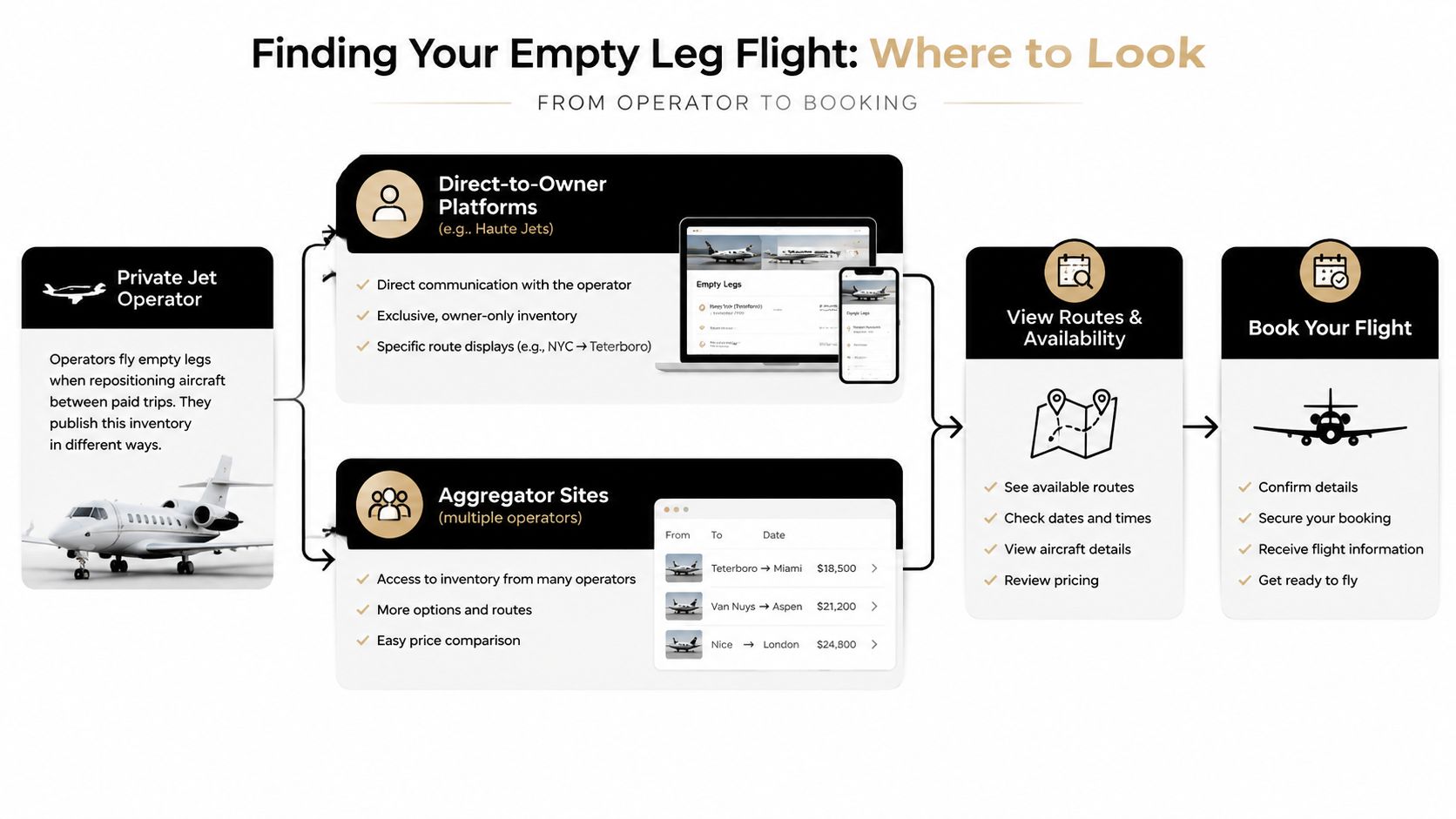
Operators and marketplaces publish empty-leg inventory through two main channels. A direct-to-owner platform may show opportunities sourced from a particular operator network, while an aggregator can display movements from multiple operators in one search environment. Neither format removes the underlying uncertainty. The quality of the listing depends on how quickly the platform receives schedule changes and how clearly it communicates the flight's conditions.
Look for listings that identify the departure airport, arrival airport, date, estimated departure time, aircraft details, passenger capacity, inclusions, exclusions, and cancellation terms. A vague route description isn't enough for a high-value trip. You should know whether the displayed fare covers the complete aircraft or a seat, and whether the operator can confirm the aircraft and crew before payment.
How to monitor inventory
Use a disciplined search process rather than checking randomly:
- Start with city pairs: Search the airports you can realistically reach, including suitable private aviation airports.
- Keep a time range open: A narrow date requirement may eliminate every useful repositioning sector.
- Use alerts where available: Notifications can surface new inventory faster than manual searches.
- Confirm before relying on the listing: Ask whether the aircraft movement remains active at the time you inquire.
- Review the provider: Request operator credentials, insurance information, and the terms governing changes or cancellation.
An empty leg is, by definition, a repositioning flight the operator must fly to return to base or prepare for another trip after a one-way charter, as explained in this empty-leg mechanics overview. For a clearer view of the booking conversation and required details, consult this guide to booking a private jet with Haute Jets.
Step by Step Empty Leg Flight Booking
Suppose a traveler needs to reach a destination for a flexible weekend and can depart from more than one nearby airport. They begin by searching live empty-leg boards for a route in the desired direction, without assuming that the first listing will remain available. The key is to treat the search as a live operational inquiry, not a conventional airfare comparison.
Start with the itinerary you can accept
Write down the practical boundaries before contacting a provider:
- acceptable departure airports
- acceptable arrival airports
- earliest and latest departure time
- passenger names and count
- baggage, pet, catering, or ground transport needs
- whether the trip has a firm arrival deadline
Then compare the listing with those boundaries. Check the aircraft type, cabin configuration, estimated flight time, operator, total price, and payment terms. Don't focus on the discount headline until you know the route and schedule are a good fit.
Request confirmation quickly
When a suitable leg appears, send the provider the complete passenger and service information. Ask whether the flight is still operationally confirmed, whether the primary charter could alter the movement, and what happens if the operator withdraws the leg.
A serious booking conversation should clarify:
- The exact airports, including the private terminal or FBO.
- The departure window, not only a broad date.
- The aircraft identity or agreed aircraft specifications.
- The operator and safety documentation.
- The refund, credit, rebooking, and cancellation rules.
- The final amount due, including applicable charges.
Before paying: get the itinerary and change terms in writing. A low fare isn't useful if you can't explain your remedy after a cancellation.
Confirm the final travel details
After payment, keep the provider's direct operations contact available. Reconfirm the departure airport, passenger manifest, baggage arrangements, and ground transfer plan. Because the aircraft is moving for another operational reason, monitor messages until departure rather than assuming the first listing is the final schedule.
If the itinerary becomes too fragile, compare it with a standard one-way charter. The point of the empty leg is to create value, not to force an important trip into an arrangement that no longer fits.
Tips for the Best Empty Leg Deals
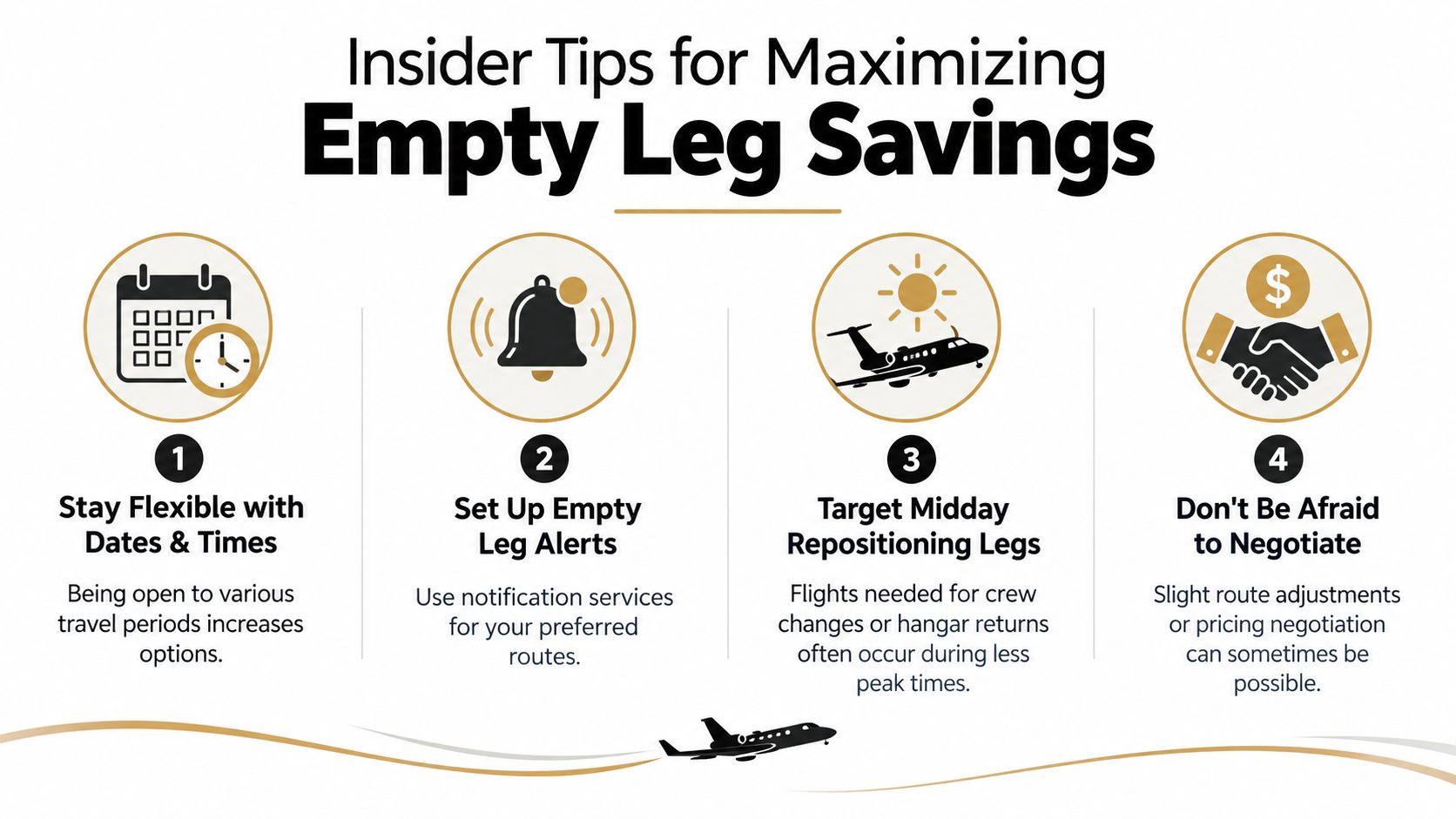
The strongest empty-leg strategy is flexibility with boundaries. You don't need to accept every time or airport, but you should decide in advance which variables can move. That lets you respond quickly without making a rushed decision that creates more logistical trouble than the fare saves.
- Stay flexible on dates and times: Allow nearby travel windows when possible. Empty legs follow aircraft movements, so flexibility increases the chance that a listing will fit.
- Set route alerts: Use notifications for preferred departure and arrival regions. New inventory can be short-lived, and manual searches may miss a suitable movement.
- Consider alternate airports: A nearby private aviation airport may match the aircraft's actual repositioning plan better than the largest commercial field.
- Compare the complete price: Ask for taxes, handling, catering, ground transportation, and any change-related charges before treating the displayed discount as your final cost.
- Plan the return separately: An outbound empty leg doesn't guarantee a matching return. Combine it with a standard charter, commercial option, or ground plan if returning on a specific date matters.
- Ask about modest adjustments: A provider may be able to discuss a nearby airport or small timing variation, but major changes can turn the movement into a normal charter.
- Use the aircraft as the starting point: If the cabin, luggage capacity, and onboard requirements are suitable, let the available route guide the destination rather than searching only for a predetermined itinerary.
For leisure planning, travelers can also use a guide for vacation rental owners to coordinate last-minute accommodation decisions with a flight that may only become available close to departure. The broader lesson is practical: don't finalize nonrefundable ground arrangements until the aircraft movement and its change terms are clear.
Putting Empty Leg Strategies into Practice
Empty legs make sense when your plans can adapt to the aircraft. They can be attractive for flexible leisure travel, open-ended trips, and business journeys with backup options. They make less sense when the departure time, arrival deadline, or return date is nonnegotiable.
A reliable process is straightforward. Search live inventory, review the exact route and aircraft, confirm the operator and total price, request written change terms, and keep an alternative plan for any time-critical obligation. Treat the listing as conditional until the provider confirms that the repositioning movement remains active.
Haute Jets offers access to Wyvern and ARGUS-rated operators, local sourcing, and transparent pricing, which can help travelers evaluate an empty-leg opportunity alongside a conventional charter. Use the same discipline for every provider: verify the itinerary, understand the cancellation remedy, and decide whether the savings justify reduced schedule control.
Haute Jets connects travelers with on-demand private jet charter options and regularly updated empty-leg opportunities, with no membership or jet card required. Visit Haute Jets to review available routes, compare a flexible empty leg with a guaranteed charter, and request a flight that matches your schedule and service requirements.