

You've got a New York meeting tomorrow, your return plans aren't settled, and a conventional charter quote looks difficult to justify. An empty leg flight to New York may solve the problem at a much lower price, but only if you can accept the aircraft's route, departure window, and airport.
The opportunity is real. The convenience is not guaranteed. Empty legs reward travelers who can move quickly and tolerate operational change, while a conventional on-demand charter remains the better choice when timing, aircraft selection, or airport access is fixed.
Why Empty Leg Flights to New York Work Differently
New York repositioning flights are governed by airport supply, not your itinerary. An aircraft may arrive from Miami, reposition toward New York, and carry flexible passengers on a segment it already needs to fly. That is why an empty leg can cost less than a bespoke charter. The operator's primary mission still controls the route, departure window, aircraft, and airport.
Empty legs are also called repositioning, deadhead, or ferry flights. SkyAccess explains the empty-leg model and pricing mechanics, including why operators may sell unused capacity instead of moving the aircraft without passengers. Availability is strongest on established business and leisure corridors, particularly connections between the Northeast and Florida, but supply varies sharply by airport.

A commonly cited New York to Miami example prices an empty leg near $7,000, compared with $15,000 or more for a conventional one-way charter. The lower figure reflects unused capacity on a flight that must operate anyway. It does not buy control over the aircraft's schedule.
Airport choice changes the odds. Teterboro and other New York-area business aviation airports can offer more practical access than a single preferred field, while a deal tied to one airport may disappear if the aircraft's next assignment changes. Ask the broker which New York airports have active inventory before judging the fare.
Last-minute planning is fragile. Empty-leg availability can change within a 62-hour booking window, and a 10-15% cancellation risk means the cheapest quote is not automatically the best choice. Compare the effective hourly rate with the normal price for the same corridor, then account for ground transfers, schedule disruption, and a backup plan.
New York availability also depends on local regulatory conditions, as the 2025 helicopter grounding and City Council restrictions demonstrated (FAA emergency grounding order).
Practical rule: Choose an empty leg when you can accept the aircraft's airport and timing, and when the hourly rate remains attractive after transfer and cancellation risk. Choose an on-demand charter when arrival certainty matters more than savings.
For airport comparisons and conventional alternatives, review New York private jet charter options before booking a fixed repositioning segment.
How Empty Leg Flights Actually Work
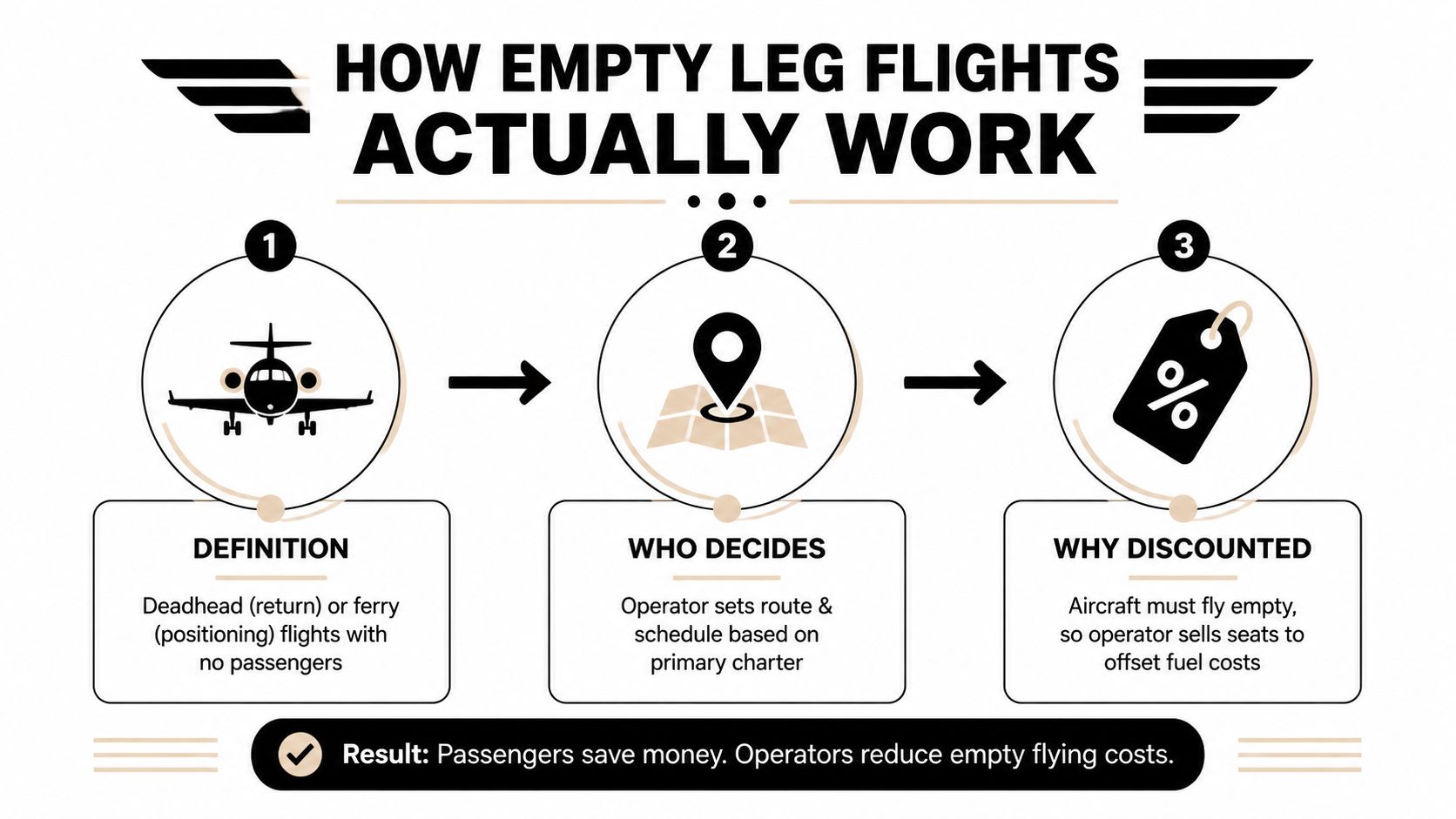
An empty leg exists because another charter already set the aircraft in motion.
The aircraft's primary mission comes first
An operator accepts a paying charter from City A to City B. After dropping off those passengers, the aircraft may need to return to base or reposition for its next assignment. That unoccupied segment becomes the empty leg.
The return movement is often called a deadhead flight. A positioning movement is often called a ferry flight. Both describe an aircraft moving without the original paying passengers, which is the core definition outlined in Haute Jets Journal's guide to empty leg flights.
The operator controls the available trip
You can request an empty leg touching New York, but you usually cannot set the exact departure time or move the aircraft to a different airport. The operator determines those details from the primary charter, crew requirements, aircraft location, airport permissions, and next assignment.
That distinction changes how you search. A normal charter begins with your preferred route and schedule. An empty leg begins with an aircraft movement, then offers you the remaining capacity.
Haute Jets' empty-leg editorial coverage explains the mechanics and trade-offs without treating repositioning flights as interchangeable with on-demand travel.
The underlying mission can change after you receive a quote. Original passengers may alter their timing, extend the trip, cancel, or select another aircraft. The empty segment can then disappear. Booking windows are commonly described as 24–72 hours, with cancellation risk near 10–15%, because the primary mission remains subject to change.
Watch the short explainer below for a visual overview of the process.
Treat every listing as conditional until the operator confirms the aircraft, route, departure time, passenger details, and cancellation terms in writing. A low quote has little value if the airport or timing no longer works for your New York trip.
Finding and Booking Empty Leg Flights to New York
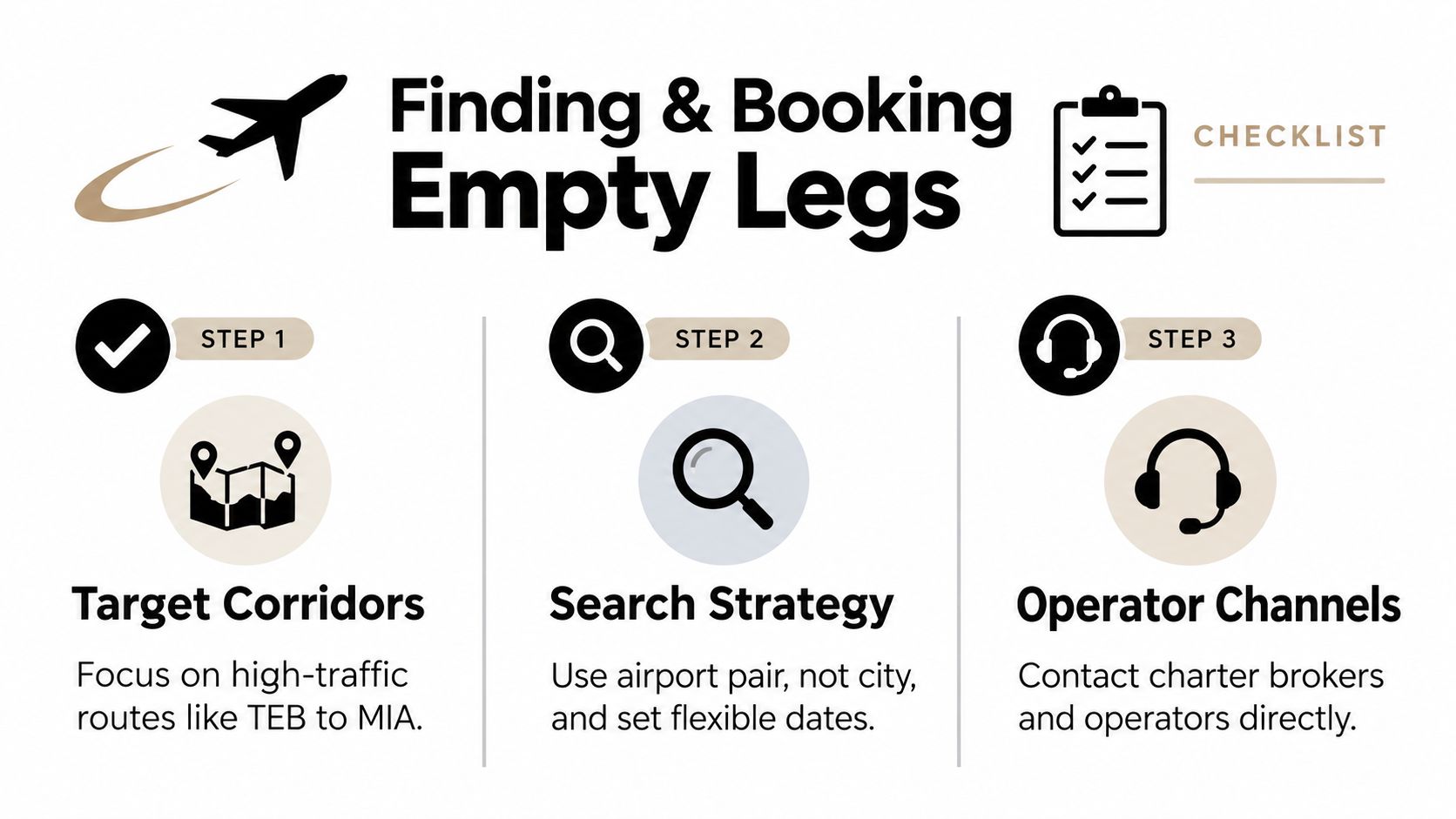
The fastest route to a successful booking is to search the aircraft's likely movement, not your ideal itinerary.
Start with corridors
Target cities that regularly connect with New York. Los Angeles, Boston, and Washington, D.C. appear among the busiest departure origins in one live marketplace dataset. Florida routes deserve special attention because New York to Miami is a frequently cited high-demand corridor.
A marketplace report recorded 358 empty legs touching New York, including 167 departures and 191 arrivals, while another dataset counted 31,051 New York listings in a nationwide sample (SkyAccess marketplace research). These figures demonstrate liquidity, not guaranteed availability for your date. Listings can sell or vanish quickly.
Search airports, not just the city
“New York” is too broad for an efficient search. Check airport pairs separately:
- Teterboro, TEB: Often the first airport to check for Manhattan-bound business travel.
- White Plains, HPN: Useful for Westchester, Connecticut, and northern suburban access.
- Morristown, MMU: A practical New Jersey alternative.
- Farmingdale and Islip: Relevant for Long Island itineraries.
- JFK, LGA, and Newark: Important for specific aircraft, international connections, or ground-access requirements.
A separate live-market view showed 290 listings from the New York metro across eight airports, confirming that supply varies by airport and day rather than by city label alone (New York empty-leg marketplace data). Ask for every viable airport before rejecting a quote.
Be ready to book immediately
Set a departure window rather than a single time. A same-day traveler might accept Teterboro, White Plains, or Morristown and leave as soon as the aircraft is confirmed. A next-day traveler should provide passenger names, identity documents, billing details, luggage requirements, and preferred airports at the first inquiry.
Use direct broker and operator channels, live marketplace alerts, and a travel advisor who can distribute one request across multiple aircraft sources. The most useful request includes:
- Origin and destination airports, with acceptable alternatives.
- A flexible departure window.
- Passenger count and luggage needs.
- Aircraft category preferences.
- Pet, catering, Wi-Fi, and ground-transport requirements.
- A clear deadline for accepting the aircraft.
An empty-leg quote should identify the aircraft type, operator, tail number when available, routing, departure window, total price, included services, payment deadline, and cancellation conditions. The insider guide to booking empty leg flights is useful background, but the final authority is the operator's written confirmation.
What Empty Leg Flights to New York Really Cost
Headline savings can mislead. Judge the quote by its implied hourly rate, cabin class, airport convenience, and corridor, not by the discount shown beside the listing.
A market report gives these empty-leg hourly benchmarks for New York-related routes (2026 empty-leg price index):
| Cabin Class | Empty Leg Hourly Range | Full Charter Context |
|---|---|---|
| Light jet | $1,000–$4,500 per flight hour | Compare against a full light-jet charter on the same route |
| Midsize jet | $2,000–$6,000 per flight hour | Account for added cabin space and longer-range capability |
| Heavy jet | $3,500–$9,750 per flight hour | Compare aircraft size, range, and mission requirements carefully |
Empty legs can save 25–75% against full charter rates, but the upper end applies only when the aircraft's repositioning route fits your trip. A low hourly figure loses value if the airport is inconvenient, the departure window is unusable, or the aircraft is larger than required.
Use a different corridor to test the quote. A New York to Boston empty leg may look attractive on price, yet its short flight time makes repositioning, handling, and airport charges more visible in the total. Compare the complete quote with the relevant light-jet hourly range, then check whether the arrival airport serves your destination. A cheap seat at an inconvenient airport is not a cheap trip.
Use a three-question pricing test
First, divide the total quote by estimated flight time. Next, compare that hourly result with the correct cabin range. Finally, price the operational trade-offs: airport transfers, fixed departure timing, luggage limits, and cancellation exposure. Empty-leg availability is often fragile close to departure, so a low quote deserves scrutiny if losing it would disrupt the trip.
Seasonality changes the routes worth monitoring. New York often produces stronger southbound demand during winter, while summer brings more leisure movement toward Northeast destinations. Monitor Florida-bound inventory in winter and Northeast leisure routes during summer, while checking airport-level availability rather than relying on “New York” as one market.
For broader context, review Haute Jets' private jet charter cost guide. The full mission comparison matters more than the discount label.
Pro Tips to Secure Last Minute Empty Leg Deals
The booking window is short, and the airport choice can decide whether the deal works. Treat an empty leg as a live operational opportunity, not a fare to browse casually. Keep your passengers reachable and be ready to approve the aircraft when a suitable option appears.
Keep the request flexible
A recent market report places the median empty-leg booking at about 62 hours before departure, with more than 65% of legs posted fewer than 72 hours before takeoff (2026 empty-leg market report). That schedule favors buyers who can respond quickly. Monitor several airports instead of waiting for one preferred field.
For New York, check Teterboro, White Plains, Morristown, Newark, JFK, LaGuardia, Farmingdale, and Islip based on the ground destination. Supply is not evenly distributed across the market. A car transfer from a nearby airport can be easier than waiting for an aircraft at the most convenient field.
Prepare the passenger file
Have legal passenger names, identification, billing authorization, luggage details, and special-service requests ready before the quote arrives. Confirm pet policies before payment. For an executive group or production team, appoint one decision-maker who can approve the aircraft immediately.
Vet safety and aircraft details
Ask who operates the aircraft, which safety ratings apply, whether the crew and aircraft are confirmed, and how the operator handles a change to the underlying charter. Request those answers in writing, along with the aircraft type, departure airport, and cancellation terms.
Haute Jets states that it can source from 3,500+ owner-operators across 175+ countries and restricts its network to Wyvern Wingman or Argus Gold/Platinum-rated operators. Its model also focuses on selecting the specific aircraft rather than stopping at a broad category, which helps when several comparable listings appear.

Hold a backup plan
The 10–15% cancellation risk covered above changes how you should book. Keep a conventional charter quote available for a board meeting, performance, medical appointment, or international connection. Written confirmation should state what happens if the primary charter changes, whether the operator will offer a replacement aircraft, and whether your payment is refunded if no replacement meets the agreed route and timing.
Booking discipline: Never treat an empty leg as confirmed until the operator has issued written confirmation and you understand the replacement or cancellation terms.
Deciding If an Empty Leg Is Right for Your New York Trip
Book the empty leg when four conditions line up:
- Your timing is flexible: You can accept the operator's departure window.
- Your airports are flexible: Teterboro, White Plains, Morristown, Newark, or another nearby field can work.
- The aircraft fits: The cabin, luggage capacity, range, and onboard requirements suit the passengers.
- The economics hold: The implied hourly rate compares favorably with a conventional charter for the same mission.
Walk away when any one of those conditions fails. A low quote doesn't compensate for missing a meeting, arranging difficult ground transport, accepting an unsuitable cabin, or rebuilding the trip after a cancellation.
The right question isn't, “How much is the discount?” It's, “Would I still take this aircraft, from this airport, at this time, if the price were compared fairly with a standard charter?” If the answer is yes, move quickly. If the answer is no, request an on-demand charter and protect the itinerary.
Use empty legs for opportunistic travel. Use a conventional charter when the trip is consequential.
For current New York repositioning availability, airport alternatives, aircraft selection, and on-demand charter support, visit Haute Jets. Its team can compare empty-leg opportunities with direct charter options, confirm operator and aircraft details, and help you decide before a fragile listing disappears.