
You're probably dealing with this right now. The event is fixed, the guest list is fluid, and someone on your team assumed the aircraft could be handled “closer to departure.” Then the calls start. The preferred jet is unavailable. The airport you want is slot-constrained. The quote jumps every few hours. What looked simple a month ago becomes a negotiation with time, inventory, and operational limits.
That's how event and seasonal private jet charter goes wrong. Not because private aviation is unreliable, but because too many travelers approach peak periods like ordinary travel days. They aren't. During event weeks and seasonal surges, you're competing with sponsors, entertainers, board members, families, athletes, and entire production teams who all want the same airports and the same departure windows.
The Challenge of Peak Season Private Aviation
The common failure point is waiting until the event feels “real.” By then, the market has already moved.
A client decides on a last-minute trip to a flagship event. The hotel is confirmed. Security is arranged. Dinner is booked. Then aviation gets treated as the final checkbox. The first quote looks aggressive. The second aircraft is coming from the wrong city. The third option can't match the schedule. Suddenly, the problem isn't luxury. It's execution.
That's not surprising in a market this large. The global events industry was valued at $736.8 billion in 2021 and is projected to reach $2.5 trillion by 2035 according to event industry market reporting. More events, more destination traffic, and more concentrated travel windows mean private aviation gets crowded exactly when timing matters most.
What usually breaks first
Peak season pressure shows up in a few predictable places:
- Availability tightens first: The most desirable aircraft disappear early, especially on obvious city pairs and same-day return patterns.
- Airport access gets harder: Slots, parking, and preferred arrival windows become restricted before many clients even submit requests.
- Pricing loses context: If you're shopping late, you're no longer comparing good options. You're comparing whatever remains.
- Ground logistics lag behind: Car service, terminal coordination, and security support often become afterthoughts, which creates friction on departure day.
If you're coordinating holiday movement at both ends, the flight isn't your only moving part. A local ground partner like All Black Limo LLC Seattle holiday services can be useful when the airport leg is only one piece of a larger event itinerary.
Book the mission when you book the event. If aviation starts after the restaurant reservations, you're already behind.
Reactive booking costs more than money
Late booking doesn't just raise the quote. It narrows your control.
You lose the ability to choose the right cabin, the right departure airport, and the right schedule buffer. That's why smart seasonal flyers lock their framework early, even if the passenger list changes later. If you travel often around end-of-year peaks, this holiday season private jet charter guide is a useful companion to keep your planning disciplined.
The clients who get effortless event travel aren't lucky. They commit early, build contingencies, and treat aircraft sourcing as part of event strategy, not event cleanup.
Mapping the High-Demand Aviation Calendar
Most travelers think in terms of famous events. Charter operators think in terms of demand clusters. That's the better way to read the market.
Aviation pressure doesn't come from a single date on a calendar. It comes from waves. Some are obvious, like championship weekends. Others are seasonal migrations, conference patterns, or destination swings that pull high-value travelers into the same airports over a compressed window.
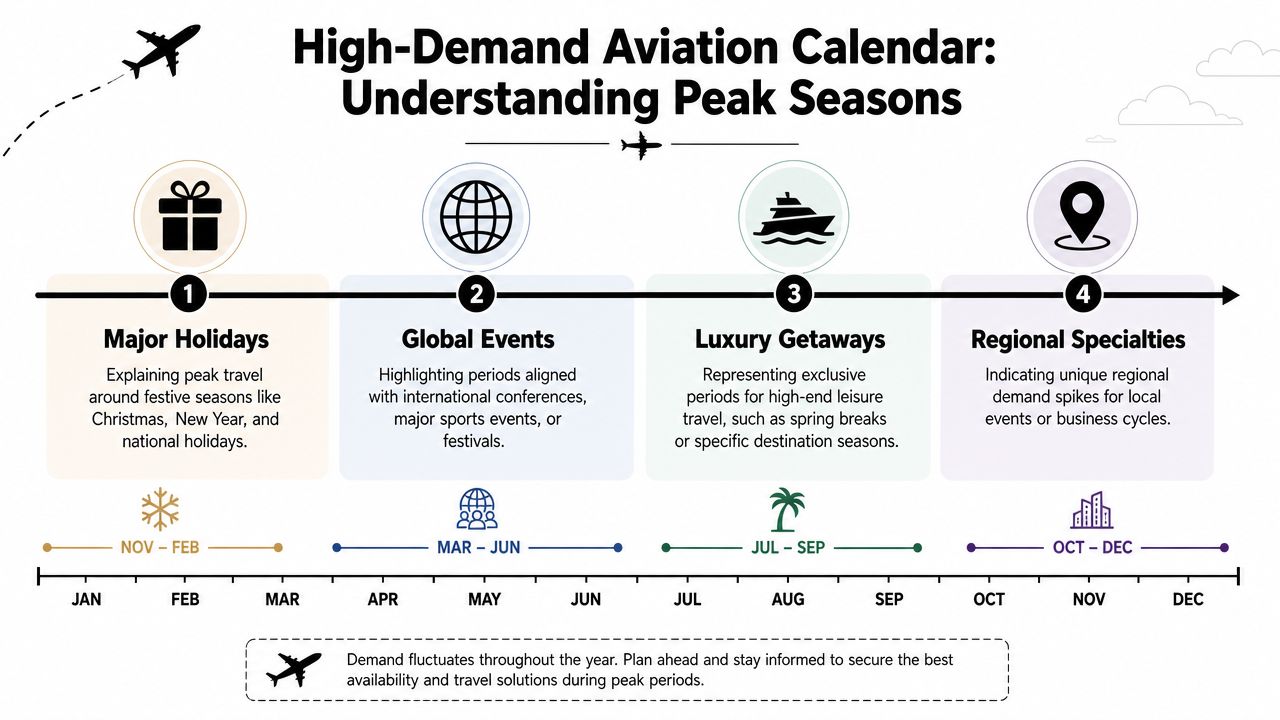
Four calendars matter
Major holidays create the broadest squeeze. Christmas, New Year, long weekends, and other family-driven travel periods hit both leisure markets and business aircraft availability. Travelers want tight departure windows and often insist on return flexibility, which reduces usable fleet supply.
Global events create sharper spikes. International sports, film festivals, major trade gatherings, and political summits concentrate demand into a few airports and a few critical arrival periods. These trips often require longer-range cabins, coordinated crew duty planning, and tighter schedule discipline.
Luxury getaways move differently. Winter ski markets, spring break destinations, summer Mediterranean patterns, and island traffic don't always look like “events,” but they behave like them. Everyone wants similar departures, similar baggage capacity, and similar airport access.
Regional specialties catch people off guard. A city may not be on every luxury travel list, but one local corporate convention, race weekend, or seasonal resort opening can absorb the useful inventory around it.
Why attention matters before the headline dates
Industry analysis cited in seasonal event trend reporting says major seasonal events can drive 20% to 35% higher attendance than off-season periods, and holiday-themed events generate about 1.5 times more social media engagement. That matters because visibility amplifies urgency. Once an event becomes culturally “must-attend,” charter demand accelerates well before the event itself.
The market doesn't tighten on event day. It tightens when enough people decide they can't miss it.
How to read pressure by category
Instead of asking, “What's the event?” ask these questions:
- Is this a fixed-date arrival market? Sports finals and opening-night events usually are.
- Does the destination rely on smaller airports? Ski and resort markets often do.
- Will travelers carry unusual luggage? Art purchases, golf clubs, ski gear, and production equipment change aircraft suitability.
- Is the return pattern synchronized? If everyone wants to leave after the same final, concert, or meeting block, outbound inventory tightens too.
For destination-specific planning around major cultural and sports weekends, this guide to private jet charter for Monaco Grand Prix, Art Basel, the Super Bowl, and more is the right starting point.
Clients who understand the aviation calendar don't chase airplanes. They anticipate where the pressure will show up first and plan around it.
Your Strategic Event Booking Timeline
There isn't one universal booking window. There are tiers. If you don't separate a global headline event from a regional seasonal surge, you'll either move too late or tie yourself up too early.
The right booking timeline depends on scarcity, airport complexity, and how much precision you need around schedule and aircraft type. If the mission is visible, fixed, and high-status, assume the market will harden sooner than you think.
Use this timeline, not your instinct
Most booking mistakes come from normal-travel thinking. Event & Seasonal charter doesn't reward spontaneity unless you're unusually flexible. If you care about the exact aircraft, preferred airport, and a clean schedule, commit early and refine later.
| Event Tier | Examples | Ideal Booking Window | Key Consideration |
|---|---|---|---|
| Tier 1 | Global sports finals, major international festivals, top political and business forums | 6 to 12 months out | Secure aircraft and airport strategy before inventory compresses |
| Tier 2 | Major domestic event weekends, marquee cultural gatherings, peak ski and summer destination periods | 3 to 6 months out | Protect schedule flexibility and cabin choice |
| Tier 3 | Regional seasonal peaks, holiday family travel, destination wedding flows | 1 to 3 months out | Ground logistics and backup options matter as much as the aircraft |
What to lock in first
Don't wait for every detail to be perfect. Start with the parts that control availability.
- Travel pattern: Confirm your likely departure date, return structure, and alternates.
- Passenger profile: Headcount, VIP splits, baggage type, pets, and onboard expectations.
- Airport strategy: Preferred airport, acceptable alternates, and terminal access needs.
- Mission priority: Decide what matters most. Lowest cost, exact aircraft, or tightest schedule.
Once those are set, a provider can hold the mission architecture even if names and timing move around the edges.
Delay creates a worse negotiating position
The market punishes indecision in a specific way. First you lose the ideal plane. Then you lose nearby options. Then you lose timing precision. Finally, you start paying for repositioned compromises and operational workarounds.
That's why I tell clients to book around the event's importance, not the trip length. A one-night trip to a major event can require earlier action than a week-long leisure itinerary in a soft market.
If your team needs a broader planning framework around the event itself, this GroupOS event planning timeline template is a practical reference. Aviation should sit inside that larger timeline, not outside it.
Practical rule: For high-visibility events, lock the aircraft plan while everyone else is still discussing dinner reservations.
A simple way to decide fast
If any two of these are true, move immediately:
- You want a specific aircraft model
- You need a high-demand airport
- You're traveling on the event's obvious peak days
- Your group has nonstandard baggage or security requirements
Clients who book early become buyers with options. Clients who wait become buyers of leftovers. That's the difference.
Decoding the True Cost of Event Charters
You approve a quote for a major event, the hourly rate looks reasonable, and the final invoice still comes in far above expectations. That usually happens because the actual cost was never the hourly rate. It was the aircraft positioning, airport pressure, and schedule risk built around your trip.
Peak event charter pricing is an operating equation, not a simple rate card.
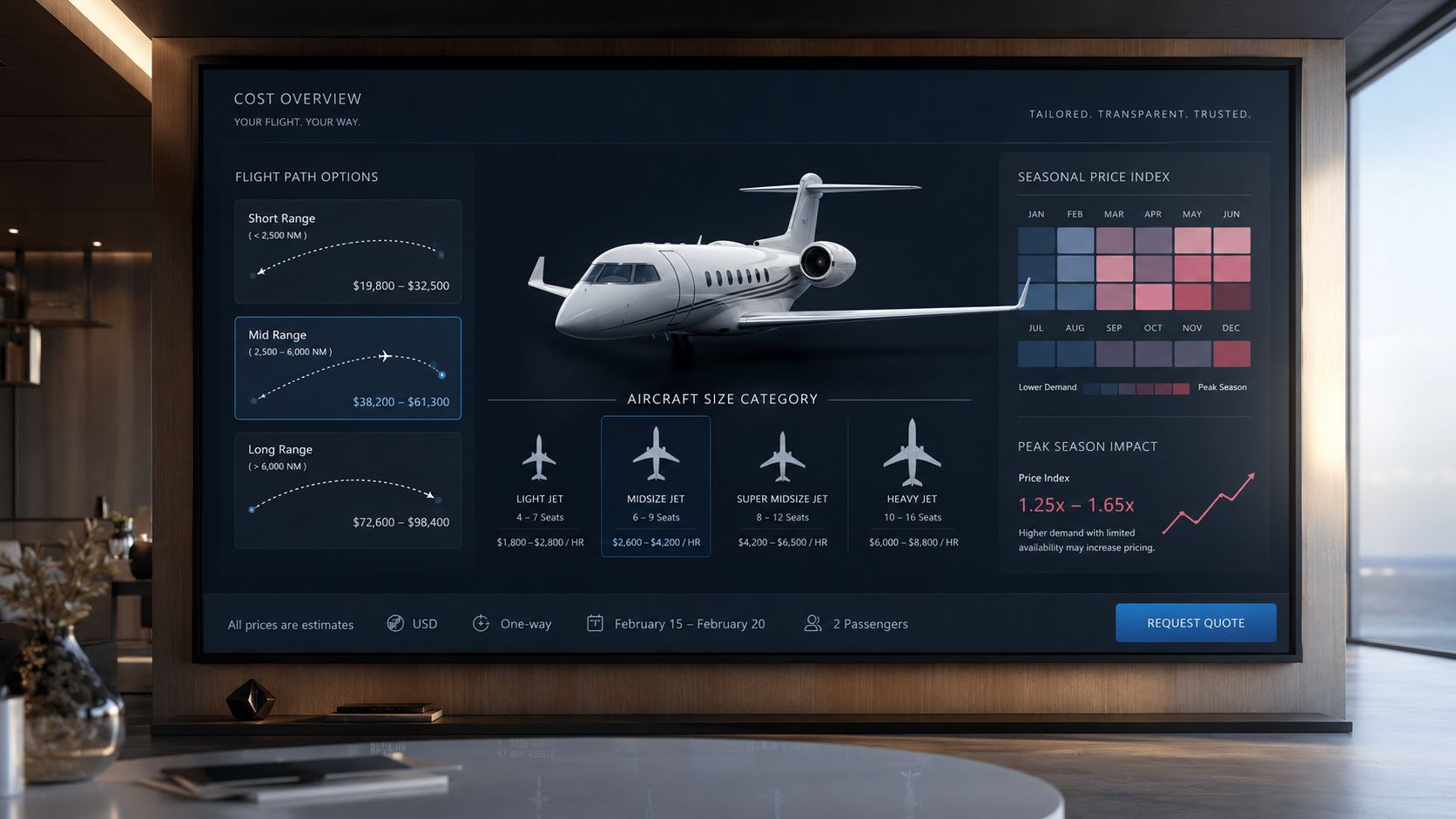
The fee many clients miss
Repositioning is the cost of moving an empty aircraft to your departure city before your trip starts. In many charter transactions, that is the line item that distorts the quote.
If the aircraft is based two states away, you may be paying for that ferry leg before your passengers ever step on board. During major events, that problem gets worse fast. Aircraft are pulled toward the same destinations, local supply thins out, and the buyer ends up funding inefficient aircraft movement.
The result is simple. Two quotes for the same route can look similar on the surface and be priced on completely different economics underneath.
Why event travel changes the math
Event demand compresses the market in a very specific way. Operators are managing tighter airport slots, heavier ground traffic, longer crew duty planning, and more aircraft displacement around the event city. That pressure shows up in the quote.
Here is what you are paying for:
- Mission flying time: the aircraft flying your itinerary
- Positioning time: the empty leg required to reach you
- Peak-demand pricing: scarcity tied to the event window
- Operational charges: handling, parking, de-icing if applicable, catering, permits, and schedule complexity
A buyer focused only on the hourly rate misses the cost drivers that matter most.
Reliability has a price, and so does fragility
A cheap quote built on a long repositioning leg is not really cheap. It is fragile.
If that inbound aircraft gets delayed by weather, congestion, or a prior mission running late, your departure is exposed before your trip even begins. For event travel, that risk is expensive because missed timing can mean missed tee times, missed arrivals, missed meetings, or forced overnight changes for an entire group.
This is why strategic sourcing matters. The closer the aircraft already is to your departure point, the fewer variables you are carrying into a high-pressure travel day.
Local sourcing usually produces the better quote
A local sourcing model reduces wasted ferry time and cuts one of the biggest failure points in event charter logistics. It also gives the client a cleaner view of what is being purchased.
Haute Jets uses a sourcing model built around locally based owner-operators instead of treating every request like a broad category search. That approach matters during peak periods because it can reduce unnecessary repositioning exposure, improve aircraft transparency, and produce quotes based on realistic operating conditions rather than optimistic assumptions.
If you want a clearer explanation of how operators build charter quotes, review this private jet charter pricing and cost breakdown guide before approving an event itinerary.
A short visual explanation helps if you're reviewing quotes with a family office, executive assistant, or travel manager:
Questions that expose inflated quotes
Ask these before you sign:
- Where is the aircraft based right now?
- How much of this quote is repositioning time?
- Is this the exact tail, or only an aircraft category?
- What changes if the operator substitutes another aircraft?
- What airport, parking, crew, and timing assumptions are built into this number?
Serious buyers do not ask, “What's the hourly?” They ask, “What exactly am I funding, and how many moving parts can fail before departure?”
Selecting the Right Aircraft for Your Mission
You arrive for a high-stakes event weekend with the wrong aircraft, and the problem shows up immediately. Bags do not fit. The closest airport is no longer an option. The cabin that looked acceptable on paper becomes a poor workspace for a team that needs to brief, change, and land ready. Peak periods punish vague aircraft selection.
Choose the aircraft by mission, not by status and not by category alone. During event demand spikes, broad category shopping creates expensive mistakes because availability tightens, substitutions increase, and small performance differences start to matter.
Start with the mission profile and force specificity.
Passenger count is only the first filter. Eight passengers with soft bags and no schedule pressure is one mission. Eight passengers with wardrobe cases, security, gifts, and a hard arrival window is another. Buy for the actual trip.
Range affects more than whether the aircraft can make the leg. It shapes routing flexibility, airport options, and how much disruption you absorb if weather or traffic affects the day.
Baggage eliminates more aircraft than clients expect. Golf clubs, ski equipment, product samples, stagewear, and pet gear change the answer quickly. List every oversized item before sourcing starts. Do not approve an aircraft on a verbal assumption that “it should fit.”
Cabin requirements need plain language. If your team needs reliable Wi-Fi for live work, a full stand-up cabin, a divan for family use, or a specific lavatory configuration, put it in writing and tie it to the exact aircraft being offered.
Airport performance often makes the decision for you. Event travel regularly pushes traffic into constrained airports with short runways, altitude limits, parking restrictions, or slot pressure. A large-cabin jet may look better on paper and still be the wrong tool if it forces a less convenient airport or creates higher repositioning exposure. This is one reason a strategic sourcing model matters. Haute Jets can source against the actual operating environment and specific tail availability, not just a generic aircraft class.
That means you should ask for the actual aircraft details. Year, make, model, baggage configuration, and airport suitability. “Super midsize” is not a plan. It is a placeholder.
Safety discipline should get tighter when the market gets crowded. Peak event weeks attract more last-minute lift and more weak options. Haute Jets screens for operators that meet high third-party audit standards, including Wyvern Wingman or ARGUS Gold or Platinum. Keep your own standard just as strict. If the provider cannot clearly confirm the aircraft, operator, crew credentials, and operating limits, reject the option.
If the aircraft fit depends on assumptions, you do not have aircraft fit.
Use this checklist before you approve the trip:
- Exact tail confirmation: Confirm the specific aircraft, not just the category.
- Cabin fit: Verify seating layout, working comfort, and passenger privacy for the full sector length.
- Baggage plan: Itemize every large or irregular piece.
- Airport compatibility: Confirm the aircraft works for the airports you want, not just the city pair.
- Onboard requirements: Verify Wi-Fi capability, power access, pet acceptance, and any security or service needs.
The right aircraft is the one that protects the schedule, fits the load, and reduces operational friction during the busiest days of the year. Prestige does not solve logistics. Precision does.
Mastering Logistics and Contingency Planning
A charter flight can be perfect on paper and still fail the client on the day. That usually happens on the ground.
The event traveler remembers the missed transfer, the catering error, the pet paperwork problem, and the awkward scramble when weather shifts. Not the tail number. That's why logistics and contingency planning deserve the same attention as the aircraft itself.
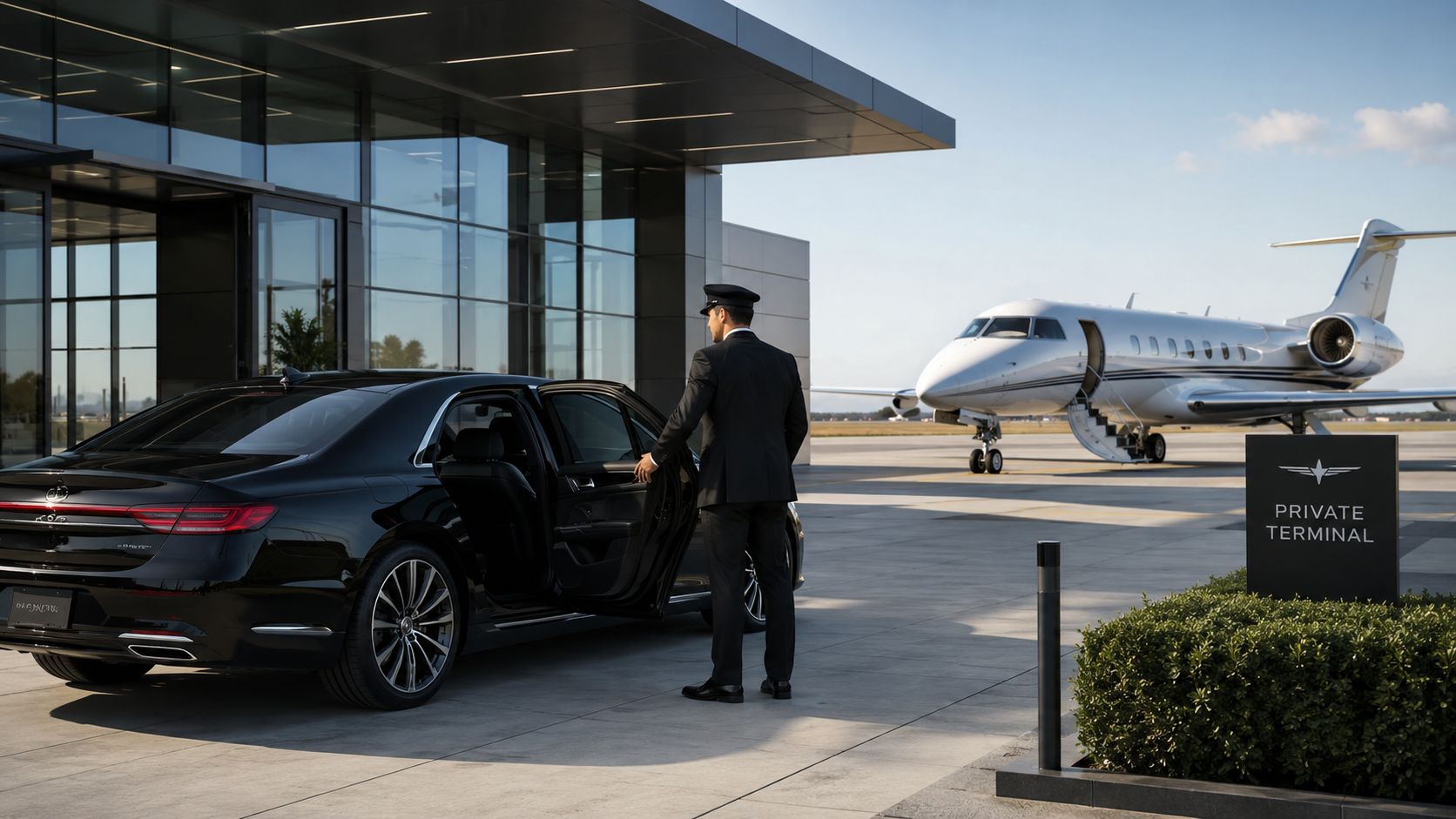
Ground execution has to be built early
You want the airport leg integrated with the rest of the itinerary, not bolted on at the end.
That means confirming:
- Chauffeured transport: Pickup sequence, vehicle type, security handling, and baggage load plan
- Terminal flow: Which FBO will be used, how access is managed, and who's meeting the passengers
- Catering precision: Timing, dietary restrictions, brand preferences, and service style
- Special handling: Pets, minors, security staff, wardrobe pieces, gifts, or event materials
These details sound minor until they're wrong. Then they become the story of the trip.
Reliability becomes the product
During peak seasonal travel, operational constraints like weather-driven cancellations, runway limitations, and last-minute aircraft substitutions become more frequent, as noted in reporting on seasonality as an operational lens. That's exactly why event travel should be built around redundancy, not optimism.
If the destination is weather-sensitive or airport-constrained, ask your charter team how they plan for disruption before disruption happens.
What a real contingency plan includes
A serious plan should cover more than “we'll monitor conditions.”
Backup airport options
If the primary field gets restricted, you need a realistic alternate with ground transfer implications already considered.Aircraft substitution protocol
If an operator has to swap equipment, who approves it, and what standards must the replacement meet?Weather response timing
De-icing, ATC delays, and runway condition changes all affect departure planning. You want decisions made early, not at the curb.Passenger communication flow
One point of contact should control updates. Mixed messages from assistants, security, drivers, and flight coordinators create confusion fast.
Reliability is planned. It isn't delivered by luck or by a nice-looking quote.
The standard I recommend
For event and seasonal itineraries, insist on a pre-flight confirmation process that gives you the actual operating details in advance, including the aircraft, crew information, weather context, and terminal plan. You should know what's happening before you arrive at the FBO, not while you're stepping out of the car.
Clients often focus on glamour during event travel. I focus on failure points. That's where smooth trips are won.
The Haute Jets Advantage for Seamless Event Travel
Peak event travel exposes every weak link in private aviation. Slow sourcing, vague aircraft categories, hidden repositioning costs, soft operator standards, and weak backup planning all become expensive at the same time.
The better approach is straightforward. Source close to departure. Verify the exact aircraft. Keep operator standards tight. Build ground logistics early. Plan for disruption before the first weather update or slot delay shows up. That's how experienced buyers protect both time and control.
For clients who travel frequently around major events and seasonal peaks, the appeal of a model like Haute Jets is practical, not theoretical. It addresses the problems that matter most during compressed-demand periods: unnecessary repositioning exposure, uncertainty around aircraft assignment, and inconsistent operator quality. It also fits buyers who don't want memberships or prepaid structures dictating when and how they fly.
If you take one thing from this guide, let it be this. Event & Seasonal charter should be handled like a mission, not a luxury impulse. The people who get the best outcomes usually aren't the ones spending the most. They're the ones making decisions early, asking sharper questions, and refusing to accept vague answers.
The trip starts long before takeoff. That's where the main advantage is built.
If you want a cleaner way to book event and seasonal private jet travel, Haute Jets offers on-demand charter with exact-aircraft selection, locally sourced options, and Wyvern or ARGUS-rated operators only. Reach out early, especially for peak dates, and build the flight plan before the market tightens.