

Roughly 3,000 to 3,400 nautical miles, depending on the Falcon 50 variant, configuration, payload, reserves, winds, and cruise profile. The Falcon 50EX is commonly associated with a maximum range of 3,260 nautical miles, while the original aircraft's published normal range is about 3,057 nautical miles.
You're probably asking because a broker has placed a Falcon 50 on your shortlist for a long charter, and the brochure number looks close to your route. A four-passenger group flying New York to London may see this tri-jet offered at an attractive rate, with useful airport access and enough cabin space for a comfortable crossing. The important question isn't whether a Falcon 50 can fly far. It's whether the specific aircraft, load, reserve policy, weather forecast, and operating certificate support your trip without turning the flight into a fuel-stop exercise.
The Falcon 50 Range Question Every Charter Flyer Asks
A broker quoting a Falcon 50 should give you more than a headline range. The aircraft's planning window sits roughly between 3,000 and 3,400 nautical miles, with the exact figure changing by variant and configuration. Independent aircraft references place the Falcon 50 in that same band, citing figures such as 3,130 nm, 3,200 nm, and 3,260 nm depending on the source and aircraft configuration, as summarized by Guardian Jet's Falcon 50 reference.
That range is an operational envelope, not a promise that every Falcon 50 will fly the outer edge of it with a full cabin. Payload, reserve fuel policy, winds aloft, and cruise profile all move the answer. A light cabin, favorable winds, and long-range cruise can produce a very different result from a full passenger load, winter headwinds, and a higher-speed schedule.
Start with the mission, not the brochure
Ask the broker to calculate the route using the aircraft's actual tail number. The calculation should include:
- Passenger and baggage weight: Confirm the load rather than relying on a generic passenger assumption.
- Fuel reserves: Establish whether the quote uses NBAA IFR reserves, the operator's stricter internal policy, or a regulatory reserve calculation tied to the flight.
- Weather routing: Review forecast winds and likely track changes, particularly on North Atlantic sectors.
- Cruise profile: A faster cruise may shorten block time while consuming more fuel than a long-range setting.
The Falcon 50's published normal range is about 3,057 nautical miles, while some industry references round maximum range to roughly 3,200 nautical miles. GlobalAir's Falcon 50 specifications ties that profile to the aircraft's original transoceanic mission and reserve requirements, not merely to a marketing figure.
Practical rule: If your route sits near the aircraft's published maximum, treat a fuel stop as a live possibility until the operator confirms the flight plan with current winds, payload, alternates, and reserves.
The right way to discuss Falcon 50 range is as a fuel budget. You spend that budget on passengers, bags, weather protection, reserve fuel, climb performance, and speed. The rest of this assessment should happen before you accept a quote, not after the aircraft is assigned.
How the Falcon 50 Was Engineered for Transatlantic Flight
A charter passenger booking an Atlantic crossing needs more than a brochure figure. Dassault designed the Falcon 50 around that mission from the start, while preserving access to shorter European runways than Gulfstream II aircraft of its era. Its three-engine layout added redundancy for oceanic operations, and its wing and fuel capacity supported a demanding long-range profile.
Dassault states that the aircraft was designed to meet a 3,400 nautical mile FAR 121 reserve requirement. The manufacturer also identifies the Falcon 50 as the first business aircraft capable of crossing the Atlantic under public-transport-style rules, as described on Dassault Aviation's Falcon 50 history page.
The design target was a regulatory mission
The original range target reflected a demanding reserve standard and a genuine transatlantic operating objective, rather than a maximum-distance demonstration with minimal payload and unusually favorable conditions. That capability came from the combined effect of aerodynamic design, fuel systems, engine arrangement, and reserve planning.
The tri-jet layout also created a practical tradeoff. Three engines increased maintenance obligations and operating complexity, but they supported the aircraft's long-range role during an era when oceanic business aviation placed a high value on redundancy. The Falcon 50 could therefore pair Atlantic capability with airport access that larger long-range aircraft could not always match.
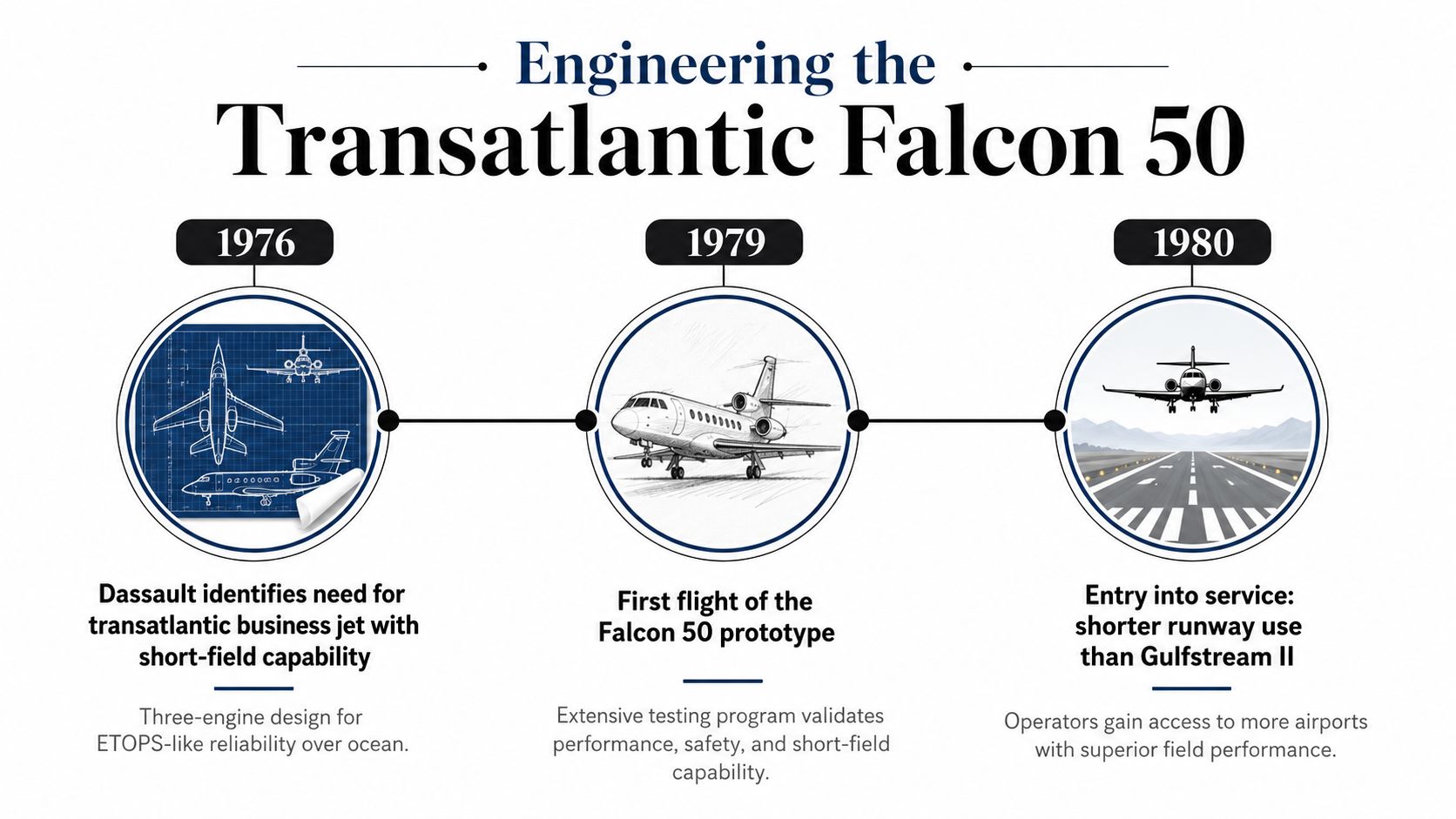
Its production history shows how long this design remained relevant. Dassault produced the Falcon 50 from 1980 to 1996. An aviation history summary records 248 Falcon 50s and 99 Falcon 50EXs built during the type's 27-year production run between 1976 and 2008, according to Guardian Jet's aircraft overview.
Why the original mission still matters
A Falcon 50 operating today is an older aircraft, but its core mission remains credible. A well-maintained example can still cross the Atlantic. The operator must verify maintenance currency, avionics capability, operating procedures, and actual performance history before accepting a long-sector charter.
For broader context on Dassault's private aircraft family, Haute Jets Journal offers a Falcon private plane guide. The Falcon 50 occupies a useful position between runway flexibility and oceanic capability, but that value depends on disciplined aircraft selection and current operational planning.
Falcon 50 vs Falcon 50EX Range Figures Side by Side
A quote showing 3,200 nautical miles does not guarantee that a Falcon 50 will complete your route with a useful reserve. The original Falcon 50 and Falcon 50EX share the same broad mission, but their published figures reflect different aircraft, assumptions, and performance standards. Dassault lists the Falcon 50EX at a maximum range of 3,260 nautical miles at Mach 0.75. Industry references commonly place the original near 3,200 nautical miles and the 50EX near 3,350 nautical miles, depending on the conditions used.
| Variant | Passengers | Reserves | Range (nm) | Source |
|---|---|---|---|---|
| Falcon 50 | 4 | NBAA IFR reserves | Around 3,200 | Published industry figure |
| Falcon 50 | 4 | NBAA IFR reserves | About 3,057 normal range | Published industry figure |
| Falcon 50EX | 4 | Published long-range assumptions | 3,260 at Mach 0.75 | Published manufacturer figure |
| Falcon 50EX | 4 | NBAA IFR reserves | Around 3,350 in industry references | Published industry figure |
Why the figures diverge
Range tables can use different passenger counts, reserve rules, climb profiles, cruise speeds, and routing assumptions. A four-passenger calculation may leave more fuel flexibility than a full-cabin charter with substantial baggage. An operator may also quote a shorter figure to protect the schedule against forecast changes, headwinds, or an alternate-airport requirement.
The 50EX benefits from later engines and performance improvements, but that advantage does not remove payload tradeoffs. Cruise selection affects both flight time and fuel burn. A long-range cruise profile may increase the margin available at landing, while a faster profile can consume that margin sooner. Tailwinds help, but they are not a planning guarantee.
The rarer 50 Legacy variant should not be assigned a separate range category without aircraft-specific documentation. For a real charter, request a tail-specific mission analysis that accounts for actual payload, reserves, and operator procedures. The tail number, weight-and-balance data, engine condition, and approved performance program matter more than the model label alone.
If a quote lists only 3,200 nm, ask for the assumptions behind it. The operator should identify the variant and aircraft, passenger and baggage load, takeoff weight, fuel load, routing, alternate, reserve requirement, and expected landing fuel. That is the usable range decision. A brochure figure is only the starting point.
What Really Moves the Needle on Usable Range
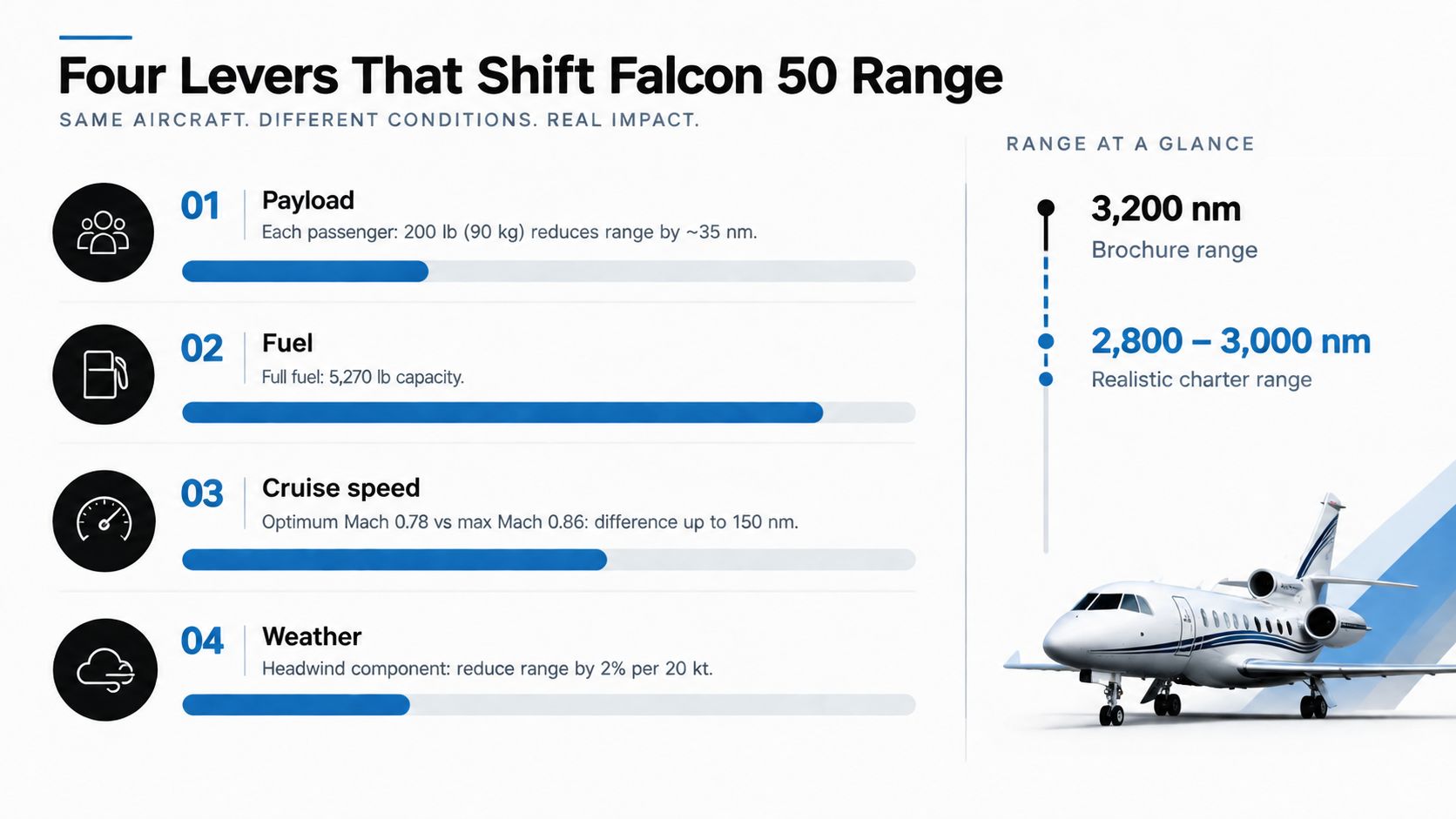
A Falcon 50's usable range starts with fuel, then gets divided among payload, reserves, weather protection, climb, and cruise speed. The aircraft has a total fuel capacity of 15,520 pounds across three separate fuel systems, and one Falcon 50 reference says that load supports about seven hours of nonstop flight with reserves, as detailed by Jet Advisors' Falcon 50 information.
Payload takes the first bite
Passengers and baggage matter because the aircraft must lift their weight for the entire flight. A light group with modest luggage gives the crew more flexibility to carry fuel, while a full cabin can force a choice between payload, fuel, and a technical stop. Don't accept a range answer until the operator has entered your actual passenger count and baggage estimate into the weight-and-balance calculation.
Reserve fuel is the second major constraint. The crew must protect against an alternate airport requirement, final reserve fuel, contingency planning, and weather deviations. Those reserves aren't spare fuel available for the advertised route. They're part of the mission requirement.
Speed and altitude change the calculation
Performance listings put the Falcon 50's cruise around 480 knots, with long-range missions commonly associated with roughly 3,000 to 3,260 nautical miles, according to Jet Advisors' Dassault Falcon 50 performance listing. A crew may choose a more economical cruise profile when the route is close to the aircraft's limit, but that can add time to the sector. North Atlantic clearances can also assign specific speeds, so the flight crew doesn't always have unlimited freedom to optimize the profile.
Weight affects altitude capability as well. A fully fueled, heavily loaded Falcon 50 may not reach its preferred cruise level immediately, and a lower initial altitude can increase fuel consumption until the aircraft burns weight and climbs. That's why range is a budget, not a fixed label.
Use the infographic as a planning prompt, but don't substitute generic assumptions for an operator's performance calculation.
The best charter quote will show how much fuel remains after landing, what alternate is planned, and whether the aircraft can carry the requested payload without eroding the reserve margin. If those details aren't visible, the range claim isn't ready for booking.
Real Routes the Falcon 50 Can and Cannot Fly
A Falcon 50 charters most reliably on routes below roughly 2,800 nautical miles with four passengers and favorable winds. New York to London sits near the upper end of practical use, so payload planning and reserve fuel must be deliberate.
| City Pair | Distance (nm) | Nonstop Feasibility | Notes |
|---|---|---|---|
| New York to London | Roughly 3,000 to 3,150 | Possible, load and winds dependent | Light loads and favorable winds help. Full seating creates a tighter margin. |
| Los Angeles to Honolulu | About 2,400 | Generally practical | Sits comfortably inside the Falcon 50's long-range cabin mission. |
| Miami to São Paulo | Near 3,400 | Stretch | Requires disciplined payload, reserve, routing, and weather planning. |
| JFK to LAX | About 2,150 | Comfortable | A straightforward transcontinental sector for the aircraft. |
| Dublin to New York | Beyond 3,200 with full payload and reserves | Often problematic | Full payload can push the trip beyond a comfortable nonstop plan. |
| United States East Coast to much of Asia | Beyond the practical envelope | Fuel stop normally required | Most such charters need a technical stop rather than a brochure-range assumption. |
The North Atlantic test
New York to London remains the clearest test of the Falcon 50's real-world range. With four passengers and a cooperative forecast, the aircraft can often make the crossing nonstop. Add a fuller cabin, heavier baggage, unfavorable winds, or a destination alternate, and the fuel margin tightens quickly.
The return flight needs its own calculation. Westbound Atlantic sectors can demand more fuel when winds reduce groundspeed. A quoted range figure has little value unless the broker also shows the planned direction, forecast conditions, payload, alternate, and landing reserve.
For route planning and the operational reasons behind a fuel stop, review this international private jet fuel stop guide. A technical stop adds time to the itinerary, requires another airport and handling plan, and can raise the charter cost through additional fuel-stop charges. The stop may still make the Falcon 50 workable on a route outside its comfortable nonstop envelope.
Airport flexibility is a genuine advantage when suitable nonstop options are limited. However, schedule certainty can justify choosing a newer, longer-range aircraft when the Falcon 50 requires a stop or leaves little room for changing winds and payload. Ask the operator for a route-specific performance calculation before treating the published range as a booking commitment.
Why Older Falcon 50s Need Extra Scrutiny on Long Trips
A recent AOG event, an approaching LLP overtake, or an overdue inspection can change a Falcon 50 charter plan quickly. Maintenance currency and dispatch history determine whether the aircraft can safely complete a long sector, not its age alone. A 30-plus-year-old tri-jet needs a tail-specific review before anyone treats brochure range as usable range.
Older engines, fuel-system components, airframe structures, and avionics can reduce the margin between book performance and a dependable mission. Payload, reserve fuel, and cruise profile still govern the flight plan, while maintenance condition determines whether the aircraft can deliver that plan consistently on a charter certificate.
Questions your broker should answer
Request clear answers before committing:
- Inspection currency: When was the last major inspection completed, and are significant inspections approaching?
- Engine condition: What is the current LLP status on all three engines, and what does recent trend monitoring show?
- Dispatch history: Has the aircraft had an AOG event or repeated cancellations during the prior 90 days?
- Oceanic capability: Does the avionics suite meet the planned route's communication and surveillance requirements?
- Insurance and approvals: Does the operator carry the required transatlantic insurance endorsement and authorization?
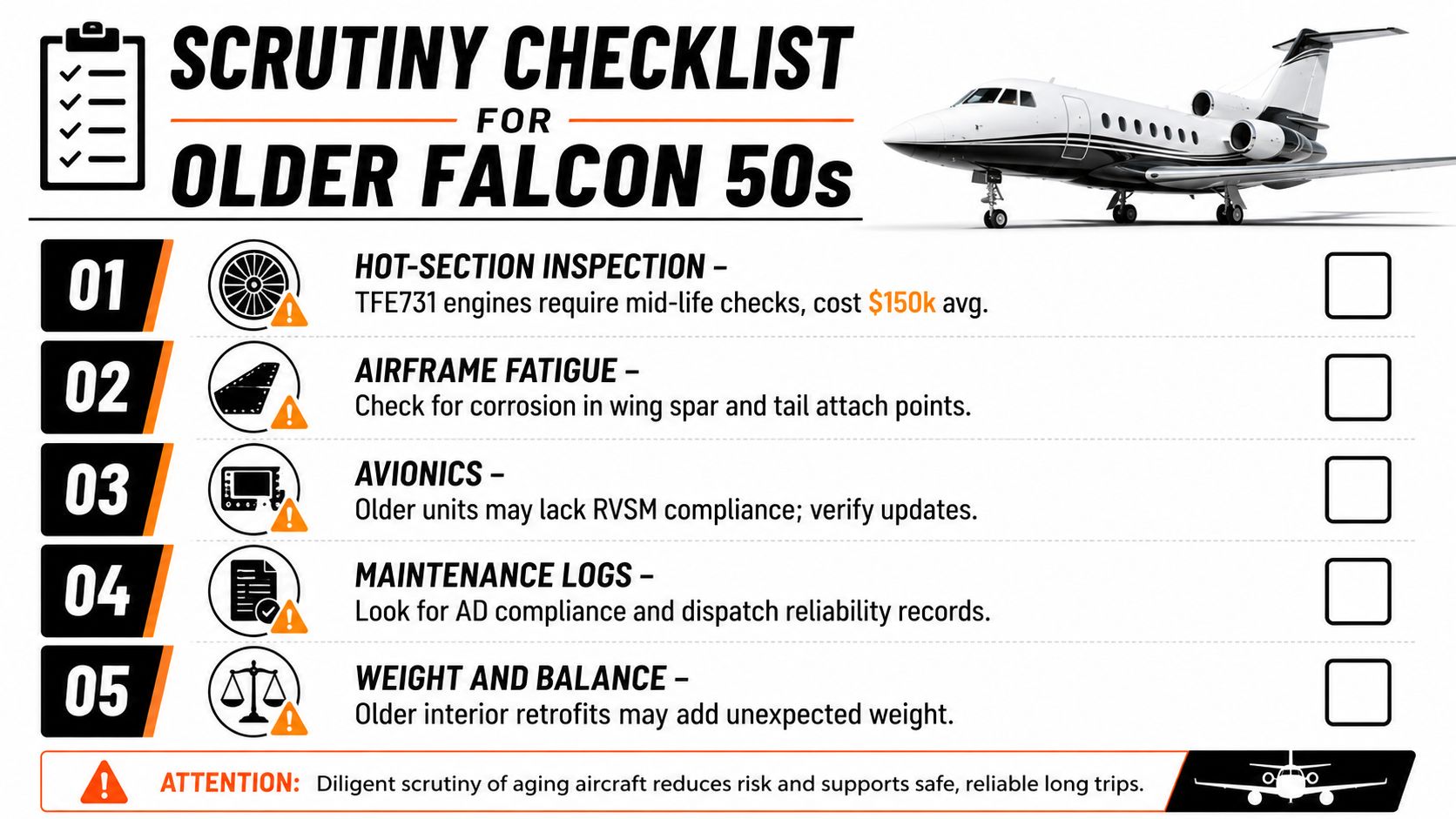
Maintenance timing deserves close attention. Maintenance references identify a 12-year landing-gear overhaul and a 6-year C-check timing. Support information also covers continued Dassault Falcon 50 series support and facilities able to handle major inspections, as summarized by Aircraft Exchange's Falcon 50 guide. Parts availability and disassembly activity can support the secondary market for components, but they do not guarantee quick turnaround for every operator or part.
Review the operator's maintenance program through this guide to MRO in aviation and flight safety. A well-maintained Falcon 50 can still cross oceans comfortably. Put its inspection status, engine condition, dispatch record, and approval status into the range calculation before approving the trip.
Deciding If the Falcon 50 Is Right for Your Itinerary
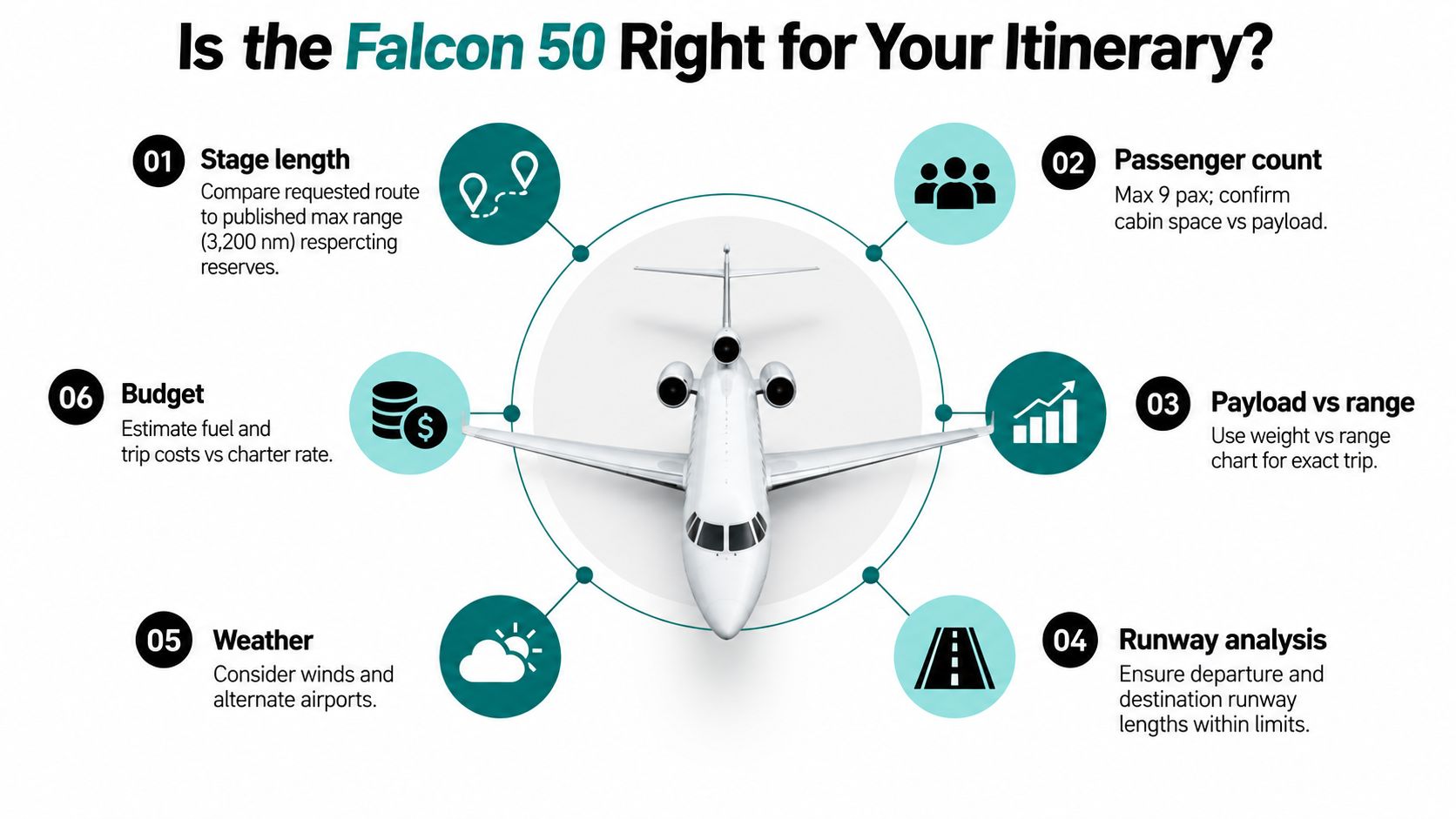
Run the quote through six checks before choosing the aircraft:
- Stage length: Compare the requested route with the published envelope, then demand a tail-specific calculation that respects reserves.
- Passenger count: Confirm that the cabin, baggage, and payload plan support every traveler without sacrificing the required fuel margin.
- Airport practicality: Verify parking, handling, customs, and fuel availability at both ends and at any planned alternate.
- Reserve planning: Ask the operator to identify the alternate and show that the reserve plan works for the forecast conditions.
- Aircraft currency: Confirm the last major inspection, engine condition monitoring status, dispatch record, and oceanic avionics capability.
- Alternative aircraft: If payload or stage length pushes the Falcon 50 toward its limit, compare it with a Challenger 604 or Falcon 900 rather than forcing the smaller mission.
For a specific quote, confirm that maximum takeoff weight allows full fuel with all bags and water. Ask whether the operator completed Engine Condition Monitoring trend analysis on all three Honeywell TFE731s within the last 60 days, and request confirmation that at least one suitable alternate is inside 200 nautical miles.
The Falcon 50 wins on a midrange transatlantic trip with 6 to 8 passengers when its airport access and lower operating rate make sense against aircraft such as a G150 or Citation X. It loses when the load is heavy, the leg is long, or the schedule has no room for an older-aircraft delay. In those cases, a newer twin or a larger long-range aircraft is the smarter hire.
Haute Jets can source a specific Falcon 50 or 50EX for your route, then compare its tail-specific range, payload, reserve plan, maintenance currency, and airport access against alternatives. Visit Haute Jets to request an on-demand charter quote built around the actual mission, not just the brochure range.