
You've got a red-eye booked, the calendar is already packed for the morning after landing, and the only real question is whether you'll arrive functional or wrecked. That's where flights with beds stop being marketing fluff and become a buying decision. Some products give you a true lie-flat seat, some give you a paid sleep add-on in economy, and some give you an actual private bedroom in the sky. Treat them as the same thing and you'll overpay, or worse, show up expecting a bed and get a recliner.
What Counts as a Flight With Beds
The phrase flights with beds sounds simple until you're standing at the gate, tired, and trying to decode airline language. One carrier says “flat bed,” another says “suite,” and a third sells a sleeping row in economy and calls it premium comfort. Those aren't the same product, and they're not priced the same way.
A proper comparison starts with three categories. First, there are commercial lie-flat seats in business and first class, the products that turned premium long-haul travel into a real sleep proposition around the year 2000, when lie-flat seating became mainstream and some major airlines had already fitted entire long-haul fleets with flat-bed cabins by the mid-2000s, according to a historical industry piece in WELT. Second, there are economy sleeper add-ons, like Air New Zealand's Skycouch and the new Skynest concept. Third, there are private aviation sleeping zones, from convertible divans to enclosed bedrooms on large-cabin jets.
That split matters because the same phrase covers radically different experiences. A lie-flat business seat is still a seat. A Skycouch is an extra-paid economy workaround. A private-jet bedroom is a different class of cabin entirely.
If you want a practical sleep strategy before you book, the advice in how to sleep on a long flight is a useful companion piece, especially if your route doesn't justify a premium bed product. For a private charter context, Haute Jets also keeps a dedicated overview of private jet sleeping overnight, which is worth reading if your trip is mission-critical and comfort can't be compromised.
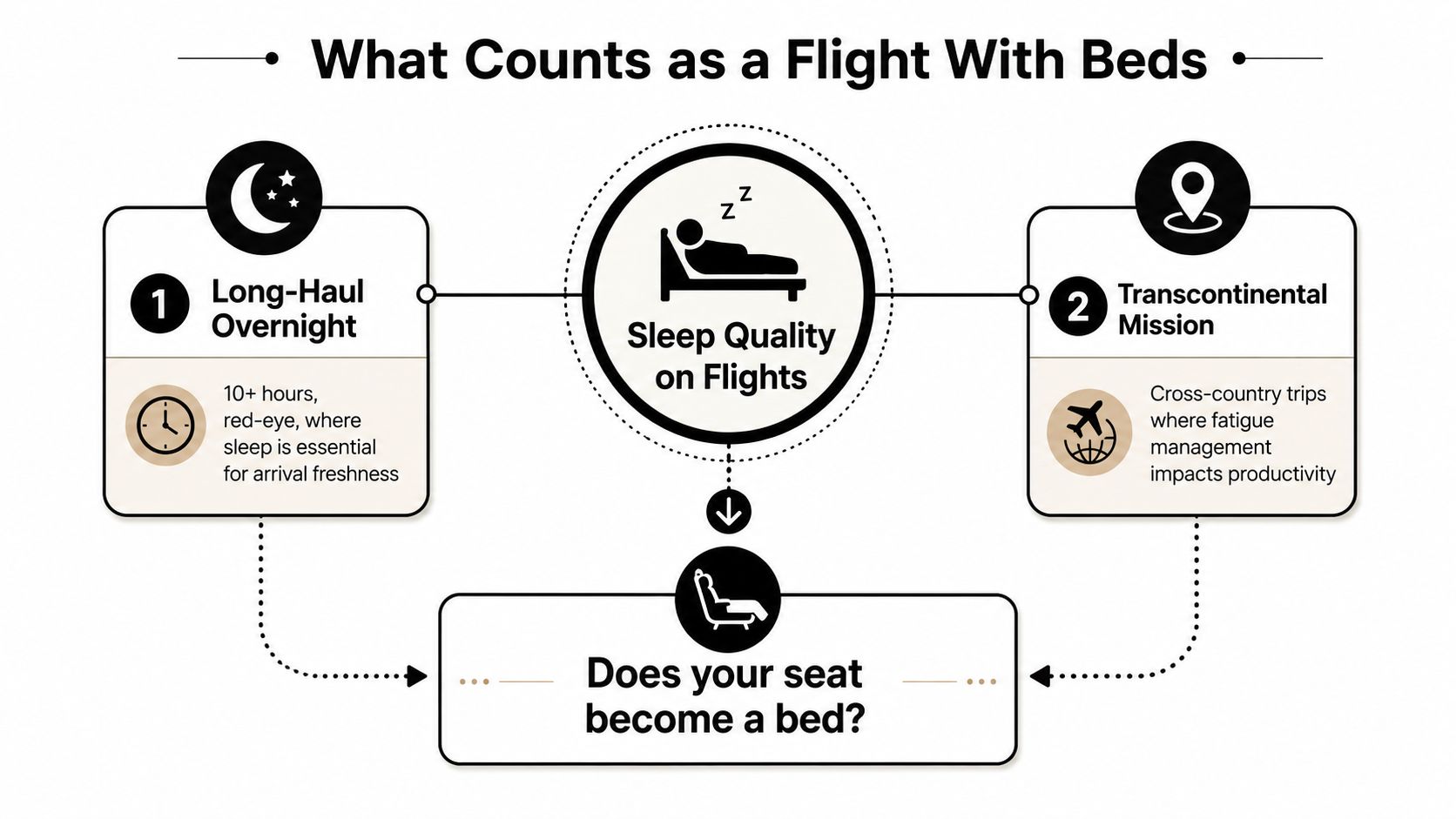
The fastest way to think about it is this. If you're on a long-haul overnight, you need to know whether your seat becomes horizontal. If you're on a transcontinental mission, you need to know whether sleep or productivity matters more on arrival. And if you're moving in the private market, you need to know whether the aircraft even has a true bed zone before you start talking about catering.
Practical rule: if the booking doesn't show the exact aircraft and seat type, don't assume the bed exists.
Lie-Flat Seats and First-Class Suites Explained
The core mechanism behind most commercial bed products is uncomplicated. A lie-flat seat reclines to a fully horizontal 180-degree position, so the seat surface becomes a sleeping surface rather than a steep recliner. That distinction is the whole game, because it separates a seat that can be slept in from one that only looks comfortable in the brochure. The basic definition is laid out clearly in Remitly's explanation of lie-flat seats, and it's the standard worth using when you're evaluating a long-haul cabin.
Lie-flat seats versus suites
A lie-flat seat can be excellent without being private. Some are wide, well-padded, and fine for actual rest, but they're still open to the aisle and often arranged in staggered rows. A first-class suite goes further. It usually adds closing doors, more enclosed storage, a separate ottoman or companion seat, and a cabin layout that feels more like a room than a row.
That's why products like Emirates A380 and 777 first class, Qatar's Qsuite on A350 and 777, and JetBlue Mint on A321LR transatlantic routes matter. They show how the market has moved from “flat seat” to “private sleeping space” without always using the same words. A suite is not just a lie-flat seat with fancier branding, it's a privacy product.
A hotel-trained eye helps here too. If you're used to good bedding at home, you already know the difference between a mattress that just lies flat and a sleeping setup that supports rest. The same mindset applies to cabins, and the comparison with guide to luxury bedding at home is useful because airline bedding is about layers, support, and separation, not just plush marketing copy.
Commercial bed products at a glance
| Product | Mechanic | Privacy | Typical Route |
|---|---|---|---|
| Business-class lie-flat | Seat converts to a horizontal bed | Moderate to high, depending on layout | Long-haul international and some premium domestic routes |
| First-class suite | Enclosed or semi-enclosed private space with bed surface | High | Long-haul premium international |
| Suite-style business product | Lie-flat seat with doors or added enclosure | High for business class | Select intercontinental routes |
| Premium transatlantic mint-style product | Flat sleeping surface in an upgraded business cabin | Medium to high | Long-haul premium routes, especially transatlantic |
The straight answer is simple. If privacy matters most, book a suite. If sleep matters most and the aircraft is confirmed, a lie-flat seat is usually enough. If you want marketing language to do the work for you, you'll get burned.
Economy Sleeper Add-Ons That Actually Work
Economy sleep products used to be a gimmick. That's changed, and some of the newer offerings now deserve real attention. They're still not business class, but they're no longer just a clever seat map trick either.
Air New Zealand's Skynest is the clearest example of where economy sleep is heading. The product is designed as six lie-flat sleeping pods arranged in three tiers, each bookable for a four-hour duration. At launch, the airline said two sessions per flight would be offered and each passenger would be limited to one session, with reservations opening on May 18 for travel beginning in November. The pods measure about 6.5 feet long and 25 inches wide at the shoulders, and they include a pillow, linens, blanket, privacy curtain, amenity kit, ventilation, USB and USB-C charging, and a reading light, according to Forbes Travel Guide's coverage of Skynest.
What economy sleepers actually buy you
The upside is obvious. You're getting a dedicated sleep zone without paying for a full business seat. That can make sense on ultra-long-haul travel where the cash gap is brutal and the main goal is to arrive less destroyed. The tradeoff is equally obvious. Privacy is limited, availability is capped, and the product only works on specific aircraft and routes.
Air New Zealand's earlier Economy Skycouch is a different but equally practical solution. It converts a row of three economy seats into a lie-flat bed with crew assistance. In a cited dummy booking for Auckland to New York JFK, the add-on was listed at NZ$1000, about US$604, on top of the economy fare, as reported by Simple Flying. That's not cheap, but it's still a different proposition from paying for business class outright.
United's upcoming Relax Row shows that the category is expanding rather than disappearing. Business Insider reported that it will be added to more than 200 Boeing widebody aircraft by 2030. That's a projection, but it tells you where the industry is heading. More airlines are carving out sleep-friendly economy products because some travelers want rest, not champagne service.
My read: economy sleep products are worth considering when the alternative is ordinary economy and a business ticket is out of reach. If the fare gap to lie-flat business is manageable, take the business seat instead.
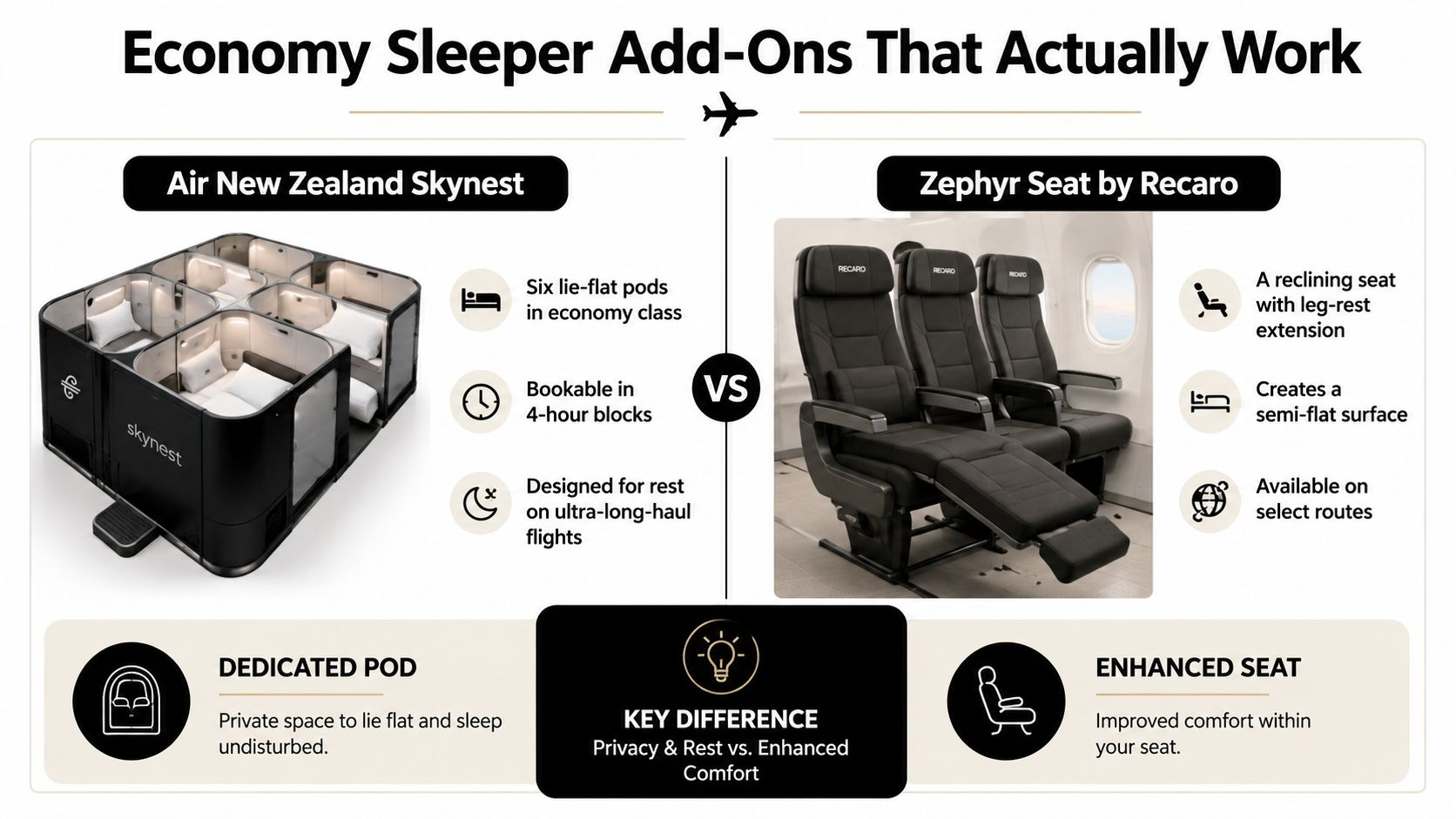
The blunt recommendation is this. Choose Skynest if you want a real rest block and the route supports it. Choose Skycouch if you're traveling as a couple or with a child and can live with an economy cabin. Choose Relax Row only if the airline gives you a materially better sleeping setup than standard seating and the price is still meaningfully below business.
How to Verify You Are Actually Getting a Bed
Most disappointment comes from assuming the brand name tells the whole story. It doesn't. Aircraft swaps happen, schedules shift, and the same airline can sell wildly different products on different segments of the same trip. That's why “bed seat” is something you verify, not something you trust.
Check the aircraft, not just the airline
Start with the booking confirmation and look for the exact aircraft type. If the ticket only says the carrier name and route, keep digging until you see the operating equipment. Then cross-check the seat map to confirm that the cabin contains lie-flat rows, suite doors, or the economy sleep product you expected. Lie-flat seats are concentrated on long-haul widebodies and only appear on some premium domestic routes, as noted in the Seats.aero guide to finding lie-flat bed seats.
The practical workflow is straightforward:
- Confirm the aircraft type: Don't book off a generic route description. Check the specific plane assigned to your segment.
- Inspect the seat map: Look for flat-bed rows, suite layouts, or a sleeping row that matches the product name.
- Watch for swaps: If the airline changes equipment, call immediately and recheck the cabin layout.
- Ask before payment: If you're booking through a broker or charter desk, ask which aircraft and cabin layout are being held for you.
Ask the right questions before you pay
A good operator or broker can tell you exactly what you're getting. If they can't name the aircraft type, cabin configuration, and whether the sleeping surface is a true lie-flat or a converted row, keep shopping. That's especially true on mixed fleets, where one segment may be a premium bed product and the next may not be.
For charter buyers, a cabin-features checklist should be part of the conversation before the deposit. Haute Jets publishes a useful cabin features guide on Haute Jets charters, and the logic is the same whether you're booking commercial or private. Verify the exact configuration, not the promise.
A simple rule saves money and avoids bad surprises. If the seat map and the aircraft type don't match the marketing image, don't book on faith.
Private Jet Bedrooms and Where They Actually Exist
True private-jet bedrooms live in a very different category from commercial lie-flat seats. You're not just buying more recline, you're buying cabin volume, privacy, and a sleeping space that isn't shared with strangers. That only happens on aircraft large enough to support it.
The aircraft that can actually carry a bedroom
Industry coverage consistently points to the Gulfstream G700 and G800, Bombardier Global 7500 and Global 8000, and Embraer Lineage 1000 as aircraft that can be configured with a full-size bed or master suite. The key feature is space. These are heavy and ultra-long-range cabin aircraft, which gives designers room for a dedicated sleeping zone, privacy door, and, on some layouts, an ensuite-style configuration. That's why requests for a true bed on a Phenom 300 or Citation Latitude usually end up with a divan or a lie-flat seat instead.
The private jet bedroom concept is described clearly in BlackJet's overview of private plane beds, and the same aircraft categories are echoed in Global Charter's guide to private jet bedrooms. The takeaway is obvious. If you want a real bedroom, the aircraft class itself has to support it.
How sourcing works in practice
You don't ask for a bedroom and hope for the best. You source from aircraft that already have the right cabin geometry. A proper charter desk matches the route, departure city, and cabin layout before the trip is confirmed, which is how you avoid dead-end searches and awkward compromises. That's particularly useful for overnight intercontinental missions where arrival readiness matters more than cabin novelty.
If you're trying to source a mission with a true bedroom rather than a convertible couch, the aircraft list matters more than the brand on the outside of the plane. That's exactly why the route, the cabin, and the interior spec need to be treated as one decision.
A useful reference point is Haute Jets' breakdown of why the Bombardier Global 7500 is the ultimate charter plane for elite travelers, because the aircraft category itself is what makes the bedroom possible. If the cabin can't support a separate sleeping zone, no amount of sales language fixes that.
What It Costs to Sleep in the Air in 2026
Price is where the story gets real. A lot of travelers talk themselves into expensive comfort because they compare the wrong things. A smart comparison starts with the sleep outcome you need, then maps that to the cheapest product that delivers it.
Commercial lie-flat seats are the default premium option on long-haul flights, and they usually sit between standard economy and true suite-level first class in both comfort and price. The problem is that the exact fare swings by route, aircraft, and booking window, so anyone pretending there's one clean number is guessing. First-class suites sit above that again, because you're paying for enclosure and exclusivity as much as sleep.
Economy sleep add-ons are where the value conversation gets sharper. Skycouch has a concrete extra cost example, NZ$1000, about US$604, on Auckland to New York JFK, and that tells you it's not a bargain-basement upgrade, just a cheaper rest option than premium cabins on many routes. Skynest is even more specialized, because you're buying a timed sleep block rather than a whole seat. That makes it useful on ultra-long-haul flights where you want a protected rest window and don't care about sitting in that zone for the full journey.
Private jet bedrooms are in a different pricing universe entirely. The economics depend on aircraft type, route, and whether the jet is already based near departure, since repositioning can distort the bill fast. The important comparison isn't private versus commercial in the abstract, it's whether the trip justifies paying for a dedicated cabin and full itinerary control. For time-sensitive or privacy-heavy travel, that trade can make sense. For a regular overnight commute, it usually doesn't.
The cleanest rule is this. Buy the least expensive product that still gives you the sleeping experience your trip demands. If the route is commercial and the aircraft is confirmed, fly lie-flat. If the budget is tighter, consider an economy sleeper. If the mission requires a true bedroom and schedule control, book the private cabin.
Booking Tips and How Haute Jets Sources True-Bed Aircraft
The decision tree is simpler than most travelers make it. Use commercial lie-flat when the aircraft and cabin are confirmed on a scheduled route. Use economy sleepers when you want real rest but can't justify premium cabin pricing. Use private-jet bedrooms when privacy, timing, or route constraints make commercial travel the wrong tool.
For private missions, the sourcing model matters more than the brand name on the invoice. Haute Jets sources from 3,500+ owner-operators across 175 countries, which gives access to aircraft near departure rather than forcing a repositioned plane into the trip. That matters because repositioning fees are what often inflate traditional charter prices by 20 to 40 percent, and operator-direct sourcing is how you avoid paying for empty ferry legs you never wanted.
The booking logic is straightforward:
- Commercial lie-flat: Book when the exact aircraft and seat map are confirmed, especially on long-haul widebodies.
- Economy sleeper: Choose when the trip is long, the budget is tight, and you're comfortable with less privacy.
- Private bedroom: Use when you need a real sleeping zone, not just a flat seat, and the aircraft category has to match that need.
Bottom line: don't buy a cabin type, buy the sleep outcome.
If you need a true-bed aircraft near departure, operator-direct sourcing is the cleanest path. It keeps the search focused on the right cabin class, the right aircraft, and the right departure city, which is where most charter requests either get expensive or fall apart. For travelers who care about exactly what they'll get, that beats generic marketplace browsing every time.
A CTA for Haute Jets. If you need a flight with a true sleeping setup, not marketing copy, send the route, timing, and preferred cabin layout, and have the aircraft matched before you pay.