

You've asked for a private jet quote, and the broker has sent a polished PDF with a cabin category, an hourly range, and a reassuring availability note. That isn't enough to approve the flight. The aircraft's location, the operator behind it, the exact tail number, repositioning requirements, and verifiable safety credentials can change both the price and the experience.
The right way to fly private charter is to treat the booking as a procurement decision. You're not buying a brochure or a vague aircraft category. You're selecting a specific asset, operated by a specific certificate holder, coordinated through a specific airport network, for a defined mission.
What Flying Private Charter Actually Means in 2026
Private charter is a large transportation market, not merely an occasional luxury purchase. One market estimate values global private jet charter services at USD 24.12 billion in 2025, with a projection of USD 27.38 billion in 2026 and USD 45.43 billion by 2030, implying a 13.5% CAGR over that forecast period. Another estimate places the market at USD 17.67 billion in 2026, growing to USD 25.79 billion by 2031 at a 7.86% CAGR, so analysts disagree on the baseline while agreeing that demand is expanding. Market estimates and regional outlook
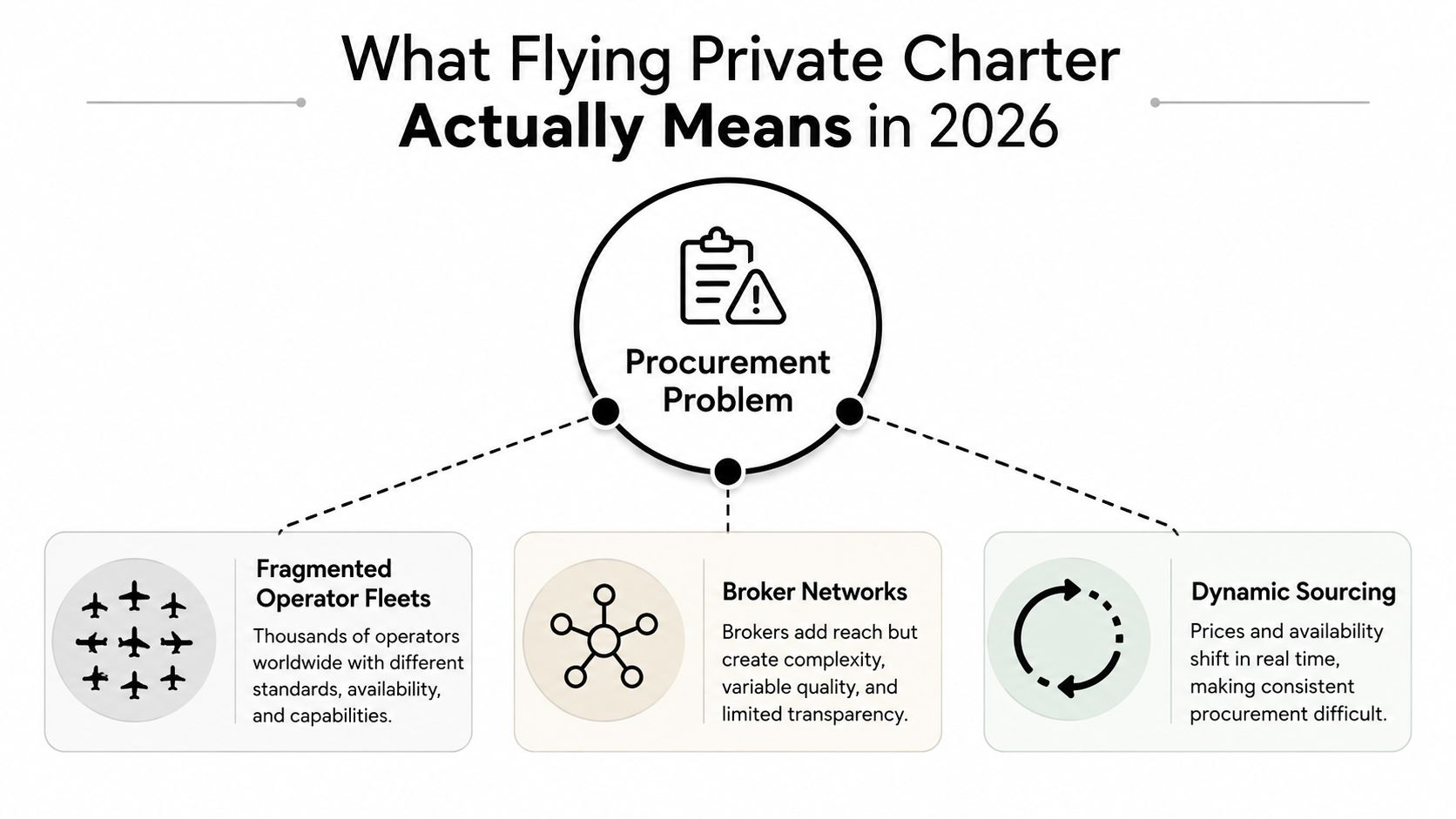
That scale creates a fragmented buying environment. A charter broker may source an aircraft from an operator's fleet, another broker's network, or a third-party provider with availability near your departure airport. The operator holds the legal operating authority, the broker manages sourcing and client coordination, the tail number identifies the aircraft assigned, and the FBO handles the physical airport experience.
Decode the quote before you compare it
Several terms deserve attention:
- Wet lease: An arrangement that includes the aircraft, crew, maintenance, and insurance from the provider operating the flight.
- Dry lease: An arrangement involving the aircraft without the operating crew and complete operational package.
- Ferry or repositioning leg: An aircraft movement to or from your origin that exists to facilitate the charter, not to carry you.
- Deadhead: A crew or aircraft movement without the revenue passengers.
- FET: Federal Excise Tax, normally shown separately or incorporated into the final total when applicable.
The most important question is simple: where is the aircraft now? Repositioning, taxes, and landing fees can add 20% to 40% to a base charter rate, according to private jet cost guidance from BLADE. An aircraft already positioned near your departure city can therefore outperform a cheaper-looking quote from a distant aircraft.
Procurement rule: Ask for the operator's legal name, the exact tail number, the aircraft's current location, and a written all-in price before you discuss convenience.
Private aviation's business role also predates today's broker platforms. The Learjet's introduction in 1963 helped establish modern jet-powered private aviation, while the Lockheed JetStar first flew on 4 September 1957. An academic review found that, in the United States in 2015, two-thirds of 24 million general aviation flight hours were for business purposes. Academic research on business aviation
How to Book a Private Jet From Inquiry to Wheels Up
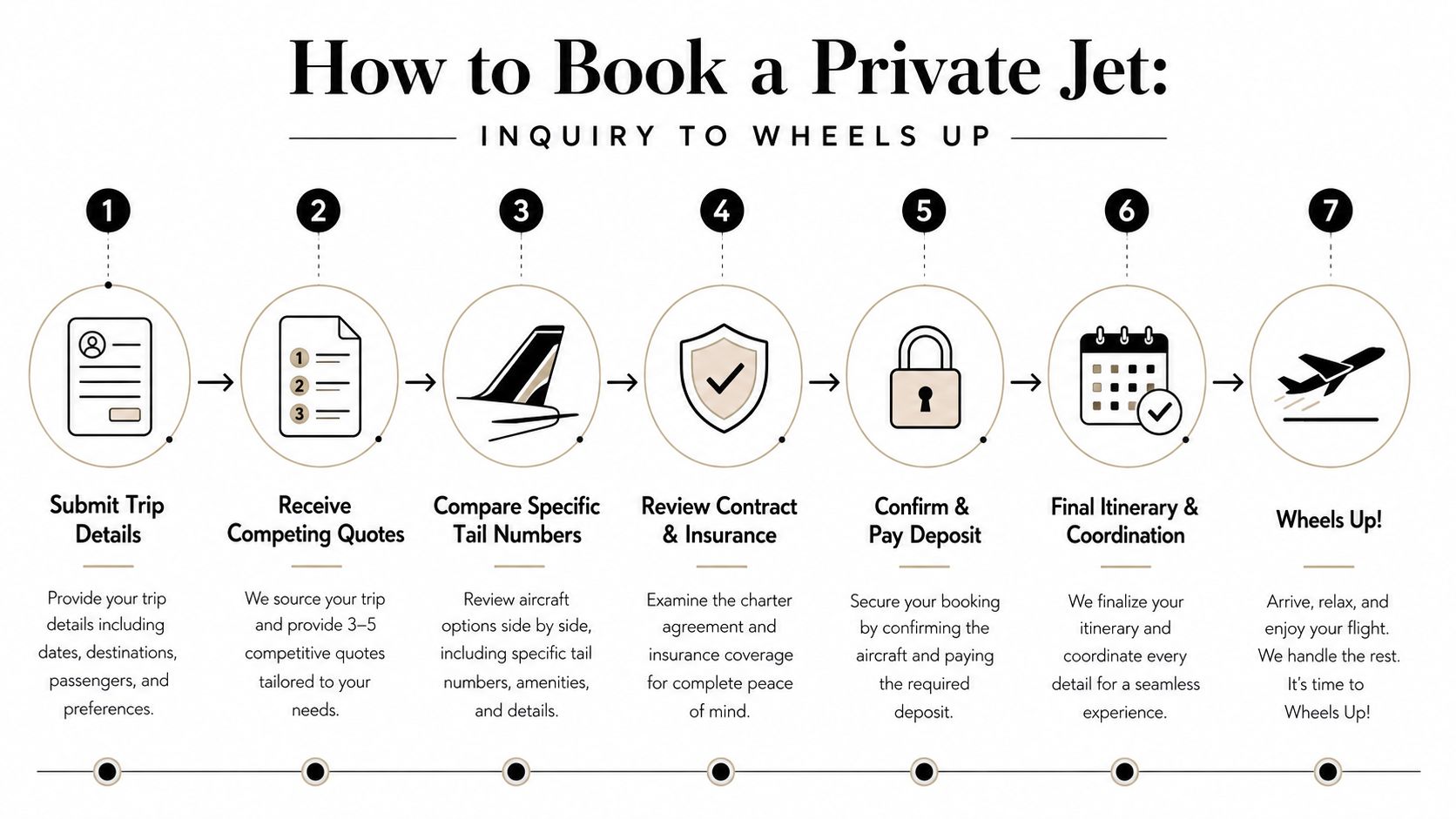
Start with a complete request. Give the broker your departure and arrival airports, preferred date and time, passenger count, luggage, pets, catering needs, and any special requirements such as Wi-Fi, a flat floor, or international customs handling. Missing details produce provisional quotes, and provisional quotes are where substitutions and extra fees begin.
Use this sequence:
- Submit the trip details. Include realistic luggage and pet information. A light jet that works for six passengers may not work once ski equipment or multiple large cases are added.
- Request competing quotes. Obtain proposals from 3 to 5 vetted brokers or operators, then compare more than the headline hourly rate.
- Identify the aircraft. Require the exact make, model, year, cabin layout, and tail number. “Midsize jet” is a category, not an aircraft.
- Verify the operator. Match the operator's legal name and certificate details to the aircraft and proposed flight.
- Review the agreement. Read cancellation windows, aircraft substitution language, FET treatment, deadhead charges, weather diversions, overnight crew terms, and payment conditions.
- Confirm the booking. The aircraft isn't locked until the required deposit or payment is received and the operator confirms acceptance.
- Reconfirm before departure. Request the final tail number, crew details, itinerary, and FBO information 24 hours before departure. Arrive at the FBO 15 to 30 minutes before wheels up.
The cleanest price control is local sourcing. Ask the broker to search for aircraft already based near the departure airport, then ask whether any empty-leg options fit your schedule. Empty legs are repositioning flights sold after a one-way charter, and industry explanations describe discounts of as much as 75% versus standard charter pricing. How empty-leg flights work
Use this private jet booking guide for 2026 as a reference, but keep control of the commercial details yourself. Before signing, send these questions in writing:
- What is the exact tail number and current aircraft location?
- Which legal operator will conduct the flight?
- Are repositioning, taxes, FBO fees, catering, and crew expenses included?
- What happens if the aircraft is substituted?
- Does a substitution preserve the cabin class, luggage capacity, Wi-Fi, and onboard amenities?
- What are the cancellation and weather-diversion terms?
- When will the final crew and tail details be confirmed?
A broker who can't answer those questions clearly hasn't given you a complete quote.
Choosing the Right Aircraft for Your Mission
Choose the mission first, then the cabin. A jet that looks impressive on a proposal can be wasteful for a short route, while an undersized cabin can create a miserable trip once passengers, luggage, pets, and weather requirements are considered.
| Cabin Class | Typical Models | Seats / Range | All-In Hourly Rate | Best Mission |
|---|---|---|---|---|
| Light jet | Phenom 300, Citation CJ3+ | 6 to 7 passengers, shorter regional missions | $3,500 to $5,500 per hour | Short business trips and efficient regional travel |
| Midsize | Citation Latitude, Hawker 900XP | Stand-up cabin, range suited to longer regional missions | $5,000 to $7,500 per hour | Trips requiring more cabin comfort and luggage capacity |
| Super-midsize | Challenger 350, Citation Sovereign+ | Transcontinental capability, small galley, flat floor | $7,000 to $10,000 per hour | Longer domestic missions and larger groups |
| Heavy and ultra-long-range | Gulfstream G450, Gulfstream G550, Global 6000 | Lie-flat sleeping arrangements and long-range capability | $11,000 to $18,000 per hour | Intercontinental travel and overnight missions |
These model examples and ranges are supplied as planning benchmarks for this guide. Treat them as comparison points, not guaranteed quotes. Actual pricing still depends on the aircraft's location, operator, route, schedule, and inclusions.
Match the cabin to the route
A New York to Miami trip may fit a light or midsize jet, depending on passenger count and luggage. Paying for a heavy jet because it offers a larger cabin is poor procurement unless you need the space, range, or sleeping arrangement.
Los Angeles to Vail requires more careful airport and performance planning. A light jet may work for a small party, but luggage volume, runway conditions, and winter operations can justify a midsize or super-midsize aircraft.
For London to Dubai, move immediately into the heavy or ultra-long-range conversation. The value comes from range, cabin endurance, crew planning, and sleeping comfort, not from the prestige of the badge on the fuselage.
Ask about the actual cabin
The same model can have different interiors, seating layouts, Wi-Fi systems, and baggage configurations. Ask for current cabin photographs, the tail number, the number of seats in the proposed layout, and confirmation that the quoted aircraft can carry your bags without compromising the mission.
A category quote protects the seller. An identified aircraft protects you.
What Private Jet Charter Really Costs
The hourly rate is only the first line. Recent independent coverage places charter pricing across a broad range of roughly $2,200 to $18,500 per hour, reflecting major differences in aircraft type, route, positioning, and service scope. Private charter pricing overview
| Cost Component | Typical Range | How to Control It |
|---|---|---|
| Base aircraft rate | Varies by cabin and aircraft | Compare the same aircraft class and mission |
| Repositioning or ferry legs | Can materially increase the quote | Source an aircraft already near departure |
| Federal Excise Tax | 7.5% of the base where applicable | Require the tax treatment in writing |
| Federal Segment Tax | Applies where relevant | Ask whether it's included or passed through |
| Overnight crew charges | Depends on multi-day itinerary | Ask for the daily crew policy before booking |
| Catering, deicing, and international handling | Route and service dependent | Request itemized inclusions |
| FBO facility fees | $200 to $1,500 per landing | Compare airports and ask which fees are included |
The largest hidden variable is usually repositioning. A broker may quote your passenger legs while adding aircraft movement before departure or after arrival. Industry commentary defines repositioning fees as charges for moving an aircraft to or from the trip origin purely to facilitate the charter, and notes that same-day or off-base flying is especially exposed to those costs. Repositioning fee explanation
Request two totals: the base charter amount and the fully inclusive trip total. The second figure should identify aircraft time, repositioning, FET, segment taxes, landing and handling fees, crew expenses, catering, deicing, and international charges. Don't transfer a deposit against a verbal range.
You'll find a more detailed framework for reviewing the invoice in this private jet charter cost guide. Pay particular attention to cancellation terms and substitution language. A low quote that lets the operator replace a selected aircraft with a smaller or less capable model isn't a low-risk quote.
Wyvern and ARGUS Ratings Explained and Verified
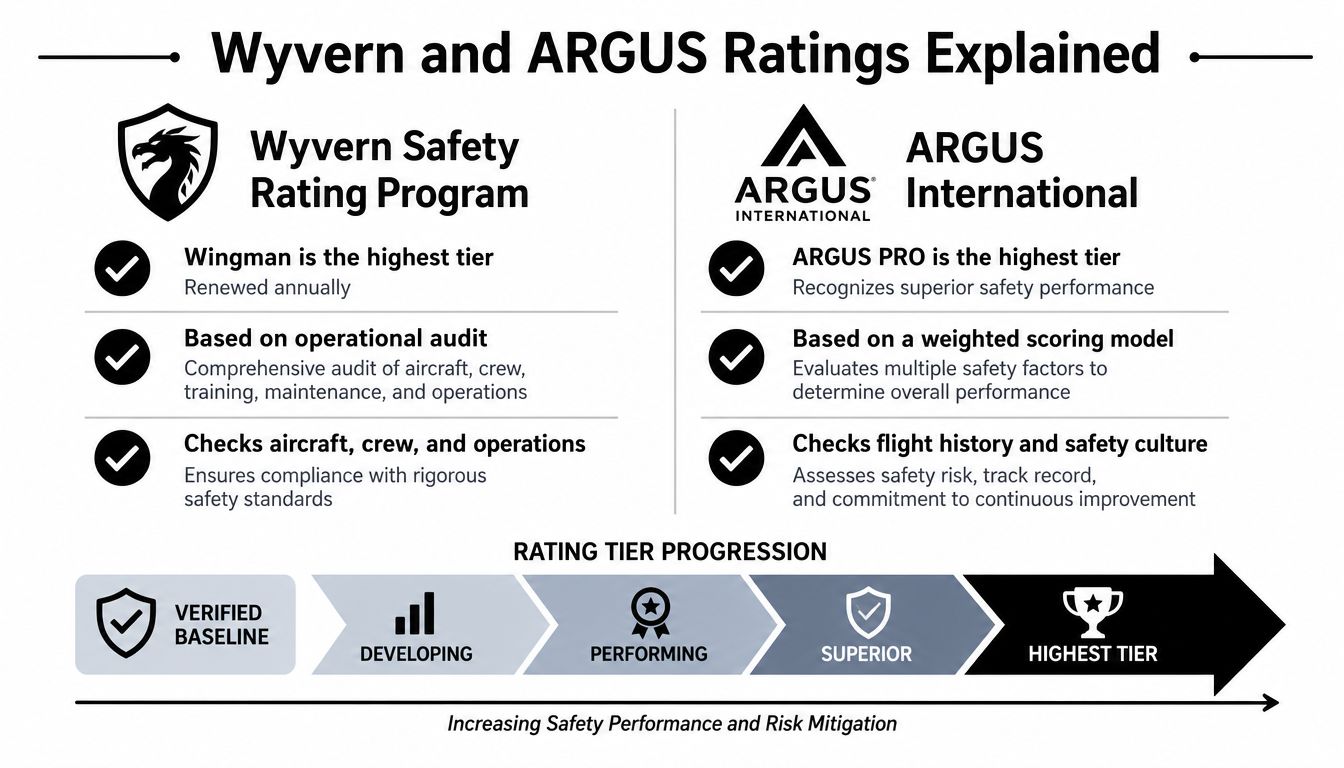
Third-party safety audits are useful screening tools, but they're not magic words. WYVERN Wingman and ARGUS Gold or Platinum reviews examine elements such as operational control, maintenance, safety management, crew training, and pilot qualification records. Industry explanation of WYVERN and ARGUS ratings
The systems are tiered. WYVERN includes Wingman and Wingman Certified levels, while ARGUS includes Gold, Gold Plus, and Platinum. Higher levels indicate more extensive operational review, not merely a different marketing badge. Overview of the rating tiers
Verify the certificate, not the brochure
Run this checklist before payment:
- Legal operator: Confirm the exact legal name of the certificate holder.
- Active status: Request the certificate number, expiration information, and confirmation that the certificate is current.
- Audit tier: Identify whether the operator holds WYVERN Wingman, Wingman Certified, ARGUS Gold, Gold Plus, or Platinum.
- Audit timing: Ask for the date of the most recent audit. Industry guidance says the WYVERN evaluation recurs at least every 24 months, while ARGUS Platinum generally requires Gold Plus standards plus safeguards such as an emergency response plan and safety management system. Safety-rating verification guidance
- Aircraft match: Cross-check the proposed tail number against the operator's authorized operations.
- Crew suitability: Ask for pilot total time on the aircraft type and the SMS program description.
A rating applies to the operator's audited system, not to a particular passenger itinerary. A highly rated operator flying an unfamiliar tail still deserves scrutiny. The strongest practical screen combines a credible audit tier, an authorized aircraft, and a crew experienced on that specific airframe.
You can also review this deeper guide to WYVERN and ARGUS safety ratings before comparing operators.
The FBO Experience From Curbside to Cabin
A Fixed-Base Operator, or FBO, is the private aviation terminal where your charter begins. Don't look for a commercial jet bridge. In many cases, your driver pulls up to a separate entrance near a hangar, often marked by a modest sign rather than a large terminal façade.
Your luggage is usually handled at the curb and taken directly to the aircraft. Inside, a concierge checks identification and the passenger manifest, then directs you to a lounge with seating, refreshments, espresso, Wi-Fi, and often a quiet room. Catering arranged through the broker or FBO is delivered to the aircraft, not necessarily served in the lounge.
For international flights, customs and immigration are generally handled within the FBO rather than the main commercial terminal. Bring a current passport and allow the FBO team to explain the required process before arrival. The walk from the lounge to the aircraft is usually short, often only a few minutes, but ramp access depends on airport procedures and weather.
FBO selection is frequently made by the operator and may never appear in the initial quote. If the location matters because you're departing from Manhattan, central London, Miami, or another congested metro area, specify your preferred airport and FBO during inquiry.
Ground transport should be coordinated at the same time as the aircraft. Depending on airport rules, the FBO may stage a vehicle near the aircraft, or your driver may meet you at the terminal entrance. Ask who controls the handoff, where the vehicle waits, and whether the driver has clearance for ramp access.
Why On-Demand Charter Beats Jet Cards for Most Flyers
Jet cards sell predictability, but the contract often buys a narrower product than the marketing suggests. You may receive a defined aircraft category while still paying repositioning, FET, empty-leg treatment, peak-day premiums, and other charges. Guaranteed availability also has limits when the program can substitute aircraft or impose booking restrictions.
The supplied comparison for this guide places a light-jet card rate at $5,200 per hour, versus an on-demand light-jet quote commonly ranging from $3,800 to $4,500 per hour. Those figures are planning examples, not universal market rates. The important point is structural: a card can carry a higher rate before the same pass-through costs appear.
| Metric | Jet Card, Light Jet | On-Demand Charter, Light Jet |
|---|---|---|
| Payment structure | Prepaid hour block or membership commitment | Pay per confirmed trip |
| Aircraft choice | Category-based, subject to program terms | Specific aircraft can be requested |
| Availability | Program rules and peak-period conditions apply | Depends on live market availability |
| Repositioning | May still be passed through | Can be reduced through local sourcing |
| Taxes and fees | FET and other charges may remain separate | Itemized in the trip quote |
| Best fit | Frequent, predictable utilization | Irregular or mission-specific travel |
Why local sourcing matters more than membership
An on-demand broker can search for an aircraft already near your departure city, compare several operators, and identify an exact tail number before you commit. Empty-leg availability can further reduce the price when your schedule is flexible, although the route and timing must fit the aircraft's existing movement.
For occasional flyers, that flexibility usually matters more than a promise of simplicity. A capable broker still provides one point of contact, manages catering and ground transport, and coordinates the final itinerary without requiring you to lock capital into a prepaid block. If the trip involves airport transfers, a resource such as executive transport by Max's Luxury Rides can help coordinate the ground segment separately from the aircraft booking.
Jet cards deserve consideration when your travel is frequent, predictable, and operationally repetitive. They shouldn't be the default for someone booking irregular leisure trips, executive travel, or route-specific missions. Compare the complete annual commitment, not just the advertised hourly figure, and demand clarity on substitutions, blackout periods, peak pricing, and pass-through fees.
Haute Jets offers on-demand charter sourcing with no membership requirement, using a network of aircraft and operators while confirming the specific aircraft, tail number, crew, and pre-flight details. Visit Haute Jets with your route, schedule, passenger count, and luggage requirements, then ask for a fully itemized quote built around an aircraft positioned near your departure airport.