
A lot of pet owners start the same way. They've booked their own seat, bought the carrier, checked the airline's pet page, and feel reasonably prepared. Then they reach the airport and learn the flight won't accept a small dog in cabin on that route, or the check-in agent spots a microchip issue that no one flagged earlier, or the health certificate falls outside the airline's document window.
That's when international pet travel stops feeling like travel and starts feeling like logistics.
The stress is understandable. Over 4 million pets are transported by air globally each year, reflecting a 19% increase in annual pet travel over the last decade, according to Condor Ferries pet travel statistics. More people are doing this. That doesn't mean the process has become forgiving. In practice, it's still rigid, document-heavy, and full of airline-specific exceptions.
The hardest part is that owners usually don't fail because they ignored the big items. They fail on the hidden ones. A route-specific in-cabin restriction. A certificate endorsed too early. A crate that looks airline-approved but doesn't meet the exact hardware standard. A well-meaning vet visit booked on the wrong day.
That's why this article appears on Haute Jets Journal with a practitioner's lens. Flying with pets internationally works when you treat it as a timed sequence, not a casual add-on to your own booking. If you get the sequence right, check-in is straightforward. If you get it wrong, the penalty is rarely minor. It's usually denied boarding, forced cargo handling, or quarantine complications on arrival.
Introduction
A familiar scene plays out at international check-in. A traveler arrives with a small dog, soft carrier in hand, and a printout from the airline website showing that pets are allowed in cabin. The desk agent looks up the route and says this flight doesn't permit in-cabin pets across that border. The owner argues. The website was clear, at least on the summary page. The agent points to a buried policy document and offers two choices: cargo reassignment, if space exists, or no travel that day.
The same thing happens with paperwork. Another owner has a healthy pet, current vaccines, and a certificate from a veterinarian. Everything looks fine until the airline notices the issuance date is outside its acceptance window. The destination country may still accept the document, but the carrier won't.
Those surprises are why experienced planners obsess over details that look small on paper. A microchip format. The order of chip placement and rabies vaccination. Written booking confirmation from the airline's pet desk. The exact route, not just the airline brand.
Practical rule: The pet policy that matters is the one attached to your aircraft, route, and date, not the marketing summary on the homepage.
Owners often assume the hard part is keeping the pet calm. That matters, but compliance is what determines whether the journey starts at all. Once you understand that, your planning improves immediately. You stop asking, “Does this airline allow pets?” and start asking, “Does this exact itinerary allow my specific pet under this document set and this crate setup?”
Pre-travel Planning and Checklist
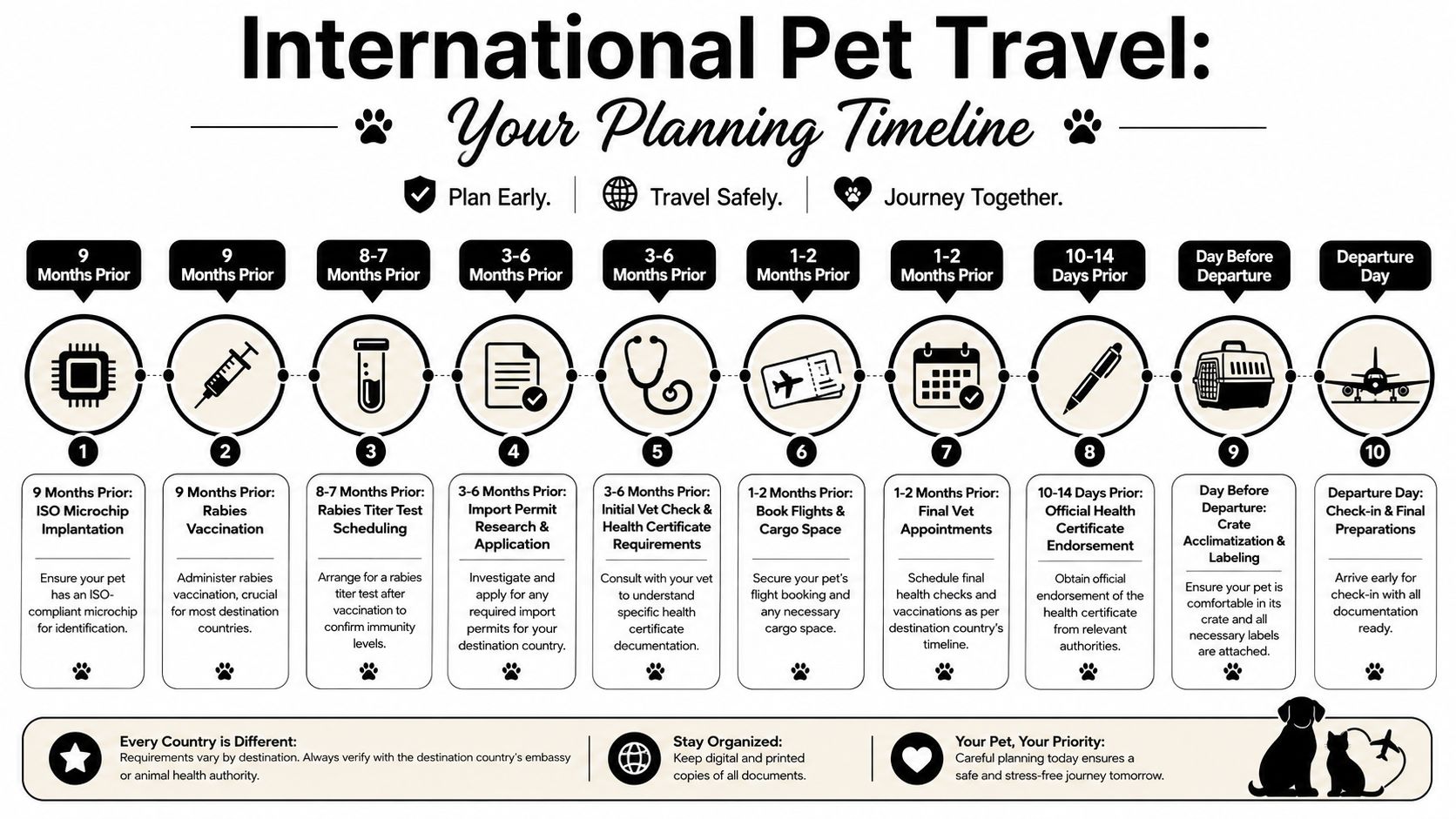
A workable international pet plan starts with dates, dependencies, and the exact route. Owners get into trouble when they book around vacation schedules first and try to fit the pet paperwork around it later. The safer approach is the reverse. Set the pet timeline first, then place flights, hotels, and transfers around it.
Start with the destination, then confirm the operating carrier
Import rules decide what documents and medical steps are required. The airline then adds its own acceptance rules, cutoffs, embargoes, breed restrictions, and pet-space limits. Those layers do not always line up cleanly.
Some destinations can be prepared for in weeks. Others take months because of microchip sequencing, rabies timing, antibody testing, permit approval, or government endorsement. The USDA APHIS pet travel pages are the right place to verify country-specific entry steps from the U.S. origin side, including which destinations require extra lead time and official paperwork: USDA APHIS international pet travel requirements by country.
The route matters as much as the country. A carrier may accept pets on one long-haul segment and refuse them on a connecting regional leg, or allow in-cabin pets outbound but not on the return. Private flights reduce some of those airline conflicts, but they do not erase import law. They also come with their own rules. Operator approval, pet count limits, cleaning fees, airport handling constraints, and owner-supplied documents still need to be confirmed in writing. That is one reason Haute Jets pet flight options are usually discussed around sourcing and trip feasibility first, with a 24-hour pre-flight confirmation before wheels up, rather than treated like a simple seat booking.
The health certificate window is where trips often fail
Healthy pet, current vaccines, correct destination, wrong certificate date. That is a common refusal pattern.
The timing rule is set by the destination and then enforced again by the carrier and, in some cases, by the export authority. The American Veterinary Medical Association explains that international travel often requires a certificate of veterinary inspection issued within a narrow pre-departure window, and some countries require USDA endorsement after the exam: AVMA guidance on interstate and international health certificates.
That creates a real scheduling trade-off. Book the exam too early and the paperwork may expire before departure. Book it too late and there may not be enough time for endorsement, corrections, or a missed appointment. I usually advise clients to reserve the exam slot before locking in nonrefundable travel on the human side.
A planning sequence that holds up under review
Use a dated checklist, not a mental list. International pet trips fail on one missing dependency more often than on a total lack of preparation.
- Confirm destination import rules. Check microchip standard, rabies rules, any antibody test requirement, permit needs, and whether advance notice is required.
- Verify the microchip can be read. Scan it at the vet and confirm the number matches every vaccine record and prior certificate.
- Audit the rabies record. Make sure the vaccine date works with the chip date and with the destination's entry sequence.
- Decide early whether a titer test applies. If it does, that result and waiting period become the calendar anchor.
- Confirm the exact pet policy for the operating flight. Use the actual carrier and flight number, not the marketing airline shown first on the booking page.
- Request the pet booking early. Cabin spots are capped. Manifested pets and cargo space can close out well before passenger inventory does.
- Book veterinary appointments backward from departure. Include any second exam, lab timing, and endorsement step.
- Confirm the export authority path. Depending on origin, that may be USDA, CFIA, or another government body.
- Prepare a document packet. Carry originals, printed backups, digital scans, and a photo of the microchip label if available.
- Map the handoff at both ends. Know who accepts the pet at departure, who releases the pet at arrival, and what office hours apply.
- Confirm ground equipment needs. Large dogs, multiple pets, and late-night arrivals often require prearranged vehicles or kennel-capable transfers. A local boarding or equipment resource can help with practical planning. For example, this guide for Georgia pet owners is useful if you need to think through temporary kennel setup before or after travel.
One more point catches owners off guard. A private jet usually gives the pet more cabin access and removes many commercial-airline crate and hold issues, but import compliance remains exactly as strict. Customs officers do not relax chip, vaccine, permit, or certificate rules because the aircraft is private.
Keep the calendar honest
If a destination requires the rabies shot to be given after microchip implantation, and the records show the opposite order, the file may need to be rebuilt from that point. If a connection changes airports, the pet acceptance rules may change with it. If the airline swaps the operating carrier, yesterday's approval may no longer apply.
The owners who get through this cleanly are rarely the ones doing more paperwork than everyone else. They are the ones checking sequence, route, and timing at every stage, then reconfirming the pet booking and document validity in the final day before departure.
Selecting Crates and Preparing Pets
A pet can clear every document checkpoint and still be refused at the counter because the crate fails inspection. I see this most often with crates marketed as "airline approved" that meet a seller's label, not the operating carrier's actual acceptance standard.
What an airline-compliant crate actually means
For international travel, start with the IATA Live Animals Regulations framework because many airlines build their pet acceptance rules from it. IATA's guidance requires a container that lets the animal stand in a natural position, turn around normally, and lie down comfortably, with ventilation and construction standards that match the species and route. The baseline is laid out in IATA's Container Requirement guidelines for pet travel.
At the airport, staff usually check four things first. Internal height. Door security. Ventilation. Hardware.
That is where owners get caught. A crate can look sturdy at home and still fail because the door uses light plastic fittings, the ventilation openings are partly blocked by accessories, or the dog's ears touch the roof when standing alert. For larger dogs, I recommend measuring the pet at full standing height, not relaxed height. A nervous dog stands taller at acceptance than it does in your living room.
Private flights change some of the comfort equation, but not all of it. On many private charters, pets can travel in the cabin without the same hold-crate constraints that apply on commercial routes. Even then, operators may still require a secure carrier for taxi, takeoff, landing, turbulence, or specific airport handling procedures. That catches owners off guard because "private jet" does not mean "no containment rules." Haute Jets helps source aircraft based on pet size, breed, and cabin setup, then confirms operator-specific pet conditions again in the final 24 hours before departure. That last check matters because the operator, aircraft type, and route can shift late. Their private jet customs and pet-entry planning guide is also a useful reference if you are aligning the flight setup with border formalities.
Crate choices that pass inspection more reliably
Rigid plastic or composite crates tend to cause fewer acceptance problems than soft-sided options on international routes. They hold their shape, protect ventilation clearance, and give staff less reason to question structural integrity.
The details matter:
- Metal bolts and door hardware: Preferred by many airlines over all-plastic assembly points.
- Absorbent bedding or crate liner: Enough to manage accidents without creating a loose, bulky bed that bunches up.
- Fixed food and water dishes: Often required for hold travel, and they should be attachable from outside the crate when possible.
- Clear labeling: Pet name, owner contacts, destination contacts, and feeding instructions should be visible without opening the door.
Common mistakes are predictable. Wheels left on the crate. Clip-on accessories that reduce ventilation. Zip ties added without checking whether the airline allows them. Last-minute upsizing into a crate the pet has never used.
Bigger is not automatically better, either. Oversized crates can be harder to secure, harder to move through acceptance areas, and in some aircraft holds they trigger space or loading limits sooner than owners expect. The goal is enough room for safe movement, not excess empty space.
For readers comparing kennel options before buying, this guide for Georgia pet owners is a practical starting point because it looks at real kennel selection issues instead of generic product roundup language.
A short visual can help owners see how proper setup looks in practice.
The acclimation period changes the trip
Crate compliance solves the airline problem. Crate familiarity solves the pet problem.
The American Veterinary Medical Association advises owners to acclimate pets to the crate before travel, keep routines calm, and avoid introducing the container as a last-minute restraint device. Their pet travel guidance reflects what handlers and vets see in practice. Pets that already eat, rest, and settle in the crate usually tolerate airport noise, separation, and transfer handling better than pets meeting the crate for the first time.
A workable progression is simple:
- Week 1: Leave the crate open in a familiar room. Feed meals beside it, then just inside it.
- Week 2: Ask for short, calm periods with the door closed while you stay nearby.
- Week 3: Increase time in the crate and move it to different rooms so the pet does not associate it with one setting only.
- Week 4: Add short car rides and a few longer sessions at ordinary parts of the day, not only right before exciting events.
I also tell clients to watch the pet, not the calendar. Some dogs settle in ten days. Some cats need a month of slow repetition. If the pet is drooling heavily, pawing frantically, or trying to break out, training needs to slow down. Sedation is a separate veterinary decision, and many airlines discourage or restrict it because sedated animals can have greater breathing and balance problems in transit.
One more policy surprise matters here. Some commercial airlines publish crate rules that look straightforward, then apply stricter breed, temperature, or transit-station limits once the booking reaches live-animal review. Some private operators are more flexible about in-cabin travel but stricter about harness restraint, cleaning deposits, or whether the pet may occupy a seat. The safest approach is to prepare the pet for confinement even if you expect cabin access. Policies change, and the pet that can rest calmly in a crate or carrier has more workable options on departure day.
Navigating Customs and Quarantine Rules
Customs problems usually begin months before arrival. The mistake happens at home, but the consequence shows up at the border.
The two most common trouble points are microchip standards and rabies timing. A 2025 CDC report found 31% of imported pets are rejected due to non-ISO microchips and 22% for rabies timing errors, as summarized in Humane World's pet travel safety guidance. That's why country-specific planning has to be literal. “My dog is vaccinated” isn't enough. The destination wants the right vaccine sequence, attached to the right chip standard, on the right dates.
Regional quarantine rules
| Region | Chip Standard | Rabies Timing | Quarantine Duration |
|---|---|---|---|
| EU | ISO-compliant chip is typically required | Rabies vaccination must follow chip implantation, with entry timing tied to destination rules | Can be avoided with correct compliance |
| Australia | ISO-compliant chip is typically required | Rabies titer pathway and waiting period apply, with planning measured in months | Quarantine or entry denial can result from errors |
| Japan | ISO-compliant chip is typically required | Rabies titer pathway and waiting period apply, with planning measured in months | Quarantine or entry denial can result from errors |
| New Zealand | ISO-compliant chip is typically required | Rabies titer pathway and waiting period apply, with planning measured in months | Quarantine or entry denial can result from errors |
How to read the region correctly
The EU is often treated as the easy option. It is easier than rabies-free jurisdictions, but owners still get in trouble there because they assume “shorter timeline” means “forgiving.” It doesn't. The chip has to be readable and compliant. The rabies shot has to line up correctly with that chip. The certificate package has to match the animal exactly.
Australia and Japan are a different category. Their systems are designed to protect biosecurity first. If a waiting period applies after the titer, there is no useful argument at arrival if the count is short. Border staff aren't there to improvise a solution.
New Zealand follows the same broader logic. The administrative burden is part of the entry process, not a side requirement.
The non-ISO trap
The most frustrating border problem is the pet that appears fully prepared but carries the wrong chip format for the destination. Owners assume a microchip is a microchip. It isn't.
If the destination expects an ISO-standard chip and your pet has a different format, you can end up in one of several bad outcomes. The chip may not scan correctly on arrival. Authorities may require additional intervention. In stricter systems, the pet may be held while the discrepancy is sorted out.
That's why I tell owners to scan the chip and verify the format early, not just confirm that a chip exists.
Border officials don't evaluate your good intentions. They evaluate whether the animal's identity chain is valid.
For readers arranging private arrivals, customs handling still has to be mapped carefully. This private jet customs guide is useful because it helps owners think through the border process from the aircraft side, not just the airline side.
What avoids quarantine complications
The pattern is consistent:
- Match the chip standard to the destination early
- Make sure rabies vaccination follows the chip when required
- Treat waiting periods as fixed
- Use exact names and numbers across every document
- Verify entry airport procedures before the travel date
Quarantine isn't usually the result of one dramatic failure. More often, it comes from a small paperwork conflict that snowballs at inspection.
Comparing Commercial and Private Jet Pet Policies
A common failure point happens after the ticket is booked. The owner has approval for a pet, shows up confident, and then learns the carrier only permits pets in cabin on certain aircraft, only on certain routes, or only until a small inventory cap is reached. I see this with connecting itineraries more than nonstop ones. One accepted segment does not guarantee the full trip is accepted.
Commercial airlines and where they get difficult
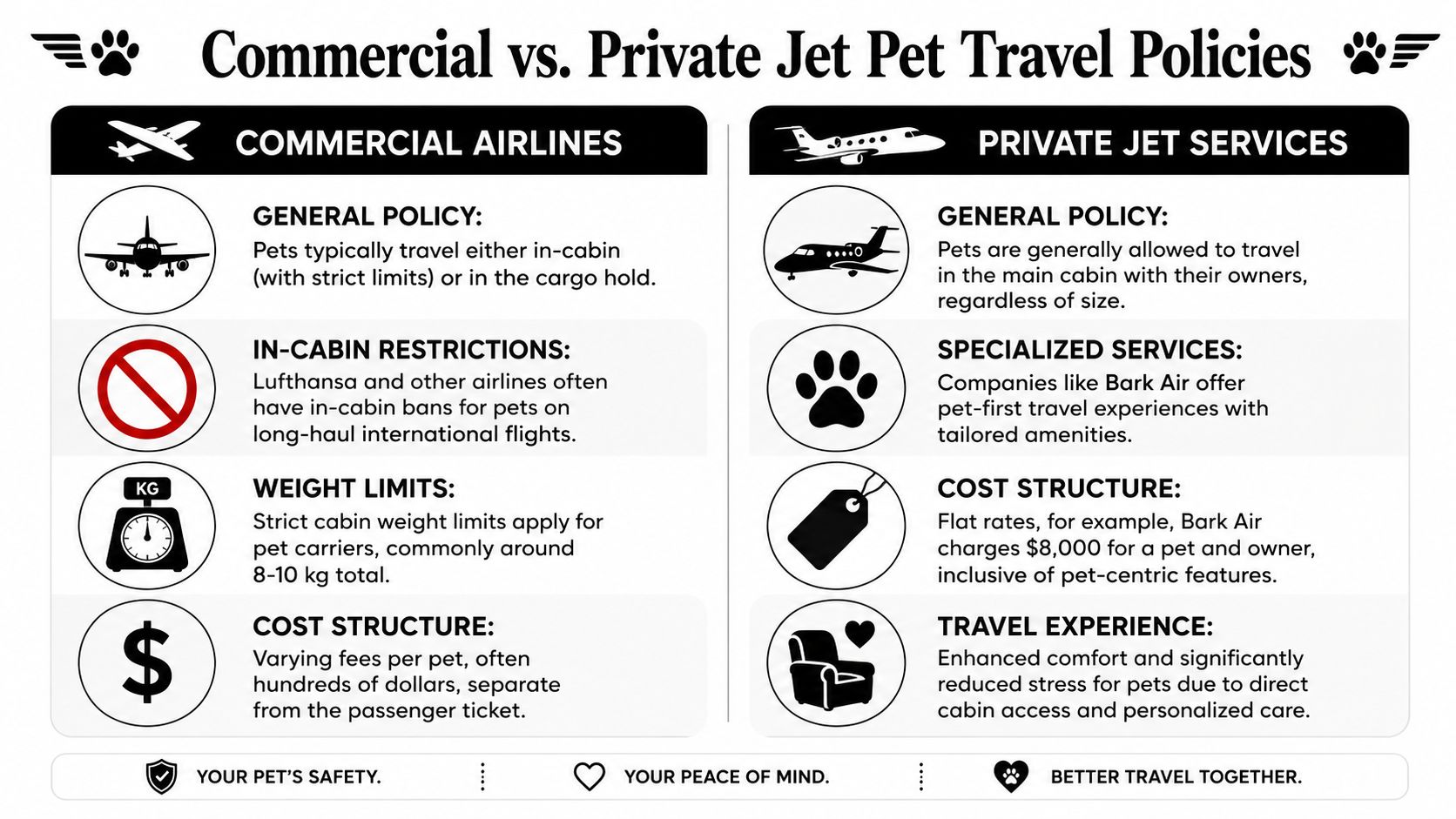
Commercial travel still makes sense for many pets, especially small animals on simple routes with stable airline rules. The problem is that published pet policies often look broader than the actual operating rules behind the booking.
The weak points tend to be operational, not theoretical:
- Aircraft-specific cabin approval: The airline may allow pets generally but block them on the aircraft assigned to your route.
- Segment-by-segment inconsistency: A pet can be accepted on the outbound and refused on the return, or cleared on one leg and denied on a connection.
- Under-seat fit rules: Soft carrier dimensions matter as much as pet weight, and staff can interpret fit conservatively at check-in.
- Breed and temperature restrictions: These can affect checked or manifested pet travel even when the booking was initially accepted.
- Limited pet inventory: Passenger seats can still be open after pet allocations are gone.
Fees are also moving targets. For a useful snapshot of current U.S. airline pet charges, NerdWallet's review of airline pet fees by carrier is a better reference point than broad government travel pages. On international itineraries, though, the fee is often the small problem. The bigger risk is paying for a ticket that works for you but fails the airline's final pet handling rules.
Private charter and what changes
Private charter usually gives owners more control over cabin access, routing, and handling. That matters most with larger dogs, senior pets, anxious animals, and long travel days where a transfer through the commercial system adds stress and uncertainty.
The hidden surprise is that private flying is not one universal pet rulebook. Each operator and aircraft has its own standards on pet count, cleaning charges, soft restraint expectations, and whether pets can occupy a seat area versus remain on the floor. Some operators are very flexible. Others are pet-tolerant rather than pet-friendly. I tell clients to ask those questions before funds are wired, not after the aircraft is sourced.
Bark Air made that demand visible when it launched a pet-first service and positioned the cabin experience as the product itself. Reuters covered the launch in its report on BARK Air starting flights for dogs and their owners. The headline price drew attention, but the more practical takeaway is why people pay for these options at all. They are buying cabin certainty and less handling.
For readers comparing charter-specific considerations, this article on safe private jet travel for your animal is helpful because it frames the comfort and handling advantages in practical terms.
Where Haute Jets fits
Haute Jets is relevant here for one reason. Sourcing depth matters when a pet has specific cabin and aircraft constraints.
The company works with more than 3,500 owner-operators across 175 countries and lets clients review aircraft options rather than accept a single generic charter solution. That gives owners a better shot at matching the trip to the pet, especially when size, route length, or onboard setup narrows the field. Its guide to flying on private jets with pets also outlines a 24-hour pre-flight confirmation process. I like that detail because last-day confirmation is where pet notes, manifest details, and handling assumptions get checked before they become airport problems.
Private charter does not remove import rules or customs screening. It does reduce the number of handoffs and policy mismatches that cause trouble on commercial itineraries.
Commercial service is still the right answer for many trips. Private charter usually starts to make financial and operational sense when the pet is too large for cabin, the route is long-haul, the owner cannot risk a last-minute pet denial, or one failed departure would cost more than solving the problem properly the first time.
Day of Flight Procedures and Arrival Logistics
Travel day is about sequence. Owners who stay organized usually move through it calmly. Owners who treat the pet as one more check-in item often hit preventable friction.
Before you leave for the airport
Start with confirmations, not packing.
Airlines enforce limited pet space. They cap in-cabin acceptance at 2 to 4 pets per cabin and require direct reconfirmation calls 48 hours before departure to secure booking, according to this airline pet booking guidance video. If the airline gave you an initial verbal yes weeks ago, that doesn't replace a proper reconfirmation close to departure.
I also recommend having one paper folder and one digital backup with the same contents. Include the microchip record, rabies certificate, import permit if applicable, endorsed health certificate, booking confirmation, and any written correspondence from the airline about cabin or cargo acceptance.
At the airport
The check-in rhythm depends on whether the pet is flying in cabin or through cargo handling, but the discipline is the same. Don't arrive improvising.
Use this airport checklist:
- Document packet first: Put all originals where you can hand them over quickly.
- Crate inspection readiness: If the pet isn't in cabin, expect staff to inspect hardware, labels, and fit.
- Water and relief timing: Handle both close enough to departure to help the pet, but not so late that check-in becomes rushed.
- Written confirmations accessible: Phone screenshots help, but printed confirmations are often easier at a counter.
If an agent says the pet isn't booked, don't argue from memory. Ask them to check the pet reservation or cargo note attached to the record and refer to your written confirmation.
During the flight and at landing
Once airborne, there isn't much for the owner to control. The useful work happens on arrival.
Customs and inspection can move quickly when names, chip details, and certificate dates align. They slow down when documents contain small discrepancies. A middle initial mismatch, a transposed microchip digit, or a certificate that references an old vaccine date can force extra review.
That's why I advise owners to think about the arrival handoff before departure. Know the inspection point. Know whether the pet is released directly to you or through a handling office. Know how you're getting from the airport to the next stop.
Arrival logistics that reduce stress
Good arrival planning is rarely glamorous, but it's what saves the day when the flight lands late.
Consider these in advance:
- Ground transport: Confirm a pet-accepting vehicle, especially if the crate is large.
- Local veterinary contact: Useful if border staff ask for follow-up or the pet seems unwell after travel.
- Nighttime backup boarding: Important if customs delays push release beyond your planned schedule.
- Accommodation policy: Don't assume a hotel that allows dogs domestically will accept a just-arrived international pet with crate and paperwork in tow.
The smoothest arrivals happen when the owner has already planned the first four hours after landing.
That includes food, water, a relief break, and a quiet environment. After a long international trip, most pets benefit less from stimulation and more from predictability.
Contingency Planning for Pet Travel
Owners usually build one travel plan. Professionals build the primary plan and the failure plan.
That difference matters because pet travel failures don't always look dramatic at first. A weather delay pushes the flight outside a document window. A route change alters pet acceptance. A crate gets damaged during handling. A customs review takes longer than expected and you miss onward ground transport.
The backups worth having
Not every backup needs to cost money, but each one should be specific.
- Written airline confirmation: If policy confusion starts at the airport, a written record helps faster than a verbal history.
- Standby boarding option near the airport: Useful if departure slips or arrival processing runs long.
- Emergency vet contact at destination: Helpful after a stressful flight or if authorities request additional review.
- Alternate routing ideas: Sometimes the right fallback is a later direct flight, not a hurried connection.
- Duplicate document set: One paper packet can get lost or damaged. Redundancy is cheap insurance.
Why this pays off
The owners who recover well from travel disruptions usually did one thing right early. They accepted that the original plan might not survive contact with reality.
Commercial airline systems are rigid. Border systems are rigid. Even private operations can face weather or slot changes. A backup kennel, a second ground transfer contact, or a pre-identified alternate airport can turn a messy day into an inconvenience instead of a crisis.
I've seen owners save a trip because they had written proof of acceptance, a nearby kennel on standby, and a local contact ready to help if customs took longer than expected. None of that feels urgent when planning months out. It feels urgent when you're standing in arrivals after a long-haul flight with a tired dog and no good next move.
The best contingency plan is boring on purpose. It lists who to call, where to go, and what document to show. That's what works.
If you're weighing commercial options against charter for an international pet trip, Haute Jets is one option to review for aircraft sourcing, route-specific pet coordination, and the kind of 24-hour pre-flight confirmation that helps reduce last-minute surprises.