
A 1/16 fractional share of a mid-size jet typically runs $850,000 to $1.2 million upfront, plus $12,000 to $18,000 a month and $4,200 to $5,500 per occupied hour. At 50 hours a year, you're looking at roughly $350,000 to $500,000 in annual cost.
That is the true starting point, not the brochure number. Fractional ownership looks clean on paper because the headline hourly rate hides the capital commitment, the fixed monthly burn, and the exit risk that determine whether the deal makes sense.
What Fractional Jet Ownership Actually Is
At 50 hours a year, a 1/16 share is already a $350,000 to $500,000 commitment. That's the number that should sit in your head before anyone starts selling you on convenience or prestige.
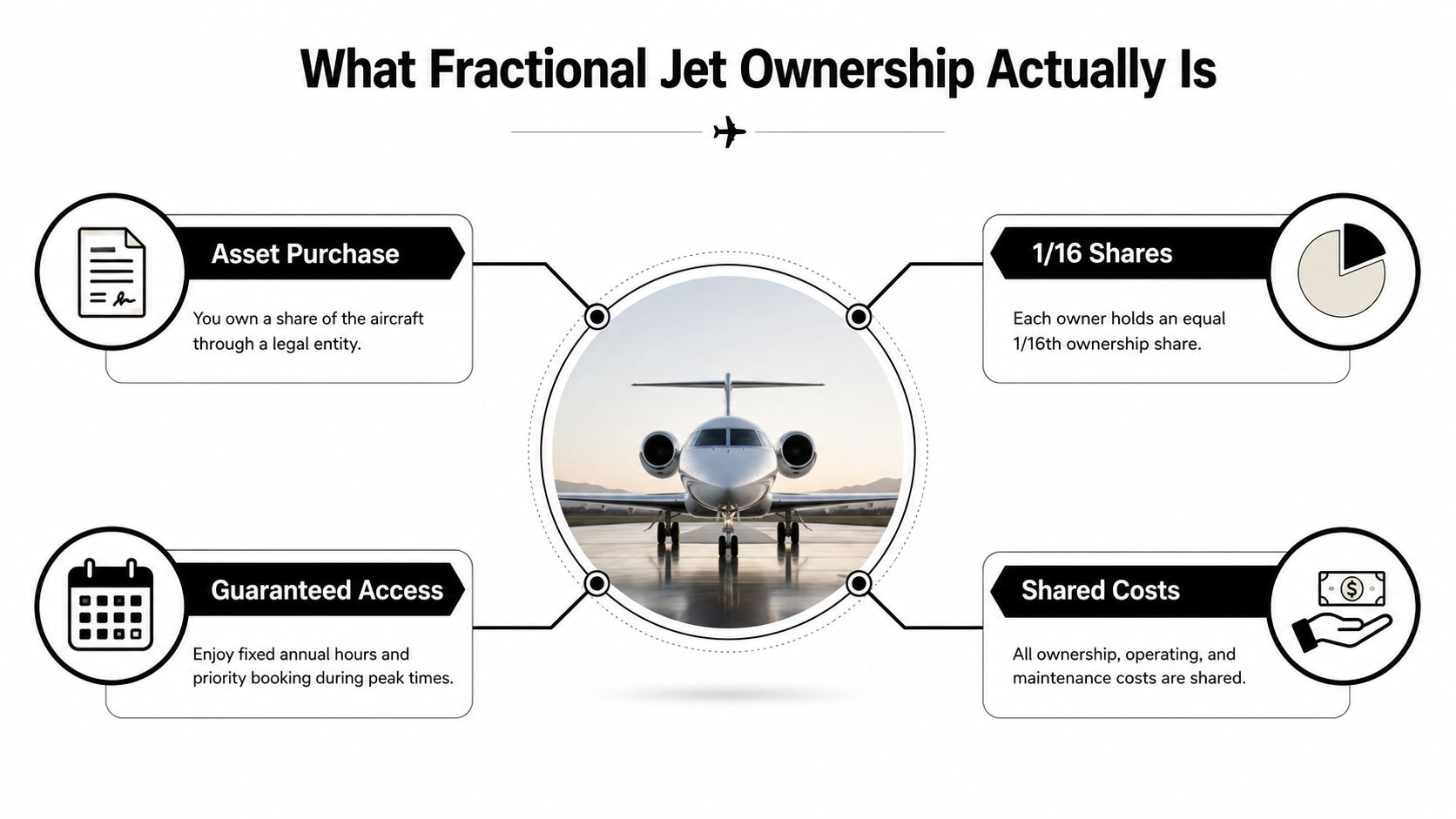
A fractional share is a partial ownership stake in an aircraft, usually sold in slices like 1/16. You're not buying a membership and you're not signing a one-off charter contract. You're buying into an asset structure run by a fractional provider, such as NetJets, Flexjet, or PlaneSense, where the provider manages the aircraft, the crew, and the scheduling while you pay for access through a mix of capital and operating fees.
That distinction matters because the economics are very different from renting a jet when you need it. With fractional ownership, you're tying up capital in a share that behaves more like a depreciating asset than a travel product. The provider may market it as simplicity, but the buyer is still taking on an ownership problem, just with a smaller slice of the airplane.
The core idea behind the model
A fractional program exists to split a jet's cost among several users while preserving a premium travel experience. In practical terms, you trade full ownership control for shared access, shared maintenance structure, and a guaranteed allocation of flight hours.
That's why a 1/16 share is the benchmark you see so often. Independent industry guidance places that slice at roughly 50 flight hours per year across several aircraft categories, which is enough for frequent flyers but too much commitment for casual travelers (fractional ownership cost analysis). If your annual flying doesn't live near that level, the model starts to look rigid fast.
Practical rule: if you don't already know your annual utilization with confidence, you're probably not ready to buy a share.
The title of the game is simple. You're not asking, “Can I afford the hourly rate?” You're asking, “Can I justify the capital lockup, the monthly burn, and the eventual resale risk for the amount I fly?” If the answer isn't a clear yes, ownership is the wrong tool.
The Full Cost Stack Behind Fractional Ownership
The sticker price is only the beginning. Fractional ownership costs stack up fast, and the gap between the advertised occupied hourly rate and the true all-in spend is where buyers usually misjudge the deal. The share purchase comes first, then monthly management fees, then flight-time charges, then the extras that show up later, like taxes, repositioning, financing, and exit friction.
Fixed costs and variable costs
The first layer is the upfront buy-in. For a mid-size jet in 2026, one independent analysis places a 1/16 share at roughly $850,000 to $1.2 million. That is the capital you commit before you fly a single hour.
The second layer is the monthly management fee, which you pay whether the aircraft flies or sits. The same analysis puts that fee at $12,000 to $18,000 per month for a mid-size jet share. For light jets, another industry source places monthly fees around $12,000 to $20,000, and a separate overview puts light-to-midsize management fees around $4,000 to $20,000 depending on program structure. The range is the warning sign. This is not a cheap membership, it is a fixed operating bill.
The third layer is the occupied hourly charge. For a mid-size jet, the 2026 analysis cites $4,200 to $5,500 per occupied flight hour. Industry guidance for light and midsize aircraft also puts those rates in the $3,000 to $5,500 per hour band. Those charges cover the flying you use, but they do not tell you what the program really costs.
| Cost Component | What It Covers | Typical Range |
|---|---|---|
| Share purchase | Your capital stake in the aircraft program | $850,000 to $1.2 million for a 1/16 mid-size share |
| Monthly management fee | Pilots, maintenance, dispatch, hangar, operations | $12,000 to $18,000 per month for a mid-size share |
| Occupied hourly charge | Flight time when you actually use the aircraft | $4,200 to $5,500 per occupied hour |
| Financing cost | Debt service on the share purchase | 5% to 8.5% common financing rates in 2026 |
Taxes and hidden operating items matter too. Fuel surcharges, Federal Excise Tax, peak-day surcharges, and exit fees can all add to the bill. Repositioning can also show up when the aircraft is not already where you need it, which is one reason charter sourcing strategy matters when you compare alternatives. For a broader look at where those line items sit in the market, see this private jet cost breakdown.
If you want financing, the cost stack gets heavier. Borrowing against the share adds another layer of drag, and a financing analysis of fractional aircraft ownership lays out how debt service can make the all-in cost look very different from the quoted program rate. Jaken Aviation financing analysis
The point is simple. Fractional ownership is a stack of costs, not a single rate. If a provider leads with the hourly number and ignores the rest, you are looking at sales copy, not the full bill.
Pricing Ranges by Aircraft Category
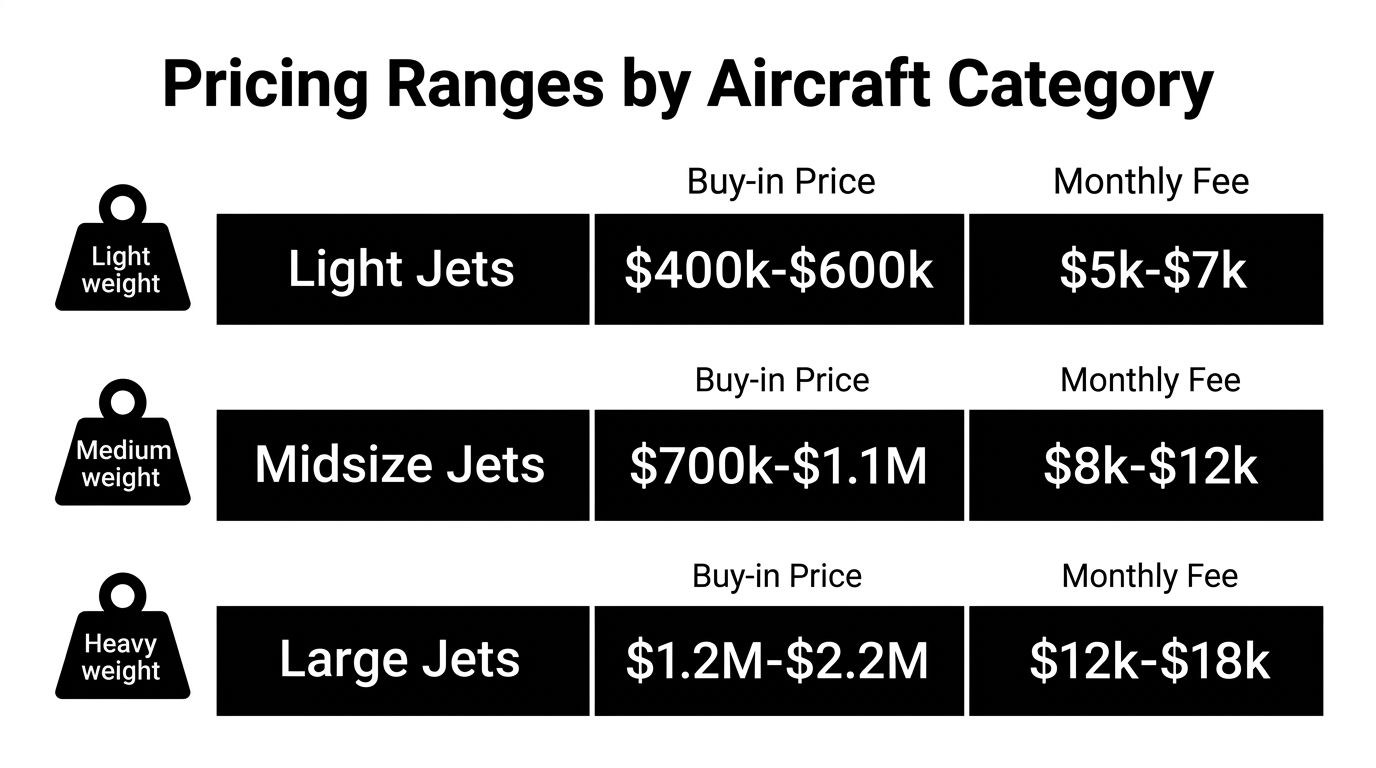
The aircraft category drives the price band more than most buyers expect. A light jet share is one thing, a mid-size cabin is another, and a large cabin program lives in a different financial universe. Once you move up a tier, the entry cost jumps hard, not gradually.
What a share looks like by cabin class
For light jets, one industry analysis says a 1/16 share often starts around $500,000 to $700,000, with monthly management fees of $12,000 to $20,000 and occupied hourly rates of $3,500 to $5,500. Another source places light-jet acquisition in the $300,000 to $700,000 range and hourly charges around $3,000 to $5,500 per hour for light to midsize aircraft (BlackJet overview).
For mid-size jets, the 2026 financing analysis puts the upfront buy-in at $850,000 to $1.2 million, with monthly management fees of $12,000 to $18,000 and occupied hourly charges of $4,200 to $5,500 (Jaken Aviation financing analysis). That is the more common “serious traveler” band, and it is where buyers start to see how quickly fixed charges dominate the economics.
Large aircraft are a different conversation. One industry analysis notes that larger aircraft can require $1.8 million to $3 million+ for a 1/16 share. That is before you layer in the rest of the program costs. If your mission does not demand that cabin size, you are paying for capacity you will not fully use.
How to read the categories
A light jet share makes sense when your flying is mostly shorter domestic missions and you care more about access than cabin size. A mid-size program fits buyers who want more range and comfort without stepping into the large-cabin price tier. Large-cabin ownership is for buyers with real cabin requirements, not people who just like the idea of flying bigger.
The mistake is to shop by sticker rather than mission. If your trips do not need a super-midsize or large cabin, do not let a provider push you up the ladder just because the sales deck looks nicer. Match the category to the routes you typically fly.
For a side-by-side aircraft comparison beyond cost alone, see this guide to light, midsize, and heavy private jets. That is the right way to think about category selection, by mission first, prestige second.
Five-Year Total Cost and the Depreciation Trap
The buy-in is the wrong number to focus on. The main question is what you spend over five years, then what you lose when you exit. Fractional ownership looks tidy on a sales sheet until you add every cost line and the exit penalty.
What the contract really costs over time
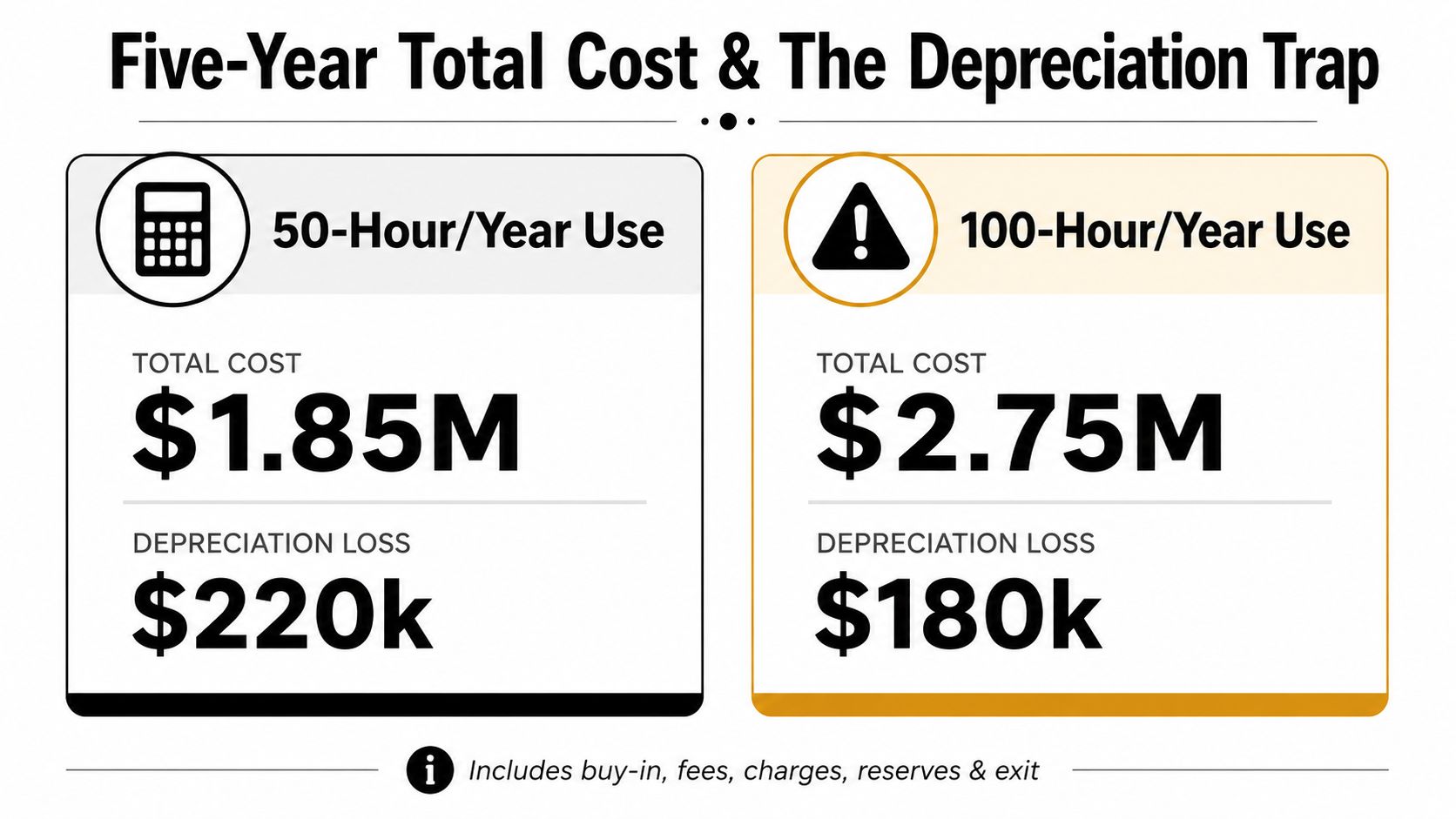
Independent market comparisons show how fast the bill grows. One analysis puts a typical light-jet fractional program at roughly $460,000 in the first year and about $110,000 per year thereafter, with some five-year ownership structures topping $1.5 million (The Jet Finder). Another source says owners flying around 50 occupied hours per year often end up at $350,000 to $500,000 annually for a 1/16th mid-size share, and $400,000 to $550,000 for a typical light-jet share (NovaJet).
That is why the headline hourly rate is a trap. The published rate leaves out acquisition, management, depreciation, and the economics of getting out. Industry guidance says the true all-in cost often runs 40% to 60% higher than the advertised hourly figure once those pieces are included (FlyEliteJets). If you only compare sticker rates, you are comparing fantasy to cash flow.
The depreciation problem
Fractional shares do not hold value the way buyers expect. One analysis says owners can lose 30% to 50% of initial capital over a five-year contract (FlyEliteJets). That loss often gets ignored because it is not billed as a monthly fee. You feel it at exit.
Borrowing makes the outcome worse. Financing analysis from Jaken Aviation says common rates in 2026 sit around 5% to 8.5%, depending on credit profile and lender type (Jaken Aviation financing analysis). If you finance the buy-in, debt service turns a large upfront check into an even larger ownership burden.
Bottom line: treat the share as prepaid access with resale risk attached. Do not expect it to behave like a clean investment.
The right model includes purchase price, management fees, use fees, financing, and the exit haircut. Stop at the share price and you will undercount the deal by a wide margin.
Who This Is For
Fractional ownership only makes sense for flyers whose missions justify the commitment and who value consistency enough to pay for it. If you are below the 50-hour threshold, or your trips are irregular enough that you do not need a reserved aircraft relationship, pay-per-flight charter is the rational answer. You keep capital free, avoid depreciation risk, and pay only when you fly. For buyers who want to compare those structures directly, see private jet cards versus charters.
Fractional vs Jet Card vs On-Demand Charter
Fractional ownership competes with two real alternatives, not one. Jet cards and on-demand charter solve the same travel problem without forcing you into equity-like exposure. The right choice depends on how often you fly, how predictable your routes are, and how much capital you are willing to leave tied up.
The practical trade-off
Fractional gives you a reserved share of access and a consistent aircraft experience, but it also brings capital commitment, monthly overhead, and a long contract. Jet cards remove the ownership layer, so you get fixed-access economics without buying into an aircraft. On-demand charter strips the model down further, you pay for each trip and stop there.
Charter pricing also hides a common trap. If an aircraft is not already based near your departure point, repositioning can raise the total trip cost far above the quote. That is why local sourcing matters. The aircraft should be near your city whenever possible, otherwise you end up paying for logistics you did not want.
| Model | Capital Commitment | Flexibility | Availability | Asset Risk |
|---|---|---|---|---|
| Fractional | High | Moderate | Strong | Yes |
| Jet card | None | High | Strong | No |
| On-demand charter | None | Highest | Variable | No |
For a direct comparison of charter and card structures, see this guide to private jet cards versus charters. That is the cleanest way to separate pay-per-flight access from ownership.
Where the break-even sits
The break-even point is not the advertised hourly rate. It is the all-in cost of access, including the buy-in, ongoing fees, and the depreciation you absorb when you exit. That is why fractional only starts to make sense for a narrow range of flyers. Industry sources point to a useful rule of thumb, fractional is aimed at flyers around 50 to 150 hours per year, while buyers below that band usually do better with charter or smaller card programs. A separate comparison puts the under 50 hours per year flyer firmly in charter territory.
Below that point, pay-per-flight charter is the rational move because you are not funding unused capacity or carrying ownership risk. Above it, fractional can start to compete because the guaranteed access begins to offset the fixed carrying cost. The mistake is to justify a share using your best-case travel plans. Model your actual flying pattern, then compare that against what charter would cost trip by trip.
Who Fractional Ownership Is Built For
Fractional ownership is built for a narrow buyer, and that is fine. The problem is the sales pitch that acts like it suits anyone who wants private aviation. It does not.
The real buyer profile
If you fly 50 to 150 occupied hours per year, want a consistent cabin category, and can tolerate capital at risk, fractional can fit. If you fly less than that, the structure is usually too heavy. If you fly far more than that, whole ownership or a fleet-style solution starts to deserve a look.
The capital requirement matters because the contract assumes you can absorb depreciation. Owners may lose 30% to 50% of initial capital over a five-year contract. That is not a side note. It is part of the economics. If that kind of loss would change your budget or your liquidity, do not buy a share.
Fractional is for the flyer who values guaranteed access enough to accept illiquidity.
The other mistake is treating a share like a liquid asset or a promise of unlimited access. It is neither. You still deal with program rules, aircraft allocation constraints, and provider-controlled resale mechanics. A share gives you access inside a managed system, not freedom outside it.
That is why I am direct about this. Most occasional leisure travelers should not buy fractional. Most rising-frequency users should not buy fractional. Most buyers under the 50-hour mark should charter instead and keep their capital free. If you need something more structured than ad hoc charter, a no-ownership access model is still cleaner than buying a depreciating slice of an airplane.
Questions to Ask Before You Sign Anything
The right questions are specific. If a provider can't answer them cleanly, you already have your answer. Don't let a polished sales process blur what you are buying.
The checklist that matters
- Peak-day rules: Ask which days are restricted, how far ahead you need to book, and whether peak access changes your rates.
- Hourly pass-throughs: Ask what's included in the occupied rate and what gets added later, especially fuel, taxes, and international fees.
- Exit mechanics: Ask how resale works, who sets fair market value, and what fees hit when you leave.
- Operational substitutions: Ask what happens if your assigned aircraft is down for maintenance or if the provider swaps equipment.
- Financing terms: Ask whether debt is available, what the rate is, and how financing changes your real total cost.
The decision rule
If you fly fewer than roughly 50 hours a year, look at on-demand charter first. If you fly around 50 to 100 hours on predictable routes and you need guaranteed access, fractional may pencil out. If you fly 100 hours or more across multiple mission profiles, whole ownership or a fleet-style solution deserves a hard look.
The right provider conversation is about all-in economics, not monthly marketing language. Ask for the complete term cost, the expected exit value, and the worst-case schedule constraints. If a rep keeps steering back to the hourly rate, they're avoiding the fundamental question.
Making the Right Call for Your Flying Profile
Fractional jet ownership cost is a layered equation. You pay for capital, monthly overhead, occupied hours, financing, and exit risk, then you wait to see how much value is left when the term ends. That's why the decision should never start with the advertised hourly rate.
The clean takeaway is this. If you're below the 50-hour mark, fractional is usually the wrong tool and pay-per-flight charter is the rational answer. If you're inside the 50 to 100 hour band and need guaranteed access to a specific cabin type, fractional can work, but only if the five-year total still beats charter after depreciation and fees. If you're well above that, you should be modeling ownership alternatives, not buying the first share that comes along.
Haute Jets arranges private charter flights on a pay-per-flight basis, which fits the buyer who wants access without buying into an aircraft. If you want a serious comparison against fractional ownership, run your actual flight pattern against a charter quote before you commit capital. Visit Haute Jets and ask for a trip-by-trip option built around your routes, not a long-term ownership pitch.