
You've been booking private jets often enough that ad hoc charter feels inefficient, but not consistently enough to feel comfortable buying a share. Your executive team wants dependable access for important meetings. Your family wants flexibility for changing holidays. You're looking at fractional jet ownership vs charter and finding plenty of hourly prices, but very little guidance on the question that decides the outcome: how many occupied hours will you fly, and how predictable will those hours be?
That's the decision framework used throughout this guide for Haute Jets Journal. Fractional ownership can make sense when fixed costs are spread across steady utilization and guaranteed access matters more than capital flexibility. Charter usually wins when your schedule changes, your routes vary, or you want to pay only for the flights you take.
Introduction Why This Choice Matters Now
A corporate traveler might fly regularly between a small group of cities, with peak-season meetings already on the calendar. A family office might use private aviation heavily for a few months, then barely fly during the rest of the year. Both may describe themselves as frequent private flyers, yet they have completely different ownership profiles.
That distinction matters because fractional ownership isn't a cheaper version of charter. It changes your relationship with the aircraft. You buy an equity interest, accept recurring management costs, and receive defined access rights under a structured program. With charter, you purchase a trip, not an asset. Your spending remains variable, and you can select an aircraft that fits each mission.
The market has also moved toward outsourced access. ARGUS TRAQPak data cited by GlobalAir's coverage of charter and fractional activity recorded roughly 5.4 million private-jet flight hours in North America in the latest year sampled. Charter and fractional flying together contributed just over 3.0 million hours, or 55.8% of total activity, compared with 43.7% in 2012. That shift shows why buyers are increasingly comparing access models instead of assuming full ownership is the natural next step.
The practical rule: choose fractional ownership for utilization and control, not because the word “ownership” sounds more sophisticated. Choose charter when flexibility has more value than fixed access.
| Decision factor | Fractional ownership | On-demand charter |
|---|---|---|
| Annual occupied hours | Usually stronger as hours rise toward roughly 175 annually | Generally strongest below about 50 occupied hours |
| Capital commitment | Upfront share purchase plus recurring fees | No equity purchase |
| Aircraft experience | Consistent program category and operating system | Exact aircraft can change by mission |
| Availability | Structured access with program rules | Subject to market and aircraft availability |
| Cost behavior | Fixed and variable | Primarily variable |
| Exit risk | Residual value and contract terms | No ownership exit required |
The analysis below focuses on utilization thresholds, fixed-cost dilution, aircraft choice, scheduling, contracts, and exit risk. It won't give you a simplistic “fractional is cheaper” or “charter is always more flexible” answer. It will give you a decision rule you can apply to your own travel history.
Understanding Fractional Ownership and On Demand Charter
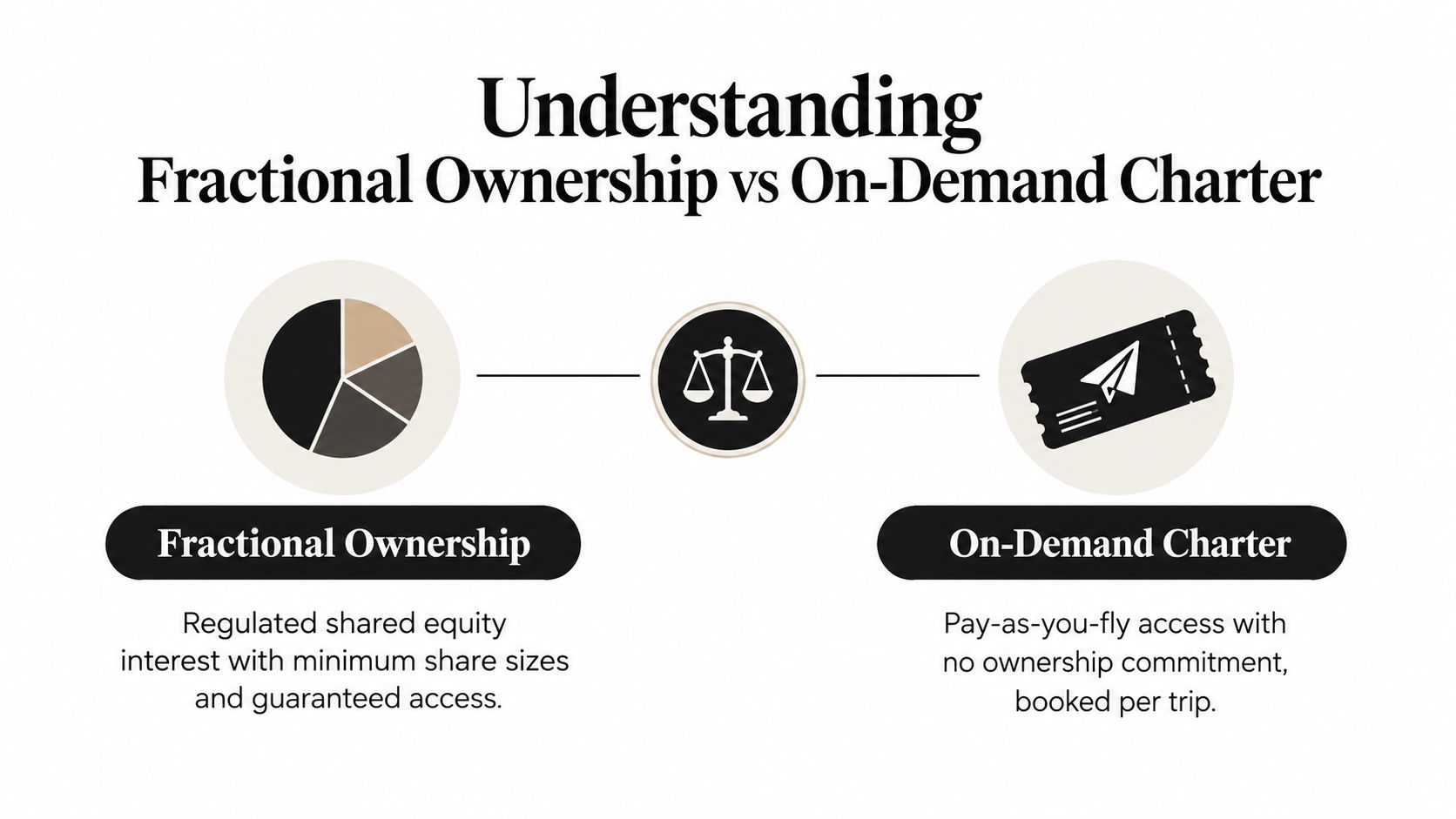
Start with the legal and commercial distinction. Fractional ownership is shared equity, while on-demand charter is trip-based access.
The FAA formalized fractional programs under Part 91 Subpart K. FAA guidance explains that fractional programs began in 1986 and expanded during the 1990s. The rules establish a minimum ownership interest of one-sixteenth, or 1/16, for a fixed-wing or powered-lift aircraft, and one-thirty-second, or 1/32, for a rotorcraft, as described in the FAA's fractional ownership guidance.
That legal structure gives the customer more than a seat or a flight reservation. The customer buys an actual interest in an aircraft, alongside contractual access rights. The provider typically manages the aircraft, crew, maintenance, scheduling, and program administration, but the owner still participates in an ownership structure with associated financial obligations.
On-demand charter works differently. You pay for a specific aircraft and itinerary, normally arranged for a particular trip. You don't acquire an aircraft interest, and you don't fund a recurring ownership structure between flights. The operator or charter provider handles the operational responsibility while you decide the route, timing, passenger list, and aircraft requirements.
Why the ownership distinction matters
Fractional programs organize aircraft access around a fleet and a contractual service model. You may receive a consistent aircraft category, defined booking procedures, and access protections subject to notice rules, peak-day conditions, and program availability.
Charter organizes the purchase around the mission. You can request a light jet for a short regional trip, a larger cabin for a group, or a different aircraft type for an international itinerary. The aircraft doesn't need to match your previous flight because you aren't buying continuity. You're buying suitability for the next trip.
For executives, family offices, or businesses reviewing the legal structure, a conversation with startup legal counsel South Florida can help separate aviation access questions from broader ownership, governance, and contracting issues. That isn't a substitute for aviation counsel or tax advice, but it can be useful when a fractional purchase sits inside a wider corporate structure.
The hierarchy is straightforward:
- Fractional ownership means equity plus access rights.
- On-demand charter means a trip purchase without equity.
- Full ownership means control of an entire aircraft and its operating burden.
Most buyers comparing fractional jet ownership vs charter are deciding between the first two. The correct choice depends on whether your flying pattern can support the fixed structure that comes with equity.
Cost Breakdown Fixed Versus Variable Spending
Fractional pricing has three core components: an upfront share purchase, a recurring monthly management fee, and an occupied hourly rate charged when you fly. Published 2026 fractional examples cite share prices of approximately $354,000 to $705,000, monthly fees of roughly $6,450 to $9,534, and occupied hourly charges of about $1,189 to $2,405, according to Fractional Aviation's guide to jet card, fractional, and charter costs. These are program examples, not universal quotes.
Another 2026 fractional ownership pricing guide places light-jet fractional hourly rates around $3,500 to $5,500, with heavy-cabin rates at $11,000 or more per occupied hour. Those figures reinforce the central point: the hourly rate isn't the complete ownership price.
Charter turns more of the expense into a trip-level charge. You pay for the aircraft, route, date, and operating requirements associated with that flight. Haute Jets' private jet charter cost guide is useful when you want to compare a trip quote against the fixed and variable components in a fractional proposal.
| Cost Component | Fractional Ownership | On-Demand Charter via Haute Jets |
|---|---|---|
| Initial capital | Share purchase required | No equity purchase |
| Recurring management | Fixed monthly management fee | No ownership management fee |
| Flight charge | Occupied hourly rate when flying | Trip-specific charter price |
| Aircraft positioning | Defined by program rules and network | Sourcing near the departure city can reduce unnecessary repositioning |
| Residual value | Share exit depends on market conditions and utilization | No aircraft resale exposure |
| Utilization risk | Owner pays fixed costs even during idle periods | Spend rises or falls with actual trips |
The fixed-cost dilution problem
Suppose two travelers each plan to fly around the same number of hours. One has a reliable schedule and expects those hours to recur each year. The other expects major changes in routes, timing, and travel volume. The first traveler can dilute monthly costs across predictable use. The second may pay the same fixed fees while the aircraft sits unused.
Idle capital is the hidden cost of fractional ownership. A low occupied-hour rate doesn't automatically make a fractional share economical if your actual flying falls below plan.
NBAA guidance places ad hoc charter below about 50 occupied hours per year and fractional ownership as a more structured option up to roughly 175 hours per year, as outlined in its business aircraft ownership and operating options guidance. Those thresholds aren't a substitute for route-specific modeling. They're a practical starting point for identifying when a deeper comparison deserves your time.
Charter also carries its own variables. Aircraft positioning, demand, route length, passenger requirements, and cancellation conditions can change a quote. Haute Jets describes a local-sourcing model that uses owner-operator aircraft near the departure city, avoiding the repositioning fees that can inflate traditional charter or membership pricing by 20% to 40%, according to its publisher information. That advantage matters most when the flight is short, the aircraft market is active, or your schedule changes close to departure.
Build the comparison around actual spending, not the lowest advertised hourly figure:
- Fractional total: share purchase, monthly fees, occupied charges, taxes, program costs, and expected exit value.
- Charter total: the sum of trip quotes, including any positioning, handling, taxes, and mission-specific services.
- Downside scenario: reduce expected hours and test whether fixed ownership costs still make sense.
- Mission scenario: compare the aircraft each model would provide for your actual routes and passenger loads.
The winner is the model with the better effective cost per occupied hour after all fixed costs and exit assumptions, not the model with the most attractive headline rate.
Operational Control Availability and Flexibility Compared
Money isn't the only trade-off. Fractional programs sell structured access and consistency. Charter sells mission-level choice.
NBAA notes that fractional aircraft can operate around 1,000 to 1,200 annual hours, including approximately 800 sold hours plus up to 400 repositioning hours, compared with traditional flight-department utilization around 430 hours, as explained in the NBAA fractional aircraft ownership FAQ. High utilization can support a dense scheduling network, but it also makes fleet depth, dispatch coordination, and substitution rules important parts of the buyer's review.
Availability and peak travel
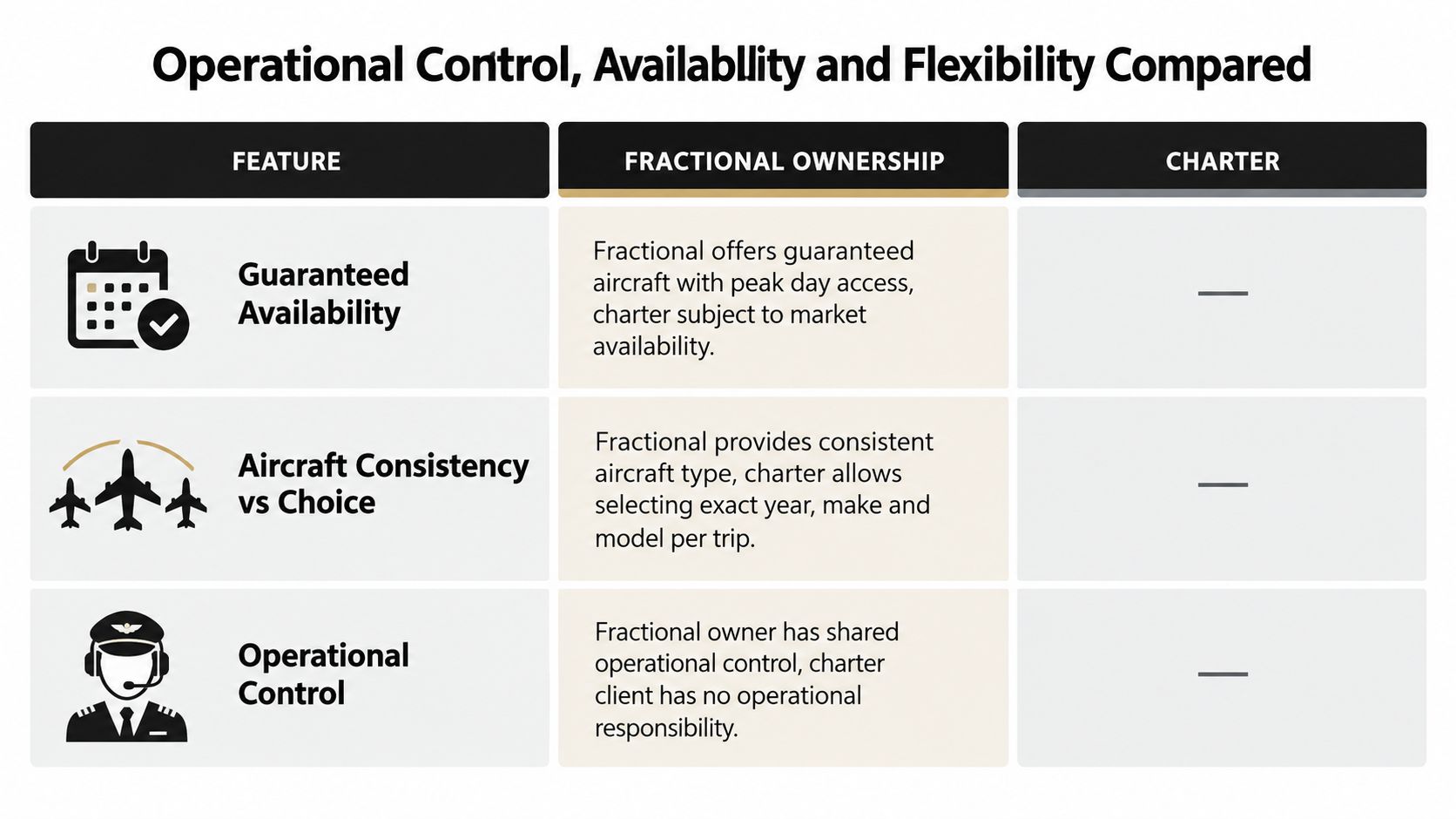
Fractional ownership is the stronger choice when you need program-defined access during busy periods and don't want to negotiate aircraft availability for every trip. That access still operates within contractual booking windows, peak-day policies, service areas, and aircraft-category rules.
Charter gives you no ownership-based access guarantee. You depend on the aircraft market at the time of booking. In exchange, you aren't committing capital to preserve access during weeks when you won't fly.
Fractional protects access. Charter protects optionality. Decide which risk creates the bigger operational problem for you.
Consistency versus selection
Fractional ownership suits travelers who value a repeatable cabin, familiar operating process, and predictable aircraft category. That consistency can simplify corporate travel standards, family routines, luggage expectations, and onboard preferences.
Charter is better when the mission changes. You can select the aircraft category, year, make, model, cabin layout, connectivity, catering, pet policy, and baggage solution for each trip. A short business flight doesn't need the same aircraft as a long international itinerary.
Operational responsibility
Fractional owners participate in a shared aircraft structure, even when a management company handles daily operations. The contract determines how scheduling, maintenance, crew, substitutions, and access are administered.
Charter clients don't carry that ownership responsibility. The operator performs the flight under its applicable authority, while the client focuses on the itinerary and passenger experience. For a practical discussion of the broader trade-offs, see Haute Jets' owning versus chartering a private jet comparison.
Use this distinction when evaluating executive travel. If a missed peak-day request would disrupt a critical meeting, structured access may justify fixed costs. If your aircraft requirements change from trip to trip, charter's ability to match the jet to the mission is more valuable than owning access to one program category.
A short visual comparison helps, but the contract controls the result. Ask exactly what “guaranteed availability” means, what substitutions are permitted, how far ahead you must book, and what happens on peak dates.
Contracts Tax Considerations and Long Term Commitment
Fractional ownership becomes a long-term financial decision as soon as you sign the program agreement. One fractional ownership guide says contracts commonly run about five years, with a buyback connected to the aircraft's residual value. The same guide notes that a 1/16 share is commonly associated with approximately 800 annual aircraft hours at the program level, while the share's exit value depends on market conditions and depreciation from heavier utilization.
That exit mechanism deserves the same attention as the purchase price. You may not receive the original capital back, and the residual value can be affected by aircraft age, market demand, maintenance condition, and fleet utilization. A buyer who expects to leave early should understand transfer rights, buyback formulas, notice periods, and possible termination charges before signing.
Charter avoids that ownership exit. You pay for a service when you travel, without a share to resell and without an aircraft residual to forecast. The trade-off is that charter doesn't give you the same contractual ownership position or the same program-based access structure.
Tax treatment requires professional review
Fractional ownership and charter shouldn't be treated as interchangeable expenses for tax analysis. Fractional ownership involves an equity interest, recurring management costs, and potential asset-related treatment. Charter is generally a purchase of transportation services. The correct treatment depends on the traveler, entity, purpose of the trip, accounting method, jurisdiction, and supporting records.
Businesses reviewing travel deductions can use Allied Tax Advisors deduction advice as a starting resource, then confirm the analysis with their own aviation tax professional and accountant. Don't rely on a sales summary or a generic online explanation to determine depreciation, deductibility, personal use treatment, or allocation between business and personal travel.
The contract also affects management exposure. A fractional buyer delegates aircraft operations to a management company but remains tied to the ownership structure. A charter customer delegates the flight to the operator without taking on the same equity commitment.
For a broader view of recurring access expenses, Haute Jets' discussion of private jet membership cost can help clarify why a fixed program fee should be evaluated against actual use rather than treated as a minor administrative charge.
Ideal User Profiles and Real World Scenarios
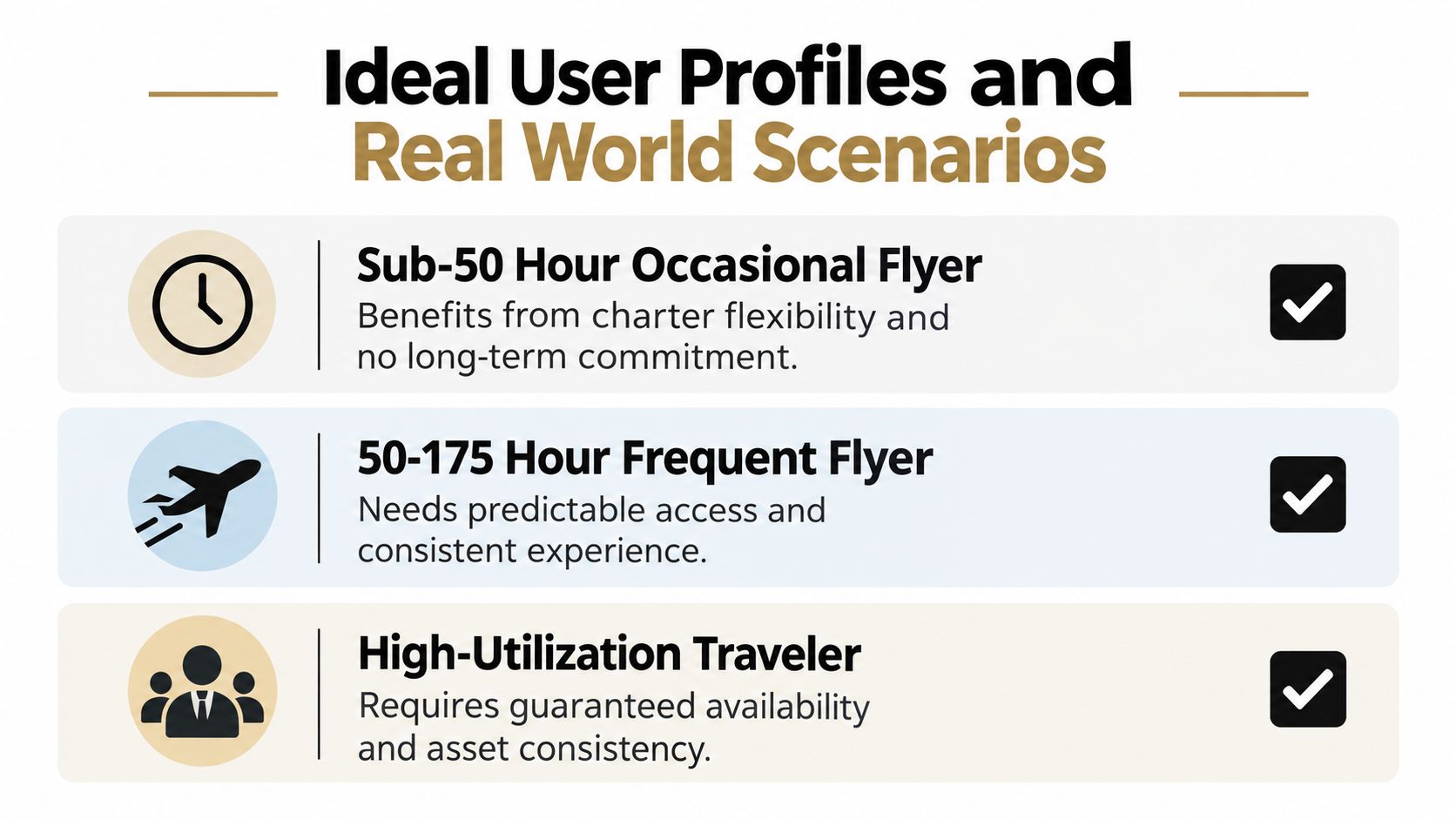
The cleanest recommendation comes from matching the model to the traveler, not from comparing status or perceived prestige. Three profiles appear repeatedly in client decisions.
The occasional flyer below 50 hours
This traveler may take important trips, but private aviation isn't a constant operating requirement. The destinations change, the dates move, and some planned travel may disappear entirely.
For this profile, on-demand charter is usually the better fit. The traveler avoids an equity purchase, monthly management costs, and the responsibility of estimating residual value. Charter also allows a light jet for one mission and a larger cabin for another, rather than locking the traveler into a single share structure.
The frequent traveler between 50 and 175 hours
This is the difficult category. A corporate executive may fly enough to make recurring access attractive, but not enough to guarantee that fixed ownership expenses will be diluted efficiently. A family may have consistent seasonal travel but unpredictable international requirements.
Fractional ownership deserves a serious review when the schedule is stable and peak access matters. Charter remains the better baseline when hours could fall, routes vary widely, or the traveler needs different aircraft types. Compare both using last year's actual occupied hours and a conservative projection for the next year.
The high-utilization traveler
A corporate shuttle, production team, or family office with frequent, repeatable missions may value aircraft consistency more than flexibility. The organization might need dependable access, repeatable cabin standards, and a program that supports coordinated scheduling across multiple travelers.
This profile is the strongest candidate for fractional ownership, provided the contract offers suitable aircraft access and the projected hours remain credible. Higher utilization doesn't eliminate the need to review peak-day rules, substitutions, repositioning treatment, and exit terms.
Mixed-use travel complicates the decision. A traveler might fly frequently on domestic routes but need a heavy cabin for occasional international trips. Another might fly heavily during a seasonal business cycle and lightly afterward. In those cases, a fractional share may handle the repeatable core while charter handles exceptional missions, but the buyer should model the combined strategy rather than assume ownership must cover every trip.
The central question is simple: will your actual missions repeat often enough to justify paying for access when you aren't flying?
How to Choose the Right Option for Your Travel Needs
Use four filters before requesting proposals.
| Question | Choose fractional when | Choose charter when |
|---|---|---|
| Annual hours | Your flying is consistently above the lower charter range and moving toward structured utilization | You expect fewer than about 50 occupied hours |
| Schedule | Peak-day access and predictable availability are essential | Dates and routes change frequently |
| Aircraft needs | You prefer a consistent category and operating experience | You want the exact aircraft for each mission |
| Capital | You accept an equity purchase and long-term commitment | You want variable spending and no resale exposure |
The hours test comes first, but it isn't enough by itself. NBAA's threshold guidance makes charter the natural starting point below approximately 50 hours, while fractional becomes more relevant as use rises toward roughly 175 hours. Route pattern, aircraft class, notice requirements, and international travel can move the practical answer.
Review every proposal with the same checklist
- Normalize the hours: Confirm occupied-hour definitions, daily minimums, taxi treatment, and repositioning rules.
- Test the downside: Recalculate the effective hourly cost if your travel drops materially.
- Read the peak calendar: Ask about booking windows, blackout dates, surcharges, and substitution rights.
- Inspect the exit: Confirm buyback mechanics, residual valuation, transfer restrictions, and early termination costs.
- Verify safety standards: Ask whether charter operators hold recognized third-party ratings such as Wyvern Wingman or Argus Gold or Platinum, and confirm which entity operates the flight.
- Separate tax from sales: Have your accountant review business use, personal use, depreciation, and deduction treatment.
- Match the mission: Compare the exact aircraft, cabin, range, baggage, connectivity, and passenger requirements you use.
For security-sensitive corporate travel, event organizers should also review the key considerations for event transport before finalizing movement plans. Aviation access is only one part of a complex itinerary.
My recommendation is direct. Stay with on-demand charter when your hours are uncertain, your aircraft needs vary, or you want to preserve capital. Investigate fractional ownership when your flying is consistently high, your schedule is predictable, and guaranteed access is worth accepting fixed costs and an eventual exit process.
Pull the last 12 months of flight records, classify each trip by aircraft and route, then project the next 12 months without assuming every planned flight will occur. Compare that realistic mission profile against both a fractional proposal and trip-level charter quotes.
Haute Jets arranges on-demand private jet charter through a network of owner-operator aircraft, with trip-specific aircraft selection and no fractional equity commitment. Visit Haute Jets to compare your projected flying pattern with flexible charter options and decide whether paying per flight fits your next year better than owning a share.