
You're trying to solve a real problem, not shop for brochure poetry. The trip is set, the passengers are serious, the bags are heavy, and the city pair is long enough that a light or midsize jet would force compromise somewhere you don't want it. That's where the Gulfstream GIV-SP still earns a place in 2026, especially when the mission calls for a true heavy-cabin jet without paying for a newer airframe just to say it's newer.
For a lot of charter buyers, the question isn't whether the GIV-SP is elegant on paper. It's whether it still does the job cleanly, with enough cabin, enough range, and enough operator quality to avoid surprises at the FBO. The answer is yes, but only if you match the aircraft to the route and stop treating it like a generic large-cabin option.
Why the Gulfstream GIV-SP Still Matters in 2026
A client calls about a New York to London trip, then adds a second problem. The bags are bulky, the passengers want to work onboard, and the departure time can't slip because of a commercial connection on the other end. That's exactly the kind of mission where the Gulfstream GIV-SP still makes sense, because it gives you a heavy cabin, serious range, and a long-running resale and charter base that keeps the type relevant even though it's been out of production for more than two decades.
The aircraft was produced from 1993 to 2002 and became the improved successor to the original G-IV, staying in the market long enough to matter as a true pre-G650 workhorse. It's powered by two Rolls-Royce Tay Mk 611-8 turbofans, each producing 13,850 lbf of thrust, and published performance figures include a maximum speed of Mach 0.85, a high-speed cruise of about 480 KTAS, and an NBAA IFR range of 4,109 nautical miles with four passengers at high speed. Those are the numbers that still matter when the mission is real, not hypothetical. Quantum Jets performance guide
Practical rule: if the trip needs heavy-cabin comfort and long legs, judge the GIV-SP by mission fit, not by production date.
The other reason it still matters is simple economics. The GIV-SP's maximum takeoff weight of 74,600 pounds is 1,400 pounds more than the earlier G-IV, and that extra payload capacity helps explain why charter buyers still use it for transcontinental and international missions. On the ground and in the air, that translates into a jet that can be more forgiving when the passenger count, baggage, or routing gets more demanding than the brochure suggested.
This guide is for buyers, charter clients, and travel managers who need a blunt answer. If you want the specs, cabin layout, booking process, pricing logic, comparison set, and operator vetting standards, this is the right aircraft to examine closely. If you need a museum piece, look elsewhere. If you need a practical heavy jet, keep reading.
GIV-SP Specifications and Real-World Performance
A GIV-SP quote means very little until you map the aircraft to the mission. Charter clients do not buy brochure numbers, they buy a jet that can lift the right payload, keep a usable fuel reserve, and finish the trip without forcing a stop nobody planned for. The GIV-SP earns its keep because it still does that job well.
What the published specs mean in practice
The aircraft uses two Rolls-Royce Tay Mk 611-8 turbofans producing 13,850 lbf each, which is why it still feels strong for an older heavy jet. It has a published high-speed cruise of about 480 KTAS, and its 74,600 pounds maximum takeoff weight is a major reason charter operators still keep it in active service. Quantum Jets performance guide
Range claims are where the market gets sloppy. One source puts the jet at about 3,880 nautical miles, while the NBAA IFR figure with four passengers is 4,109 nautical miles. Those are different planning tools, and buyers need to treat them that way. The lower number is a broad estimate, the higher number assumes a specific payload, reserves, and operating profile. Guardian Jet brochure
| GIV-SP Range at a Glance | |||
|---|---|---|---|
| Configuration | Passengers | Range (NM) | Notes |
| Baseline figure | Not specified | About 3,880 | Commonly cited planning estimate |
| NBAA IFR figure | 4 | 4,109 | High-speed, reserves included |
| Heavy mission planning | More than 4 | Qualitatively lower | Expect payload trade-offs |
Rule of thumb: once the cabin fills up, the bags get heavy, or winter winds show up, plan to the conservative number and stop assuming every route closes nonstop.
What that means on actual trips
For transcontinental missions, the GIV-SP is a straightforward aircraft. East Coast to West Coast, or Texas to the Northeast, sits inside the kind of work it was built to handle when the load is reasonable. Some transatlantic legs are workable too, but the margin tightens fast once you add more passengers, more baggage, or a route that is less forgiving on winds and alternates.
That is why charter clients should ask for the payload math before they ask for the price. Passenger count with bags matters more than the optimistic headcount a broker tosses into a quote. If you do not get that context, you are buying a headline, not a trip plan.
A practical way to read GIV-SP performance
The right question is not whether the aircraft can fly a route on paper. The right question is what assumptions sit behind the quote. Four passengers, light baggage, favorable winds, and clean routing produce a very different result from a fuller cabin and a winter segment with tighter fuel planning.
For a long leg such as New York to London, Miami to Aspen, or any route with meaningful baggage and timing pressure, the GIV-SP works best when the itinerary is built around its actual load and fuel limits. That is the difference between a clean departure and a last-minute fuel stop nobody wanted. For a broader look at cabin layout and onboard space, see this private jet interior guide.
Cabin Experience and Typical Configurations
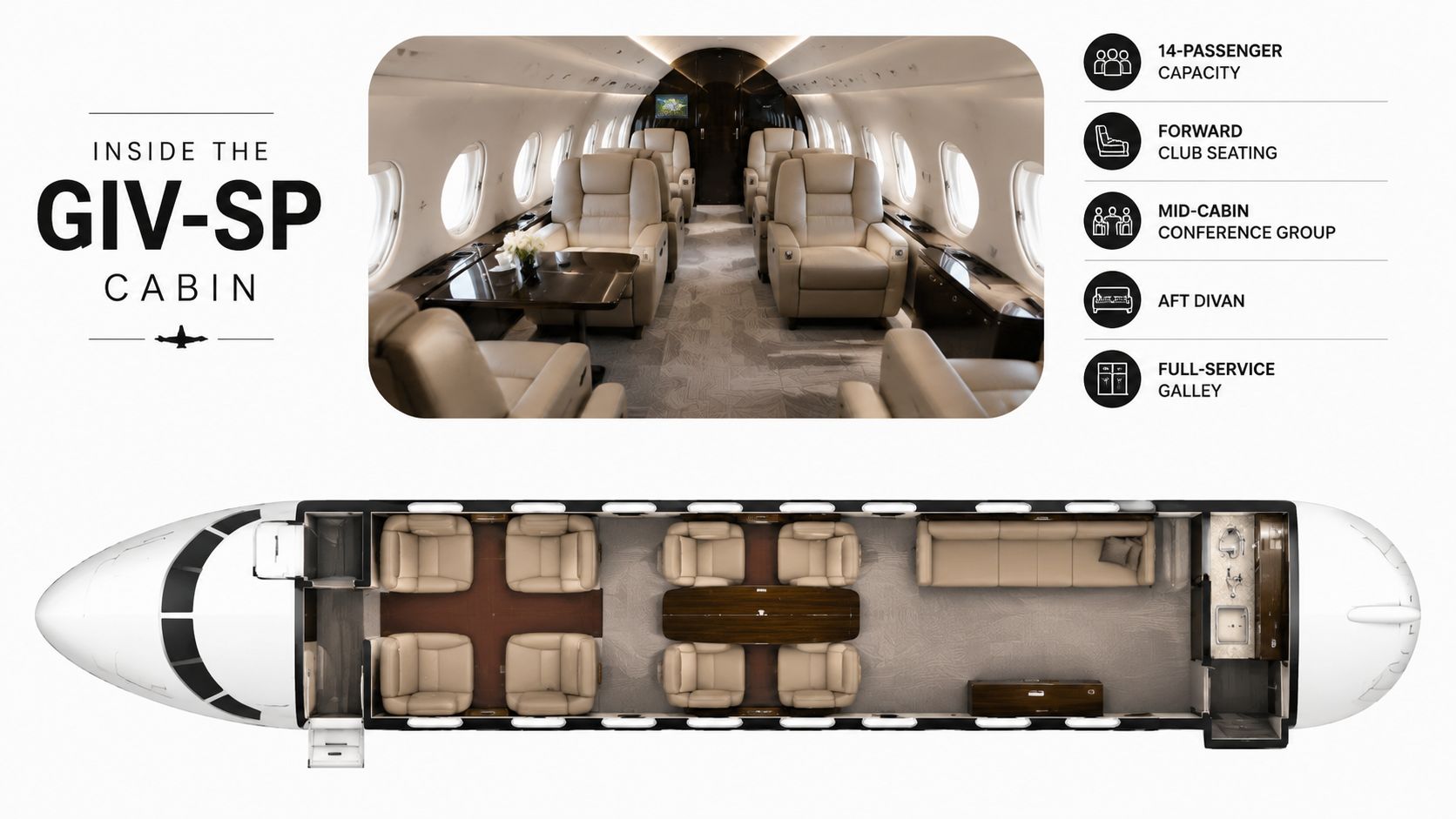
The cabin is where the GIV-SP either feels like a smart charter choice or a dated compromise. Well-kept examples still feel spacious, private, and practical. Neglected ones feel exactly like what they are, an old jet with expensive upholstery.
What the standard layout gives you
The typical GIV-SP charter layout is around 14 passengers with one flight attendant, though the exact configuration varies by operator. A common floor plan includes a forward club, a mid-cabin conference grouping or divan, and an aft seating area, which gives the aircraft a flexible feel for mixed business and leisure trips. Air Charter Service aircraft guide
That matters because the cabin isn't just about seat count. It's about whether your group can separate cleanly, meet onboard, nap, and eat without everyone colliding in the aisle. The one-flight-attendant norm also shapes service timing, so don't expect the same tempo you'd get on a larger, newer cabin crew setup.
For readers who want a deeper visual benchmark on cabin layouts, this interior guide is useful context.
What to verify before you book
The GIV-SP can be excellent, but only if the operator has maintained the interior and matched it to the mission. A refurbished aircraft may have updated lighting, better soft goods, and more modern cabin management. An older interior may still be perfectly serviceable, but you need to know that before wheels-up.
Ask these questions every time:
- Wi-Fi status: Is connectivity installed, and is it usable in flight?
- Cabin layout: Is it a true 14-seat setup, or a denser version that sacrifices comfort?
- Galley capacity: Can the crew handle hot catering, or is this a limited-service setup?
- Pet policy: Are pets allowed, and what's required onboard?
- Baggage access: Which bags are accessible in flight, and which aren't?
- Ground transport: Has the operator coordinated it, or are you managing that separately?
The cabin you see in the quote isn't always the cabin you get unless you ask the right questions in writing.
What older interiors feel like in the real world
A good GIV-SP cabin feels quiet enough for work, generous enough for a proper meal, and big enough that people don't feel stacked on top of each other. A tired one can still be fine for a short reposition, but not for a premium international leg. That's the line charter clients need to draw.
If you're booking this jet for a family trip, a corporate run, or an overnight sector, insist on photos of the exact tail if possible. Don't accept vague language about “similar configuration.” On a 25-plus-year-old airframe, the difference between a maintained interior and a neglected one is not subtle.
Charter Pricing and Operating Economics
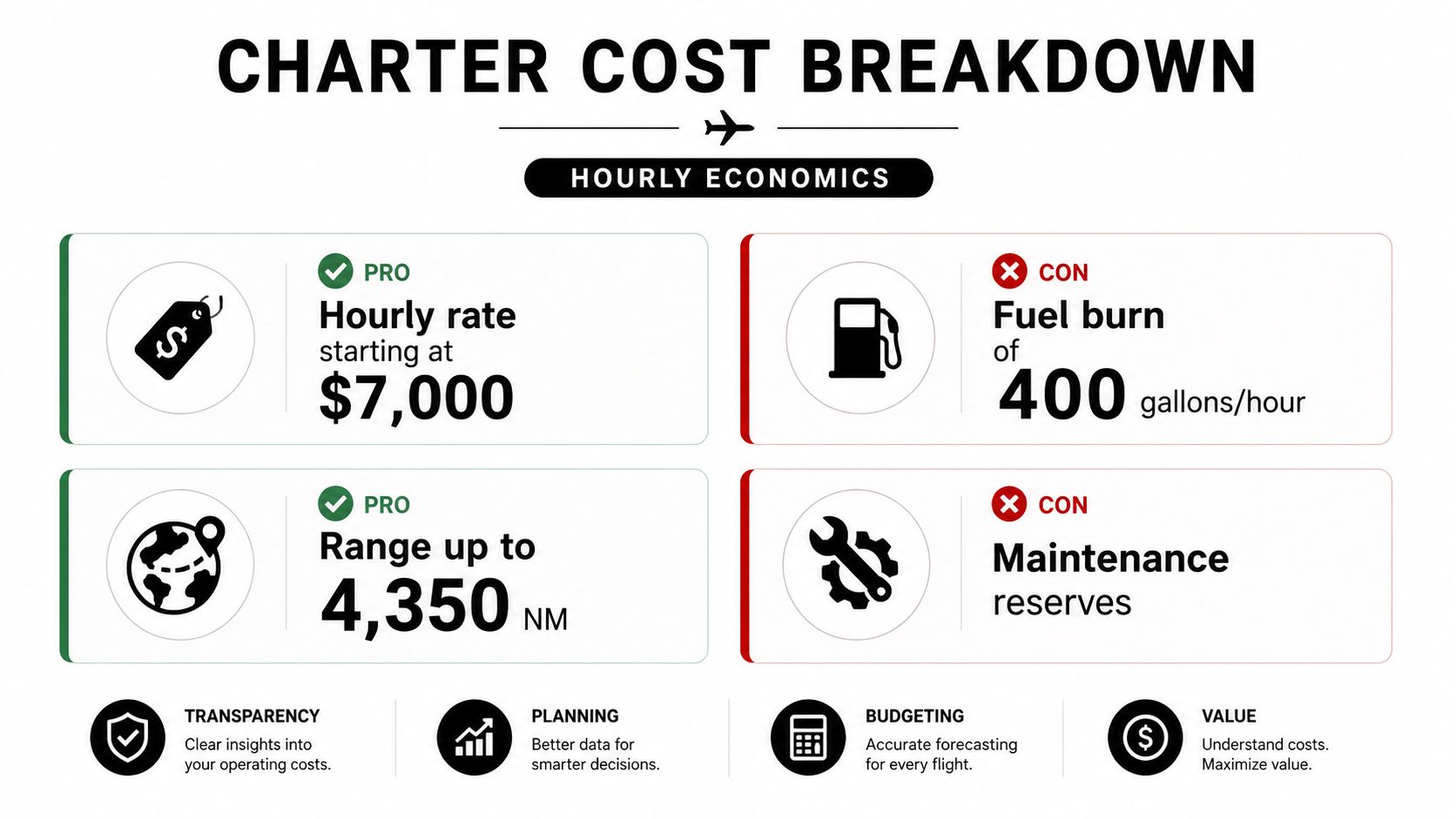
Pricing a GIV-SP correctly starts with the mission, not the hourly sticker. The rate matters, but the trip outcome matters more. A heavy jet earns its keep when it removes fuel stops, cuts wasted time, and keeps a long itinerary to one clean leg instead of two compromised ones.
What the published economics say
The market usually puts the GIV-SP in a charter band starting around US$7,000 per hour, with another reference point near US$8,500 per hour, depending on operator, region, and repositioning. Published operating data also shows a total variable cost of about $4,043 per flight hour and a cost per nautical mile of $8.71. Air Charter Service aircraft guide, MyBusinessJet buyer's guide
Those numbers are only useful if you know what sits behind them. One operator may be quoting the aircraft cleanly. Another may be building in repositioning, schedule friction, and add-ons that make the final bill look very different from the advertised rate.
The value case is straightforward. A long-range heavy jet with a higher hourly burn can still be the smarter buy if it avoids a fuel stop, protects the schedule, and keeps the trip simple. That is the economic edge charter clients pay for.
Where the money really goes
Fuel, maintenance, and crew are the obvious costs. The less obvious cost is oversight. Older aircraft need sharper operator discipline if you want the cabin, dispatch reliability, and service level to stay consistent.
Repositioning is the first line item to challenge. Catering upgrades, de-icing, and overnight positioning fees matter too, especially when the aircraft is not based near your departure point. Traditional brokers and jet card programs often build in 20 to 40 percent through markup and repositioning structure, so local sourcing can change the final number materially.
If you want to compare that structure with broader market pricing, this private jet charter cost guide is the cleanest starting point.
How to judge a quote without getting fooled
Use a simple filter.
- Hourly rate: Compare it with the published market range, not a glossy teaser.
- Repositioning: Ask where the aircraft sits before you approve the quote.
- Mission fit: If a smaller jet would need a stop, the GIV-SP may still be cheaper overall.
- Cabin standard: A low rate does not excuse a tired interior.
- Inclusions: Confirm whether crew, taxes, and ground handling are already included.
For one-off charter, the GIV-SP usually makes the most sense when you need a real heavy-cabin aircraft for a specific trip, not a fixed asset on the balance sheet. Frequent flyers may run a different calculation, but for charter clients who care about trip completion, cabin space, and schedule control, it remains a strong economic choice.
How the GIV-SP Compares to Similar Heavy Jets
The GIV-SP sits in a very specific lane. It's not the newest jet in the comparison set, and it's not the longest-range jet either. It's the value play when you want a real heavy cabin and enough range to cover serious city pairs without paying for extra capability you may never use.
The practical comparison set
The jets charter buyers usually cross-shop against it are the Gulfstream G550, Dassault Falcon 900, and Bombardier Challenger 604. The G550 is the upgrade path if you want newer pedigree and longer-range headroom. The Falcon 900 is attractive if you value trijet redundancy and a different cabin feel. The Challenger 604 is the move when you don't need transoceanic range and want to spend less.
The GIV-SP's advantage is straightforward. It gives you heavy-cabin utility and intercontinental reach without forcing you into the cost structure of a newer ultra-long-range jet. That's why it remains a working charter aircraft instead of a nostalgia piece.
Which mission fits which jet
Use the GIV-SP when the mission is long, the passenger load is real, and you want to keep the charter spend rational. It's the right call for many East Coast to Europe itineraries, coast-to-coast trips with serious baggage, and routes where cabin space matters as much as raw speed.
Step up to a G550 when the route is longer, the schedule is tighter, or you want more range cushion than the GIV-SP gives you. Choose the Falcon 900 when the trijet layout and operational profile matter more than squeezing every last dollar. Move down to a Challenger 604 when you're staying inside shorter long-range missions and don't need the GIV-SP's full profile.
Don't compare these jets by vanity. Compare them by whether they solve the route without adding waste.
A clean buyer's lens
- GIV-SP: Best when you need value, cabin volume, and proven long-range charter utility.
- G550: Best when you want a newer, longer-range Gulfstream.
- Falcon 900: Best when trijet redundancy and cabin style matter.
- Challenger 604: Best when the route is easier and the budget matters more than nonstop reach.
The mistake most buyers make is stepping up too early. They pay for range they don't use, then complain that charter is expensive. If the GIV-SP already covers the mission cleanly, it's the smarter aircraft.
Safety, Operator Vetting, and Why Ratings Matter
An old airframe is only as good as the operator flying it. That's the truth buyers need to internalize with the GIV-SP, because maintenance quality, crew discipline, and dispatch standards matter more on a mature jet than on a newer one. If the operator is sloppy, the aircraft age becomes your problem fast.
What the rating systems do
Haute Jets only works with operators that hold Wyvern Wingman or ARGUS Gold/Platinum ratings. Those are the two highest third-party safety audits in private aviation, and they exist for a reason. They pressure the operator to stay current on maintenance, crew standards, and operational procedures.
For a broader overview of why that matters, this private jet safety guide is worth reading.
The point isn't that a badge guarantees perfection. The point is that a rated operator has already passed a serious screening layer before a client ever gets near the aircraft. That's exactly what you want when the jet itself is older.
What to demand before wheels-up
The 24-hour pre-flight package should include the tail number, crew bios, weather briefing, and passenger manifest. If an operator can't provide that clearly and on time, you're already dealing with weak execution. On a long-range charter, that's unacceptable.
Older Gulfstreams often trigger the same questions from clients, and they're fair questions. Has the aircraft been maintained properly? Has the cabin been refreshed? Does the crew know the route and the aircraft type well enough to handle a delay, weather change, or last-minute revision? Those are operator questions, not just aircraft questions.
My blunt view
If you're booking a GIV-SP, stop obsessing over the airframe date and start vetting the company behind it. A well-run operator flying a mature aircraft is usually a better bet than a careless operator with a newer one. That's not a theory. That's how charter works.
Booking a Gulfstream GIV-SP Through Haute Jets
Start with the route, the date, and the exact cabin profile you want. If you ask for a “large jet,” you'll get broad options. If you ask for a specific GIV-SP, the network can narrow to the right tail, layout, and operator faster.
Haute Jets sources from 3,500+ owner-operators across 175 countries, so the practical job is to find the right aircraft near your departure city and confirm the details that matter, including year, layout, Wi-Fi, catering, pet policy, and ground transport. There are no membership fees and no jet card commitment, so the pricing stays per flight rather than forcing you into prepaid hours.
A typical run might be Miami to Turks and Caicos for a leisure trip or New York to London for a business mission. You get the quote, review the exact aircraft, and approve the trip once the operator details line up with your expectations. That's the whole point, direct sourcing without the usual markup games.
If you need the process handed to a travel manager, make the request with the route, passenger count, and bag load. The clearer the brief, the faster the match.
The Case for Flying a 1990s Heavy Jet in 2026
A production-end jet isn't automatically a bad charter choice. That assumption costs people money. The right Gulfstream GIV-SP, flown by a rated operator and matched to the right route, still delivers cabin space, range, and operational value that newer jets often price out of reach. The age matters only if the mission doesn't fit. If it does, the GIV-SP is still a sharp tool, not a compromise.
If you want a direct quote on a Gulfstream GIV-SP for a specific route, use Haute Jets and send the exact departure city, passenger count, and timing. You'll get a real aircraft match, not a generic category pitch, and you'll see quickly whether the GIV-SP is the right fit for your trip.