
Air Associates Charter does not appear to be accepting new charter bookings, after independent reporting said its charter operations shut down in June 2025 following more than 20 years in business. The FAA still lists the company and aircraft associated with its certificate, so is the name you find online a functioning operator, or a historical record that has not caught up with reality?
That distinction matters before anyone submits passenger details, sends a deposit, or assumes that an old fleet page represents current availability. Air Associates Charter was launched in 2002 after Tom Cargin purchased the assets of Air Associates of Kansas. Company descriptions later portrayed it as a privately held regional aviation business that had grown from a small FBO with two hangars into a broader operation covering charter, aircraft management, maintenance, storage, rental, and instruction. The company's public profile also describes a workforce of 51–200 employees, while a business-database estimate placed annual revenue at about $1.37 million.
The practical question is no longer just what Air Associates Charter once offered. It's whether a customer can still obtain a legal, confirmed flight from the company today, and when a regional operator makes more sense than a broker with access to aircraft in multiple markets.
What Air Associates Charter Is and Where It Stands Today
The clearest current answer is cautious: prospective charter customers should not assume that Air Associates Charter is actively booking flights. Independent reporting said the Kansas City-based company apparently closed its charter operation in June 2025, after more than 20 years of activity. At the same time, directory pages and FAA records continued to associate the brand with charter aircraft, creating the kind of mismatch that can mislead a buyer who relies on a search result alone. The independent report on the closure is more relevant to present availability than an older service description.
Air Associates grew out of the assets of Air Associates of Kansas and developed into a regional aviation business rather than a pure charter marketplace. Public company descriptions connect the brand with charter, management, maintenance, storage, rental, and flight instruction. That broader structure helps explain why historical references may remain online even when one business line has stopped accepting new customers.
Why public records can confuse buyers
FAA records are regulatory records, not live booking calendars. The FAA's operator-and-aircraft file still identified Air Associates Charter, Inc. as a Part 135 certificated operator, with aircraft including a Citation CJ3 and a Learjet 60XR listed for charter. The FAA file therefore confirms a historical or recorded regulatory connection, but it doesn't independently prove that the company is currently quoting trips.
That gap is why a customer may encounter an old website, a directory entry, or a fleet reference and still reach no booking desk. A certificate record can persist after operations change, and aircraft can later move to another operator. Readers can still use this guide to understand Air Associates' historical role, the missions associated with its certificate, and the checks required to redirect a genuine travel need to an active provider.
Services the Operator Built Its Reputation On
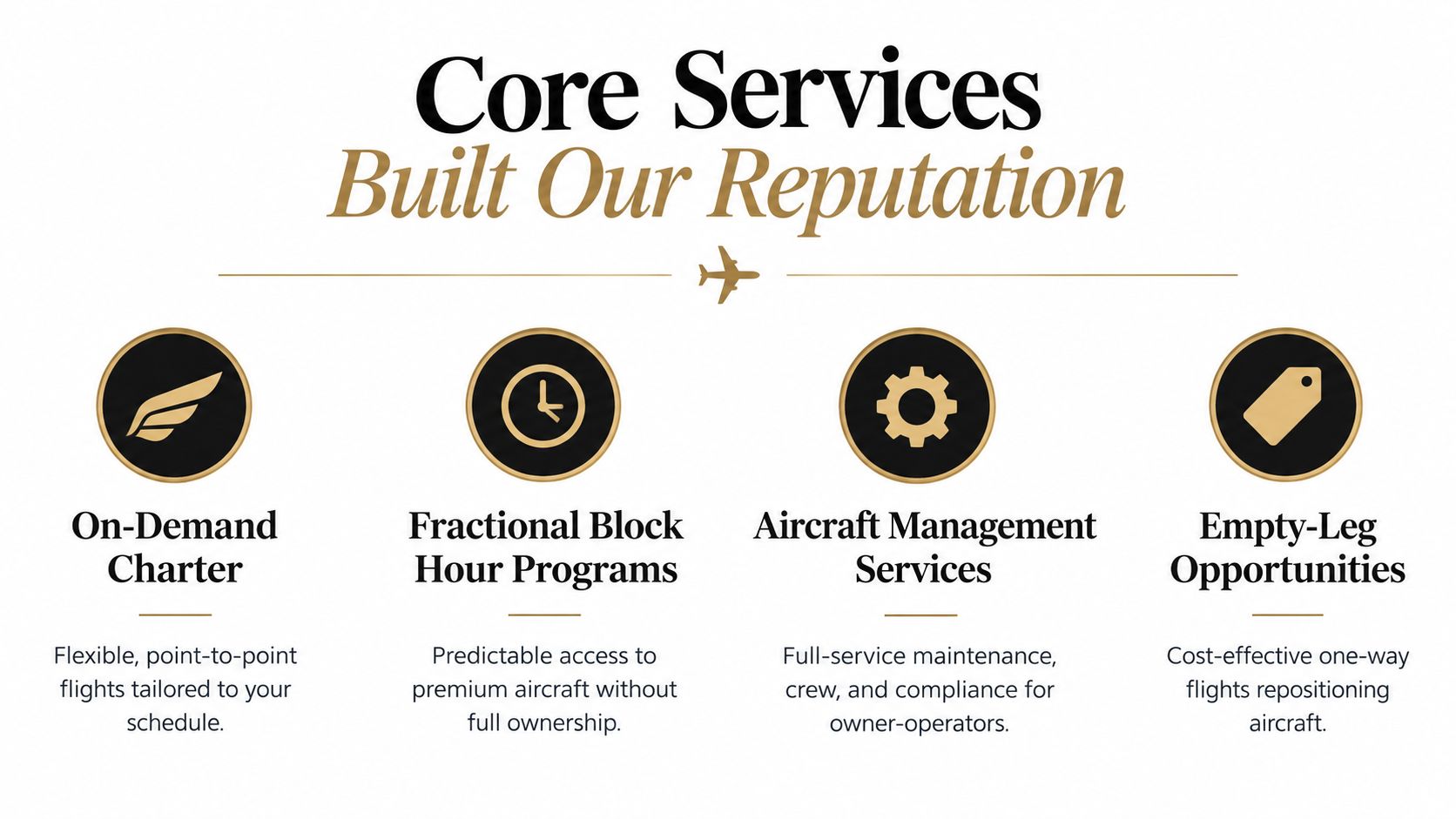
Air Associates' historical profile covered several aviation functions, but those categories shouldn't be treated as proof of current availability. The company was described as offering charter alongside management, maintenance, storage, rental, and instruction, with public business information portraying it as a small but established regional operator. Those services served different customers and carried different levels of continuity.
The historical service mix
On-demand charter: The most visible customer-facing service, intended for travelers who needed a private aircraft for a particular itinerary rather than scheduled airline service. Its present reachability is the least certain because reporting specifically identified the closure of charter operations.
Aircraft management: Management contracts can include maintenance coordination, crew administration, compliance, and operational planning for aircraft owners. A company may continue honoring an existing management relationship even if it has paused new charter sales, but no public source supplied here confirms which contracts remain active.
Maintenance, storage, rental, and instruction: These services fit the company's origin as an FBO-centered aviation business. They're operationally distinct from selling charter flights, so a surviving facility or phone line wouldn't automatically mean that new charter missions are available.
Empty-leg flights: Repositioning sectors can sometimes be sold when an aircraft must move without its main customer. Any such opportunity depends on a current aircraft, an active certificate, and a confirmed operator, so buyers shouldn't infer availability from a historical empty-leg page.
The apparent customer base included regional business and leisure travelers who valued flexible departures from a local aviation facility. However, the supplied evidence doesn't verify specific airports, routes, fractional block-hour products, sports teams, or entertainment contracts. Those details shouldn't be presented as established facts.
Practical rule: Treat a historical service menu as background information. Ask the provider to confirm, in writing, which entity holds operational control for the proposed flight.
The wider market has also made service menus harder to read. A regional company may own, manage, maintain, or store an aircraft without being the entity authorized to sell a particular charter flight. That's why a working alternative must verify the operator, aircraft, and current booking authority separately.
Safety Credentials and What Part 135 Actually Covers
Part 135 is the FAA regulatory framework associated with on-demand commercial air-carrier operations. In practical terms, a Part 135 certificate indicates that an operator has been approved to conduct certain passenger flights for hire under defined operating specifications. Those specifications connect the certificate to matters such as approved aircraft, crew qualifications, maintenance procedures, and operating limitations.
Part 135 is important, but it isn't a consumer safety badge that answers every trip-level question. The certificate and aircraft records need to align with the flight being sold. The FAA listing associated with Air Associates included a Citation CJ3 and Learjet 60XR, yet the company's reported closure demonstrates why a public record must be checked against current operational status.
Third-party audits add another filter
ARGUS and WYVERN are voluntary, independent audit programs, not FAA regulatory requirements. Their value comes from recurring oversight that can examine operator procedures, crew qualifications, maintenance systems, and safety-management practices beyond minimum certification. A plain-language comparison of ARGUS and WYVERN explains why buyers use those programs as a filter for operational maturity.
An expired or missing rating isn't proof that an operator is unsafe. It is, however, a reason to request current documentation and ask who will operate the flight. A periodic audit can miss a short-term change, a newly transferred aircraft, or a different operating entity.
| Credential | What It Verifies | How to Check |
|---|---|---|
| FAA Part 135 | Regulatory authorization for specified commercial operations | Check the current FAA operator and aircraft records, then confirm the exact aircraft and operating entity |
| ARGUS | Independent review of operator and safety-management practices | Request current status and trip-specific verification |
| WYVERN | Independent review that can include operator procedures and crew records | Request a current report or confirmation from the broker or operator |
| IS-BAO | An international safety-management benchmark used by some business aviation operators | Ask whether the operating company holds a current registration and what scope it covers |
For readers who need a concise regulatory explanation, this guide to FAA Part 135 provides useful context. The key point is simple: a rating, certificate, or badge should support a current verification process, not replace it.
Fleet and Typical Aircraft for Mid-Size Missions
The aircraft record tied to Air Associates Charter included a Citation CJ3 and a Learjet 60XR. That is enough to establish that those models appeared in the FAA's operator-and-aircraft file, but it isn't enough to support a complete historical fleet specification. The supplied evidence doesn't verify passenger capacity, range, baggage volume, cabin dimensions, runway performance, or route schedules, so those figures shouldn't be filled in from assumptions about the aircraft type.
The difference matters because an aircraft's published capability isn't the same as the capability available on a particular trip. Payload, weather, runway conditions, fuel requirements, crew duty limits, and the aircraft's current operating status all affect the mission. A buyer asking for a “midsize jet” needs the actual tail number, seating layout, baggage configuration, and dispatch confirmation, not merely a model name from an old directory.
What the recorded models suggest
The Citation CJ3 and Learjet 60XR represent business-aviation aircraft suited to private, point-to-point travel, but the available evidence doesn't establish that either model was continuously based at a particular airport or available to the public throughout the company's final operating period. Nor does it verify a standard seating configuration or a defined network of nonstop city pairs.
| Aircraft | Passengers | Range (nm) | Baggage (cu ft) | Typical Mission |
|---|---|---|---|---|
| Citation CJ3 | Not verified in the supplied records | Not verified in the supplied records | Not verified in the supplied records | Private regional or business-aviation mission, subject to aircraft status and trip conditions |
| Learjet 60XR | Not verified in the supplied records | Not verified in the supplied records | Not verified in the supplied records | Private regional or business-aviation mission, subject to aircraft status and trip conditions |
A model-specific quote should identify the aircraft's registration, operator, seating plan, and baggage limitations. It should also explain whether the aircraft is being offered under the certificate of the company named in the quote or under another operator's authority.
A familiar aircraft name doesn't establish current charter eligibility. The operating entity and aircraft authorization do.
A regional operator could once have had an advantage. Local staff may have known the aircraft, the facility, and recurring customer preferences. But once the original charter operation is uncertain, the same local familiarity can't substitute for current documentation.
Booking Process, Pricing Structure, and Cost Expectations
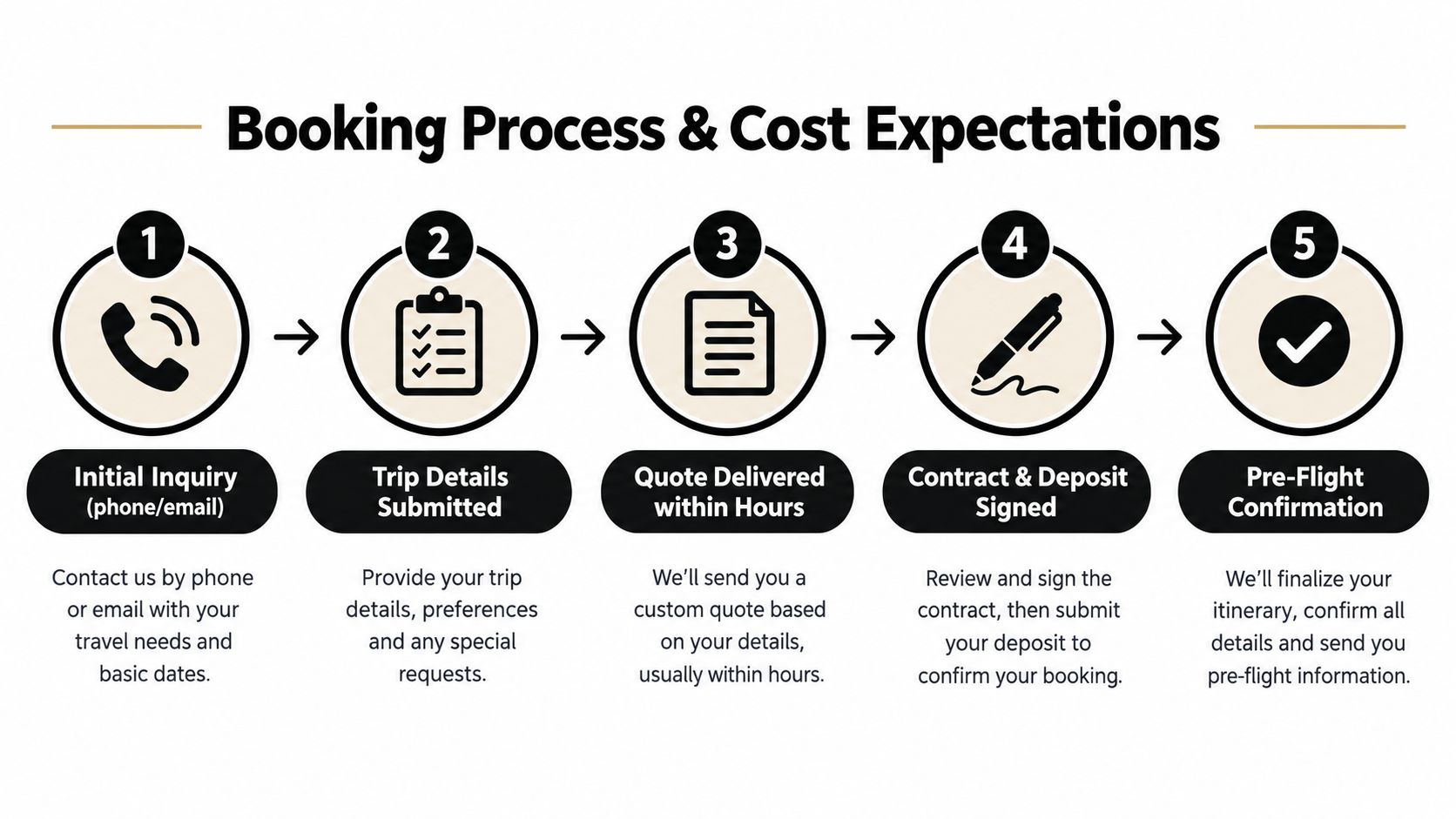
What should a traveler expect when Air Associates Charter's current operating and booking status remains unresolved? A standard charter request starts with departure and arrival airports, travel dates, preferred times, passenger count, baggage, aircraft preferences, catering, and ground transport. The provider then checks aircraft availability, crew legality, airport suitability, and positioning before issuing a written quote.
Historical descriptions do not establish a current Air Associates quote turnaround time, deposit policy, contract language, catering minimum, overnight crew charge, federal excise tax treatment, or hourly rate. These details remain unknown for present-day Air Associates inquiries and should not be presented as published company terms.
What a careful buyer should request
Trip confirmation: Ask who will operate the flight, which aircraft registration is assigned, and whether the quote covers an owned, managed, or third-party aircraft.
Complete price: Request a written all-in figure identifying aircraft time, positioning, crew expenses, taxes, catering, ground transportation, cancellation terms, and overnight charges.
Lease language: If the quote mentions a wet lease or dry lease, ask which party controls the aircraft, crew, dispatch, and operational decisions. The label alone does not explain the legal structure or passenger protections.
Payment terms: Confirm the deposit schedule, refund rules, card or wire requirements, and the remedy if the aircraft becomes unavailable.
Pre-flight record: Obtain the final operator name, aircraft registration, crew information, departure facility, and confirmation contact before going to the airport.
Positioning can materially change the economics when an aircraft must fly empty to meet a customer. It can add roughly 20–40% to a traditional charter invoice and, on some routes, 30–100%, depending on distance and trip structure, according to this explanation of repositioning and deadhead fees. A local aircraft may reduce that exposure, but only if it is available and legally positioned for the mission.
For context on the components that commonly shape a charter quote, consult this guide to private jet charter cost. A broker such as Haute Jets may compare operating companies, while a regional operator may offer a direct relationship when its aircraft and authority are current. In Air Associates' case, documentation should come before convenience.
Air Associates Charter Compared to Haute Jets
The comparison is less about a familiar brand versus a newer one than about operating model. Air Associates Charter was a regional operator with aircraft recorded under its Part 135 file. Its strength, when active, would have been direct knowledge of its own operation. Its limitation was reach. A customer needing an aircraft outside the available fleet or operating footprint would have needed another provider.
Haute Jets operates as a charter broker, not as the operator of every aircraft it offers. Its journal describes access to 3,500+ safety-vetted aircraft across 175 countries, with no membership requirement. The 2026 charter overview supports a global sourcing model in which the client requests a route and receives aircraft options rather than selecting from one company's own certificate.
Three practical differences
| Factor | Air Associates Charter | Haute Jets |
|---|---|---|
| Fleet access | Historically tied to aircraft listed under its operator record, including a Citation CJ3 and Learjet 60XR | Broker access to aircraft sourced across a global network |
| Pricing mechanics | A direct operator quote reflects that operator's aircraft, crew, positioning, and operating costs | A broker can compare offers from multiple operating companies for the same mission |
| Confirmation | Dependent on the company's current booking desk and aircraft status | A broker can coordinate options, operator documents, and alternatives through one request |
| Safety review | FAA certification and any current third-party status must be checked | The brokerage's published journal describes safety-vetted sourcing, which still requires trip-level confirmation |
The distinction between broker and operator deserves transparency. A broker doesn't eliminate operational risk by presenting more aircraft. It must identify the actual certificate holder, verify the aircraft, and provide current documentation. The buyer should still ask who controls the flight.
Haute Jets' private charter page presents that brokerage approach as on-demand sourcing without a membership requirement. For a customer facing an uncertain regional operator, the practical benefit is access to alternative quotes without restarting the search with each operator.
Why Local Sourcing Can Still Cost More Than You Think
Can a regional operator still be the better choice when its current booking status is uncertain? Yes, but only when the operator's aircraft, crew, and operating schedule fit the mission. A nearby company is not automatically the lower-cost option, and a global broker is not automatically the better one.
Local sourcing has practical advantages. A regional operator may know the airports, crews, and operating conditions around its usual service area. For repeat travel on a familiar route, that local knowledge can make planning easier and reduce the number of parties involved. Direct communication may also help a client understand who controls the aircraft and how the quote was built.
Those advantages depend on the operator being available and operational for the requested flight. If Air Associates Charter's current booking desk, aircraft status, or operating arrangements cannot be confirmed, the value of a local relationship becomes harder to assess. A customer may spend time pursuing an aircraft that cannot be booked, then need to restart the search elsewhere.
When broader sourcing earns its place
A broker such as Haute Jets approaches the same decision from a wider pool of operators. That can help when the departure airport is outside a regional company's normal pattern, when the itinerary is one-way, or when the requested aircraft is unavailable locally. The broker can compare aircraft already positioned near the client, along with alternatives from other operating companies.
This does not guarantee a lower quote. A broader search can also produce more choices without resolving the underlying questions about operational control, aircraft availability, or documentation. The buyer still needs to identify the certificate holder and the company responsible for conducting the flight.
The financial difference often comes from the trip's structure rather than the label attached to the seller. An aircraft that appears local may require an empty flight before or after the passenger leg. Crew scheduling, overnight requirements, and an unpaired return can change the total even when the aircraft model and route look similar. The earlier discussion of the repositioning premium, including the factors described in The published repositioning analysis, provides the cost context.
The practical rule is conditional. Local sourcing can make sense for recurring regional travel with predictable aircraft placement and a confirmed booking channel. Broader sourcing is often more useful for urgent departures, one-off missions, unusual city pairs, or trips that do not match the regional operator's normal schedule. The strongest choice is the provider that can confirm the aircraft, operating company, and full trip cost clearly, not the one closest to the passenger.
How to Verify Availability and Choose the Right Option
Start with the operator, not the aircraft photograph. Ask whether Air Associates Charter is currently accepting new charter bookings, which company will hold operational control, and whether the proposed aircraft is authorized for the specific flight. The FAA record is a useful starting point, but the reported closure means it shouldn't be treated as a live reservation system.
A four-part verification checklist
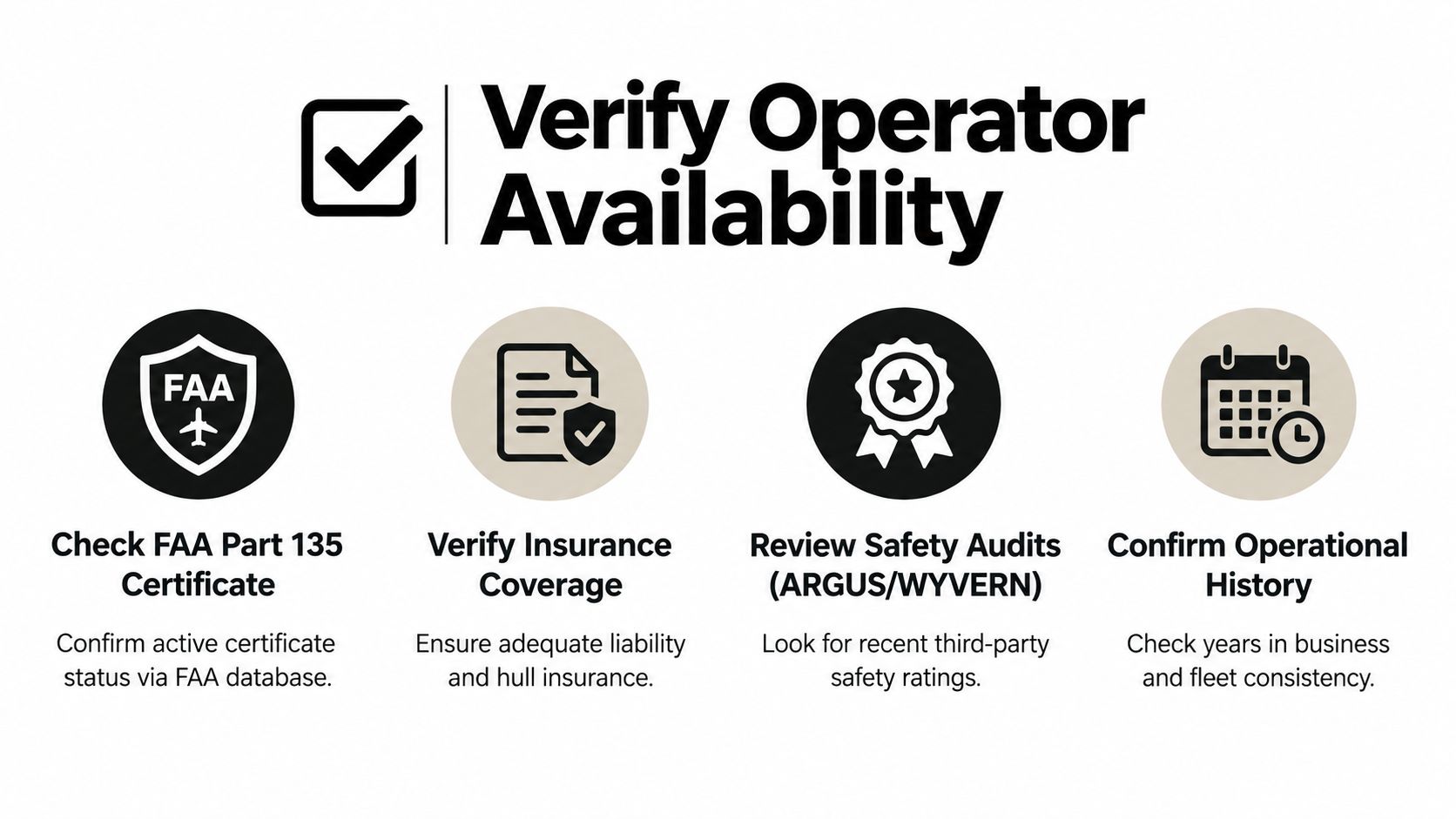
Check certificate status: Review the current FAA operator-and-aircraft information and compare the operator name with the name on the quote. A listing that still contains Air Associates doesn't, by itself, prove that the charter desk is active.
Verify the aircraft: Request the registration or tail number and ask which certificate authorizes its commercial use. Don't accept a generic model description as the final aircraft confirmation.
Review safety credentials: Ask for current ARGUS or WYVERN status where available, and understand that these are voluntary third-party audits rather than FAA requirements. Confirm the status of the actual operating company, not only a broker's general network.
Confirm insurance and history: Request proof of appropriate insurance and a clear operating history for the entity selling the flight. If the provider can't explain who will operate the mission, stop the booking process until that gap is resolved.
The decision framework is straightforward. If a confirmed Air Associates representative can provide current operator details, aircraft authorization, insurance, safety documentation, and a written all-in quote, a regional conversation may still be worth pursuing. If the phone line is inactive, the quote names another company without explanation, or the aircraft record doesn't match the proposed operator, redirect the request.
For a regional trip with flexible timing, compare a local quote against at least one broader sourcing option. For a time-sensitive or multi-leg itinerary, ask for several aircraft choices and a backup plan. The buyer's next action should be specific: request written confirmation from the operator, or submit the route, dates, and passenger count to an active broker and ask for the operating company, tail number, safety documentation, and complete price before paying.
Haute Jets can source on-demand charter options from safety-vetted operators across multiple markets, which is useful when Air Associates Charter's current booking status can't be confirmed. Share your route, dates, and passenger count, then compare the available aircraft and operating documentation through Haute Jets.