

The great-circle distance from JFK to Heathrow is about 3,451 statute miles, which is roughly 5,555 km or 3,008 nautical miles. This figure answers how many miles from New York to London, and in the air it means a true transatlantic mission, not a long domestic hop with ocean views.
Readers usually stop at the mileage. That's the wrong place to stop. In charter planning, the better question is what that distance does to range, payload, winds, fuel stop risk, and cabin comfort, because the same New York to London corridor can be easy in one jet and tight in another.
The Headline Distance From New York to London
The cleanest headline number is 3,451.4 statute miles from JFK to LHR, or 5,554.5 km if you prefer metric, with many route tools rounding the corridor to somewhere between 3,451 and 3,471 miles depending on the exact airport pair used as measured here. In nautical miles, the route sits at about 3,008 nautical miles, which is the unit charter crews care about when they talk fuel and range.
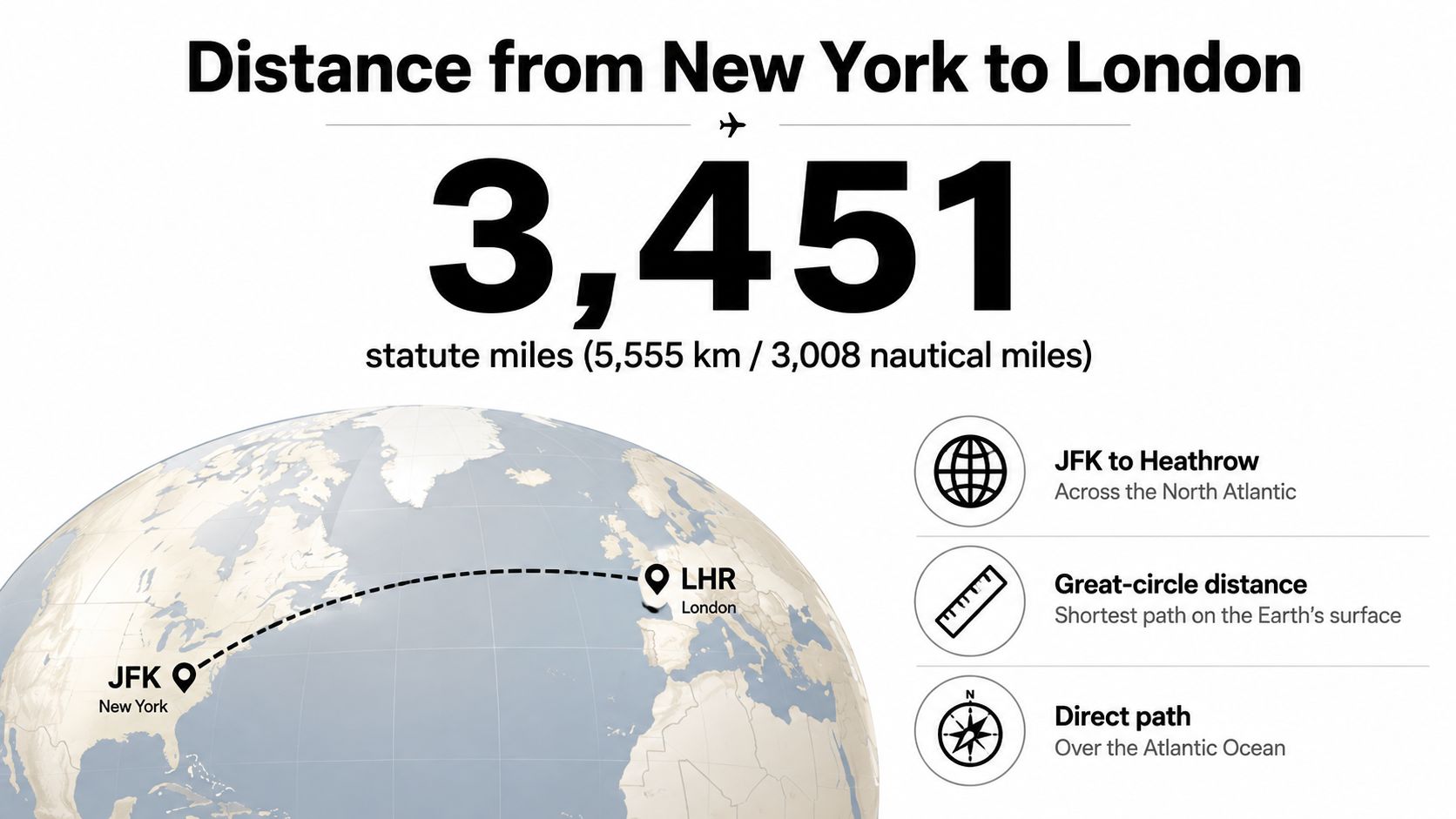
The number is smaller than many people expect because the Earth is curved and the shortest path between two points follows that curve. A flat map makes the Atlantic look wider than it really is on a great-circle route. That's why the corridor is best understood as a little over 3,400 miles, give or take the airport pair.
Why the airport pair matters
New York and London are not single pins on a map. They're a family of airport combinations, and each pairing shifts the mileage slightly. That's normal, not a contradiction.
The practical takeaway is simple. JFK to Heathrow is the benchmark many people mean when they ask how many miles from New York to London, but private aviation doesn't live on benchmarks alone. If your trip starts at a different New York airfield or ends at a different London airport, the total distance changes with it.
Practical rule: use the airport pair, not the city name, when you're sizing an aircraft or reading a quote.
For route planning, Haute Jets keeps a focused overview of the corridor on its New York to London route page. That's the level of specificity executives need, because the gap on paper is only useful when it's tied to the actual departure and arrival airports.
Great-Circle Math and Why the Map Lies
A great-circle route is the shortest path over the surface of a sphere. On a globe, that path looks curved. On a flat map, it looks deceptive because the map itself stretches and distorts distance as you move away from the center.
That's the reason New York to London doesn't fly as a straight ruler line drawn across a wall map. Aircraft typically arc over the North Atlantic, and that geometry is part of the mission planning, not an academic footnote. The route length matters because crews and dispatchers size fuel, alternates, and payload around the actual path, not the simplified one.
What crews care about
The cockpit doesn't care how elegant the map looks. It cares about the actual route length, the winds aloft, and the fuel state on arrival. A route that appears short on paper can still carry operational penalties if weather or traffic constraints push the aircraft off the ideal track.
That's why great-circle math matters in charter work. It gives you the baseline before anything else changes. Once the flight is airborne, the story becomes routing, weather, and runway choice.
Distance on paper is only the starting point. The dispatch decision is built on what the jet can fly comfortably, not on what a map projection suggests.
Aerial conditions over the North Atlantic can also shape how crews think about the mission. The corridor is not just about getting from A to B, it's about staying inside the aircraft's range envelope while keeping the trip efficient and predictable. When that balance works, the flight feels routine. When it doesn't, the itinerary becomes more fragile.
How Airport Pairs Quietly Change the Mileage
The city names hide the fact that this route is really a set of airport combinations. JFK to Heathrow is the cleanest reference point, but New York flyers may start from other airports, and London arrivals may end somewhere other than LHR. Those swaps don't just change convenience, they change mileage.
For private aviation, the difference can be operationally meaningful even when it looks minor on paper. A few dozen miles can affect fuel planning, block time, and whether the aircraft has the margin to carry the cabin load the client wants. That's why serious charter planning starts with the exact airports, not a generic city pair.
Common New York and London pairings
| Departure Airport | Arrival Airport | Statute Miles | Nautical Miles | Kilometers |
|---|---|---|---|---|
| JFK | LHR | 3,451.4 | 3,008 | 5,554.5 |
| New York city pair, rounded by calculators | London city pair, rounded by calculators | 3,451 to 3,471 | about 3,008 | 5,555 km, approx. |
The variation is normal because “New York” and “London” can mean different airport pairs, and calculators round differently. That's not a flaw in the math, it's the reality of aviation geography. The route is fixed only after the airports are fixed.
If you're comparing departures in the New York area, the terminal choice can matter as much as the aircraft. On the London side, the arrival airport shapes schedule flexibility and ground handling. A charter quote that ignores those details is only half a quote.
For a reference point on the New York side, Haute Jets publishes a dedicated page for JFK private terminal service, which is the sort of operational detail that matters more than a broad city label.
Good charter habit: ask for the exact airport pair before you compare aircraft. Without that, you're not comparing the same trip.
Transatlantic Flight Times and the Jet Stream Effect
The mileage tells you the geography, but the clock tells you the passenger experience. Published route estimates put nonstop New York to London time at roughly 7 hours 2 minutes to 7 hours 35 minutes, with most calculators landing in the 7 to 8 hour range for direct service. That's long enough to feel like real international travel, but short enough that the cabin can still function as a working office or a proper rest environment.
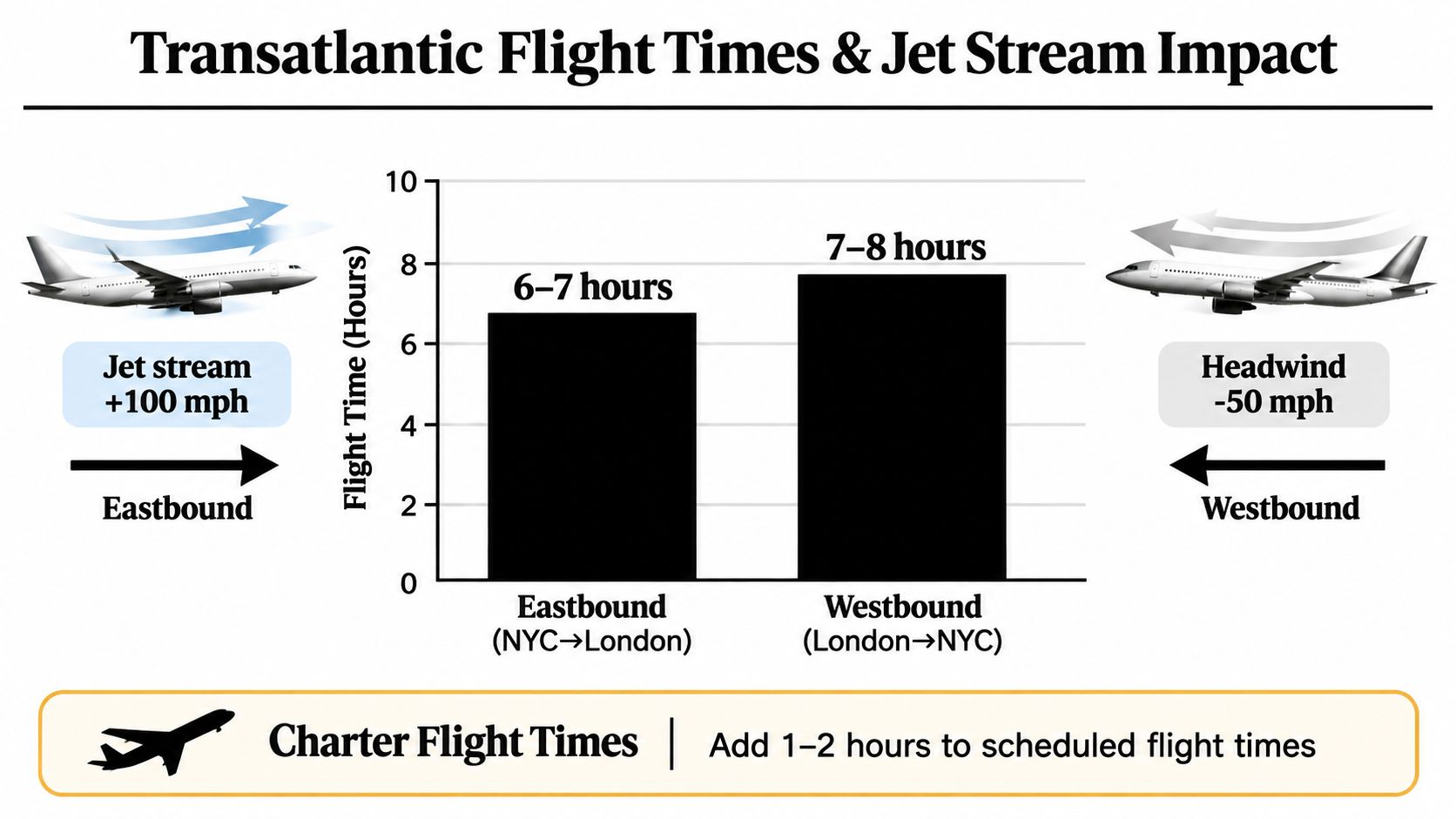
The jet stream is the reason the same corridor can feel asymmetric. Eastbound and westbound legs don't behave the same way, because winds aloft can either help or slow the airplane. That's why operators file different routings on different days.
What that means in the cabin
A westbound trip can feel longer even when the miles are the same, because the crew may be working against stronger airflows. Eastbound, the flight often feels cleaner and more direct. Passengers notice it as a different sleep window, a different meal cadence, and a different arrival feel.
The North Atlantic Track system adds another layer. Airlines don't just pick one path and stick with it, they adapt to winds and traffic management. For charter clients, that means schedule accuracy is tied to atmospheric conditions as much as distance.
Here's the practical part. Flight time is not a fixed translation of miles. It's a live variable shaped by aircraft performance and the day's weather picture. If you're booking transatlantic charter, you should read the clock, not just the route length.
Which Private Jets Can Nonstop the Transatlantic
The New York to London corridor is a useful test because it separates aircraft that can do the mission from aircraft that can only pretend to on paper. Neutral route references place the corridor at about 3,008 nautical miles, with direct flight times typically ranging from 7 hours to 7 hours 35 minutes depending on winds and aircraft type as noted here. That distance is easy for some jets and impossible for others.
Aircraft classes that make sense
Ultra-long-range jets are the cleanest answer. They're built for crossings like this, so they have the range margin and cabin comfort to handle the route without drama. That means less compromise on payload and fewer operational headaches.
Long-range midsize and heavy jets can also work, but the margin gets tighter. If the weather is ugly or the cabin is full, the operator may need to make trade-offs. That can affect baggage, catering, or the payload carried onboard.
Super-midsize and light jets are the wrong tool for this mission. They don't belong on a nonstop Atlantic crossing from New York to London, and anyone telling you otherwise is selling optimism instead of capability. In those aircraft, a fuel stop becomes part of the plan.
| Jet Category | Nonstop Capability | Operational Reality |
|---|---|---|
| Ultra-long-range jet | Yes | Best fit for nonstop transatlantic work |
| Heavy jet | Often yes | Strong choice, still depends on loading and winds |
| Long-range midsize jet | Sometimes | Can work, but margin gets tighter |
| Super-midsize jet | No | Fuel stop required |
| Light jet | No | Not a transatlantic aircraft for this route |
A good operator won't just say “yes” or “no.” They'll explain whether the aircraft can make the trip with margin, which is what matters when the weather shifts. That's the difference between a mission that feels smooth and one that starts turning into a workaround.
For readers comparing cabin options, Haute Jets' ultra-long-range jet fleet is the right place to think about aircraft that are purpose-built for this kind of crossing.
Operational truth: nonstop capability is not the same as comfortable capability. The gap between the two is where charter mistakes happen.
Operational Factors That Move the Numbers
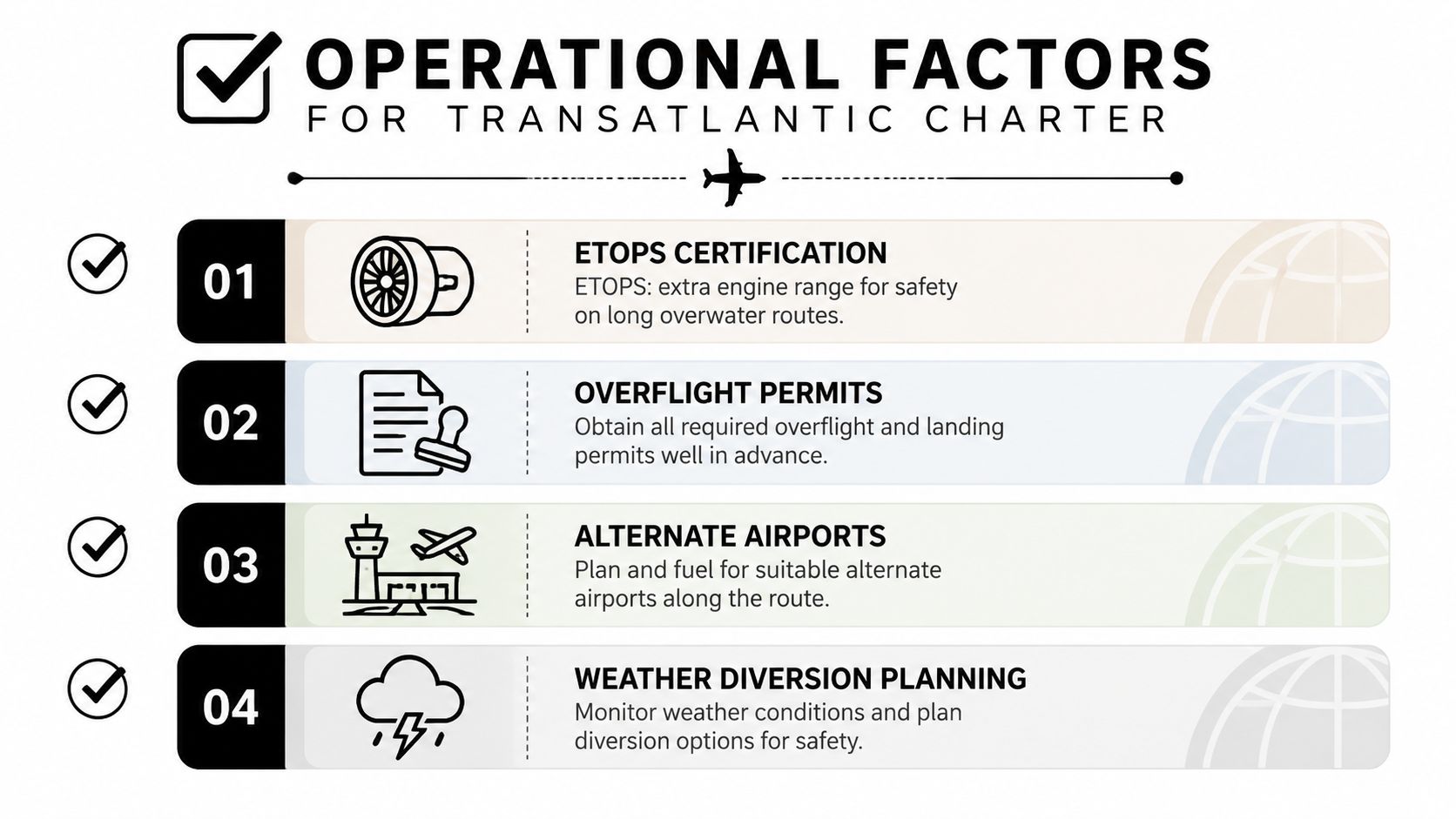
The distance doesn't change, but the flight still can. That's because transatlantic charter is shaped by a stack of operational issues that sit underneath the route length. Weather, airspace, alternates, permits, and airport congestion all matter, and each one can alter the day's plan.
What changes the mission
Overflight routing is one of the first variables. The aircraft may need to pass through multiple airspaces, and the chosen route has to work with permits and traffic flow. A clean airway can keep the trip efficient, while a constrained one can force a longer track.
Airport constraints matter too. Heathrow and London City are not interchangeable from an operator's perspective, and not every jet is a neat fit for every runway or schedule. Slot pressure, ground handling, and arrival timing all influence what the crew can legally and practically file.
Weather changes the flight plan in a more visible way. Winter storms over the North Atlantic can push routes around, summer convection can add detours, and volcanic-ash concerns can create further rerouting risk. These aren't theoretical issues, they're part of transatlantic dispatch reality.
Fuel planning and alternates close the loop. A crew doesn't dispatch based on the shortest line alone. They dispatch based on the safest feasible route with the right contingency built in.
The bottom line is plain. Two identically named New York to London charters can produce different itineraries a week apart because the operating environment changed. If you want a meaningful answer, you need the aircraft, the date, the airport pair, and the weather picture together.
Planning a Charter on the New York to London Route
If you're reading a quote for this corridor, don't focus on miles first. Focus on the aircraft type, the exact airport pair, and the day's wind forecast, because those three inputs do more to shape the trip than the route name ever will. A quote built on the wrong assumptions can look attractive and still be operationally weak.
Ask one direct question before you confirm anything. Can the aircraft make the mission nonstop with the actual payload onboard? If the answer is vague, the quote is incomplete.
A New York-based aircraft often makes more sense than a European ferry-in because the aircraft is already positioned where you need it. That reduces waste and keeps the schedule tighter. If you're comparing options, the cheapest-looking number can hide a repositioning problem.
Haute Jets sources on-demand charter from a wide operator network and matches the aircraft to the mission instead of forcing the mission into the nearest available jet. That approach matters on transatlantic work, where the difference between a strong aircraft choice and a marginal one shows up fast in the cabin and on the clock.
If you need a real transatlantic plan, not a generic quote, start with the route, the aircraft, and the actual operating conditions. Then make the booking.
If you're arranging a New York to London charter, Haute Jets can source the aircraft around your schedule, your airport pair, and your cabin needs instead of pushing a one-size-fits-all option. Visit Haute Jets to compare transatlantic charter choices and get a flight plan built around the mission, not just the mileage.