
Each carry-on liquid container must be 3.4 ounces (100 mL) or smaller, all of those containers must fit in one quart-size zip bag, and the limit applies to the container itself, not the liquid left inside it. If you're standing over a toiletry kit right now, that's the rule that decides what makes it to the gate and what gets tossed.
The traveler most likely to feel this rule in real life is the one who packed a favorite full-size perfume, a half-used shampoo, or a skincare serum they swear is “basically empty.” Security doesn't care how sentimental the bottle is, and it doesn't usually care how little product remains. It cares about the shape and capacity of the container, which is why this rule is simpler to memorize than it first sounds, but easier to misunderstand than almost any other airport packing rule.
The One Number Every Packer Should Memorize
A traveler at the security belt usually realizes the mistake at the worst possible moment. The bottle is already in the bin, the line is moving, and the officer is about to flag a full-size serum or perfume that looked harmless in the hotel bathroom. That sinking feeling is why 3.4 ounces matters more than any other packing number for carry-on liquids.
The checkpoint rule is built around a single ceiling, 3.4 ounces, or 100 milliliters, for each liquid, aerosol, gel, cream, or paste container at U.S. and Canadian airports. That number is the anchor for almost every liquids question a first-time flyer asks, because it tells you what can go in your carry-on and what needs to stay behind or move to checked baggage. The rule is also steady enough that you can learn it once and use it on almost every trip.
Think in containers, not totals
The easiest way to remember it is this, the bottle must be small enough before you even fill it. A half-empty big bottle still counts as a big bottle, which is why the number printed on the container matters more than the amount of liquid you see inside. That distinction trips up travelers who assume “almost empty” should pass.
For practical packing, that means you can build a small toiletry kit around travel-size items and stop worrying about ounces in the abstract. If a container is labeled 3.4 ounces or 100 mL, it belongs in the carry-on liquids bag, assuming it fits with the rest of your items. Anything larger belongs elsewhere unless it qualifies for an exception.
Practical rule: If the container itself is larger than 3.4 ounces, don't gamble on how full it looks. Security is judging the container, not your math.
That's the rule in its cleanest form. Learn the number, trust the container size, and the rest of the liquids puzzle gets much easier.
Decoding the 3-1-1 Rule the Easy Way
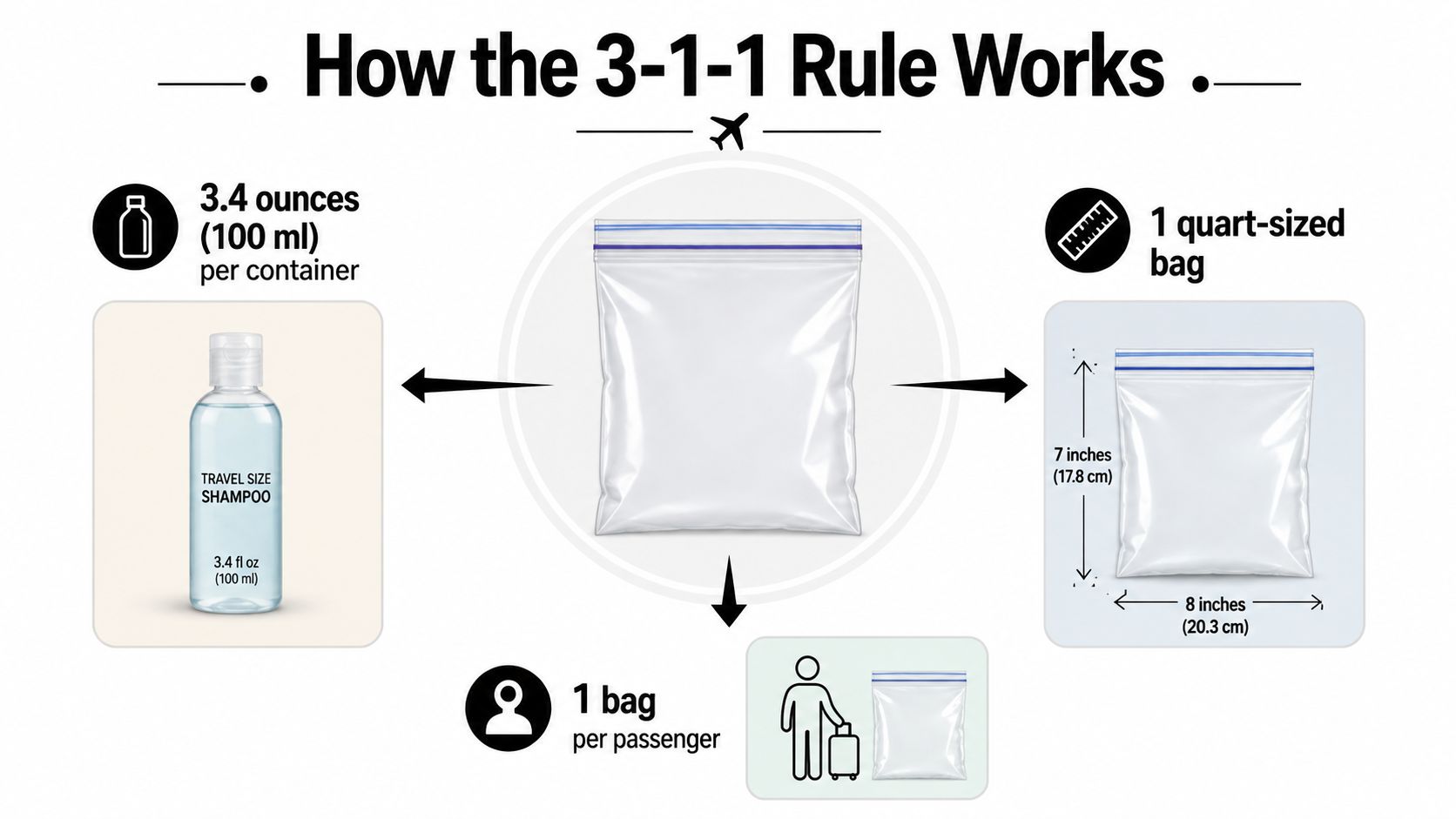
The 3-1-1 rule sounds bureaucratic until you translate it into something ordinary, like a lunch bag. The first 3 means 3.4 ounces per container, the first 1 means one clear quart-size zip-top bag, and the last 1 means one bag per passenger. Once you see it that way, it stops feeling like airport jargon and starts feeling like a packing container problem.
The bag is the real bottleneck
Think of the quart bag as the shared lunchbox for everything liquid in your carry-on. Your shampoo, toothpaste, lotion, and perfume all have to live inside that one small bag, and the bag itself has to close. That's why two travelers can both obey the ounce rule and still have very different experiences, one person packs a few slim bottles, the other tries to cram in bulky round containers and runs out of space.
The TSA's own guidance says each passenger may bring one quart-size bag of liquids, aerosols, gels, creams, and pastes, with each container at 3.4 ounces (100 mL) or less. You can have multiple small containers, so long as they all fit in that single bag. A traveler with nine small bottles is still limited by the bag's size, not by a separate bottle-count cap.
For a visual reference on bag sizing, small gear for airport travel is a useful way to picture the physical limits before you leave home. The point isn't to buy a special kit, it's to understand the container you're working with.
A short video demo can also help the rule stick in your head before a flight.
The checkpoint isn't asking, “How much liquid do you own?” It's asking, “Can all of it fit in one small bag without violating the container limit?”
That mental model is the shortcut. Once you think in containers and bag space, the 3-1-1 rule becomes something you can check in less than a minute.
Why Container Size Beats What Is Inside the Bottle
The most common mistake is assuming a partly used bottle gets a pass because there isn't much product left. Security doesn't work that way. TSA screens the container's maximum capacity rather than the liquid inside it, so a half-full 6 ounce bottle can still be confiscated even if you've used most of the product already. TSA's liquids screening guidance is clear on that point.
The label matters more than the fill line
A traveler who pours shampoo from a big bottle into a travel container has a much better chance of clearing the checkpoint. The reason is simple, the new container itself is small enough to qualify. By contrast, a bottle that was manufactured as a larger container can fail even if it's only half full, because the officer is looking at the bottle's capacity, not how heavy it feels in your hand.
That's where a lot of travelers get stuck. They check the remaining liquid, not the container's printed size, and then they're surprised when a “nearly empty” bottle gets pulled. The smarter move is to decant products into containers that are clearly travel size, then keep the originals in checked baggage or leave them at home.
A common question is whether mixed toiletries change the calculation. They don't. A set of small bottles still has to fit together in the same bag, and each one still has to meet the size cap on its own. The practical limit is space in the bag, not a running total of ounces across your whole kit.
Good checkpoint habit: if the bottle isn't clearly travel size, assume it's too large until you've relabeled or repackaged it.
That's the core shift. Stop thinking, “How much is left?” Start thinking, “What's the largest container I'm carrying?” That one change prevents most confiscations before they happen.
Carry-On vs Checked Baggage Ounce Limits Compared
Carry-on liquids are about checkpoint screening. Checked baggage is about storage. That difference is why the same bottle that gets stopped at security can be perfectly fine in a suitcase below the plane.
The simple split is this, carry-on liquids must stay at 3.4 ounces per container and inside one quart-size bag, while checked bags are where full-size toiletries usually belong. For many travelers, that means a small, compact carry-on kit for the flight and a normal bathroom routine packed in the checked suitcase.
| Bag Type | Per Container Limit | Container Count | Notes |
|---|---|---|---|
| Carry-On | 3.4 ounces (100 mL) or less | As many as fit in one quart-size bag | One bag per passenger, containers must clear screening |
| Checked Baggage | Full-size toiletries are generally fine | No quart-bag limit | Protect bottles from leaks and seal them well |
A traveler on a long trip might keep a tiny shampoo, toothpaste, and moisturizer in the carry-on, then pack the full-size versions in the checked bag. That setup avoids the checkpoint scramble without forcing the person to travel like they're camping for a weekend. It also keeps the liquids bag lean enough that screening feels routine rather than stressful.
For private aviation travelers comparing packing styles, the same principle still helps, even if the baggage flow is different, and what you can bring on a private jet still benefits from the same organized thinking.
The key point is that the ounce limit applies to carry-on bags, not to all travel. Separating your flight essentials from your full toiletries makes packing much simpler.
Exceptions That Let Liquids Exceed 3.4 Ounces
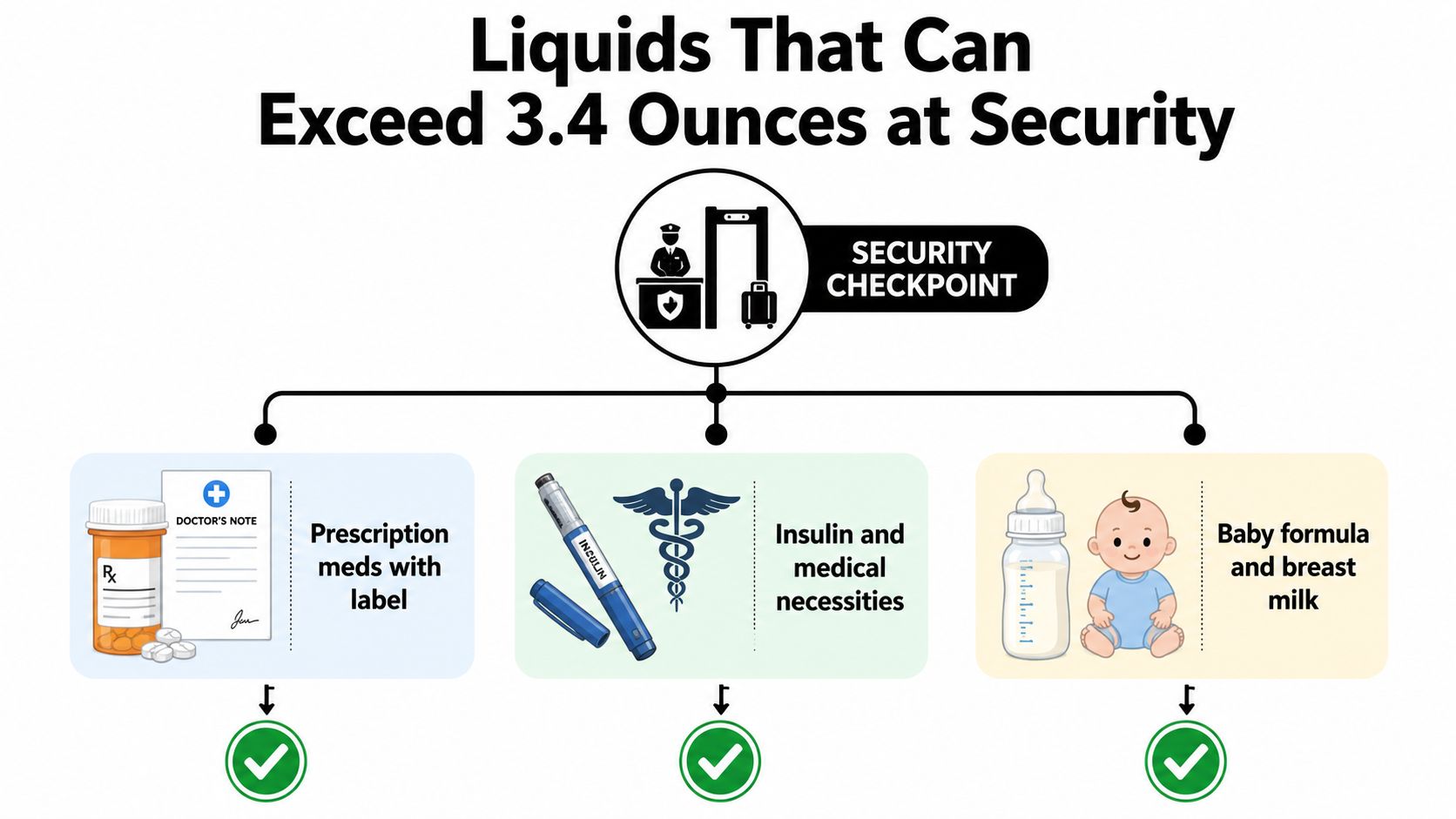
A parent at security with baby formula doesn't follow the same logic as someone carrying face wash, and TSA knows it. The checkpoint rule has built-in exceptions for items that are medically necessary or essential for infants and young children, including medications, baby formula, breast milk, and toddler drinks. Those items can exceed 3.4 ounces and are handled separately at screening. TSA also notes that sealed duty-free liquids can qualify for separate handling when they're packed properly.
What travelers actually do at the checkpoint
A traveler carrying prescription liquid medicine should keep it easy to access and tell the officer it's a medical item. A parent with formula or breast milk does the same thing, then follows the officer's instructions for separate screening. A shopper who bought perfume after security in an international airport keeps the receipt visible and leaves the item in its sealed, tamper-evident bag.
The point isn't that exceptions are casual. They're specific. Medically necessary liquids and infant items may be screened differently, and duty-free liquids need the right packaging to avoid problems if you're connecting through another airport. That distinction matters, because a traveler who understands the rule as absolute may overpack or, worse, leave essential items behind.
For families and travelers moving through customs-sensitive itineraries, the private jet customs guide is a useful companion read for understanding how carefully screened items move through international travel.
Checkpoint reality: if your liquid belongs to a medical or infant category, declare it early and keep it separate from your regular toiletries.
That's the practical advantage of knowing the exceptions. You don't need to force every bottle into the same 3.4-ounce box when the rule itself already makes room for medically necessary and child-related liquids.
How TSA, CATSA, and Europe Handle the Same Ounce Limit
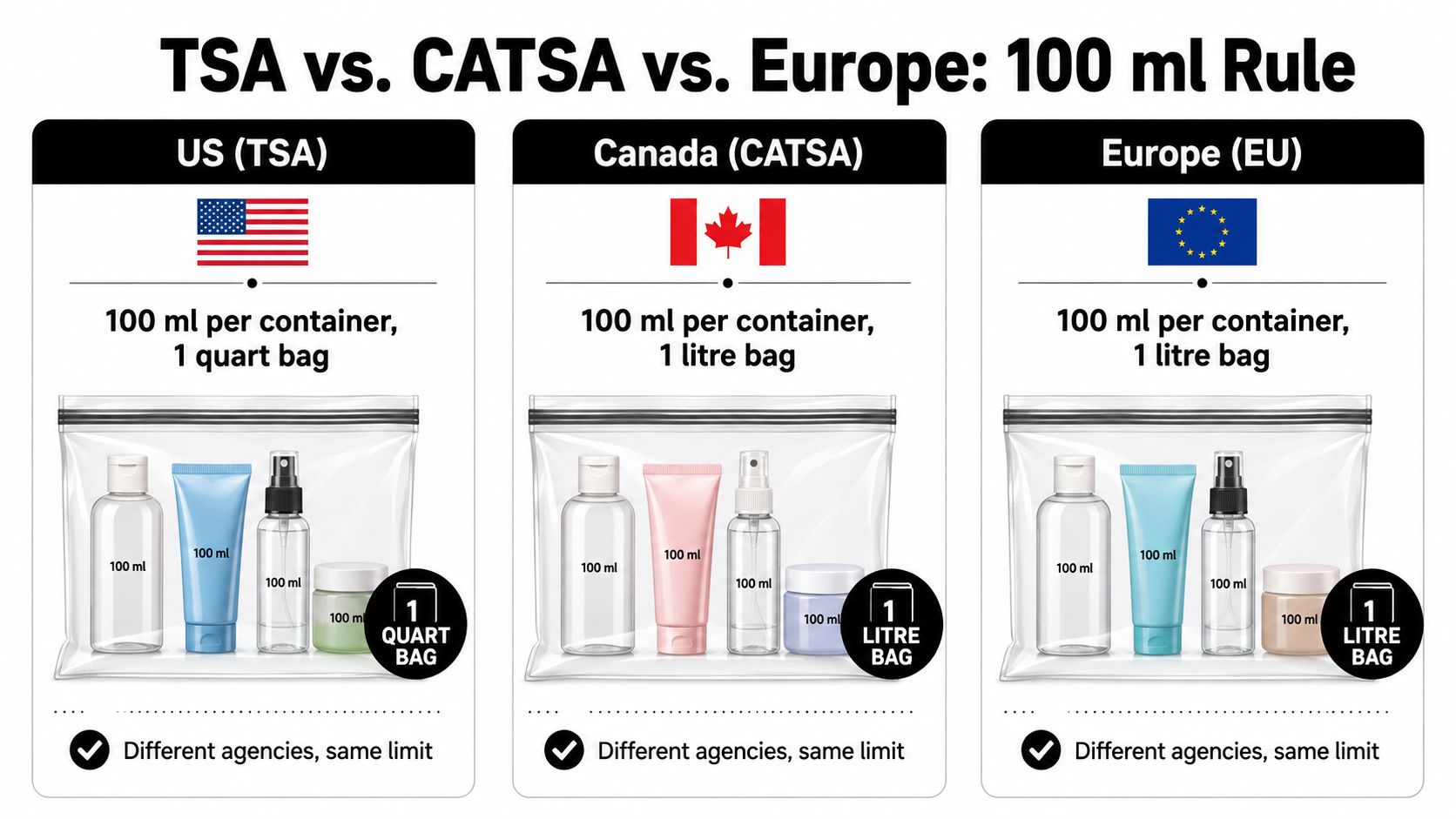
A bottle that passes in one country usually passes in another because the rule is built around the container, not the liquid inside it. Canada's CATSA uses the same 100 mL, or 3.4 ounce, carry-on liquid threshold as TSA, so the practical check at the checkpoint looks very similar on both sides of the border. Europe follows the same 100 mL container limit inside a transparent resealable bag, which means the packaging standard stays familiar even when the airport branding changes. Travelpro's guide to liquids in airplanes explains that this shared structure is the reason the rule feels so consistent.
How travelers handle the checkpoint
The differences usually show up in the bag name, the signs at security, and how airports handle liquids bought after screening. The core logic stays the same. If your container is too large, the contents do not rescue it. A half-full bottle still gets treated like a full one if the container itself exceeds the limit.
That is why the rule travels better than the branding does. TSA, CATSA, and EU screening all point back to the same small-container test, so a traveler who learns the container-capacity rule in one airport can use it in another without starting over. The airport language may change, but the checkpoint question stays simple, does the bottle fit the rule or not?
Travelers who move between regions often do best by packing to the 100 mL standard first and treating the local airport wording as the only variable. According to travel reports from March 2025, TSA considered a possible increase to 6 ounces, but the everyday packing rule still centers on the smaller container size, so it remains the safest reference for carry-on liquids. That keeps a toiletry kit usable in most major airports without turning every trip into a new packing problem.
Practical Packing Tips and Quick Conversion Tricks
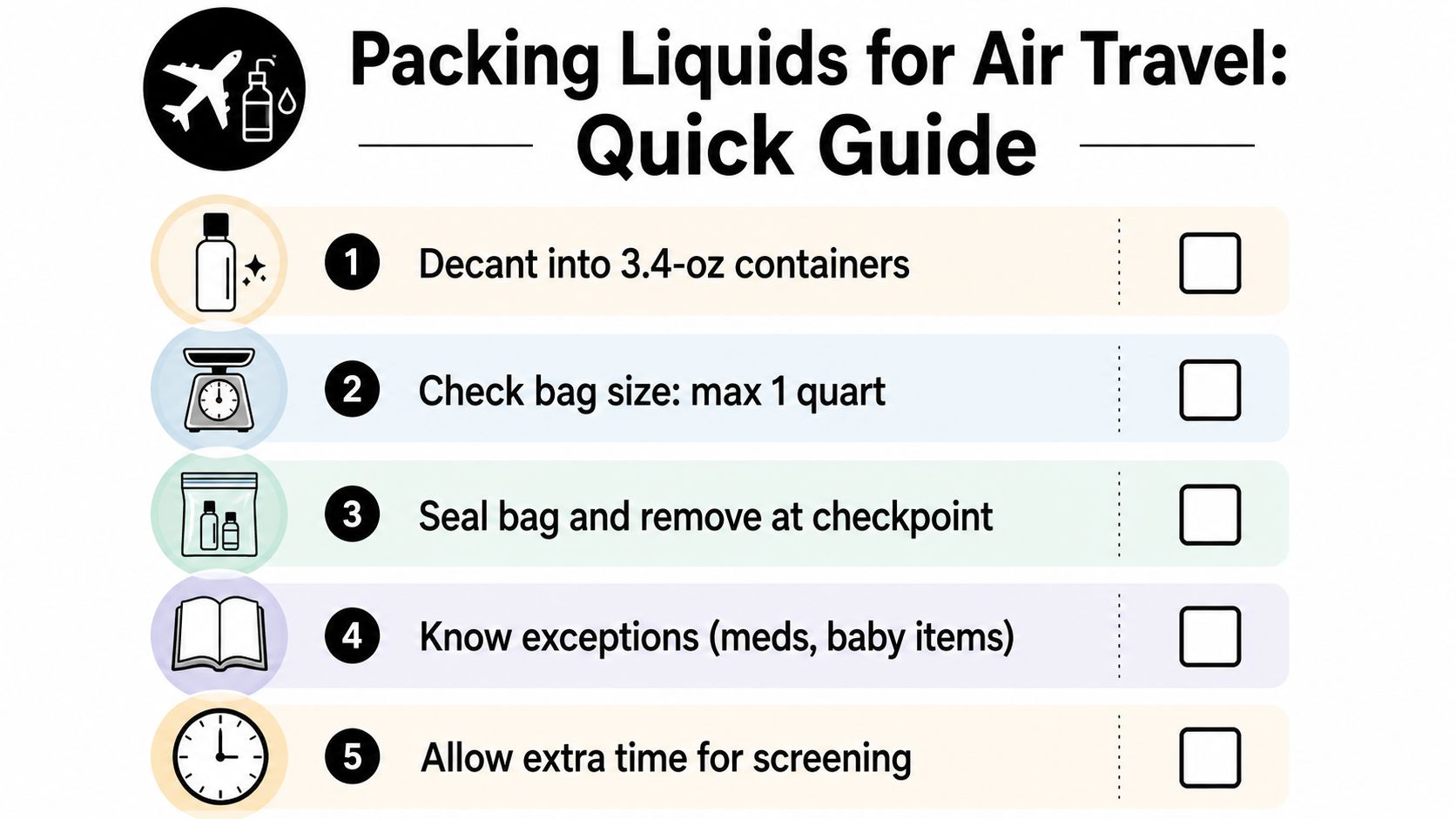
Pack at home with the checkpoint in mind, not the hotel sink. Decant full-size products into 3.4-ounce travel containers, then label them if you poured them yourself so you're not guessing later. If you prefer one simple reference, 1 fluid ounce is about 29.6 mL, so 3.4 fluid ounces is about 100 mL. That's fluid ounces, not weight ounces, which is where plenty of travelers accidentally mix up the measurement.
A fast packing routine that actually works
Start with the items you use every day, then decide what deserves carry-on space. Put liquids into the quart bag first, because that bag is the true constraint, and test the closure before you leave the house. A standard quart-size zip bag usually fits about seven to nine travel bottles depending on shape, so slim containers often pack better than wide ones.
If you're traveling with non-liquid comfort items, it helps to separate them from the toiletries kit so the bag stays easy to inspect. For guests who like to keep a fresh face or fresh hands on the move, pre-moistened face wipes for guests are a handy non-liquid option that doesn't compete for quart-bag space.
Haute Jets luggage and private jet travel guide is also worth a look if you want a cleaner packing routine for premium travel days. For airport screening, the simplest habit is still the best one, keep the quart bag on top of your carry-on so you can remove it fast.
Pack the liquids bag last, then place it where you can grab it in one motion at the checkpoint.
That small habit saves time, reduces fumbling, and lowers the odds that a forgotten bottle gets buried until the officer is already waiting.
Where the Rule Is Heading After Checkpoint Tech Upgrades
The 3.4 ounce rule is stable today, but it isn't frozen forever. Travel reporting in March 2025 said TSA had considered a possible increase to 6 ounces, tied to newer CT scanner rollout, though no change had been implemented at that point. That matters because the screening logic is starting to catch up with the technology.
Older X-ray systems are good at enforcing a simple container-capacity rule, but they're less flexible than newer screening tools. As CT scanners spread, the number itself could rise while the core habit stays the same, declare the liquids, keep them organized, and let the checkpoint inspect them. In other words, the ceiling may move, but the packing discipline won't.
The durable lesson is not “memorize one number forever.” It's “understand why the number exists.” If you know the rule is about container size, bagging, and screening, you'll adapt faster when airports update the limit.
If you want travel planning that's as precise as your packing, visit Haute Jets and see how on-demand private aviation fits into a smoother airport experience. Haute Jets connects travelers to the right aircraft with a level of control that matches the detail you've just put into your carry-on.