
Private jet charters cost about $2,000 to $25,000+ per hour depending on the aircraft. But that headline number is only the starting point, because the actual bill is shaped by taxes, airport fees, crew costs, aircraft age, and most of all whether your provider is forcing you to pay for an empty repositioning leg.
That's where most first-time charter clients get misled. They focus on the advertised hourly rate, then wonder why the quote they receive looks nothing like the number they had in mind. If you want a clean answer to how much do private jets cost to rent, you need to look at the all-in trip cost, not the teaser rate.
At Haute Jets Journal, that's the only way I think about charter pricing. Serious travelers don't need vague promises. They need to know what drives the number up, what's negotiable, and which costs can be avoided entirely.
Understanding the Private Jet Charter Market in 2026
The private charter business isn't a niche corner of luxury travel anymore. The American private jet charter market was valued at $28.9 billion in 2025, up from $21.24 billion in 2024, a 36% year-over-year increase, according to Element Aviation's charter market statistics. That's a large, fast-moving market, and it tells you something important. More people are chartering, more aircraft are being booked on demand, and pricing transparency matters more than ever.

Why the old pricing shortcuts don't work
Years ago, clients could get away with a rough mental formula. Pick a jet class, multiply by hours, accept the quote. That doesn't work now.
The reason is simple. Charter pricing has become more dynamic, and the sourcing model behind your flight matters almost as much as the aircraft itself. Two quotes for the same route can differ sharply if one operator has an aircraft already near your departure city and the other has to move one in empty.
Practical rule: If a charter quote looks attractively low at first glance, check what isn't included before you compare it with anything else.
What smart clients actually ask
Experienced buyers don't start with, “What's your hourly rate?” They ask better questions:
- Which exact aircraft is pricing this trip? Category alone isn't enough.
- Where is the aircraft based? This determines whether repositioning charges will appear.
- What mandatory extras are included? Taxes and airport fees can't be ignored.
- How old is the aircraft? Newer cabins often cost more, but may offer better value.
- Is this an on-demand quote or a program rate? The structure changes the final economics.
If you understand those five points, you'll read a charter quote the way a broker does. That's when you stop paying retail for private aviation and start buying intelligently.
The Foundation of Charter Pricing Hourly Rates by Jet Category
Hourly rates in private aviation span a wide range. As of 2026, charter pricing runs from about $2,000 per hour for a turboprop to more than $25,000 per hour for an ultra-long-range jet, with midsize jets typically priced at $4,500 to $7,500 per hour for many domestic trips, according to Simple Flying's 2026 private jet rental cost guide.
That range matters, but clients often give it too much weight. The hourly figure is only the starting point. Your real job is choosing the smallest aircraft that handles the mission comfortably, then sourcing one close enough to your departure point that the final quote does not get distorted by avoidable ferry time.
2026 private jet charter costs by aircraft category
| Aircraft Category | Hourly Rate (USD) | Passengers | Common Use Case |
|---|---|---|---|
| Turboprop | $2,000 and up | Short regional groups | Efficient short flights, smaller airports |
| Very Light Jet | $2,000 to $5,000 | 4 to 5 | Quick business hops |
| Light Jet | $2,500 to $4,500 | 5 to 8 | Short to mid-range domestic travel |
| Midsize Jet | $4,500 to $7,500 | 7 to 9 | Popular domestic coast-to-coast missions |
| Super Midsize Jet | $7,500 to $12,500 | 8 to 10 | Longer domestic flights with more comfort |
| Heavy Jet | $10,000 to $22,000 | 12 to 16 | Large cabins, long-range itineraries |
| Ultra-Long-Range Jet | $15,000 to $25,000+ | Intercontinental groups | International nonstop missions |
Which category makes the most sense
For most domestic U.S. trips, midsize and super midsize jets are the strongest value. They give you the range, baggage space, and cabin comfort most clients want without pushing you into heavy-jet pricing.
Buyers waste money by booking according to label instead of mission. A heavier cabin looks impressive on paper, but if your trip only needs six seats, moderate baggage, and a few hours of range, paying for extra aircraft is poor buying.
Use a light jet for shorter trips with a smaller group. Move to midsize when you need better cabin dimensions, longer legs, or a stronger baggage profile. Go larger only when the route, passenger count, or nonstop requirement demands it.
The right aircraft is the one that covers the trip cleanly at the lowest all-in cost. Anything larger is often just expensive excess.
Category pricing is only the first filter
Jet category gives you a budget range. It does not give you a real charter price.
The exact aircraft still drives the quote. Cabin age, onboard Wi-Fi, galley setup, baggage layout, and airport compatibility all matter. So does aircraft location, which often matters more than clients expect because it can determine whether the rate you liked turns into a much higher final number. If you want a clearer view of how operators build these quotes, read this guide on calculating private jet cost per hour.
The smartest buyers do one thing differently. They judge aircraft categories by total trip cost, not by hourly rate alone. That is also why the sourcing model matters so much. An on-demand model that can pull from a wider operator network usually gives you a better chance of finding the right aircraft in the right place, which is how you keep the all-in number under control.
Beyond the Hourly Rate Uncovering Additional Charter Costs
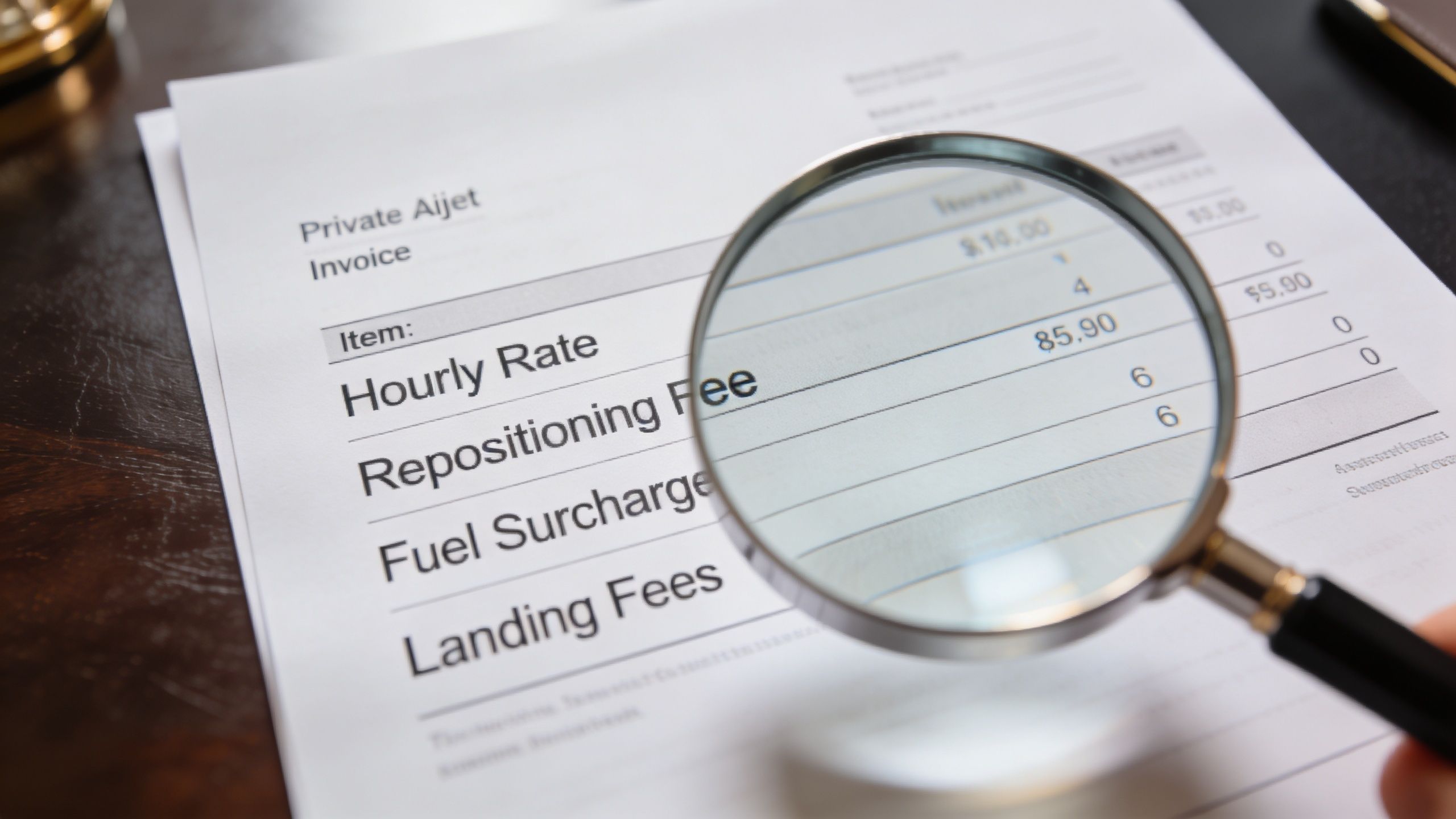
A charter quote can jump by 20 to 40% before the wheels ever leave the ground. The hourly rate gets attention, but the all-in cost is what determines whether you booked well or overpaid.
The fee that wrecks quotes
The biggest avoidable cost in private aviation is usually the repositioning fee. This is what you pay when the aircraft must fly empty to your departure airport before your trip can begin. According to Acc Air Charter's cost breakdown, repositioning fees can inflate the total charter cost by 20 to 40%, and for a typical midsize jet they can add more than $10,000 to a cross-country flight.
That is the line item clients miss most often.
If you charter a midsize jet from New York to Miami and the aircraft is sitting in Chicago, you are buying more than your itinerary. You are also paying to bring that aircraft to New York. Many brokers fold that cost into the quote and let the hourly rate do the selling.
The smarter move is simple. Source the aircraft closest to your departure point. That is where you find actual savings. An on-demand sourcing model with broad operator access usually beats a closed fleet or rigid membership program because it can shop for the right aircraft in the right place, not just the aircraft someone needs to sell you.
Ask before you approve anything: “Where is this aircraft positioned right now?” If the answer is vague, expect padding in the quote.
The required charges that belong in every real quote
Some costs are standard and should be shown clearly from the start.
- Federal Excise Tax: U.S. domestic charter flights include 7.5% Federal Excise Tax.
- Landing fees: Airport charges vary by airport and aircraft size.
- Crew overnight expenses: Multi-day trips often add hotel, meals, and transport for the crew.
- Deicing and special handling: Seasonal weather or high-traffic airports can push the final bill higher.
These costs are normal. Hidden positioning is not.
That distinction matters because many first-time charter clients focus on the headline hourly rate and miss the bigger pricing problem. A clean quote with visible taxes and airport fees is far easier to trust than a low-looking quote that hides an expensive aircraft ferry.
Aircraft age affects value as much as price
A newer jet often carries a higher hourly rate. There can be a good reason for that. According to Clay Lacy's private jet charter cost analysis, Year of Manufacture can add $100 to $2,000 per hour because newer aircraft tend to offer better fuel efficiency, updated avionics, and stronger cabin amenities.
Pay for newer metal when the upgrade improves the trip. Skip it when it does not.
If you need current Wi-Fi, a better interior, lower cabin noise, or newer connectivity systems, the premium may be justified. If the flight is short and functional, an older but well-kept aircraft often gives you better value. The right answer depends on mission, not vanity.
This short explainer is useful if you want a visual sense of how quotes get built and where costs hide.
How I'd read a quote before approving it
When I review a charter quote, I check the avoidable costs first. That is where savings usually sit.
- Identify the exact aircraft. Tail-specific pricing is more reliable than a generic category quote.
- Confirm current aircraft location. This exposes repositioning risk immediately.
- Separate taxes and airport fees from discretionary markup. They are different costs and should be treated that way.
- Review crew overnight exposure. Multi-day itineraries can add cost fast.
- Decide whether newer aircraft features are worth the premium. Sometimes yes. Often no.
If your broker cannot explain every line clearly, do not accept the quote.
Sample Private Jet Charter Routes and Their Costs
Charter quotes on the same route can swing by thousands. The hourly rate explains part of that. Aircraft location explains the rest.
A city pair is only the starting point. Your final number depends on four things: the trip length, the aircraft category, the tail that is offered, and whether that aircraft has to reposition to pick you up. Clients who focus only on the advertised hourly rate usually overpay.
Los Angeles to Las Vegas
This is a short mission, so efficiency matters more than cabin size. A light jet or turboprop is often the right answer for a small group. Book a midsize or super midsize jet for this route without a clear reason, and you are paying for excess airplane.
The bigger mistake is ignoring where the aircraft starts the day. If the jet is already in Southern California, the quote can stay disciplined. If it has to ferry in from Scottsdale or the Bay Area, your short hop starts carrying extra flight time you never intended to buy.
For a route like this, I would choose the smallest aircraft that fits the passenger count, baggage, and comfort requirement. That keeps the all-in cost under control.
New York to Miami
This route exposes weak sourcing fast. Many clients assume it is a simple, high-volume pairing, so pricing should be predictable. It is not.
A properly sourced midsize or super midsize jet usually fits well here. You need range, baggage capacity, and a cabin that still feels comfortable after a few hours. But the major pricing variable is often aircraft position, not cabin class. Two quotes can show similar jets and very different totals because one aircraft is already near Teterboro or White Plains, while the other has to reposition before your trip begins.
That is why smart buyers compare total trip cost, not headline hourly rate. Haute Jets' on-demand sourcing model works in your favor here because it widens the aircraft search and helps cut unnecessary ferry expense instead of burying it inside the quote.
On New York to Miami, the better deal is usually the aircraft that is already close, not the one with the lower-looking hourly number.
Cross-country trips and newer aircraft
Longer domestic flights change the math. Cabin comfort matters more. Baggage matters more. Wi-Fi, noise level, and stand-up room matter more because you will feel every shortcut over four to six hours.
You will also see a wider spread between older and newer aircraft. As noted earlier, newer jets often carry a higher hourly rate. Sometimes that premium is justified. Sometimes it is pure vanity. Pay it when the trip benefits from better connectivity, a fresher cabin, or a more suitable operating profile. Skip it when an older, well-kept aircraft handles the mission just as well.
On longer routes, sourcing discipline still beats category shopping. A well-located super midsize jet can produce a better all-in price than a heavy jet with a tempting base rate that needs a long repositioning leg.
What these route examples teach you
Route examples are useful because they show where money is won or lost.
- Short routes punish oversizing. Keep the aircraft tight to the mission.
- Busy routes reward local sourcing. The closest suitable jet often wins on total cost.
- Long flights justify selective upgrades. Pay for comfort that you will use, not status.
- The sourcing model drives the final bill. Better aircraft access reduces hidden repositioning fees and produces cleaner quotes.
If you want another way to cut cost on specific city pairs, read this insider's guide to booking empty leg flights.
A good quote fits the trip and minimizes wasted aircraft movement. That is how experienced charter buyers keep private aviation expensive, but not overpriced.
How to Significantly Reduce Your Charter Costs with Empty Legs
If your schedule is flexible, empty legs can be one of the smartest ways to lower the price of private aviation. These are flights an aircraft is already making without passengers, usually because it's returning to base or repositioning for its next mission.
The trade-off is simple. You get the aircraft at a lower cost, but you give up control over timing and route flexibility.
When empty legs make sense
Empty legs work well for travelers who can decide quickly and don't need a perfect departure window. They're especially useful for leisure trips, one-way travel, or spontaneous weekend flying.
They're less useful for corporate travelers with fixed meeting times, families coordinating multiple ground transfers, or anyone who needs guaranteed schedule control.
The real pros and cons
- Best upside: You can access private aviation at a materially lower total cost than a standard custom charter.
- Main limitation: The route, date, and departure timing are largely fixed.
- Operational reality: If the primary booked client changes plans, the empty leg can change too.
- Ideal traveler: Someone flexible, decisive, and comfortable treating the flight as an opportunity rather than a certainty.
Empty legs are a sharp tool, not a default strategy. Use them when your calendar can bend.
If you want a clearer view of how to approach them without getting burned, this insider's guide to booking empty leg flights lays out the process well.
For everyone else, standard on-demand charter remains the cleaner solution because you control the departure, the aircraft type, and the airport choice.
Choosing Your Pricing Model On-Demand vs Jet Cards vs Fractional
Most clients don't just ask how much do private jets cost to rent. They also ask how they should pay for access. That's the better question.
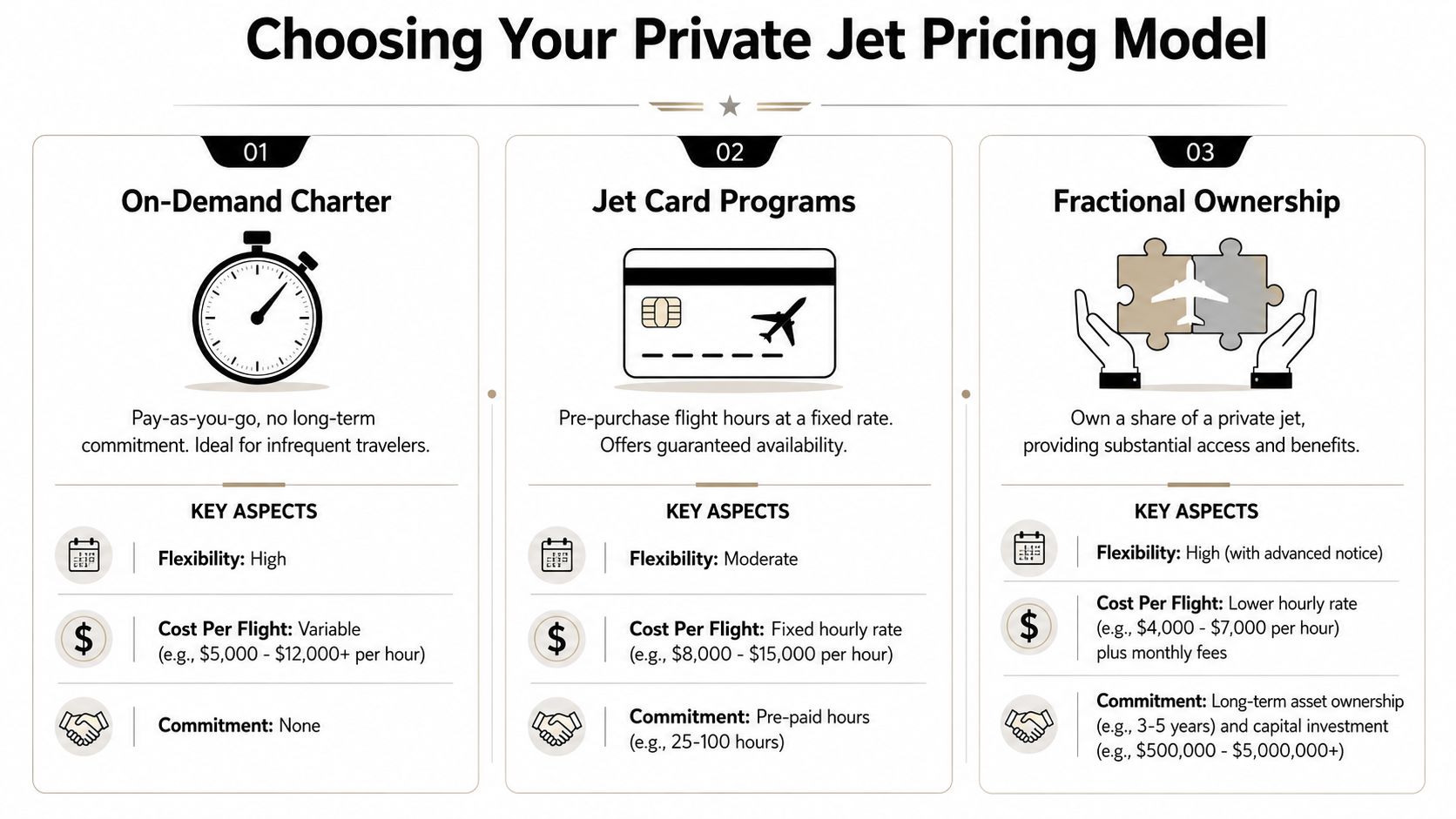
There are three common models. On-demand charter, jet cards, and fractional ownership. They are not interchangeable, and they don't suit the same type of traveler.
On-demand charter
This is the cleanest structure for most buyers. You book trip by trip, choose the aircraft that fits that mission, and avoid long-term financial commitment.
The strength of on-demand is flexibility. You're not trying to use prepaid hours just because you own them, and you're not trapped in a fleet or category rule that doesn't fit the trip.
Jet cards
Jet cards appeal to travelers who want predictability, but they often pay for it in ways that aren't obvious at the start. You pre-purchase hours or funds, then operate within the provider's rules.
Those rules matter. Category substitutions, service area limitations, peak-day restrictions, and aircraft allocation policies can all change the value of what you thought you bought.
Fractional ownership
Fractional is for people who want quasi-ownership and are prepared for the complexity that comes with it. You buy a share, commit capital, and take on a structure that makes sense only if your flight pattern justifies it.
For most clients, it's more machinery than they need. The model can work, but it's a poor fit for anyone who values flexibility over long-term program participation.
Which model usually wins
Here's the practical comparison:
- Choose on-demand charter if you want flexibility, transparent trip-by-trip buying, and the ability to match aircraft to each mission.
- Use a jet card only if you fully understand the program terms and know you'll use it the way the provider intends.
- Consider fractional only if your annual usage and planning style support an ownership-style commitment.
For a more direct comparison of those trade-offs, this breakdown of private jet cards vs charters is useful.
In my view, most discerning travelers don't need more program. They need better sourcing.
The Haute Jets Advantage Sourcing Wholesale Rates On-Demand
If you've read this far, the conclusion is straightforward. The biggest pricing mistake in private aviation is buying a charter based on category and hourly rate alone. The smarter move is buying the right aircraft in the right place at the right time.
That's where the sourcing model matters most. Haute Jets operates on an on-demand structure and sources from 3,500+ owner-operators across 175 countries, with a focus on aircraft based near the client's departure point, according to the publisher's company information. That approach is built to reduce the empty repositioning problem that drives quotes higher. It also lets clients choose the exact aircraft instead of accepting a vague category promise.
The other part I like is operational clarity. Tail number, crew details, aircraft specifics, and amenities should not be mystery items until departure day. High-value clients expect precision, and they should get it.
If you want to keep charter costs under control, my recommendation is simple:
- Buy on demand, not out of habit
- Ask where the aircraft is based
- Review the exact jet, not just the class
- Treat repositioning fees as a red flag
- Use providers that can source locally and transparently
That's how you avoid paying for flights you never intended to take.
If you want a clear, tail-specific quote without membership fees or prepaid hours, Haute Jets offers on-demand private jet charter with exact-aircraft sourcing, transparent trip pricing, and access to Wyvern and Argus-rated operators. Request a quote, compare the aircraft options, and see the all-in cost before you book.