

Booking a private jet used to feel like a complex, insider-only process. It's not anymore. The simplest way is to figure out your route and how many people are flying, then use an on-demand charter service to get quotes directly from local aircraft operators.
This direct approach cuts through the noise, avoiding hefty membership fees and long-term commitments, and connects you with the right aircraft for your specific trip at wholesale pricing.
The Modern Way to Charter a Private Jet
The world of private aviation has changed dramatically. Forget the old, inflexible models of fractional ownership or pricey jet cards. Today, booking is all about transparency and direct access, putting you in the driver's seat with on-demand charter.
Think of it as a pay-as-you-fly service. You book a single trip without any massive upfront investment or recurring fees. It’s the difference between buying a timeshare and just booking a hotel room when you need it. You get the freedom to pick the perfect aircraft every time, whether it's a nimble turboprop for a quick business hop or a spacious, ultra-long-range jet for an international journey.
How On-Demand Charter Compares
To really understand the benefits, it helps to see how on-demand charter stacks up against the older models.
On-Demand Charter vs Traditional Models
| Feature | On-Demand Charter (Haute Jets) | Jet Card Programs | Fractional Ownership |
|---|---|---|---|
| Commitment | Pay per flight, no long-term contract | Upfront deposit, fixed hours | Multi-year ownership contract |
| Pricing | Dynamic, market-based wholesale rates | Fixed hourly rates, plus fees | Pro-rated share of all aircraft costs |
| Aircraft Choice | Access to thousands of aircraft globally | Limited to the program's fleet | Limited to specific aircraft type owned |
| Repositioning Fees | Avoided by using local aircraft | Often baked into higher hourly rates | Billed to the owner |
As you can see, the on-demand model gives you the ultimate flexibility without locking you into a single fleet or a long-term financial obligation.
Sidestepping Traditional Markups
One of the biggest financial wins with on-demand charter is avoiding repositioning fees. These costs pop up when a broker has to fly an empty jet from its home base just to pick you up, and they can easily inflate your final price by a shocking 20-40%.
Modern services connect you directly to a huge network of local owner-operators. By sourcing an aircraft that's already based near your departure airport, those repositioning costs completely vanish. It makes private travel not just more affordable, but far more efficient.
This flowchart shows just how much simpler the booking process has become, shifting from the convoluted traditional methods to the direct, cost-effective on-demand model.
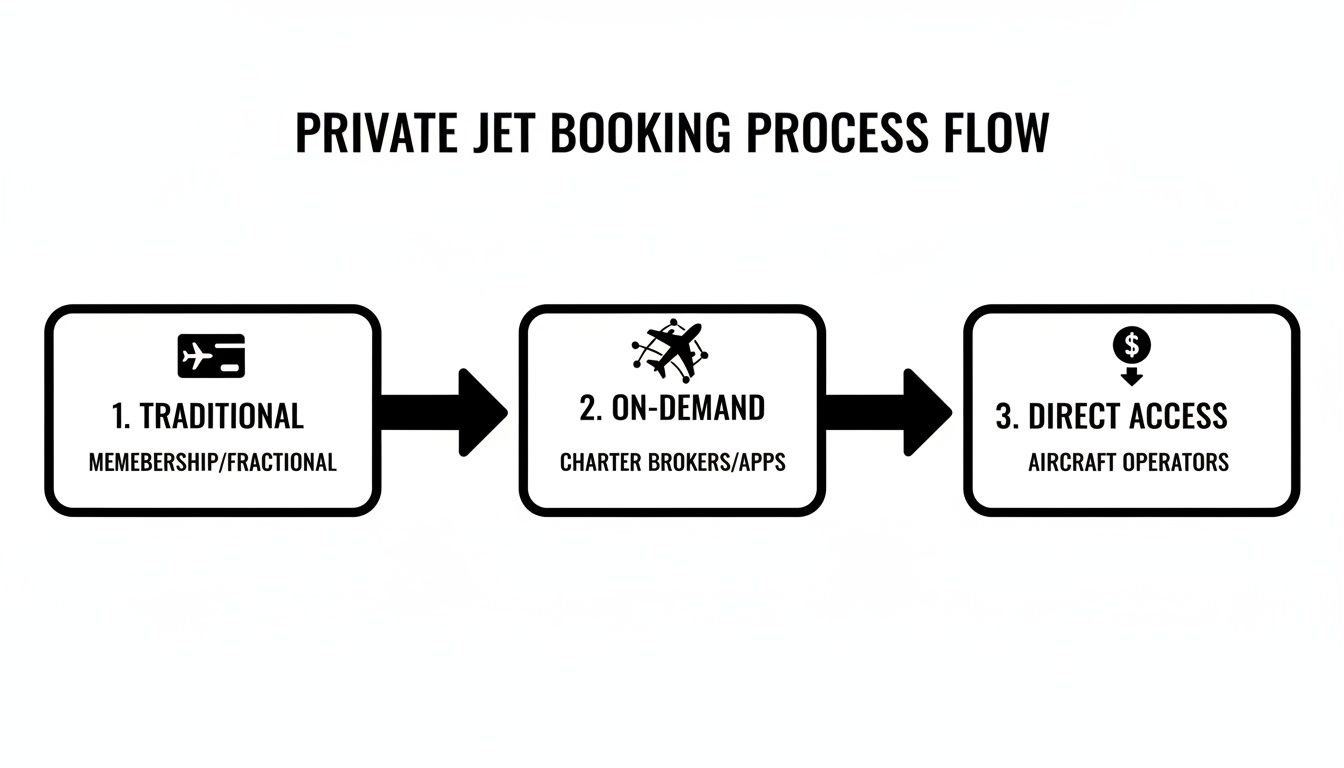
The key is cutting out the unnecessary middlemen and logistical hurdles that drive up costs in the first place.
Unlocking a World of Options
Having access to a large, diverse fleet is everything. When you can choose from thousands of aircraft, you aren't stuck with the small, pre-selected fleet that comes with a specific jet card or fractional program.
Booking a private jet has never been more straightforward, especially with services that tap into a network of over 3,500 aircraft across 175 countries. This global reach is how you dodge those hefty 20-40% repositioning fees.
It also means that no matter where you are or where you need to go, the right aircraft is always nearby.
Key Takeaway: The on-demand model is about much more than just saving money. It’s about giving you total choice, transparency, and control over every detail of your flight—from the exact aircraft model to the final, all-inclusive price.
Whether you're planning a trip months from now or need a flight in a few hours, this approach fits your schedule. You can get a personalized quote for your next trip and see just how simple it is.
Matching the Right Aircraft to Your Mission

A successful private charter is decided long before you ever step onto the tarmac. It really begins with selecting the perfect aircraft for your trip. In the industry, we call this defining the "mission profile"—which is just a detailed way of saying we need to understand exactly what your trip entails.
This is about more than just picking a "light jet" or a "heavy jet" from a menu. A truly flawless trip comes from matching the exact aircraft model and its specific amenities to your needs. Before you even start looking at quotes, you need to have clear answers to a few fundamental questions.
First, let's cover the absolute basics:
- Who is flying? Your passenger count is the first filter. It immediately dictates the minimum cabin size you'll need.
- What's the full itinerary? A non-stop flight from New York to London demands a completely different class of aircraft than a series of short hops down the West Coast.
- What are you bringing? A golf trip for four with clubs and luggage requires far more baggage capacity than a quick business trip for two people with just their carry-ons.
Nailing down these three points will instantly shrink the pool of thousands of available jets down to a much more manageable list of real options.
Going Beyond Passenger Count
Once the basics are handled, you can get into the details that truly shape the flight experience. Think about the purpose of the trip. The right jet isn't just about transport; it's about creating the right environment for the journey itself.
For example, a corporate team flying from Chicago to a critical meeting in Miami will probably want an aircraft with high-speed Ka-band Wi-Fi so they can work without interruption. They’ll need a quiet cabin and seating that allows for collaboration.
But a family heading to Aspen for a ski holiday? Their priorities are completely different. They're going to be far more concerned with ample baggage space for skis, boots, and bulky winter coats. A more relaxed cabin layout with good entertainment options for the kids might also be high on their list.
By getting specific about your needs upfront—from Wi-Fi reliability to galley amenities—you make sure the jet that shows up is the one you actually want. Never hesitate to ask for a specific make, model, and even year of manufacture.
Real-World Aircraft Scenarios
Let's put this into practice. Seeing how different mission profiles connect to specific types of aircraft is a huge part of learning how to book a private jet like a pro. For a deeper dive into the models, you can read our complete guide to understanding private jet types.
The Short-Haul Business Trip
- Mission: A team of four flying from Teterboro to Washington, D.C., for a day of meetings and returning the same evening.
- Needs: Speed, efficiency, and a professional environment. Luggage is minimal.
- Good Fit: A light jet like a Phenom 300 or Citation CJ3. They're fast, very cost-effective on shorter routes, and can land at smaller airports that might be closer to your final destination.
The Cross-Country Family Vacation
- Mission: A family of six flying from Los Angeles to Orlando with several large suitcases and strollers.
- Needs: A comfortable cabin for a longer flight, serious luggage capacity, and in-flight entertainment.
- Good Fit: A super-midsize jet like a Challenger 350. It has a stand-up cabin, which makes a huge difference on longer flights, and a baggage hold that can easily swallow everything a family needs for a week away.
The International Board Meeting
- Mission: Eight executives traveling from London to Dubai for a multi-day conference.
- Needs: Transcontinental range, a flight attendant for premium service, lie-flat beds for overnight travel, and a fully private lavatory.
- Good Fit: A heavy jet like a Gulfstream G650 or Global 7500. This is the top tier of private aviation, offering the range and amenities needed to cross oceans and arrive refreshed and ready for business.
Don't ever feel like you're being difficult by confirming these details. You're just being a smart client. Any good broker or operator will appreciate your clarity because it helps them deliver a perfect experience. Always ask for the aircraft’s tail number and year of manufacture to prevent any unwelcome last-minute substitutions.
How to Vet Operators and Confirm Safety Ratings

So, you've narrowed down your aircraft choices. Now comes the most important part of the entire process: making sure the company flying you is impeccably safe. In the world of private aviation, the FAA's regulations are just the starting point—the absolute minimum standard. The truly elite operators go much, much further.
This is where third-party safety auditors enter the picture. Think of these independent organizations as the gold standard for vetting an operator. They conduct exhaustive, top-to-bottom reviews of everything from maintenance logs and pilot training records to the company's overall safety culture. Their stamp of approval isn't mandatory, but for anyone who takes safety seriously, it's non-negotiable.
The two names that carry the most weight in this space are Wyvern and ARGUS. When you see their certification, it’s a clear signal that the operator has invested heavily in exceeding standard safety protocols. It gives you unbiased, deeply researched proof that you're in good hands.
Decoding Wyvern and ARGUS Ratings
It’s one thing for a broker to say an operator is "certified," but it's another to know what that really means. These ratings aren't all the same; they signify different levels of scrutiny. Knowing the difference is what separates a savvy flyer from a novice.
Here’s a breakdown of the key ratings to look for:
- Wyvern Wingman: This is the pinnacle. Achieving Wingman status is no small feat. It requires an operator to pass a demanding on-site audit, demonstrate an advanced Safety Management System (SMS), and prove their pilots and maintenance crews meet exceptionally high experience benchmarks. It's Wyvern's highest endorsement.
- ARGUS Gold: A solid and respected rating. ARGUS Gold confirms that an operator has a strong historical safety record and that their pilot backgrounds have passed rigorous checks. It's a reliable indicator of a professional, well-run company.
- ARGUS Platinum: The top tier from ARGUS. To earn Platinum, an operator must meet all the Gold criteria plus undergo a comprehensive on-site audit that scrutinizes every aspect of their operation, from flight procedures and maintenance to their emergency response plans.
If you really want to get into the weeds of what these auditors look for, our detailed guide on Wyvern and ARGUS safety ratings is the perfect place to start. It lays out the specific criteria they use.
How to Verify an Operator's Status
Never, ever take a safety claim at face value. A truly professional charter provider will be proud of their safety record and will happily provide proof. If you encounter any hesitation when you ask for documentation, that’s a major red flag.
Always ask your broker or the operator for a copy of their current Wyvern or ARGUS certificate. Check the expiration date to make sure it's active. For flight-specific verification, you can go a step further and request a TRIP (Trip & Registration Information Portal) report from ARGUS or a PASS (Pilot & Aircraft Safety Survey) report from Wyvern. These reports confirm that the specific jet and crew assigned to your flight meet the highest safety standards.
Key Takeaway: Insisting on a Wyvern Wingman or ARGUS Platinum-rated operator is the single most important decision you can make for your safety. For experienced private flyers, this isn't a "nice-to-have"—it's a requirement.
Some platforms have flipped the script on this, allowing you to filter exclusively for Wyvern Wingman or Argus Gold/Platinum-rated operators from the very beginning. This lets you select your exact aircraft, model year, and even Wi-Fi preferences knowing that every single option presented has already cleared the industry’s highest safety bar. As industry analysis shows when you discover more about the private jet market, this approach removes all the guesswork and gives you total peace of mind.
Decoding Quotes and Understanding Contract Terms
You've done the legwork, found some solid operators, and now the quotes are rolling in. This is where the real decision-making begins. Knowing how to book a private jet isn't just about picking a plane; it's about learning to read these quotes like a seasoned pro, spotting the difference between a great deal and a price that's just too good to be true.
A private charter quote is much more than a single number. It’s the full story of your flight costs, and believe me, two quotes for the exact same trip can look wildly different. Let's break down what you're looking at so you can compare them with confidence.
Breaking Down the Charter Quote
When a quote lands in your inbox, resist the urge to just scan for the final price at the bottom. The devil is always in the details. A trustworthy operator will give you a transparent breakdown, leaving no stone unturned and no room for surprise charges down the line.
You'll typically see these core components on any quote:
- Base Hourly Rate: This is the fundamental cost for using the aircraft, billed for every hour it's in the air. The rate can swing dramatically based on the jet's size, age, and current demand.
- Fuel Surcharge: Sometimes this is baked into the hourly rate, but often it’s a separate line item. If it’s listed separately, it can fluctuate with the market price of oil.
- Federal Excise Tax (FET): For any domestic flight in the U.S., this is a mandatory tax. It's calculated as 7.5% of the flight cost, plus a small per-passenger segment fee.
- Crew Fees: This covers your pilots' pay and their expenses (like hotels and meals) if your trip involves an overnight stay. It's usually a flat daily rate.
Getting a handle on these items is the first step. The real skill, though, is in spotting what's missing.
Spotting Hidden Costs and Red Flags
The single biggest mistake I see new flyers make is jumping on the lowest number without reading the fine print. Some less-than-scrupulous brokers will deliberately leave out potential costs to make their quote look more appealing at first glance.
Keep an eye out for exclusions or variable fees that can sneak up on you. For example, if you're planning a winter ski trip to a place like Aspen or Telluride, your aircraft will almost certainly need de-icing. This isn't cheap—it can run from a few thousand dollars to over $20,000 for a heavy jet. If a quote for a January flight to the mountains doesn't mention de-icing, that’s a huge red flag. You need to ask about it.
Pro Tip: Always ask your broker, "Is this quote completely all-inclusive?" Then, get specific. Inquire directly about potential costs for de-icing, international handling, Wi-Fi, and any special catering you requested. A good partner will be upfront and honest.
To help you truly compare apples to apples, it’s smart to use a checklist. Before you even think about signing, every quote you're considering should be put through its paces.
Here is a quick-reference table that covers the essential items you should verify in any charter quote.
Private Jet Charter Quote Checklist
| Line Item | What to Check | Potential Red Flag |
|---|---|---|
| Aircraft Details | Is the specific make, model, and year of manufacture listed? | A vague description like "Midsize Jet" or "Similar." |
| All-Inclusive Price | Does the quote explicitly state it is "all-in" or "fully inclusive"? | Missing line items for taxes, landing fees, or crew costs. |
| De-icing | Is the cost of potential de-icing clearly outlined or included? | No mention of de-icing for winter flights to cold climates. |
| International Fees | Are customs, immigration, and international handling fees included? | A low quote for an international trip with no mention of these fees. |
Think of this checklist as your first line of defense. A quote that passes this test is likely from a transparent and reliable provider.
Reviewing the Charter Contract
Once you’ve settled on a quote, the final step before payment is reviewing the charter agreement itself. This is a legally binding document, so you need to understand what you're signing. Pay close attention to a few key clauses—starting with the cancellation policy.
Cancellation terms in this industry are notoriously strict. It's not uncommon to face a 100% cancellation fee if you back out within a specific window, which could be anywhere from 7 to 14 days before your flight. Make sure you know exactly what the penalty is at every stage.
Next, check the payment schedule. Nearly all charters require 100% prepayment to secure the aircraft, typically via bank wire. For those interested in how to book a private jet using different assets, it's worth noting that some forward-thinking providers now accept cryptocurrency, which can add a layer of convenience.
Finally, look for the aircraft substitution clause. Mechanical issues are rare, but they do happen. A solid contract will state that if your booked aircraft becomes unavailable, you will be provided with a jet of an equivalent or superior category at no additional cost to you. This is your protection against a last-minute downgrade.
Finalizing the Details: Your Pre-Flight Game Plan
Your jet is booked. In the final 24 hours before takeoff, the last details start falling into place. This is when a truly professional charter service shines, moving beyond a simple itinerary to give you complete confidence for a stress-free departure.
You should receive a comprehensive pre-flight confirmation that leaves no room for guesswork. This isn't just a formality; it's the final layer of transparency that proves you're getting exactly what you paid for and that everything is ready for your arrival.
What to Look for in Your 24-Hour Confirmation
About a day before your flight, a detailed confirmation package should hit your inbox. Think of this as the master document for your trip—it’s designed to answer questions before you even have them, so all you have to do is show up.
Here are the non-negotiable details it must include:
- Aircraft Tail Number: This is the plane's unique ID, like a license plate. It confirms the exact jet you chartered is the one waiting for you on the tarmac, with no last-minute swaps.
- Flight Crew Biographies: You'll get to know your pilots before you even meet them. Expect brief professional bios on your captain and first officer, covering their experience, total flight hours, and specific aircraft ratings.
- Route-Specific Weather Briefing: A real-time outlook on the weather conditions along your flight path and at your destination.
- Final Passenger Manifest: A simple list confirming all passengers for the flight, ensuring the crew has everyone accounted for.
Getting this level of detail is the mark of a quality operator. One of the best market advantages of booking directly with an aircraft’s owner is that these detailed 24-hour confirmations—complete with tail numbers and crew bios—are standard practice for on-demand charters. If you're interested in the numbers behind this model, you can review key private jet market statistics.
When you have these specifics in hand, there are no surprises. You walk into the terminal knowing the exact aircraft, the crew at the controls, and the plan for the day. That’s the foundation of a genuinely seamless private flight.
Your Passenger Departure Checklist
With the aircraft and crew squared away, your only job is to get yourself to the airport. Private aviation lets you skip the commercial terminal chaos, but a little prep on your end makes the experience flawless.
Lock In Your Ground Transportation First things first, double-check your car service arrangements for both departure and arrival. Your charter confirmation will list the exact address and phone number for the FBO (Fixed-Base Operator) you'll be using.
Know the FBO Drill The FBO is the private terminal where you'll meet your jet. There's no need to show up hours in advance; arriving 15-20 minutes before your scheduled wheels-up time is perfect. In many cases, your car can drive directly onto the ramp, right up to the aircraft steps.
Have Your ID Ready The requirements are simple but crucial.
- Domestic Flights: For travel within the U.S., every adult passenger just needs a valid government-issued photo ID, like a driver's license.
- International Flights: A valid passport is non-negotiable for every passenger, including infants and children. Always verify visa requirements for your destination well ahead of your travel date.
Beyond the flight itself, it's always smart to think about securing your luggage. Taking a moment to enhance your travel security provides extra peace of mind. By running through this quick checklist, you'll arrive at the FBO relaxed, prepared, and ready to enjoy the flight.
Same-Day Flights and International Trips: A Pro’s Guide

Sometimes you need to fly right now. Other times, you're planning a complex, multi-country tour. While the fundamentals of booking a jet are the same, these two situations—urgent domestic flights and intricate international travel—are where having an expert on your side really pays off.
Let's break down what you need to know for each.
The Art of the Last-Minute Booking
Same-day charters are the ultimate expression of private aviation's flexibility. A sudden business opportunity, a family emergency—when you need to be somewhere immediately, there’s no time to spare. The goal is to get in the air quickly without cutting corners on safety or service.
The secret? Access to a deep network of locally based aircraft. By finding a jet that's already parked near your departure airport, you can be wheels-up in as little as two hours and, just as importantly, avoid the hefty repositioning fees that come with bringing in an aircraft from another city.
This on-demand model is what allows executives and private individuals to have same-day access in major cities without committing to a jet card or fractional ownership. It's also fueling major market expansion. In the Asia-Pacific region, for instance, the charter jet fleet is expected to jump by 18.8% by mid-2025 over 2023 levels, driven by everything from business travel to luxury tourism. You can see more market insights on private aviation growth and how this trend is unfolding globally.
To make a last-minute charter happen, you need to be prepared to move fast:
- Be Ready to Commit: Know your exact passenger count and have everyone's ID or passport information handy. The faster you can confirm the details, the sooner the operator can secure the jet and crew.
- Stay Flexible on Aircraft: Your go-to jet model might not be available on short notice. Be open to a comparable alternative—it’s often the key to getting off the ground sooner.
- Have Payment Ready: Whether you're using a wire transfer or crypto, have it lined up. The aircraft is not officially booked until the payment is confirmed.
Tackling International Charter Logistics
Crossing borders adds a whole new layer of complexity. An international trip is about much more than just the flight itself; it's a major logistical puzzle involving multiple government agencies and regulations. Your charter broker essentially becomes your mission controller.
The single most important element of any international charter is handling customs and immigration. A great operator will arrange for pre-clearance or have agents meet you at the FBO, allowing you to bypass the chaos of commercial terminals entirely.
Beyond that, your provider is managing a dozen details behind the scenes that could easily derail a trip. They’re securing landing permits, filing flight plans across different air traffic control zones, arranging ground handling, and confirming every passenger has the necessary visas.
For a trip with multiple international stops, this level of proactive coordination is what separates a smooth, enjoyable journey from a logistical nightmare.
Your Top Questions, Answered
Once you've got the basics down, a few practical questions always seem to pop up. As someone who's coordinated countless flights, I've heard them all. Here are the answers to the most common things first-time charter clients ask, so you can finalize your trip without any guesswork.
Can I Bring My Pet on Board?
Yes, absolutely! This is one of the best perks of flying private. Your pets can travel right alongside you in the cabin, not in a scary cargo hold.
Just give your broker a heads-up when you request a quote. Let them know the breed and weight of your pet so they can confirm the aircraft's specific policy. For international trips, you’ll also need to have all the proper pet documentation ready—think health certificates and vaccination records.
What Are the Luggage Limits on a Private Jet?
There’s no hard-and-fast rule like with the airlines. The luggage capacity is all about the specific jet you book. A light jet is perfect for a weekend getaway with soft-sided bags, but if you're planning a longer trip or bringing gear, you'll want something bigger. A heavy jet can easily swallow multiple large suitcases, golf bags, and ski equipment for everyone.
The main constraint is simply the total physical volume and weight the baggage compartment can handle.
The best advice I can give is to be upfront about what you’re bringing. If it’s a golf trip with four sets of clubs or a ski vacation with bulky gear, mention it during the booking process. That way, we can be certain the aircraft has plenty of room for everything.
How Much Notice Do I Need to Book a Flight?
Private aviation is built for flexibility. For domestic trips out of major hubs, you can often book a jet with as little as two to four hours' notice. It’s one of the biggest advantages of flying on-demand.
That said, if you want the best pricing and the widest selection of aircraft, try to give at least a few days' notice. The global business aviation market has seen explosive growth, ballooning into a $35-38 billion industry with over 5.2 million flights annually from a fleet of 22,000+ active jets. While the U.S. still dominates with 60% of all flights, demand is surging in Europe and the Middle East, making it smart to plan ahead, especially for international routes. You can explore more private aviation statistics and trends to see just how fast the market is moving.
Ready to experience this for yourself? With Haute Jets, you get direct access to over 3,500 safety-rated aircraft worldwide at wholesale rates. Skip the membership fees and book your exact aircraft on-demand by visiting https://www.hautejets.com.