

A destination wedding often begins as a clear visual. Sea light at sunset. A restored villa in the hills. A private beach dinner that feels effortless. What clients discover very quickly is that beauty is the easy part. Booking it well is the demanding work.
For high-net-worth families, the question usually isn't whether the celebration should be abroad. It's how to book destination weddings in a way that protects privacy, keeps travel orderly, and delivers service that feels calm from the first contract to the final airport transfer. That requires more than inspiration. It requires sequence, influence, and discipline.
The Allure and Reality of a Destination Wedding
Destination weddings have moved well beyond a niche category. One market analysis valued the global destination wedding market at $18.5 billion in 2023 and projected $35.2 billion by 2030, while also noting an average destination wedding cost of $35,000 and an average guest count of 39 according to this destination wedding market overview. Those numbers matter because they describe a format that is smaller on paper, but far more intricate in execution.
A guest count of 39 isn't a simple wedding with fewer chairs. It usually means a more curated event with more moving parts per guest. Travel windows narrow. Arrival patterns vary. Dietary needs become more visible. Families expect privacy, flexibility, and polished handling at every step.
Why luxury destination weddings are harder to book well
At the upper end of the market, the usual advice falls short. A luxury destination wedding may involve:
- Multi-city arrivals from New York, London, Dubai, or Los Angeles on different schedules
- Venue exclusivity decisions such as a full buyout versus a selective room block
- Local sensitivity around noise, access, weather exposure, and nearby development
- Service continuity across the resort team, imported vendors, local production, and transport partners
That is why the booking phase carries so much weight. If the first decisions are made casually, the rest of the planning cycle becomes expensive damage control.
Practical rule: Book a destination wedding as an operating plan, not as a mood board.
Some locations make this easier because the hospitality ecosystem is already built around wedding travel. If you're evaluating Indian Ocean options, this comprehensive guide to Mauritius weddings is useful because it helps frame venue style, guest experience, and destination fit in one place.
What clients often underestimate
The fantasy is the ceremony. The practical side is inventory.
Premier properties are competing for the same dates, the same suites, and the same vendor calendars. Families also tend to underestimate how much emotional ease comes from getting the booking sequence right early. Once the venue, accommodation strategy, and guest movement are properly anchored, the celebration starts to feel exciting again.
That is the key appeal of doing this well. Not just a beautiful wedding abroad, but a wedding that feels composed from the moment invitations begin circulating.
Crafting Your Strategic Foundation
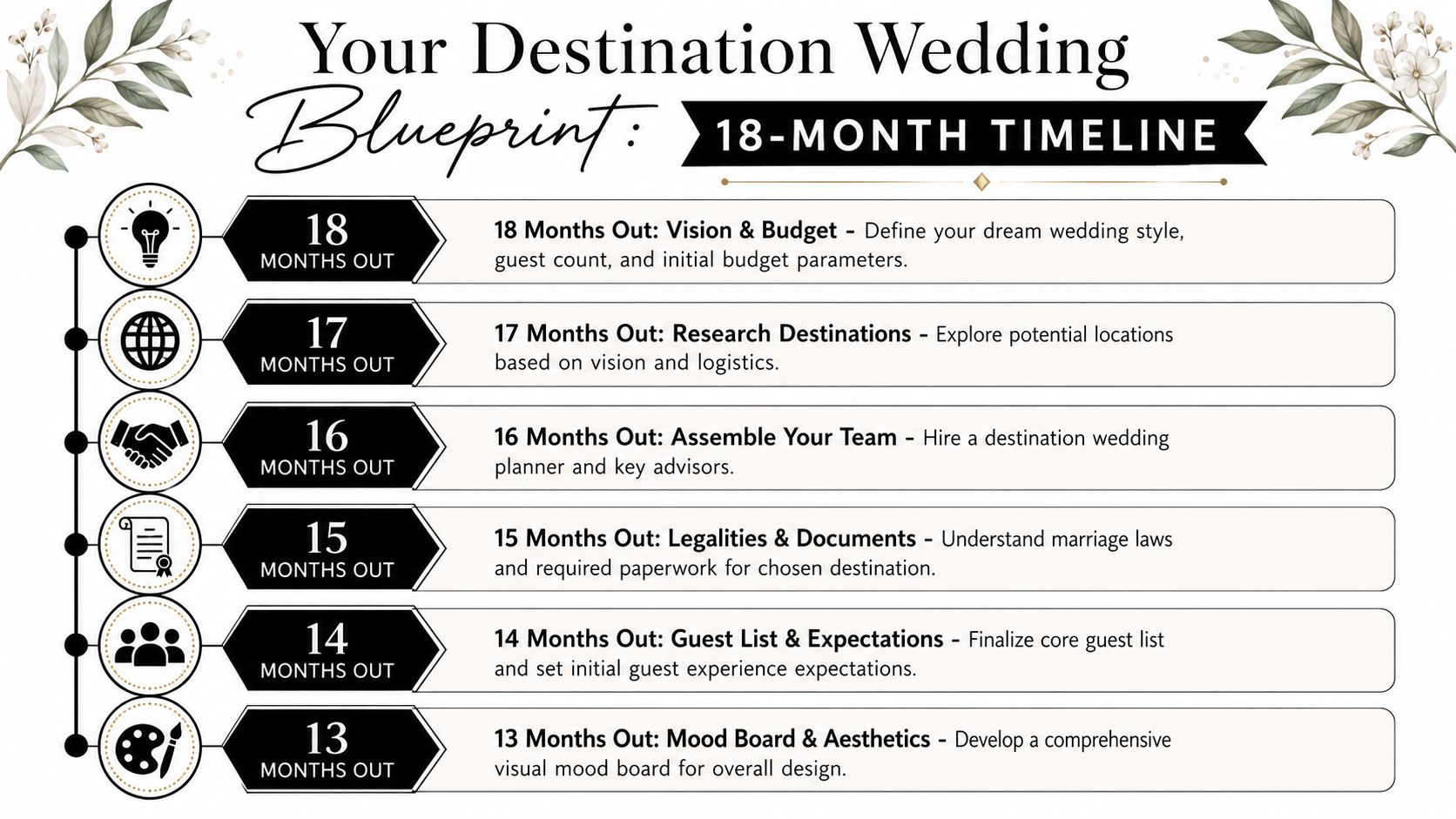
The first decisions shouldn't be floral, musical, or decorative. They should be structural. The clients who book destination weddings well start by deciding what kind of experience they are funding, for whom, and under what constraints.
Planning windows reflect that reality. Recent guidance puts the average lead time at 13 to 18 months, and North American destination wedding spending is projected to grow from $8.4 billion in 2024 to $15.23 billion by 2033 in this industry planning report. In practical terms, more demand means less room for hesitation around prime weekends and premium properties.
Start with the guest experience, not the map
Before choosing a country, define the guest experience in concrete terms.
Do you want three days of close family immersion, or a larger social celebration with layered hospitality? Will older relatives need minimal transfers and easy walking access? Do you have guests who expect complete discretion, private entrances, or separate accommodations from the main group?
These questions narrow destinations faster than aesthetics do.
A strong foundation usually answers five points first:
Guest profile
Identify who must attend, who is likely to attend, and who requires extra support. Elderly family members, children, security teams, and household staff all change the destination brief.Privacy threshold
Some clients are comfortable inside a top resort with protected event spaces. Others need a full buyout or a standalone estate where movement can be controlled.Travel complexity
A destination with beautiful imagery but awkward air access often becomes difficult once multiple family branches are involved.Budget philosophy
Decide whether spending should prioritize privacy, design, food and wine, entertainment, or guest travel support. Every luxury wedding has a hierarchy, even when the budget is substantial.Legal tolerance
Some couples want the legal ceremony abroad. Others prefer to complete the legal formalities at home and keep the destination event symbolic. That decision removes a great deal of friction in some countries.
Build a budget that behaves like a real travel plan
Many wedding budgets are drafted too narrowly. Venue and catering are only part of the commitment. A destination budget should account for room commitments, transport, imported production, local labor standards, contingency spending, and the friction that comes with international execution.
I prefer to treat the budget as a series of operational buckets rather than one headline number.
| Budget area | What it should include |
|---|---|
| Property | Venue fee, buyout terms, accommodation commitments, event spaces, backup spaces |
| Travel | VIP arrivals, airport handling, ground transport, luggage support, possible charter options |
| Production | Lighting, sound, staging, power, flooring, tenting if required |
| Creative team | Planner, photographer, florist, entertainment, beauty, content, technical crew |
| Guest care | Welcome amenities, hospitality desk, itinerary printing, concierge support |
| Contingency | Weather adjustments, schedule changes, replacement sourcing, last-minute staffing |
Families considering private aviation for principals or key guests should also review practical charter variables early, including aircraft suitability, airport access, and ground coordination. This overview of things to consider before booking a private jet is a sensible starting point.
Set the timeline before emotion takes over
The timeline is what protects standards. Without it, clients get seduced by imagery and then discover the property cannot hold their guests, the desired date is gone, or the preferred photographer is unavailable.
A disciplined early timeline creates options. A delayed one reduces them.
The first version of the plan should be built around availability, not optimism.
Securing Your Exclusive Venue and Accommodations
Venue selection is the hinge point. Once that contract is signed properly, the rest of the planning process can move with confidence. Until then, almost everything is provisional.
Published guidance is direct on this point. Top resorts and exclusive-use properties commonly book 12 to 18 months ahead, and the critical path is to sign the venue and group room contract first so the date and inventory are protected as outlined in this destination wedding booking guide.

Buyout or room block
Luxury clients often ask whether they should buy out the property. The answer depends less on status and more on behavior.
A full buyout gives you control. It simplifies security, reduces visual intrusion from unrelated guests, and creates freedom across rehearsal dinner, pool use, breakfast service, and after-hours programming. It is often the right choice when family dynamics are sensitive, the guest list is highly visible, or the event runs over multiple days.
A room block strategy is more flexible. It works well when the property is large, the group occupies a distinct section, or some guests prefer alternative accommodations nearby. It can also preserve budget room for design and entertainment.
A quick comparison helps.
| Option | Best for | Main compromise |
|---|---|---|
| Full buyout | Privacy, security, immersive weekend control | Higher financial commitment and stricter contract exposure |
| Room block | Flexibility, mixed budgets, less lock-in | Less exclusivity and more dependence on property operations |
Remote due diligence matters more than taste
Many excellent destination weddings are booked without a site visit. That isn't reckless. It requires sharper due diligence.
The problem is that most remote vetting stops at a polished video tour. That never tells you enough. You need targeted evidence. Ask for walkthroughs at the exact ceremony hour. Ask to hear ambient sound. Ask what sits beyond the visible edge of the lawn, beach, or courtyard. Ask what construction, nightlife, public access, or traffic patterns affect the property.
For couples considering southern Europe, this guide to Portugal wedding venues is helpful because it frames the range of property styles and settings in a way that supports venue comparison, not just visual browsing.
Here is the minimum remote diligence I insist on before recommending signature:
Noise review
Request recordings or live video at ceremony time and dinner time. A quiet afternoon can become a noisy evening very quickly.Weather exposure
Ask how wind behaves on terraces, beaches, and cliffside lawns. “Sunny” is not the same as usable.Guest flow
Map the route from suites to ceremony, ceremony to cocktails, and cocktails to dinner. Beautiful spaces often fail between moments.Food proof
If an in-person tasting isn't possible, ask for current banquet menus, plating photos, and a candid explanation of what the kitchen executes repeatedly versus exceptionally.Vendor policy
Confirm whether outside planners, florists, lighting teams, photographers, and bands are welcomed, restricted, or penalized.
A charter plan may also affect venue choice more than clients expect. Nearby airport infrastructure, customs handling, and transfer times for principal guests should be reviewed before the venue is finalized. This private jet charter guide is useful for understanding those logistics in practical terms.
To help clients visualize property questions before signing, I often share a short venue walk-through like the one below.
What works and what fails
What works is decisiveness with verification. Shortlists. Contract review. Room inventory analysis. A fast move once the facts are clear.
What fails is romantic indecision. Families spend weeks discussing three properties they would never choose, then lose the one that met the brief.
Assembling Your Elite Vendor Team
Luxury destination weddings are delivered by people, not by concepts. The vendor team determines whether the event feels restrained and exacting or merely expensive. Here, taste and logistics intersect.
The most important hire is the planner. Not a generalist who “also does destination weddings,” but someone who understands international contracts, local etiquette, cross-border production, and the service expectations of clients who are used to private household standards. The planner should be comfortable managing principals, family offices, assistants, and resort teams without creating noise.
The planner is your operating center
A strong destination planner does three things exceptionally well.
First, they translate your priorities into a sequence that vendors can execute. Second, they pressure-test local promises. Third, they keep service standards consistent across people who may never have worked together before.
When evaluating planners, ask questions that reveal operating depth:
International experience
Which countries have they worked in, and how do they handle unfamiliar local systems?Vendor control Do they rely on a loose directory, or do they maintain trusted relationships they can activate?
Communication style
Can they handle a principal, a parent, and a private office without letting decisions drift?
A luxury planner isn't valuable because they know what is beautiful. They're valuable because they know what breaks.
Fly in talent or hire local
This is rarely an all-or-nothing decision. The best answer is often a hybrid team.
Bring in vendors when their style is central to the wedding's identity or when execution tolerance is low. This usually applies to photography, entertainment, beauty direction, or floral design for highly specific aesthetics. Hire locally when the destination has strong specialists who understand the climate, sourcing, labor structure, and venue rhythm better than anyone arriving from abroad.
A sensible split often looks like this:
| Vendor type | Usually worth flying in | Often better local |
|---|---|---|
| Photography | If signature style matters deeply | If local portfolio is strong and aligned |
| Floristry | For highly custom design language | For climate-smart sourcing and install knowledge |
| Entertainment | For headline talent or family preference | For ceremony music or regional performance |
| Hair and makeup | For principals with exact standards | For supporting party services |
| Production crew | For specialized creative direction | For labor-heavy local execution |
Cohesion matters more than prestige
Clients sometimes collect impressive names without asking whether those people can function as a team. A celebrated photographer who resists the planner, a florist who ignores venue restrictions, or a band that won't adapt to sound rules can destabilize the entire weekend.
Choose people who are excellent and collaborative. The destination itself already introduces enough variables. Your team shouldn't be one of them.
Managing Guest Travel and Logistics Seamlessly
Guest travel is where a destination wedding either becomes gracious or stressful. Most problems that families describe as “wedding issues” stem from travel design failures. Guests weren't given enough notice. Arrival patterns were too fragmented. The accommodation plan didn't reflect the guest mix. Nobody owned the small but critical questions.
Experienced planners recommend securing the venue contract and accommodations before sending save-the-dates, with save-the-dates sent 8 to 12 months in advance so guests have time to arrange passports, leave, and travel budgets as advised in this destination wedding timeline guide. That timing matters even more when guests are balancing school calendars, business commitments, or international connections.
Design the guest journey in layers
Not every guest should be managed the same way. That is the first principle.
The couple and immediate families need a controlled, high-touch plan. The wedding party needs clarity and scheduling discipline. The wider guest group needs simple instructions, reliable booking pathways, and visible support.
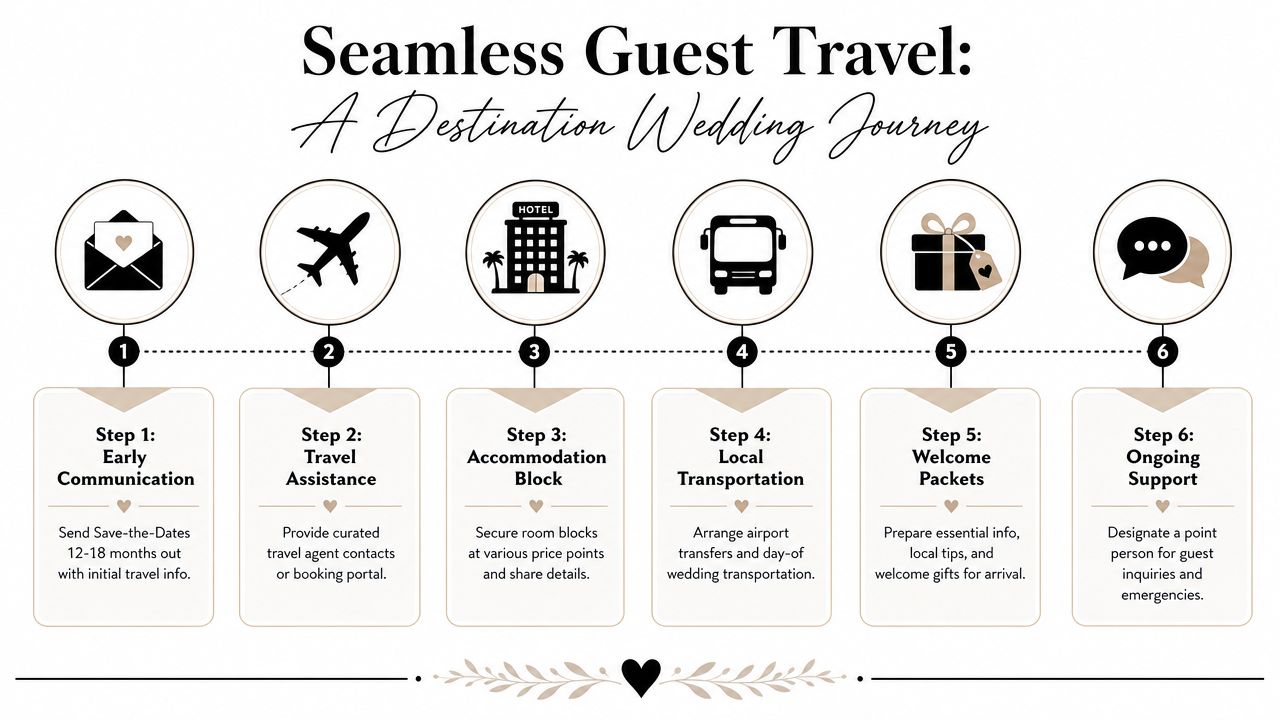
I usually divide guest logistics into three tiers.
| Guest tier | What they usually need |
|---|---|
| Principals and immediate family | Protected schedules, premium transfers, arrival privacy, luggage oversight |
| Wedding party and VIP friends | Coordinated flights, rooming clarity, event-by-event transport |
| General guests | Clear booking instructions, room block details, FAQs, emergency contact |
A scenario that shows what good planning looks like
Consider a wedding in southern Europe with guests arriving from the U.S., the U.K., and the Middle East.
General guests receive save-the-dates once the room block is live, followed by a wedding website that includes accommodation options, nearest airports, transfer windows, dress codes, and an RSVP deadline that reflects flight realities. A travel advisor or hospitality contact handles rooming questions and special requests. Airport transfers are grouped where practical, with late arrivals assigned private cars.
The wedding party follows a different path. Their itineraries are monitored more closely because rehearsals, styling calls, and photography timing depend on them. Arrival buffers matter. So do baggage contingencies for formalwear.
Principals and select family members may require private movement for privacy, schedule control, or simple comfort. In those cases, on-demand charter can be one part of the transport plan. Haute Jets publishes practical guidance on flying private for destination wedding travel, including aircraft selection and routing considerations that matter when you're moving key guests rather than the full guest list.
Guests are very forgiving about glamour. They are not forgiving about confusion.
What high-touch travel support includes
A polished guest logistics plan usually covers more than airfare and rooms.
Accommodation mix
Offer clear choices. Some guests want the main property. Others prefer privacy, larger villas, or a lower nightly rate nearby.Transfer choreography
Arrange airport meet-and-greet, luggage handling where appropriate, and transport that reflects actual arrival patterns rather than optimistic grouping.Communication discipline
The wedding website should answer practical questions first. Airports, passport reminders, transfer windows, check-in guidance, event times, and dress expectations.Arrival hospitality
Welcome notes, weekend itineraries, local essentials, and one reachable point person reduce guest anxiety immediately.Exception handling
Missed connections, delayed luggage, early arrivals, and medical or accessibility requests need an owner before they happen.
What doesn't work
The common failure is underestimating administrative load.
Families assume guests will “figure it out” because the wedding is beautiful and the guests are well-traveled. Well-traveled guests still need clear information. They expect it to be delivered without fuss. That is the standard.
Finalizing Details and On-Site Execution
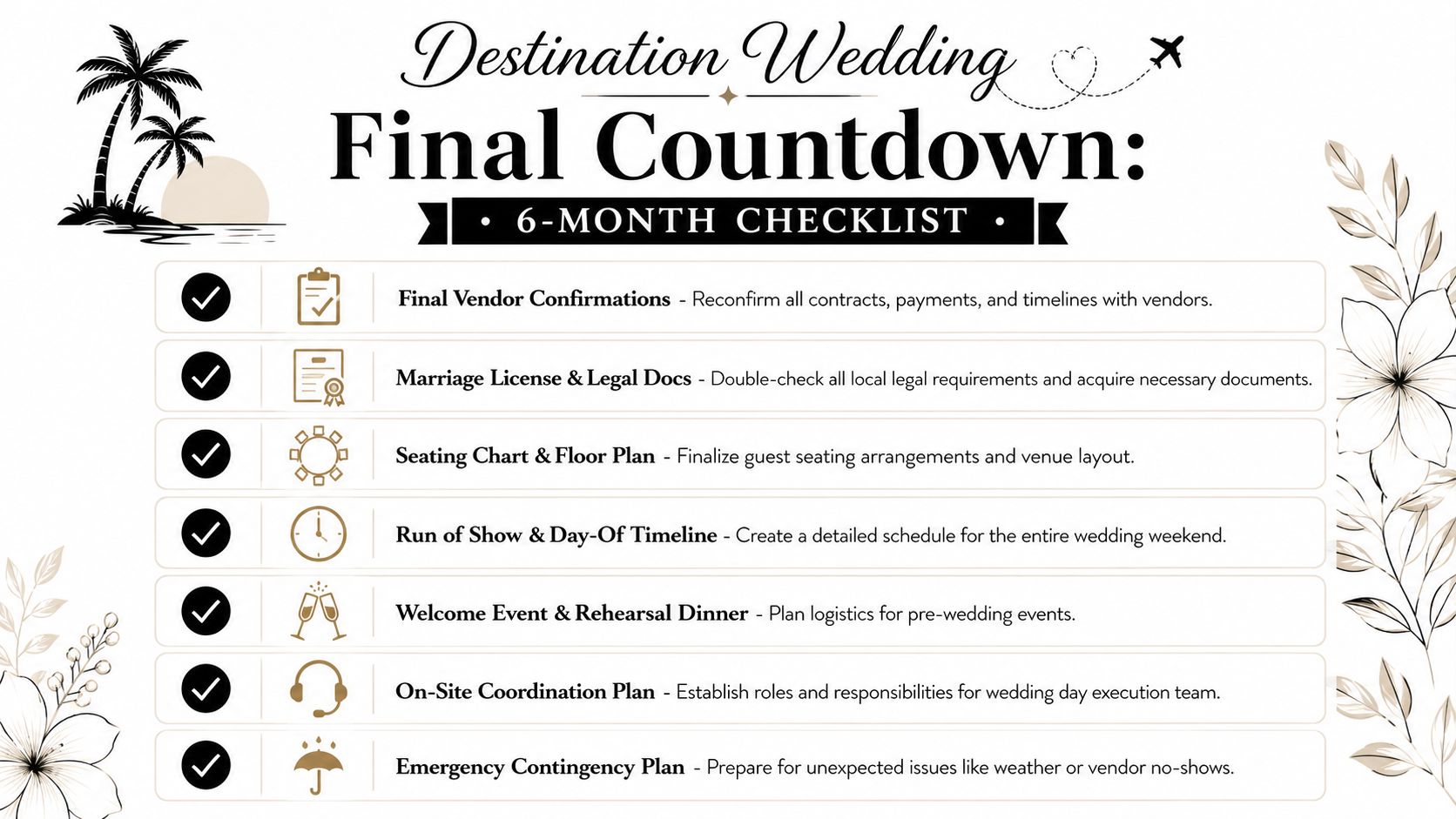
The last stretch is where planning becomes choreography. The broad decisions should already be settled. What remains is precision. Contracts must be final. The legal path must be confirmed. Every event needs a run-of-show detailed enough that no one is improvising under pressure.
One of the most important realities in this phase is the risk profile of remote booking. Practical guidance on booking without an in-person visit emphasizes the need for a due-diligence framework that evaluates weather patterns, ambient noise, and vendor quality remotely so couples avoid on-site surprises as discussed in this remote venue vetting article. By this stage, those risks should no longer be abstract. They should be assigned, mitigated, and documented.
Resolve legalities early or simplify them
If you're having the legal ceremony abroad, verify the requirements directly through your planner and legal contacts well before travel. Some destinations require translations, certified copies, witnesses, or in-country timing rules that don't align neatly with a wedding weekend.
For many luxury clients, the cleaner solution is to complete the legal marriage at home and keep the destination ceremony symbolic. That preserves the experience while reducing administrative fragility.
Build the run-of-show properly
A proper run-of-show is not a casual timeline. It is an operating document.
It should cover every event across the weekend, including load-in, rehearsal timing, dressing windows, photography movement, ceremony cues, speeches, entertainment changes, transport departures, and close-down instructions. Families often underestimate how many separate timelines must be synchronized.
The core documents usually include:
Master weekend schedule
One document for principals and senior staff that shows the entire event architecture.Vendor production schedule
Load-in, setup, sound checks, floral install, catering access, power timing, and strike.Guest-facing itinerary
Clean, simple, and free of internal complexity.VIP movement sheet
Cars, security handling if needed, private entrances, and holding spaces.
The smoother a wedding feels on site, the more detailed the paperwork was behind it.
Contingency planning is part of luxury
Luxury doesn't mean nothing goes wrong. It means disruptions are absorbed without becoming visible.
Weather planning is the most obvious example. If your dinner is outdoors, the backup can't be a vague promise from the venue. It must be a real plan with capacity, lighting, flooring, and service flow that has already been approved. The same applies to wind exposure, heat management, and late-night sound restrictions.
Travel disruptions deserve equal attention. A late-arriving parent, delayed gown, or missing musician shouldn't force emergency decision-making in the final hours. Assign fallback roles and replacement pathways in advance.
A useful contingency review should cover:
Weather
Backup ceremony and dinner spaces, tenting thresholds, flooring, umbrellas, fan or heater plans.Transport
Delayed arrivals, car reserve capacity, airport rerouting, after-hours transfer options.Power and sound
Generator access, venue decibel rules, band technical requirements, microphone redundancy.Medical and accessibility
Local clinic knowledge, dietary escalation process, wheelchair routes, mobility support.Remote booking risks
Noise spillover, nearby development, beach access changes, kitchen limitations, staffing gaps.
The on-site command structure
By the wedding week, there should be no confusion about authority.
The planner or lead coordinator runs the event. A family representative can approve high-level changes if needed, but they shouldn't become the operations desk. Assign one person for guest inquiries, one for vendor coordination, and one for principal-facing support. That separation protects the couple from noise and keeps decision paths short.
What works on site is quiet competence. The timeline moves. Rooms are ready. Cars are where they should be. The family feels attended to without being managed publicly. That is the standard clients remember.
If you're determining travel for the couple, close family, or select guests, private aviation should be organized with the same level of discipline as the wedding itself. Haute Jets can coordinate on-demand private jet charter for destination wedding travel, which is useful when timing, privacy, and multi-stop routing need tighter control than commercial itineraries allow.
For families planning a destination wedding where travel is part of the production, not just the transport, a private aviation strategy can remove friction at the exact points where schedules usually tighten. Haute Jets works on an on-demand charter model and can support aircraft sourcing, route planning, and principal guest movement for wedding weekends that span multiple cities or require discreet arrivals.