

Booking a private jet used to feel like an opaque, complicated affair. Thankfully, those days are long gone. The entire process really boils down to three simple phases: defining what you need, getting a quote, and finalizing your flight. Getting this right from the start means you get accurate, transparent pricing without any surprises.
Your Quick Guide to Booking a Private Jet
Contrary to what many believe, booking a private jet is surprisingly straightforward, especially with today's on-demand charter market. We’ve moved past the era of being tied to costly jet cards or the immense financial burden of fractional ownership. The new standard is paying per flight, giving you complete freedom over your aircraft, schedule, and budget.
The secret to a smooth booking is clarity. When you know your details upfront, a good charter service can act as your dedicated aviation advisor, finding the perfect aircraft for your mission.
The Modern Booking Process
Forget about confusing paperwork or endless back-and-forth. The path from your initial idea to stepping into a private jet cabin is clear and direct. It starts with you outlining your trip and ends with you bypassing the chaos of a commercial terminal for a quiet, private arrival.
This entire system is built for efficiency, transparency, and putting you in the driver's seat.
This visual gives you a great high-level look at the core stages.
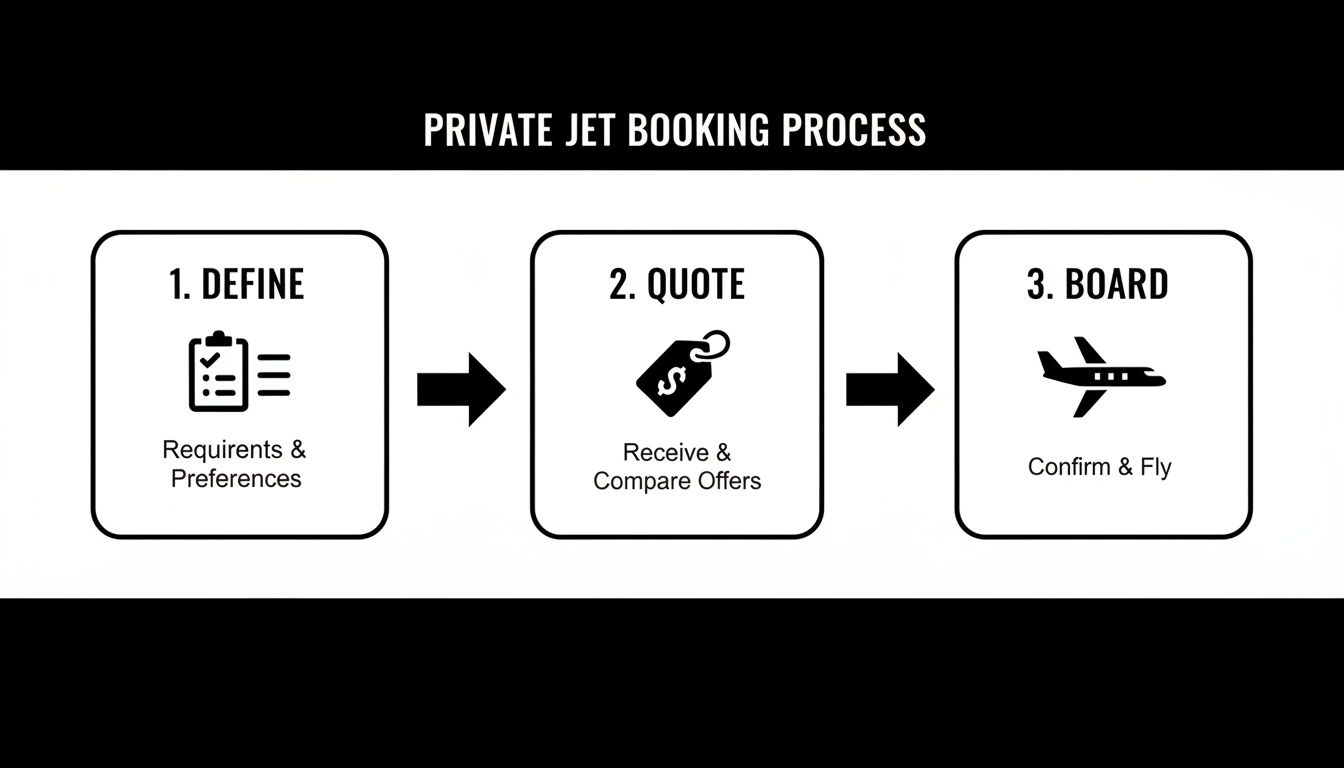
As you can see, it all begins with clear communication, which leads to transparent pricing, and ultimately delivers a travel experience built entirely around you.
Why On-Demand Charter Is the Smart Choice
On-demand charter has completely changed the game by getting rid of huge upfront investments and hefty annual fees. You gain access to a worldwide fleet of aircraft without any long-term strings attached. It's a model founded on flexibility and delivering real value.
Here’s why it works so well:
- No Long-Term Commitment: You pay as you go. Fly once a year or once a week—the choice is yours.
- Wholesale Pricing: By tapping into a vast network of vetted operators, you get true market rates, avoiding the steep markups common with older brokerage models.
- Total Aircraft Choice: You’re not stuck with a generic jet "category." You can pick the exact make, model, and year of the aircraft that best fits your trip.
One of the biggest wins here is avoiding repositioning fees. These charges, which can inflate your total cost by 20-40%, are for the empty flight an aircraft must make to get to your departure airport. A modern charter service sidesteps this by sourcing from a network of over 3,500 aircraft to find a jet that’s already close by.
This strategic sourcing is how you get the best of both worlds: five-star luxury and smart pricing.
To help you get started, here's a quick reference table summarizing the key actions and considerations you'll encounter.
Private Jet Booking Quick Reference Guide
| Action | Key Consideration | Pro Tip |
|---|---|---|
| Define Your Trip | Number of passengers, luggage, destination, and desired dates. | Be specific about your needs. Are you bringing golf clubs or skis? Do you need Wi-Fi for work? The more detail, the better the aircraft match. |
| Request Quotes | Compare options from different operators or charter services. | Look beyond the price. Check the aircraft's age, operator safety rating (like ARGUS or Wyvern), and included amenities. |
| Select Aircraft | Choose the jet that best fits your group size, range, and budget. | For short hops, a turboprop or light jet is efficient. For cross-country or international flights, you’ll need a midsize or heavy jet. |
| Review Contract | Carefully read the charter agreement, especially cancellation policies. | Pay close attention to de-icing policies and catering terms. Don't be afraid to ask for clarification on any line item before you sign. |
| Finalize & Board | Confirm payment, receive your itinerary, and prepare for your flight. | Arrive at the private terminal (FBO) about 20-30 minutes before departure. Your crew will handle your luggage, and you can board immediately. |
Understanding this fundamental approach is your first step toward booking smarter and avoiding common industry pitfalls. In this guide, we'll walk you through each of these stages in detail, giving you the confidence to book your next private flight like a seasoned pro.
First Things First: Pin Down Your Flight Details
Before you even start looking at aircraft, the most important work happens on the ground. It all starts with building what we in the industry call a "mission profile." This isn't just about picking a destination; it's a detailed brief that helps a charter provider find the absolute perfect aircraft for your trip, not just any plane that can get you there.
Think of it this way: you’re not just booking a ticket, you're commissioning a bespoke travel experience. The clearer your instructions, the smoother the journey.
Building Your Mission Profile
Let's start with the basics. This is the foundational information every charter quote is built on. While private aviation offers incredible flexibility, getting these core details right from the start is key.
Departure and Destination: Be specific. Are you flying from Teterboro (TEB) to Van Nuys (VNY)? Let your provider know. Also, if your final stop is a bit remote, mention it. This helps them identify the most convenient airport from the 5,000+ private options across the U.S., which might be much closer than the nearest commercial hub.
Dates and Flexibility: Lock in your ideal departure date and time. But here's a pro tip: if you have some wiggle room, say so. Something as simple as, "We'd like to leave the morning of June 10th, but could fly out the evening of the 9th," can sometimes unlock better aircraft availability or more favorable pricing.
Passenger Count: This seems obvious, but it’s a detail where people often get tripped up. Be exact. A jet configured for six passengers cannot legally or safely take a seventh. A last-minute addition is rarely possible if the aircraft is already at its limit, so confirm your headcount upfront.
With this initial framework, your provider can start zeroing in on the right options.
One-Way, Round Trip, or a Multi-City Tour?
The structure of your itinerary dramatically affects both the cost and the logistics. There's no one-size-fits-all answer, so understanding how each trip type works will help you make a much smarter decision.
One of the biggest shifts in on-demand charter has been the ability to book true one-way flights. You no longer have to pay for the plane's empty return journey. By sourcing aircraft already near your departure city, savvy providers can cut your costs by up to 40% compared to older models that just passed those repositioning fees on to you.
Here's how to think about your options:
- One-Way: Perfect if you're relocating, heading off on a long vacation, or simply don't have a firm return date yet. It offers the most freedom.
- Round Trip: This is your best bet for quick turnarounds—think a day trip for a board meeting or a weekend getaway. If the same aircraft waits for you, you'll typically cover daily minimum flight times and crew overnight fees, but you won't have to source (and pay for) a second one-way flight home.
- Multi-Leg: Essential for complex itineraries like a financial roadshow hitting multiple cities (e.g., New York to Chicago, then on to Dallas). This is where meticulous planning pays off, ensuring your aircraft and crew are ready for each leg of the journey without a hitch.
Don't Forget the Details: Luggage and In-Flight Needs
This is the final piece of the puzzle, and it's one I've seen cause more day-of-travel headaches than anything else: what you’re bringing with you.
Baggage capacity is a critical factor. For instance, a light jet might seem perfect for four passengers, but if those four are heading to Aspen for a week with skis and bulky winter luggage, you’re going to have a problem. You'll almost certainly need to upgrade to a midsize jet purely for its larger baggage hold.
Always be specific about any bulky or unusual items:
- Golf bags
- Skis or snowboards
- Film and production equipment
- Strollers, car seats, or pack-n-plays
- Multiple large, hard-shell suitcases
The same goes for your needs once you're in the air. Do you need to be productive? Then reliable, high-speed Wi-Fi is non-negotiable. Celebrating a milestone? You might want specific catering and champagne. Clearly communicating these preferences ensures the aircraft you book actually has the right amenities, whether that's a fully equipped galley or a cabin layout that’s perfect for getting work done.
Choosing the Right Aircraft and Operator

With your travel needs defined, we get to the exciting part: picking the perfect jet and, just as crucially, the right team to fly it. True luxury in private aviation isn't just having a jet to yourself; it’s about flying in the exact aircraft that fits your trip like a glove.
This goes way beyond just picking a "light jet" or "heavy jet" from a menu. A top-tier charter service will let you select the specific make, model, and even the year of the aircraft you're booking. You should be able to see actual photos of the interior, check the seat layout, and confirm the amenities. What you see in the quote should be precisely what’s waiting for you on the tarmac.
Matching the Aircraft to Your Mission
Getting the aircraft choice right is a balancing act. You have to consider range, the number of passengers, luggage space, and the amenities you can't live without. A mismatch here can quickly take the shine off an otherwise perfect trip.
For instance, I've seen clients book a Cessna Citation CJ3 for a quick hop from Miami to the Bahamas. For four passengers with weekend bags, it’s an incredibly efficient and comfortable choice. But if that same group tried to fly the CJ3 from New York to Los Angeles for a week-long business trip, they'd be in for a rough time. The jet simply doesn't have the range or the cabin space. They would need to upgrade to a super-midsize or heavy jet, like a Gulfstream G450, for that kind of mission.
When you're looking at your options, ask these questions:
- Range: Will the jet make it nonstop? A fuel stop isn't the end of the world, but it will add 45-60 minutes to your travel time.
- Cabin Size: Is there enough room for everyone to be comfortable for the entire flight? A cozy cabin is fine for two hours, but on a five-hour journey, you’ll be glad you opted for more space.
- Amenities: Is reliable Wi-Fi a must for getting work done? Do you need a proper galley for specific catering requests? Don't overlook these details.
- Luggage Capacity: This is a big one people often misjudge. Always confirm the baggage hold can handle what you’re bringing, especially if you have bulky items like golf clubs or skis.
If you want to get a better handle on the different classes and what they offer, you can explore our comprehensive guide on understanding private jet types. It’s a great resource for comparing your options with more confidence.
The Non-Negotiable World of Operator Safety
While the look and feel of an aircraft are important, nothing—absolutely nothing—is more critical than the safety record of the company operating it. In an industry built on precision, safety is the one area with zero room for compromise. This is where you need to look for third-party safety audits.
The two gold standards in private aviation are accreditations from Wyvern and ARGUS. These organizations perform incredibly thorough audits that go far beyond the FAA's minimum requirements.
An operator holding a Wyvern Wingman or ARGUS Platinum rating has voluntarily subjected their entire operation—from maintenance logs and pilot training records to their internal safety culture—to intense, ongoing scrutiny. In my book, choosing an operator without one of these ratings is a risk you simply shouldn't take.
This is why elite charter brokers, including Haute Jets, build their networks exclusively with operators who hold these top-tier safety ratings. This pre-vetting process means every aircraft option you're presented with already meets the industry's highest safety benchmarks.
Why Safety Certifications Are the Gold Standard
The private jet market has exploded, with its value projected to hit $39.84 billion by 2026, up from $25.87 billion in 2021. This boom, partly driven by a 20% surge in demand during the pandemic, has brought a flood of new aircraft and operators into the charter world. With North America alone accounting for 64% of new aircraft deliveries, knowing who to trust is more important than ever.
This is precisely why top-tier services are so strict, curating their networks to include only Wyvern Wingman and Argus Gold/Platinum-rated operators. With access to over 3,500 aircraft globally, this commitment to safety ensures every flight meets the same uncompromising standard.
Here’s a quick look at what those ratings really mean for you:
| Certification | What It Means | Why It Matters |
|---|---|---|
| ARGUS Platinum | The highest ARGUS level, earned through a proven safety history, an on-site audit, and a robust Safety Management System (SMS). | This is a hands-on verification of an operator's daily safety culture and practices. |
| Wyvern Wingman | Confirms an operator meets Wyvern’s strict standards, verified through a successful on-site audit and continuous monitoring. | It proves the operator doesn't just have a safety plan on paper—they live by it. |
By insisting on operators with these credentials, you're not just booking a flight; you're ensuring it's managed by a highly experienced crew on an aircraft maintained to the most exacting standards possible. That diligence is the real foundation of a safe and seamless private travel experience.
Getting to Grips with Charter Costs and Real Value

When you’re ready to book a private flight, understanding the price you’re quoted is everything. A good quote isn't a puzzle; it's a transparent breakdown that gives you the confidence to know exactly what you’re paying for.
The core of any charter price is the aircraft's hourly rate. This number can swing quite a bit depending on the jet's size, age, and range. For instance, a nimble light jet might run $4,000 an hour, whereas a spacious heavy jet built for international trips could easily be $12,000 per hour or more. This rate, multiplied by your flight time, forms the foundation of your cost.
But that's just the starting point. Your final quote will also include a few standard fees that are part of any flight operation. Think of them not as hidden charges, but as the basic costs of doing business in aviation.
- Federal Excise Tax (FET): A 7.5% tax is applied to all domestic flights within the United States.
- Landing and Ramp Fees: Airports charge for using their runways and tarmac. A major hub like Teterboro (TEB) will naturally have higher fees than a smaller, regional airport.
- Crew Overnight Fees: If your itinerary requires the flight crew to stay overnight, your quote will include their hotel and per diem costs.
A trustworthy charter provider lays all of this out clearly, so there are no surprises. If you want to get really granular on this topic, our guide on unraveling private jet charter pricing breaks it all down even further.
The One Fee You Should Never Have to Pay
If there’s one "hidden" cost that truly separates old-school brokers from modern on-demand platforms, it's the repositioning fee. This is the charge for the aircraft's "empty leg" flight—the flight it takes to get to your departure airport before your trip even begins.
Let's say you're in Miami and need a jet to New York. If your broker finds an aircraft sitting in Atlanta, you'll be billed for the flight from Atlanta to Miami before you even set foot on the plane. These repositioning fees can easily inflate your total charter cost by 20-40%, a huge and often unnecessary expense.
This is where a smart, technology-driven charter service changes the game. By tapping into a massive, real-time network of aircraft, they can pinpoint a jet that's already at or very near your departure airport. This strategic sourcing completely eliminates repositioning fees, passing incredible savings directly to you.
The private aviation market is a serious business, expected to hit a valuation between $35-38 billion in 2026. Yet, many outdated brokerage models still pass on these hefty repositioning costs. In stark contrast, a modern service like Haute Jets, which sources from over 3,500 owner-operated aircraft across 175 countries, can find a plane right where you need it, giving you direct, wholesale pricing.
Comparing Your Booking Options: On-Demand vs. Jet Cards
As you explore booking a private jet, you'll run into a few different models. They all get you in the air, but the way they handle costs and flexibility couldn't be more different.
Take a look at how on-demand charter stacks up against the more traditional jet card model. The differences in cost structure and commitment are significant.
Cost Comparison On-Demand Charter vs. Jet Card
| Cost Factor | Haute Jets (On-Demand) | Traditional Jet Card |
|---|---|---|
| Upfront Cost | $0 – You only pay per flight. | $100,000 - $500,000+ deposit. |
| Repositioning Fees | Eliminated through local sourcing. | Often baked into the hourly rate. |
| Flexibility | Choose the exact aircraft for each trip. | Locked into a specific jet category. |
| Pricing | Dynamic, market-based wholesale rates. | Fixed hourly rates, plus surcharges. |
As you can see, jet cards and fractional ownership demand huge upfront capital and lock you into long-term commitments. On-demand charter, on the other hand, gives you complete freedom to pay as you go, with no membership fees or strings attached.
Paying for Your Flight
Once your trip is confirmed, the final step is payment. Standard wire transfers and credit cards are always an option, but the industry is evolving. A growing number of forward-thinking providers now accept cryptocurrency for charter payments, offering a seamless and private option for those who prefer it.
While we're talking about jets, it's interesting to note the similarities with other luxury travel sectors. For example, understanding the true private yacht charter cost involves a similar breakdown of base rates, operational fees, and value. The more you understand these financial structures, the more empowered you become to spot a great deal and ensure every trip delivers the best possible value.
Locking In Your Flight and Pre-Departure Prep
Once you've picked the perfect aircraft and given the green light on the quote, you're in the home stretch. This is where we move from planning to confirmation, and frankly, it's where a high-end charter service earns its keep by handling every last detail so your travel day is completely seamless.
First up is the paperwork: the charter agreement. This is the contract that makes everything official. Don't let the term "contract" intimidate you; a reputable provider ensures this document is straightforward and transparent, without any confusing legal jargon designed to trip you up.
What to Look for in Your Charter Agreement
Think of this agreement as the blueprint for your trip—it protects you just as much as it protects the operator. I always advise clients to pay close attention to a few specific clauses before signing.
- Cancellation Policy: Life happens. You need to know the financial implications if your plans change. Typically, the fees increase the closer you get to your departure date, so understand that timeline.
- Passenger Manifest: You’ll need to provide the full legal names and birthdates of everyone flying. This isn't just red tape; it's a non-negotiable security requirement.
- Aircraft Substitution Clause: This is a standard and important clause. It gives the operator the ability to swap in an equivalent or upgraded jet if your original aircraft has an unexpected mechanical issue. It’s a safety net for your trip.
- Variable Costs: The agreement should clarify how potential extra costs, like de-icing in cold weather, are handled. There should be no surprises.
With the signed agreement in hand, the next step is payment. Wire transfers and credit cards are standard, but for clients who value ultimate privacy and speed, forward-thinking services like Haute Jets also accept digital assets, making it incredibly easy to secure a flight from anywhere in the world.
The 24-Hour Countdown: Your Flight Briefing
About 24 hours before you fly, you should receive a comprehensive flight briefing. This isn't just a quick reminder; it's the signature of an elite charter service and the final confirmation that every single detail is locked in place.
This briefing is what separates a simple booking from a fully managed, bespoke travel experience. It’s the moment you can truly relax, knowing a dedicated aviation partner has everything under control. It transforms the process from a transaction into a service.
This pre-flight dossier should have everything you need:
- Final Itinerary: Locked-in departure and arrival times.
- Aircraft Tail Number: The specific registration of the jet that will be yours for the day.
- FBO Information: The name and address of the private terminal (Fixed-Base Operator) you'll use.
- Crew Details: A little background on your flight crew, which always adds a nice personal touch and reinforces the commitment to your safety.
In an industry that saw an estimated 3.9 million flights in 2026, this level of detailed confirmation is more critical than ever. Navigating such a busy market requires access and precision. That’s why Haute Jets maintains a curated network of over 3,500 Wyvern and Argus-rated aircraft—to ensure that no matter the demand, you get the exact jet you want, followed by this crucial, detailed briefing. You can get more context on these private jet travel trends and their impact from industry leaders like Paramount Business Jets.
Your Pre-Flight Checklist
With everything confirmed by your charter team, your only job is to get ready for an effortless departure. Just plan to arrive at the private FBO about 20-30 minutes before your flight. Forget the long security lines and crowded terminals.
Just be sure to have these items with you:
- Valid Government-Issued ID: A driver's license or passport is required for all adult passengers.
- Passports and Visas: An absolute must for any international travel.
Your flight crew will be there to greet you, take care of your luggage, and walk you straight to the aircraft. Once you're onboard, all that's left to do is sit back and enjoy what flying is supposed to feel like.
If you're ready to see how simple this process can be for your own trip, you can get an instant quote and explore your aircraft options.
Your Final Questions, Answered
Even after you’ve got the basics down, a few practical questions almost always come up before booking your first charter flight. Let’s tackle some of the most common things people ask, so you can book with total confidence.
Think of this as the final checklist—the details that turn a good trip into a seamless one.
How Far in Advance Should I Book a Private Jet?
While private aviation is known for its incredible flexibility, a little planning goes a long way. For the best selection of aircraft and the most competitive pricing, the sweet spot is booking one to two weeks in advance. This gives your broker enough time to source the perfect jet without the rush.
That said, life happens. One of the biggest perks of on-demand charter is the ability to get in the air fast. We can often arrange flights for the same day or the very next day, which is a lifesaver for urgent business or personal travel.
Just remember, for major holidays or huge events like the Super Bowl or the Monaco Grand Prix, you’ll want to book one to two months ahead to lock in your preferred jet.
Can I Bring My Pets on a Private Jet?
Yes, absolutely! For many of our clients, this is one of the best parts of flying private. The key is to mention you're traveling with a pet right from your initial request.
Every operator has slightly different rules, so early communication is crucial. Some might ask for your pet to be in a carrier for takeoff and landing, while others are happy for them to curl up on the seat next to you. By letting your broker know upfront, they can find a specifically pet-friendly aircraft and crew.
If you're planning a trip with a furry friend, checking out an ultimate pet travel planning guide is also a great idea to make sure you have all your bases covered.
What Is the Difference Between On-Demand Charter and a Jet Card?
This question really gets to the heart of how you want to fly private and manage your budget. The two models offer completely different approaches to cost and commitment.
On-Demand Charter: This is the pay-as-you-go model. You charter a specific jet for a specific trip, with no upfront investment or long-term contracts. The pricing is live and reflects the market, which means you’re getting direct access to the best available rates.
Jet Card: This is a prepaid program. You make a large deposit—often $100,000+—to buy a block of 25 or 50 hours on a certain aircraft category at a fixed hourly rate. While this offers predictable costs, these programs often come with extra fees, fuel surcharges, and restrictions on busy travel days.
The biggest difference is freedom. On-demand charter gives you total flexibility to pick the right aircraft for every single trip—a light jet for a quick business meeting, or a heavy jet for a family vacation overseas—without being locked into one type of plane or a massive financial commitment.
Ready to experience the freedom of on-demand charter? The team at Haute Jets can provide a transparent, no-obligation quote for your next trip in minutes. https://www.hautejets.com