

You're already in the worst part of the private-jet search, the part where the clock is running and every broker sounds the same. A quote lands in your inbox, the aircraft looks right on paper, and then the core issue appears: the jet may be coming from nowhere near your departure airport, which means you're paying for repositioning you didn't ask for.
The smartest way to how to find private jet flights is to stop thinking like a buyer of hours and start thinking like an aircraft sourcer. The first question isn't, “Who can quote me?” It's, “Where is the aircraft, who owns it, and can I verify the exact jet before I commit?” That shift saves money, cuts noise, and keeps you away from the glossy broker markup that too often hides behind a cheap-looking hourly rate.

Why Most Flyers Overpay Before They Even Search
They start in the wrong place. They call a familiar broker, ask for a jet to a destination, and accept the first polished quote without checking whether the aircraft is local or if it has to deadhead in from another airport. That's where charter pricing gets distorted, because local sourcing can cut charter costs by 20 to 40 percent by eliminating repositioning fees that traditional brokers and jet card programs typically pass through to the client.
The real decision is the source, not the headline rate
There are three ways to find private jet flights. You can work with a traditional broker, search an on-demand marketplace, or go directly to an owner-operator. Only one of those paths puts you closest to the aircraft itself, and that matters more than people admit.
A broker can be useful when the trip is weird, late, or multi-city, but brokers also make it easy to compare a fake bargain against a real aircraft. The quote looks elegant until you notice the hidden cost stack, fuel surcharges, crew fees, landing fees, and a deadhead leg baked into the price. If you want a cleaner benchmark before you call around, compare auto transport rates and notice how transport pricing changes once distance, pickup flexibility, and timing are introduced. Private aviation works the same way, the aircraft source shapes the final bill.
Practical rule: if the quote doesn't tell you where the aircraft is based, treat the number as provisional, not real.
A quick New York to Miami search shows the difference. One broker quotes a heavy jet that needs to reposition from Connecticut. Another source offers a smaller aircraft already based at Teterboro, which often changes the economics immediately. The point isn't that the smaller jet is always right, it's that the search should begin with the aircraft's location, not the cabin fantasy.
If you want a useful pricing benchmark before you request anything, start with the private jet charter cost guide and then compare it against actual aircraft availability. That sequence keeps you from paying luxury prices for empty positioning.
Comparing Owner-Operators, Brokers, and Marketplaces
The cleanest way to judge private jet sourcing is to compare the channels on the things that matter, not on branding. Fleet reach, pricing transparency, safety vetting, customization, and quote speed all matter. If you optimize only for speed, you usually end up with a mediocre aircraft at an inflated price.
What each channel is really good at
Owner-operators give you the most direct line to the aircraft. You usually get tighter pricing, cleaner confirmation, and fewer surprises about the tail number or cabin layout. The tradeoff is simple, you need to know how to vet safety and you need to be comfortable working with a narrower slice of the market.
Traditional brokers offer reach and can source odd routes, but they also insert another margin layer and often swap aircraft at the last minute. That can be fine for flexible trips, but it's a bad fit when cabin consistency or exact timing matters.
Marketplaces sit in the middle. They can surface live inventory across a broader network and let you compare options faster, especially for one-off trips. Haute Jets, for example, sources from 3,500+ owner-operators across 175 countries, and every operator in that network holds a Wyvern Wingman or Argus Gold/Platinum safety rating. That is the kind of sourcing structure that matters when you care about both access and vetting. For a deeper operational walkthrough, see how to charter a private jet in 2026.
| Sourcing Channels for Private Jet Flights | Fleet Reach | Typical Pricing | Safety Vetting | Best For |
|---|---|---|---|---|
| Owner-operators | Narrower, direct access | Usually the cleanest all-in rate | Must be checked carefully | Repeat flyers, local trips, exact aircraft needs |
| Brokers | Broad, but mediated | Often includes markup and repositioning | Depends on the broker's process | Complex itineraries, hard-to-source routes |
| Marketplaces | Broad live inventory | More transparent than broker loops | Often pre-vetted | One-off leisure, last-minute comparisons, fast shopping |
If you travel often, build a shortlist of direct operators and marketplaces first. Save brokers for edge cases, not routine booking.
For me, the default is simple. Use an owner-operator or vetted marketplace for standard point-to-point trips. Use a broker only when the route, schedule, or aircraft requirement is unusual enough that the added margin is worth it.
Tracking Aircraft and Verifying the Exact Jet You're Booking
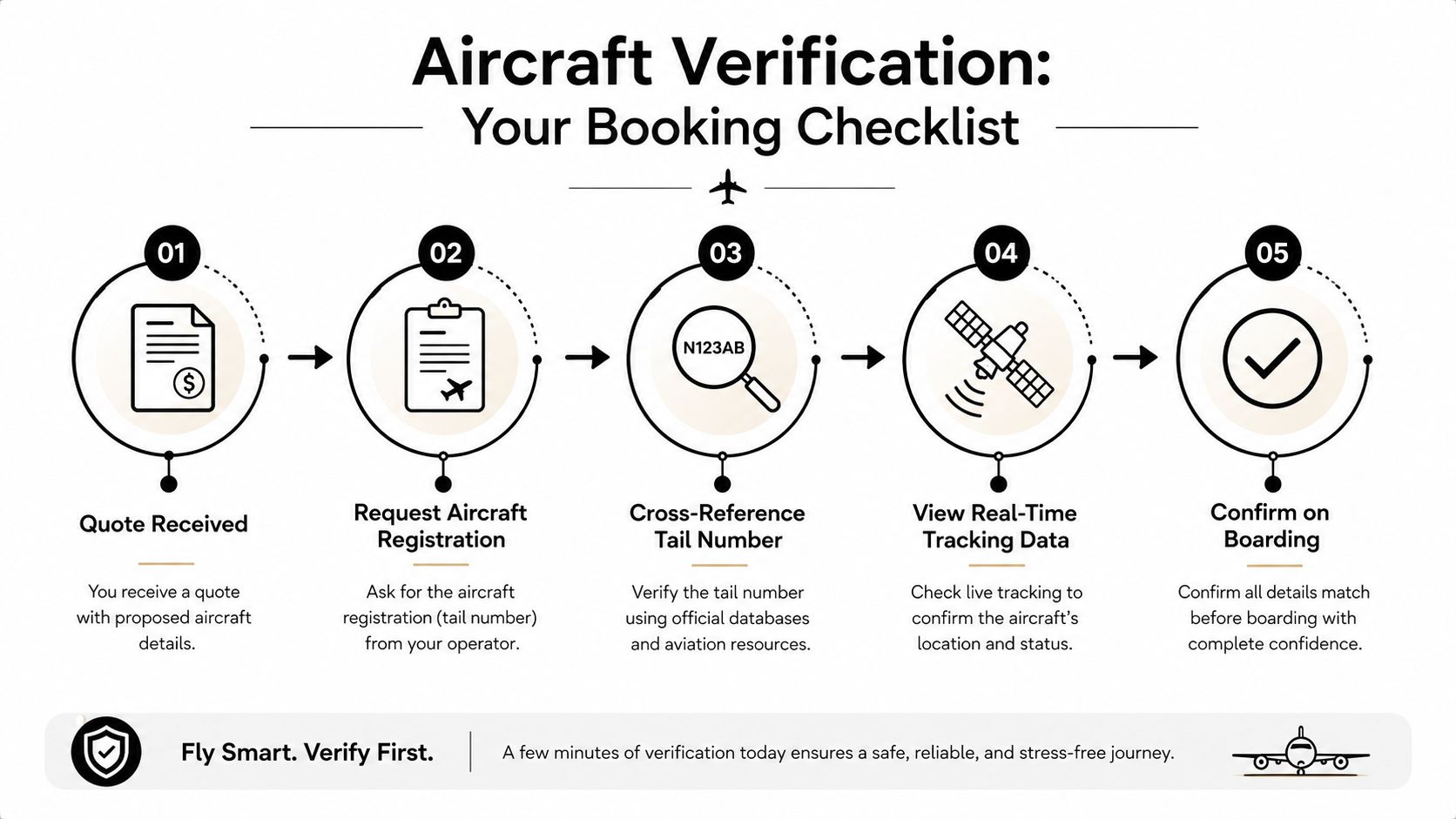
A quote is not a booking. Until you know the tail number, you don't really know what you're buying. That's the part too many flyers skip, and it's how substitutions happen without much pushback.
Start with the registration, not the promise
A private jet can be tracked by its tail number, the registration painted on the aircraft. In the U.S. it typically starts with N, and in the U.K. it often starts with G-. Search that identifier in tools such as FlightAware, Flightradar24, FlightStats, or FlightView, and you can see location, speed, altitude, route history, and current status. The operator's own tracking feed is usually the most accurate because it matches the system they use internally.
The workflow is practical. Find the registration through the FAA registry, airport photography, or tracking communities. Enter it into a tracker. Then watch for live movement and set alerts for departure and arrival changes. If the aircraft is blocked on one platform, check another, because data gaps are real and no single tracker sees everything.
The 24-hour confirmation is where bad surprises get exposed
Industry workflow examples show that for a standard domestic trip, clients typically receive the confirmed tail number, FBO, and slot details 24 to 48 hours before departure. That window matters. It's when you should confirm the exact aircraft make, model, and cabin layout, not just the category. It's also the moment to verify that the crew and FBO details line up with the booking you were sold.
Do this every time: ask for the registration as soon as the quote is narrowed, then compare the live tracker to the operator's confirmation before you send payment.
If the seller won't share the aircraft identity until the last second, that's a weak signal. You're not booking mystery metal. You're booking a specific asset with a specific position, and the registration should prove it.
Empty Legs and How to Spot a Real Deal
Empty-leg flights are the first thing people search when they want a cheaper private jet. That instinct is fine. The mistake is assuming every cheap empty leg is a good trip.
Cheap only counts if the schedule actually works
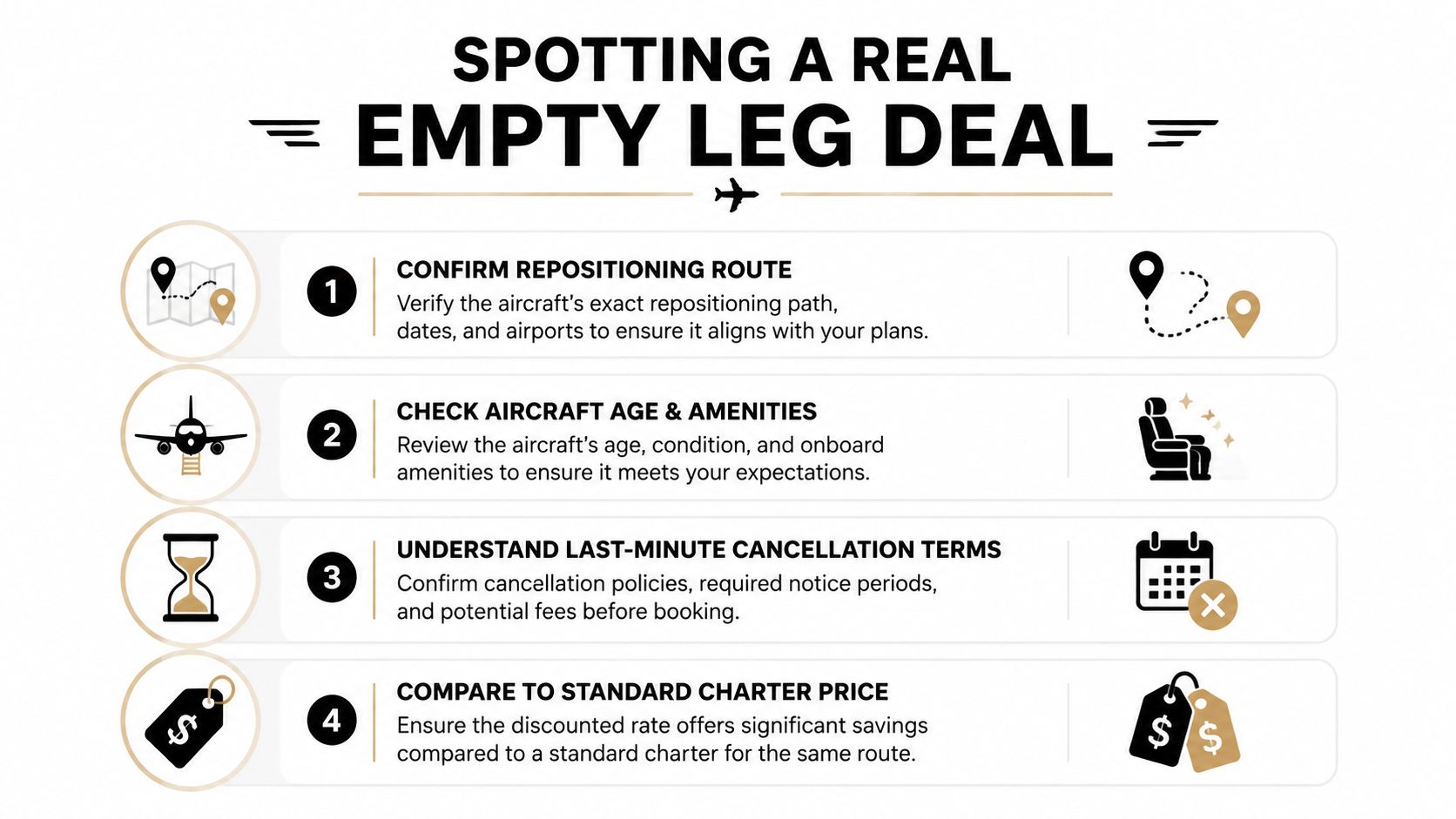
An empty leg is a one-way repositioning flight sold at a discount because the aircraft has to be somewhere else anyway. Some marketplaces advertise savings of up to 75% versus standard charter pricing. That sounds fantastic, and sometimes it is. But an empty leg is aircraft-specific, schedule-specific, and vulnerable to change if the underlying paid trip shifts.
The smart move is to ask one question first, “What is this aircraft doing before and after my leg?” If the answer is vague, the deal is fragile. A confirmed paid charter is usually a sturdier foundation than a tentative leisure repositioning, and that difference matters when your trip can't move.
Don't chase the obvious airport
The best empty-leg search often isn't centered on the destination city at all. It's centered on airport flexibility. Scan multiple nearby private aviation airports, not just the closest one, and be willing to look within a realistic driving radius. Inventory is fragmented, operators don't all publish the same way, and a better departure point can lead to a better aircraft or a better price.
The cheapest sticker price is not the best deal if it comes with schedule fragility and no backup plan.
Response speed matters. Empty legs move fast, and the best options usually reward flexible aircraft preferences more than rigid brand loyalty to one jet model. If you're willing to take the right cabin size and route, you'll do better than someone who insists on one exact jet and one exact airport.
For more detail on the mechanics, the empty-leg guide is the right place to go after this. Watch a real example too, since the market moves better than static lists do.
The Booking Checklist That Prevents Last-Minute Surprises
A vague request gets you a vague quote. A precise request gets you aircraft options that fit the mission. If you want a same-day response, stop writing “need a jet” and send a brief that answers the operational questions up front.
Send the right details the first time
Use airport codes, not city names. Include departure and arrival airports, the travel date, the time window, passenger count, luggage volume, pet details, catering preferences, Wi-Fi needs, and ground transfer requirements at both ends. Those inputs drive aircraft selection and pricing, and they save you from back-and-forth that slows down the quote.
A good request also covers the less glamorous details. Specify whether you need customs or immigration handling on an international leg, whether the FBO address matters for your ground team, and whether you care about a specific cabin layout. If you're paying for convenience, don't sabotage it with incomplete information.
- Departure and arrival codes: use the exact airport identifiers so the operator can price the routing.
- Passenger and baggage details: give the full headcount and luggage load, not a loose estimate.
- Cabin requirements: note pets, Wi-Fi, catering, and any medical or comfort needs.
- Ground logistics: include pickup timing, transfer needs, and whether you want the FBO confirmed.
- Aircraft preference: ask for the year, make, model, and cabin layout if you care about consistency.
Ask for the confirmation package, not just the price
You should also ask for safety ratings during the quote stage. If the operator can't clearly confirm Wyvern or Argus status, move on. For many trips, that's the difference between a polished sales process and a serious operation.
Payment matters too. Some operators and marketplaces now support Bitcoin and other crypto assets, which is useful for travelers who want speed and flexibility on settlement. The payment method doesn't matter nearly as much as the aircraft identity, the confirmation process, and whether the quote includes all-in items such as fuel surcharges, landing fees, crew fees, taxes, and premium services.
| The Perfect Charter Booking Brief | What to Include |
|---|---|
| Date, Time, and Flexibility | Exact travel date and window |
| Passenger Count and Baggage Details | Headcount, bags, pet notes |
| Airport Preferences | Primary and alternate airports |
| Specific Aircraft Requirements | Make, model, cabin, Wi-Fi |
| Onboard Catering and Amenities | Food, drinks, special requests |
| Ground Transport Coordination | Pickup and drop-off needs |
A complete brief shortens the whole cycle. It also makes it easier to compare multiple aircraft options instead of accepting the first number that comes back.
Real Scenarios and Last-Minute Strategies
The right sourcing strategy changes fast when the trip shape changes. A same-day Hamptons hop, a corporate roadshow, and a beach escape all call for different tradeoffs, and pretending they don't is how people overpay.
Match the aircraft to the mission
For a same-day Hamptons flight, a locally sourced turboprop can make more sense than a heavy jet deadheading from Teterboro. The issue isn't prestige, it's math and timing. If the aircraft is already positioned near your departure airport, you remove a lot of friction before the trip even starts.
For a corporate roadshow across three cities in two days, fleet consistency matters more than a bargain hourly rate. The team needs predictable timing, a cabin that works for calls, and a booking structure that won't collapse after one schedule shift. An operator or marketplace with direct access to the aircraft pays off.
Sports team travel adds another layer. Oversized luggage, multiple ground transfers, and short turnarounds can turn a cheap quote into an operational mess if the aircraft isn't set up for the load. The same is true for Bahamas or Turks and Caicos trips, where customs pre-clearance and FBO choice shape the start of the trip as much as the jet itself.
Last-minute doesn't mean careless
Flyius says indicative prices can appear instantly, firm offers usually follow within 2 hours, and last-minute trips are often possible in the 48 to 72 hour range, while Charterscanner says direct operator quotes can come within 30 minutes. That's useful, but speed alone doesn't make the trip better. If you have a hard departure time, lock the route, passenger count, and exact airports first, then choose the fastest sourcing path that can support them.
For event-driven travel, the biggest mistake is locking onto a specific aircraft type before you know what's actually available near your departure point.
That's why a flexible playbook beats a rigid one. For an Aspen ski-week departure or a major event charter, the winning move is usually the one that balances local aircraft availability, safety vetting, and confirmation speed rather than trying to force one perfect quote.
Your Action Plan and Common Questions
Keep the process simple. Define the route and timing, choose the sourcing channel, verify the tail number and safety rating, send a complete request, and don't close the deal until the 24-hour confirmation matches the aircraft you expected. That's the whole playbook.
How early should I book for the best pricing? If you can plan ahead, do it, but last-minute trips can still work when you give the operator the exact airports, passenger count, and time window. Can I pay with crypto? Sometimes, yes, and it's becoming a real option in private aviation. What if the aircraft gets swapped? Demand the registration and compare it against the confirmation package before you approve the final leg. Can I bring pets? Yes, but you need to state that upfront so the aircraft, cabin, and ground handling are all set correctly.
If you want a clean search instead of a broker loop, Haute Jets gives you direct access to vetted aircraft and a quote process built around the exact jet, not a generic category. Visit Haute Jets when you're ready to compare real options and stop paying for repositioning you never asked for.