
You're probably planning a trip and thinking about everything except the part that matters most to your pet. You can manage your luggage, ground transport, and departure time. What you can't control on a commercial flight is whether your dog is separated from you, moved through a noisy terminal, or treated like cargo.
That's why clients ask me the same question again and again: how do you fly with pets without turning the journey into an ordeal? My answer is simple. Prepare the paperwork early, choose the right travel setup, and remove friction from the day itself. If your standards are high for your own travel, they should be just as high for your companion's.
This guide appears on Haute Jets Journal because luxury pet travel shouldn't feel vague or improvised. It should feel organized, calm, and fully under control.
Preparing Your Pet for Air Travel
If you want to know how to fly with pets properly, start with the documents. People obsess over carriers and cabin setup, but the critical failure point is paperwork. A relaxed airport experience means nothing if your pet doesn't have the health records required for departure or entry.
Start with the veterinary file
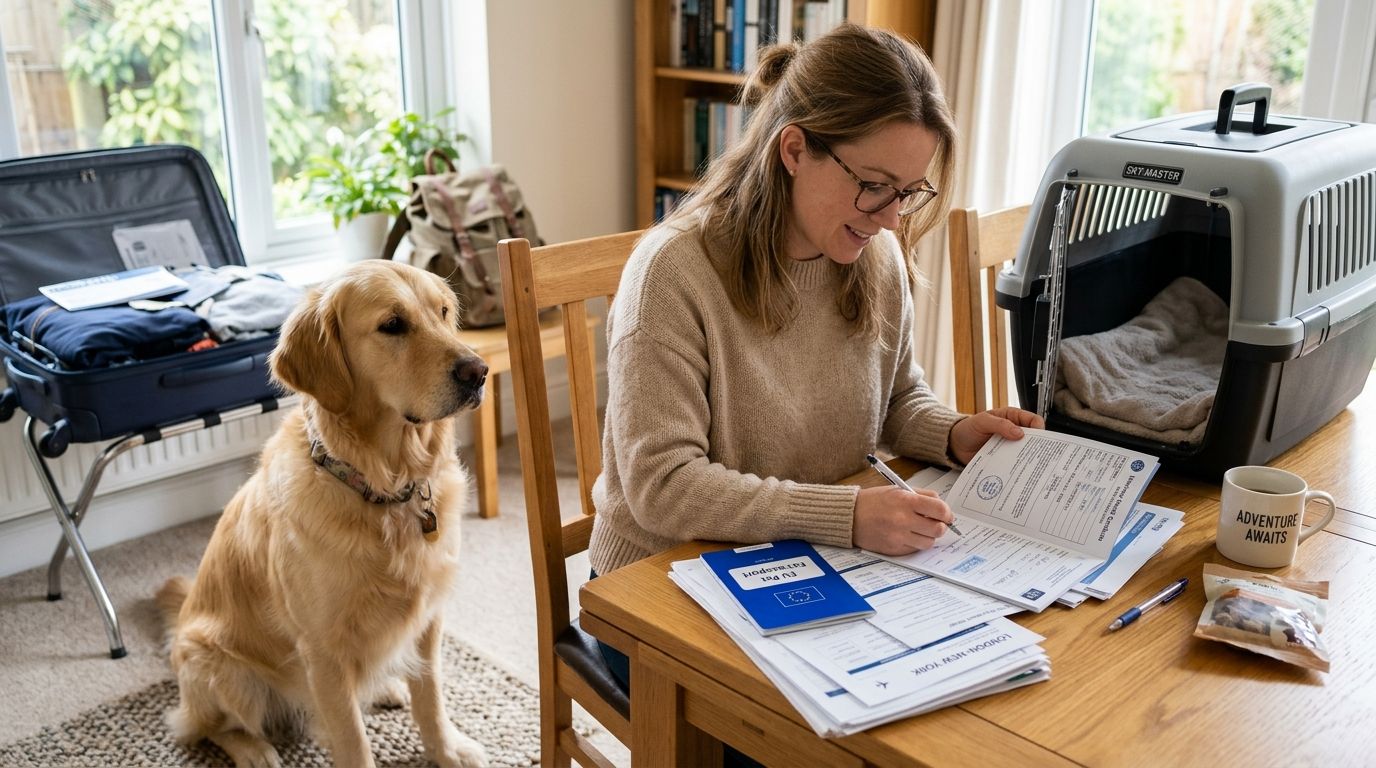
Book a veterinary visit as soon as your itinerary firms up. You need to confirm that vaccinations are current, that your pet is fit to travel, and that every record matches the exact name and description you'll use for travel documents.
One point matters more than most owners realize. For international private flights, the critical mechanical requirement is not airline approval but the specific health documentation: pets must possess current vaccinations and a valid health certificate, with international regulations often requiring additional specific certificates that must be carried in both digital and physical copies to avoid denial of entry, as outlined in this private jet dog travel dossier.
Practical rule: If a document exists, carry it twice. Keep one printed set in a folder and one digital set on your phone.
Microchipping also belongs in this first stage, not at the last minute. It creates a clean identification trail and helps align your veterinary records, border requirements, and ownership documentation.
Respect the 10 day window
Your health certificate timing isn't flexible. If your veterinarian is issuing an International Health Certificate, commonly referred to in private jet pet travel as the USDA-APHIS 7001, the timing matters because it's typically issued within 10 days of departure, according to this guide to flying private with a dog. Leave it too late and you'll scramble. Do it too early and you may need it redone.
That's the mistake I see most often. Owners assume they can gather paperwork in any order. They can't. The sequence should be deliberate:
- Confirm destination rules first. Domestic and international trips are not the same. Neither are country-to-country requirements.
- Update vaccines next. Don't wait until the week of departure to discover a lapsed rabies record.
- Schedule the travel certificate inside the valid timeframe. Your veterinarian should know the timing, but you should verify it yourself.
- Create a travel folder. Include vaccination records, microchip information, health certificate, and any destination-specific treatment records.
For a practical mainstream checklist alongside private aviation planning, these flying with your pet tips are worth reviewing before departure.
Don't leave coordination to the final week
Your travel advisor or charter coordinator should review the pet file before the travel day. If you're arranging private travel, send the records early so the operator has time to review them and flag any issue before the aircraft is confirmed.
If you need a starting point for private pet charter planning, Haute Jets maintains a dedicated page on how to fly with pets on private aircraft. Use it as a planning reference, then have a real person check the details against your route.
A pet travel day feels easy only when the preparation is exact.
Commercial Cargo vs Private Cabin
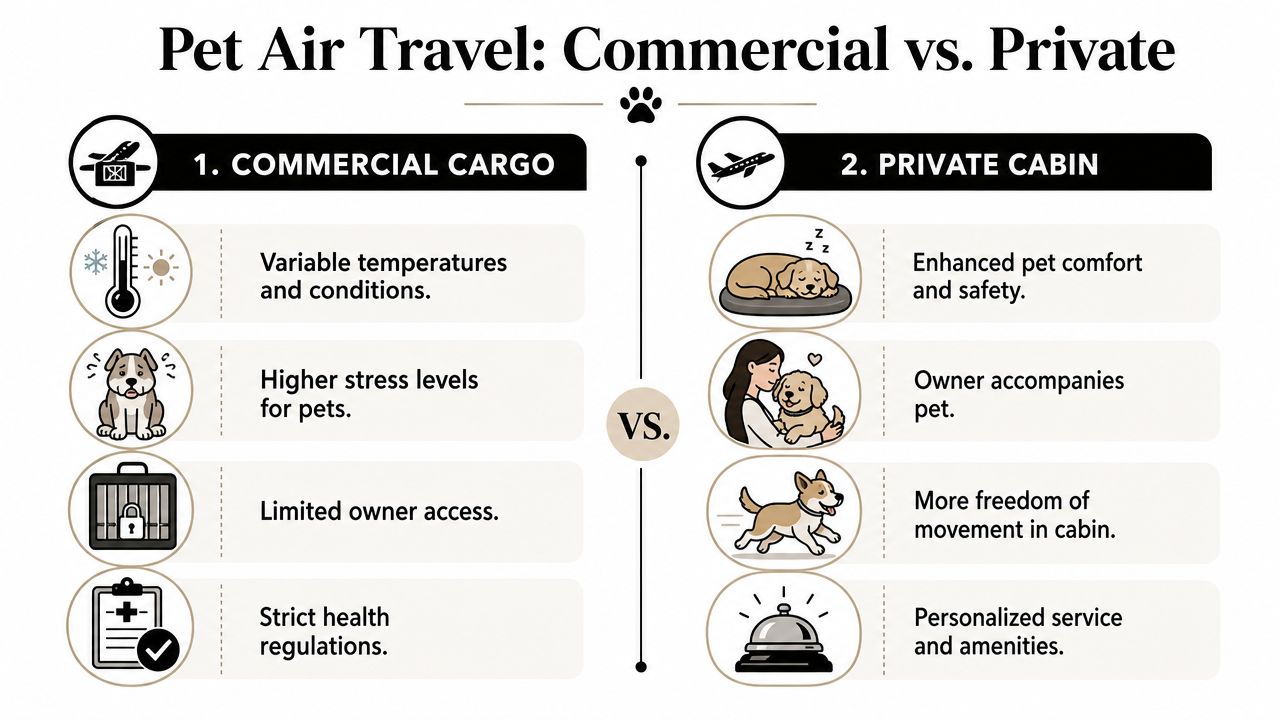
Most owners don't need a lecture on this comparison. They already know how it feels. Commercial travel asks you to trust a process you can't see and can't control. Private travel keeps your pet with you.
What commercial travel actually looks like
Commercial airlines move a large volume of animals. In 2019, US airlines transported over 404,000 animals, with a documented incident rate of 0.47 per 10,000 animals, according to this pet air transport study. That's a statistically low risk. It's still a risk many owners don't want to accept when the alternative is to keep the pet in the cabin.
The larger issue isn't just the number. It's the structure of the experience.
| Travel factor | Commercial cargo | Private cabin |
|---|---|---|
| Owner access | Limited once the pet is checked in | Pet remains with owner |
| Size flexibility | Often restricted | Generally far more flexible |
| Travel environment | Process-driven and impersonal | Controlled and individualized |
| Stress level | Usually higher | Usually lower |
A commercial airline may be suitable for some itineraries. I still don't recommend it for clients who have another option, especially if the pet is older, anxious, large, or strongly attached to the owner.
Why private cabin travel changes everything
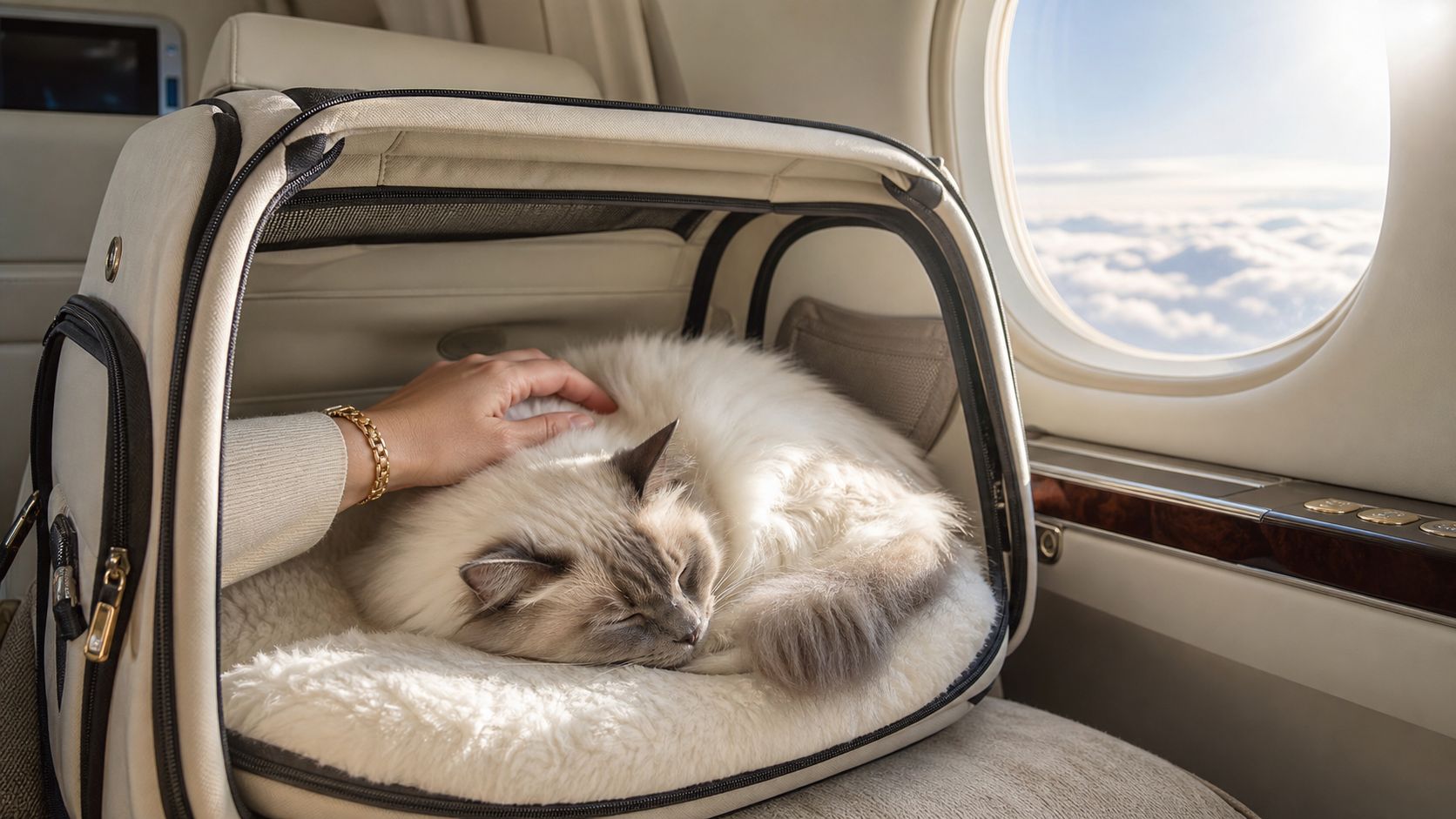
Private aviation solves the problem at the root. Your pet doesn't disappear into a holding system. Your dog or cat stays in the cabin, near you, with a crew that knows in advance an animal is traveling.
That changes the emotional tone of the entire day. It also changes the owner's behavior. People stay calmer when they can see their pet, reassure them during boarding, and settle them into a familiar environment.
Private travel doesn't just move a pet more comfortably. It removes the separation that owners dread most.
There's another practical distinction. Commercial travel often comes with strict size and breed limitations. Private aviation is much more accommodating for larger animals and households traveling with more than one pet. For clients with big dogs, bonded pairs, or unusual itineraries, that flexibility matters more than any lounge access or catering menu ever will.
My recommendation
Use commercial travel only if the route, timing, and pet profile make it sensible. Otherwise, book a private cabin itinerary and keep the animal with you from terminal to landing. If your pet is family, treat the logistics that way.
Booking a Pet-Friendly Private Jet
Your driver pulls onto the tarmac, your dog stays beside you, and the crew already knows where the water bowl, restraint, and boarding path need to be. That outcome is decided at booking, not on departure day.
A good private jet booking starts with full disclosure. Give the charter team your pet's breed, weight, age, routine, and flight history in the first conversation. If you wait until the aircraft is sourced, you limit your options and invite avoidable changes in cabin setup, handling, and crew briefing.
Operators need specifics, not vague reassurance. “He's friendly” is useless. Say whether your dog is noise-sensitive, whether your cat stays calm in a carrier, whether your pet has flown before, and whether any digestive issues could affect the trip. If that is a concern, support dog gut health before travel instead of trying to fix stomach stress in the cabin.
What to disclose immediately
Send this information before you approve the quote:
- Breed and exact size. A Labrador, a French Bulldog, and a Great Dane create very different cabin and handling requirements.
- Weight and age. This affects restraint planning, boarding assistance, and aircraft fit.
- Temperament. Mention reactivity, anxiety, noise sensitivity, or dislike of strangers.
- Species-specific needs. Cats, birds, and other animals often need different containment and boarding plans.
- Vaccination and paperwork status. Have records ready before the operator asks.
- Any operator-sensitive breed issues. Some breeds require prior approval or stricter handling protocols.
Ask for the pet policy before you commit. Haute Jets is one company that can arrange on-demand private aircraft and confirm pet-related operating rules during the booking process. I also recommend reviewing these private jet pet travel tips for owners flying with animals before you finalize the itinerary.
Ask the questions clients forget
The wrong question is, “Do you allow pets?” That tells you almost nothing.
Ask how the flight will work:
- Will my pet stay in the cabin for the full trip?
- What restraint is required during taxi, takeoff, and landing?
- Is a carrier mandatory for cats or small dogs?
- Are there cleaning fees or aircraft-specific limits?
- Does the crew want behavioral notes added to the manifest?
- How will boarding work on the ramp?
Those answers matter more than the aircraft category. A light jet with a clear pet protocol is a better choice than a larger aircraft with vague rules and last-minute restrictions.
Build the booking around the animal
Start with the pet profile, then choose the aircraft. That is the correct order.
Large dogs need space to settle without blocking access. Senior pets may need easier boarding and fewer legs. Anxious animals do better when the crew knows in advance where they will sit, what equipment is required, and how much interaction is helpful. This is service design, not a footnote in the manifest.
Here's a useful visual walkthrough before you finalize your plan:
Book the trip the way you would for any valued family member. Be precise early, confirm the pet protocol in writing, and choose the operator that treats animal handling as part of the flight experience, not an exception to it.
Ensuring a Calm and Comfortable Journey
A smooth flight starts hours before you leave for the airport. Most pet travel problems are not logistical. They're physiological and behavioral. If the animal is overstimulated, under-exercised, or fed badly, you'll feel it during taxi and cruise.
Handle the energy before you leave home
One of the most common private pet travel mistakes is simple. Owners don't exercise the pet enough before departure. A shared private pet travel benchmark notes that a good walk before leaving and offering a normal meal a few hours before the flight can significantly reduce in-flight anxiety and restlessness.
That advice is sound because it addresses the problem directly. A restless dog on board is usually a dog whose routine was disrupted too aggressively.
Use this pre-departure rhythm:
- Exercise first. Give your dog a real walk, not a quick curb stop.
- Feed normally, but earlier. Don't overfeed right before wheels up.
- Keep the routine familiar. Use the same bowl, leash, and commands you'd use at home.
- Avoid drama. Pets read your body language better than your calendar.
A calm flight usually comes from ordinary habits done at the right time.
Acclimate before the travel day
If your pet will use a carrier for any part of the journey, don't introduce it on departure morning. Leave it open at home in the days before the trip. Put in a blanket that smells familiar. Let the pet move in and out without pressure.
Cats especially benefit from this. They don't need a motivational speech. They need a familiar object that doesn't feel like a trap.
For dogs that won't use a carrier, practice the restraint system you plan to use. If the operator requires a body leash or harness during takeoff and landing, the dog should already know what that feels like.
Pack a serious pet bag
A proper pet kit prevents small disruptions from becoming cabin problems. Pack it as if you won't be able to buy anything en route.
- Water and collapsible bowl. Hydration should be easy and clean.
- Waste bags and absorbent pads. You want immediate control if there's an accident.
- Familiar blanket or toy. Scent matters more than novelty.
- Medication and instructions. Keep them in your hand luggage, not checked baggage.
- Spare collar tag. If one tag fails, you need a backup.
- Digestive support if your vet already uses it. Some owners also review options related to dog gut health before travel when routine changes tend to upset digestion.
For more practical cabin planning, this Haute Jets guide to flying on private jets with pets is a useful companion read.
The pet shouldn't feel like an add-on to the trip. The calmer approach is to plan for the animal as deliberately as you plan for the aircraft.
Your Seamless Day-of-Travel Itinerary
On a commercial travel day, pet owners spend energy managing uncertainty. On a private travel day, the goal is the opposite. You arrive knowing who's expecting you, where you're walking, and how your pet is getting on board.
Arrival at the private terminal
You pull up to the FBO, not a crowded main terminal. There are no long check-in lines, no conveyor belts, and no packed gate areas full of rolling bags and strangers reaching toward your dog. Your pet stays with you while the staff confirms the manifest and handles the baggage unobtrusively in the background.
That change alone makes a visible difference in animal behavior. Most pets settle faster when the environment is controlled and the owner isn't rushing.
Boarding and settling in
You'll usually walk from the lounge area straight to the aircraft. Keep the leash short, your voice steady, and your movements boring. Excitement is the enemy here.
Once on board, settle your pet quickly in the agreed area. Offer water. Place the familiar blanket or toy nearby. If a harness is required for taxi and takeoff, use it exactly as the crew instructed instead of trying to negotiate in the doorway.
The best boarding routine is quiet, predictable, and fast.
In flight and on arrival
During the flight, most pets do best when the cabin feels uneventful. Don't constantly fuss over them. Reassure them when needed, but let them rest. If your dog is the type to pace, redirect calmly and keep the environment low stimulation.
Arrival should feel as smooth as departure. Have the leash, wipes, and waste bags ready before descent so you're not rummaging through luggage on landing. A private itinerary works because it removes unnecessary friction from every stage of the day, and pets respond to that efficiency, often with greater ease than their human companions.
Navigating International and Breed-Specific Rules
You can board a private jet with a calm dog, a polished itinerary, and every comfort arranged, then lose time on arrival because one document is dated incorrectly. International pet travel is won on paperwork.
Use the destination rules as your master checklist
Start with the entry rules of the country where you are landing. Build your veterinary timeline backward from that date, then confirm the operator can accommodate any inspection or handling requirements attached to your route.
For the UK, that means getting the basics right from the start: your pet must be microchipped, vaccinated against rabies, and, for dogs, treated for tapeworm within the approved pre-arrival window. The official UK government guidance on bringing your pet to Great Britain is the right reference point. Use it, not a forum post, not an airline summary, and not what worked on someone else's trip last year.
One missed timing window can force a delay or a change of plan. Private aviation gives you control over the cabin experience. It does not give you a pass on border entry rules.
Get every approval in writing
Do not rely on verbal reassurance from a charter coordinator, ground handler, or overseas contact. If a breed, routing, or arrival airport raises any question, ask for a written confirmation before funds are committed.
This matters most for brachycephalic breeds, larger dogs, and any pet traveling to a country with stricter animal import controls. Some destinations restrict certain breeds outright. Some operators permit a breed but require specific restraint, cleaning, or seating arrangements in the cabin. Those details should be settled before the aircraft is sourced, not while your crew is preparing for departure.
Carry every document in two forms. Keep a printed set in a hard folder and a digital set saved offline on your phone. Border officials, FBO staff, and veterinary inspectors do not all work the same way.
If your itinerary includes customs clearance on arrival, this guide to the customs and immigration process when flying overseas in a private jet will help you prepare for the border side of the trip.
Precision makes this easy. Once the documents, breed policies, and arrival procedures are confirmed in advance, international private travel with a pet feels controlled, orderly, and far more civilized than trying to fit an animal into a commercial airline process.
If you want a private flight arranged around your pet instead of forcing your pet to adapt to a rigid airline process, speak with Haute Jets. Their team can confirm aircraft-specific pet policies, review route logistics, and help structure a cleaner travel day from departure to arrival.