

An IFR flight plan is, in essence, a detailed digital handshake between your pilot and Air Traffic Control (ATC). It lays out the exact route, altitude, and timing for your private jet's journey, serving as the backbone for flying under Instrument Flight Rules (IFR), especially when visibility is poor or the skies are busy.
Why Your Charter Relies on an IFR Flight Plan
Think of an IFR flight plan as a meticulously detailed road trip itinerary, but for the sky. Before your jet’s wheels ever leave the tarmac, this comprehensive document has already been filed, reviewed, and given the green light by air traffic controllers. It’s a shared playbook that ensures everyone, from the flight crew to the controllers on the ground, is on the same page about the aircraft's intentions from takeoff to touchdown.
This level of pre-planned coordination is absolutely essential for the elite Wyvern and Argus-rated operators we partner with at Haute Jets. Flying under IFR isn't just about navigating through clouds; it's about gaining access to a far more efficient and reliable air traffic system. It allows our pilots to fly at higher, smoother altitudes—well above most weather and commercial airline traffic—which translates to a more comfortable and direct flight for you.
The IFR flight plan is the key that unlocks the "highways in the sky." Without it, an aircraft is confined to lower altitudes and clear weather, which severely limits routing options and opens the door to potential delays.
Core Elements of Your Flight Itinerary
This plan is built on several key pieces of information, each one critical for ATC to manage the airspace safely. Getting a sense of these components helps pull back the curtain on the complex logistics we handle for every single flight.
The core elements always include:
- Aircraft Details: This part identifies the jet's specific model, its registration (tail number), and all its onboard navigation and communication gear. It tells ATC exactly what the aircraft is capable of.
- Proposed Route: This is much more than just a straight line between two points. It details the precise sequence of navigational waypoints, airways, and transitions the pilots intend to follow.
- Timing and Speed: The plan locks in the proposed departure time, cruising speed, and the estimated time the journey will take. This data is crucial for ATC to manage the flow of traffic.
- Alternate Airports: Safety is always the priority. The plan must list at least one alternate airport—and confirm there's enough fuel to get there—in case the primary destination becomes unavailable for any reason.
By filing a detailed IFR flight plan, your charter becomes part of a safe, controlled, and predictable system. This is a crucial aspect when you want to learn more about how private jet charters operate in any weather. All this meticulous planning is the invisible engine that powers a seamless, reliable, and luxurious travel experience, turning what is a complex aerial ballet into your simple, elegant journey.
Decoding the Sections of Your Flight Plan
At first glance, an IFR flight plan looks like a wall of cryptic codes and abbreviations. But once you know what you’re looking at, it’s not so intimidating. In fact, it tells a clear and logical story about your journey. For the kinds of complex, often international trips we manage at Haute Jets, we rely on the modern ICAO (International Civil Aviation Organization) flight plan, which is the global standard.
Think of it as a detailed dossier for your flight. This document is filed with air traffic control (ATC) to ensure your trip is seamlessly coordinated with every other aircraft in the sky. Each field provides a critical piece of the puzzle, telling ATC everything they need to know for a safe and efficient flight.
This mind map breaks down the four pillars of information that form the foundation of every plan.
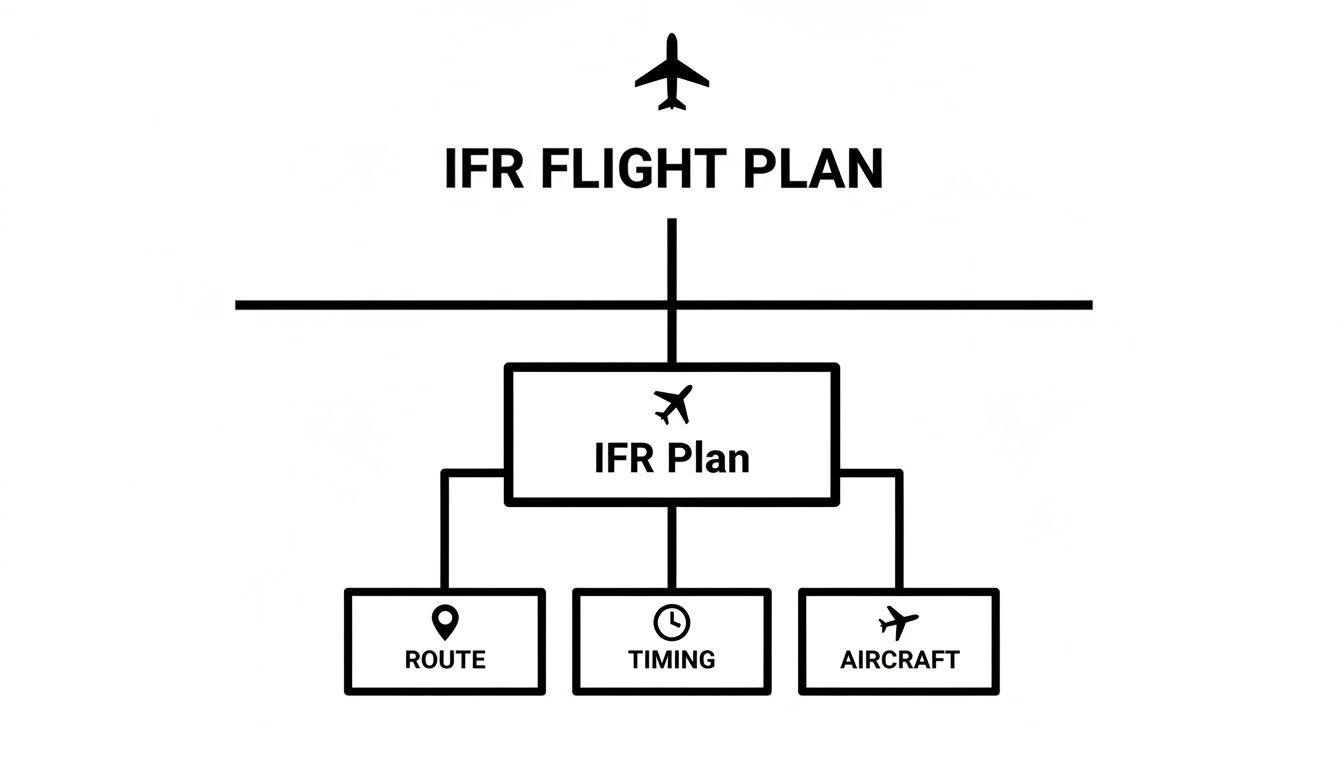
As you can see, the plan is built around the aircraft itself, the specific path it will take, and the exact timing of the flight. Let’s pull back the curtain on a few of the most important sections.
Your Jet's Technical Resume
Item 10 (Equipment): This isn't just a random string of letters; it’s your jet’s technical resume. This field tells ATC exactly what navigation and communication gear is on board. For example, a code like 'G' signifies GPS, while 'S' indicates standard equipment like VOR, ILS, and VHF radios.
These codes are far from trivial. A modern jet with advanced satellite-based navigation can fly more direct, efficient routes—essentially, the express lanes in the sky. This single field confirms the aircraft is properly equipped for the proposed route, which is especially critical for flying over oceans or remote areas.
The Turn-by-Turn Sky Directions
Item 15 (Route): This is the heart of the flight plan. It’s the precise, turn-by-turn sequence of airways and waypoints the pilots will follow. It’s much more than a straight line between two airports; it's a carefully plotted course through an invisible highway system.
The route data is what allows ATC to safely separate your jet from thousands of others. To get an even deeper sense of how pilots track this journey, take a look at a typical navigation log, which translates these planned routes into real-time flight data.
Item 16 (Destination and EET): This field lists your destination airport and, just as importantly, the Estimated Enroute Time (EET). The EET is a core component of fuel planning. It ensures the aircraft has more than enough fuel to not only reach the destination but also to handle potential delays, fly a holding pattern, and divert to a designated alternate airport if necessary.
Key Differences Between ICAO and FAA Flight Plan Forms
The level of detail in the modern ICAO form is essential for the types of global operations we manage. While many are familiar with the older, simpler FAA domestic form, it just doesn't provide the depth needed for today's advanced navigation systems and international airspace.
Here’s a quick comparison to highlight why the ICAO format is the worldwide standard.
| Feature | ICAO Flight Plan Form | Legacy FAA Flight Plan Form |
|---|---|---|
| Global Standard | Yes, used worldwide for international and domestic flights. | Primarily used for domestic U.S. flights; now largely phased out for IFR. |
| Equipment Codes | Highly specific codes for advanced navigation (SATCOM, ADS-B, etc.). | General codes (e.g., /G for GPS). |
| Aircraft Data | Includes detailed surveillance and performance data. | Limited information on aircraft capabilities. |
| Route Specificity | Supports complex international routes and Performance-Based Navigation. | Less structured for intricate, multi-leg journeys. |
This comprehensive format ensures that whether you're flying from New York to Dubai or hopping from London to Geneva, every air traffic controller along the way has a complete and identical picture of your flight's capabilities and intentions. It's this very standardization that makes the global aviation system work so safely.
How Global Air Traffic Shapes Your Itinerary

When we file your private jet’s IFR flight plan, we aren't just sending a document into the void. We're reserving your specific slot in a massive, dynamic system—a complex network of aerial highways where millions of flights must coexist safely. Think of it as claiming a dedicated lane on a multi-level superhighway in the sky, where every vehicle's route is meticulously planned and approved long before takeoff.
The sheer scale of this system is hard to overstate. In 2026, the global aviation network managed roughly 35.2 million commercial flights alone, a figure that highlights just how critical precise IFR planning is. You can get a closer look at these global aviation trends on ifairworthy.com.
In this environment, the precision of an IFR flight plan and smart logistics aren't just details; they are what make or break your charter experience.
Navigating Congested Skies
During peak travel seasons or around major hubs, Air Traffic Control (ATC) becomes the ultimate choreographer. If too many aircraft are slated to arrive at an airport at once, ATC will step in to manage the flow and maintain safety.
You might experience this as:
- Ground Holds: Your departure might be briefly delayed on the ground to prevent a traffic jam in the air near your destination.
- Reroutes: ATC may assign a new flight path mid-air to navigate around weather or avoid a crowded sector.
- Holding Patterns: Your crew might be instructed to fly an oval-shaped route near the airport until it’s your turn to land.
A well-built IFR plan anticipates all of this. It includes more than enough fuel for potential holds and identifies pre-vetted alternate airports, giving your flight crew the flexibility to handle disruptions smoothly and with minimal impact on your arrival time.
Your IFR flight plan is the best defense against delays. By defining a clear, compliant, and flexible route, it gives Air Traffic Control the information they need to integrate your flight seamlessly, even when the skies are at their busiest.
The Advantage of Local Sourcing
The old way of chartering often involves repositioning a jet from a distant home base. This "repo leg" is a flight that happens before your flight even begins, requiring its own flight plan and introducing another chance for delays in an already packed system.
At Haute Jets, we sidestep this problem entirely. Our strategy is to source a locally-based aircraft from our vetted network of 3,500+ operators. By finding a jet already positioned at or near your departure airport, we eliminate the repositioning leg and file a more direct, efficient IFR flight plan from the start.
This significantly cuts down the risk of delays and ensures a more punctual departure. It’s an approach that becomes even more valuable when flying some of the world's most popular private jet routes in 2025.
Ultimately, this combination of intelligent sourcing and expert IFR planning means your itinerary is optimized not just for comfort, but for operational excellence in a very complex global airspace.
The Lifecycle of Your Flight Plan: From Filing to In-Flight Changes
Think of an IFR flight plan not as a static ticket, but as a living document. It's the strategic game plan for your journey, and just like any good plan, it's designed to adapt to real-world conditions from the moment it's created until you touch down.
The process kicks off when your aircraft operator files the flight plan with Air Traffic Control (ATC). This usually happens a few hours before your scheduled departure, officially reserving your jet's place in the sky. To get a real sense of the detail involved from the cockpit, it’s interesting to see how to file a flight plan from a pilot's point of view. This initial filing is the foundation for the entire trip.
Built-In Flexibility for a Dynamic World
Of course, the one constant in travel is change. The entire IFR system is built with this in mind, allowing for surprisingly nimble adjustments. Behind the scenes, our team at Haute Jets is always in sync with the operator's dispatchers to manage any changes, making sure your trip happens on your schedule without ever cutting corners on safety.
Here are a few common reasons a flight plan might get an update:
- You're Ready Early (or Late): A meeting wrapped up ahead of schedule? No problem. We simply coordinate with the crew to update the departure time with ATC.
- Dodging the Weather: If a thunderstorm complex brews along the planned route, the pilot or ATC will amend the flight path for a smoother and safer ride.
- Navigating Busy Skies: During peak travel hours, ATC might issue a slight reroute or a different cruising altitude to keep air traffic flowing smoothly and safely for everyone.
The real comfort in private aviation comes from knowing your flight plan is actively and professionally managed. Whether you decide to leave an hour earlier or ATC makes a minor adjustment for traffic, the system is designed to handle it without a hitch.
This incredible adaptability means you aren't chained to a rigid itinerary. The flight plan provides a solid framework, but it's a flexible one. This constant, behind-the-scenes logistical work is a huge part of the private charter experience, giving you the freedom to fly how you want while we handle the complexities.
We believe in keeping you in the loop, which is why we provide tools that offer real-time flight insights for your private jet charter. Ultimately, managing your IFR flight plan is a constant conversation between your flight crew, our operations team, and air traffic controllers—all working together to execute a flawless flight.
How Your IFR Plan Impacts Your Charter Experience
 An IFR flight plan is far more than just a route filed with air traffic control. Think of it as the flight's operational playbook, meticulously crafted to ensure your safety and comfort from takeoff to landing. While the details can get technical, their impact on your journey is very real and incredibly reassuring.
This plan is what turns abstract data into a seamless, reliable experience. Two of the most critical—and often misunderstood—components are alternate airports and extra fuel. If you see these on your itinerary, it’s not a red flag. It’s a hallmark of a professional, well-prepared crew that puts your safety first.
The Logic Behind Alternate Airports and Extra Fuel
Under Instrument Flight Rules, listing an alternate airport isn’t optional; it’s a strict safety requirement. It's your flight’s built-in Plan B. Before the engines even start, your crew has already confirmed there's enough fuel to fly to your destination, make an approach, and—if a landing isn't possible—divert to that pre-selected alternate and land with reserves to spare.
This kind of proactive planning is what you pay for. If unexpected weather rolls in or a runway issue closes your destination airport, your flight can reroute smoothly without a moment’s hesitation.
The flight plan also accounts for extra holding fuel. This is a specific amount of fuel calculated for potential ATC delays, like circling in a holding pattern near a busy airport. It's a mandatory buffer that gives your crew the freedom to wait for clearance without any pressure.
Think of your IFR flight plan as a financial plan for your time in the air. The alternate airport is your emergency fund, and holding fuel is your liquid savings—both are essential for a secure and stress-free journey, ensuring you have ample resources for any scenario.
Navigating International Skies and Congestion
This level of detailed planning becomes even more vital on international flights, where every country has its own set of rules. Filing an IFR flight plan for a trip from the U.S. to Europe means dealing with multiple air traffic systems, different procedures, and complex regulations. It’s a puzzle where experience is everything.
This is precisely why we insist on partnering with Argus and Wyvern-rated operators. Their flight departments are masters at crafting plans that satisfy the exact standards of every country on your route, guaranteeing a flawless cross-border journey. As air traffic returns to pre-pandemic levels, this expertise is more important than ever.
For instance, projections show Europe could be managing a staggering 10.9 million IFR flight movements in 2026. This surge means traditional brokers often face aircraft shortages, which can result in repositioning fees of 20–40%. Haute Jets’ model of sourcing from over 3,500 local owner-operators worldwide is built to sidestep these costs by finding the right jet near you. You can explore the data behind these projections in Eurocontrol's performance plan.
At the end of the day, every detail on that flight plan—from the fuel load to the alternate routes—is a deliberate choice made to deliver the safest and most efficient flight possible. It is the invisible architecture that underpins a perfect charter.
We Handle the Details, You Enjoy the Flight
While you're focused on the purpose of your trip, our team and your flight crew are already deep in the weeds of your IFR flight plan. It's a world filled with technical codes, strict filing deadlines, and constant coordination, but all that complexity on our end is designed to achieve one simple goal: a completely effortless journey for you.
At Haute Jets, we don't just book a jet; we manage the entire operational lifecycle of your flight. We work hand-in-glove with the world's top-rated Wyvern and Argus operators to ensure every logistical detail is handled proactively. Think of us as your personal flight operations department, working behind the scenes to make sure everything runs like clockwork.
From Logistics to Luxury
The real magic of a private charter happens long before you step onto the tarmac. Here’s a glimpse of what our team is managing for you:
- Matching the Jet to the Journey: We double-check that your aircraft's avionics and performance capabilities are a perfect fit for the route. This means ensuring it has the right equipment for a transatlantic flight or the specific navigation gear needed for a tricky approach into a mountain airport.
- Constant ATC Dialogue: We aren't just filing a plan and hoping for the best. Our partners are in constant communication with Air Traffic Control, ready to negotiate better departure slots or find smoother altitudes to avoid turbulence. This active management often resolves potential delays before you're even aware of them.
- Keeping You in the Loop: We believe in absolute transparency. You’ll always know what’s happening with your flight, but you'll never be burdened with the operational jargon. We give you the important updates, not the logistical headaches.
Your peace of mind is our bottom line. We absorb the complexities of global air traffic management so the only thing on your to-do list is to sit back and enjoy the flight. This obsession with flawless execution is what the Haute Jets experience is all about.
This all comes together 24 hours before your departure. At that point, you’ll receive a final pre-flight confirmation from us. This isn't just an email; it's the culmination of all that planning, containing your finalized itinerary, the jet's tail number, and bios for your personal flight crew.
It’s our final promise to you—a confirmation that every single detail of your IFR flight plan has been checked, double-checked, and is ready for execution. From the moment you book with us until you touch down safely, you can rest assured that your journey is in the most experienced hands in the industry.
Common Questions About IFR Flight Plans
Naturally, our clients have a few questions about how all this planning works in the real world. Think of an IFR flight plan not as a rigid contract, but as a professional, dynamic playbook that gives us the structure to ensure safety while maintaining the flexibility private travel demands.
Can We Change Our Departure Time?
This comes up all the time, and the answer is almost always yes. A flight plan is a formal notice to Air Traffic Control, but it's not set in stone. If your meeting runs late or wraps up early, just let your Haute Jets representative know.
We’ll work directly with the operator to amend the plan with ATC. The key is giving us as much notice as possible, especially for significant changes at busy airports. This helps us secure your new departure slot without a hitch.
What if Our Flight Is Rerouted for Weather?
Weather reroutes are a normal part of flying and a perfect example of the IFR system working to keep you safe. Your flight crew and ATC handle everything behind the scenes.
Because your flight plan already contains all the necessary aircraft performance data, controllers can quickly assign the safest and most efficient new route around the weather. Your experienced pilots manage all the communications, so the only thing you’ll notice is a smooth, continuous journey.
Why Does My Itinerary List an Alternate Airport?
An alternate airport is a mandatory safety requirement for all IFR flights and a sign of thorough planning. It's a crucial contingency, not a prediction of problems.
This is one of the cornerstones of aviation safety. Before your flight even pushes back, your crew has a "Plan B." They ensure there's more than enough fuel to fly to your destination, make an approach, and if for any reason a landing isn't possible (like sudden fog), fly to a designated nearby airport.
At Haute Jets, our job is to manage all these complex logistics so you can simply relax and enjoy the flight. Book your next charter and experience the difference.