
You're probably looking at Japan for one of two reasons. You need certainty, or you need relief from the usual airline mess. Maybe it's a board meeting in Tokyo with no margin for delay. Maybe it's a family trip built around Niseko, Kyoto, or a yacht connection in Osaka. Either way, commercial schedules, crowded terminals, and opaque premium cabin pricing stop making sense fast.
A private jet to Japan solves the obvious problems. It also introduces a few hidden ones that most brokers gloss over. This route is long, operationally demanding, and full of quote inflation if the aircraft isn't positioned intelligently. That's where people overspend.
This Haute Jets Journal guide cuts through that noise. I'm going to give you the practical version. Which routes make sense, what drives the charter price, where fees get buried, what aircraft are worth your money, and what to ask before you sign anything.
Your Seamless Arrival in the Land of the Rising Sun
The trip should start in a private car, not a security line. You pull onto the ramp, clear the FBO in minutes, step aboard, and settle in while the crew finalizes departure. By the time most commercial passengers are still queuing for boarding groups, you're already in the air over the Pacific.
That's the appeal of a jet to Japan when time matters. Tokyo isn't a casual hop. It's a serious long-haul mission, often tied to a serious reason for traveling. Business travelers want to land ready for Marunouchi, not wrecked from connections. Families want the children asleep in a quiet cabin, not stretched across airport seats.

What clients usually get wrong
Most first-time Japan charter clients focus only on the airplane. That's a mistake. The aircraft matters, but so do airport slots, crew legality, diversion planning, ground handling, customs timing, and whether your quote includes a painful repositioning bill.
A glossy rate means nothing if the operator has to ferry the airplane halfway across the map before you even board.
Practical rule: If the quote looks clean but the aircraft isn't local to your departure side or Pacific routing, expect hidden cost pressure somewhere.
What a well-run trip feels like
A proper charter to Japan feels calm because the complexity is handled before you ever leave home. Your aircraft is selected for the route, not just the photo. Your arrival airport fits your final destination. Your ground car is waiting. Your catering reflects the length of the mission. Your baggage plan is confirmed in advance, especially if you're moving skis, golf clubs, garment bags, or production gear.
That's the standard you should expect. Not luxury theater. Operational competence.
Typical Routes and Non-Stop Flight Times to Japan
Japan charter planning starts with the right city pair. Not every route should be flown the same way, and not every Tokyo airport solves the same problem. Haneda is usually the more convenient Tokyo arrival for clients who want faster access into the city. Narita often gives you more breathing room operationally. Kansai makes more sense when Osaka, Kyoto, or Kobe is the primary destination.
What the route really means
From the U.S. West Coast, non-stop service on the right heavy or ultra-long-range jet is straightforward. From the U.S. East Coast, it's still viable, but you need to treat the flight like a true trans-Pacific operation. That means selecting an operator that knows North Pacific routing, alternates, and the actual nature of changing airspace conditions.
For clients looking at northern routings or Pacific staging logic, this Anchorage to Tokyo private jet route guide is a useful reference point.
Estimated Flight Times to Tokyo on an Ultra-Long-Range Jet
| Departure City | Airport Code | Estimated Flight Time | Approx. Distance (NM) |
|---|---|---|---|
| New York | TEB | 14 to 16 hours | 6,600 to 6,800 |
| Los Angeles | LAX | 9 to 11 hours | Qualitatively shorter than New York to Tokyo |
| London | FAB | Long-haul, typically non-stop on the right aircraft | Qualitatively transcontinental to East Asia |
| Dubai | DXB | Long-haul, mission-specific depending on aircraft and routing | Qualitatively intercontinental |
The hard data we do have is strongest on the U.S. market. A New York to Tokyo ultra-long-range profile typically covers 6,600 to 6,800 nautical miles and runs about 14 to 16 hours according to the verified route data in the brief.
Haneda, Narita, and Kansai serve different priorities
Haneda is the airport most clients ask for first, and for good reason. It's closer to central Tokyo and usually the most convenient arrival for finance, media, and diplomatic schedules. The tradeoff is operational friction. Tokyo airspace is busy, and slot access can tighten quickly.
Narita is often the smarter answer when schedule flexibility and operating practicality matter more than shaving some ground time into the city. You may spend longer in the car, but you often gain a smoother planning window.
Kansai should be your first look if Tokyo isn't the point. If the trip revolves around Osaka business, Kyoto hospitality, or western Japan leisure, don't force a Tokyo arrival just because it sounds familiar.
A bad Japan charter itinerary usually starts with the wrong arrival airport, not the wrong airplane.
My recommendation on route selection
If you're flying from Los Angeles, optimize around convenience and exact aircraft availability. If you're flying from New York, optimize around operator experience first and luxury second. On East Coast departures, route discipline matters more than cabin marketing.
And if someone gives you a generic “Tokyo quote” without discussing Haneda versus Narita, that's not serious charter planning.
Decoding the Cost to Charter a Private Jet to Japan
Most clients get misled at this stage. They ask for a jet to Japan and receive a quote that looks tidy on page one. What they don't get is a useful explanation of what's built into it, what's exposed to change, and which costs were inflated before the quote ever reached them.
The headline rate is only the beginning
For this mission, the aircraft category alone doesn't tell you enough. A heavy or ultra-long-range jet may be appropriate, but the quote changes materially based on where that specific aircraft is sitting before your trip, how it will return, what crew logistics are required, and how Japan airport access affects scheduling.
A verified benchmark from Universal Weather's Japan business aviation guide puts a Los Angeles to Tokyo one-way charter on a heavy jet like a Gulfstream G650 at $250,000 to $400,000. The same verified data notes that traditional brokers often add 20% to 40% for repositioning fees, while local sourcing from 3,500+ operators in the Pacific region can reduce that pressure and, in some cases, make a closer aircraft such as a Challenger 605 available at around $180,000.
What actually drives the number
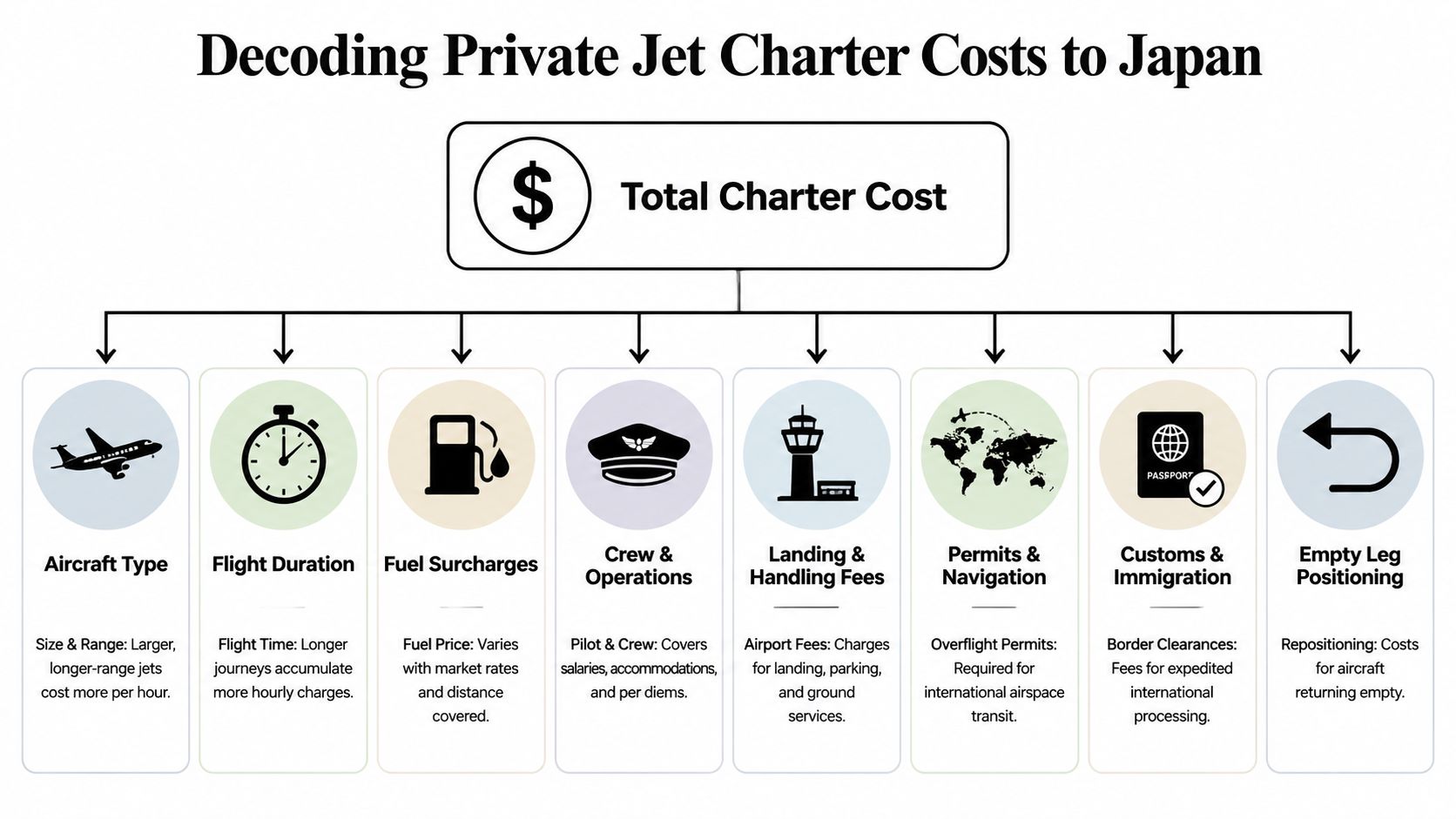
Here's what I look at before I trust any quote:
- Aircraft positioning: If the aircraft must ferry to you empty, you're paying for that movement one way or another.
- Flight duration: This is a long mission. Crew time, operating hours, and fuel exposure all compound.
- Airport restrictions: Tokyo access can introduce premium pricing because operators are dealing with congestion and tighter windows.
- Handling and international ops: Permits, navigation, ground services, and cross-border support are not decorative line items.
- Return logic: One-way and round-trip economics can be very different depending on where the airplane goes next.
If you want a broader framework for reading charter pricing, this private jet charter cost guide breaks down how operators and brokers structure quotes.
Repositioning is the fee that quietly wrecks value
This is the part clients remember after the invoice arrives.
Repositioning happens when the airplane you're booking is not already where you need it. The broker still wants to sell you the trip, so the empty ferry cost gets folded into the charter price. On shorter domestic trips, that can be annoying. On Japan routes, it can be enormous.
Traditional brokerage models often push the wrong aircraft because they're selling availability, not local efficiency. That's how clients end up paying premium trans-Pacific money for an airplane that started in the wrong place.
What I recommend instead
Ask three direct questions.
- Where is the aircraft right now
- Is the quote based on the exact tail being offered
- What empty repositioning is built into this number
If the answer to any of those is fuzzy, move on.
One practical option in the market is Haute Jets, which states that it sources from 3,500+ owner-operators across 175 countries, focuses on local aircraft sourcing, and avoids membership or jet card structures. For a route like Japan, that model is relevant because it addresses the single biggest source of unnecessary cost. Empty repositioning.
If your broker can't explain where the airplane is coming from, they can't explain your price.
The right way to compare quotes
Don't compare by total alone. Compare by structure.
A higher quote on the right aircraft, already positioned sensibly, can be the better buy than a lower teaser rate that later expands through ferry time, airport constraints, and schedule changes. Japan is not the route for vague assumptions.
You want the exact aircraft, exact routing logic, and exact operating assumptions in writing. Anything less is guesswork dressed up as luxury.
Selecting the Best Aircraft for Trans-Pacific Flights
Aircraft selection on a jet to Japan isn't about bragging rights. It's about choosing the cabin and range profile that fits the mission. For these flights, I'd stay focused on heavy jets and ultra-long-range aircraft that can handle Pacific sectors without forcing compromise.

The aircraft I'd actually shortlist
Gulfstream G650ER
This is the obvious reference point for Japan because it's purpose-built for long sectors and strong dispatch reliability on demanding international missions. The appeal for passengers is straightforward. Quiet cabin, serious range, and a flight profile that supports a direct, efficient trip without feeling like you're squeezing the mission.
Bombardier Global 7500
If your group wants distinct living zones, this aircraft usually gets the nod. It's well suited to clients who need separate spaces for sleep, work, dining, and private conversation. That matters more on a long trans-Pacific leg than people realize.
Dassault Falcon 8X
This is the aircraft smart buyers ask about when they care about efficiency and cabin comfort in the same sentence. It can be a strong choice for smaller groups who still want intercontinental capability without defaulting to the largest cabin available.
What matters more than the brochure
Don't get distracted by generic category labels. “Heavy jet” is not enough detail for a Japan charter. You need to know the exact year, make, model, and cabin layout you're boarding. Wi-Fi quality varies. Bed configuration varies. Luggage access varies. Lavatory and crew-rest practicality vary.
Those differences are easy to ignore on a two-hour hop. They matter a lot at Pacific length.
The right aircraft for Japan is the one that fits your group's sleep plan, baggage, and routing reality. Not the one with the flashiest name.
How I match aircraft to traveler type
| Traveler need | Better fit |
|---|---|
| Executive team working in-flight | Global 7500 or G650ER |
| Family trip with sleep priority | G650ER with a proven quiet cabin setup |
| Smaller group, sharp operating efficiency | Falcon 8X |
| High luggage demand | Larger-cabin aircraft with confirmed baggage compatibility |
A short cabin video helps if you're comparing layouts and onboard feel. This gives useful visual context before you commit to a specific airframe.
My recommendation
For West Coast to Japan, pick based on cabin experience and exact aircraft availability. For East Coast to Japan, put route capability first, then cabin finish. A beautiful interior means nothing if the operating profile is marginal for the day's routing.
And don't accept “or similar.” On this mission, similar often isn't similar enough.
Navigating Japan's Landing Permits and Customs
Japan rewards preparation. If you're flying private, the arrival can be smooth and discreet, but only when the operator and trip coordinator handle the paperwork and operational planning properly. If they don't, the route gets expensive and irritating fast.
Permits are not a formality
Landing permits for Japan need to be treated as part of the flight plan, not an afterthought. Availability, airport choice, and schedule precision all affect what's workable. This is especially true when your preferred arrival is Haneda and your travel window is narrow.
Clients rarely see this side of the process, which is fine. You shouldn't have to. But your charter team should be discussing lead times, ground handling, airport viability, and customs coordination before the contract is finalized.
For a useful overview of what passengers can expect on international private arrivals, this guide to customs and immigration on overseas private jet flights is worth reviewing.
The operational layer most buyers never see
The hard part of a New York to Tokyo mission isn't just endurance. It's contingency planning. Verified route data in the brief states that operators must plan diversion airports within a 180-minute flight radius, with Anchorage (PANC) as a typical example. The same data notes that geopolitical airspace restrictions or volcanic ash advisories can force 300 to 500 NM detours, adding 1 to 2 hours and increasing fuel burn by 5% to 8%.
That's not abstract technical trivia. It directly affects timing, fuel planning, and charter cost.
What customs should feel like on arrival
A proper private arrival in Japan should be quiet and quick. You deplane into a controlled handling environment, clear immigration and customs away from the commercial crowds, and move directly to your vehicle or helicopter transfer if one is arranged.
That experience depends on two things:
- A capable ground handler: They coordinate your arrival sequence, documentation, and passenger flow.
- A route-experienced operator: They avoid operational surprises that can spill into the arrival window.
Japan arrivals are smooth when the planning is boring. Boring is what you want in international operations.
My advice for clients
Don't leave permit strategy to the last minute. Don't assume every operator that flies long-range can fly Japan well. And don't ignore routing experience in North Pacific operations just because the cabin looks impressive.
If I were booking this flight for a client, I'd ask for operator familiarity with Pacific alternates, Japanese airport procedures, and shifting airspace restrictions before I asked about champagne brands.
Arranging Ground Transport Catering and Onboard Services
The flight is only part of the experience. The trip succeeds when the handoffs are clean. Wheels up is important. Wheels down is where weak planning gets exposed.
Ground transport should already be waiting
On a Japan arrival, your car plan needs to be locked before departure. That sounds obvious, but it's where too many charter trips become clumsy. You don't want a vague “someone will meet you” answer after a long-haul flight.
For clients connecting through the Gulf before Asia, a high-quality Dubai airport chauffeur service is a useful example of the standard you should expect. Clear pickup coordination, professional drivers, and vehicle quality that matches the aviation side of the trip.
Catering needs to match the mission length
A Japan sector is long enough that catering should be staged, not just loaded. You want a departure service, a true meal plan, and a light arrival option. Good crews know this. Weak ones ask whether you'd like “sandwiches or sushi” and call it personalization.
I advise clients to request by rhythm, not just by menu:
- Departure preference: light, familiar, easy on the stomach
- Mid-flight meal: substantial and plated properly
- Pre-arrival option: tea, broth, fruit, lighter proteins
If you're landing for meetings, keep the food clean and digestible. If this is a celebratory leisure trip, you can be more indulgent.
Small details matter more on long flights
Three things deserve explicit confirmation before departure:
- Wi-Fi quality: Not just “Wi-Fi available.” Ask whether it supports stable business use.
- Pets: Confirm policy aircraft by aircraft, not by operator marketing.
- Oversized baggage: Skis, golf clubs, camera kits, and garment bags should be approved against the exact luggage hold and cabin setup.
Long-haul charter comfort comes from planning the boring details before anyone boards.
My recommendation
Use one point of contact for aircraft, car service, catering, and special requests. Split responsibility across multiple providers and things get missed. On a domestic charter, you might tolerate that. On a Japan trip, it's sloppy.
Your Booking Checklist for a Flawless Trip to Japan
A clean Japan charter isn't built on one decision. It's the result of several good ones made in the right order. Cost, aircraft, routing, and service all interact. Get one wrong and the whole trip gets less efficient.
Start with the quote, not the dream
Clients often begin with the fantasy version of the trip. Preferred aircraft, preferred airport, preferred departure time. Fine. But the quote needs to survive contact with reality. On this route, that means understanding whether the price is inflated by Tokyo constraints and empty movement.
Verified data in the brief states that a New York to Tokyo ultra-long-range charter can cost $320,000 to $430,000, and that operators often build in a 15% to 25% premium because of Tokyo congestion and landing-slot constraints. The same verified data notes that a local-sourcing model can reduce the 20% to 40% repositioning surcharges commonly seen with U.S.-centric brokers.
That's the key economic lesson on a jet to Japan. The route is expensive enough already. You don't need to subsidize lazy aircraft positioning on top of it.
The checklist I'd give a client
Confirm your true destination
If you're going to Kyoto, stop defaulting to Tokyo. Pick the airport that fits the ground plan.
Request the exact aircraft
Not category. Not “or similar.” Exact tail, exact layout, exact onboard specs.
Ask where the aircraft is based
This question exposes hidden ferry cost faster than anything else.
Verify safety audits
Stick with operators that hold Wyvern or Argus credentials. On a route this demanding, safety oversight isn't optional.
Get a written breakdown of operational assumptions
You want visibility into schedule, airport choice, and what could shift the final price.
Confirm baggage and special handling early
Pets, ski gear, production equipment, or medical needs shouldn't be discussed the day before departure.
Lock in ground transport before wheels up
Don't treat the car as an afterthought.
Review the pre-flight packet
Tail number, crew details, manifest, and weather briefing should all be confirmed in advance.
What smart buyers do differently
They don't shop only for glamour. They shop for structure.
They compare quotes based on where the aircraft sits, how the route is being operated, and whether the operator has Japan experience. They also avoid prepaid membership logic when they don't need it. On-demand charter is often the cleaner fit for this kind of mission because you're buying the trip in front of you, not subsidizing a program.
The mistakes I'd avoid
- Choosing the wrong airport because it sounds prestigious
- Accepting a vague quote with no tail assignment
- Ignoring repositioning because the total price “seems normal”
- Waiting too long to address permits and arrival handling
- Assuming all heavy jets offer the same cabin experience
One more point matters. Communication. If your charter partner can't give you final flight details with clarity before departure, don't expect them to solve operational friction elegantly once the trip is live.
Buy transparency first. Luxury follows naturally when the planning is right.
My bottom-line recommendation
For Japan, I would favor an on-demand charter model that prioritizes local sourcing, exact aircraft confirmation, and audited operators over any branded membership promise. This route punishes lazy brokerage. It rewards precision.
That's why the most sensible booking process is simple. Start with the actual route. Match the right aircraft. Eliminate unnecessary repositioning. Confirm safety standards. Demand full pre-flight clarity.
Do that, and a jet to Japan becomes exactly what it should be. Efficient, comfortable, and predictable.
If you're planning a private flight to Japan and want a clean quote built around the exact aircraft, transparent positioning logic, and audited operators, contact Haute Jets. A serious long-haul mission deserves serious trip planning.