
JSX seats can start as low as $149 one way, but most travelers should think in a more realistic band of about $200 to over $1,000 per seat, depending on route and timing. That puts JSX in a rare middle tier: not commercial economy, not true private jet charter, but a premium shortcut through the airport process that can make sense if you buy it for the right reason.
The query “JSX private jet cost” often reflects a desire for more practical answers than marketing provides. Users want to know whether this is private aviation, whether it's worth paying more than first class, and whether the final bill still makes sense after the add-ons show up.
My view is simple. JSX is a smart product for some travelers, but people confuse it with private charter all the time. That confusion leads to bad buying decisions. A seat on JSX is not the same thing as controlling your own aircraft, your own departure time, or your own airport pairing. It's a premium scheduled seat product with some private-terminal advantages.
For many travelers, that's enough. For others, it's the wrong tool entirely.
The Semi-Private Promise of JSX Travel
You know the moment. Your commercial flight leaves in the morning, the airport is already jammed, parking is a mess, the security line looks ugly, and you're asking yourself why flying still feels harder than it should.
JSX sells the opposite of that headache. You book a seat, show up at a private terminal, skip the normal airline churn, and board a much smaller aircraft with a more relaxed process. That's why people start calling it “private jet travel” even when that description isn't technically right.

What people are really buying
Most buyers aren't paying for exclusivity. They're paying to remove friction.
That distinction matters because the JSX private jet cost conversation often starts with a teaser fare and stops there. That's not enough. A traveler choosing between JSX, commercial first class, and actual charter needs to look at the full trip economics, not just the headline price.
Advisor view: JSX is best understood as a premium airport-access product first, and a luxury flight product second.
A good example comes from a published fare comparison. On a Westchester to Miami Opa Locka round trip, JSX priced at $1,798 for Hop On and $2,598 for All In, while American Airlines priced the same market at $509 in main cabin and $1,009 in first class, according to NerdWallet's JSX fare comparison. That's why JSX can feel expensive if you compare it only to a commercial seat.
Why the product still appeals
The appeal isn't hard to understand. You get a private-terminal style experience without paying whole-aircraft charter pricing. That's a strong value proposition for solo travelers, couples, and executives on city pairs JSX already serves.
What you should not do is call it a bargain private jet. That's the wrong frame.
JSX occupies the middle market. It gives you less stress, less airport time, and a more polished boarding experience. It does not give you the core thing true private aviation buyers are paying for, which is control.
Decoding the JSX Per-Seat Pricing Model
JSX works like a VIP shuttle, not a private limousine. That's the cleanest way to think about it.
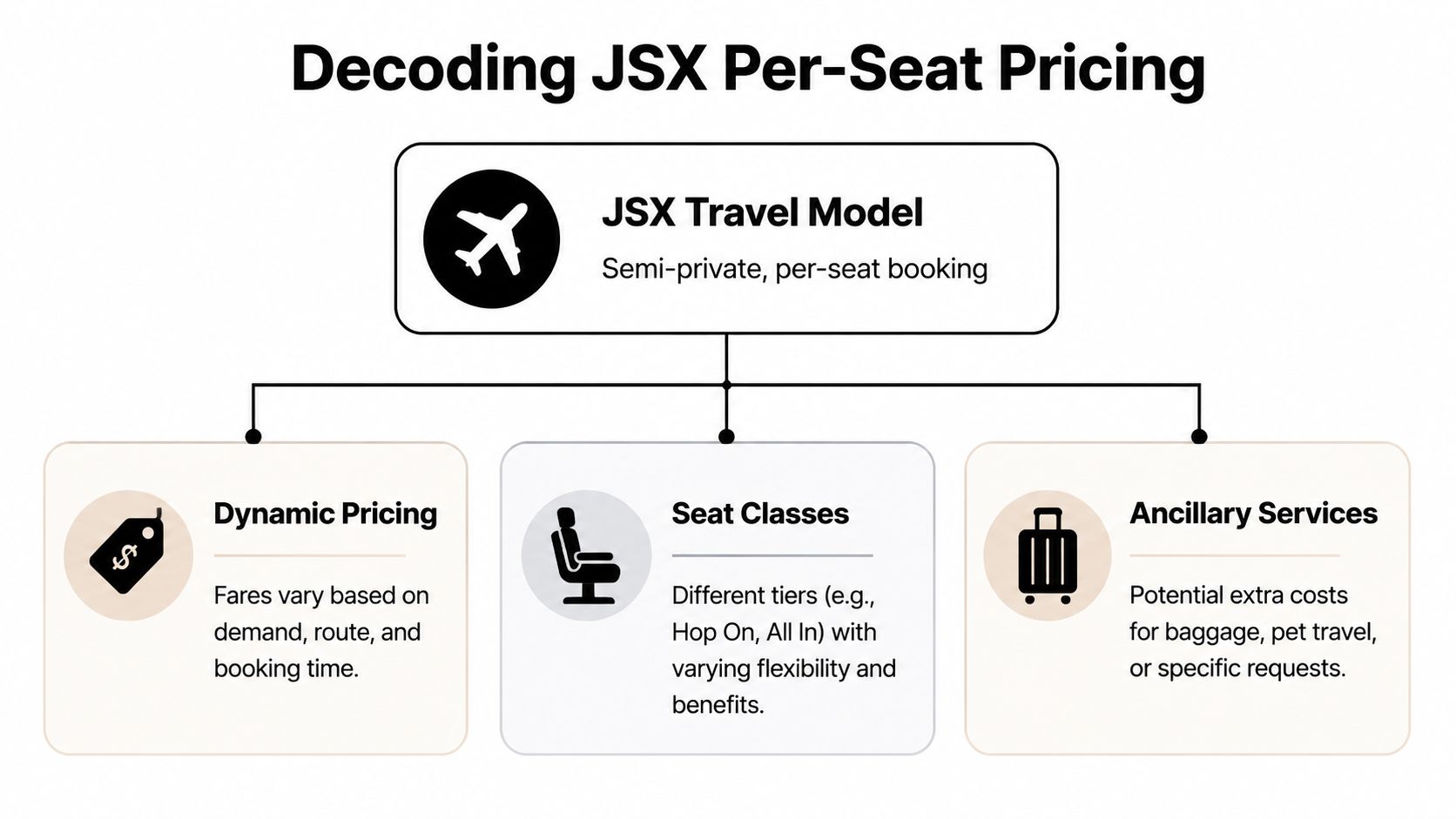
With a real charter, you rent the aircraft. With JSX, you buy a seat on a scheduled public-charter flight. The aircraft may look and feel more exclusive than a commercial airline gate experience, but the underlying economics are still based on seat inventory, route demand, and fare class.
What the base fare actually means
Published examples show JSX seats can start at $149 one way on shorter routes, while other coverage places typical prices around $200 and sometimes over $1,000 depending on route and timing, as summarized in NerdWallet's review of whether JSX is worth the cost.
That range tells you two things:
- Low teaser fares exist: They're real, but they don't define the whole network.
- JSX prices dynamically: Popular dates and longer routes can move the seat far above what casual shoppers expect.
- The product sits in the middle: It's not airline-cheap, but it's nowhere near whole-aircraft charter economics.
Hop On versus All In
The important fare split is between Hop On and All In.
Hop On is the more price-sensitive option. It can look attractive upfront, especially if your plans are fixed and you don't care much about flexibility. All In costs more, but it removes some of the nuisance charges and can be the better value if you're the kind of traveler who changes plans, brings extras, or wants less fare friction.
To frame it practically:
| Fare type | Best for | Trade-off |
|---|---|---|
| Hop On | Travelers with firm plans | Lower starting fare, more exposure to add-on costs |
| All In | Travelers who want flexibility | Higher upfront ticket price, fewer annoyances later |
Buying the cheapest JSX fare without checking the restrictions is how people end up overpaying for a product they thought was simple.
Where JSX sits in the broader market
JSX is a public-charter carrier selling individual seats on 30-seat Embraer aircraft, with pricing generally above economy and below true private jet charter, as described in this breakdown of JSX's market position. That's why I don't advise treating it like a substitute for renting a full jet.
If you're curious how the shared-seat side of aviation fits into the broader aviation picture, Haute Jets Journal has a useful explainer on how to book a seat on a private jet. It helps separate the seat-sharing model from full charter, which many buyers blur together.
Factors That Influence Your Final JSX Cost
The base fare is only the opening number. Your final bill depends on what kind of traveler you are.
Some people fly light, never change plans, and don't care where they sit. For them, JSX can be relatively straightforward. Others want seat selection, flexibility, pet transport, or last-minute booking changes. That's where the cost starts drifting upward.
The fees that change the math
JSX's published fee schedule includes a $25 technical booking fee and seat-selection fees from $10 to $115, depending on product and itinerary, according to JSX's fees and optional services page.
Independent coverage adds more useful detail. NerdWallet notes that Hop On fares can require a $10 to $30 seat-assignment fee, a $50 change or cancel fee for credit, and a $100 pet fee. It also notes that All In removes some of those charges and can be as high as $499 on some routes in the examples reviewed in its JSX review.
What usually pushes the trip cost higher
A traveler rarely gets surprised by one giant fee. The final total usually rises because of several smaller decisions.
- Seat choice: If you want to pick instead of accept assignment, that can add cost.
- Flexibility: Cheap fares are usually less forgiving when plans change.
- Pet travel: Bringing a pet can materially change the value equation.
- Booking method: Certain booking paths can introduce extra charges.
Here's the practical takeaway. If you care about flexibility, forcing yourself into the lowest fare bucket often backfires. The cheapest seat can become the expensive choice once you add the extras you were always going to buy anyway.
Practical rule: Price JSX the way you'd price a hotel room. Start with the advertised rate, then add the version you'll actually use.
Timing and route matter more than people admit
JSX isn't pricing a generic luxury experience. It's pricing specific seat inventory on specific routes.
That means your result will depend heavily on whether you're booking a shorter route or a longer one, whether demand is soft or strong, and whether you're buying early or close to departure. You don't need a complicated formula to understand this. If there are limited seats on a route people actively want, the premium grows.
The mistake I see most often is this: travelers compare a low-end teaser seat to a full-service commercial fare, then compare a high-end JSX fare to an empty idea of “private.” Neither comparison is honest. You need your actual trip, your actual extras, and your actual flexibility needs.
JSX Cost vs True Private Jet Charter
Now, the conversation gets serious. A seat on JSX and a private charter are not two versions of the same purchase.
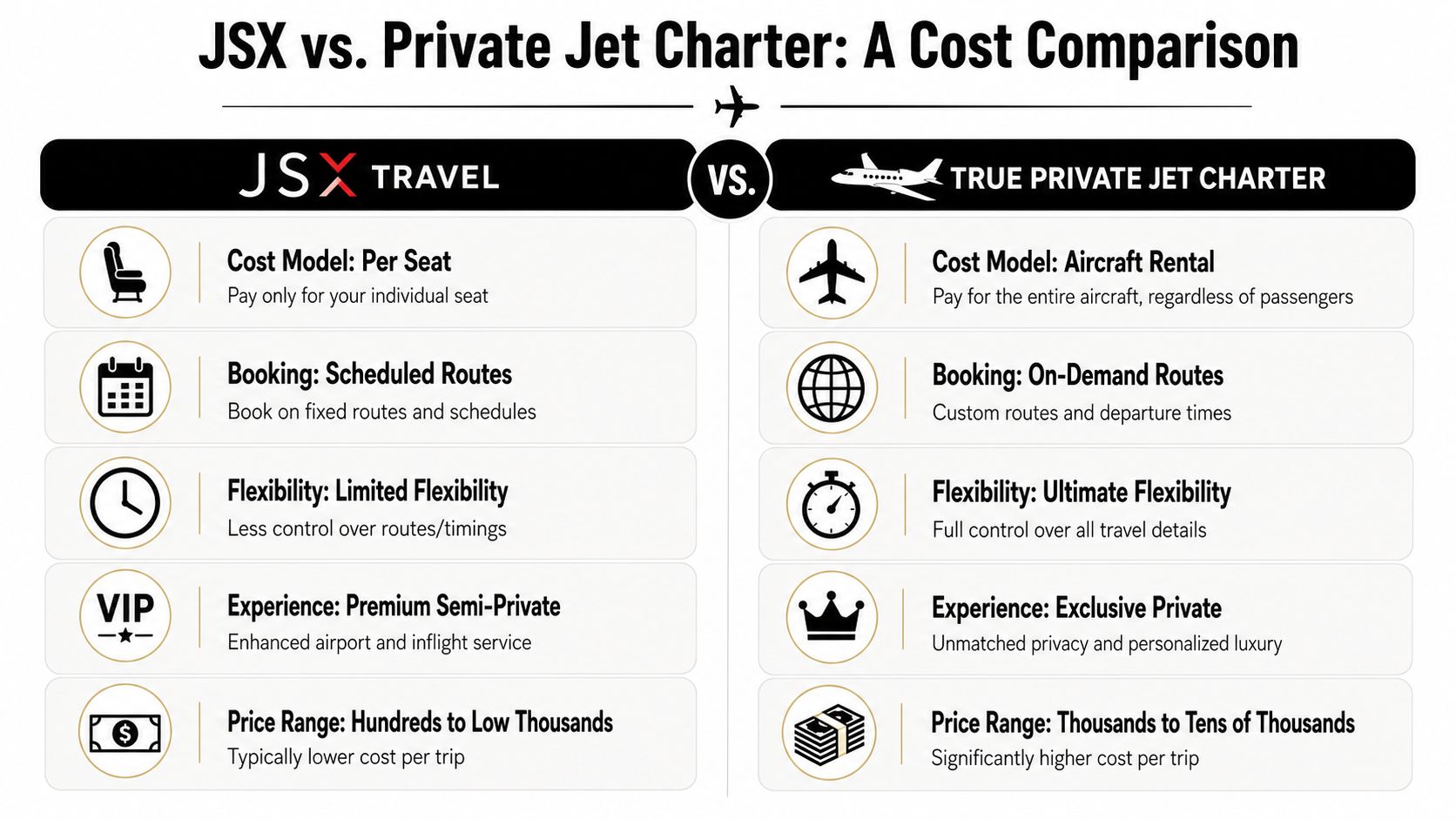
JSX is a seat-sale model. Private charter is an aircraft-rental model. Once you understand that, the cost gap stops being confusing.
The charter benchmark that resets expectations
JSX itself states that its full charter rates typically start around $12,000 per hour, plus reposition costs, FBO fees, and taxes, with a $20,000 daily minimum pre-tax, as listed on JSX charter pricing.
That single benchmark tells you almost everything you need to know. If you're comparing a few hundred dollars or a few thousand dollars for one or two seats against a full aircraft charter priced by the hour, you are shopping in different categories.
JSX also says it operates a fleet of 51 Embraer regional jets and 2 ATR 42-600 turboprops as of April 2026 on that same charter page. That supports the basic point: its business depends on scheduled utilization of smaller aircraft, not bespoke on-demand sourcing for one party at a time.
Side by side economics
Here's the blunt version:
| Factor | JSX | True private charter |
|---|---|---|
| What you buy | One seat | The entire aircraft |
| Schedule | Fixed route and departure | You choose departure timing |
| Airport options | Limited to published network | Based on aircraft and trip needs |
| Privacy | Shared cabin environment | Exclusive use |
| Pricing logic | Seat inventory and demand | Flight hours, aircraft, positioning, fees |
That difference becomes critical when your priorities shift from convenience to control.
For readers comparing providers and charter models more broadly, this roundup of best private jet charter companies is useful as a general market orientation tool. It helps frame how charter buyers evaluate service style, network, and booking model before they ever compare one quote to another.
Here's a useful visual summary before going further.
What you pay for with charter
People fixate on hourly rates and miss the actual product. Charter buyers are paying for:
- Control of schedule: The plane leaves when your party needs it to leave.
- Privacy: You know exactly who is on board.
- Airport flexibility: You can often use airports JSX won't serve.
- Aircraft fit: You select around mission, baggage, pets, range, or cabin needs.
That's why I tell clients not to compare JSX to charter until they define the mission first. If you just want a smoother airport day on a route JSX already serves, the seat model may be perfectly rational. If you need to move a family, executives, sensitive materials, or a time-critical itinerary, the seat model breaks down quickly.
For a more direct look at how private charter is typically priced, Haute Jets Journal has a practical guide on how much a private jet charter flight costs. One charter option in this category is Haute Jets, which sources aircraft from owner-operators and focuses on local sourcing to reduce unnecessary repositioning.
Charter is expensive because you're not buying transportation alone. You're buying authority over the trip.
When to Choose JSX vs a Private Charter
This choice gets easier when you stop asking which one is “better” and start asking which one matches the trip.
The wrong way to buy aviation is emotionally. The right way is operationally. Who's flying, how fixed is the schedule, how much privacy matters, and what happens if the plan changes?
Choose JSX when convenience matters more than control
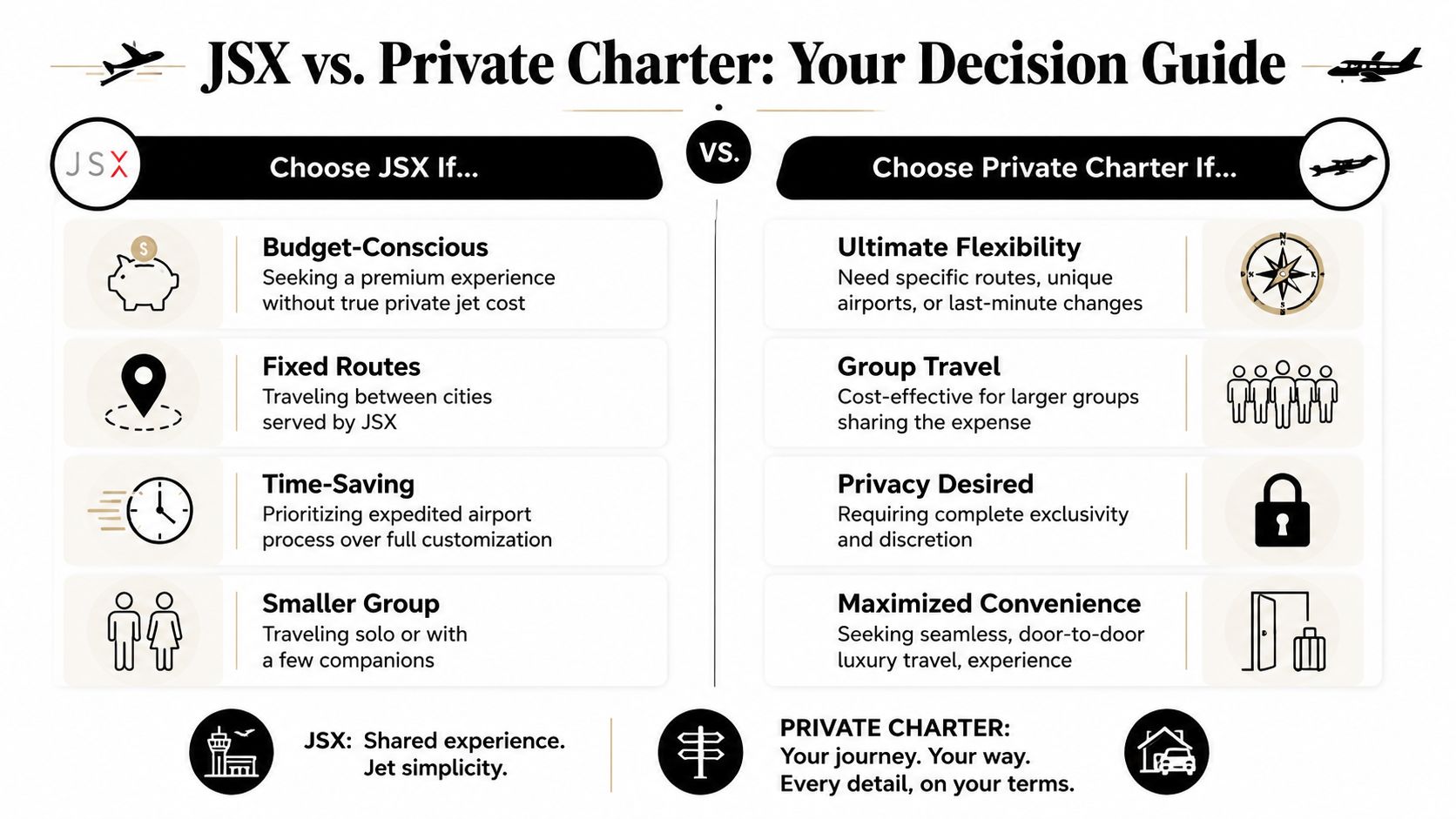
JSX is a strong fit if you're a solo traveler or traveling as a pair, your route is already on its map, and your main frustration is commercial airport friction.
It's also a sensible buy for people who want a premium experience without taking on the economics of whole-aircraft rental. As covered earlier, JSX is a public-charter carrier selling individual seats on 30-seat Embraer aircraft, with pricing generally above economy but below private charter, according to the earlier market-position overview.
Choose JSX if this sounds like you:
- You fly alone or with one companion: Paying per seat makes more sense than renting capacity you won't fill.
- Your dates are set: A scheduled model works fine when your plans won't move.
- You value airport simplicity: Private-terminal access is the feature you're really buying.
- You don't need total privacy: Sharing the aircraft isn't a problem.
Choose private charter when the mission is bespoke
The charter case is simpler than many people think. If the trip needs to bend around you, charter wins.
That includes families traveling with pets and luggage, executives with meetings that may run late, groups trying to stay together, and anyone using privacy as a requirement rather than a nice-to-have. It also includes travelers who need airports JSX doesn't serve or want to depart on their own exact clock.
A private charter is the correct choice when:
- Your schedule may move. Scheduled-seat products punish uncertainty.
- You're moving a group. Shared aircraft cost can make more sense when several people are traveling together.
- Discretion matters. Shared cabins aren't built for confidential travel.
- You want full trip control. Airport choice, aircraft type, baggage profile, and departure timing all stay in your hands.
If you're asking whether JSX feels private enough, you probably want charter.
The profile-based recommendation
Here's my direct recommendation.
Book JSX when you want an upgraded alternative to commercial flying and you can live inside someone else's route map and departure schedule. It's a quality convenience buy.
Book private charter when the trip carries business consequences, family complexity, privacy concerns, or timing risk. In those cases, the added cost isn't indulgence. It's operational insurance.
That's the dividing line. JSX sells a refined version of scheduled flying. Charter sells control.
Booking Smart and Maximizing Your Travel Value
If JSX is the right fit, buy it carefully. The smartest move is to ignore the teaser fare and price the trip you'll take.
Start by choosing fare type based on your behavior, not your optimism. If you know you like to pick your seat, may need flexibility, or plan to travel with a pet, price those extras in from the beginning instead of pretending you'll travel bare-bones. That's how you decide whether Hop On still makes sense or whether All In is the cleaner purchase.
A simple buying checklist
- Check the final price: Add seat selection and any flexibility-related costs before comparing against commercial first class.
- Match the fare to your habits: The cheapest ticket only works when your behavior is cheap-ticket behavior.
- Use JSX for the right mission: Fixed routes, lighter personalization, faster airport flow.
- Switch to charter when the stakes rise: Group travel, schedule uncertainty, privacy, or nonstandard airports all change the answer.
The broader point is this. JSX is not fake luxury, but it also isn't private jet charter in the strict sense. It's a middle-market product that can be very smart when your needs line up with the model.
If you're trying to push it into a role it wasn't built for, you'll either overpay or get frustrated.
For travelers who want to stretch value on the charter side instead, it's worth understanding how empty leg flights work. They won't replace full on-demand flexibility, but they can change the economics for certain trips.
If your trip demands more than a premium seat and a smoother terminal, Haute Jets is worth considering for on-demand charter. It gives travelers a way to source a specific aircraft for a specific mission without memberships or jet cards, which is the right model when schedule control, privacy, and airport flexibility matter more than saving on a single seat.