
Your charter invoices keep arriving. The trips are getting more frequent. The passenger list is predictable. Someone on your team has started asking the obvious question: should you stop buying flights one by one and start leasing a private jet instead?
That question usually comes up at exactly the wrong moment. Travel demand is high, schedules are tight, and the appeal of having a dedicated aircraft feels clean and logical. But leasing isn't a convenience product. It's a financial commitment wrapped inside an operational commitment, and most first-time lessees underestimate the second part.
That matters because the headline lease payment is only the beginning. The real decision sits in the details you won't see on a glossy term sheet: who controls operations, who pays for crew, how maintenance reserves work, what happens when the aircraft has to be repositioned, and what the exit clause does to you when your travel pattern changes. Those details determine whether leasing becomes a smart tool or an expensive trap.
This article appears on Haute Jets Journal for readers who want a blunt answer, not a sales pitch. If your flight profile is stable, frequent, and operationally disciplined, leasing can make sense. If your schedule is irregular, your routes change often, or you want transparency, charter is often the better answer.
Is Leasing a Private Jet Your Next Move
A familiar scenario plays out in boardrooms and family offices. A company has outgrown occasional charter. An executive assistant is booking repeat city pairs. A principal wants the same cabin feel, the same departure rhythm, and fewer moving parts. The instinct is to move one step closer to ownership without buying an aircraft outright.
That's where leasing sits. It gives you more control than booking ad hoc flights, but less permanence than owning a jet. It can be the right middle ground. It can also be the most misunderstood option in private aviation because people treat it like a payment plan when it's really an access model with legal, operational, and residual-value consequences.
Why leasing has become a serious aviation tool
This isn't a niche corner of the market. The global aircraft leasing market was valued at USD 197.88 billion in 2025 and is predicted to increase from USD 213.81 billion in 2026 to approximately USD 425.33 billion by 2035, expanding at a CAGR of 7.95%, according to Precedence Research's aircraft leasing market analysis. That growth tells you something important. Leasing has become a core financing and access strategy, not an afterthought.
For the right client, that makes sense. Leasing can preserve capital, avoid the full burden of ownership, and create predictable access to a specific aircraft type. For the wrong client, it locks money into a fixed structure while travel demand drifts, routes change, and unused capacity eats the budget.
Practical rule: If you want the feeling of control but not the burden of ownership, leasing deserves a look. If you want flexibility first, it usually doesn't.
The first question isn't price
The first question is pattern.
If you fly the same missions repeatedly, move the same core passenger group, and value aircraft consistency enough to accept contractual rigidity, leasing may fit. If your travel is opportunistic, seasonal, or split across very different mission lengths, you'll likely resent being tied to one asset or one lease structure.
Ask yourself these questions before you ask for quotes:
- Are your routes repeatable: Leasing rewards repeat use on consistent missions.
- Do you want operational involvement: Some lease structures shift real responsibility onto you.
- Can you tolerate fixed cost: The invoice shows up whether you fly or not.
- Do you know your exit plan: If the answer is no, you're not ready to sign.
The clients who do best with leasing know exactly why they need it. Everyone else gets seduced by availability and learns later that availability is expensive when it comes attached to the wrong contract.
Understanding the Four Types of Jet Leases
Most confusion around leasing a private jet comes from people mixing up who provides the airplane with how the money works. Those are separate issues. One pair of terms explains operations. The other pair explains financial intent.
Use a real estate analogy. A wet lease is like renting a fully staffed, serviced residence. A dry lease is like taking an unfurnished property and handling everything yourself. An operating lease is a use-right arrangement. A finance lease behaves more like long-term asset financing.
The operational split between wet and dry
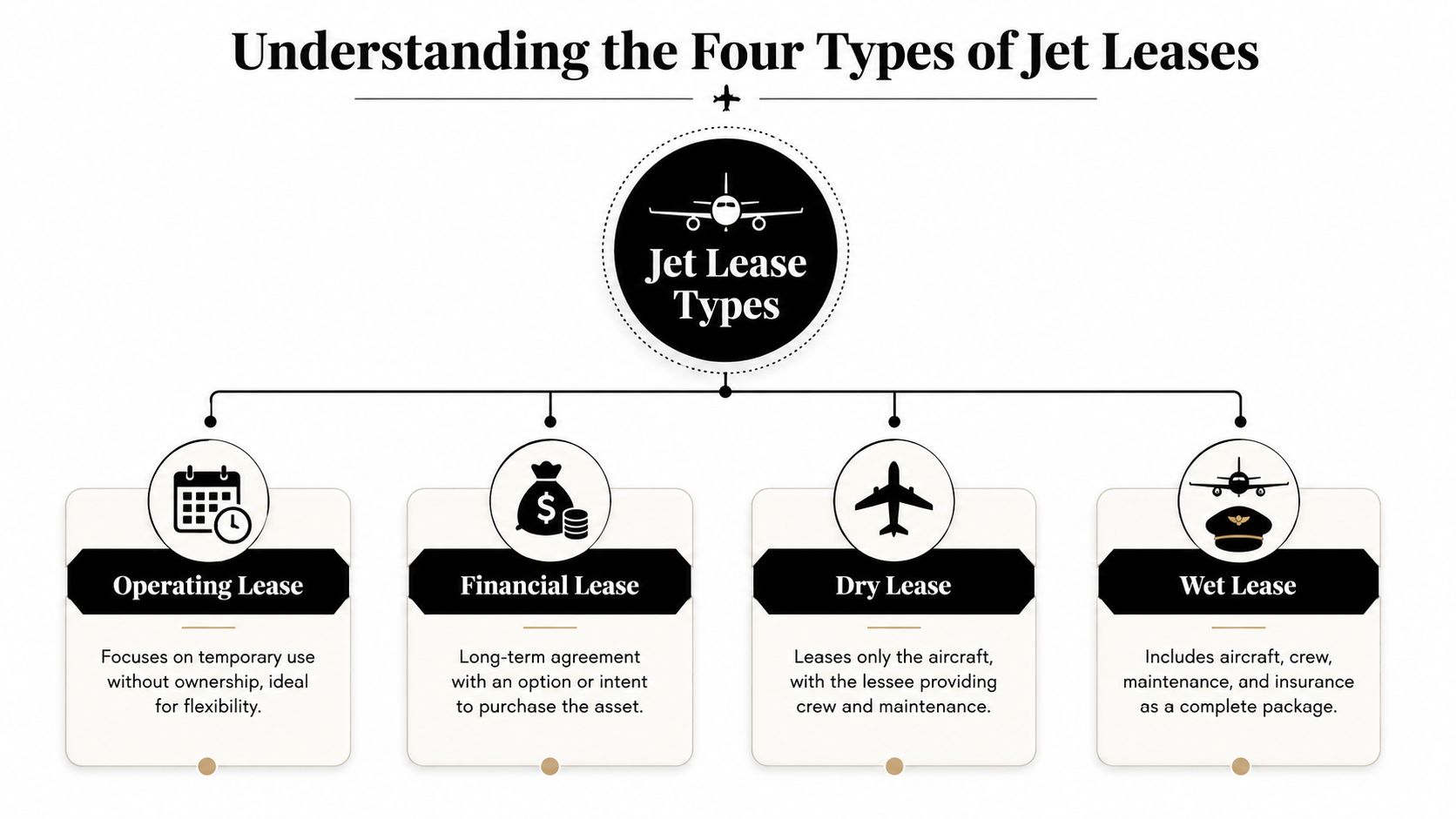
A wet lease includes the aircraft plus crew, maintenance, and insurance. In aviation shorthand, people often refer to that package as ACMI. This is the easier entry point for clients who want access without building an operational structure around the aircraft.
A dry lease gives you the aircraft only. You take on significant operational duties. That means securing pilots, arranging maintenance oversight, carrying insurance, and handling the day-to-day responsibilities that many first-time lessees wrongly assume are included.
Here's the blunt version:
- Wet lease: Better for clients who want simplicity and less operational burden.
- Dry lease: Better for experienced users who already have aviation management capability or want direct control.
- Wrong choice: Taking a dry lease because the base rate looks better, then discovering you've leased a headache.
A cheap dry lease is often expensive by the time you've added people, compliance, insurance, and downtime risk.
The financial split between operating and finance leases
Now separate that operational issue from the financial one.
An operating lease is focused on access and temporary use. You lease the aircraft for a defined period, return it at the end, and typically don't approach the arrangement as a path to ownership. This is the cleaner structure for clients who want flexibility and don't want the transaction to behave like a purchase substitute.
A finance lease is longer-term and much closer in spirit to acquisition financing. It's the right structure only when the lessee wants a longer commitment and is comfortable with a more ownership-like economic posture.
A simple way to think about it:
| Lease type | Best fit | Main benefit | Main risk |
|---|---|---|---|
| Wet lease | Client wants turnkey access | Convenience | Less control |
| Dry lease | Client wants direct control | Customization | More responsibility |
| Operating lease | Client wants use, not ownership | Flexibility | Limited equity-style upside |
| Finance lease | Client wants long-term asset alignment | Ownership-like economics | Higher commitment |
How to choose without overcomplicating it
Most prospective lessees don't need all four options. They need the right filter.
Choose based on these priorities:
Operational simplicity
If you don't want to manage pilots, insurance, and maintenance planning, eliminate dry leases first.Control preference
If having your own crew standards and operating decisions matters, wet leasing may feel too restrictive.Balance sheet mindset
If you want aircraft access without ownership-style economic exposure, lean toward an operating lease.Long-horizon commitment
If your travel profile is stable for years and the asset matters strategically, a finance lease may deserve discussion.
Clients get into trouble when they negotiate rate before structure. That's backwards. Structure determines obligation. Obligation determines cost.
The True Cost of Leasing a Private Jet
The advertised lease payment is not the cost of leasing a private jet. It's the entry point.
The actual cost lives in a stack of fixed and variable obligations that many clients don't model properly until after signature. That's why lease decisions should be built from the bottom up, not from the monthly headline number down.
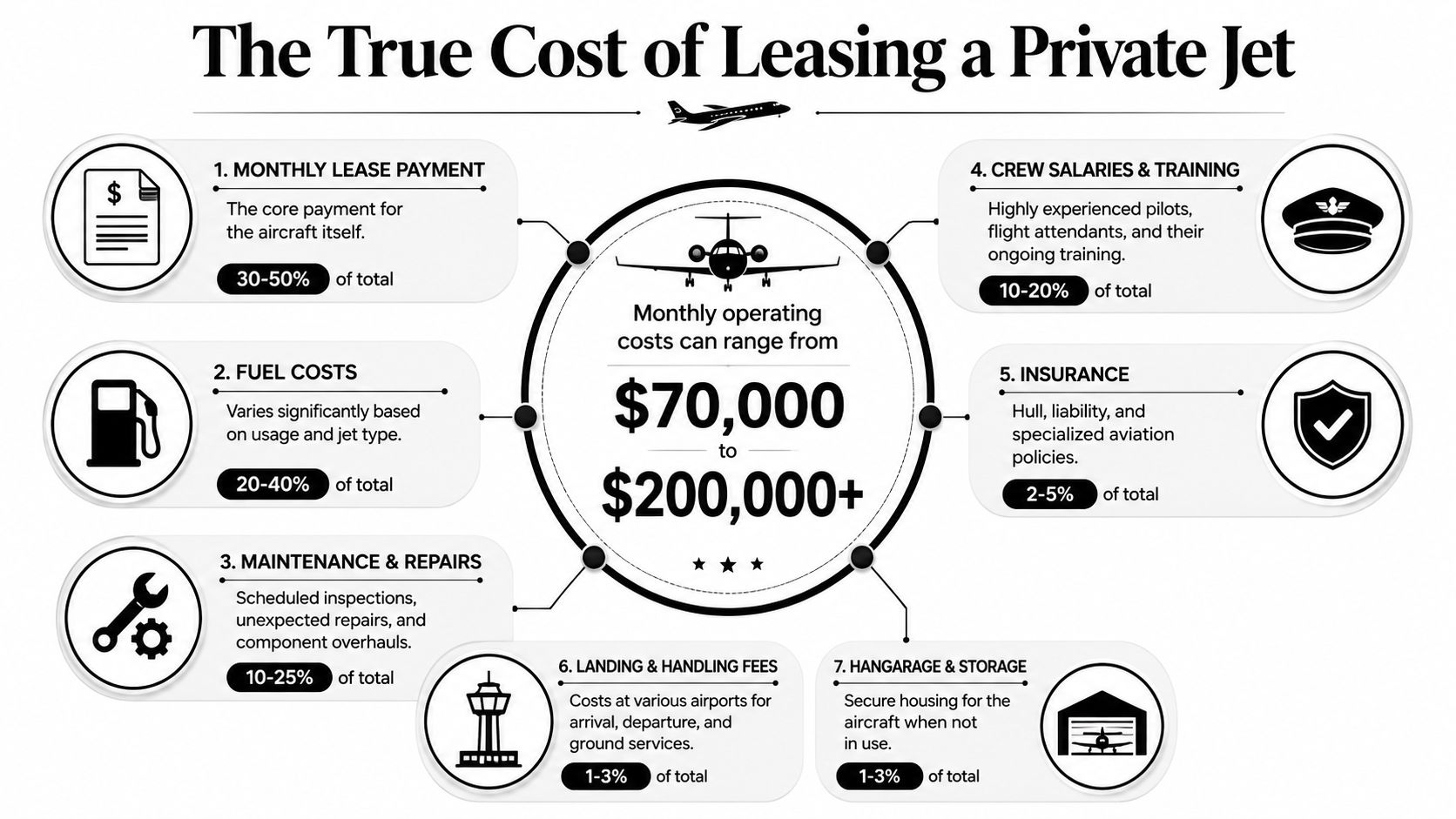
A visual breakdown helps before you get into the details.
The fixed costs that don't care whether you fly
In a dry lease, the lessee is responsible for major cost categories that many newcomers underestimate. According to JetVice's dry lease cost breakdown, hull and liability insurance runs from $30,000 to $150,000 annually, hangar storage runs from $3,000 to $10,000 per month, and annual crew salaries and simulator training run from $250,000 to $500,000 per year. The same analysis states that the monthly lease payment is typically 0.75% to 1.5% of the aircraft's value, and hourly operating costs can reach $5,500 to $9,000.
Those aren't side costs. They are the cost structure.
If you want a broader sense of how private aviation expenses stack up beyond the lease itself, this private jet cost breakdown on Haute Jets Journal is a useful companion read.
What the monthly payment hides
Clients love to focus on lease rate because it feels comparable. It isn't. Two leases with similar monthly pricing can produce very different real-world outcomes depending on:
- Aircraft age and maintenance profile: Older aircraft may look cheaper until reserves and downtime enter the picture.
- Base location: An aircraft far from your primary departure point can become a billing problem immediately.
- Crew structure: Experienced crew, recurrent training, and positioning all add up.
- Insurance terms: Coverage quality matters as much as premium amount.
- Storage and support: Hangarage, handling, and support infrastructure are not optional.
Here's the practical issue. A lease quote can look elegant because it strips complexity from the first conversation. Then the complexity comes back as separate invoices.
The hidden cost most buyers miss
The most consistently ignored cost in leasing is repositioning.
If the aircraft isn't based where you need it, you can pay to move that asset before your useful lease experience even begins. That cost can distort the economics of the whole transaction, especially on shorter lease terms or schedules with limited route concentration.
This video offers a useful primer on the broader economics around private aircraft access before you commit to a structure that may be more rigid than you need.
Build your lease model this way
If I'm advising a client, I want to see the cost stack in this order:
Base lease obligation
The recurring payment for the airframe itself.Operational labor
Pilots, cabin crew if needed, training, travel, and scheduling support.Protection and housing
Insurance and hangarage.Per-flight variable cost
Fuel, engine reserves, maintenance reserves, airport charges, and handling.Positioning and exit exposure
The costs people skip, then regret.
Advisor's view: If a lease proposal doesn't show repositioning assumptions, maintenance reserve logic, and return-condition expectations clearly, it's incomplete.
A lease only looks efficient when the asset sits where you need it, the mission profile fits the aircraft, and the contract reflects how you'll use it. If those three things don't align, the lease turns into a premium-priced compromise.
Leasing vs Other Private Aviation Models
Leasing has its place, but it's only one way to solve the private aviation problem. The better question is not “Can I lease?” It's “Which model matches the way I fly?”
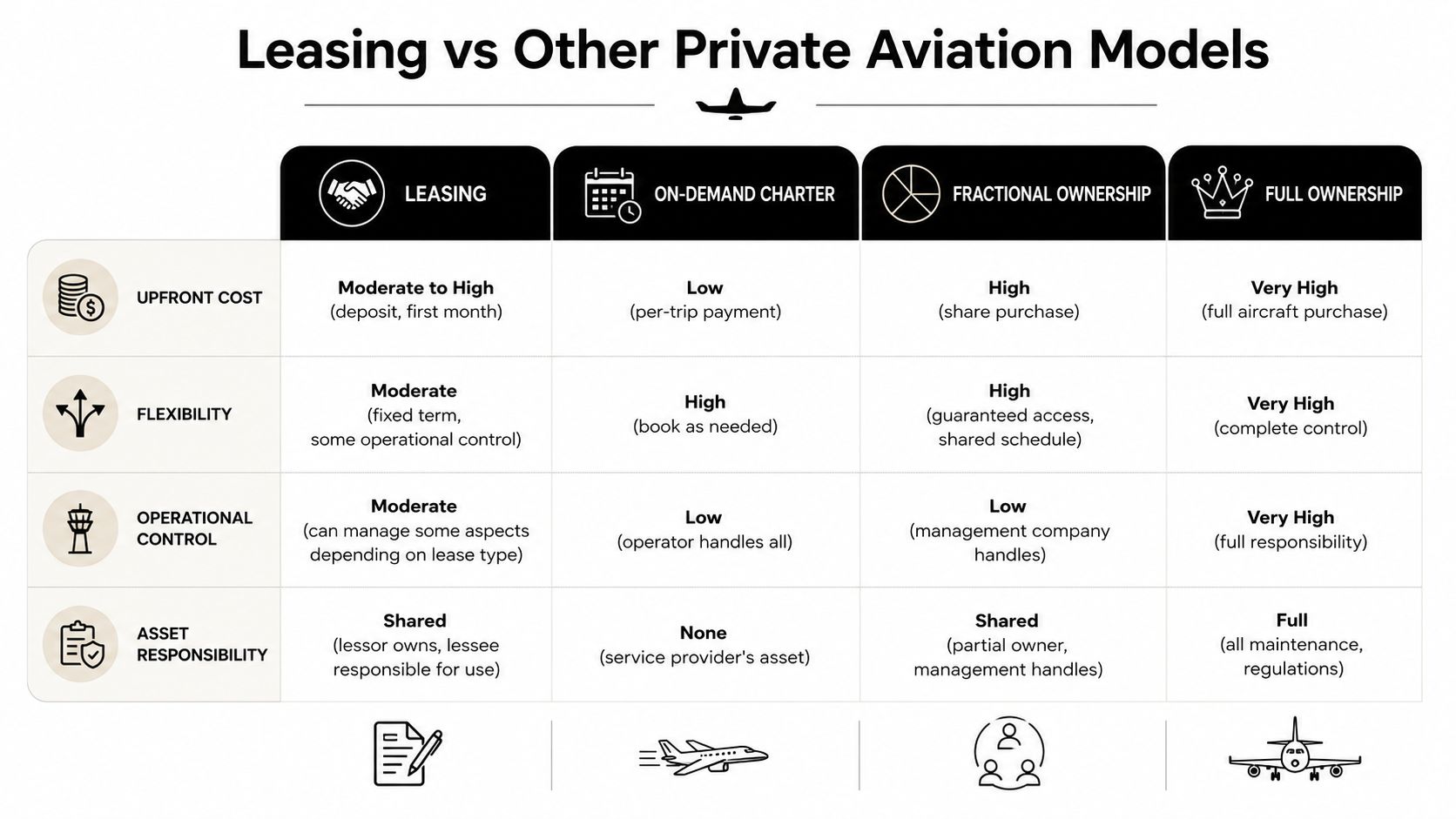
That answer changes fast once you compare commitment, transparency, and usage pattern side by side.
Where leasing wins and where it doesn't
Leasing works best for a client who flies often enough to justify fixed cost and predictability. It starts to lose its appeal when the schedule varies, passenger count changes trip to trip, or mission lengths swing across aircraft categories.
According to Fractional Jet Ownership's comparison of leasing and charter economics, leasing becomes economically advantageous over on-demand charter when annual usage exceeds 50 hours on consistent routes. The same analysis notes that below that threshold, charter rates of $2,000 to $14,000+ per hour are typically more cost-effective than carrying a fixed monthly lease payment plus operating costs.
That's the key phrase: consistent routes. Not just flight hours. Consistency.
For readers comparing all major access models, this owning vs chartering private jets guide on Haute Jets Journal adds useful context.
Side-by-side decision table
| Model | Upfront commitment | Ongoing commitment | Operational control | Best for |
|---|---|---|---|---|
| On-demand charter | Low | Pay per trip | Low | Variable travel and low commitment tolerance |
| Jet card | Moderate | Prepaid structure | Low | Frequent flyers who want simplified booking |
| Leasing | Moderate to high | Fixed lease plus operating obligations | Moderate to high, depending on structure | Repeat routes and predictable demand |
| Fractional ownership | High | Shared ownership economics | Low to moderate | Users who want access with management support |
| Full ownership | Very high | Full asset responsibility | High | Clients who want maximum control and accept maximum burden |
The transparency advantage of charter
The biggest advantage of charter isn't just flexibility. It's clarity.
You pay for a mission. You select an aircraft suited to that mission. You don't carry idle fixed cost when plans change. That matters more than people think, especially for clients who assume future flight volume will remain steady and then watch it soften.
Charter is usually the better choice when:
- Your routes move around: One month may call for a light jet, the next for a heavy cabin.
- Your volume is uneven: Busy quarter, quiet quarter, then a burst of event travel.
- You don't want operational responsibility: You want flying solved, not managed.
- You value pricing visibility: Per-trip economics are easier to audit than layered lease economics.
Fractional and ownership sit in different lanes
Fractional ownership appeals to buyers who want more guaranteed access than charter but don't want to run an entire aircraft. Full ownership fits clients who need maximum control and can justify the capital and management burden.
Leasing sits between those poles, but that middle ground isn't automatically attractive. It only works when your usage pattern is steady enough to absorb fixed cost and your team is comfortable with the operational reality that comes with controlling a dedicated asset.
If you're still guessing at next year's flight profile, don't lease. Uncertainty and fixed aviation cost are a bad combination.
My view is simple. If you fly heavily on repeat missions and care about aircraft continuity, leasing deserves serious analysis. If your travel demands change often, on-demand charter remains the cleaner answer.
Navigating the Leasing Process and Timeline
A lease goes wrong long before the first flight. It goes wrong when a client skips due diligence, rushes aircraft selection, or treats the contract as paperwork instead of risk allocation.
The process itself isn't mysterious. It's just unforgiving.
Start with the mission, not the aircraft
It's common to begin with a favorite model. That's a mistake. Start with how you fly.
List your typical city pairs, passenger count, baggage profile, runway constraints, notice requirements, and whether overnight aircraft positioning is common. That tells you what kind of aircraft fits. It also tells you whether leasing is even the right model.
Your first phase should answer these questions:
- How predictable is your annual use
- Do you need one aircraft type or multiple
- Will you accept a fixed term if your schedule changes
- Who will oversee the lease from your side
If no one on your team can own that process, bring in an advisor before you source aircraft.
Sourcing and diligence take longer than people expect
Once the mission is clear, shortlist aircraft that fit the profile and the intended lease structure. Then do the work clients most want to skip: records, maintenance status, operational history, and return-condition assumptions.
This phase should include:
Aircraft shortlist
Focus on fit, not vanity. A respected midsize aircraft that matches your route profile beats an oversized cabin you rarely use properly.Document review
Maintenance logs, inspection status, engine program details, and deferred items matter.Physical and technical inspection
Never rely on marketing summaries. Verify the aircraft's real condition.Operational review
If it's a dry lease, confirm how crew, management, and compliance will be handled from day one.
The contract stage is where economics change
The letter of intent creates momentum. Momentum is dangerous if the economics haven't been pressure-tested.
At negotiation, focus on the terms that decide your downside:
- Usage limitations
- Maintenance obligations
- Return condition
- Early termination rights
- Positioning responsibility
- Default triggers
Clients often negotiate monthly rate hardest and everything else softly. That is exactly backward.
The return clause can matter more than the lease rate. One bad exit provision can erase the savings you thought you negotiated.
Expect a real timeline
A disciplined lease process usually takes time because aircraft, records, legal review, and operational setup all need scrutiny. Rushing usually means the lessee absorbs ambiguity that should have been priced or negotiated out.
A realistic mindset is better than a rushed target. If someone tells you they can make a complex private jet lease feel frictionless, ask what they're skipping.
Key Legal and Contractual Considerations
Most lease disputes don't begin with bad intent. They begin with vague drafting.
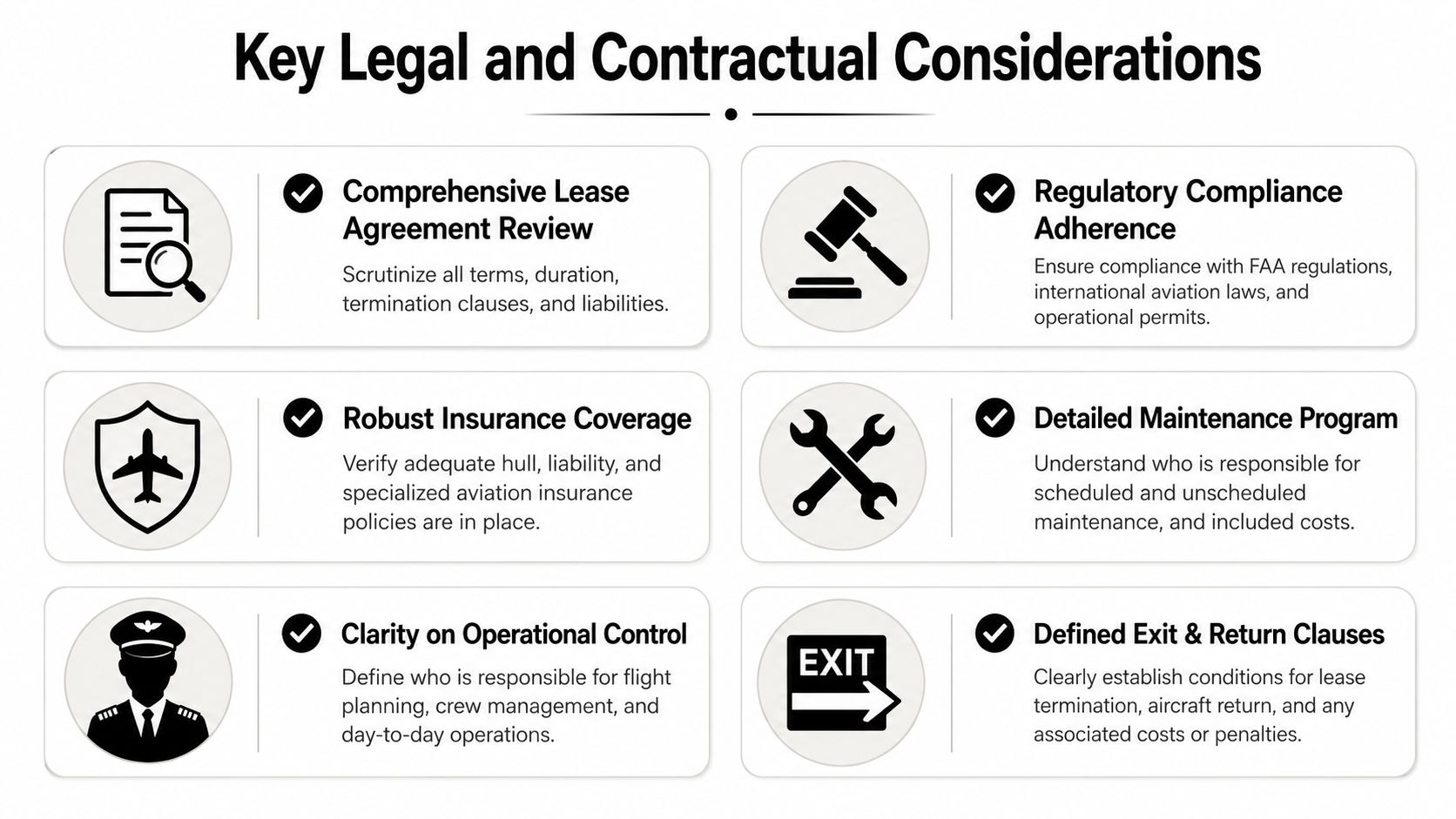
That's why the legal review in a private jet lease isn't just a final check. It's the part where the economic reality of the deal becomes enforceable. If the contract is sloppy, your exposure is real even if the relationship starts well.
The lease termination clause matters more than most people realize
The clause I care about first is the lease termination provision.
According to Global Jet Capital's guidance on aircraft acquisition questions, a critical and often overlooked issue is the lease termination clause because it dictates residual value mechanics. That same guidance notes that short-term leases can embed a hidden 20% to 30% repositioning depreciation cost, which means a weak exit strategy can cost far more than a slightly higher monthly rate on a better-structured asset.
That's the center of the whole decision. People obsess over getting into the lease and barely think about getting out of it.
Clauses you need to pressure-test
A strong review doesn't just confirm that a clause exists. It asks how that clause behaves under stress.
Look closely at these areas:
Operational control
Who is legally responsible for flight planning, crew authority, dispatch decisions, and regulatory compliance?Maintenance responsibility
Who pays for scheduled events, unscheduled repairs, and return-condition discrepancies?Insurance obligations
Who carries what coverage, at what limits, and how are named insured interests handled? If you need context on coverage basics, this private jet charter insurance explainer on Haute Jets is a solid starting point.Usage restrictions
Geographic limits, runway restrictions, crew-day rules, and approval requirements can all affect practical access.Default language
What constitutes a breach, and how quickly can the other party act?Early termination
Can you exit, at what cost, and how are remaining obligations calculated?
Regulatory and tax issues are not DIY work
A lease can also trigger operational distinctions that matter greatly. Private operations and charter operations don't live under the same framework, and any confusion about who controls the aircraft can create compliance problems fast.
Tax and accounting treatment can also change the attractiveness of the structure. I'm not going to pretend this can be handled with a checklist and good intentions. It requires aviation counsel and tax counsel who understand aircraft transactions, not general commercial contract lawyers dabbling in the space.
The return condition trap
The lease ends where many clients finally discover what they signed.
Return condition language decides whether the aircraft has to come back with certain inspections complete, maintenance status current, interiors restored to agreed condition, and positioning handled at your expense. If the lease doesn't define this tightly, the lessor usually has the stronger hand at the end.
Non-negotiable point: Never sign a lease without a written exit scenario that shows who pays for return positioning, maintenance catch-up, and any condition shortfall.
The best lease contracts don't rely on trust. They remove ambiguity before money starts moving.
Conclusion Your Next Steps in Private Aviation
Leasing a private jet is not a status decision. It's a utilization decision.
It works best for a narrow type of client: someone with high, predictable flight volume, repeat routes, and the discipline to manage or supervise the operational and contractual details that come with dedicated aircraft access. If that's you, leasing can deliver consistency and control without the full capital burden of ownership.
But those considering a lease are better served by slowing down and asking harder questions first.
Ask yourself these before you move forward
- Are your routes consistent enough to justify a dedicated aircraft
- Will you fly enough to absorb fixed obligations comfortably
- Do you want operational responsibility or just reliable lift
- Can you evaluate exit terms with the same seriousness as entry pricing
- Would a pay-per-flight model match your travel better
If any of those answers feel uncertain, don't force yourself into a lease because it sounds like the next step up. In private aviation, the wrong structure is more expensive than the wrong airplane.
My direct recommendation
If your travel profile is stable and you already know you want more control over aircraft access, evaluate leasing carefully and negotiate the exit before you negotiate the rate.
If your schedule changes, your mission profile varies, or you want straightforward pricing with no long-term commitment, on-demand charter is usually the smarter move. It's cleaner, more transparent, and far easier to adapt when business or personal travel shifts.
That's the practical divide. Leasing rewards certainty. Charter rewards flexibility.
If you want private aviation access without locking yourself into lease complexity, Haute Jets is the cleaner option. Haute Jets sources from 3,500+ owner-operators across 175 countries, focuses on locally based aircraft to reduce the repositioning costs that often inflate quotes, and offers pay-per-flight access with no memberships or jet cards. For travelers who want the right aircraft, transparent trip-by-trip economics, and vetted Wyvern or Argus-rated operators, it's a smarter way to fly private.