
You're probably in the exact spot where serious private flyers end up. Charter activity has become routine. Your assistant knows the routes, your family knows the FBO rhythm, and finance is starting to ask the obvious question: should you keep booking trip by trip, or lock in something more permanent?
That question matters now because private aviation isn't slowing down. The global private jet charter services market is valued at USD 17.67 billion in 2026 and is projected to reach USD 25.79 billion by 2031, expanding at a CAGR of 7.86%, according to Mordor Intelligence's private jet charter services market analysis. More clients are paying for privacy, control, and time savings. That doesn't mean leasing is automatically the smart move. It means more people are confronting the tradeoff between access and commitment.
On Haute Jets Journal, I'd frame it. Leasing private jets only makes sense when your flying pattern is both frequent and predictable. If your schedule changes, your destinations vary, or your passenger profile shifts from trip to trip, a lease can become an expensive answer to the wrong question.
Is It Time to Move Beyond On-Demand Charter
Frequent charter users often assume the next logical step is a lease. Sometimes that's right. Often it isn't.
What pushes people toward leasing private jets is rarely price alone. It's frustration. They're tired of sourcing aircraft repeatedly, tired of wondering whether the same cabin standard will be available, and tired of paying premium rates during peak periods. They want consistency. They want access. They want fewer moving parts.
The real trigger is predictability
A lease starts to deserve consideration when your travel calendar looks more like a program than a series of trips. Think recurring board meetings, weekly shuttle patterns, seasonal family movements, touring schedules, or a corporate team moving between the same handful of cities. If that sounds like your life, leasing belongs on the table.
If it doesn't, keep your discipline. Don't confuse frequent flying with predictable flying.
Practical rule: If you can't map your next year of travel with confidence, don't sign a lease just because you've had a busy quarter.
There's also a middle ground many clients skip over too quickly. Before you commit to an aircraft for months or years, compare your current charter behavior against alternatives like cards and fixed-access programs. If you're weighing those options, this breakdown of private jet cards vs charters is a useful reality check.
Why this decision is getting harder
Private aviation has matured. More clients now treat it as infrastructure rather than indulgence. That shift is exactly why leasing private jets gets pitched so aggressively. Sellers know that once a client is flying regularly, the idea of “dedicated access” sounds rational.
The issue is that a lease isn't just access. It's a financial commitment with operational consequences. You're not merely buying convenience. You're buying exposure to fixed costs, contract terms, downtime risk, inspection issues, insurance conditions, and a defined exit path that may not suit you later.
The right question isn't “Can I afford a lease?”
It's “Will this commitment still make sense when my schedule changes?”
Decoding Private Jet Lease Agreements
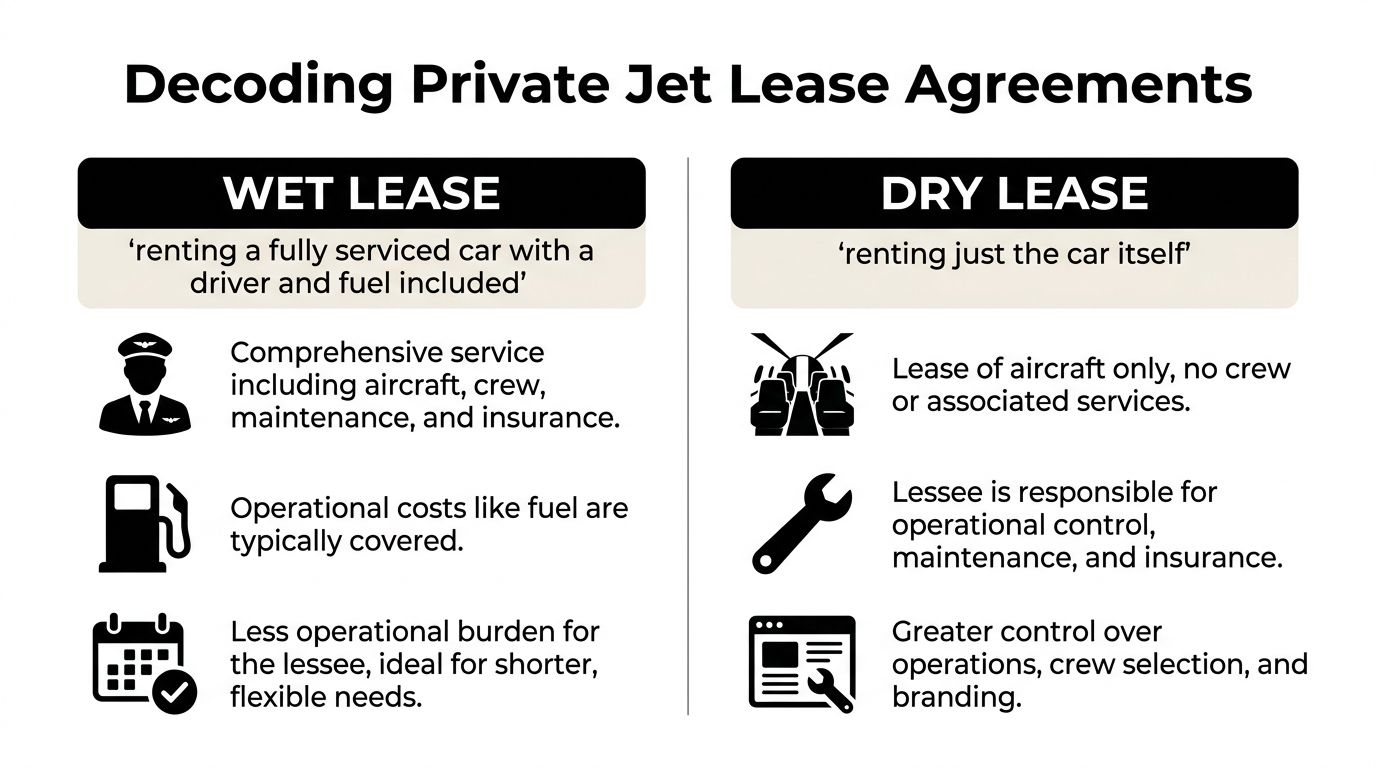
Individuals discussing leasing private jets blur together wet lease and dry lease structures. That's a mistake. The difference determines who controls the aircraft, who pays operating costs, and who gets surprised later.
Wet lease means convenience
A wet lease is the all-inclusive version. This arrangement is akin to renting a fully serviced villa. The aircraft comes with crew, maintenance support, and insurance. In many arrangements, the operating framework is handled for you. That reduces friction for the lessee and keeps the experience closer to premium charter, just with a longer commitment and a more structured agreement.
Wet leasing is usually the cleaner option for clients who want access without building their own aviation management capability. You pay for that convenience, of course. You're outsourcing complexity.
Dry lease means responsibility
A dry lease is more like renting an unfurnished property. You're getting the aircraft itself, and then the burden shifts to you. You're responsible for the operating setup, crew coordination, maintenance oversight, insurance, and the practical realities that make the airplane usable.
That's where many first-time lessees underestimate the commitment. In a dry lease, monthly payments for a light jet can run from $75,000 to $150,000, but that excludes fuel at $300 to $700 per flight hour and maintenance reserves of $100,000 to $500,000 annually, as outlined by Element Aviation's guide to leasing.
Here's the plain-English version:
- Aircraft only: You're paying for access to the asset, not a finished travel solution.
- Operational control: Someone still has to manage the flying legally and safely.
- Variable expenses: Fuel and maintenance don't care whether your schedule was lighter than expected.
- Administrative burden: Contracts, compliance, insurance, inspections, and scheduling all need active management.
A dry lease gives you control, but control is expensive when you don't have an internal flight department.
Read the lease like a liability document
Most clients focus on monthly rent. Astute clients focus on risk transfer. That means looking at the agreement the way a legal team would look at an operating asset, not the way a traveler looks at a cabin upgrade.
If you want a useful framework for how legal teams think about these documents, this article on equipment lease contract management for legal teams is worth reading. The asset is different, but the discipline is the same. Definitions, obligations, inspection standards, default clauses, and termination rights matter more than marketing language.
My recommendation
If you don't already have aviation counsel and operational support, avoid a dry lease. It looks more customizable on paper, but the hidden workload is where clients get punished. A wet lease costs more upfront, yet it's often the safer route for people who need reliability without building an internal aviation operation.
The Full Financial Picture of a Private Jet Lease
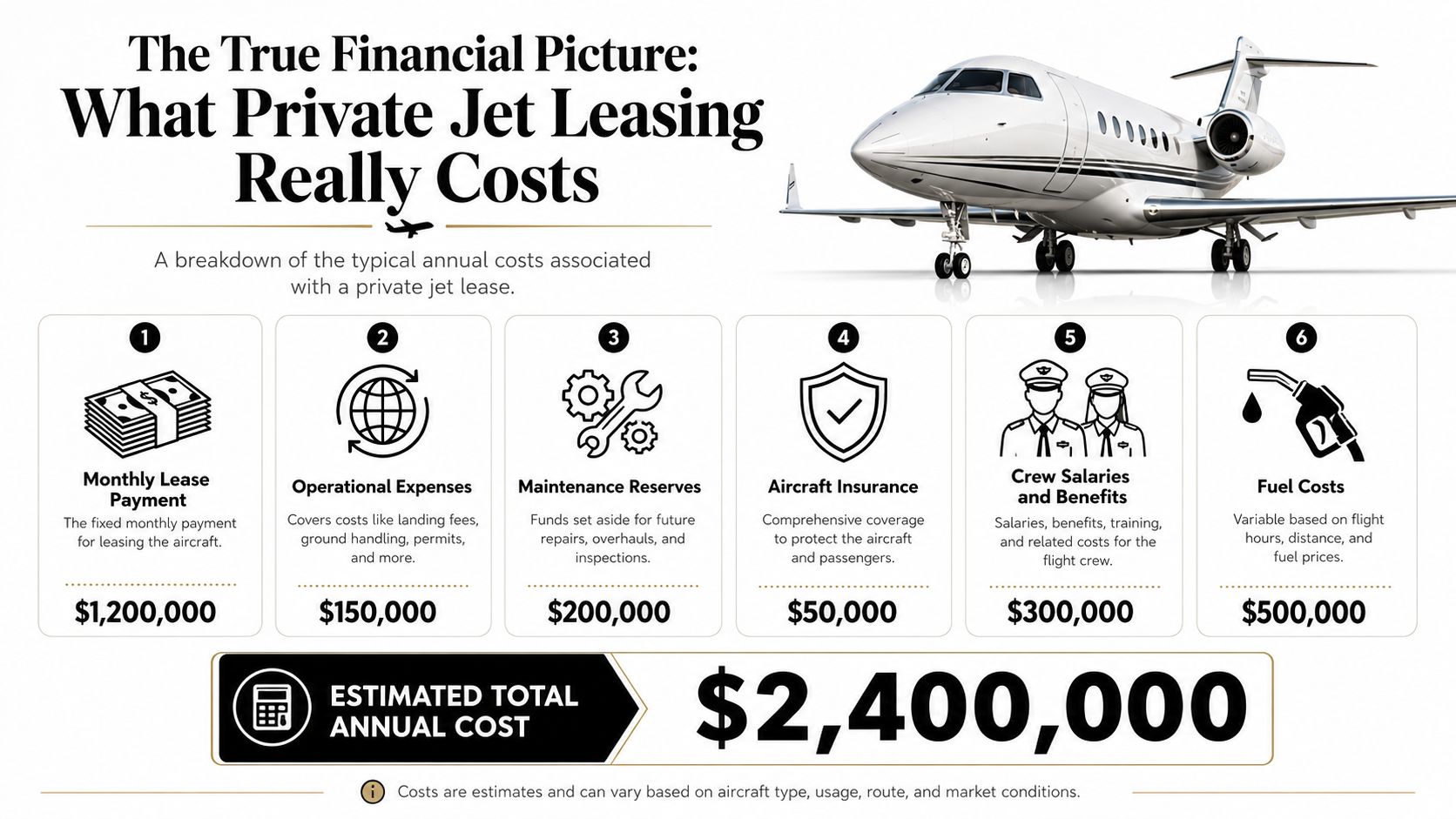
The advertised lease payment is the least interesting number in the deal. The actual number is the total cost of commitment.
Start with the capital you lock up
Leasing private jets requires cash before the aircraft flies a single mission. Security deposits typically run from 15% to 20% of the total lease cost, and the economics only start to make sense when annual usage rises into the 150 to 400 hour range, according to Stratos Jets' analysis of private jet lease cost.
That alone should stop casual buyers.
A deposit on a lease isn't building equity. It's capital tied to a contract. Then the monthly clock starts. For larger cabins, monthly payments can exceed $400,000 regardless of whether you fly the aircraft. That fixed-cost pressure is why low-utilization lessees almost always regret the decision.
The monthly payment is only the first line item
A serious lease budget needs more than rent. At minimum, your model should account for:
- Security deposit tied up at signing
- Base lease payment due every month whether the aircraft is heavily used or not
- Fuel exposure if the structure pushes variable operating cost to the lessee
- Maintenance reserves for inspections, parts, and eventual heavy events
- Insurance premiums that can change with usage and aircraft type
- Hangar and storage costs
- Crew costs or management costs, depending on the structure
- Contract-end obligations, especially return condition disputes
If you need a clean way to pressure-test these inputs, a private jet cost calculator guide helps frame what should go into the model before you sign anything.
Your breakeven is utilization, not ego
Clients often lease because they want certainty. Fair enough. But certainty is expensive when the aircraft sits idle.
Here's the economic truth. Charter is variable cost. Leasing is fixed cost plus variable cost. If your annual flight hours are low or inconsistent, charter wins because you're buying mobility only when you need it. Once your utilization becomes high enough and stays high enough, the fixed cost of the lease can be justified by dedicated access and operational continuity.
That's why the 150 to 400 hour annual viability range matters. It isn't a marketing threshold. It's the line between a strategic aviation tool and an underused luxury liability.
Advisory view: If your team can't prove likely utilization in writing, assume the lease will cost more than expected.
Build the model backwards
Don't start with the aircraft. Start with the missions.
Use a simple sequence:
- List your actual routes from the past year.
- Separate predictable travel from opportunistic travel.
- Estimate committed annual hours you're confident you'll fly.
- Assign aircraft requirements based on those missions, not aspiration.
- Stress-test the downside if usage drops.
That last step is where smart clients protect themselves. If your travel falls off, a charter client books less. A lessee keeps paying.
Leasing vs The Alternatives A Head to Head Comparison
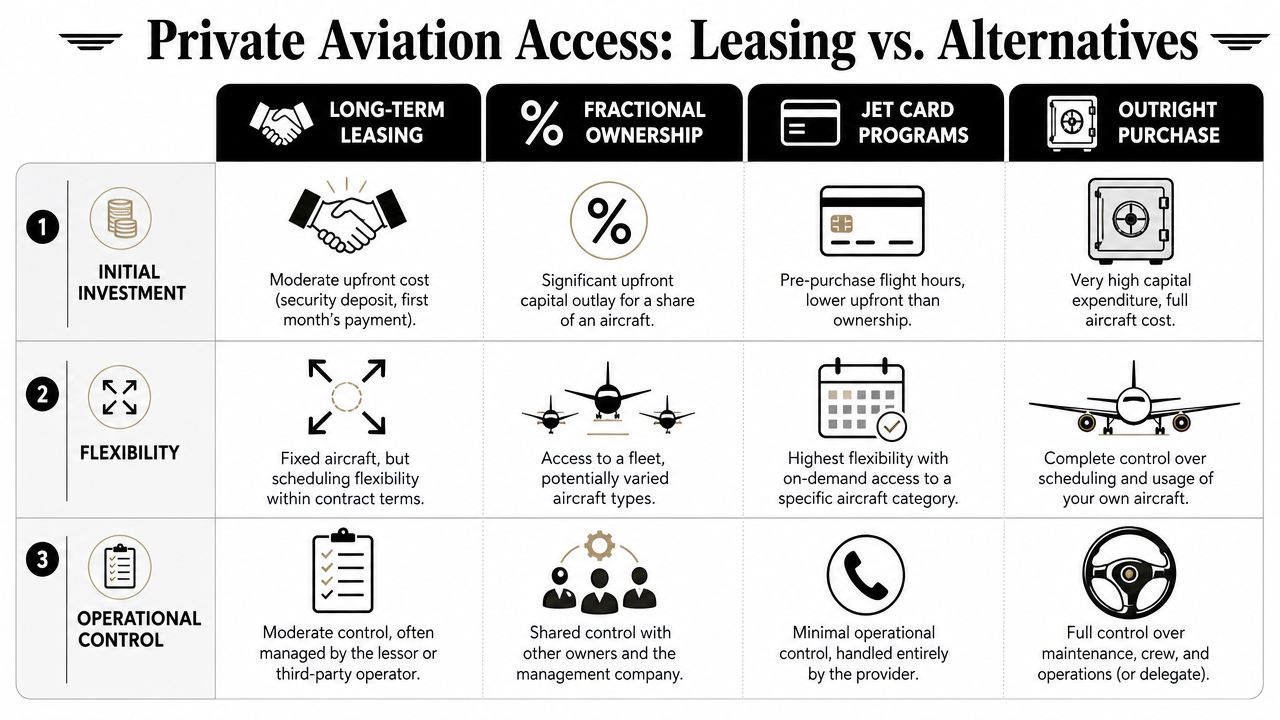
The best private aviation structure depends on how much flexibility you need and how much financial dead weight you're willing to carry. Leasing private jets can work well, but it isn't the default winner.
Four ways to access private aviation
On-demand charter is the cleanest option for clients with changing schedules. You book what you need, when you need it, and you don't carry a long-term aircraft obligation.
Jet cards appeal to travelers who want prepaid convenience, but they can hide structural inefficiencies if the provider has limited sourcing flexibility.
Fractional ownership gives you a share of an aircraft program with structured access. It suits people who want more continuity than charter, but less operational burden than full control.
Leasing sits in an awkward middle ground. It can give you dedicated access and consistency, but without the asset ownership of a purchase. That can be useful. It can also leave you paying heavily for an aircraft that no longer matches your flying pattern.
The hidden problem with access models that aren't truly flexible
One cost issue deserves more attention. On-demand charter models can eliminate repositioning fees, which traditional brokerage and jet card programs can inflate by 20% to 40% when aircraft must be moved, as noted in Jettly's market overview of private jet fleet numbers and trends.
That matters because many clients assume prepaid or structured access automatically means better pricing. It doesn't. If the aircraft isn't already near your departure point, someone pays to move it. Often, that someone is you.
Private Aviation Access Models Compared
| Criteria | On-Demand Charter | Jet Card | Fractional Ownership | Leasing |
|---|---|---|---|---|
| Upfront capital | Low. Pay per trip | Moderate. Prepaid hours or deposits | High. Capital commitment for a share | Moderate to high. Deposit plus ongoing contract |
| Commitment term | Minimal | Program-based | Multi-year | Fixed lease term |
| Aircraft flexibility | High. Match aircraft to each mission | Moderate. Usually by category | Moderate to high within provider fleet | Low to moderate. Often tied to one aircraft or setup |
| Operational responsibility | Minimal | Minimal | Shared with program manager | Moderate to high, especially in dry lease |
| Cost predictability | Trip-based | More predictable than charter | Structured but layered | Predictable base cost, less predictable total cost |
| Risk of underuse | Low | Moderate | Moderate | High |
| Best for | Variable schedules | Frequent users who want simplified booking | Clients wanting program access | High-use, predictable flyers |
The right structure is the one that matches your schedule, not the one that flatters your status.
My blunt view
Choose on-demand charter if your routes vary, your annual hours fluctuate, or you want the freedom to select the right aircraft for each trip.
Choose a lease if your flying is heavy, repetitive, and stable enough that dedicated access solves a real problem.
Be careful with jet cards if you haven't examined repositioning exposure and sourcing limits.
Consider fractional ownership only if you value program consistency enough to tolerate shared-control economics.
What you shouldn't do is lease private jets because you're tired of making booking decisions. That's not a financial reason. That's fatigue.
Your Pre-Lease Due Diligence Checklist
Most expensive lease mistakes happen before the first flight. Not after.
The pattern is predictable. A client falls in love with availability, signs quickly, and only later discovers that the contract return standard is strict, the inspection process is uneven, the operator setup is weak, or the exit path is ugly.
To keep that from happening, use a disciplined checklist.
Start with the practical roadmap below.
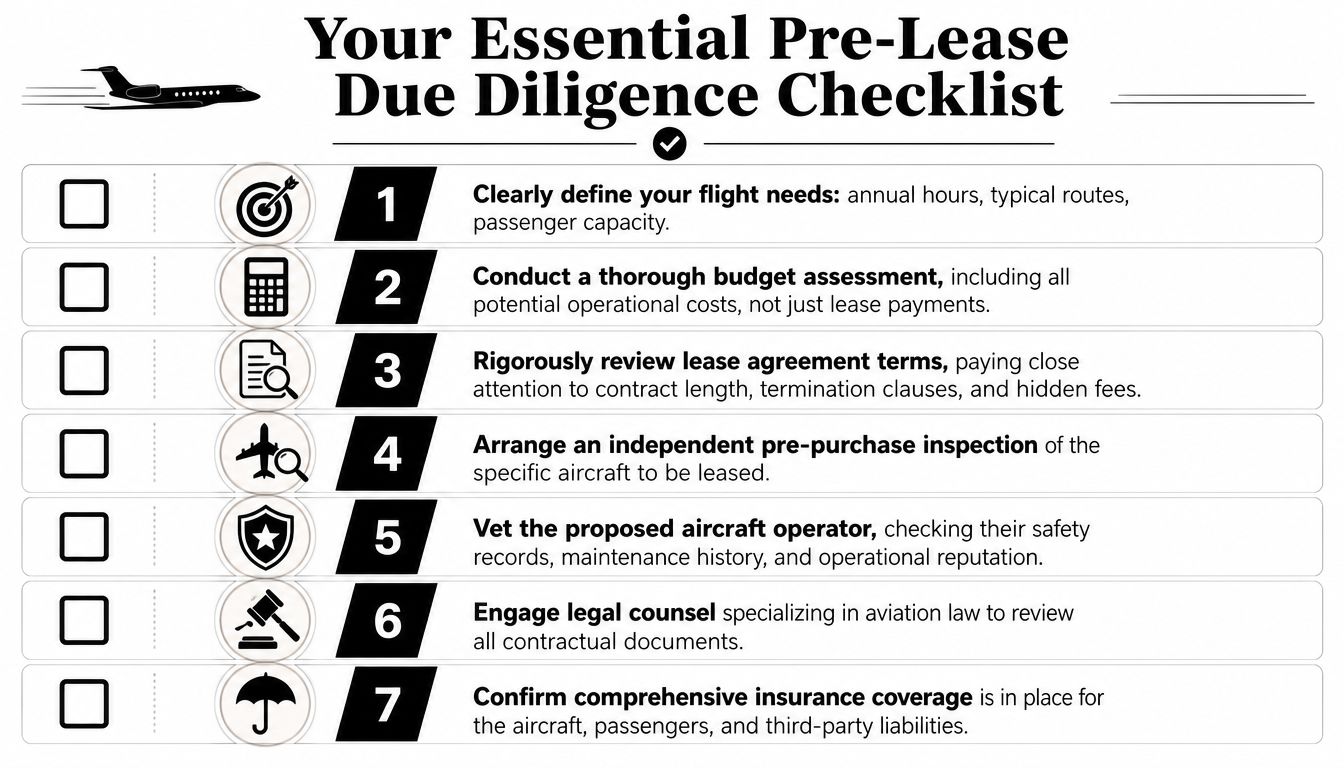
The seven checks that matter
Define the mission clearly
Write down annual hours, common city pairs, passenger count, baggage needs, pet travel, and whether you need transcontinental, regional, or mixed capability. Vague travel assumptions lead to the wrong aircraft.Model the full budget
Don't stop at lease payment. Include every recurring obligation and every likely variable cost. The wrong model will make almost any lease look reasonable.Interrogate the lease terms
Pay attention to duration, usage restrictions, return conditions, damage provisions, maintenance responsibilities, scheduling rights, and default language.Order an independent inspection
Never rely on seller representations alone. Physical condition, maintenance status, cabin wear, and record quality all affect your financial risk.
First-time acquirers often miss two points that later become expensive: exit strategy and inspection standards. Global Jet Capital's questions to ask before acquiring a private aircraft highlights how often those oversights create avoidable financial problems.
A short video like the one below is useful if you want a practical mindset before reviewing documents and operators.
What people skip and regret
The next items aren't glamorous, which is why they get skipped.
- Operator vetting: You need to know who will manage the flying, what their maintenance culture looks like, and how they handle disruptions.
- Insurance review: Confirm aircraft, passenger, and third-party liability coverage in writing.
- Legal review: Aviation counsel should review every key document, not your general commercial attorney alone.
- Return condition planning: Define now what “acceptable condition” means at lease end.
If you're evaluating operators, this guide to Wyvern and Argus private aviation safety ratings is useful because it gives you a baseline for what credible third-party oversight should look like.
Ask how you get out before you ask how quickly you can start.
My recommended order of operations
Use this sequence:
- First: Validate your actual usage.
- Second: Shortlist aircraft types that fit those missions.
- Third: Review operator quality and legal structure.
- Fourth: Inspect the aircraft and records.
- Fifth: Negotiate termination, return, and remedy language.
- Last: Sign.
Clients usually reverse that order. That's why they end up negotiating from excitement instead of an advantage.
Navigating Safety and Regulatory Compliance
Safety is where wealthy clients often assume someone else has handled the hard part. That assumption can be dangerous.
If you're leasing private jets, you need clarity on who has operational control, which regulatory framework applies, and which operator is carrying the safety burden. In practice, many discussions turn to the distinction between private non-commercial operations and charter-style commercial operations. The labels matter because responsibility, oversight, and liability follow them.
Operational control is not a technical detail
A wet structure usually keeps more of the operational complexity with the professional operator. A dry structure can shift far more responsibility toward the lessee and the operating arrangement they establish. That's not just paperwork. It affects who manages crew standards, maintenance planning, insurance coordination, and legal compliance.
If you don't understand who controls the aircraft on paper and in practice, you don't understand the risk.
Third-party safety validation should be mandatory
My standard is simple. Only work with operators that carry recognized third-party safety credentials such as Wyvern Wingman or Argus Gold/Platinum. Those benchmarks aren't decorative. They give you an external check on training, systems, oversight, and operational discipline.
That doesn't replace legal review or internal due diligence. It gives you a higher floor.
Safety in private aviation isn't about the aircraft brochure. It's about the operator behind the trip.
What to demand before signing
Ask for the following before you get deep into final negotiation:
- Operator identity and responsibility: Know exactly who flies and manages the aircraft.
- Safety audit status: Require current Wyvern or Argus documentation.
- Maintenance governance: Confirm how inspections, recordkeeping, and defect handling are managed.
- Crew standards: Verify training, recency, and operational supervision.
- Insurance confirmation: Make sure coverage matches the structure of the lease and the way you'll use the aircraft.
A well-structured lease can be safe. A vague one can leave dangerous gaps. Don't let a polished cabin distract you from the operating reality.
Leasing FAQs For The Discerning Traveler
Is a private jet lease tax-efficient for business use
Sometimes, yes. Sometimes, not at all. The tax treatment depends on who is leasing, how the aircraft is used, how personal and business travel are allocated, and how the agreement is structured. Don't sign based on generic “business aviation tax advantages.” Get aviation-savvy tax counsel to model the actual use case before execution.
What happens if I need to terminate early
Usually, it hurts. Early termination is one of the most underappreciated financial risks in leasing private jets. The lessor negotiated for predictable revenue. If you want out early, expect resistance, penalties, settlement pressure, or a difficult negotiation around replacement use and return condition. If there's one clause to negotiate aggressively at the outset, it's this one.
Can I pay for a private jet lease with cryptocurrency
In some cases, yes, but it's still not standard. About 15% to 20% of new private aviation clients in markets such as Miami ask for crypto payment options, yet most lease agreements still rely on traditional banking because of volatility and tax-reporting complexity. Pilot crypto-escrow structures are starting to emerge. That means demand is real, but contract infrastructure still lags. If you want to use digital assets, insist on clear payment timing, valuation mechanics, escrow terms, and compliance review before funds move.
The bottom line is straightforward. Leasing can be a smart tool for the right flyer. It becomes a bad deal quickly when clients underestimate fixed costs, operational burdens, and exit friction.
If you want private aviation access without long-term capital lockup, Haute Jets offers a cleaner option. Haute Jets sources from 3,500+ owner-operators across 175 countries, focuses on local aircraft sourcing to help avoid repositioning inefficiencies, works only with Wyvern Wingman or Argus Gold/Platinum-rated operators, and lets clients choose the exact aircraft rather than buying into a membership or prepaid card structure. If your schedule demands flexibility more than commitment, that model is usually the smarter place to start.