
You're booking a private charter because time matters, privacy matters, and predictability matters. You want the aircraft where you need it, the crew briefed, the cabin configured correctly, and the ground transfer waiting when you land. What most passengers never ask about is the one protection that matters most if the day goes sideways. Liability coverage.
That omission is expensive.
In private aviation, the polished experience can hide the dividing line between a well-run operator and a risky one. Leather seats, a clean hangar, and a professional-looking quote don't tell you whether the operator's insurance program is strong enough to protect passengers, bystanders, property on the ground, and your own financial position if lawyers start naming everyone connected to a flight.
Liability coverage explained transitions from a generic insurance topic to a practical risk management tool. If you fly privately, especially with family, executives, clients, or household staff, you should treat liability insurance the same way you treat pilot qualifications and maintenance records. It's part of the safety equation, not separate from it.
The Invisible Safety Net of Your Private Charter
A client books a weekend charter from South Florida to Aspen. The aircraft is ideal, the timing is clean, and the operator says all the right things. On the surface, that's enough for most buyers.
It shouldn't be.
The flight itself is only one part of the risk chain. There's movement on the ramp, fueling activity, baggage handling, catering vehicles, crew transport, passenger boarding, and operations inside controlled airport environments where small mistakes can become large claims. If an incident injures a third party or damages someone else's property, the question isn't whether the flight felt luxurious. The question is who pays.
That's what liability coverage does. It stands behind the operator when another person alleges injury, property damage, or financial harm tied to the operation.
Private aviation clients often focus on aircraft quality and scheduling flexibility. The more important question is whether the operator has the financial capacity to defend and pay a serious claim.
For a high-net-worth passenger, that matters for two reasons. First, a weak insurance structure often signals weak overall discipline. Second, when a claim is severe, lawyers cast a wide net. They don't only look at the operator. They look at owners, managers, brokers, trip organizers, and anyone else they think might have money or influence.
An informed flyer doesn't wait for a dispute to learn how the operator was insured. You verify it before wheels up. That's part of buying private aviation properly.
Understanding the Core of Liability Protection
The cleanest way to understand liability protection is to start outside aviation.
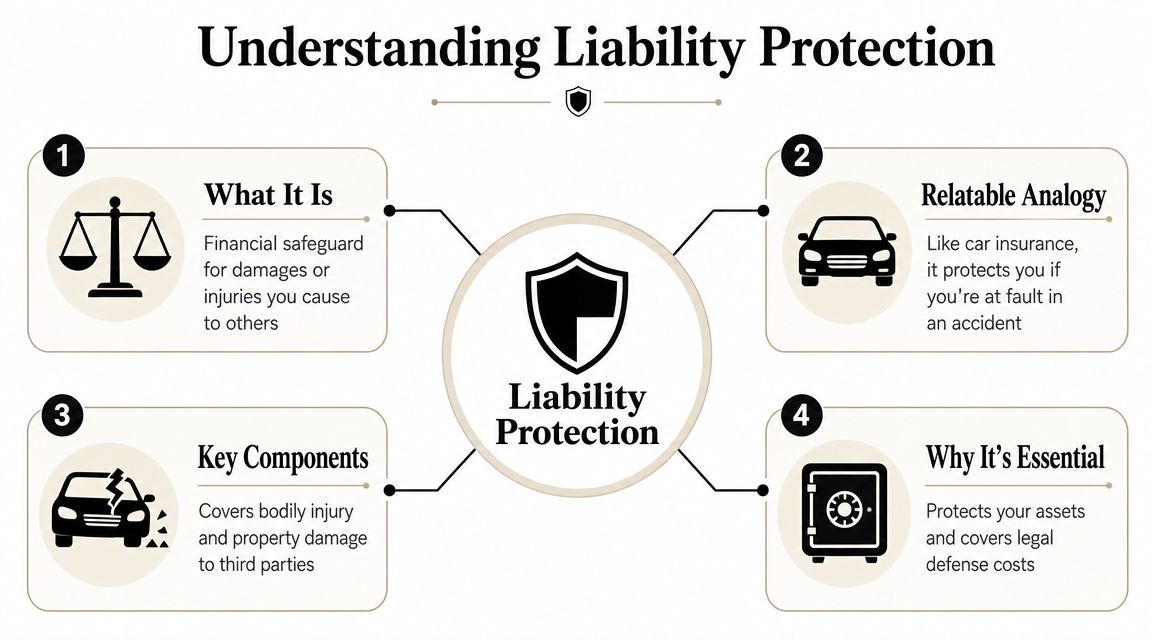
If you carry auto insurance, you already know the basic logic. Liability insurance doesn't repair your own car first. It pays for damage or injury you cause to other people. That same principle applies across major lines of insurance. According to Investopedia's explanation of liability insurance, liability coverage is third-party protection. It pays for injuries, property damage, and legal defense costs owed to others. The same source notes that common U.S. auto minimums are often written as 25/50/25, meaning $25,000 bodily injury per person, $50,000 bodily injury per accident, and $25,000 property damage per accident, while average 2024 claim costs were $28,278 for bodily injury and $6,770 for property damage. That gap is exactly why minimum coverage can fail when a claim turns serious.
What third-party protection means in practice
Core principle: Liability insurance protects your balance sheet from claims brought by other people.
That includes three buckets most clients care about:
- Bodily injury claims for people who say they were hurt
- Property damage claims for things allegedly damaged
- Legal defense costs when attorneys get involved, even before fault is fully sorted out
The legal side matters more than most passengers realize. A dispute starts with allegations, not conclusions. If you want a plain-language overview of how legal responsibility begins with a duty of care analysis, Mattiacci Law's discussion of duty of care in personal injury cases is a useful companion read.
Why aviation raises the stakes
Aviation compresses high values into one event. You have expensive equipment, multiple passengers, airport property, trained crews, and a highly regulated operating environment. That means a single incident can produce several competing claims at once.
Hull insurance and liability insurance are not the same thing. Hull insurance concerns the aircraft itself. Liability coverage concerns what the operation may owe other people.
That distinction is where many charter clients get sloppy. They hear “fully insured” and assume that means broad protection across the board. It doesn't. You need to know what policy responds, who it protects, and whether the limits are built for real-world loss severity rather than paperwork compliance.
Decoding Key Types of Aviation Insurance
Private aviation insurance isn't one blanket product. It's layered. That's a good thing, because different risks need different responses.
Texas Department of Insurance explains that commercial liability coverage is typically layered, and that policy form matters. An occurrence policy responds to injury or damage happening during the policy period regardless of when the claim is filed, while a claims-made policy generally requires timing conditions that can narrow protection. The same guide also notes that umbrella liability can extend above both auto and general liability, which is why multi-layer programs matter for high-severity risk in commercial settings, including aviation-adjacent structures of risk transfer. See the Texas Department of Insurance guide to general liability coverage.
The main coverage buckets
In aviation, I focus clients on four practical layers.
| Coverage Type | What It Covers | Who It Protects |
|---|---|---|
| Third-party liability | Injury or property damage involving people or property outside the aircraft operation itself, such as airport property or people on the ground | The operator, and sometimes other scheduled protected parties depending on policy wording |
| Passenger liability | Claims by passengers or their estates alleging injury, death, or related damages from a covered occurrence | Primarily the operator and insured parties named in the policy |
| Hull insurance | Physical damage to the aircraft itself | The aircraft owner, lender, lessor, or operator depending on insurable interest |
| Excess or umbrella liability | Additional limits above the primary liability layer when a severe claim exceeds the base policy | Insured parties that qualify under the excess structure |
The coverage clients confuse most often
Third-party liability and passenger liability sound similar, but they don't solve the same problem. If a baggage cart strikes a neighboring aircraft, that's a different claim path from a passenger injury allegation after a hard landing or boarding incident.
Hull insurance is the easiest one to misunderstand. It protects the aircraft asset. It does not replace robust liability coverage. An operator can insure the airframe and still carry weak third-party protection.
A charter customer should never hear “the aircraft is insured” and treat that as the end of the inquiry. The aircraft may be insured while the liability structure remains inadequate.
Why excess liability matters
Primary limits are the first layer. Excess or umbrella liability sits above them. For clients who fly with family offices, public profiles, complex corporate structures, or substantial visible assets, that upper layer matters because serious claims don't stop at the first policy number.
A large loss also raises another issue. You want the right parties protected. That's where additional insured status becomes important. If you're being added properly, the certificate and policy language should reflect it. A serious operator won't treat that request as unusual.
My view is simple. If an operator resists transparency around named insureds, additional insured status, or excess layers, move on. There's always another aircraft.
What Are Typical Coverage Limits and Exclusions
The first mistake clients make is asking only whether coverage exists. The second is ignoring the exclusions. Both are dangerous.
Liability insurance is expanding globally because claim severity and litigation complexity are rising. One market projection cited by Fortune Business Insights on the liability insurance market estimates growth from $299.43 billion in 2026 to $460.86 billion by 2034, following a 2025 valuation of $285.92 billion, at a projected 5.5% CAGR. That doesn't tell you what your flight should carry, but it does confirm the broader direction of risk. Liability is becoming more important, not less.

Don't rely on generic “typical” limit talk
You'll often hear market chatter about certain limit ranges by aircraft category. Ignore it unless you're looking at the actual policy or certificate for the specific operator and aircraft involved.
What matters is this:
- Combined single limit tells you the total amount available for a covered occurrence under that liability layer
- Per occurrence language tells you the cap for one event
- Aggregate language, where applicable, tells you the maximum available across claims in a policy period
For private charter clients, the practical question isn't abstract. It's whether the available limit can absorb a serious passenger claim, a ground injury event, or a multi-party lawsuit without leaving someone to chase assets beyond insurance.
Exclusions decide whether the policy actually responds
A glossy certificate can still hide meaningful gaps. Exclusions are where a policy narrows the promise.
Watch for these categories in principle:
- Illegal activity can void or severely restrict coverage
- Intentional acts are generally outside the protection bargain
- War and related hostile risk are commonly carved out or handled separately
- Contractual assumptions of liability may not be covered unless the policy specifically contemplates them
You also need to read the operational conditions. If a flight falls outside approved use, crew requirements, or other underwriting conditions, a claim can become far uglier than the booking conversation suggested.
For readers thinking about layering protection around personal assets, this primer on a Florida personal umbrella policy for asset protection is useful background. Just don't assume a personal umbrella automatically follows you into aviation risk. It often won't.
Before you commit funds, review the operator's governing booking terms as carefully as the insurance evidence. A contract can shift obligations in ways passengers overlook, which is why it's worth reading the charter terms and conditions before confirming a flight.
Why Operator Safety Ratings Dictate Insurance Quality
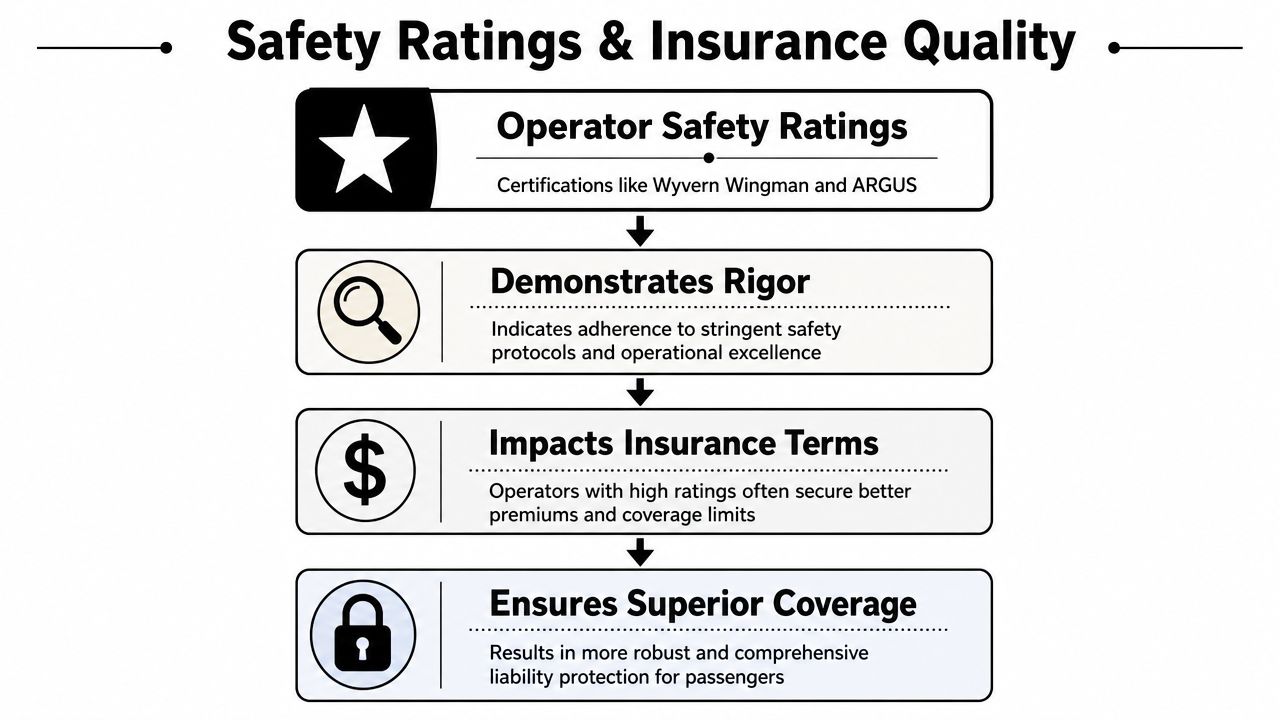
A polished broker deck is not proof of financial protection. Independent safety ratings are more useful because they force operators to maintain discipline that passengers can't observe from the cabin door.
That's why I treat top-tier operator ratings as one of the best screening tools available to charter clients. Not because a badge is magical, but because rigorous third-party review tends to correlate with better operational systems, cleaner documentation, and more serious insurance housekeeping.
Why the rating matters beyond pilot training
Clients often think Wyvern and ARGUS only speak to pilot history, maintenance, manuals, and safety management. Those factors matter. But financially strong operators usually show their discipline in the insurance file as well.
A serious rating process rewards operators that can document compliance, maintain current records, and satisfy scrutiny without excuses. In the charter world, that's exactly the kind of operator you want carrying your family or executive team.
For a deeper look at how those third-party systems work, this guide to Wyvern and ARGUS safety ratings lays out why those audits matter in private aviation.
Use ratings as a shortcut, not a substitute
Ratings are a filter. They are not a waiver of due diligence.
You should still confirm the insurance evidence for the actual trip. Aircraft can change. Operators can use different structures. Coverage can be layered through multiple insurers. A strong rating gets you closer to quality, but it doesn't eliminate the need to verify named insureds, limits, and additional insured status where appropriate.
My recommendation is blunt. If an operator lacks recognized third-party safety validation, treat the flight as higher risk from both an operational and insurance perspective. You may still fly. But you should do so with your eyes open and with far more documentation in hand.
Real-World Scenarios Showing Coverage in Action
The best way to understand liability is to look at what happens when ordinary airport activity turns into a claim.
Scenario one, the manageable incident
Your charter is boarding at the FBO. During the turn, ground equipment makes contact with another party's property on the ramp. Nobody is seriously hurt, but there's a damage allegation, paperwork, and lawyers making calls.
If the operator carries a well-structured liability program, the issue is handed into the insurer, defense gets organized, and the claim moves through the proper channels. You may still be inconvenienced. You should not be improvising a legal strategy from your phone.
This is what good coverage does. It converts chaos into process.
Scenario two, the underinsured operator
Now take a more serious event. There's a major injury allegation after a flight incident, and several parties claim losses. Standard consumer guides acknowledge a basic truth that many buyers ignore: damages can exceed policy limits and leave the policyholder personally exposed. The AAA explanation of liability coverage makes that point clearly and notes that severe injury claims can quickly run into the millions, far beyond basic limits.
That logic applies even more forcefully in private aviation. If the operator's limit is too thin, plaintiffs' counsel won't stop at the policy. They'll examine contracts, booking communications, corporate affiliations, and anyone with a plausible connection to the trip.
The personal umbrella misconception
A lot of affluent travelers assume their personal umbrella policy will catch whatever the operator's aviation policy misses. That's a dangerous assumption.
Some personal umbrellas are designed around home and auto liability. Aviation exposure may be excluded, narrowly defined, or subject to conditions that don't help in a charter dispute. You don't want to discover that after a loss.
Your personal umbrella is not a substitute for robust operator aviation liability coverage. It may complement a broader asset-protection plan, but it should never be your first line of confidence for a charter flight.
That's why operator quality matters so much. Strong coverage isn't just about paying settlements. It's about controlling the legal battlefield before it reaches your balance sheet.
Key Questions to Verify Coverage Before You Fly
Clients often worry that asking insurance questions will make them sound difficult. It won't. It makes you sound experienced.
In liability insurance, the duty to defend can attach before liability is established. Courts often compare the complaint's allegations to the policy, which means a strong policy matters from the opening legal salvo, not just at final judgment, as explained in this overview of liability insurance defense obligations.
Ask these questions every time
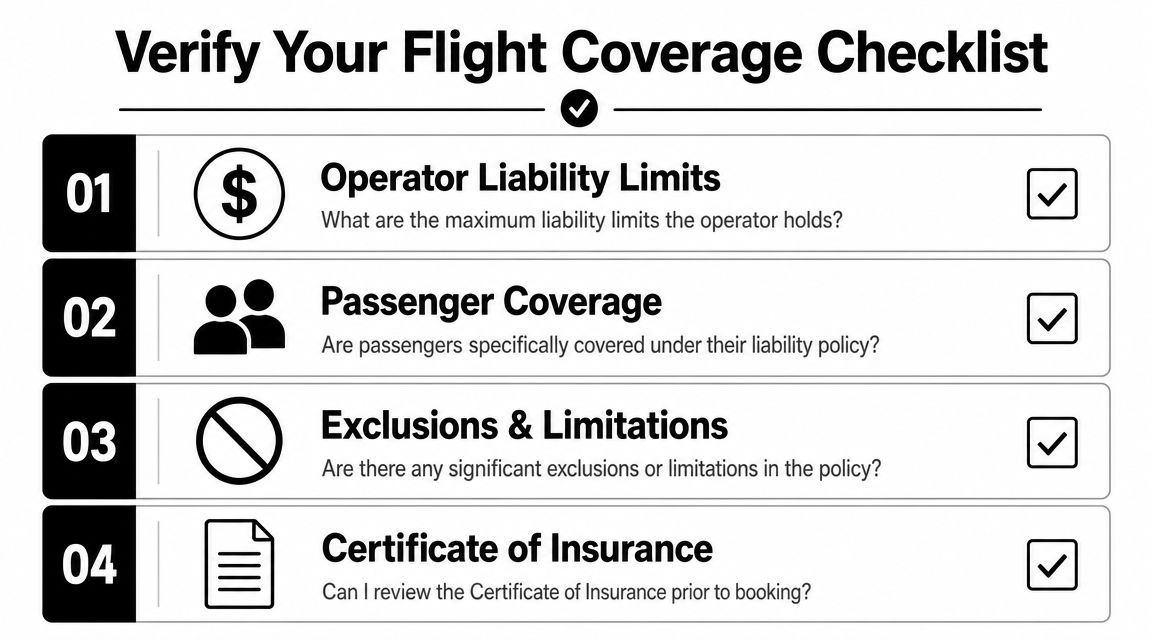
What are the liability limits for this specific aircraft and operator?
Don't accept a fleet-wide generality. You want the actual coverage tied to the trip you're booking.Are passengers covered under the liability structure?
That answer should be direct, not evasive. If the response is vague, keep pressing.Will I or my entity be added as an additional insured if appropriate?
This matters when the trip is being booked through a family office, company, or other legal structure.Can I review a current certificate of insurance before funds are released?
A competent operator should be able to provide current evidence of coverage.Are there notable exclusions or operating limitations relevant to this itinerary?
At this stage, seasoned buyers separate themselves from casual charter users.
What a good answer sounds like
A good answer is fast, specific, and documented. A weak answer is verbal, delayed, or padded with “don't worry, we're covered.”
You should also ask who reviewed the operator and how they were vetted. If you want that process handled cleanly from the start, use a provider that can explain its sourcing standards and trip documentation before you book through a private charter quote request.
The right reaction to an insurance question is professionalism. If you get defensiveness, that's your answer.
If you want private charter arranged with the same seriousness applied to aircraft sourcing, operator standards, and pre-flight transparency, Haute Jets is built for that job. It sources from Wyvern and ARGUS-rated operators, confirms trip-specific details before departure, and helps clients book private aviation with the kind of diligence high-value travel requires.