

You've got the bag packed, the group chat is deciding between a late dinner on the Strip and one last pool day, and the same question keeps coming up, do you really want to burn half the weekend in airports? On Los Angeles Las Vegas flights, the decision isn't whether you can find a seat, it's whether the fare you see is the cheapest way to move your time, your luggage, and your patience from one city to the other.
This corridor deserves a cleaner rule set than most travel guides give it. The short hop between Los Angeles and Las Vegas is busy, frequent, and cheap on the surface, but it's also one of the few routes where the cheapest ticket can still be the wrong answer once you account for transfers, baggage, timing, and how much friction you're willing to tolerate.
Why the LA to Las Vegas Route Deserves Its Own Playbook
Friday night at Harry Reid has a familiar rhythm. One traveler is trying to get back to Los Angeles after a Vegas weekend, another is checking whether the Sunday return will make them miss dinner, and someone in the group is already doing the math on whether a private charter is absurd or sensible.
That question is the whole route in one sentence. Los Angeles Las Vegas flights look simple because the distance is short, but the trip is never just the flight. It's the drive to the airport, the wait, the boarding process, the return drive, and the way a missed departure can wreck a tight weekend schedule.
Why the cheap fare is often not the cheap trip
Mainstream fare pages can make the route look almost trivial, with one-way pricing often advertised at very low levels, while ignoring the actual costs that matter most on a short hop, like airport transfers, checked bags, seat selection, and last-minute changes, all of which can erode the headline fare on a route that's only about 236 miles (Expedia). That's why this corridor needs a different lens.
Practical rule: if your trip ends the moment the plane lands, the airfare matters. If your trip ends when you're in the car at the hotel, the total door-to-door cost matters more.
Private aviation makes sense here because the stage length is short enough that every saved minute on the ground has real value. It also helps that the market is deep enough to support different departure airports and aircraft types, which means you're not choosing between “commercial” and “private” in the abstract. You're choosing between very different versions of the same trip.
The route is busy enough that charter pricing can become practical for more travelers than people assume, especially when empty legs are available or when a group is splitting the cabin. That's why a route-specific playbook beats a generic luxury-travel pitch every time.
What Commercial LA to Vegas Looks Like in 2026
Commercial service on this route is dense, but it is not uniform. Depending on the source, you will see 24 to 31 nonstop departures per day from Los Angeles to Las Vegas, with average flight times around 1 hour 17 minutes to 1 hour 20 minutes (Expedia). That is fast in the air, but the schedule still gets shaped by airport timing, gate availability, and how tightly you have packed the rest of the day.
The route is busy enough to give travelers real choice. One tracker reports 81 nonstop flights per week with 7 airlines operating the city pair, while another says Southwest leads with 46 flights per week, followed by Alaska with 35 and Delta with 34 (PlainFlights). FlightConnections also lists 7 airlines, 81 flights per week, and departure times from 05:15 to 22:59 (FlightConnections).
What the fare pattern tells you
Commercial pricing on this route moves around enough that timing matters. The cheapest month is May, with an average return fare of ₪328, while March and December are pricier at ₪415 and ₪402 respectively, and booking about 2 weeks in advance can save about 37% versus last-minute pricing (Kayak). That is a useful signal, not a promise.
If you are flying solo, light on baggage, and flexible on timing, commercial wins most of the time. If you are locking in a Friday departure, a Sunday return, or a same-day turn, the schedule starts mattering more than the fare.
The short version is blunt. Commercial is cheap when you can fit your life around the airline. The moment you need the airline to fit around your life, the route stops being a commodity and starts becoming a timing problem.
| Metric | Value |
|---|---|
| Nonstop departures per day | 24 to 31 (Expedia) |
| Weekly nonstop flights | 81 (PlainFlights, FlightConnections) |
| Operating airlines | 7 (PlainFlights, FlightConnections) |
| Average flight time | 1 hour 17 minutes to 1 hour 20 minutes (Expedia) |
| Departure window | 05:15 to 22:59 (FlightConnections) |
| Cheapest month | May (Kayak) |
Commercial vs Private on a Door to Door Basis
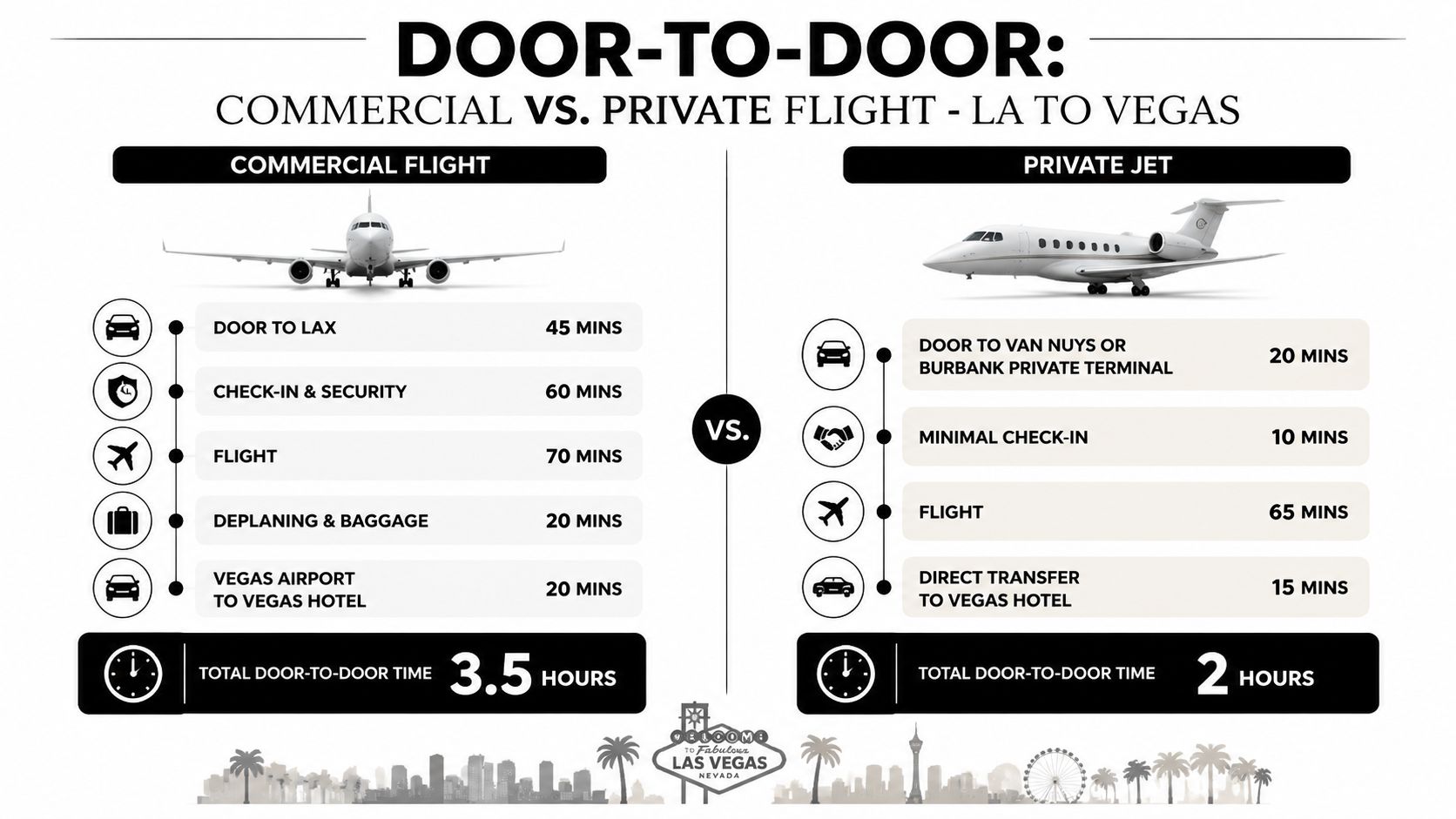
The wrong comparison is ticket price versus charter quote. The right comparison is curb-to-curb time, because that's what you spend.
Where commercial loses time
A commercial trip out of Los Angeles usually starts with a drive that can eat your afternoon before you've even reached the terminal. Then comes check-in, security, boarding, taxi, and the return sequence on the Vegas side, baggage claim, then the drive to the Strip.
The in-air time is short, but that's not where the day goes. On this route, the airport is often the least efficient part of the trip, not the flight itself.
Why private is different on a route this short
Private flying cuts out the biggest wasted blocks. You drive to a private terminal, arrive close to departure, walk on, fly, and leave the aircraft into waiting ground transport. The actual flight time doesn't change much, but the rest of the trip gets compressed.
That compression matters because this is a 235 to 237 mile hop where the cruise segment is tiny relative to the total experience (PlainFlights, FlightsFrom). When a route is that short, airport processing can outweigh the flight itself.
Direct advice: commercial wins for solo leisure flyers with flexible timing, no checked bags, and no interest in paying for convenience. Private wins when you care about exact departure timing, returning after an event, or keeping a group together without wasting the night in a terminal.
The round-trip time gap is the story. Once you add both sides of the journey, the private option can save hours of friction even when the aircraft time is similar. That's why a charter can feel expensive on paper and rational in practice.
The infographic above reflects the basic pattern. Commercial is cheaper, but it pays for that with more time on the ground, more waiting, and more room for small disruptions to snowball.
Choosing Your Departure and Arrival Airports
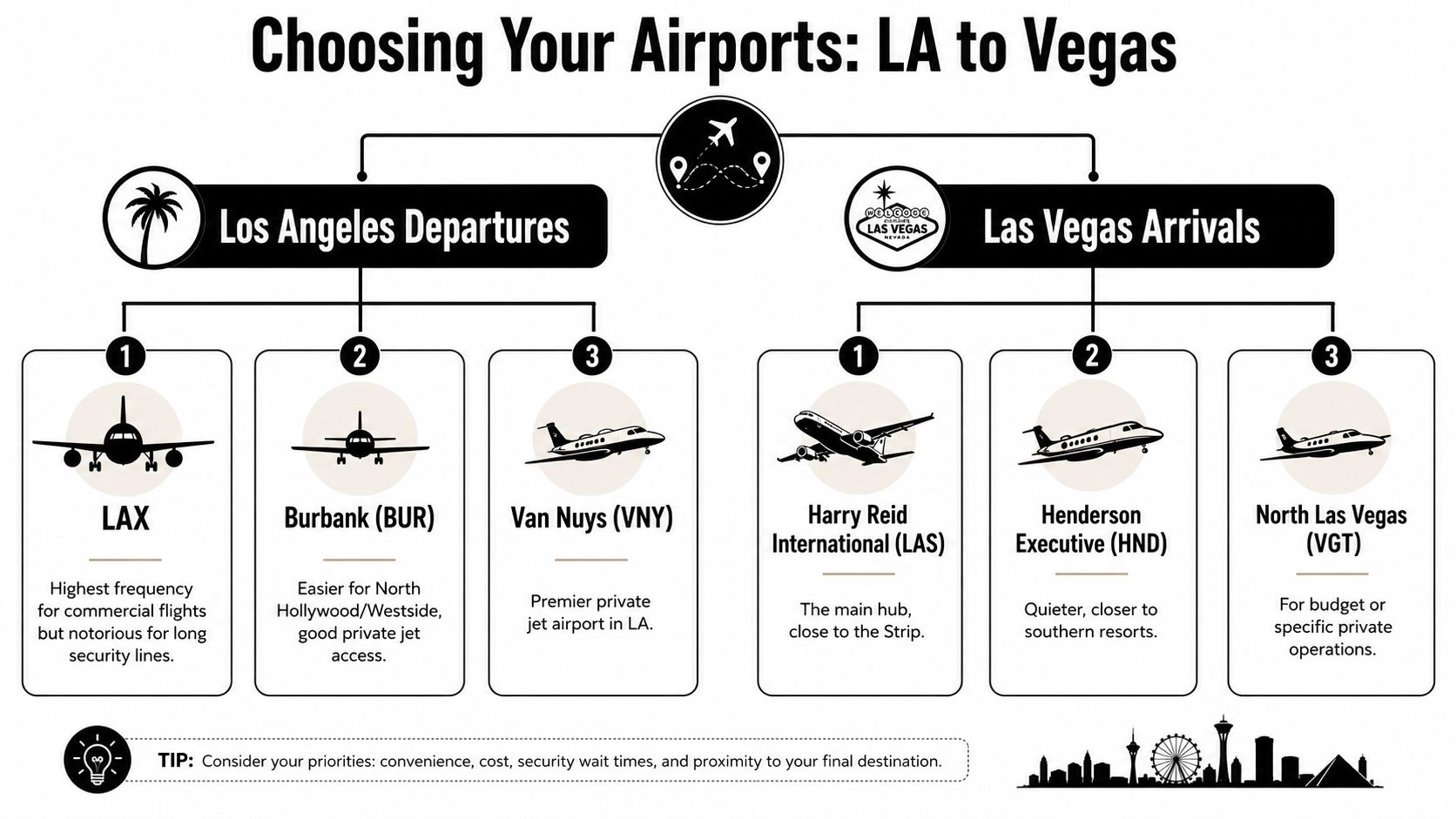
Airport choice is the single most underrated lever on this route. People obsess over aircraft category and ignore the fact that the wrong airport can wipe out the advantage of a better jet.
On the Los Angeles side, LAX is the commercial heavyweight, but private travelers often do better through Van Nuys, Burbank, Hawthorne, Long Beach, or Santa Ana depending on where they live and work. On the Las Vegas side, Harry Reid International is the main hub, but Henderson Executive and North Las Vegas can make more sense for certain resort stays and private arrivals.
How to think about the LA side
If you're flying commercial, LAX still gives you the deepest schedule. If you're flying private, start with the airport that cuts your ground time the most, not the one with the most brand recognition. That's usually the smarter move on a route this short.
A lot of travelers also underestimate how much terminal cleanliness and terminal flow affect the experience. If you want a sharper take on that part of the journey, facility sanitation in airports is worth reading because the first and last impression of a trip often comes from the terminal, not the cabin. facility sanitation in airports
How to think about the Vegas side
Harry Reid is the default because it sits closest to the Strip and handles the bulk of traffic. Henderson Executive is the quieter, more private option and can work especially well for southern resort access. North Las Vegas is a practical third option for certain general aviation needs.
For a deeper operational breakdown of Vegas private arrival points, use this Las Vegas FBOs guide. It's the fastest way to understand which terminal matches your itinerary instead of just your aircraft.
Rule of thumb: pick the airport that shortens the car ride on the ground first, then pick the aircraft. On this route, that order usually saves more time than chasing a slightly larger cabin.
Private Jet Charter Pricing for the LA to Vegas Route
Private pricing on this route only makes sense when you stop pretending there's one number. The aircraft category matters, the date matters, and the aircraft's position relative to your departure city matters a lot.
A light jet such as a Phenom 300 or Citation CJ4 typically falls in the $4,500 to $7,500 one-way range on this hop. A midsize aircraft such as a Citation Latitude or Challenger 350 usually lands around $6,500 to $10,500, with super-midsize options running higher. For broader context on how charter pricing is built, see our private jet charter cost guide.
| Category | Example Aircraft | Typical Range |
|---|---|---|
| Light jet | Phenom 300, Citation CJ4 | $4,500 to $7,500 |
| Midsize jet | Citation Latitude, Challenger 350 | $6,500 to $10,500 |
| Super-midsize | Larger cabin options in the category | Higher than midsize |
What actually drives the quote
Repositioning is the biggest swing factor. If the aircraft already sits near your departure airport, the quote looks cleaner. If it has to be ferried in, the price moves up fast.
Crew duty time, fuel, and landing fees also shape the final number. So do the practical details people forget about until the invoice shows up, like catering, ground transport, and specific airport handling.
Empty legs can change the math completely. These are positioning flights operators need to fly anyway, which means flexible travelers sometimes find one-way pricing at 40% to 75% below standard charter rates. That's not a guarantee, and it usually comes with timing trade-offs, but it's a real lever on this corridor.
If you want a realistic packing mindset for a charter weekend, this travel friendly clothing guide is a useful outside resource. The right clothes matter more than people admit when you're moving from car to private terminal to resort with almost no downtime.
My view: pay for a light jet when the trip is a quick couple or small group move, and pay for midsize only when the cabin needs to work as a real room. Anything beyond that should be justified by passengers, luggage, or the need for a more serious onboard setup.
How to Book a Private Jet From LA to Las Vegas
Booking a charter should feel like ordering exactly what you need, not shopping blind. The best process is simple, transparent, and specific about the aircraft before money changes hands.

What a clean booking flow looks like
Start with the trip request, then compare aircraft by tail number, year, make, model, and cabin configuration. That's the standard I'd insist on for any serious charter quote, because aircraft category alone doesn't tell you enough.
Haute Jets works this way by sourcing from 3,500+ owner-operators in 175 countries, with operator vetting limited to Wyvern Wingman and Argus Gold/Platinum rated providers. The booking process also includes a 24-hour pre-flight confirmation with the tail number, crew bios, weather briefing, and passenger manifest, which is the right level of detail for a route like this.
What you should ask for before you confirm
Use the same discipline you'd use for any high-stakes travel purchase. Ask about cabin layout, Wi-Fi, luggage handling, and whether the aircraft is positioned where you need it to be.
- Tail number and aircraft type: confirms the exact jet, not just the category.
- Cabin configuration: tells you whether the aircraft fits your group and baggage.
- FBO details: tells you where you'll depart and arrive.
- Special requests: covers pets, catering, and ground transport before departure.
A good packing checklist helps too, especially if you're moving fast. The Family Folder packing list is a practical reference when you want the trip to run without last-minute surprises.
The article on how to charter a private jet in 2026 gives a broader booking framework, but the Los Angeles to Las Vegas route is usually even simpler than one might expect. You don't need a membership or a jet card to get a straight quote and a specific aircraft.
Safety, Amenities, and What the Cabin Experience Actually Delivers
Safety is not a side issue on a route this short. When people chase the lowest quote, they often forget that the operational standard matters just as much on a 1-hour hop as it does on a transcontinental flight.
What the safety vetting is really doing
Wyvern Wingman and Argus Gold/Platinum are third-party audits, not marketing labels. They look at pilot training records, maintenance programs, operational history, and safety management systems, which is why those ratings matter more than cabin photos or a polished booking page.
That's also why Haute Jets keeps its network to those tiers only. On a busy corridor like Los Angeles to Las Vegas, the temptation to book fast and cheap is real, but the operator still has to earn trust before the wheels move.
What changes when you fly private
The cabin experience is mostly about removing hassle. You show up at an FBO instead of a crowded terminal, baggage gets handled with less friction, and pets usually travel in the cabin with you instead of disappearing into a cargo process.
Catering is more flexible, ground transport meets you closer to the aircraft, and the flight itself feels calmer because you're not spending the day bouncing between lines and gates. Even on a short flight, the difference between a Phenom 300 and a Challenger 350 is noticeable in how the cabin feels, how the luggage works, and how much room the trip gives you to breathe.
Straight answer: private flying on LA to Vegas is worth it when the trip is part of a bigger schedule problem. If all you need is a seat and you're not fighting time, commercial is still the rational choice.
Weather diversions can happen, turbulence can still show up, and short-haul flying will never be perfectly smooth every single time. But the onboard product is still distinctly different when the aircraft, terminal, and ground handling are chosen for your itinerary instead of for a mass-market schedule.
If you're comparing Los Angeles Las Vegas flights and want the trip priced around your timing, not the airline's schedule, Haute Jets can source the aircraft, confirm the exact tail number, and handle the details that decide whether the charter is worth it. Send the trip request, compare the options, and book the flight that matches the weekend you want.