

You need to be in Aspen by 5 p.m. for a board dinner. The aircraft looks perfect in the brochure, the cabin is finished in cream leather, and the quote appears competitive. Then someone asks the questions that matter: Which operator is flying the trip? Which tail number is assigned? Where is the aircraft based, and who is the verified crew?
That's luxury air travel in practice. It isn't mainly a contest between caviar menus, lie-flat seats, and polished lounges. It's a sourcing and verification decision that determines whether the aircraft arrives on time, whether the invoice includes an expensive repositioning leg, and whether the experience matches what was sold. The global business aviation market was valued at $52.3 billion in 2025 and is projected to reach $79.2 billion by 2034, according to MarketIntelo's business aviation market report. This is a scaled transportation system, not a novelty reserved for occasional celebrities.
Why Luxury Air Travel Is Really a Sourcing Decision
The traveler heading to Aspen doesn't need another generic promise about service. They need a desk that can compare aircraft already near the departure airport, confirm runway and weather constraints, and identify the operator and crew before the quote becomes a booking. A marketed aircraft category tells you very little about the delivered trip.
Two identical city pairs can produce radically different prices. One aircraft may already be positioned near the passenger, while another may need to fly empty from its home base, collect the client, and later return or continue to another assignment. Industry explainers note that these empty positioning legs can add roughly 30% to 100% to a charter invoice, depending on the route, aircraft location, and trip structure, as described in this explanation of repositioning and deadhead fees.
The hourly rate is only the opening number
A quote should distinguish between the aircraft's occupied flight time and the total delivered itinerary. Ask whether the proposal includes:
- Repositioning: Empty ferry legs may be billed at the aircraft's standard hourly rate, either fully or partially, as explained in this guide to reading a private jet charter quote.
- Aircraft type: A light jet, super-midsize cabin, and ultra-long-range aircraft solve different missions and shouldn't be compared by hourly rate alone.
- Crew and duty planning: A technically available aircraft may still require a crew change, overnight, or operational adjustment.
- Airport and ground handling: The FBO, landing arrangements, parking, and ground transfer affect both convenience and the final invoice.
- Catering and special requests: Dietary requirements, pets, skis, golf bags, and unusual baggage should be confirmed before departure.
A reliable booking process also identifies the exact aircraft rather than stopping at “Gulfstream” or “large cabin.” The tail number, cabin layout, connectivity, catering plan, and operator rating matter more than the logo on the proposal.
Practical rule: Never approve a luxury charter from the category and hourly rate alone. Approve the specific aircraft, operator, crew plan, routing, and all-in price.
Private aviation has become a worldwide fleet ecosystem. Industry summaries place the global business jet fleet at roughly 24,270 to 25,500 aircraft in service in 2026, compared with about 11,000 in 2001, while Aviation Week's forecast covered more than 9,000 new business jet deliveries and nearly 2,800 turboprops over 2025 to 2034, with a combined value of $298 billion, as reported in this overview of private jet statistics. The buyer's advantage comes from navigating that fragmented supply intelligently, not from assuming the most expensive aircraft will produce the best trip.
The Tiers of Luxury Flying Explained
Start with the mission, not the aircraft badge. A short regional hop into a constrained airport may favor a turboprop or light jet, while a long ocean crossing demands cabin volume, range, crew planning, and enough onboard systems to support passengers for many hours.
The figures below are practical planning ranges, not promises. Weather, payload, runway conditions, routing, and aircraft configuration can change the result.
Match the aircraft to the trip
| Tier | Typical Range (nm) | Passengers | Best Use Case | What Sets It Apart |
|---|---|---|---|---|
| Light turboprop | Short regional missions | Small group | Short hops into regional fields | Efficient operation and access to smaller airports |
| Entry light jet | Short to regional missions | Small group | Fast point-to-point travel | Speed and lower operating footprint than larger cabins |
| Midsize jet | Regional and longer domestic missions | Small to medium group | Business travel with more baggage and cabin comfort | Better range, lavatory options, and cabin space |
| Super-midsize jet | Long domestic and selected international missions | Medium group | Multi-hour travel requiring standing room and strong baggage capacity | A useful balance of range, comfort, and operating cost |
| Large-cabin jet | Long international missions | Medium to larger group | Corporate travel and premium leisure itineraries | More space, stronger galley capability, and sleeping options |
| Ultra-long-range jet | Intercontinental missions | Medium group | Nonstop global travel | Maximum range, privacy, and cabin zoning |
| Commercial business suite | Long-haul airline routes | Individual or small party | International travel where schedule and airport network align | Flat beds, premium service, and airline connectivity |
| Commercial first class | Select long-haul routes | Individual or small party | Privacy and comfort on a suitable airline itinerary | Enclosed or semi-enclosed suites without a dedicated aircraft |
| Premium economy | Medium and long-haul airline routes | Individual or group | Comfort-focused commercial travel at a lower cabin tier | More space than economy with fewer premium privileges |
A light turboprop can make sense when the destination is close and the arrival airport is small. An entry light jet adds speed and a smoother premium experience, but it won't provide the cabin volume or baggage flexibility of a midsize aircraft. Midsize and super-midsize jets are often the sensible choice for executives traveling with colleagues, luggage, and a demanding schedule.
Large-cabin and ultra-long-range aircraft are built for a different kind of mission. Aircraft such as the Gulfstream G700 and Global 7500 are designed for missions lasting 14 or more hours nonstop, but that capability carries a substantial operating cost and only makes sense when the routing, passenger count, and schedule justify it.
Commercial premium cabins still have a role
Commercial first class can be the right answer on a dense international route with convenient departure times and strong lounge connections. Business-class suites with sliding doors, including Air France, ANA, and Qatar Qsuite, can rival private cabins for bed quality and personal space.
The difference appears on the ground and in the schedule. Private aircraft offer control over departure timing, smaller private terminals, direct access to numerous regional airports, and a more personal baggage and pet process. A top commercial suite may be more economical for a solo traveler, especially when the airline route already fits. A private jet becomes more compelling for groups, multi-stop itineraries, remote destinations, or passengers whose time is more valuable than the fare difference.
Private Jet vs. First Class and the Membership Models
There are four practical ways to reach the front of the aircraft: on-demand charter, jet cards, fractional ownership, and commercial first or business class. The right choice depends less on prestige than on how often you fly, how much schedule control you need, and how much capital you're willing to commit before departure.
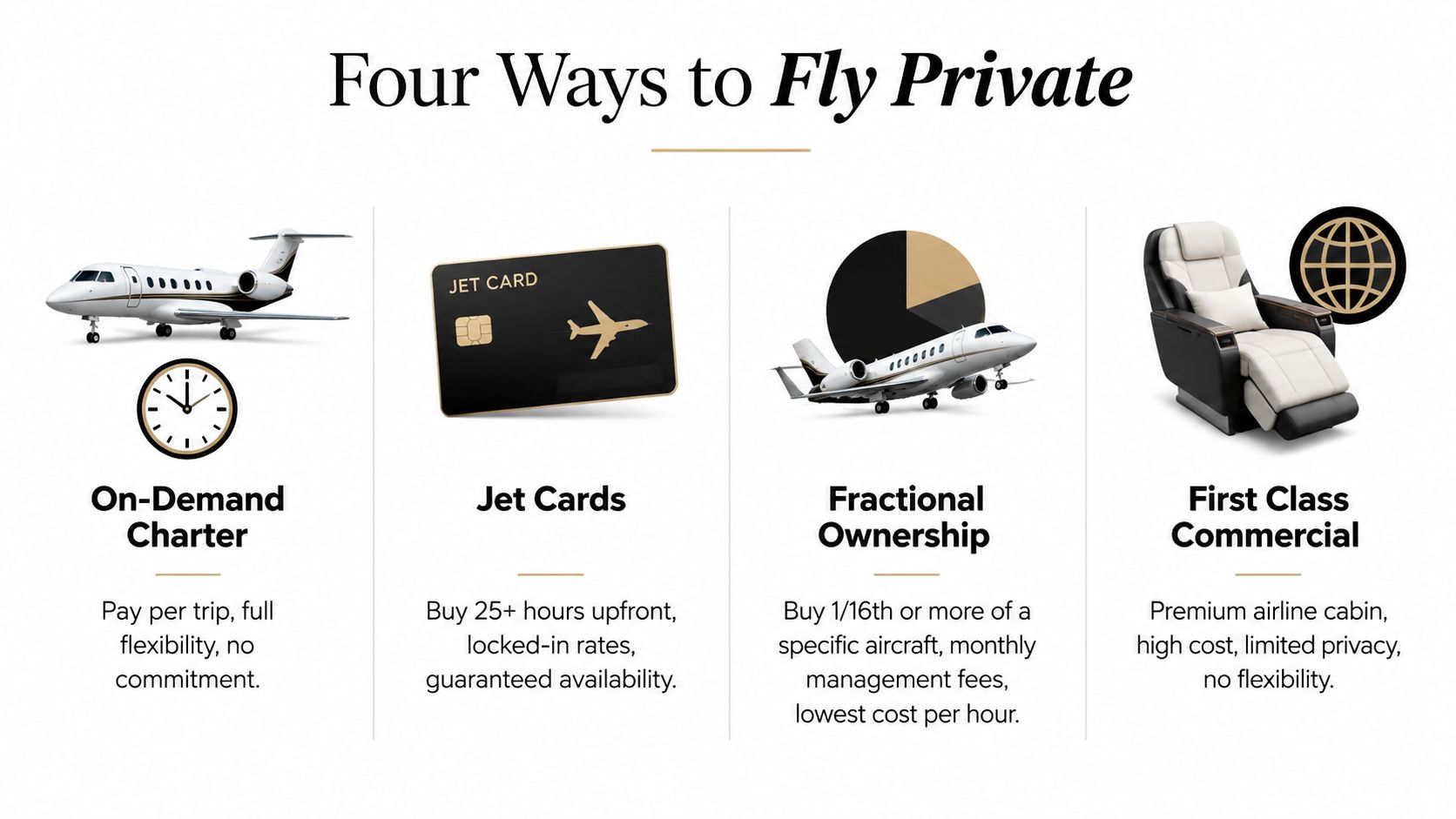
On-demand charter is pay-as-you-go aviation. The aircraft is sourced for each itinerary, so you can choose among light, midsize, super-midsize, and ultra-long-range options without buying a share or prepaying hours. On-demand charter is commonly structured without a membership or long-term commitment, but pricing can be less predictable because aircraft positioning, demand, and availability change from trip to trip.
Jet cards offer a more controlled buying experience. Clients typically purchase flight hours in advance in exchange for a defined aircraft category, availability terms, and often a fixed hourly rate. That predictability can be valuable, but the funds are committed before the trip, and the aircraft choice usually remains within the card's category rules.
Fractional ownership provides a share in a specific aircraft type or fleet structure. Programs such as NetJets and Flexjet can offer consistency, operational support, and an established access framework. The trade-off is capital commitment, recurring management costs, and less freedom to select any aircraft on every route.
Compare the decision by what you actually value
| Model | Cost Logic | Schedule Flexibility | Commitment |
|---|---|---|---|
| On-demand charter | Pay for each delivered trip | Highest route and aircraft flexibility | None beyond the booking |
| Jet card | Prepaid hours and defined terms | Strong within program rules | Funds committed upfront |
| Fractional ownership | Share-based access and recurring costs | Structured access and consistency | Significant capital and ongoing fees |
| First or business class | Ticket-based pricing | Limited to airline schedules and routes | No aviation asset commitment |
First class wins when the airline schedule, airport, lounge, and destination all align. Private charter wins when the itinerary involves several stops, a group, pets, unusual baggage, or a departure time the airline can't offer.
The sourcing issue remains central. A capable charter desk should be able to compare the private options against commercial premium cabins without hiding the assumptions behind each quote. For a practical comparison of commitment structures, review this guide to private jet membership costs.
What Wyvern and ARGUS Ratings Actually Verify
A safety badge is useful only when you understand what it represents. WYVERN and ARGUS evaluate operator systems, records, and controls, but they aren't interchangeable labels and neither one guarantees that every aircraft or crew combination is equally suitable for every mission.
WYVERN audits recur at least every 24 months and assess safety-management and risk-mitigation systems, according to this independent explanation of business aviation safety ratings. ARGUS uses tiers such as Gold, Gold Plus, and Platinum, incorporating elements such as on-site audits, emergency-response planning, and documentation checks.
Look past the badge
Auditors and aviation safety teams examine the operator's operating structure rather than judging cabin leather or brand recognition. Relevant areas include:
- Safety-management systems: Whether the company documents hazards, reports incidents, and maintains corrective processes.
- Maintenance controls: How the operator manages records, inspections, vendors, and aircraft status.
- Crew qualifications: Pilot experience, recurrent training, licensing, and records.
- Operational control: Who makes decisions about dispatch, weather, routing, and aircraft substitutions.
- Emergency planning: Whether the operator has usable response procedures rather than a policy document that sits untouched.
- Insurance and documentation: Whether required records and coverage are current and properly maintained.
ARGUS Gold generally reflects certificate, incident-history, and aircraft-record checks. Gold Plus adds a passed on-site audit, while Platinum requires a current on-site audit, a functioning safety-management system, and an emergency-response plan, as summarized in this ARGUS and WYVERN glossary.
| Audit Feature | Wyvern Wingman | ARGUS Gold | ARGUS Platinum |
|---|---|---|---|
| Operator and crew records | Emphasized through audit review | Reviewed within tiered program | Reviewed within deeper audited framework |
| On-site audit | Program-dependent audit structure | Not the defining requirement | Required as part of the tier |
| Safety-management system | Assessed through safety and risk controls | Considered within program checks | Functioning SMS required |
| Emergency response | Assessed as an operational control | Checked within documentation and program review | Emergency response plan required |
| Trip-level guarantee | No | No | No |
The limit matters. A rating audits an operator's systems at a point in time. It doesn't guarantee the tail number assigned today, the crew's recent experience on a particular aircraft, or the operational decision-making required by changing weather.
Before confirmation, ask for the operator's current status, the assigned tail number, crew qualifications, and the substitution process. The Haute Jets guide to WYVERN and ARGUS safety ratings is useful background, but the booking team still needs to verify the actual trip.
The Cabin Experience and What to Confirm Before You Fly
Luxury begins before boarding. The FBO determines how quickly you move from curb to aircraft, how private the terminal feels, and whether the ground transfer is handled cleanly. Signature, Atlantic, Million Air, and Jet Aviation are familiar names in business aviation, but the brand alone doesn't tell you how the specific location will handle your arrival, departure, parking, or vehicle handoff.
Ask for the exact FBO name and ground contact. A good plan includes who meets you, where the vehicle waits, what happens if the aircraft changes terminals, and whether the destination airport has the same quality of handling.
Confirm the cabin as delivered
Aircraft categories hide meaningful differences. Two midsize jets may have different seat layouts, lavatory arrangements, baggage capacity, and connectivity. A heavy jet may offer lie-flat sleeping, a stronger galley, and separate cabin zones, but that doesn't mean every long-range aircraft has the same bedding, noise profile, or internet performance.
Catering should match the sector. A 90-minute flight needs well-timed refreshments and practical packaging, while a 10-hour ocean crossing requires a credible meal sequence, storage capacity, reheating capability, and crew coordination. Ask who is preparing the food and whether the operator can support allergies, religious requirements, children's meals, or specific beverages.
Connectivity deserves a direct answer rather than “Wi-Fi available.” Ask whether the aircraft uses Ka-band or Ku-band satellite connectivity, what performance the operator expects on the route, and whether the system has known coverage limitations. The crew should also know how pets are handled, where they can remain during flight, and whether skis, golf bags, musical instruments, or oversized cases fit inside the assigned aircraft.
Before departure, verify: tail number, operator rating, crew plan, FBO, catering vendor, ground contact, Wi-Fi system, baggage fit, pet policy, and the contingency plan for weather or maintenance changes.
The crew composition affects the service as much as the cabin. Confirm whether the itinerary requires additional crew, whether the assigned pilots are current on the aircraft type, and who will communicate operational changes. A polished flight attendant can improve the journey, but no service detail compensates for vague answers about aircraft identity or dispatch.
A 24-hour pre-flight confirmation should give you the final aircraft information, crew details, passenger manifest, weather briefing, and ground arrangements. If the operator can't provide a clear confirmation process, treat that as a sourcing weakness rather than a minor administrative inconvenience.
Where Luxury Private Flying Is Growing Fastest
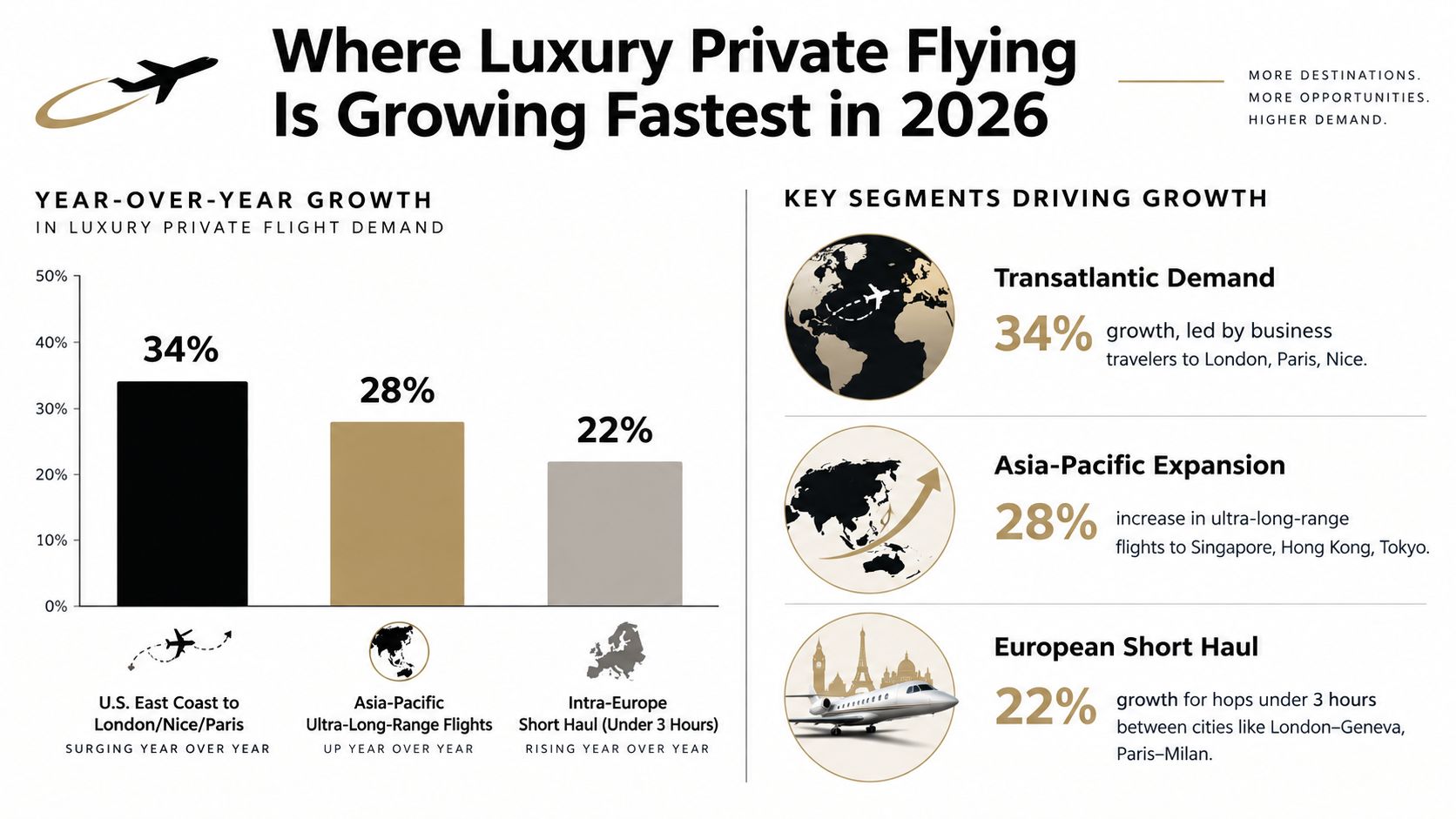
Private aviation demand is spreading beyond its traditional North American and Western European base. In the first half of 2026, worldwide private jet flights reached 1,967,290 departures, up 4% year over year and 36% above 2019 levels, according to MarketIntelo's business aviation market data. Charter and fractional flights reached 1,035,941 departures, up 7% year over year and 42% above 2019, while the United States represented 69.5% of global departures during that period.
The U.S. remains the deepest sourcing market, yet the growth story is broader. Full-year 2025 activity reached a record 3.9 million flights, approximately 4.6% higher year over year and roughly 35% above pre-pandemic levels. Latin America grew 11%, Africa 15%, and Europe 1%, according to this analysis of global private jet flight activity.
Regional sourcing has different logic
The best opportunities appear where aircraft already move for business, leisure, sports, or entertainment demand. Brazil and Colombia provide useful Latin American sourcing depth. Nigeria and Morocco connect African and European networks. Japan and the Philippines matter in Asia-Pacific, where airport access and aircraft positioning can change a charter's economics.
In the U.S., Austin, Nashville, Aspen, and Miami attract sustained executive, entertainment, seasonal, and leisure traffic. More FBO capacity can improve competition, but it will not automatically lower every quote. First check whether an aircraft is already nearby or must be ferried into the market.
An operator repositioning an empty leg into your city may quote less than one sending an aircraft from a distant base. Compare aircraft location before cabin décor, catering, or membership benefits. Route length, crew positioning, return demand, and airport access often reshape the invoice more than the destination's reputation.
The growth market is not a list of fashionable cities. It is the point where aircraft, crews, and return demand intersect, and where an operator can verify those details before you commit.
Sustainability, SAF, and Honest Tradeoffs
Luxury aviation hasn't become “green” because operators now discuss sustainability. Sustainable Aviation Fuel, or SAF, can reduce lifecycle emissions compared with conventional jet fuel, but availability, airport infrastructure, supply, accounting, and routing determine whether a client receives a measurable benefit.
SAF also isn't a magic substitute for efficient trip planning. A newer aircraft, a direct route, a well-filled cabin, and actual SAF uplift can all matter. An offset purchased after the flight is a different instrument, and forestry credits vary in quality and permanence. A buyer should ask what happened operationally, not just what language appears in the sustainability section of the proposal.
Separate the real levers
| Lever | Verified CO2 Impact | Typical Cost Premium | Availability |
|---|---|---|---|
| SAF uplift | Can reduce lifecycle emissions compared with conventional fuel | Varies by supply and procurement | Constrained and airport-dependent |
| Newer aircraft | Usually supports more efficient operation than older designs | Reflected in aircraft selection and charter pricing | Depends on fleet and route |
| Direct routing | Avoids unnecessary flight time when operationally feasible | May change aircraft or routing economics | Dependent on weather, airspace, and aircraft |
| Operator reporting | Improves visibility into trip emissions | May be included or separately priced | Varies by provider |
| Offsets | Addresses reported emissions through a separate credit mechanism | Varies by program | Widely marketed, quality differs |
Industry coverage has highlighted SAF development and increased environmental scrutiny while flight activity has continued to rise, as discussed in this overview of private aviation trends. That tells us demand hasn't materially disappeared. It also means clients need more honest reporting, not broader green language.
Ask one concrete question: “Can you confirm actual SAF availability for this departure, or are you offering an offset after the flight?”
A Gulfstream G700 using available SAF on a necessary long-distance itinerary may be a more responsible choice than sending a smaller aircraft on a poorly positioned, inefficient routing. The answer depends on the trip's actual aircraft, load, fuel source, and route. For a deeper discussion of the category, see this guide to sustainable luxury and eco-friendly jet travel.
How Haute Jets Fits the Modern Luxury Landscape
The modern luxury traveler doesn't need another company that displays aircraft photographs. They need a sourcing layer that can compare operators, aircraft, routes, and delivered costs in a fragmented market.
Haute Jets operates within that model as an on-demand charter service rather than a fleet owner. The booking approach lets a client compare a turboprop, light jet, midsize aircraft, super-midsize cabin, or ultra-long-range jet against the same itinerary. That's useful when the initial request sounds simple but the right answer depends on passengers, baggage, runway access, nonstop requirements, pets, or multiple stops.
The useful parts of the model
The first advantage is flexibility. A client can book flight by flight without buying a membership or committing to a jet card. That suits travelers who want private aviation for a specific corporate trip, family journey, event, or time-sensitive itinerary rather than an ongoing aviation program.
The second is verification. The network is built around operators carrying WYVERN Wingman or ARGUS Gold/Platinum ratings, which creates a starting compliance filter. The booking team still needs to confirm the exact tail number, crew, aircraft records, and operational plan, because an operator-level rating isn't a trip-level guarantee.
The third is quote clarity. A useful proposal should identify the aircraft, operator, repositioning, federal excise tax, catering, ground handling, and other relevant charges rather than compressing everything into an attractive hourly figure. Repositioning is especially important because a nearby aircraft can remove an empty leg instead of discounting it after the cost has already entered the quote.
Commercial first class remains sensible for solo travelers on a well-served route who value airline miles, lounges, and predictable published schedules. Charter is usually stronger for groups, pets, multi-stop travel, remote airports, irregular departure times, and itineraries where avoiding a connection matters more than optimizing a ticket price.
The right advisor doesn't push every traveler toward private aviation. The job is to make the comparison auditable, then recommend the model that fits the mission. That's how luxury air travel becomes a disciplined logistics decision rather than a status purchase.
Haute Jets offers flight-by-flight private charter sourcing, operator verification, aircraft selection, and ground coordination without requiring a membership or jet card. Visit Haute Jets to compare a bespoke aircraft solution for your route and receive a quote built around the actual aircraft, positioning, and service requirements.