

Luxury private jet rental cost isn't a single number. A light jet often starts around $2,500 to $4,500 per hour, while an ultra-long-range jet can run $15,000 to $25,000+ per hour before additional trip fees are added.
If you're pricing a trip right now, you've probably already seen the problem. You request the same route from three charter providers and get three very different numbers. One looks reasonable, one looks inflated, and one seems suspiciously low until you ask what is included.
That confusion isn't accidental. In private aviation, the published hourly rate is only the visible part of the bill. The invoice that matters is the full trip cost, and the biggest mistake new buyers make is focusing on cabin glamour before they understand how the quote is built.
My advice is simple. Start with aircraft category, then interrogate every extra line item, and pay special attention to whether you're funding an empty repositioning flight you never asked for. That's where a lot of “luxury private jet rental cost” gets distorted.
Decoding Your Private Jet Rental Quote
Most first-time charter clients assume they're buying a route. They aren't. They're buying aircraft time, plus a stack of operational costs that can vary sharply depending on where the aircraft is based, how the trip is scheduled, and what the operator has to do to perform it.
At the core, charter pricing is a billed-hour model. The base formula is aircraft class multiplied by occupied flight time, then adjusted for repositioning, minimums, and trip-specific fees. A 3-hour light-jet mission at $3,500 per hour equals $10,500 in base airframe cost before landing fees, catering, and taxes, as outlined in Monarch Air Group's charter cost calculator.
What confuses buyers
You'll often see one quote framed as “hourly” and another framed as “all-in.” Those aren't comparable until you know what each one includes.
Common differences come down to:
- Aircraft location: If the jet isn't near you, someone has to pay to move it.
- Billing minimums: A short trip can still trigger minimum daily usage rules.
- Airport choice: Major airports and premium terminals usually cost more than simpler alternatives.
- Trip shape: One-way itineraries often price differently from round trips.
Practical rule: If two quotes for the same route are far apart, don't ask which one is cheaper. Ask which one is more complete.
How I tell clients to read a quote
Use this sequence:
- Identify the aircraft class first. That tells you the baseline market band.
- Confirm billable flight hours. Not just airborne time, but what the operator is charging.
- Ask where the aircraft is based. Hidden cost often starts here.
- Review every add-on line by line. If a fee is vague, challenge it.
- Compare total trip economics, not advertised hourly rates.
Transparency matters more than theatrics. A clean charter quote should tell you exactly what you're paying for and why. If it doesn't, assume the final bill will move in the wrong direction.
Private Jet Charter Costs by Aircraft Class
Aircraft class is the first real pricing filter. Not branding. Not cabin photos. Not sales language. If you choose the wrong category, the rest of the quote discussion is noise.
The broad 2026 market bands are consistent enough to use as a planning framework. According to Simple Flying's private jet rental cost breakdown, a very light or small turboprop can start around $2,000 per flight hour, light jets typically run $2,500 to $4,500 per hour, midsize jets $4,500 to $7,500 per hour, super-midsize jets $7,500 to $12,500 per hour, and heavy jets $10,000 to $22,000 per hour, with ultra-long-range models exceeding $25,000 per hour.
Estimated Private Jet Hourly Charter Rates for 2026
| Aircraft Class | Typical Hourly Rate | Passengers | Common Use Case |
|---|---|---|---|
| Very light jet or small turboprop | Around $2,000 per hour | Small group | Short regional trips |
| Light jet | $2,500 to $4,500 per hour | Small group | Short to mid-range domestic routes |
| Midsize jet | $4,500 to $7,500 per hour | Mid-size group | Longer domestic missions with more cabin comfort |
| Super-midsize jet | $7,500 to $12,500 per hour | Mid-size group | Cross-country travel with stronger range and baggage capability |
| Heavy jet | $10,000 to $22,000 per hour | Larger group | Long-range luxury travel |
| Ultra-long-range jet | Exceeding $25,000 per hour | Larger group | Intercontinental nonstop missions |
What each category is really for
A light jet is the practical entry point for many luxury travelers. It works well when you want speed, privacy, and a cleaner airport experience without paying for range or cabin volume you don't need.
A midsize or super-midsize jet is often the sweet spot for clients who care about stand-up cabin comfort, stronger baggage capacity, and better coast-to-coast utility. Many repeat charter users end up here because it balances comfort and economics.
A heavy or ultra-long-range jet is a different purchase decision. You're paying for mission capability, cabin size, and international reach. That makes sense for transatlantic flying, larger parties, or travelers who want a true long-haul luxury environment.
The right aircraft is the smallest cabin that comfortably handles your passenger count, baggage, and route without forcing a fuel stop.
That's the discipline many buyers skip.
Don't let category creep inflate the bill
Clients often overbuy aircraft because a broker pushes “more luxury” instead of “right-sized capability.” That's expensive. If you're flying a short domestic leg with a small party, a heavy jet is often a vanity upgrade, not a smart charter choice.
If you want a deeper way to think about rate bands, occupied time, and airframe economics, read Haute Jets Journal's guide to calculating private jet cost per hour.
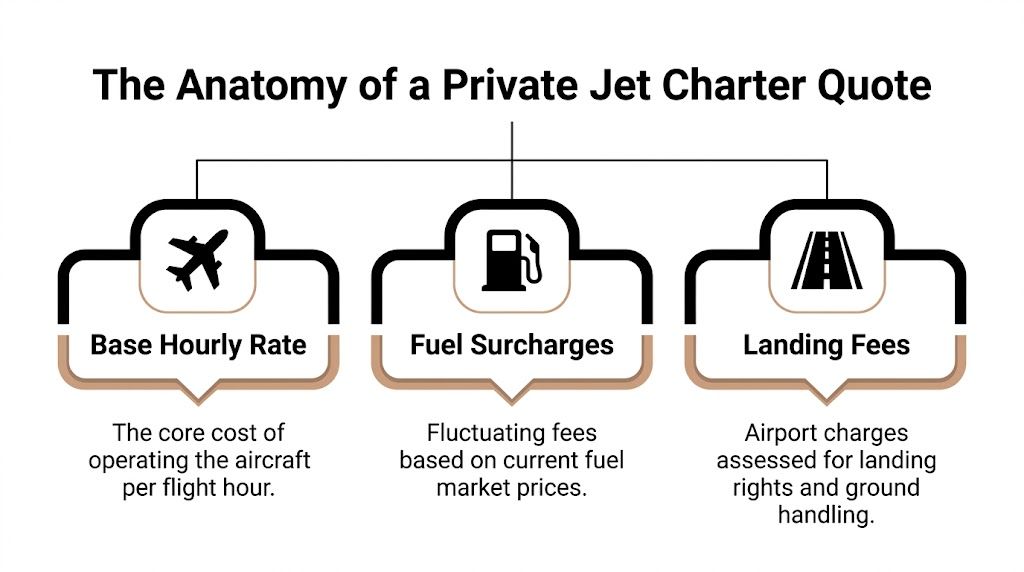
The Anatomy of a Private Jet Charter Quote
A charter quote has layers. The hourly number gets your attention, but the final invoice is built from the operational details sitting underneath it.
That's why two flights on the same aircraft category can still price differently. The route, the airport pair, the timing, the aircraft's current position, and the operator's trip assumptions all shape the actual number you'll pay.
What usually appears in a quote
Standard charter quotes may include repositioning, overnight crew, airport handling, international permits, Wi-Fi, and catering, and those ancillary costs can materially inflate the bill because they sit on top of the hourly rate and shift with route type and seasonality, as explained in Acc Air Charter's cost guide.
In plain terms, your quote may include:
- Base flight charge: The airframe and crew time tied to the mission.
- Airport and handling costs: Charges tied to terminals, services, and parking.
- Crew-related expenses: Especially relevant if the crew must remain overnight.
- Passenger service items: Catering, cabin requests, Wi-Fi, permits, and similar extras.
Some of those are normal. Some are discretionary. One is routinely abused.
Repositioning is the real cost trap
Repositioning means the aircraft has to fly empty to reach your departure point, or empty again after dropping you off. If the broker sources an aircraft that isn't already near your trip origin, you can end up paying for that deadhead movement.
That's why the published hourly rate often tells only half the story. A lower nominal rate attached to a badly located aircraft can cost more than a higher hourly rate on a local aircraft.
Buyers obsess over cabin category. Operators and brokers know the real margin often sits in aircraft positioning.
What to challenge before you approve
Don't sign off on a quote until you've asked these questions:
- Where is the aircraft based right now?
- How many billed hours are occupied flight time versus positioning?
- Which line items are fixed and which can still move?
- Are overnight crew costs necessary for this itinerary?
- Is this the nearest suitable aircraft or just the first available one?
A serious advisor should answer those quickly and specifically. If the quote arrives with polished branding but vague fee logic, you're looking at marketing, not clarity.
Example Charter Costs for Popular Routes
Route pricing becomes much easier to understand when you stop treating it as a rate card and start treating it as a mission. The same city pair can price very differently depending on the aircraft category, whether the itinerary is one-way or round-trip, and whether the aircraft has to be brought in.

One useful benchmark comes from a midsize charter example shown by evoJets. Their sample trip includes $17,000 in flight time plus $1,900 in fuel surcharge, crew fees, and landing fees, which shows how quickly the final invoice moves beyond the base flight charge, as detailed in evoJets' pricing basics.
How this plays out on real routes
Take New York to Miami. A client flying with a small group might be well served by a light or midsize jet. The mission is straightforward, but the quote can still rise if the aircraft is sourced from another city or if premium airports are used on both ends.
Now compare that with Los Angeles to Las Vegas. It's a shorter route, but scarcity around peak weekends and event-driven demand can change the economics quickly. In these situations, airport access and local aircraft availability often matter more than the nominal class rate.
International and island trips change the fee stack
For Miami to the Bahamas, buyers often focus on the short flight time and expect a very simple quote. That's a mistake. Short flights can still accumulate handling and permit-related costs, and aircraft selection matters because you don't want to pay for excess cabin that the mission doesn't require.
For New York to London, the logic changes completely. At that point, you're not merely selecting a luxury cabin. You're buying long-range capability, crew planning, and an aircraft that can handle the route profile without compromise. That pushes you into heavy or ultra-long-range territory.
Short routes expose minimums and handling costs. Long routes expose the premium for range, cabin volume, and crew complexity.
If you want route context around where demand concentrates and why certain city pairs behave differently, Haute Jets Journal has a helpful overview of the world's most popular private jet routes in 2025.
The right way to budget
When clients ask me for a route estimate, I don't start with “what's the hourly rate?” I start with:
- How many passengers are flying
- How much baggage is involved
- Whether the trip is one-way or round-trip
- Which airports they're willing to use
- How flexible they are on departure time
That's how you get to a realistic number. Hourly rate is only the starting point. Mission design is what determines whether the charter feels efficient or overpriced.
How to Reduce Your Private Jet Rental Cost
The fastest way to overpay is to chase a glamorous aircraft and ignore the structure of the quote. If you want to reduce luxury private jet rental cost, focus on the parts of the bill you can control.
The biggest lever is sourcing. According to Paramount Business Jets' pricing guide, traditional brokers and jet card programs can inflate charter prices by 20 to 40 percent through repositioning fees, while a model that sources from a worldwide network of owner-operators near the departure city can eliminate that cost entirely.
Start with structural savings, not gimmicks
Here's the order I recommend.
- Choose a local aircraft first: A nearby jet cuts out the deadhead cost that bloats many quotes.
- Right-size the cabin: Don't pay for intercontinental capability on a domestic hop.
- Use airport flexibility: If you can depart from or arrive at a nearby alternative airport, the quote often improves qualitatively.
- Book around your real mission: A clean round trip may price better than two disconnected one-ways, depending on aircraft positioning.
One factual example of this local-sourcing approach is Haute Jets, which states that it sources from 3,500+ owner-operators across 175 countries to find aircraft near the client's departure city and avoid repositioning-heavy pricing models, based on the company information provided by the publisher.
Empty legs help, but they aren't a strategy
Empty legs can be useful when your schedule is flexible and the route happens to align. They are not a reliable procurement method for executives, families, or anyone with a fixed timetable.
That's why I don't tell serious clients to build their travel around opportunistic leftovers. I tell them to remove the structural waste from the booking model itself.
Advisory view: The smartest savings rarely come from hunting for discounted scraps. They come from refusing to pay for an empty aircraft to reach you in the first place.
A short look at the charter process helps clarify why quote quality depends so much on sourcing and operator fit.
What to ask before you book
Use these screening questions with any charter provider:
- Is this aircraft already near my departure airport?
- Am I paying for repositioning on either end of the trip?
- Can you show me the exact aircraft options rather than only a category?
- What fees are likely to change after I approve this quote?
If those answers come back vague, the quote probably is too.
On-Demand Charter vs Jet Cards and Fractional Ownership
Most clients don't need a jet card. Far fewer need fractional ownership. They need access, flexibility, and transparent pricing for the trips they fly.
That's why on-demand charter remains the cleanest model for many high-net-worth travelers and corporate flight buyers. You pay per mission, select the right aircraft for that specific trip, and avoid locking capital into a system that may not match your usage pattern.
Where each model fits
| Model | Upfront Commitment | Flexibility | Aircraft Choice | Cost Visibility |
|---|---|---|---|---|
| On-demand charter | Low | High | High | Strong if quote is transparent |
| Jet cards | Higher | Moderate | More limited by program rules | Mixed |
| Fractional ownership | Highest | Moderate | Tied to ownership structure | Complex |
A jet card can appeal to travelers who want simplified booking and predictable program rules. The tradeoff is that those programs often narrow your aircraft options and can obscure the true economics of each mission.
Fractional ownership makes sense for a narrow band of very frequent flyers who value access enough to accept capital commitment, long-term obligations, and ownership-style complexity. Most newer private aviation buyers overestimate how much they'll use it.
Why on-demand works for modern buyers
On-demand charter is usually the smartest place to start because it keeps your options open. You can choose a Phenom 300 for one trip, a Challenger 350 for another, and a long-range cabin only when the route actually requires it.
That flexibility matters more than people think. It's often the difference between buying the right aircraft for the mission and buying into a prepaid program that nudges you toward using what's available rather than what's optimal.
If you're weighing those models more closely, Haute Jets Journal has a useful comparison of private jet cards vs charters.
The bottom line is straightforward. If you want control over aircraft choice, limited financial commitment, and cleaner trip-by-trip economics, start with on-demand charter and make providers earn your trust on every quote.
If you want a quote that reflects the actual mission instead of a padded brochure rate, speak with Haute Jets. Ask for the exact aircraft, ask where it's based, and ask whether repositioning is included. Those three questions will tell you more about your real charter cost than any flashy hourly number ever will.