

Popular advice says luxury travel concierge services are just for people who want nicer restaurants and faster reservations. That advice is lazy. Its value is operational control, because affluent travelers don't pay for pretty itineraries, they pay for someone who can keep flights, cars, hotels, villas, timing, and last-minute changes aligned when the trip gets complicated.
That's why the market keeps expanding across premium travel and concierge services. One industry estimate puts the global luxury travel concierge services market at USD 801.64 million in 2025, rising to USD 859.52 million in 2026 and reaching USD 1.32 billion by 2032, which implies a 7.38% CAGR over the forecast period, while another model values the broader luxury concierge service market at USD 744.3 million in 2026 and USD 1.3782 billion by 2033 with travel concierge services accounting for 37.0% of market share in 2026 (360iResearch). That growth makes sense when you look at how much of the service is really logistics, contingency planning, and execution under pressure.
Why Luxury Travel Concierge Services Are More Than Booking Agents
The biggest mistake buyers make is assuming a concierge is just a polished booking desk. A real luxury travel concierge is closer to an operations team that coordinates flights, ground transport, accommodations, dining, and experiences as a single system. If one piece changes, the rest has to move with it, fast.
That's the difference between making reservations and managing a trip. The service has to absorb schedule changes, weather delays, supplier issues, and guest preference changes without exposing the client to chaos. Industry reporting describes these services as requiring a high-end supplier graph, advanced CRM, 24/7 communication coverage, and strict data-privacy compliance, which tells you the business is built for orchestration, not just taste-making (IMARC Group).
Practical rule: if a provider can't explain how they recover from disruption, they're selling access, not execution.
This is also why concierge work often overlaps with transport-sensitive services such as safe pet relocation options when the traveler's itinerary includes animals, special handling, or timed transfers. The best providers don't just book around the pet, they build the entire journey around the constraint.
A well-run concierge relationship should feel invisible when it's working. No visible handoffs. No repeated explanations. No client-side firefighting. If you're still fielding confirmations from three different vendors, you're not paying for concierge service, you're paying for coordination overhead.
Core Offerings That Define Premium Concierge Travel
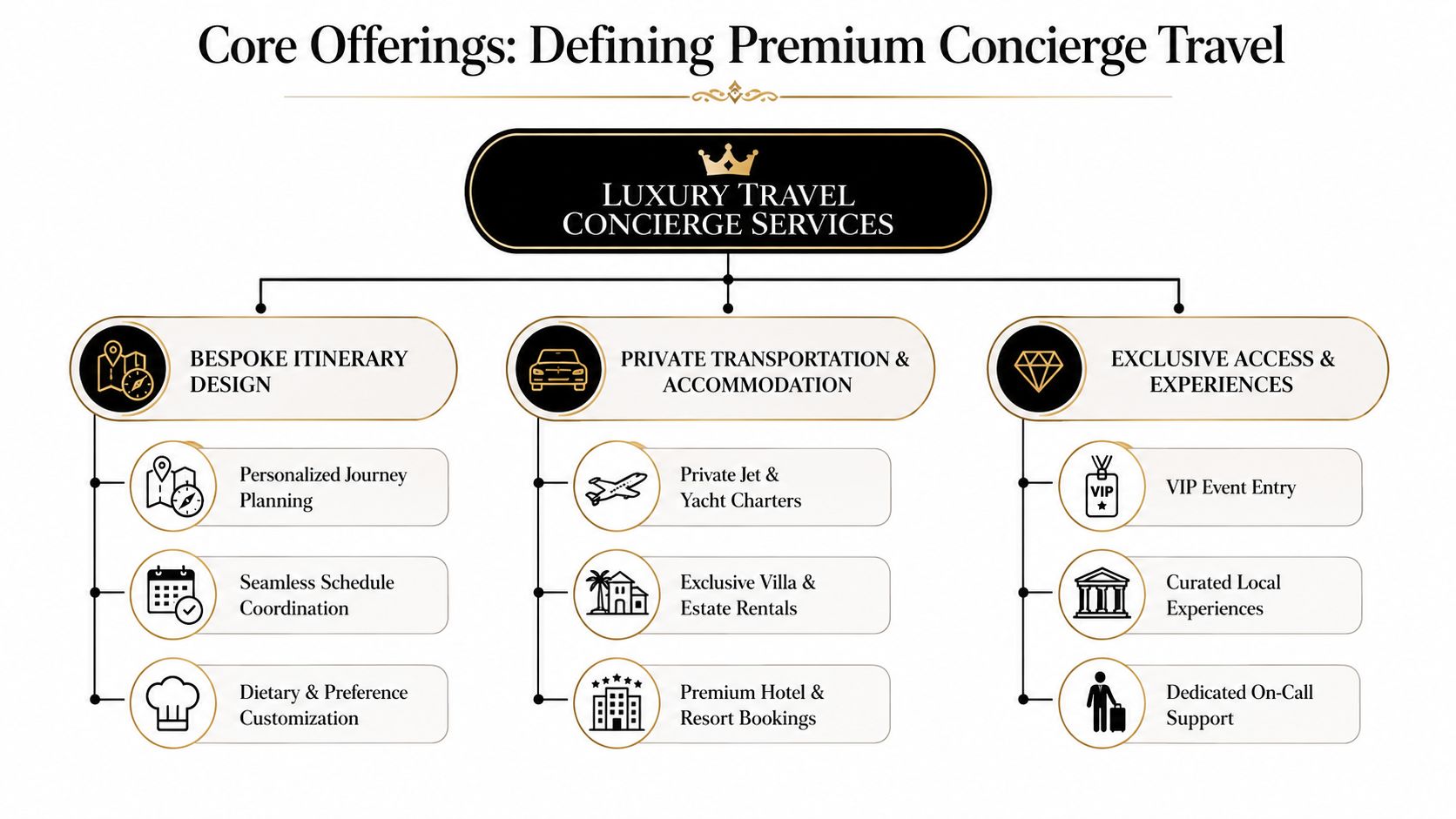
Premium concierge travel starts with bespoke itinerary design. That means the provider learns how the traveler moves, family structure, preferred pace, meal constraints, privacy requirements, and tolerance for transit. A real planner doesn't just pick destinations, they sequence days so arrivals, check-ins, transfers, and experiences don't fight each other.
What separates design from booking
A generic agent gives you options. A concierge stitches the trip together so those options work in the world. That distinction matters most when the itinerary spans multiple cities, private aviation, villas, special events, and hard timing windows.
Private transportation and accommodation is the next layer. This can include jet coordination, yacht charters, villa sourcing, premium hotels, and smooth ground transfers. The point isn't abundance, it's fit. The wrong aircraft, wrong villa location, or badly timed transfer turns luxury into friction.
Then comes exclusive access and experiences. VIP entry, hard-to-get reservations, private guides, and curated local moments are useful only when the execution is clean. Access without timing discipline is just a nicer way to be late.
For travelers who need flexible aircraft sourcing, Haute Jets sources from 3,500+ owner-operators across 175 countries, which matters because breadth gives you more control over aircraft matching and origin positioning. For readers who want to see how charter pricing should be evaluated in that context, the internal guide on private jet charter cost is worth reviewing before you compare quotes.
Good concierge service is built on matching, not marketing.
If the provider can't explain why a particular jet, car, hotel, or villa was chosen, they're probably selling vibes instead of judgment.
Two differentiators are easy to miss but matter a lot. Pet-friendly travel arrangements save families from last-minute scrambling. Crypto payment options matter for clients who want faster settlement or prefer digital-asset workflows. Neither is a luxury gimmick if they remove friction from a real trip.
Luxury Concierge Pricing Models Compared
| Model | Typical Cost Structure | Best For | Hidden Costs to Watch |
|---|---|---|---|
| Membership-based | Annual fee plus included or discounted services | Frequent travelers who value ongoing access | Services that feel included but still trigger add-ons |
| On-demand pay-per-trip | Fee per itinerary, trip, or booking | Occasional travelers and one-off complex trips | Supplier commissions, change fees, and markups |
| Retainer arrangement | Ongoing monthly or seasonal commitment | Families, executives, and repeat travelers with heavy coordination needs | Paying for unused capacity or vague service scope |
Pricing Models and Hidden Costs You Need to Understand
Most buyers ask the wrong question first. They ask what concierge service costs, when they should be asking how the pricing is structured and where the hidden charges live. A flat fee can be fair, but only if the scope is clean. A membership can look convenient, but only if you use the service enough to justify the commitment.
The cleanest way to compare options is to separate service fee, supplier cost, and trip disruption cost. Supplier commissions can be buried in the quote. Change fees show up when schedules move. Cancellation exposure becomes expensive when weather, aircraft availability, or event timing shifts late in the process.
The cost traps that change the real price
One major cost driver in charter and premium travel is repositioning. In private aviation, repositioning fees can inflate charter prices by 20 to 40% with traditional brokers and jet card programs, according to Haute Jets' own charter pricing guidance, which is exactly why local sourcing matters. If you're comparing offers, factor that into the total, not just the headline rate.
Some travelers are moving away from prepaid models. They'd rather pay per trip, avoid blackout dates, and choose the actual aircraft rather than accept a category promise. That's a rational response to a market where flexibility often gets sold twice, once in the membership fee and again in the fine print.
Candid rule: if a provider won't show the components of the quote, assume the quote isn't optimized for you.
A useful test is simple. Ask whether the provider can explain what happens if the trip changes by six hours, six days, or six minutes. If they can't explain the cost impact, they probably haven't built the workflow to protect you from it.
The broader lesson is straightforward. Pay-per-trip works when your travel is irregular but complex. Retainers make sense when travel support is constant. Memberships only work if you're extracting ongoing value, not just buying peace of mind.
How to Vet Providers for Safety and Operational Reliability
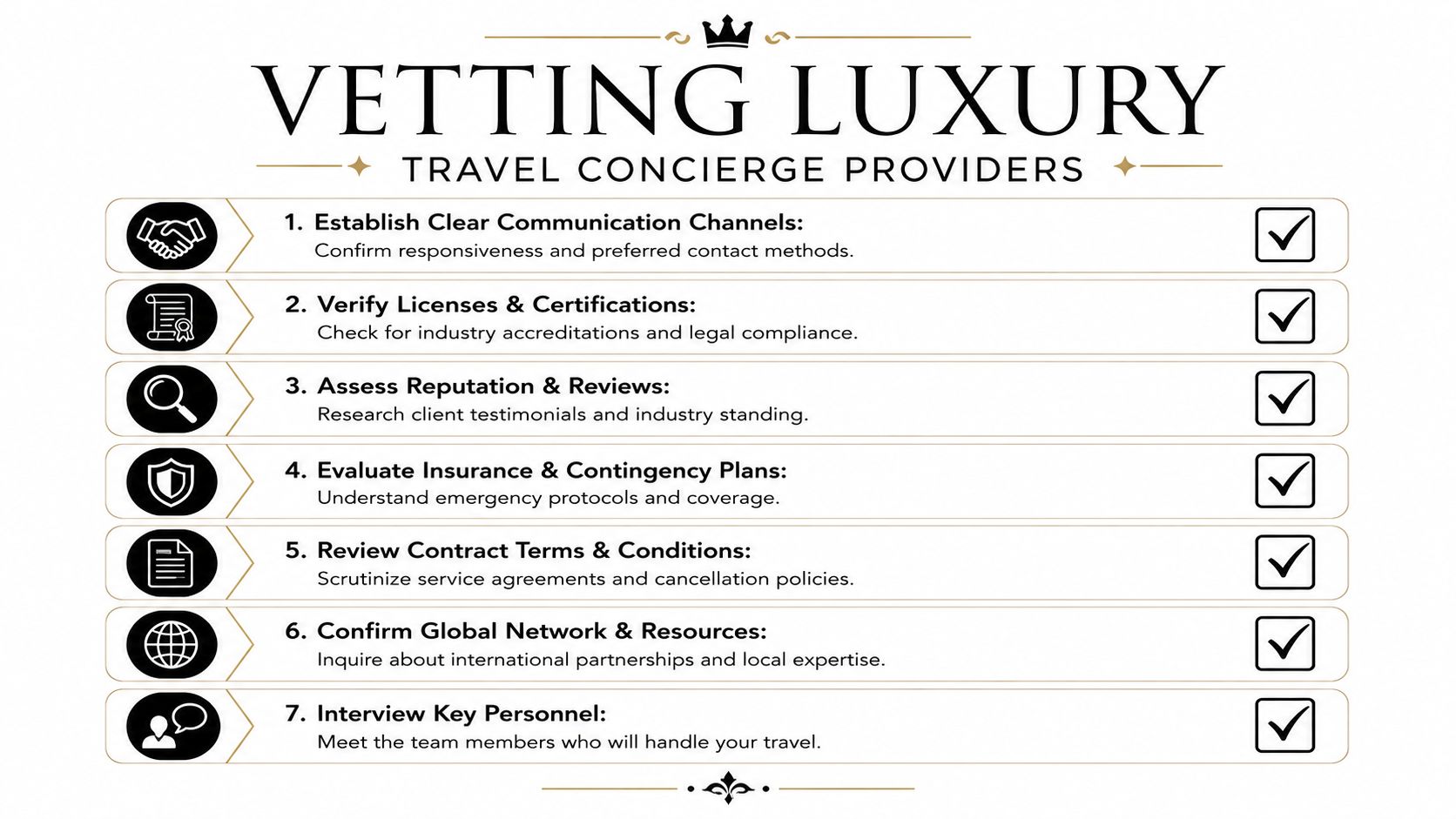
Safety starts with proof, not promises. If the provider is arranging private aviation or complex transfers, ask for the operational standards they use. Haute Jets states that it works only with operators holding Wyvern Wingman or Argus Gold/Platinum ratings, which are widely treated as the two highest third-party safety audits in private aviation.
The questions that separate real operators from middlemen
Start with communication. Industry statistics cited in 2026 reports say concierge services respond in about 90 seconds on average, and 80% of clients rate response time as “very important” (Zipdo). That doesn't mean you should expect instant miracles in every case, but it does mean slow replies are a service failure, not a personality quirk.
Ask these questions before you commit:
- Who handles the trip end to end? You want named personnel, not a rotating inbox.
- What are your backup protocols? If the first aircraft, car, villa, or booking fails, what's the second move?
- How do you confirm details before departure? Serious operators verify the essentials in advance, not after you're already en route.
- Which vendors do you control directly? The more links in the chain, the more room for blame-shifting.
- How do you document safety and insurance? No documentation, no trust.
For private aviation specifically, the internal deep dive on Wyvern and ARGUS safety ratings is the right place to start if you want to understand what those audits signal.
You should also look at FBO quality, because the terminal experience is part of the trip. Clean handoffs, clear passenger processing, and coordinated ground support matter more than one might assume. If the provider can't explain how they handle airport-side logistics, they're not operating at the level luxury travelers need.
For ground transport, I'd rather see a vetted network than a vague promise. If a trip depends on luxury cars, insist on named vendors, not a generic reassurance. A resource like our trusted car hire providers is useful precisely because it shows how supplier screening should feel, specific, accountable, and documented.
Real World Use Cases for High Net Worth and Corporate Travelers
The value of concierge service becomes obvious in messy itineraries. A multi-generational family trip sounds glamorous until you're managing mobility needs, different arrival times, meal preferences, and baggage logistics across several cities. A good concierge compresses that complexity into one coherent plan.

For celebrities and public figures, privacy is the service. That means discreet arrivals, schedule flexibility, and rapid rescoping when a location leaks or a timing window changes. The win isn't glamour, it's control of exposure.
Where the service earns its keep
Corporate executives need the same discipline, just in a different form. Same-day multi-city travel for board meetings, investor calls, or deal work often collapses without real-time coordination. The concierge value is continuity, because missed connections and poor routing cost more than the airfare delta ever will.
Sports teams and entertainment productions are even less forgiving. They move people, equipment, and timing-sensitive schedules across multiple destinations. In those cases, concierge support protects the itinerary from avoidable drag, which is an enemy.
Aviation and travel coverage often points out that concierge teams now handle transportation, accommodations, excursions, and real-time adjustments, but the core issue is recovery speed, not branding. That's why disruption handling matters more than aspirational language. If a service can't reroute a trip cleanly, it's not built for high-stakes travel.
When a trip is moving fast, the provider's ability to absorb change becomes the product. That's true whether the traveler is a family moving between villas or a production team trying to keep a schedule intact. The best outcome is the same in both cases, fewer decisions pushed back onto the traveler.
What to Expect During the Booking and Travel Workflow
Good concierge service starts with a sharp intake, not a glossy proposal. You should expect to share the trip purpose, dates, traveler count, timing constraints, destination sequence, luggage or equipment needs, and any privacy or dietary requirements. The more complex the trip, the more the provider needs to know before they quote.
The first response should not be a canned brochure. It should be a structured proposal with realistic options, trade-offs, and timing implications. If the itinerary is for private aviation, the confirmation should be detailed enough that you know the aircraft, crew, weather outlook, and the operational plan before travel day.
What clean execution looks like
A serious provider does the last-mile work early. That includes the day-of timing, FBO coordination, and transfer readiness, so you're not discovering basic details while standing on a curb with luggage. The internal guide on booking a private jet with Haute Jets is useful if you want a concrete example of how organized pre-departure coordination should feel.
Don't accept vague final confirmation.
If a provider can't tell you what's happening 24 hours before departure, they're not controlling the trip.
During travel, the standard should be proactive monitoring. If weather, airport slots, hotel timing, or ground transport change, the concierge should adjust the sequence and tell you what changed before it becomes your problem. That's the difference between a luxury service and an expensive referral list.
Post-trip follow-up matters too. Good teams capture preferences, friction points, and recurring patterns so the next journey is sharper than the last. That memory is part of the product, and it should save time on every future trip.
Common Questions and Next Steps for Affluent Travelers
Luxury concierge services differ from travel advisors because they are built for execution under pressure, not just planning. They also differ from jet card programs because the better providers let you pay for what you need, rather than forcing you into a prepaid structure that may not fit your trip pattern.
Yes, some providers accept cryptocurrency, but that is a payment feature, not a measure of operational quality. The critical question is whether the provider can manage cancellations, reroutes, and day-of changes without turning every adjustment into a billing argument.
If you travel only occasionally, start with a single trip. That one booking will tell you more about communication speed, vendor quality, and disruption handling than any website ever will. If you travel often, look closely at whether a retainer, membership, or on-demand model matches how you move, and whether the pricing stays clear when plans change.
Ask for specifics before you commit. Who answers after hours, how quickly they confirm changes, what happens when a hotel misses a setup, and how fees are handled when an itinerary shifts. Those answers show whether the provider runs operations or just sells access.
The right concierge partner should save time, reduce decision load, and keep the trip intact when plans change. Your next step is simple: request a real trip proposal, then judge the provider on clarity, speed, and how it handles disruption when something goes wrong.
Haute Jets arranges private aviation with a focus on operational control, pre-flight confirmation, and direct-to-owner sourcing, which is exactly the mindset luxury travel concierge buyers should demand. If you want a charter partner that treats routing, timing, and execution as the primary product, visit Haute Jets and compare how it handles your next trip.