The private aviation conversation usually starts in the wrong place. People ask which new jet is hottest. They should ask whether owning one is financially rational.
That matters because this isn't a boutique corner of aviation anymore. The global private aviation fleet sits at about 22,000 aircraft worldwide, the market hit $36.94 billion in 2023, and it's projected to exceed $40 billion by 2028, according to BlackJet's private jet market overview. That scale changes the decision. In a market this deep, access is often more valuable than ownership.
For a first-time buyer or a client who wants the benefits of new private jets, my advice is blunt. Don't fall in love with a delivery slot before you've defined your mission. Range, speed, cabin layout, and dispatch flexibility matter. Prestige matters far less than most buyers think.
The New Golden Age of Private Aviation
About 22,000 private aircraft are already flying worldwide, and the market was valued at $36.94 billion in 2023 with projections above $40 billion by 2028, according to industry data summarized here. That scale changes the buying conversation. A new jet is no longer a trophy purchase first. It is a capital allocation decision.
That distinction matters most for first-time buyers. The premium for a factory-fresh aircraft only makes sense if your schedule, trip frequency, passenger count, and routing justify full ownership. If they do not, chartering late-model aircraft often gives you the same cabin standard and similar performance without tying up millions in a depreciating asset.
New jets have improved where serious travelers feel it. Range is longer. Cabins work better for overnight flights and full business days. Operating economics have improved on select models. You can see that shift in the private jet industry changes shaping 2025, but the practical takeaway is simple. Better aircraft do not automatically make ownership the right move.
Why this moment feels different
The top end of private aviation used to be easier to define. Buy the newest aircraft you could afford, gain schedule control, and accept the carrying costs. That formula is weaker now because the charter market gives clients access to far better equipment than it did a decade ago.
A client evaluating a new jet in 2026 should focus on four questions:
- How often do you need true long-range nonstop flying instead of occasional access to it
- How many annual hours will you fly once the novelty wears off
- Which airports matter most to your family or business and whether the aircraft fits them well
- What is the cost of idle capital versus paying only when you fly
The appeal of a new aircraft is obvious. You control the schedule, the cabin standard, the crew culture, and the maintenance history from day one. The downside is just as clear. You also own the fixed costs, the depreciation curve, and the risk that your mission changes before the aircraft is halfway through its first ownership cycle.
The buyers who do best in this market stay disciplined. They start with mission profile, then compare ownership against charter access on the same routes, with the same passenger load, over a full year. Prestige is part of the equation, but it should never drive it.
New private jets have raised expectations across the category. They have not changed the basic rule. Buy only when your usage supports the cost. Charter when flexibility gives you the better deal.
Market Trends Driving the 2026 Fleet
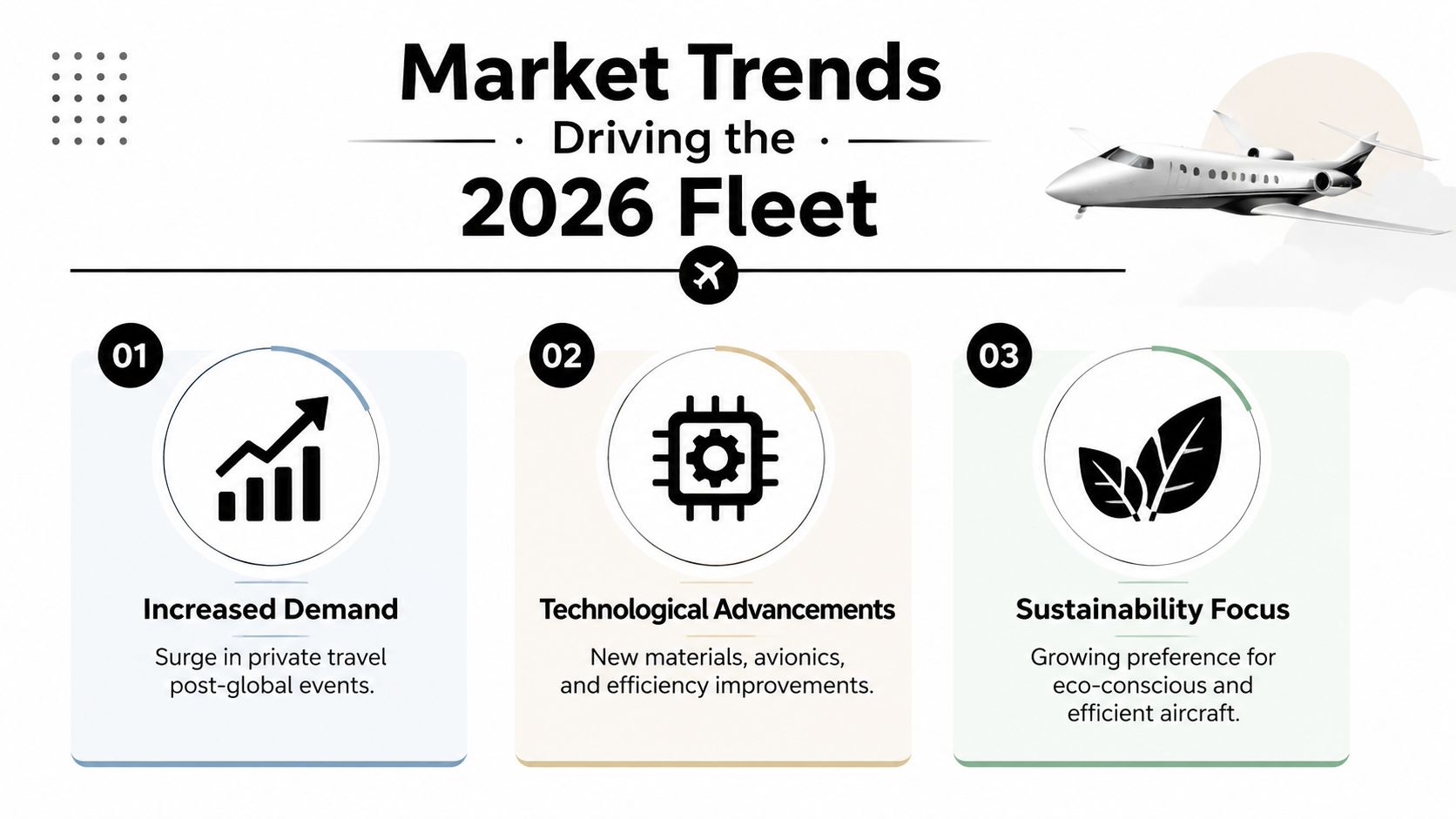
More than 6,000 new private jets are projected to enter the market over the next decade, representing well over $200 billion in aircraft value, according to Stratos Jets' private jet statistics roundup. That level of spending changes how you should evaluate a new aircraft. It expands supply, improves charter access to newer cabins, and raises the standard a purchased jet must meet to justify its cost.
Capital is flowing to aircraft that solve expensive problems
Buyers are not paying premiums for novelty. They are paying for aircraft that remove routing limits, reduce travel time, and give passengers a cabin they can use for work, rest, and privacy on long sectors.
That distinction matters.
A new jet only makes sense if its added capability changes your operating reality often enough to offset fixed ownership costs. If it does not, the same market forces driving new deliveries also work in your favor as a charter client. More new aircraft in service usually means better access to newer fleets without putting your capital into a depreciating asset.
The current fleet cycle is centered on three practical priorities:
- True intercontinental range: nonstop city pairs that reduce fuel stops, overnight delays, and crew complexity
- Cabins built for longer missions: defined zones for meetings, dining, sleep, and family privacy
- Better efficiency: newer airframes and engines that improve trip economics and operating flexibility
Those same delivery trends are also feeding the charter market. New aircraft do not stay confined to owner fleets. They appear in managed programs, charter certificates, and fractional availability. For a client still deciding whether to buy, that is good news. It means the gap between owning the newest product and accessing it on demand is narrower than many first-time buyers assume.
Technology now filters serious buyers from emotional ones
A disciplined buyer asks a simple question. What does this aircraft do for my mission that an excellent charter option cannot do just as well?
Use that standard:
| What changed | Why it matters |
|---|---|
| Longer-range platforms | More nonstop missions and fewer itinerary disruptions |
| Faster cruise profiles | Less total travel time on long-haul routes |
| Better cabin zoning | A more usable cabin for work, sleep, and family travel |
| Modern airframe and engine design | Lower operating friction and stronger long-term mission fit |
If you want a closer look at the technologies pushing the category forward, Haute Jets has a useful read on private jet technologies pushing the industry forward.
Practical rule: Pay the premium for a new jet only if the added range, speed, cabin utility, or airport flexibility materially improves your annual travel pattern. If those gains show up only a few times a year, charter the aircraft type instead of owning the balance sheet exposure.
Flagship Aircraft Defining the New Era
Most articles on new private jets make the same mistake. They list names and quote brochures. That's not how you evaluate a flagship aircraft. You evaluate what it lets you do that your current options don't.
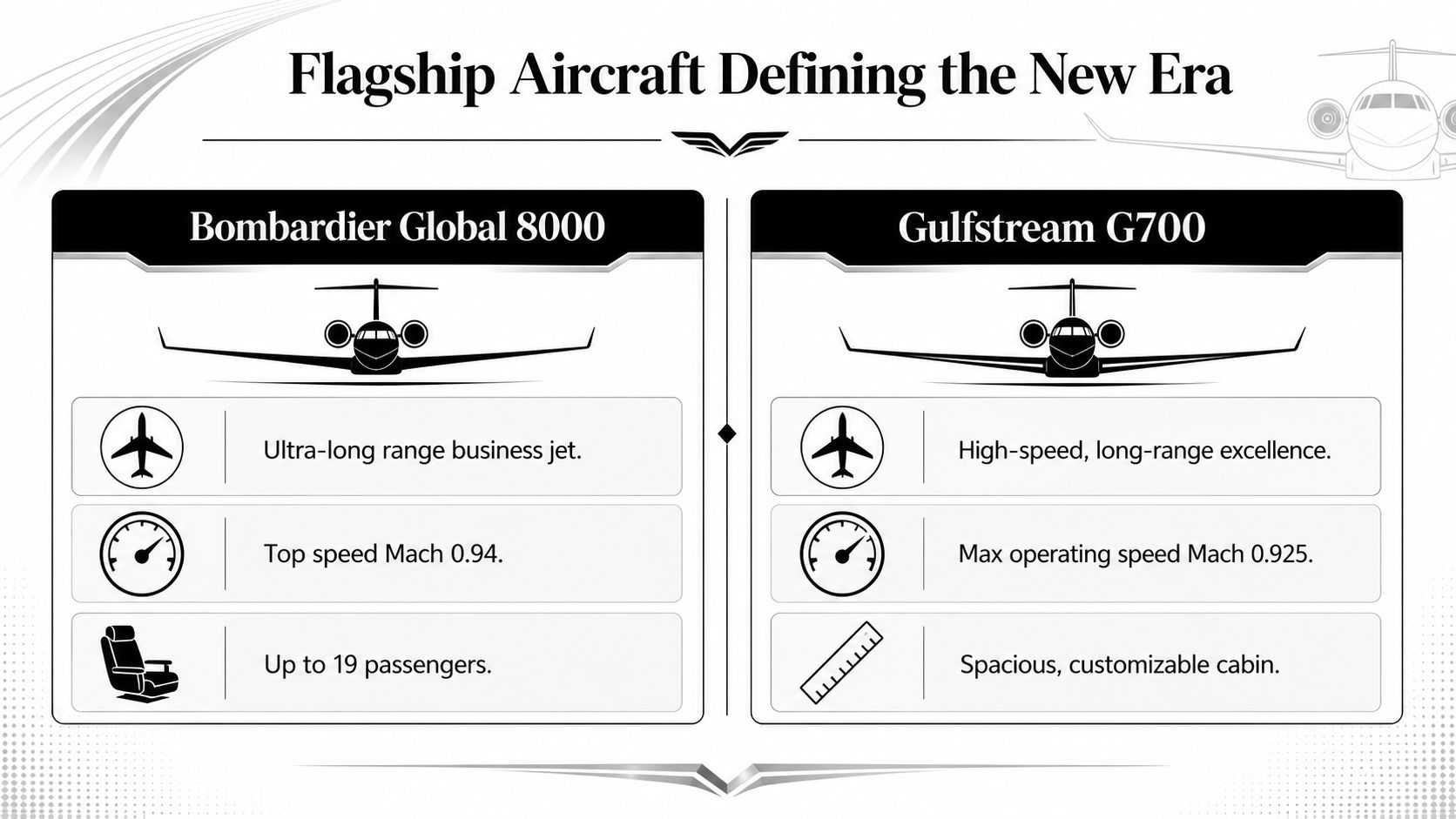
Two aircraft define the current conversation better than anything else: the Bombardier Global 8000 and the Gulfstream G800. Both sit in the ultra-long-range category. Both aim at clients who travel globally and don't want operational excuses.
Bombardier Global 8000
The Global 8000 matters because it translates extreme range into practical utility. It offers 8,000 nautical miles of range and integrates four distinct living spaces, which is an unusual cabin proposition in this segment.
Bombardier pairs that cabin concept with serious performance. The aircraft uses GE Passport engines delivering 18,920 lbf of thrust, supports high-speed cruise at Mach 0.92, and can operate routes such as New York to Dubai or Los Angeles to London nonstop. For clients who have historically planned around fuel stops, that changes the rhythm of international travel.
The part that deserves attention isn't just the headline range. It's the fact that the aircraft is designed to keep speed without surrendering the mission. If you regularly move leadership teams across continents, that's meaningful.
Gulfstream G800
The G800 takes a slightly different angle. It leans into speed-to-range efficiency. Certified in April 2025, it offers a maximum range of 8,200 nautical miles, a long-range cruise at Mach 0.85, a high-speed cruise of Mach 0.90, and a maximum operating Mach number of 0.935.
That gives it a practical edge for clients who care about shaving time without giving up distance. The aircraft can complete New York to Dubai in under 15 hours, and Gulfstream's layout supports five living areas with 19-seat capacity. It's built for serious global use, not occasional bragging rights.
Another point in its favor is operating flexibility. The G800 is described as able to access 98% of paved runways globally, with a takeoff distance of 1,827 meters under ISA/MTOW conditions. That combination of range and airport flexibility is what makes it relevant to multinational families, boards, and principals with shifting itineraries.
Which one deserves your attention
If your priority is a refined long-haul cabin with major nonstop capability, the Global 8000 is compelling. If your priority is pushing maximum distance while preserving strong cruise performance, the G800 is hard to ignore.
Here's the clean comparison:
| Aircraft | Best fit | Standout strength |
|---|---|---|
| Bombardier Global 8000 | Clients who value cabin zoning and nonstop intercontinental utility | Four living spaces and 8,000 nm range |
| Gulfstream G800 | Clients who prioritize range plus fast long-haul execution | 8,200 nm range and strong speed profile |
Buy for mission profile, not for cocktail-party recognition. At this level, the wrong flagship is just an expensive mismatch.
To Buy or To Charter New Jets
A new ultra-long-range jet can require an initial outlay of roughly $72.5 million to $80 million, according to Business Jet Traveler's coverage of new and upcoming business aircraft. That figure gets attention. The real decision starts after it.

Ownership makes sense for a narrow type of client
I recommend ownership only for clients with a repeatable flight pattern, a clear need for control, and the appetite to run an aviation asset properly. If you want dedicated crew, consistent cabin setup, brand control, and year-round availability for a specific mission profile, buying can be justified.
That said, the purchase price is only the first commitment.
In my experience advising first-time buyers, the bigger surprise is not acquisition. It is everything attached to acquisition: crew payroll, maintenance planning, insurance, hangar contracts, compliance, scheduling oversight, and the fact that your aircraft will still have downtime. If you decide to buy, use an experienced acquisition team and compare factory delivery positions with late-model pre-owned options. DuBois Aviation aircraft sales is a practical starting point if you want to see how the market looks beyond the manufacturer brochure.
Charter often delivers better value
For many clients, chartering a new or nearly new aircraft is the sharper first move. It gives you access to the right tool for each trip without tying up capital in one jet that will be excellent for some missions and wasteful for others.
That matters more than prestige.
A nonstop business trip to the Gulf, a winter family rotation into a mountain airport, and a short-notice domestic meeting run do not call for the same aircraft every time. Charter lets you match cabin size, baggage volume, runway performance, and range to the actual itinerary. You pay for use, not for idle days, fixed overhead, and depreciation.
If you want a structured way to evaluate that tradeoff, Haute Jets has a practical private jet purchase guide which outlines the acquisition process in plain terms.
My recommendation
Start with charter unless your travel pattern already proves the case for ownership.
Use this filter:
- Map your real flying, not your aspirational flying. Review the city pairs you expect to fly over the next 12 to 24 months.
- Measure passenger and baggage patterns. A jet that works for four executives may be wrong for a family of eight with ski equipment.
- Price the full ownership stack. Include staffing, maintenance exposure, insurance, hangar, and replacement lift during downtime.
- Test whether factory-new changes the mission. If a newer pre-owned aircraft covers the same trips with little compromise, keep the capital.
The premium for a brand-new jet is justified only when it buys a real operational advantage, not a better photo on the ramp.
Decoding Jet Capabilities Range Speed and Mission
Most buyers focus on the wrong labels. Light jet, super-midsize, ultra-long-range. Those categories matter, but only as shorthand. What matters more is mission.
Think of aircraft selection the way you'd think about a car collection. You wouldn't use the same vehicle for city errands, family touring, and cross-continent driving. Private aviation works the same way.
Three ways to think about the market
Light jets are your quick-response tools. They suit short regional flying, smaller parties, and trips where airport convenience matters more than cabin sprawl.
Midsize and super-midsize jets are the workhorses. They handle longer domestic sectors and many cross-border missions with a better blend of comfort and efficiency.
Ultra-long-range jets are mobile headquarters. They're built for travelers who want to cross oceans nonstop, work in flight, rest properly, and arrive ready for a meeting or an event.
What range really means
Range is not a trophy number. It's a planning tool.
The Gulfstream G800 is a good example because its performance profile shows how serious aircraft capability changes itinerary design. It offers 8,200 nautical miles at Mach 0.85, and it can also sustain Mach 0.90 for high-speed cruise. That allows a New York to Dubai mission in under 15 hours, which is why this class of aircraft appeals to clients who value both distance and time efficiency.
That doesn't mean you should always choose the longest-range jet available. It means you should understand what uninterrupted mission capability is worth to you.
Match the aircraft to the trip
Use a simple screen before you book or buy:
- Trip length: Are you flying regionally, coast-to-coast, or intercontinentally?
- Cabin purpose: Do you need a quiet rest environment, a team workspace, or just comfortable transport?
- Passenger count and baggage: A sleek profile on paper can become a poor fit fast.
- Airport strategy: Some itineraries depend on getting closer to the final destination, not just crossing distance efficiently.
Clients who adopt this mindset make better decisions. They stop asking, “What's the most impressive jet?” and start asking, “What's the right aircraft for this mission?”
Safety and Sustainability in Modern Private Travel
Luxury means nothing if the safety standard is weak. I don't care how new the aircraft is or how polished the interior looks. Operator quality comes first.
That's why third-party safety vetting matters. In private aviation, Wyvern Wingman and ARGUS Gold or Platinum are the ratings serious clients should look for because they indicate a higher level of independent audit discipline than simple marketing language. If a provider can't clearly explain the operator standard behind your trip, move on.
What to check before you fly
A discerning traveler should expect more than a tail number and departure time. Ask for clarity on:
- Operator safety credentials
- Crew information
- Aircraft-specific details, not just category promises
- Weather and operational planning
- Ground handling coordination
That level of transparency reduces surprises and tells you whether the provider runs a disciplined process or a sales process.
Safety is not a feature. It is the filter that determines whether the rest of the conversation matters.
Sustainability needs a practical lens
Many clients want to fly more responsibly. That's sensible, but the discussion should stay grounded in operational reality.
The useful sustainability questions are straightforward:
| Question | Why it matters |
|---|---|
| Is the aircraft newer and more efficient? | Modern designs can improve mission efficiency |
| Is Sustainable Aviation Fuel available for the route? | SAF access varies by airport and operator |
| Can the trip be matched to a right-sized aircraft? | Oversizing a mission is wasteful |
| Are offset options credible and clearly explained? | Poorly defined programs don't help the client make a serious decision |
A smart sustainability strategy in private aviation usually starts with better aircraft matching and cleaner operational choices, then adds SAF where available and credible offsetting where appropriate. Haute Jets has a useful overview of the environmental impact of private jets and sustainable solutions if you want that topic broken down without slogans.
Access the Future of Flight with Haute Jets
The market for new private jets is exciting, but excitement is not a strategy. You don't need to own the newest aircraft to benefit from what the new generation offers. You need disciplined access to the right aircraft for each trip.
For most clients, the practical path is simple. Define the mission. Choose the correct cabin and range profile. Vet the operator standard. Book only what the trip requires.
If you want to approach the market rationally, use a checklist:
- Start with your recurring routes. That reveals whether you need occasional ultra-long-range lift or something else entirely.
- Decide how you value flexibility. If your missions vary, charter usually beats ownership.
- Insist on aircraft specificity. Model, year, layout, Wi-Fi, pet policy, and catering details should be confirmed.
- Keep safety standards paramount. Operator vetting should never be assumed.
- Review buy-versus-charter only after real usage is visible. Your travel history should drive the decision, not vanity.
The right way to experience the future of private aviation is to stay flexible enough to use it intelligently.
If you want a direct assessment of whether you should buy, charter, or wait, speak with an advisor at Haute Jets. They can help you match mission profile, aircraft type, and operator standards before you commit capital or book your next trip.