
You're probably dealing with the same private jet problem almost every frequent charter client eventually hits. You ask for a midsize jet, get quoted quickly, feel good about the rate, and then the details start shifting. The aircraft isn't the one you expected. The operator is nowhere near your departure city. The final number creeps up. By the time wheels are up, you've paid for positioning, accepted a substitute cabin, and still don't have a clear answer on what exactly you bought.
That's why the term Owner Operator Network matters, especially on Haute Jets Journal, where readers expect more than recycled charter sales language. In private aviation, this model is one of the industry's most useful and least clearly explained mechanisms. Most of the public discussion around “owner-operator network” gets pulled into trucking, which leaves a major gap in explaining how aviation networks work for luxury travelers, a distinction RXO's owner-operator deep dive helps expose.
The Hidden Costs of Traditional Private Jet Charter
The classic charter mistake starts with buying a category instead of an aircraft.
A traveler asks for a light jet or super midsize option because that's how many brokers sell inventory. The quote looks clean at first glance. Then the underlying friction appears. A different tail gets assigned. The plane has to be brought in from another market. Catering, Wi-Fi expectations, baggage assumptions, and cabin configuration all become separate conversations. The client thought they were buying certainty. They were buying approximation.
That's where pricing gets slippery. The flight itself may be reasonable, but the movement of the airplane into position can skew the total. If you've ever looked at one charter quote and wondered why it feels disconnected from the route, that's usually the reason.
Traditional charter often hides the biggest cost in plain sight. You're not just paying for your trip. You're paying for where the airplane was before your trip started.
Most online explanations won't help much, because the phrase owner operator network is still badly muddled. Search results often drag you into freight boards, trucking dispatch, and driver load matching. That has almost nothing to do with the way a private aviation network should be evaluated.
If you're trying to understand charter pricing, start with one question. Is the aircraft already near you, or are you funding someone else's repositioning problem? If you need a benchmark for how charter pricing is typically framed, Haute Jets' private jet charter cost guide is a useful place to compare how route, aircraft, and sourcing affect what you pay.
What frustrates sophisticated flyers most
- Aircraft swaps: You approve one expectation and receive another.
- Opaque sourcing: You're told the plane is available, but not where it's based.
- Layered pricing: Fees appear after the initial quote feels settled.
- No tail-level transparency: You know the category, not the specific aircraft.
That frustration is exactly what the aviation owner-operator model is built to remove.
What Is a Private Aviation Owner Operator Network
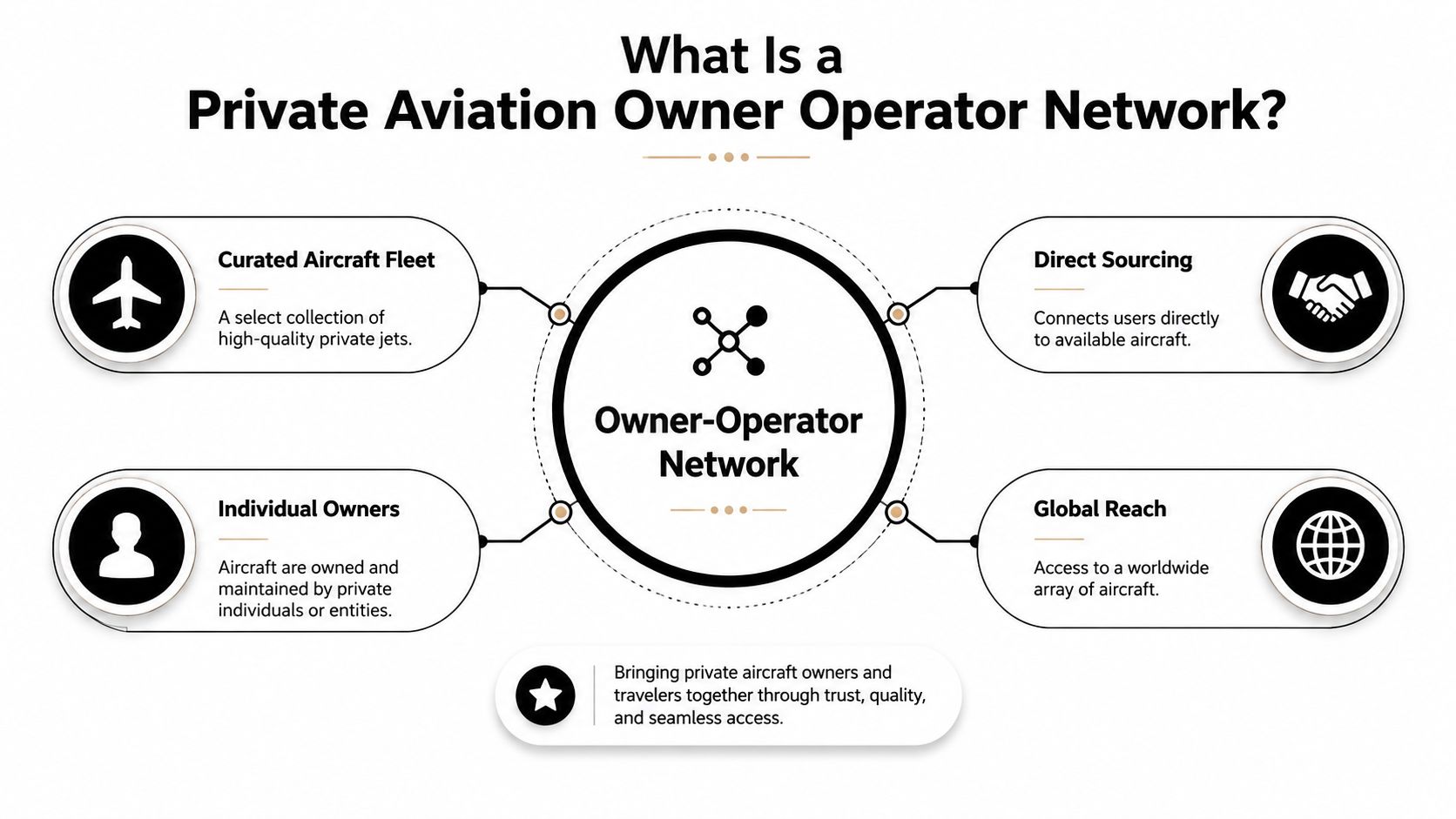
A private aviation owner operator network is a curated supply model in which aircraft owned by individuals, corporations, or operating entities are made available for on-demand charter through a centralized access point. The key distinction is direct aircraft sourcing without forcing the client to vet dozens of operators one by one.
This is not the trucking version of owner-operator. In freight, the term usually points to independent drivers who own and run their trucks. In private aviation, it refers to aircraft ownership and operational access within a highly regulated charter environment.
The structure that actually matters
The model has four moving parts:
- Aircraft ownership: The jet is owned by a private individual, company, or related entity.
- Commercial availability: That aircraft can be offered for charter when it meets the right operating standards.
- Centralized sourcing: A network surfaces real aircraft options from multiple operators.
- Client-side simplicity: The traveler gets one booking path instead of a fragmented operator search.
That matters because private aviation isn't a niche corner of this model. In the business jet market, approximately 45% of all activity is owner-operated, according to FlyCraft's private jet usage statistics. That's not a fringe supply channel. It's a substantial share of how business aviation functions.
Why the model works better than category selling
When you source through a real owner operator network, you're closer to the actual supply. That usually means better visibility into aircraft location, interior, onboard amenities, and operator standards. It also means you can move beyond vague labels like “heavy jet” and evaluate an actual airplane.
The smartest clients ask for specifics:
- What exact aircraft is being offered
- Where that aircraft is based
- Whether it's charter compliant
- What amenities are confirmed, not assumed
Practical rule: If a provider can't identify the actual aircraft early in the process, you're still shopping a category, not a solution.
A proper aviation owner operator network gives you direct access, but not unmanaged access. That distinction is everything. The network should filter supply, standardize vetting, and present aircraft that are commercially usable, not theoretically available.
Key Benefits Unlocking Unprecedented Value and Choice
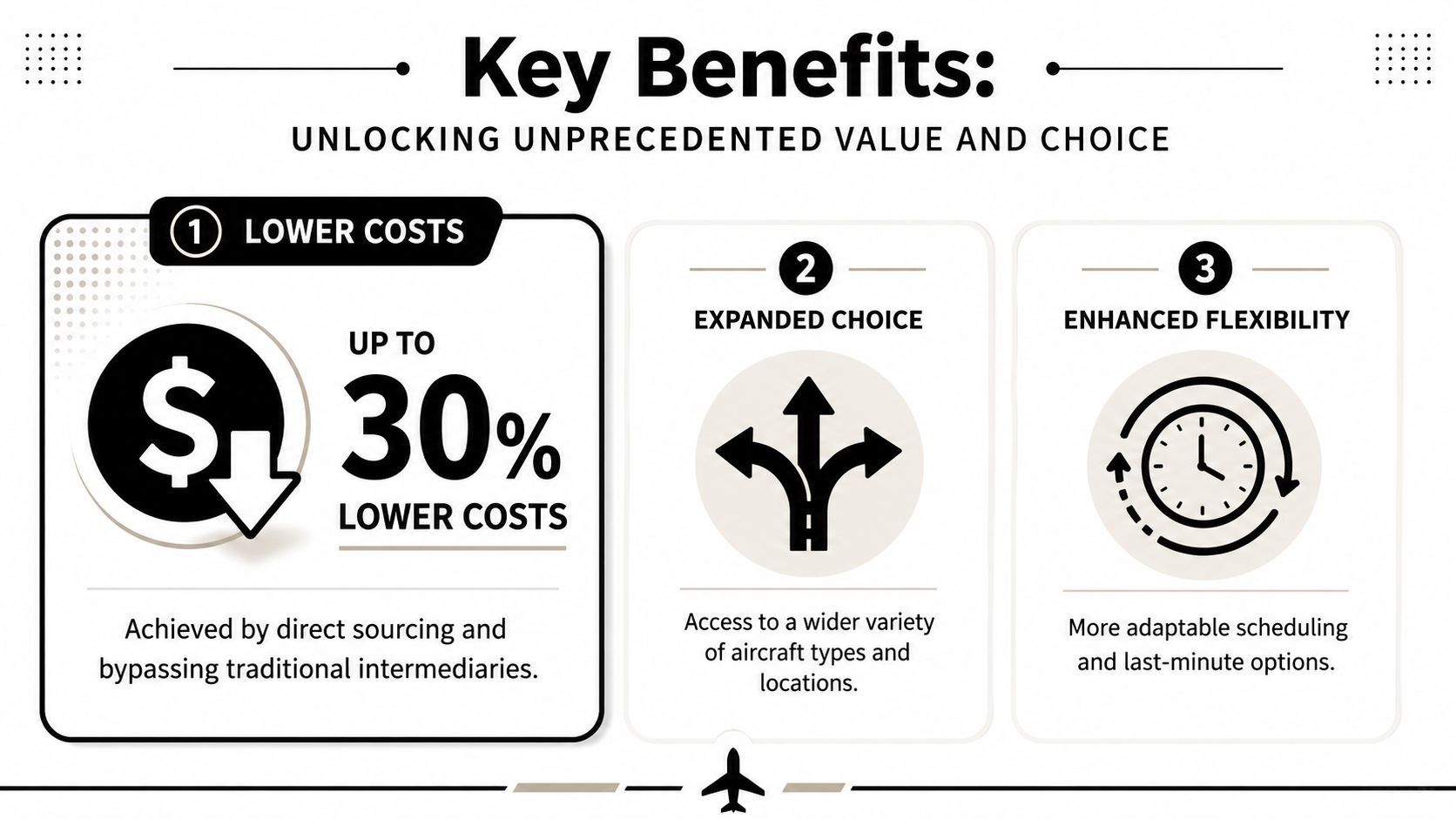
Book a Friday afternoon departure out of Teterboro through a traditional charter channel, and you may get a polished quote that obscures the underlying issue. The aircraft is often coming from somewhere else, the options are narrower than they appear, and the program structure pushes you toward prepaid commitments that serve the seller better than the traveler. By sourcing aircraft directly from owners and operators, this model addresses three common frustrations: inflated costs, limited aircraft choice, and restrictive booking programs.
Lower costs by removing unnecessary positioning
The biggest pricing advantage is simple. You stop paying for bad sourcing decisions.
Traditional charter quotes often carry extra ferry time because the aircraft is not where you need it. In private aviation, that means you can end up funding repositioning legs that add no value to your trip. An owner operator network cuts that waste by finding aircraft already near your departure point and matching the mission to a plane that fits.
That is how serious buyers reduce cost. Not through clever sales language. Through disciplined sourcing.
A better quote usually comes from three things:
- Local aircraft sourcing: Reduces unnecessary ferry flights
- Fewer middle layers: Limits stacked markups between supplier and client
- Specific aircraft pricing: Matches the mission to a real plane instead of a broad category
If you are comparing prepaid programs with on-demand charter, the Haute Jets membership options show the difference between commitment-based access and pay-per-flight sourcing.
A short explanation helps more than another sales pitch, so watch this before you compare options further.
Greater aircraft choice
Category selling compresses the market. An aviation owner operator network opens it back up by giving you access to actual aircraft, not just a label on a quote sheet.
That difference matters more than many first-time charter clients realize. “Super midsize” can describe aircraft with very different cabin dimensions, baggage access, Wi-Fi quality, galley capability, and runway performance. If you are flying executives from New York to Miami, your priorities are different from a family going to Aspen with skis, cold-weather bags, and a dog. The right aircraft is the one that fits the trip, not the one that fits a sales category.
Better choice does not mean endless browsing. It means better fit, faster.
Flexibility without lock-in
Jet cards and similar programs sell predictability by asking you to commit capital upfront. That structure works for some flyers, but it is a poor default for anyone with changing schedules, mixed trip types, or seasonal travel patterns.
The smarter approach is to buy each mission on its own merits. Keep your capital available. Choose the aircraft that fits the route, passenger count, baggage profile, and timing of the trip in front of you.
That flexibility pays off in three common situations:
| Need | Why the network model fits |
|---|---|
| Last-minute departures | It surfaces aircraft already in the market |
| Irregular travel patterns | You are not boxed into prepaid hours |
| Mission-specific trips | You can choose the right aircraft for that exact flight |
If you want lower waste, better aircraft matching, and more control over how you book, this is the private aviation model to use.
Ensuring Elite Safety Standards Through Rigorous Vetting
Some travelers hear “direct access” and assume looser standards. That's backward. In private aviation, direct sourcing only works if the screening is tougher than what the average client could perform alone.
Part 91 and Part 135 are not interchangeable
A privately owned aircraft flying its owner under Part 91 is not the same thing as a charter-ready aircraft operating under Part 135. That distinction isn't paperwork trivia. It's the line between personal use and commercial charter compliance.
According to the technical standards outlined in FlyElite Jets' guide to broker versus operator safety standards, FAA Part 135 compliance is the benchmark for charter eligibility and requires a minimum $50 million aircraft liability insurance policy plus third-party safety audits such as ARGUS Gold or Wyvern Wingman. The same source also notes that Part 135 operations involve recurring pilot training cycles, aircraft-type-specific flight hour scrutiny, and maintenance records with no overdue major inspections.
That's why discerning flyers should stop asking only, “Is it a nice jet?” and start asking, “Under what certificate is this aircraft operating?”
What a serious vetting process should include
A credible network should verify more than availability. It should verify operational legitimacy.
Look for these standards:
- Commercial charter compliance: The flight must be operated under the proper charter framework.
- Third-party audited safety: Wyvern and ARGUS matter because they review systems a client can't fully inspect from the outside.
- Maintenance discipline: Documentation should be current and complete.
- Pilot qualification review: Training currency and type-relevant experience matter more than glossy branding.
For travelers who want a cleaner understanding of audit systems, Haute Jets' review of Wyvern and ARGUS safety ratings breaks down what those labels are supposed to signal.
Safety in charter isn't about trusting a logo. It's about confirming the operator meets the commercial standard required to carry you for hire.
The right question to ask before you wire funds
Ask for the operating framework, the safety audit status, and the exact aircraft details before payment. If the answers are fuzzy, walk away.
A network only deserves trust when it screens operators tightly enough that the client doesn't have to become their own compliance department.
How Haute Jets Leverages Its Global Network for You
You need an aircraft in Aspen on a holiday weekend. One broker sends a generic light jet quote. Another promises availability, then swaps the plane. A strong owner-operator network fixes that problem by starting with real operator access, then narrowing to aircraft that can perform the trip.
Haute Jets uses that model to give clients one booking relationship with access to owner-operated aircraft and managed fleet options across multiple markets. As noted earlier, the value is not a bigger list of airplanes. The value is getting relevant options without calling half the charter market yourself.
What that looks like in practice
Haute Jets is a clear example of the private aviation owner-operator network in action. In this context, "owner operator network" has nothing to do with the trucking term people often find in search results. Here, it means access to aircraft supply through operators and fleet relationships that can be matched to the mission, instead of pushing clients into whatever one provider happens to control that day.
That changes the booking experience in a practical way. The trip drives the recommendation. The inventory does not.
What discerning travelers should expect
A properly run network should give you:
- Specific aircraft options: Actual jets, not vague category placeholders.
- Trip-fit matching: Range, baggage capacity, airport performance, and cabin layout aligned with the mission.
- Confirmed service details: Wi-Fi, pet policy, catering, and other cabin requests verified before departure.
- Pre-flight transparency: Tail number, operator, and flight details shared before funds move.
- Pay-as-you-fly access: No forced membership or prepaid structure just to get reasonable availability.
A global network only works when someone filters it hard. That is the core service. Experienced charter clients do not need endless choice. They need a short list of flyable, properly sourced options with clear terms and no surprises.
Comparing Charter Models Head-to-Head
Most private flyers don't need ownership. They need reliability, transparency, and a fair price on the aircraft that fits the mission. That's why comparing charter models side by side matters.
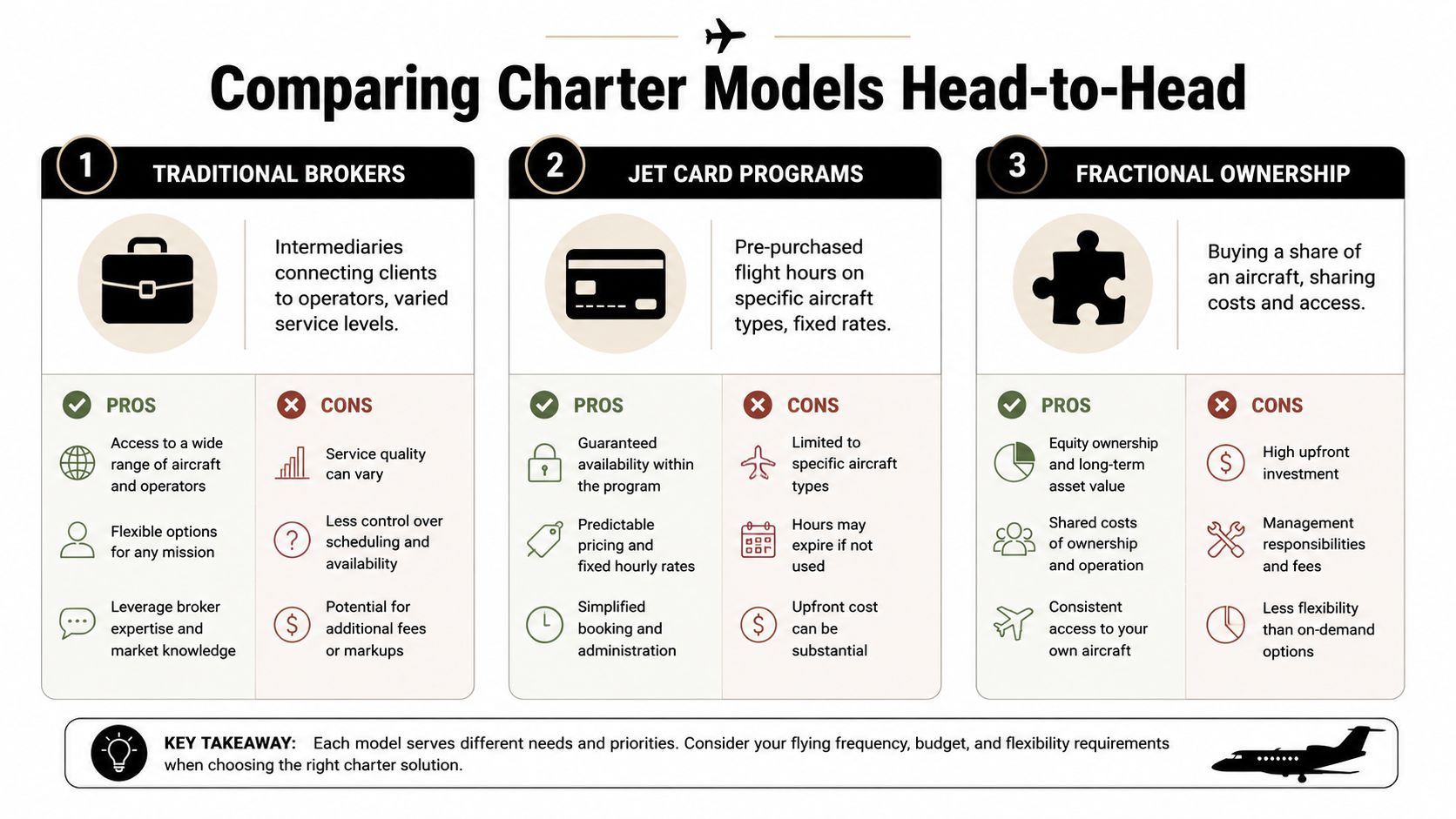
Traditional brokers
Traditional brokers can be useful when the broker knows the market and discloses what they're sourcing. The problem is that many clients never get that level of transparency. They get speed, category labels, and a quote that may not reflect the final aircraft movement behind the scenes.
The upside is convenience. The downside is distance from the actual supply.
Jet card programs
Jet cards sell predictability. Some travelers like that. But the tradeoff is obvious. You often prepay, accept program rules, and narrow your flexibility in exchange for simplified access.
That can work for people with highly repetitive travel patterns. It's less compelling for clients who want aircraft-level choice and don't want capital parked in a flight program they may not use evenly.
Fractional ownership
Fractional ownership makes sense for a small slice of the market. If you want recurring access to a similar class of aircraft and you're comfortable with the economics and administrative structure, it can be rational.
It's still ownership. Ownership brings complexity, fixed obligations, and less agility than many buyers expect.
On-demand owner operator network access
This model gives most travelers the sweet spot. You keep the trip on demand, gain visibility into real aircraft supply, and avoid long-term commitments. You also stay closer to the source of the plane itself, which usually means cleaner pricing and better mission fit.
If you fly privately because time matters, don't choose a model that adds financial or operational drag before the trip even starts.
Here's the practical comparison:
| Model | Cost structure | Aircraft visibility | Flexibility | Transparency |
|---|---|---|---|---|
| Traditional broker | Can include hidden positioning and layered margins | Often category-first | Good, but inconsistent | Varies widely |
| Jet card | Prepaid or commitment-based | Usually aircraft class, not always exact tail early | Moderate | Better on rules than on sourcing |
| Fractional ownership | Ownership costs plus ongoing obligations | Strong within program structure | Lower for irregular flyers | Clearer contract, less nimble use |
| Owner operator network | Pay per trip, tied more closely to actual supply | Stronger aircraft-specific visibility | High | Strong when the network discloses location, operator, and aircraft details |
Which traveler fits which model
- Traditional broker: Fine for occasional users who trust a specific broker relationship.
- Jet card: Better for travelers who value program convenience over aircraft precision.
- Fractional ownership: Better for buyers comfortable with ownership logic and recurring utilization.
- Owner operator network: Strongest for clients who want on-demand access, real aircraft choice, and a cleaner line between quote and reality.
For most discerning travelers, the network model is the more intelligent middle path. It avoids the opacity of casual brokerage and the rigidity of prepaid or ownership-heavy programs.
How to Book Your Next Flight the Smart Way
Booking smart starts with refusing vague answers.
Ask what specific aircraft is being quoted. Ask where it's based. Ask whether the flight is operating under the proper charter standard. Ask what safety audit status the operator holds. Ask what amenities are confirmed, not merely typical.
The questions worth sending before you approve a quote
Use this short checklist:
- Can I see the exact aircraft being offered
- Is the jet based near my departure point
- Is the flight operated under Part 135
- What third-party safety rating does the operator hold
- Will you confirm tail number and trip details before departure
If a provider stalls on any of those, that's your answer.
The smarter booking behavior
Don't lead with “What's your cheapest jet?” Lead with mission facts. Share your city pair, dates, passenger count, baggage profile, pet requirements, Wi-Fi needs, and whether you care about cabin height, lavatory privacy, or nonstop range. Better inputs produce better aircraft options.
Then compare the quote against the actual aircraft, not just the category label. That's how you avoid getting sold one expectation and flown on another.
The owner operator network model works when it's handled with transparency. That means clear sourcing, clear compliance, and clear aircraft-level disclosure from the start.
If you want a cleaner way to charter, Haute Jets offers access to owner-operators and managed fleets through a single booking path, with aircraft-specific quoting instead of category-only selling. Start with your route and requirements, review the exact aircraft options available, and book the trip that fits.