
A private jet from Pennsylvania to California is typically a 5 to 6 hour trip, with an estimated 5h 20m on a midsize jet and 6h 11m on a very light jet for this roughly 2,271-mile mission. If you're weighing that against a 43h 25m drive or the friction of commercial connections, private aviation wins when your schedule matters more than chasing the lowest ticket price.
You're probably making this decision for one of three reasons. You need to be in California the same day without sacrificing the workday. You're moving family or key staff and don't want the uncertainty that comes with commercial airports. Or you've already learned that “PA to California” looks simple in a route search and becomes messy once timing, airport choice, baggage, and ground coordination enter the picture.
That's where experienced charter advice matters. This route isn't difficult, but it is strategic. Aircraft class, nonstop capability, and the airport pair you choose will decide whether this feels effortless or expensive.
Why Fly Private from Pennsylvania to California
The mistake most travelers make is treating Pennsylvania to California as a basic point-to-point trip. It isn't. It's a transcontinental movement that punishes inefficiency.
Public route tools tell you the obvious. Rome2Rio's Pennsylvania to California route overview lists flying at about 7 hours 2 minutes, the cheapest air option at €95–€250, and driving at about 43 hours 25 minutes. Useful, but incomplete. That data answers how long a journey might take in broad terms. It doesn't answer what a time-sensitive traveler should book.
Time is the real budget
If you're an executive, founder, family office principal, or production coordinator, the cheap ticket is rarely the cheap option. Commercial travel adds layers of waste that don't appear on a fare screen:
- Airport friction: Security lines, gate changes, boarding delays, and baggage claims.
- Schedule rigidity: You leave when the airline says, not when your meeting ends.
- Routing compromises: The “best fare” often means a bad connection or an airport far from your final destination.
- Lost productivity: You spend the day traveling instead of arriving ready to work.

Private charter fixes the part of travel that wealthy clients care about. Control. You choose departure timing, avoid the commercial terminal, and build the trip around your day instead of rebuilding your day around the trip.
Practical rule: On a route this long, don't compare private aviation to the cheapest airline seat. Compare it to the value of arriving on time, together, and without operational drama.
The route is simple only on paper
A Pennsylvania departure can mean Philadelphia, Pittsburgh, Harrisburg, or a nearby business aviation field. California can mean Los Angeles, Orange County, San Jose, Oakland, San Diego, or a smaller airport closer to your real destination. The route isn't just PA to CA. It's suburb to campus, estate to studio lot, headquarters to plant, family home to ski house connection.
That's why private aviation works so well here. It compresses complexity. One itinerary, one aircraft, one crew, one schedule.
For clients making this trip regularly, I recommend thinking in terms of door-to-door efficiency, not airfare. Once you do, the logic gets clear fast.
Choosing Your Aircraft for the PA to CA Route
Aircraft selection is where most charter budgets are won or lost. Pick too small, and you risk a compromise on speed, baggage, or fuel-stop flexibility. Pick too much airplane, and you pay for cabin volume you don't need.
For this route, the key fact is straightforward. Air Charter Service's California to Pennsylvania private jet analysis puts the great-circle distance at about 2,271 miles, with estimated flight times of 5h 20m on a midsize jet and 6h 11m on a very light jet. That tells you two things immediately. First, this is a real coast-to-coast mission. Second, aircraft class changes your experience materially.
My view on aircraft classes
For most clients on the Pennsylvania to California route, I'd start the conversation with midsize, super-midsize, and heavy jets. Very light and light jets can make sense in narrow circumstances, but they're usually not my first recommendation for a high-net-worth traveler crossing the country.
| Aircraft Comparison for Pennsylvania to California Flights | |||
|---|---|---|---|
| Aircraft Class | Typical Flight Time | Passenger Capacity | Best For |
| Very Light Jet | About 6h 11m | Small group | Lowest-entry private option when flexibility matters more than cabin space |
| Light Jet | Route-dependent | Small group | Lean travel with lighter baggage and simpler passenger needs |
| Midsize Jet | About 5h 20m | Mid-size group | Most balanced option for nonstop comfort, business use, and reasonable cabin size |
| Super-Midsize Jet | Route-dependent | Mid-size group | Teams that want stronger baggage capability, stand-up comfort, and better transcontinental fit |
| Heavy Jet | Route-dependent | Larger group | Families, executives, or production travelers who want maximum cabin comfort and onboard capability |
What I'd recommend by traveler type
- Solo executive or couple: A midsize jet is usually the right answer. It balances speed, comfort, and mission fit.
- Leadership team or client group: Move up to super-midsize if everyone intends to work, carry meaningful baggage, or arrive fresh for a meeting.
- Family with luggage, staff, or pets: A heavy jet often makes more sense than people expect. Cabin volume changes the tone of the day.
Don't buy a category label. Buy the right cabin for your specific trip. The exact aircraft matters more than the marketing term.
Nonstop comfort matters more than brochure language
This route exposes weak aircraft decisions. A cabin that feels fine on a short East Coast hop can feel cramped over a transcontinental sector. Wi-Fi reliability, lavatory comfort, baggage access, and cabin layout all become part of the decision.
If you want a broader framework for matching aircraft to long sectors, Haute Jets' journal piece on the best private aircraft for long-distance travel is a useful companion read.
My advice is blunt. If the trip matters, don't optimize for the smallest jet that can technically do it. Optimize for the smallest jet that can do it well.
Deconstructing the Cost of a PA to California Charter
Charter pricing confuses first-time clients because they expect a single clean number. That's not how this market works. Consider a high-end restaurant bill. The main course drives the total, but the sides, service, and extras decide what you pay.
The main course is the aircraft itself. Everything else attaches to that choice.
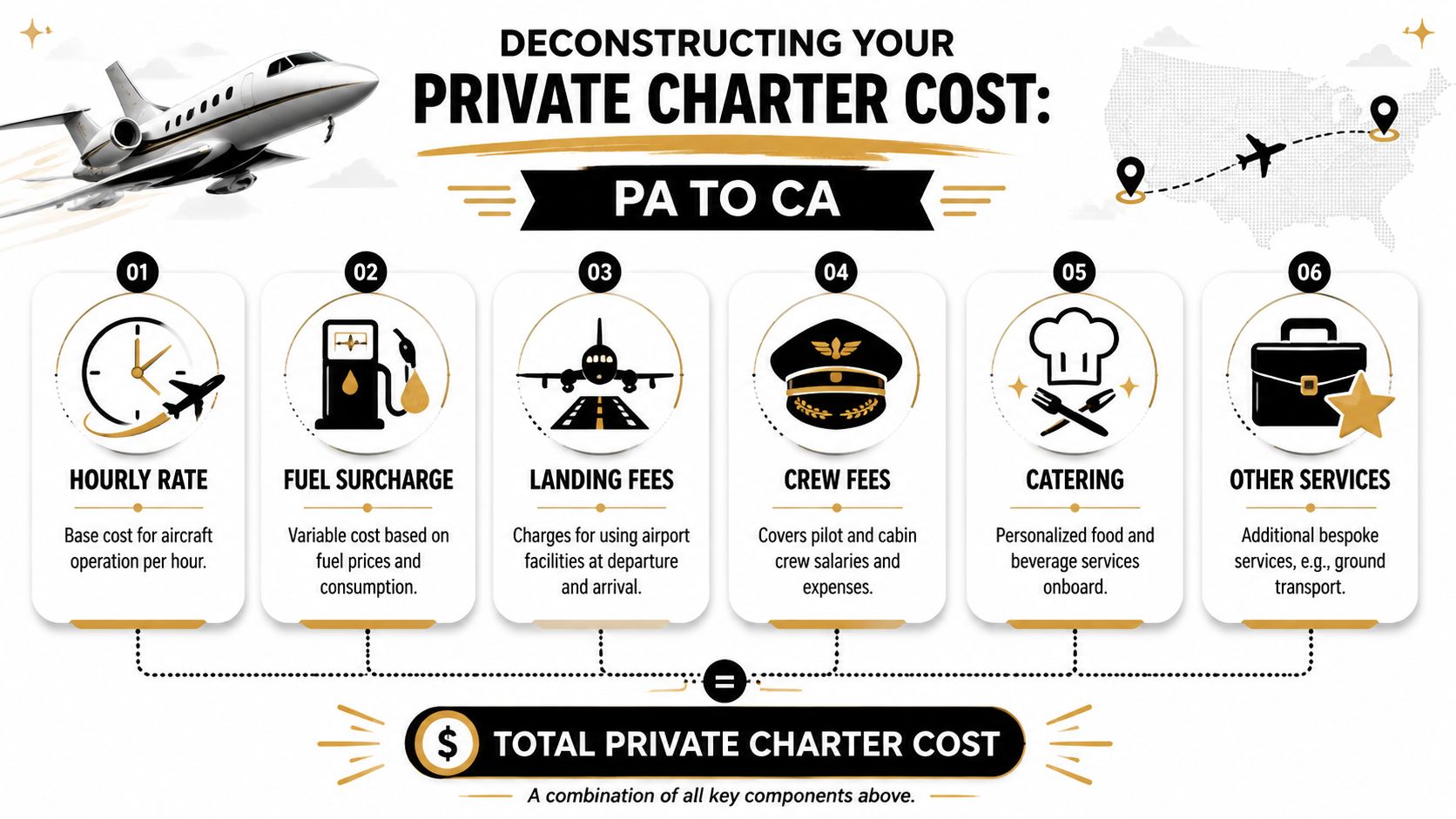
What actually makes up the charter price
Here's the cost stack I walk clients through:
- Hourly aircraft rate: This is the base operating cost tied to the specific jet.
- Fuel surcharge: Fuel moves. So does this line item.
- Landing and handling fees: Airports and FBOs charge for access and service.
- Crew costs: Pilot expenses and duty-related logistics are part of the trip.
- Catering: Minimal requests and full bespoke service price differently.
- Ground extras: Cars, special handling, pets, and last-minute requests add up.
That's why two quotes for “the same route” can look very different. They may not be quoting the same aircraft quality, airport strategy, or operator position.
What pushes the price up or down
A few variables matter most:
Aircraft class
Bigger jets generally cost more, but they can also deliver better nonstop performance, more comfort, and stronger baggage flexibility.
One-way versus round-trip
One-way trips can be efficient or expensive depending on where the aircraft is based and where it needs to go next.
Repositioning
Many clients overpay in this situation. If your broker brings in an aircraft from another city, you may end up covering that movement indirectly.
Airport pairing
Smart airport selection can reduce operational friction and, in some cases, simplify the whole mission.
A cheap-looking quote often becomes an expensive flight once you inspect positioning, airport choice, and the actual aircraft being offered.
For a plain-English breakdown of how these charges usually work, see Haute Jets' private jet charter cost guide.
My recommendation on cost strategy
Don't ask for the lowest quote. Ask for the cleanest quote. You want to know:
- Which exact aircraft is being quoted
- Whether it's local to your departure area
- Whether the trip is planned as nonstop
- What onboard services are included
- Which airport pair is being used and why
One factual model worth noting is that Haute Jets says it sources from nearby owner-operators and avoids membership structures, which is operationally relevant because local sourcing can reduce repositioning exposure and the pay-per-flight model keeps the transaction simple. That doesn't remove the need to compare options carefully, but it does point you toward the right questions.
If you care about value, focus on fit, not just sticker price. The right aircraft near your departure airport often beats a “deal” on the wrong airplane.
The Best Departure and Arrival Airports
Airport strategy is where seasoned clients separate themselves from first-time charter flyers. If you default to the biggest name airport in each city, you'll often add congestion, ground delays, and unnecessary drive time.
Private aviation works best when you use airports built around private aviation.
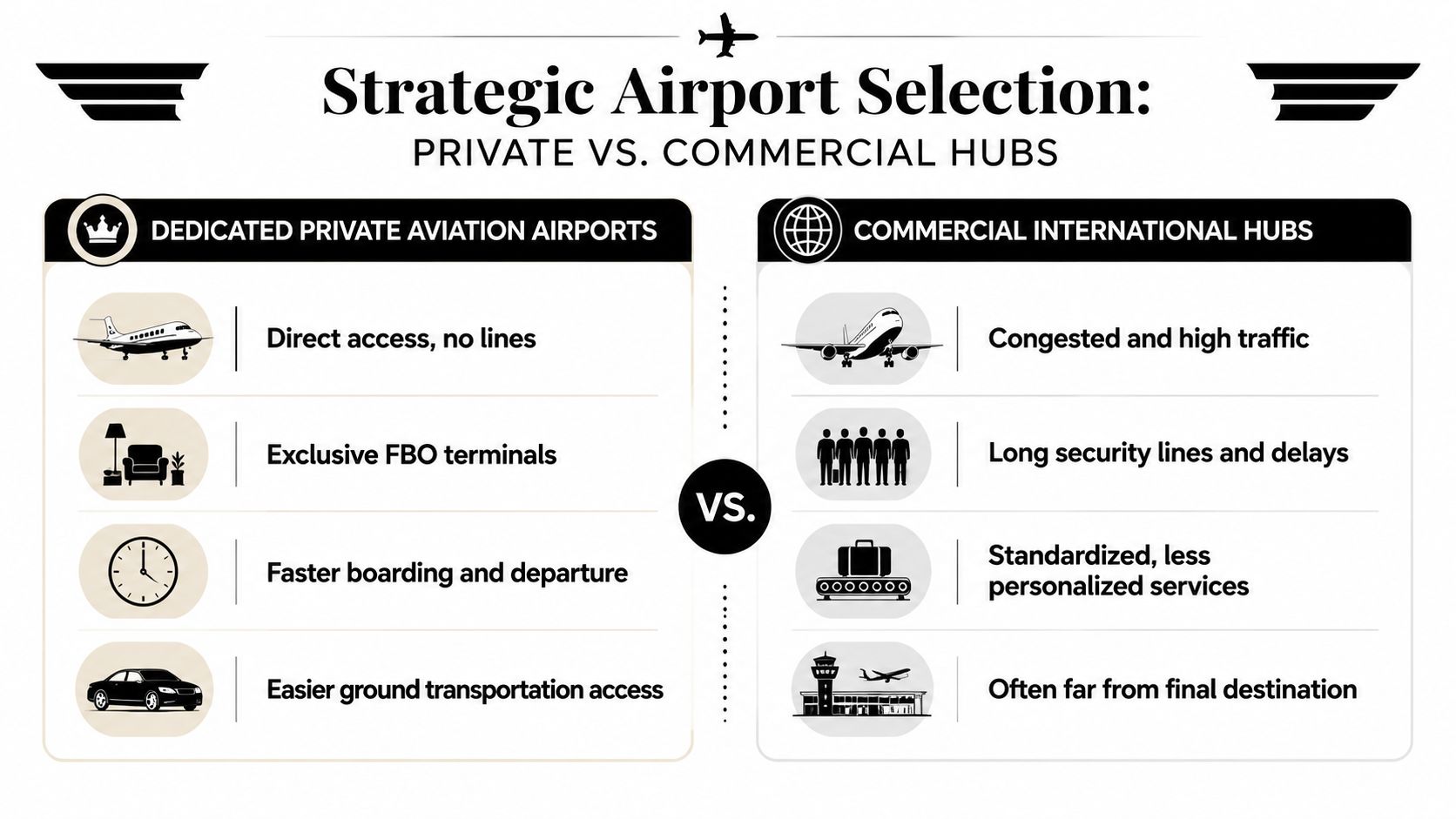
Why dedicated private airports usually win
A strong FBO airport gives you what the commercial hub can't:
- Direct access: You drive up close to the aircraft instead of navigating a commercial terminal.
- Faster turns: Boarding is cleaner and departure is usually more efficient.
- Privacy: Better for executives, public figures, and family travel.
- Better car logistics: Chauffeur pickup and drop-off are simpler.
Smart airport thinking in Pennsylvania
Pennsylvania isn't one market. It's several. Your departure choice should depend on where you are, not which airport your assistant recognizes first.
Consider these patterns:
- Philadelphia area travelers: A reliever airport can be more practical than the main airline hub.
- Pittsburgh-based travelers: Business aviation fields often create a smoother same-day departure.
- Central Pennsylvania clients: Smaller regional airports can cut hours of ground hassle from the itinerary.
There's a historical footnote worth mentioning because it catches people off guard. California, Pennsylvania is a real borough founded in 1849, named for the gold rush, with a population of 5,479 in the 2020 census. If someone says they're flying from “California, PA,” make sure your team confirms whether they mean the borough in Washington County or the state departure region. It sounds obvious until a rushed travel day proves otherwise.
The right airport is the one closest to your real life, not the one with the biggest terminal.
Smart airport thinking in California
California is even more sensitive to airport choice because traffic patterns and final destinations vary so much.
A few practical examples:
- Los Angeles basin: A private aviation airport can be far more efficient than a major international hub.
- Bay Area: The right field depends on whether you're heading to San Francisco, Silicon Valley, Marin, or wine country.
- San Diego: Smaller private-friendly airports often create a cleaner arrival than the largest commercial gateway.
My rule is simple. Start with the address you need to reach. Then choose the airport. Not the other way around.
Finding Value with Empty Legs and Nonstop Options
If you want savings on this route, there are two levers worth understanding. Empty legs and aircraft capability. They solve different problems.
Empty legs are real, but they're for flexible travelers
An empty leg is a repositioning segment an aircraft was already going to fly without passengers. If your timing and routing happen to line up, you can access a private flight without paying for a fully custom mission.
That sounds ideal. Sometimes it is. But empty legs come with a tradeoff: they serve the aircraft's existing movement first, and your convenience second.
Use an empty leg when:
- Your dates are flexible
- Your departure window isn't mission-critical
- You can tolerate changes if the underlying aircraft schedule shifts
Avoid relying on one when:
- You have a board meeting, closing, or fixed event
- You're moving family on a tight clock
- You need a specific airport pair
If you want the mechanics explained clearly, this empty leg flight guide gives a practical overview.
Nonstop is usually the right answer on this route
Pennsylvania to California is the kind of trip where travelers think they're saving money by downsizing aircraft, then lose the savings in time, comfort, and operational complexity.
A smaller aircraft may be workable. But if a fuel stop enters the picture, the day changes. You add another landing, another ground segment, and another chance for delay. For business-critical travel, that's usually the wrong trade.
If the trip is important enough to charter, it's important enough to protect from avoidable stops.
My advice on choosing between the two
Use this framework:
- Choose an empty leg if price sensitivity is high and schedule flexibility is genuine.
- Choose a nonstop custom charter if the trip has real consequences attached to arrival time.
- Choose the larger, better-suited aircraft if comfort, baggage, or onboard work matters.
Clients often ask me whether they should “wait for a deal.” My answer is no, unless your plans are very loose. Empty legs are opportunistic. A dedicated nonstop charter is deliberate. Most high-value travelers need deliberate.
Your Step-By-Step Booking Process
Booking a Pennsylvania to California charter should feel controlled, not opaque. If it feels vague, you're not getting good enough guidance.
The right process is simple, but each step matters.
Define the mission precisely
Don't start with “I need a jet to California.” Start with the actual mission profile.
Include:
- Passenger count: Adults, children, staff, security, pets
- Preferred airports: Or better yet, the actual pickup and drop-off addresses
- Timing: Hard departure, preferred departure, and latest acceptable arrival
- Baggage: Especially golf bags, skis, production gear, garment bags, or pet equipment
- Cabin priorities: Wi-Fi, sleeping capability, enclosed lavatory, catering style
Effective sourcing makes a difference in the outcome. A precise brief gets you a precise aircraft recommendation.
Review exact aircraft, not just categories
You shouldn't be buying “a midsize jet” in the abstract. You should be choosing a specific aircraft with a specific cabin, operator, and configuration.
Ask for confirmation on:
- Year, make, and model
- Cabin layout
- Wi-Fi availability
- Baggage fit
- Pet policy if relevant
- Airport feasibility for your chosen route
That level of detail matters more than glossy sales language.
Vet safety and operator quality
This is not optional. Every charter conversation should include third-party safety standards, operator qualifications, and flight-specific confirmation.
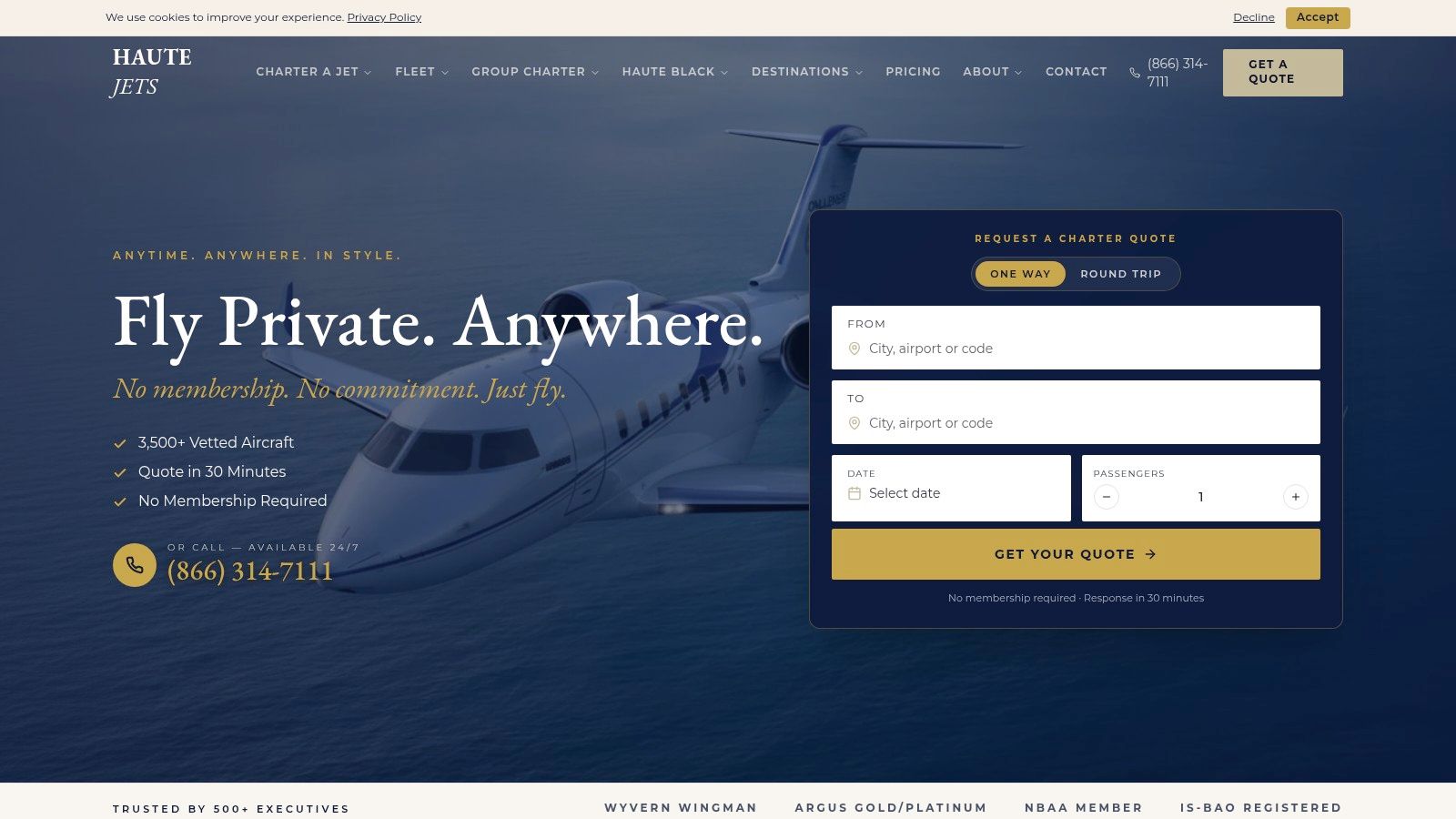
Haute Jets states that every operator in its network holds a Wyvern Wingman or ARGUS Gold/Platinum rating, and that clients receive full pre-flight details including tail number, crew bios, weather briefing, and passenger manifest 24 hours before departure. That's the kind of operational transparency you should expect from any serious charter arrangement.
Here's a look at the booking environment:
Confirm the ground side, not just the flight side
Many charter mistakes happen after the plane is booked. The aircraft is only one part of the trip.
Make sure someone has locked down:
- Chauffeur timing
- FBO name and arrival procedure
- Catering requests
- Special handling for pets or minors
- Return-flight contingencies if needed
There's one more practical issue people overlook when relocating staff or planning ground movement in Pennsylvania. PennDOT's point-based driver system fact sheet states that a driver who reaches 6 points for the first time must complete a special written exam or Driver Improvement School within 30 days, and 11 points or more triggers an automatic license suspension. If your itinerary relies on executive drivers, staff transfers, or local ground operations, administrative details like this matter more than people think.
Book cleanly and keep the payment model simple
For most clients, on-demand charter is the cleanest structure. You pay for the mission you need. No prepaid hours, no membership pressure, no trying to “use up” a program that doesn't fit your actual travel pattern.
That's especially true if your Pennsylvania to California travel is important but irregular. Charter should stay flexible because your life is flexible.
A good booking process leaves you with confidence in five things: the aircraft, the crew, the airports, the timing, and the final invoice. If any of those still feels fuzzy, keep asking questions.
If you're planning a Pennsylvania to California charter and want aircraft-specific options with transparent sourcing, Haute Jets is one on-demand option to review. Ask for exact aircraft, local sourcing details, operator ratings, and a clean nonstop strategy before you sign off.