

You're probably dealing with one of two scenarios right now. A meeting on the West Coast can't move, or your family wants to cross the country without losing a full day to airport friction, delays, connection risk, and the usual parade of commercial travel compromises.
That's what makes Pennsylvania to California such a revealing route. It isn't just long. It exposes every weakness in a travel plan. If you drive, you give away days. If you fly commercial, you hand your schedule to the airline. If you charter badly, you can end up paying premium rates for an aircraft that wasn't even nearby to begin with.
Haute Jets Journal exists for this exact kind of decision. The smart choice on a transcontinental trip is not only the cheapest seat or the flashiest jet. It's the option that protects your time, limits dead cost, and gives you control over the trip from departure to arrival.
The 2700 Mile Question An Introduction
A founder leaves a dinner in suburban Philadelphia knowing they need to be in Silicon Valley by 9 a.m. A family in Pittsburgh wants to reach Napa the same day without dragging children, bags, and a tight connection through two commercial terminals. Same route. Very different priorities. The wrong booking approach fails both of them.
Pennsylvania to California is not a simple airfare decision. It is a long-range scheduling problem with real cost traps. The visible price is only the starting point. The expensive mistakes usually sit underneath it: deadhead legs, weak airport pairing, wasted ground time, rigid airline schedules, and an aircraft that does not match the mission.
That matters on a trip like this because transcontinental charter pricing can swing sharply based on where the aircraft is based, where it needs to reposition, how long it waits, and whether your routing forces unnecessary operating time. Clients who only compare hourly rates miss the part that drives the bill.
What clients usually underestimate
Start with the schedule, not the seat.
On this route, the right questions are:
- Where is the aircraft coming from? If it is not already positioned near your departure point, you may be paying for someone else's empty flight time.
- Which airports fit the trip? The closest major city pairing is not always the smartest or most efficient option.
- How much unproductive time is built into the day? Terminal dwell time, connection risk, baggage delays, and ground transfers all count.
- What level of control do you need once plans change? Coast-to-coast travel punishes rigid itineraries.
A well-run charter model removes a lot of this waste. Haute Jets gives clients access to on-demand aircraft sourcing instead of pushing a fixed fleet from wherever it happens to sit. That reduces the odds of paying inflated repositioning costs and gives you better odds of finding real value on a long domestic mission. If you are weighing private travel against premium airline cabins, this breakdown of private jet vs first class for long-distance travel is a useful place to start.
The headline lesson is simple. On a trip this long, efficiency is purchased before wheels up. Choose the booking model, airport strategy, and aircraft source carefully, or the route will expose every weak decision.
Comparing Your Transcontinental Travel Options
If you're deciding between the road, the airlines, or a private aircraft, compare the whole trip, not the headline fare.
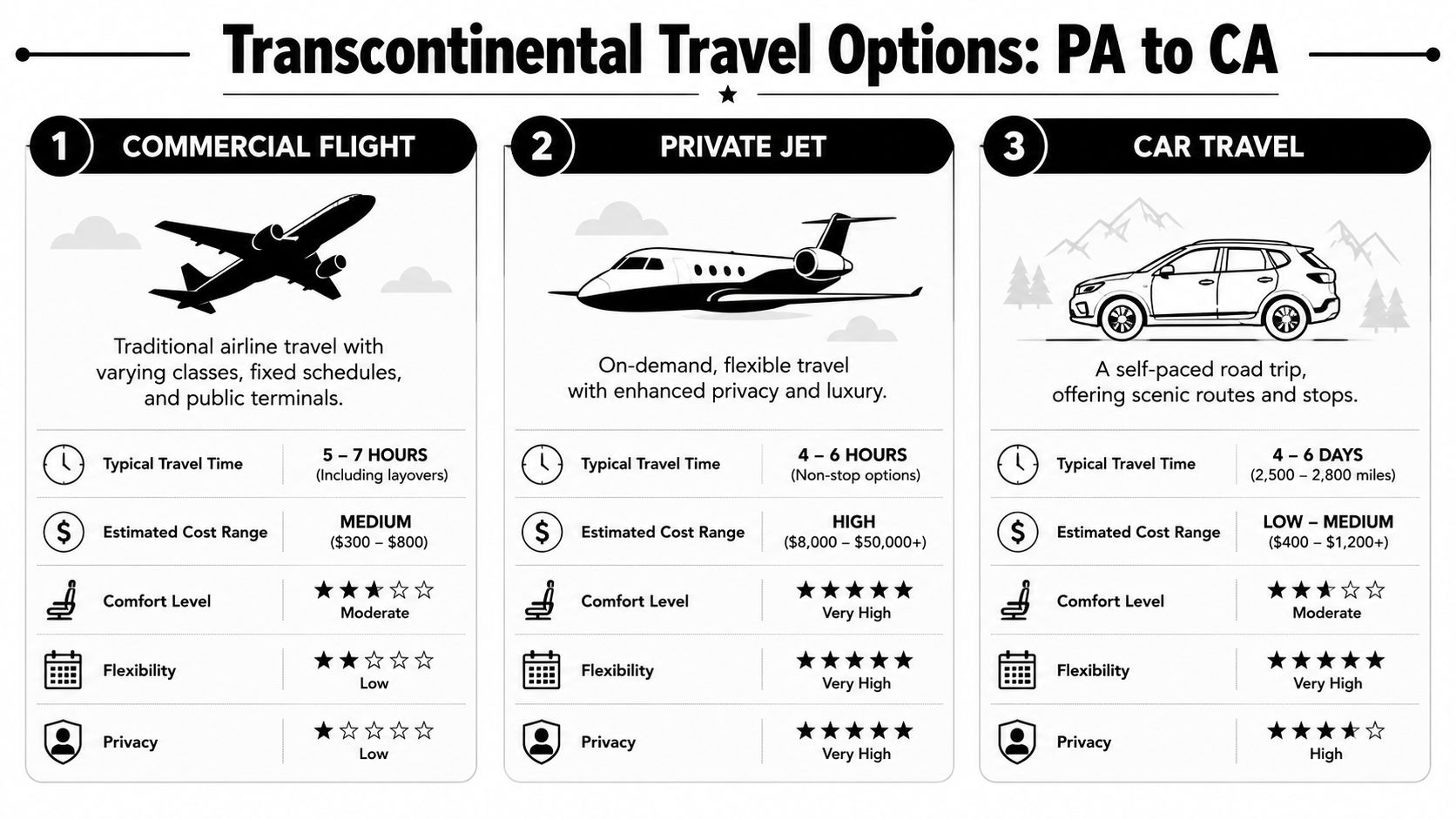
The side by side reality
| Travel method | Time profile | Cost profile | Privacy | Flexibility | Convenience |
|---|---|---|---|---|---|
| Car travel | Multi-day trip with overnight stops | High total trip spend once lodging, fuel, meals, and wear are included | High within your vehicle | Strong en route flexibility, weak overall efficiency | Useful only if the trip itself is the objective |
| Commercial first class | Fast in the air, but still shaped by fixed schedules, airport arrival windows, and public terminal processes | Medium to high depending on route and booking window | Limited | Low to moderate | Better than coach, still built around airline rules |
| Private jet | Fastest door-to-door for time-sensitive travelers | High, but highly variable based on aircraft and sourcing method | Maximum | Maximum | Built around your itinerary, not the carrier's |
That table is the clean version. The lived experience is even more lopsided.
Commercial first class can work if your schedule is forgiving, your destination aligns with major hubs, and you don't mind building your day around check-in timing, terminal movement, baggage handling, and arrival logistics. It still leaves you exposed to delays, crowding, and schedule rigidity. If you want a deeper comparison, Haute Jets has a useful breakdown on private jet vs first class.
Why the gap widens on long routes
On a short route, commercial friction is annoying. On Pennsylvania to California, it becomes expensive in a different way. One delay can force a missed meeting, a later hotel arrival, or an unplanned overnight shift for a family itinerary.
Driving sits at the opposite extreme. You control the stops, but the trip takes over your calendar. That only makes sense if you want the road trip itself.
Private charter changes the equation because it removes the layers that consume executive time:
- Terminal access: You use a private terminal rather than a public concourse.
- Departure timing: You fly to your schedule, not a published bank of departures.
- Arrival logic: You can choose airports that are more practical for your final destination.
- Onboard use of time: The cabin can function as an office, a quiet family environment, or both.
The right comparison isn't airfare versus charter quote. It's controlled travel day versus uncontrolled travel day.
For a client whose time has real value, private aviation stops looking indulgent and starts looking rational.
The True Value of Private Air Travel
Private air travel earns its value on this route long before the wheels leave the ground.

A founder leaving Pennsylvania for Los Angeles doesn't need a better snack basket. He needs a cabin where he can review sensitive material, take calls without an audience, and arrive ready to work. A family heading west doesn't need “premium boarding.” They need a calm, direct experience that avoids packed gates, public delays, and the performance of traveling through a crowded terminal with children, pets, or both.
Privacy is the feature that changes everything
Commercial first class gives you a nicer seat inside a public system. That's all. You still move through the same terminal ecosystem, hear the same gate announcements, and deal with the same interruption risk.
Private charter gives you control of environment. That matters for:
- Confidential business travel: board materials, acquisition discussions, legal reviews
- Family travel: children sleep, routines stay intact, stress stays lower
- Public-facing travelers: celebrities, athletes, and executives avoid unnecessary exposure
The cabin becomes useful, not just comfortable.
Time recovered is value created
There's also a more practical truth. A smooth travel day compounds. When you leave from a private terminal, board quickly, and land closer to where you need to be, the trip stops swallowing the rest of your schedule.
That's why seasoned travelers often choose charter even when they could tolerate first class. They're not paying for status. They're buying back productive hours and reducing variables.
A closer look at the onboard experience helps explain why that matters:
The strategic advantage clients notice immediately
The first private trip usually changes a traveler's benchmark. After that, the pain points of commercial travel become hard to ignore.
You don't notice how much public aviation interrupts your day until you remove the interruptions.
On Pennsylvania to California, that difference is amplified. It's a long enough route that poor process shows up everywhere. It's also long enough that a well-chosen private flight can convert travel time into usable time. For the right traveler, that's the entire point.
Choosing the Right Aircraft for a Coast-to-Coast Flight
Choose the wrong aircraft for Pennsylvania to California and the trip gets expensive in all the wrong places. You feel it in cabin fatigue, baggage limits, slower routing, and repositioning costs that had nothing to do with your actual mission. Choose well, and you control both comfort and total spend.
This route is long enough to expose bad aircraft selection fast. A jet that looks acceptable on paper can feel cramped by hour five, force payload compromises, or price attractively only because the operator plans to recover margin elsewhere. That is why serious buyers look past category labels and focus on the exact aircraft, the actual routing, and where the airplane is based before they approve a quote.
Light jet when the mission is strict and simple
A light jet works for a small party with a tight brief. The right use case is straightforward. Few passengers, limited baggage, and a client who cares more about keeping the charter spend disciplined than stretching out in a larger cabin.
A Phenom 300 is often the first aircraft clients ask about for good reason. It is efficient and widely available. On a transcontinental trip, though, efficiency has limits. Cabin size matters more on this route than it does on a shorter East Coast shuttle, and small differences in space become very obvious over several hours.
Choose a light jet if your priorities are:
- A small passenger count
- Controlled spend
- Minimal baggage
- No expectation of a larger-cabin service environment
Midsize and super midsize are usually the smart buy
For this mission, midsize and super midsize aircraft often deliver the best value. Not the lowest sticker price. The best value.
Aircraft like the Challenger 350 and Citation Latitude give clients what they need on a coast-to-coast flight. Better cabin comfort, stronger luggage capacity, and a trip that still feels efficient from a cost standpoint. That balance matters because the cheapest quote is often attached to the least forgiving aircraft, or to an operator recovering margin through ferry time and other logistics.
If you want a broader view of category fit, review this guide to the best private jets for cross-country travel.
The right aircraft for Pennsylvania to California is the one that protects your schedule, your comfort, and your total trip economics at the same time.
This is also the part of the market where an on-demand model earns its keep. Haute Jets can source from a broad operator network instead of pushing a limited in-house fleet, which gives clients a better shot at finding the right cabin in the right location. That reduces the odds of paying for an aircraft to reposition just so a broker can fill your trip with whatever is easiest to sell.
Heavy jet when the trip needs to feel effortless
A heavy jet is the right call for larger groups, senior executives traveling together, or clients who want a full-cabin experience that matches the distance. A Gulfstream G550 fits here for a reason. You get meaningful cabin volume, stronger range margin, and a service level that makes a long domestic flight feel proportionate to the mission.
Heavy jets make sense when you need:
- More seats without compromise
- Better baggage flexibility
- A cabin attendant and a higher service standard
- Space to work, dine, or rest without crowding
The mistake is booking heavy merely because it sounds premium. If the passenger count is modest and the luggage profile is manageable, a super midsize aircraft often gives you nearly all of the comfort with better cost discipline.
My recommendation by traveler type
| Traveler profile | Aircraft lane |
|---|---|
| Executive traveling with a compact team | Super midsize first, midsize second |
| Family prioritizing comfort and luggage | Super midsize or heavy |
| Larger group with premium expectations | Heavy |
| Cost-aware traveler with a small party | Light jet, only after confirming cabin tolerance, baggage profile, and aircraft positioning |
Do not let a broker sell you category shorthand. Ask for the exact make and model, where the aircraft is coming from, whether repositioning is built into the quote, and whether another cabin in the market would deliver better value on the same day. That is how experienced clients avoid paying transcontinental prices for a mismatched airplane.
Demystifying Private Jet Charter Costs and Hidden Fees
Many charter quotes diverge from expectations. The headline number isn't always the actual figure, and the discrepancy often arises from logistics unseen by the client.
A private jet flight from Los Angeles to Philadelphia requires roughly 4 hours of block time, with light jet charter costs ranging from $41,200 to $65,700, midsize jets from $35,900 to $88,100, and heavy jets from $87,200 to $155,100, depending on aircraft and demand, according to Air Charter Service's California to Pennsylvania pricing overview.
Those ranges are useful. They are not enough.
What actually drives the quote
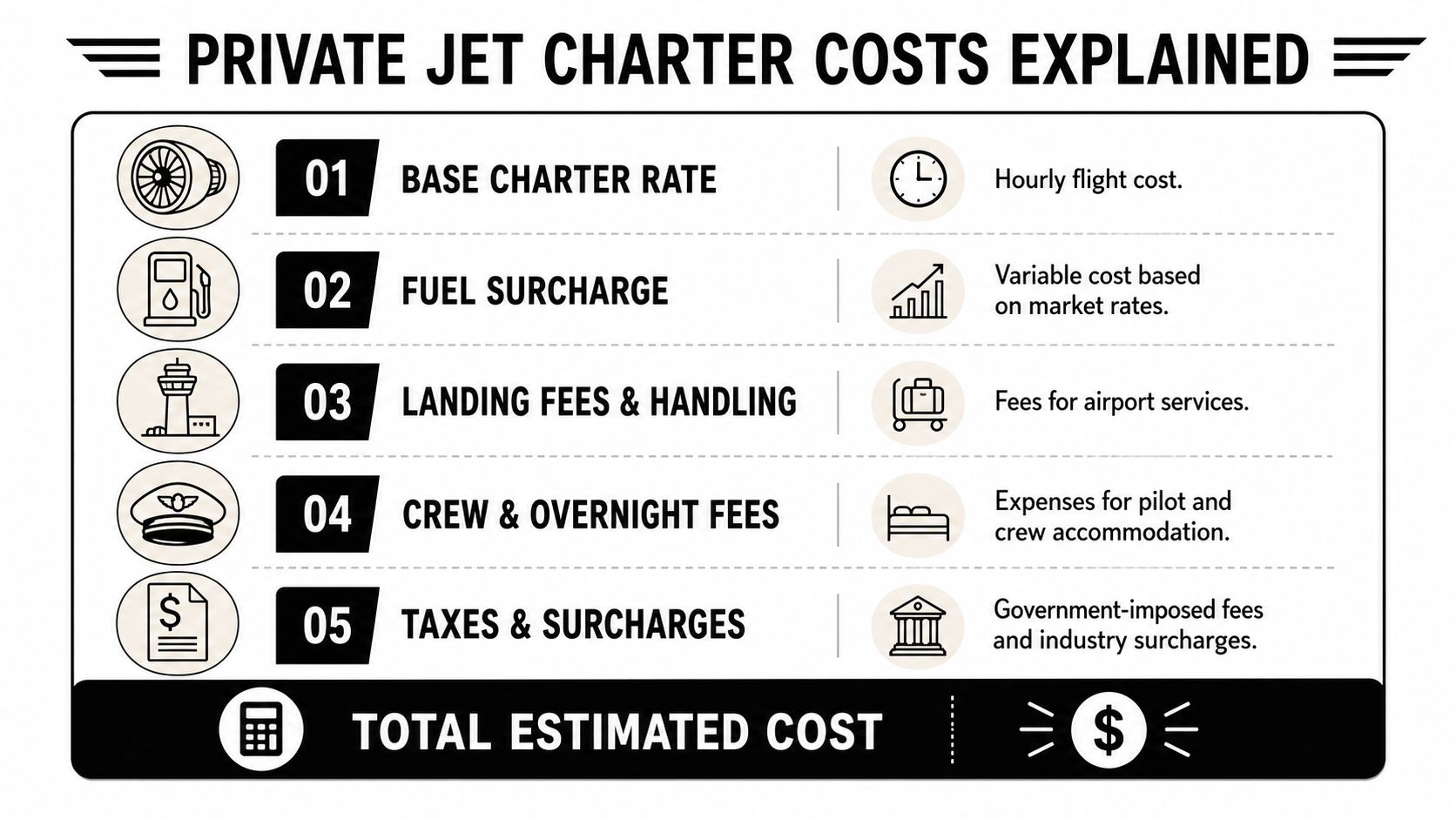
A charter price usually reflects several moving parts. The obvious one is aircraft category. The less obvious ones are where clients get trapped.
Typical quote components include:
- Aircraft time: the primary flight charge
- Fuel exposure: especially relevant on longer domestic sectors
- Landing and handling: airport-specific service costs
- Crew logistics: depending on routing and duty realities
- Taxes and surcharges: mandatory line items, not optional fluff
For a breakdown of how providers structure those numbers, this overview of private jet charter cost is a practical reference.
The hidden fee that matters most
The biggest pricing distortion on Pennsylvania to California is usually repositioning. That means the aircraft isn't where you are. It has to fly empty to pick you up, and you pay for that movement one way or another.
Often, many “good” quotes are anything but good. A quote can look competitive and still include expensive deadhead flying in the background.
The fix is simple in principle and inconsistent in practice. Source aircraft that are already close to departure. That's where the on-demand local sourcing model is stronger than the old broker pattern. Haute Jets, for example, sources nearby aircraft from owner-operators rather than forcing clients into whichever tail is easiest to resell from a distant market.
If the aircraft starts somewhere else, you're often paying for a flight you never take.
Empty legs are real, but they're not magic
Clients hear “empty leg” and assume guaranteed bargain. Sometimes that works. Sometimes it's a poor fit.
An empty leg can reduce cost when your timing matches an aircraft's scheduled reposition. The trade-off is control. The routing exists because of another mission, not yours. If the primary trip shifts, your empty leg may shift with it.
Use empty legs when your schedule is flexible. Don't use them for can't-miss board meetings, fixed events, or family travel where certainty matters more than chasing a lower number.
The quote question to ask every time
Before approving any coast-to-coast charter, ask one direct question: Where is the aircraft positioned right now?
If the answer is vague, the quote probably is too.
The Booking and Travel Process, Simplified
A coast-to-coast charter feels easy only when someone has already handled the details that usually create delays, cost creep, and last-minute surprises.
The Philadelphia to Los Angeles private jet route covers roughly 2,085 nautical miles, and pricing on this city pair often rises sharply when the aircraft is not already aligned with your itinerary, according to PrivateJetCharter.com's Philadelphia and Los Angeles route data. That is why a smart booking process starts with trip design and aircraft sourcing discipline, not a glossy quote.
Start with airport strategy
Set up the mission correctly first.
For Pennsylvania to California travel, the right airport choice can save more time than upgrading the cabin category. Teterboro-style thinking does not apply everywhere. The best option is usually the airport that cuts drive time, reduces ramp congestion, and matches the aircraft range and runway needs cleanly. On the West Coast, that can also mean avoiding the wrong arrival airport and paying for extra ground logistics you did not need.
What a disciplined booking flow looks like
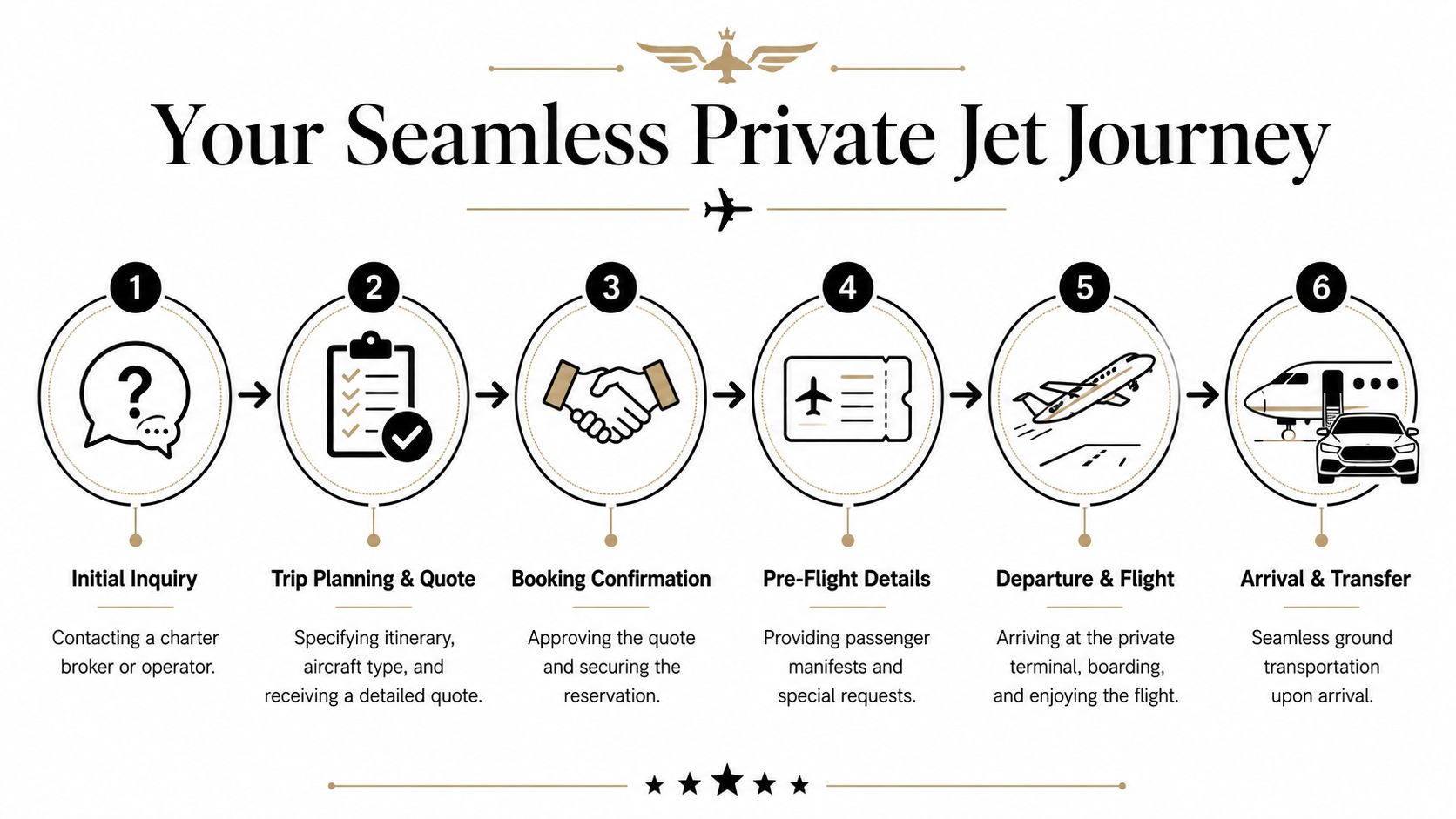
A strong process usually follows this order:
- Trip brief with route, schedule, passenger count, luggage profile, and any pet, catering, or ground transfer requirements
- Airport pairing that reduces drive time and avoids operational friction
- Exact aircraft options with tail-specific availability, not a generic jet class
- Quote review that spells out schedule, amenities, and operator details clearly
- Trip confirmation once the aircraft, crew, and mission fit are approved
- Pre-flight packet with final logistics before departure
- FBO arrival and direct boarding through the private terminal
That order matters. Clients who skip straight to the lowest quote usually end up revisiting details that should have been settled upfront.
What proper transparency looks like
You should know exactly what you are buying before funds move.
That means the provider should confirm the specific aircraft, operator, crew status, and cabin details in writing. If you are traveling with a dog, ask for the pet policy on that exact aircraft, not a general yes. Nandog's complete travel guide is a practical resource for carrier prep and in-cabin comfort, but the operator's approval still controls the trip.
The strongest providers also send a real pre-flight package, including:
- Tail number
- Crew information
- Departure terminal and timing
- Passenger manifest confirmation
- Cabin details such as Wi-Fi, catering, and pet rules
Haute Jets uses that exact-aircraft model and sends a 24-hour pre-flight confirmation package. That is the standard I recommend expecting from any charter provider.
A premium charter process should remove uncertainty and protect your time.
What departure day should feel like
Departure should be quiet, fast, and controlled.
You arrive at the FBO, confirm final details, and board directly. No public terminal, no gate delays, no wasted time fighting airport flow that adds nothing to the trip. For clients used to commercial first class, this is usually the point where the value stops looking theoretical and starts looking obvious.
Frequently Asked Questions for Discerning Travelers
How do I avoid paying for a repositioned aircraft?
Ask where the aircraft is based before you sign anything. A common traveler question is how to avoid paying for repositioned jets. Many guides quote base prices but miss the fact that a jet from Philadelphia to Los Angeles may start at $53,400 and still include a 1,000+ mile repositioning fee. Locally sourcing Wyvern/Argus-rated aircraft is the overlooked fix, as noted in this Pennsylvania private jet charter overview.
Can I bring pets on a Pennsylvania to California charter?
Usually yes, but confirm the policy on the exact aircraft before booking. Pet acceptance, cabin setup, and any cleaning rules vary by operator. If you're traveling with a dog, Nandog's complete travel guide is a useful prep resource because it covers carrier planning and in-transit comfort in a practical way.
What should I expect for Wi-Fi and catering?
Expect variability unless it's confirmed in writing. Some aircraft are well-equipped for working en route, others are better suited to a quiet ride and lighter service. Don't assume. Ask for the exact aircraft details, cabin layout, and onboard amenities in advance.
How do I think about safety without getting lost in jargon?
Keep it simple. Choose operators that hold Wyvern Wingman or ARGUS Gold/Platinum credentials. Those are the third-party standards discerning travelers should insist on. If a provider can't clearly tell you who the operator is and what safety audit they hold, keep looking.
Is a light jet enough for this route?
Sometimes. Often, a midsize or super midsize cabin is the better call. The route is long enough that cabin comfort, luggage profile, and onboard usability matter. Saving money on paper can create a worse trip in the air.
Should I book an empty leg?
Only if your schedule can bend. Empty legs can offer value, but they exist to serve another mission first. If your timing is fixed, book a standard on-demand charter and focus on local aircraft sourcing instead.
If you're planning a Pennsylvania to California trip and want a clean quote on the exact aircraft you'll fly, Haute Jets is a practical place to start. You can review specific jet options, avoid membership structures, and focus on locally sourced aircraft that fit the mission instead of paying for someone else's repositioning problem.