
You're usually not starting from a blank slate when you look for pet friendly charter flights. You already have a destination, a schedule, a dog or cat with a specific temperament, and often a hard constraint that made commercial travel unworkable. The trouble starts when someone says, “No problem, it's a private jet, pets are allowed,” and leaves the real questions unanswered.
That's where bookings fail.
A flight can look perfect on paper and still fall apart because the operator hasn't approved the species, the route changes the import requirements, the arrival airport can't receive the animal under the relevant rules, or the cabin setup isn't right for the pet you're bringing. In private aviation, pet travel can be excellent. It just isn't automatic.
Beyond the Brochure What Pet Friendly Really Means
Most travelers hear “pet friendly” and assume it means one simple thing: the animal rides in the cabin instead of cargo. That matters, but it's only the first filter. The essential booking question is whether a specific aircraft, flown by a specific operator, on a specific route, with your specific pet, is approved from departure to arrival.
That's why I don't treat pet friendly charter flights as an amenity category. I treat them as an operator-screening and compliance exercise.
According to Air Charter Service's guide to pets on private jets, “pet friendly” is not a binary service label. It's a route-by-route problem, especially on international itineraries where country rules, paperwork, and animal-entry requirements can change by destination. That distinction sounds technical, but it's what separates a smooth departure from a last-minute refusal.
What the brochure leaves out
A polished listing may tell you the cabin is spacious and the operator accepts pets. It usually won't tell you:
- Whether approval is automatic or manual for your exact pet
- Whether cats and dogs are handled differently on that aircraft
- Whether the route triggers extra customs coordination
- Whether the destination accepts arrival through that airport
- Whether another party affects the booking, if you're looking at a shared arrangement
Those details aren't small print. They are the booking.
Practical rule: If a provider can't confirm pet acceptance for the exact operator and route before contract stage, the flight isn't really confirmed.
The variables that actually matter
When clients ask what makes a flight pet friendly, I look at four layers first:
| Variable | Why it matters |
|---|---|
| Operator policy | Some operators are comfortable with in-cabin pets, some are selective, and some won't accept certain situations at all. |
| Aircraft layout | Cabin size, seat configuration, aisle space, and restraint practicality affect whether the pet can travel comfortably and safely. |
| Route | A domestic hop and an international crossing are completely different planning exercises. |
| Destination rules | Import requirements can override everything else, even if the flight itself is approved. |
A detail-first charter process is essential. If you're comparing providers, look for one that confirms the exact aircraft, operator, and pet policy in writing before you wire funds. For travelers reviewing options for flying with pets on a private jet, that level of confirmation is more useful than any generic “yes, pets are welcome” statement.
Pet friendly is a planning standard
The cleanest bookings happen when the pet is treated like part of the operating profile, not an afterthought. That means the advisor or broker screens the route first, then the operator, then the cabin fit, then the documentation sequence.
When someone skips that order, they create avoidable risk. The plane may still be available. The trip may not be.
The Pet Friendly Charter Booking Process
The strongest pet charter bookings start with better questions, not faster deposits. You want the provider to validate the trip in layers. First the operator. Then the aircraft. Then the route. Then the paperwork timeline.
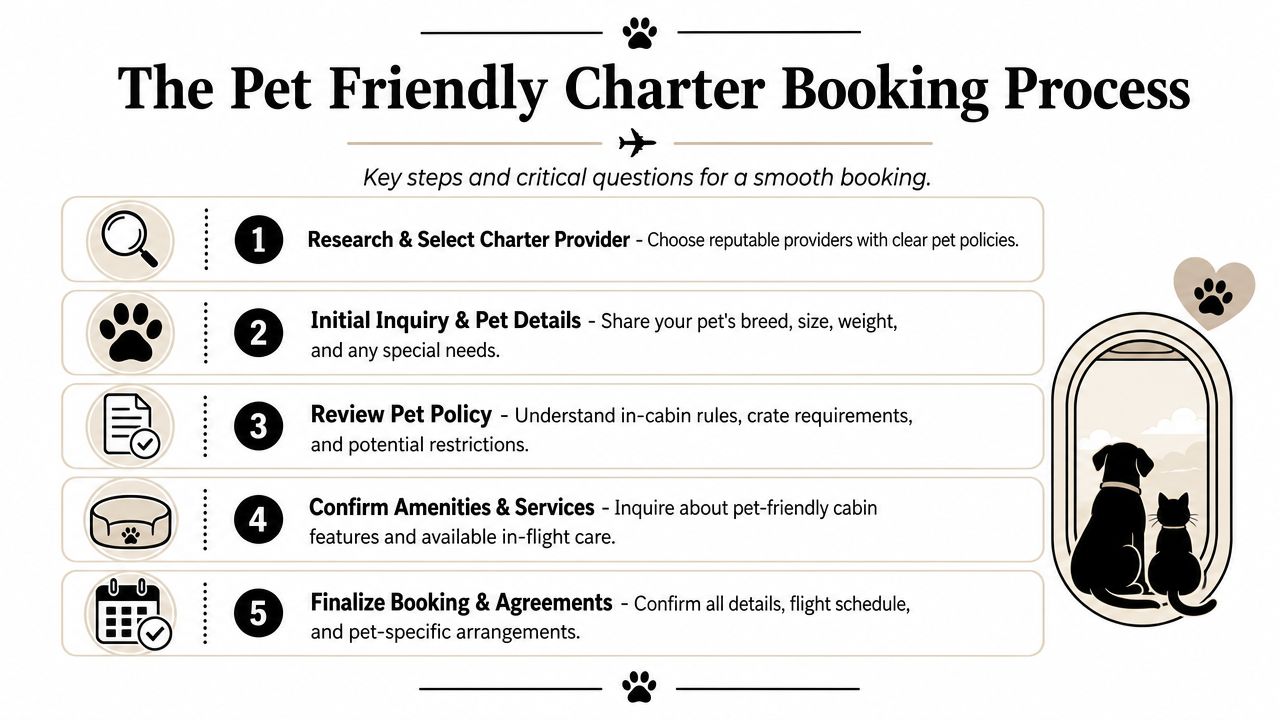
An independent charter guide notes that the practical workflow is to verify the operator's pet policy, complete a veterinary appointment within the required timeframe, prepare documents, and confirm destination customs or import rules before departure. The same guide also notes there is no fixed limit on the number of pets in cabin because the actual constraint is aircraft size and operator policy, not a universal cap, as explained in Iona Jets' private pet travel guide.
Start with a real pet profile
Don't open with “I'm bringing a dog.” That's too vague to get a reliable answer. Give the charter team a usable profile at the first inquiry:
- Species and breed if known
- Approximate size and weight
- Age and temperament
- Whether the pet has flown before
- Whether you expect the pet to stay loose, restrained, or crated
- Any medical or behavioral considerations
- Whether the trip is domestic or international
That profile forces the provider to check something real. It also reduces the chance that a generic yes turns into a later no.
The questions that expose weak screening
Ask these before you review contracts:
Has the operator approved this pet for this route?
Not “Do you allow pets?” Ask for approval tied to the exact itinerary.What are the in-cabin rules?
Dogs and cats may be handled differently. Taxi, takeoff, and landing procedures matter.Is a crate required, optional, or recommended?
Different operators treat this differently, and owners often assume more flexibility than the operator will allow.What documents need to be ready before dispatch?
If the answer is vague, the booking process is still too loose.What happens if the routing changes?
A weather-driven airport change can create a paperwork issue on some international itineraries.
How I vet a provider
I want a provider to do more than source aircraft. I want them to pressure-test feasibility before the booking is locked. That includes confirming the pet policy for the exact tail and operator, not just for the category of aircraft.
One option in the market is requesting a quote through Haute Jets, where the process centers on exact aircraft selection and pre-flight confirmation rather than broad category matching. That model is useful for pet travel because policy details often live at the operator level, not the marketing level.
The better the charter team is at eliminating ambiguity before contract, the fewer surprises you'll have at the terminal.
A simple booking sequence that works
Here's the sequence I recommend in practice:
- Screen the route first: Domestic and international trips behave very differently.
- Match the pet to the aircraft: Cabin layout and operator comfort come before aesthetics.
- Get written policy confirmation: Verbal reassurance isn't enough.
- Align documents to the departure date: Not the other way around.
- Review contingency options: Delays and reroutes affect pets more than most passengers expect.
Pet friendly charter flights go smoothly when the provider treats pet transport as an operating condition. They go badly when someone treats it like a catering preference.
Navigating Health Checks and Travel Paperwork
Most pet charter stress doesn't come from the flight itself. It comes from paperwork sequencing. Travelers often focus on aircraft availability, then discover the harder problem is having the correct veterinary documents, identification, and import approvals lined up for the route they chose.
That's why I separate this into two tracks immediately: domestic and international. Mixing them together causes mistakes.
Domestic travel is simpler, but not casual
For domestic flights, clients sometimes assume private aviation means they can be informal. I wouldn't advise that. Even when the route is operationally straightforward, you still want a recent veterinary review, organized vaccine records, and both digital and printed copies of whatever the operator requested.
Keep the paperwork packet concise and accessible. The goal is to make every handoff easy, from charter team to FBO staff to crew.
A clean domestic file usually includes:
- Current veterinary records
- Any required health certificate
- Vaccination history
- Microchip information if available
- Owner contact details and emergency contact
- Medication list, if relevant
International travel is a document chain
International pet travel is different because one document often depends on another. The microchip must align with the vaccination record. The health certificate has to fit the destination's rules. The import process may be tied to the arrival point, customs handling, or inspection procedures.
Travelers lose time by gathering documents out of order.
Bring both physical originals and digital backups. If your phone dies or a file won't open, the paper set becomes your insurance policy.
As a practical matter, many international trips involve checking destination rules around microchipping and vaccination or documentation requirements, since country rules can differ substantially. That's one of the clearest reasons pet travel needs route-specific review rather than generic advice.
A workable international checklist
For international pet friendly charter flights, I advise clients to build a checklist around these categories:
| Category | What to verify |
|---|---|
| Identification | Microchip details and whether the destination expects a specific standard |
| Vaccination | Required vaccines and timing |
| Health certificate | Correct form, correct window, correct endorsements if required |
| Import permission | Any permit, advance filing, or customs coordination |
| Arrival logistics | Whether the selected airport can legally and practically process the pet |
If you're traveling into the U.K. or working through British paperwork, a useful reference is this guide on how to get a pet passport UK. It's helpful because it frames the process in plain language instead of assuming you already know the regulatory vocabulary.
Keep the aviation plan tied to the customs plan
I've seen travelers do the hard part well, then create risk by changing the airport late in the process. That can undo careful paperwork preparation. Customs handling, arrival procedures, and animal-entry rules have to remain aligned with the final routing.
If your itinerary crosses borders, it also helps to review a private jet customs guide before you finalize the trip. Not because pets and passengers are processed identically, but because the customs side of the flight affects the pet's arrival path too.
The safest habit is simple. Don't treat veterinary paperwork as a final administrative task. Treat it as part of flight planning from the first call.
Understanding Pet Charter Costs and Fees
Pet charter pricing gets misunderstood in two ways. Some travelers assume the pet itself drives the cost. Others assume private aviation removes the usual trade-offs and that any charter option will work if the budget is high enough.
In practice, the aircraft and route drive the economics first. The pet layer affects handling, suitability, and sometimes added services, but it doesn't replace the core charter math.
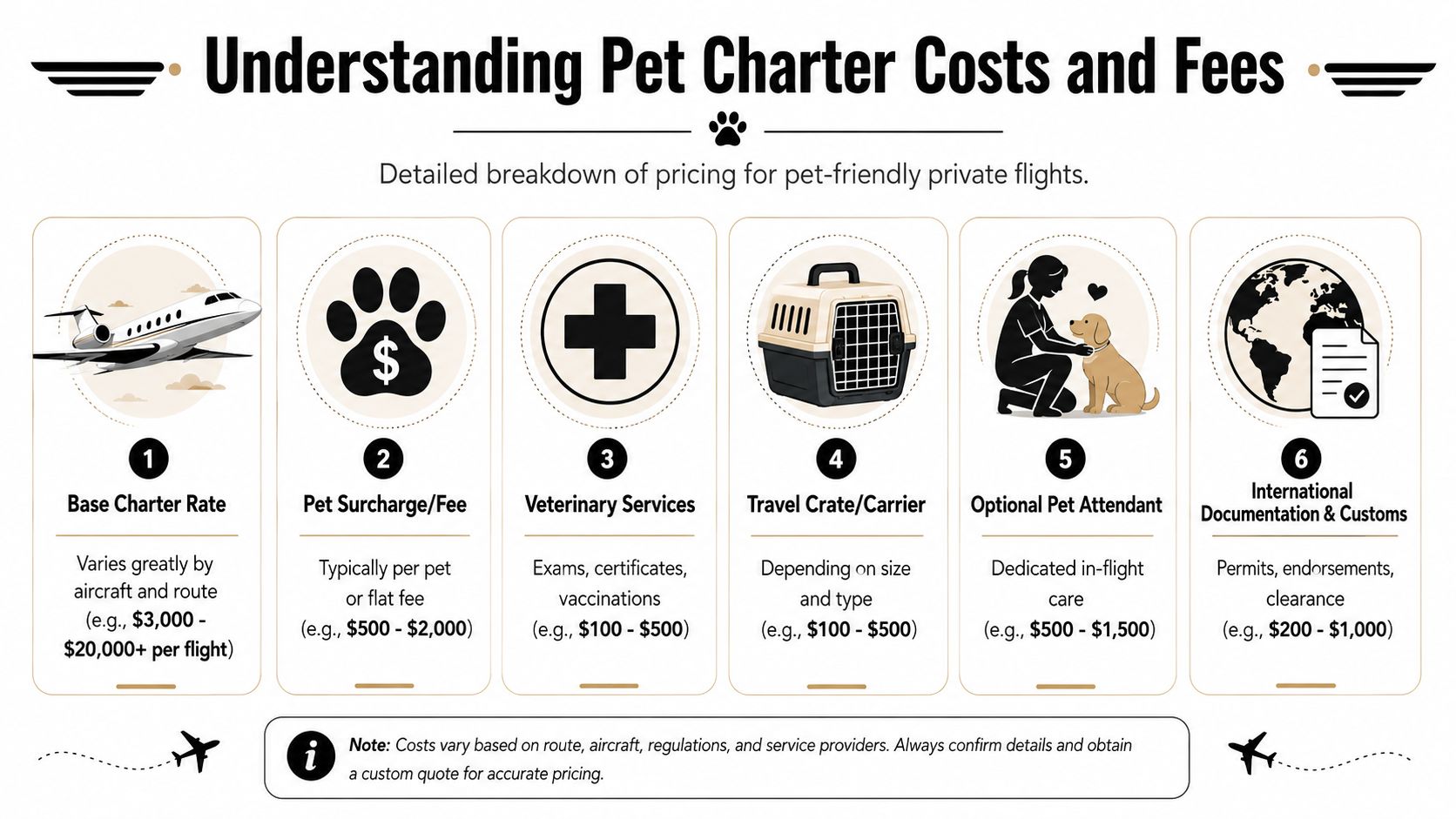
According to Paws Abroad's 2025 to 2026 pet charter pricing guide, full private jet charter pricing for pet-inclusive travel is commonly estimated at $5,000 to $50,000+ for U.S. domestic trips and $70,000 to $120,000+ for transatlantic trips. The same guide says shared-seat products are priced around $4,000 to $8,000+ per seat domestically and $6,000 to $12,000+ per seat on U.S. to U.K. or EU routes.
Comparing the booking models
The right structure depends on what you value most: control, privacy, flexibility, or a lower entry point.
| Model | Best for | Trade-off |
|---|---|---|
| Full-aircraft charter | Families, multiple pets, sensitive animals, schedule control | Highest overall spend |
| Shared-seat pet charter | Travelers who want in-cabin pet access without chartering the whole jet | Less control over timing and cabin environment |
| Empty leg | Flexible travelers who can adapt to a pre-existing aircraft movement | More operational uncertainty |
The costs clients overlook
The quoted charter figure is often only the start of the conversation. I also tell clients to ask about operational extras that can appear around pet travel:
- Cleaning charges: Especially if an operator expects post-flight deep cleaning.
- Special handling: Some routes need more coordination on the ground.
- Customs-side support: International arrivals can involve extra handling steps.
- Ground time implications: If the itinerary includes pet breaks or schedule padding, that can affect planning.
Not every trip triggers those items. But if you don't ask, you don't really know your all-in number.
A lower headline price can become the more expensive option if it creates stress, rerouting, or a poor cabin fit for the animal.
Cost should follow the pet, not ego
I often tell clients that the most expensive option isn't automatically the smartest. Full charter makes sense when you need cabin control, exact timing, or room for multiple animals. Shared-seat arrangements can work when your pet is adaptable and the route is well established. Empty legs can be appealing if your dates are flexible and the operational constraints are acceptable.
The financial decision should follow the welfare and logistics profile of the trip. Not the other way around.
Ensuring In-Flight Safety and Animal Welfare
The biggest mistake I see in pet charter planning is assuming cabin access solves everything. It solves one important problem. It does not guarantee a calm animal, a smooth flight, or the right onboard setup.
A good pet flight feels uneventful. That usually means the planning was disciplined.
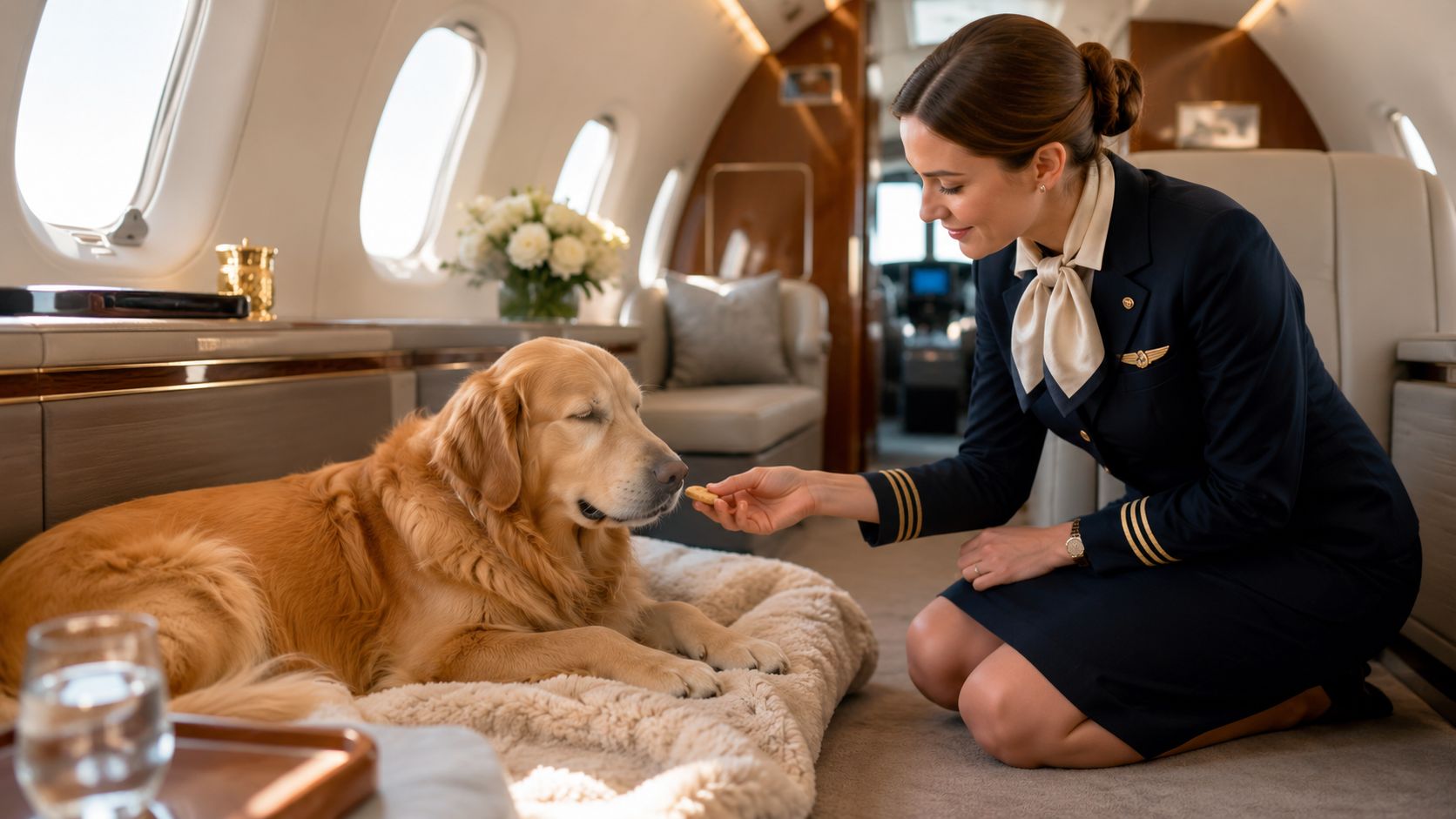
One operator example notes that pets may stay with passengers in the cabin and that crating is not required unless the owner prefers it, as described in Magellan Jets' overview of flying with dogs on private jets. That flexibility is a real advantage. It's also where judgment matters, because “not required” doesn't always mean “best for this pet.”
Crate or no crate
Some dogs are calmer with direct owner contact and open cabin space. Some cats are better in a secure carrier from the moment they leave the car until they reach the destination. Some nervous dogs settle better in a familiar soft-sided setup than they do loose in a new environment.
I look at three factors:
- Temperament: A confident dog and an anxious cat usually need different handling.
- Flight length: What works for a short sector may not work on a longer mission.
- Operator procedures: The crew's expectations during taxi, takeoff, and landing matter.
Comfort comes from routine
Private aviation can reduce noise, crowding, and rough transitions compared with commercial travel. But the flight still asks your pet to tolerate a new sensory environment. The easiest way to improve that experience is to preserve routine where you can.
Focus on basics that help:
- Hydration: Offer water in a way your pet already recognizes.
- Feeding timing: Don't experiment with a new schedule on flight day.
- Exercise before departure: A proper rest stop before boarding matters.
- Familiar items: A blanket, bed, or toy can reduce novelty.
- Cabin predictability: Fewer unnecessary changes usually means less stress.
For owners who want a veterinary perspective on reducing canine stress and supporting routine-based wellness, PMV's dog wellness strategies offer useful ideas that complement flight planning.
The aircraft choice still matters
A larger cabin can be helpful, but it isn't automatically the best welfare answer. On some trips, the better outcome comes from the aircraft with less repositioning, a simpler boarding flow, and a more predictable cabin arrangement.
That's especially true on empty-leg travel, where the aircraft may be attractive on price but less ideal for a pet that needs consistency.
This short clip illustrates the in-cabin side of private pet travel:
What good crews do well
The best crews don't just tolerate pets. They prepare for them. They know where the animal will settle, how to coordinate boarding, when to keep movement minimal, and when to help create a calmer cabin.
The best option for a pet isn't always the most luxurious aircraft. It's often the one that gives the animal the shortest, steadiest, most predictable experience.
That's the standard I use. Not glamour. Stability.
Your Day-of-Flight Procedures and Contingency Plan
Departure day should feel calm and boring. If it feels rushed, too many decisions were left too late.
The final twenty-four hours are about confirmation, not discovery. You should already know the terminal, the pet handling plan, the document packet, and the boarding sequence. The pet should also have a simple, familiar rhythm around food, water, and exercise.
What to do before leaving for the FBO
I recommend a short final review rather than a long checklist marathon. You're looking for anything that could interrupt boarding.
Check these items in one pass:
- Documents: Bring originals and digital backups together in one folder.
- Comfort items: Pack the bed, blanket, leash, carrier, bowls, and any cleaning essentials you rely on.
- Feeding plan: Keep the timing sensible and familiar.
- Rest stop: Give the pet a proper break before the car ride to the terminal.
- Ground transport: Confirm that the vehicle setup works for the animal, especially if a crate is involved.
At the private terminal
The FBO experience is easier than a commercial terminal, but don't mistake easier for informal. Keep the pet close, keep the paperwork accessible, and let the crew lead the boarding sequence.
This is also where aircraft choice shows up in practical terms. As noted in guidance on pet travel and empty-leg planning, the best option for a pet is not always the most luxurious aircraft. It may be the one with the shortest repositioning time and the most predictable cabin setup, with attention to hydration, feeding timing, and rest stops before boarding, as discussed in Jettly's article on empty-leg flights for dogs.
Build a contingency plan before you need one
Weather delays, late slots, or minor route changes can affect pets more than they affect passengers. The answer isn't to panic. It's to decide in advance what the fallback looks like.
Ask yourself:
- If there's a delay, where can the pet rest comfortably?
- If boarding shifts later, do you need to adjust water or feeding?
- If the animal becomes anxious, what familiar calming measures already work at home?
- If the route changes, who is checking that the paperwork still aligns?
A good charter contact and a good crew can help with the operational side. But owners should still bring the things that make their own pet feel normal.
Don't improvise stress management on the tarmac. Use the routines, objects, and handling methods your pet already trusts.
Keep the trip simple
On flight day, simple wins. Fewer bags to search. Fewer conflicting instructions. Fewer surprises for the pet. If you've chosen the right aircraft, confirmed the operator's policy properly, and matched the paperwork to the route, the day should feel remarkably smooth.
That's the standard for pet friendly charter flights. Not that the pet was merely allowed onboard. That the entire trip was designed to work.
If you're planning a route that includes a dog or cat, Haute Jets can be a practical place to start because its booking model focuses on exact aircraft selection and pre-flight confirmation, which are two details that matter disproportionately in pet travel. The right next step isn't just asking whether pets are allowed. It's confirming whether your pet, on your route, with your timing, is fully cleared to fly.