
Your trip usually starts with a simple question that turns complicated fast: can the dog come, and can the flight be handled without stress, paperwork errors, or a last-minute policy surprise at the terminal?
That’s where most first-time clients hit the same wall. Commercial airlines treat pets as an exception to the trip. A private itinerary has to treat them as part of it. If your companion is large, anxious, elderly, brachycephalic, or traveling internationally, the difference matters even more. A casual “pets allowed” note in a quote isn’t enough.
At Haute Jets Journal, the standard I use is straightforward. Confirm the exact aircraft. Confirm the exact operator. Confirm the exact pet policy for that tail. Then build the itinerary around the animal’s comfort and the owner’s risk tolerance, not around whatever airplane happens to be easiest to sell.
The Unmistakable Advantage of Private Jet Travel for Pets
At 6:30 a.m., a first-time client pulls up to the FBO with a senior Labrador, two bags of medication, and one concern: no surprises. That is the standard private charter has to meet. For pet travel, the primary advantage is not image. It is control.
A pet friendly private jet charter keeps the animal with you in the cabin and removes the commercial airline variables that create the most stress. There is no crowded terminal, no cargo acceptance cutoff, no argument at check-in over carrier dimensions, and no last-minute policy change handled by an agent who has never seen your booking before. For brachycephalic breeds, large dogs, nervous cats, and older pets, that difference is practical risk reduction.
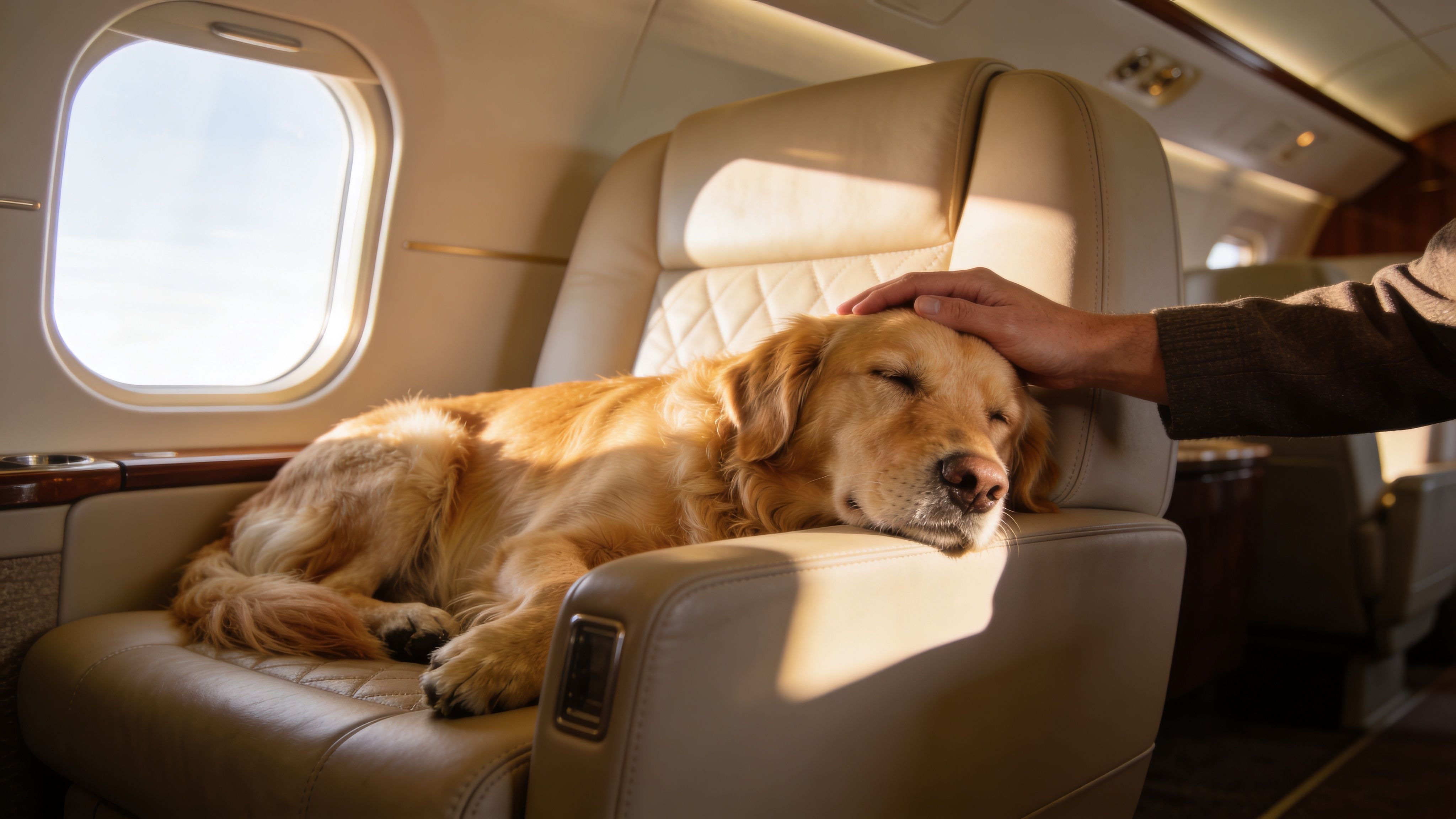
The benefit starts before takeoff. You arrive through a private terminal, board on your schedule, and give the pet time to settle before the door closes. That slower, controlled handoff matters more than many owners expect.
With a direct-to-operator model, the planning is also cleaner. Haute Jets confirms the actual aircraft, operator approval, cabin rules, and handling requirements before the itinerary is finalized, which helps clients avoid the common broker problem of hearing "pets are fine" and learning later that the tail assigned to the trip has different restrictions. Clients booking a private jet charter for pets through Haute Jets are usually buying predictability as much as convenience.
What private charter changes for the animal
The strongest advantage is that the trip can be built around the pet instead of forcing the pet into an airline policy.
That changes several parts of the experience:
- Access to the aircraft: You move through an FBO with minimal noise, foot traffic, and waiting.
- Cabin supervision: Your pet stays near you, where behavior, breathing, hydration, and comfort can be monitored in real time.
- Departure timing: Boarding can be paced around the animal, not around a general boarding group.
- Handling consistency: Fewer transfer points mean fewer chances for miscommunication, delay, or rough handling.
I tell first-time clients the same thing every time. The safest pet flights are usually the ones with the fewest unknowns on the ground.
Why seasoned pet owners keep flying this way
After one well-run private trip, owners tend to focus less on luxury and more on repeatability. They want the same operator standards, the same clear pet rules, and the same calm handoff from vehicle to cabin. That is especially true on longer flights or multi-leg itineraries, where small planning errors can turn into a bad day for both the animal and the owner.
A flight only deserves to be called pet friendly when the approvals, timing, cabin setup, and handling plan all line up for a smooth and predictable trip. That is the key advantage.
Vetting Operators for Uncompromised Pet Safety
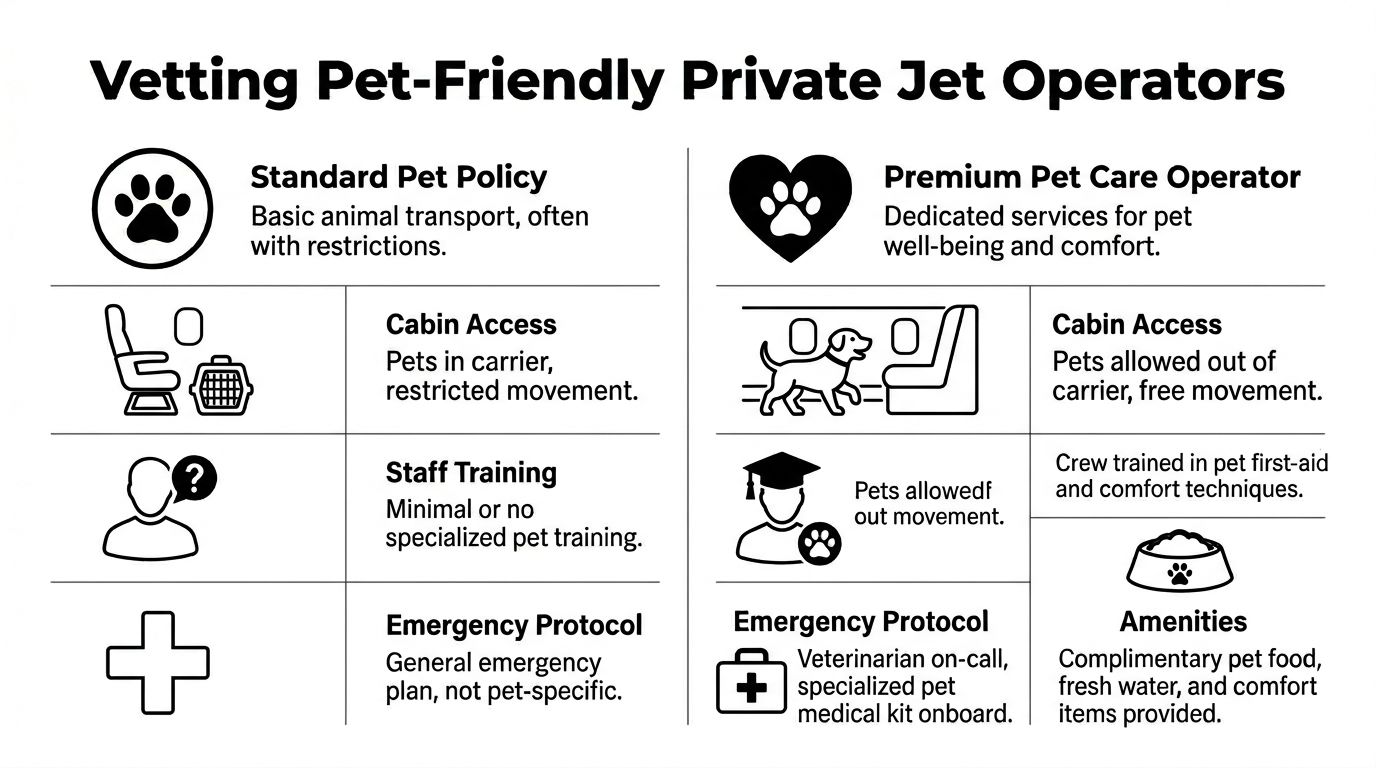
“Pet friendly” is one of the loosest phrases in charter. It can mean anything from “dogs are welcome in the cabin” to “we’ll allow a small carrier if the crew approves it.” For a first booking, that ambiguity is where avoidable risk enters.
The first filter should be operator quality, not cabin photos. Pet transport is only as strong as the crew, the procedures, and the consistency of the operator behind the aircraft.
Pet-friendly private jet charters rely on operator standards that can be verified. Networks used for this kind of travel may include Wyvern Wingman or Argus Gold/Platinum-rated operators, which are described as the industry’s highest third-party safety audits across 3,500+ aircraft in 175+ countries in Magellan Jets’ pet travel overview.
What to verify before you accept a quote
A serious vetting call should answer operational questions, not just commercial ones.
Ask these directly:
- Exact aircraft approval: Is this specific aircraft approved for pets, or is the quote based on a general operator policy?
- Cabin rules: Can the animal be out of a carrier in cruise, and what applies during taxi, takeoff, and landing?
- Multiple pet handling: If you’re bringing more than one animal, how is space and restraint managed?
- Crew familiarity: Has the assigned crew handled pet itineraries before?
- Cleaning and turnaround protocol: If there’s a same-day return or onward segment, who confirms the cabin is reset appropriately?
If those answers sound vague, the quote is incomplete.
Broker language versus confirmed policy
A common pitfall for clients is that a traditional broker may tell you an operator is “usually fine with dogs.” That doesn’t help if the specific owner of the aircraft has stricter cabin rules, if a crew member requires a carrier for cats, or if a shared arrangement changes handling assumptions.
A direct-to-operator workflow is cleaner because the pet policy gets confirmed against the exact aircraft being flown. That’s the practical difference. You’re not relying on category-level assumptions. You’re matching your itinerary to a specific tail, cabin, and crew.
For clients who want a concise starting point, fly with pets on a private jet outlines the kind of aircraft-specific confirmation that matters before booking.
Practical rule: If your charter contact can’t tell you how your pet will be secured for takeoff and landing on the exact aircraft offered, you’re not ready to issue payment.
What works and what doesn’t
Here’s the side-by-side reality I’ve seen matter most.
| Decision point | What works | What doesn’t |
|---|---|---|
| Operator screening | Verified safety ratings and aircraft-level confirmation | Generic reassurance that “pets are fine” |
| Pet handling | Written notes on cabin movement, restraint, and amenities | Verbal promises with no manifest updates |
| Crew readiness | Crew briefed in advance with pet details | Crew learning about the pet on arrival |
| Policy fit | Matching aircraft to animal size and behavior | Forcing the pet into the cheapest available cabin |
Red flags clients should catch early
Three warning signs usually tell you the booking is being handled loosely:
- No one asks about breed, size, or temperament. That means the flight planner hasn’t assessed cabin suitability.
- The quote is aircraft-category only. If you can’t see the exact make and model being held, you can’t evaluate fit.
- The pet isn’t discussed in the manifest process. That creates downstream issues with crew prep and, on international routes, customs coordination.
Good pet charter planning is detail-heavy by design. That’s a strength, not friction. The more precisely the operator is vetted, the more relaxed the travel day feels.
Selecting the Ideal Aircraft Cabin for Your Companion
Aircraft selection is where pet travel becomes either smooth or compromised. Owners often start with range or price, but the better first question is simpler: where will your pet rest safely for the whole mission?
A cat on a short regional flight has one set of needs. A large retriever on a coast-to-coast itinerary has another. The aircraft should fit the animal’s body, behavior, and tolerance for movement.
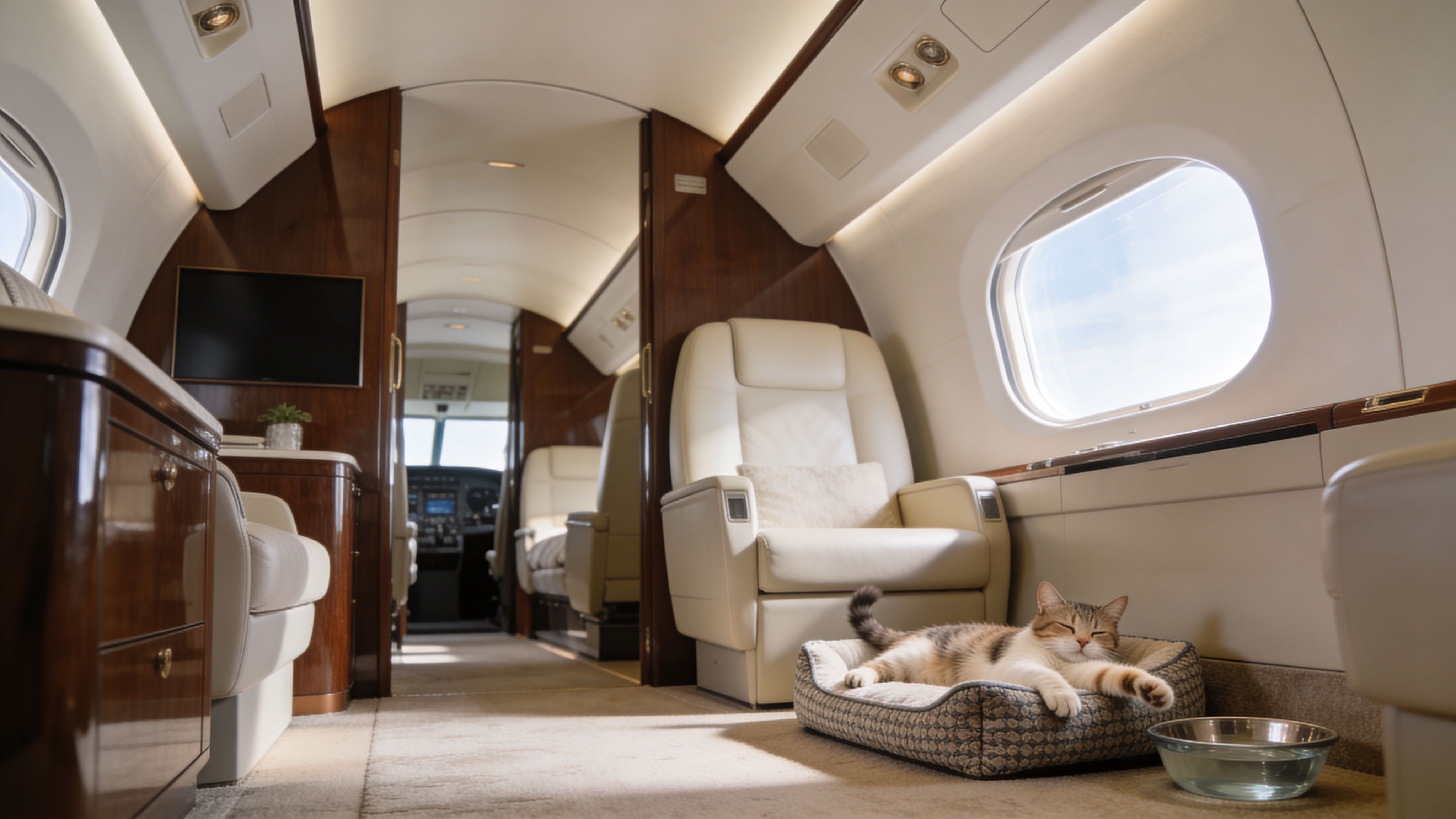
A proper technical review looks at floor space, cabin height, seat layout, and where the pet can remain during critical phases of flight. One reason midsize cabins are so useful is that some layouts provide 20-50% more floor space than commercial first class, and a Challenger 350 offers a 6'8" cabin height with lie-flat options suited to larger breeds over 50lbs that must remain on the floor during takeoff and landing, according to this pet travel aircraft review.
Match the cabin to the animal, not the route alone
For short hops, a piston aircraft or turboprop can make sense when the pet is calm, the weather is favorable, and the cabin setup is straightforward. For a large dog, though, a cheap short-hop option can become cramped quickly if floor space is limited.
Here’s how I frame the decision:
- Small pets that settle easily: A light jet may be perfectly comfortable if the cabin rules are clear.
- Large breeds that need floor space: A midsize cabin often works better than a light jet, even on a moderate route.
- Older or anxious animals: A more stable, roomier cabin with easier movement is usually worth prioritizing.
- Long-range international flights: The cabin should support rest, hydration access, and owner proximity for many hours.
Exact aircraft selection removes guesswork
The strongest booking process lets you review the exact aircraft rather than accepting “a light jet” or “a super midsize” as a placeholder. That matters because cabin geometry varies. So does seat spacing, baggage access, and where a large dog can lie down without blocking movement.
If you want a better sense of how cabin layouts differ from one aircraft to another, this private jet interior guide is useful context before you choose between categories.
A dog that can stand, turn, and settle naturally will usually travel better than one forced to adapt to a cabin chosen only for price.
Practical aircraft examples
A few patterns come up repeatedly in pet bookings.
| Travel scenario | Better cabin fit | Why it tends to work |
|---|---|---|
| Weekend hop with a small dog | Light jet or turboprop | Quick boarding, efficient trip, manageable cabin footprint |
| Family trip with a large dog | Midsize jet | More usable floor area near seating |
| Long international mission with multiple pets | Heavy jet or long-range cabin | Better room distribution and owner comfort over longer sectors |
The aircraft video below gives a useful visual reference for how cabin layout changes the onboard experience.
What clients often underestimate
They focus on whether the pet is allowed, not on whether the pet can rest well. That’s the wrong threshold. Permission is the minimum. Comfort and restraint compatibility are what determine whether the flight feels easy.
The right aircraft should let your pet settle without constant repositioning, keep you close enough to reassure them, and give the crew a clear, safe cabin flow. Once those three conditions are in place, the rest of the flight tends to work exactly as it should.
Navigating the Paperwork Maze for Domestic and Global Travel
Paperwork mistakes don’t usually look dramatic at first. A missing certificate, a mismatched microchip record, or a form signed outside the accepted timing window can sit unnoticed until the day of departure. Then the whole trip stops.
Domestic trips are simpler, but “simpler” doesn’t mean casual. International trips require even more discipline because pet import rules are tied to country entry rules, not your charter schedule.
Domestic travel inside the U.S.
For domestic flights, I tell clients to think in layers. First, confirm what your veterinarian needs to issue. Then confirm what your operator wants in the file. Then confirm what the destination state or local authority may ask for if the trip involves an event venue, resort, or onward ground transfer with separate pet policies.
A basic domestic file usually includes current vaccination records and a health certificate if requested for the itinerary or destination. Don’t leave that to the last week if your vet runs a busy practice. If your dog has a medical issue, a history of anxiety, or needs medication timing adjusted around travel, get that conversation done early.
Domestic preparation that helps
- Vet timing: Schedule the health review with enough lead time to correct anything missing.
- Digital copies: Keep every pet document in one shareable file your charter contact can access quickly.
- Ground coordination: Confirm your car service, hotel, and final destination all accept pets under the same assumptions as the flight.
- Feeding routine: Ask your vet whether your normal feeding and medication schedule should change on travel day.
International travel requires precision
International pet movements are where inexperienced planning shows immediately. Requirements can include rabies titers, compliant microchipping, destination-specific forms, customs notices, and timing rules that can’t be rushed.
For 2026 international pet travel, key compliance areas often include rabies titers, microchip ISO standards, and the 180-day EU re-entry rules for non-commercial flights, according to VistaJet’s information on traveling internationally with pets. On routes such as New York to London, those details aren’t side notes. They determine whether the trip is admissible.
Critical deadline: If a destination requires testing or country-specific health documentation, the issue usually isn’t whether you can get the form. It’s whether you can get it within the required timing window.
If you’re comparing destination rules across multiple countries, a practical companion resource is this guide to international pet travel requirements. It’s helpful for building your own checklist before your charter team locks in the final sequence.
The documents that deserve special attention
For international pet flights, these are the items clients most often underestimate:
Microchip compatibility
The microchip must match the destination’s accepted standard and match the records tied to vaccinations and testing.Rabies documentation
Not just whether the vaccine exists, but whether the record aligns to the pet’s chip, timing, and destination rule set.Health certificate format
Some destinations are very specific about the exact form, endorsement sequence, and inspection timing.Non-commercial movement rules
Private charter doesn’t exempt the trip from import rules. In some jurisdictions, the legal classification of the movement matters.
UK and EU routes need extra care
Owners often assume private travel means easier border entry. The cabin experience is easier. Border compliance is not. The UK and parts of Europe can be exacting about sequence, documentation, and proof.
For Europe-bound itineraries, verify whether you’re planning for entry only or entry plus future re-entry. Those are not always the same paperwork path.
That distinction matters if you’re moving between the U.S., the EU, and the UK across one season. A pet can be perfectly comfortable in the cabin and still face trouble on the ground if the paperwork chain isn’t coherent.
Service animals and household pets aren’t handled the same way
Another common mistake is assuming any animal with a support role will be treated under a service-animal framework. Rules depend on jurisdiction, documentation, and the legal category recognized by the destination. Household pets should be planned as household pets unless your advisor confirms otherwise with certainty.
The cleanest process is to build the file early, circulate it for review, and treat customs compliance as a separate workstream from the flight itself. That’s how you avoid preventable denials, forced holds, and quarantine exposure.
Understanding Costs and Ensuring In-Flight Comfort
Clients usually ask about price first, then comfort second. In pet travel, those two are linked. The cheapest quote can become the worst value if it uses an aircraft that must reposition, lacks enough cabin room, or creates handling issues that surface only after deposit.
The pricing side of a pet friendly private jet charter should be evaluated in terms of aircraft fit, routing efficiency, and how the quote was sourced.
One cost driver that’s often overlooked is repositioning. Local aircraft sourcing can cut repositioning fees by 20-40%, reducing the total charter price for pet travel, as discussed in this analysis of pet charter pricing gaps.
Where the quote can go wrong
A quote often gets inflated in one of two ways:
- The aircraft isn’t based near your departure city. You end up paying for the airplane to come to you.
- The aircraft category is technically available but poorly matched. You save on paper, then lose comfort and flexibility in practice.
That’s why I look at the mission backward. Start with departure airport, destination, pet size, number of passengers, and desired cabin setup. Then source the nearest suitable aircraft rather than selling a distant aircraft already in someone’s system.
Value is not the same as the lowest hourly rate
Hourly pricing matters, but the total mission cost matters more. A lower headline rate can hide waste if the routing is inefficient or if the aircraft doesn’t fit the pet and has to be changed later.
For context on the onboard environment itself, this review of private jet cabin air and cleanliness is worth reading, especially for clients concerned about pet comfort on longer sectors.
Clients who get the best value usually decide on cabin suitability first and aircraft positioning second. Clients who shop only by hourly rate often end up revising the plan.
In-flight comfort that actually helps
Comfort isn’t about overpacking the cabin with accessories. It’s about keeping the environment stable and familiar.
A few habits work reliably:
- Bring one known comfort item: A blanket or bed your pet already uses is usually more effective than something new bought for the trip.
- Keep hydration simple: Offer water steadily, not excessively, and use the same bowl style your pet knows if possible.
- Avoid dramatic routine changes: Don’t switch foods or introduce travel aids for the first time on departure day.
- Use proper restraint during critical phases: Your pet should be secured for taxi, takeoff, and landing according to the operator’s confirmed procedures.
What doesn’t work well
Owners sometimes assume the pet should roam freely the entire flight. That’s not the safest plan. Freedom should expand once the aircraft is in stable cruise and the crew confirms it’s appropriate.
Sedation is another area that should never be handled casually. If your veterinarian recommends anything for anxiety or motion response, test and discuss it in advance. The cabin is not the place to discover how your animal reacts.
The smoothest flights are usually the least eventful ones. Correct aircraft, local sourcing, a calm routine, and a crew briefed in advance will do more for comfort than any luxury add-on.
The Ultimate Pre-Flight Confirmation Checklist
At 7:00 a.m. on departure day, the aircraft should already be set, the crew should already have your pet details, and every document should already be where operations expects it. If anyone is still “checking on” the basics in the final twenty-four hours, risk has entered the trip.
My standard is simple. The last confirmation call should verify the operational file, not build it. That is one of the clearest differences between a direct-to-operator model and a loose broker chain. With Haute Jets, the goal is to confirm the exact aircraft, crew briefing, pet notes, and ground handling plan against the live trip record so nothing gets lost between sales, dispatch, and the flight crew.
What to review on the final confirmation call
Use the call to confirm the details that cause the most expensive day-of-travel problems. Keep your pet supplies in one organized carry item rather than splitting them across multiple bags. If you want a practical packing reference, this guide to building a dog travel bag is a useful prompt.
Bring less, but bring the items your pet already knows.
Pre-Flight Pet Charter Confirmation Checklist
| Item to Confirm | Details to Verify | Confirmed (✔) |
|---|---|---|
| Aircraft assignment | Exact tail number, aircraft make and model, departure FBO | |
| Crew details | Crew names or bios, pet handling awareness, contact flow for day of departure | |
| Pet on manifest | Pet name, species, breed, approximate size, any handling notes added to file | |
| Cabin rules | Restraint procedure for taxi, takeoff, and landing, plus in-cabin movement rules during cruise | |
| Pet amenities | Water bowls, approved treats, bedding space, cleaning supplies if needed | |
| Documents onboard and on file | Health records, required certificates, customs paperwork if applicable | |
| Ground transport | Pet-accepted vehicle confirmed at both ends of itinerary | |
| Arrival plan | Relief break location, customs handling if international, handoff timing |
The problems this checklist catches before they become delays
A pet-friendly charter can still go wrong in very ordinary ways.
The first is a manifest error. A client mentions the dog early in the booking process, but the final operational release does not reflect the animal’s breed, size, or handling notes. That can trigger a last-minute review by the operator or a dispute at the FBO if the trip record is incomplete.
The second is equipment assumption. Owners often expect bowls, pads, blankets, or cleanup supplies to appear onboard because the flight was described as pet friendly. Sometimes they do. Sometimes they do not. Confirming those items in advance avoids a poor substitute bought on the ramp or an unnecessary departure hold.
The third is the arrival gap. The flight itself is cleared, but the receiving car service, hotel, villa, or handler has a separate pet policy. I have seen otherwise well-planned trips lose an hour on the ground because nobody confirmed where the first relief stop would happen or whether the onward vehicle would take a large dog.
Strong execution looks quiet because every handoff was checked in advance. That is the actual purpose of the final review.
Frequently Asked Questions about Pet Jet Charters
Can I bring more than one pet?
Often, yes. It comes down to whether the specific cabin can handle the number, size, and temperament of the animals without compromising safety or passenger movement. Multiple small pets can be straightforward. Multiple large dogs usually require more deliberate aircraft selection and pre-briefing.
Are there breed restrictions on private charters?
Private operators are generally more flexible than commercial airlines, but that doesn’t mean every aircraft owner or crew handles every breed the same way. The smart approach is to disclose breed, size, and behavior early and get the policy confirmed against the exact aircraft.
What if my dog is very large?
Then cabin choice becomes central. Very large dogs often need a layout with usable floor space during takeoff and landing, not just an operator willing to say yes. A midsize or larger cabin is often the more practical answer.
What happens if my pet has an issue in flight?
The first layer of protection is prevention. Correct aircraft, routine, hydration, and crew awareness solve most problems before they start. For pets with known medical or anxiety issues, your veterinarian should advise on travel readiness before the charter is booked. In flight, the crew should already know the handling plan and any sensitivities disclosed in advance.
Are shared private flights a good option for pets?
Sometimes, but they come with compromises. Shared arrangements can involve stricter rules because other passengers and operator-specific limits affect what’s possible in the cabin. Full charter gives you more control over movement, timing, and comfort.
Can I pay with modern payment methods like Bitcoin?
Payment options vary by provider. If that matters to you, ask before funds are requested or a contract is issued. It’s easier to structure the transaction correctly from the start than to adjust it late in the booking cycle.
The clients who have the easiest pet flights don’t rely on broad assurances. They insist on exact aircraft confirmation, exact policy confirmation, and exact paperwork review. That’s the difference between a pleasant cabin experience and a preventable travel problem.
If you want a pet itinerary reviewed before you book, Haute Jets can help assess aircraft fit, operator standards, and routing so your pet is planned into the trip from the start, not added as an afterthought.