
You’re probably looking at the Gulfstream V for one of two reasons.
Either you want the reach and status of a true ultra-long-range jet sitting on your balance sheet, or you’re tired of hearing a charter quote that looks reasonable until the final invoice arrives with repositioning costs layered on top. Both are valid concerns. Both can get expensive fast.
The price gulfstream v question sounds simple, but it isn’t. A Gulfstream V has a purchase price, an operating price, a charter price, and then the ultimate number that matters most, your all-in access cost for the way you fly. That’s the number high-net-worth buyers and flight departments need to focus on in 2026.
The Gulfstream V An Enduring Icon of Private Aviation
A principal lands after a Europe run, then asks the question that matters. Do I buy a Gulfstream V, or do I keep chartering and stop paying for empty aircraft movement every time the jet is in the wrong city?
That is why the GV still gets serious attention. It remains one of the aircraft that changed what business aviation could do, giving owners and charter clients true intercontinental reach in a cabin with real executive presence. The airplane built its reputation on missions that save a full day of travel and keep decision-makers off the airlines.

The GV was produced from 1995 to 2002, and its place in the market is still clear. It is a large-cabin, ultra-long-range platform with the legs for transatlantic and many transpacific business missions, plus the kind of cabin volume that lets a team work, rest, and arrive ready to perform. If you want a closer look at the Gulfstream GV aircraft profile, start there before you get distracted by listing prices.
Why the GV still commands attention
The appeal is practical, not sentimental.
- Range that still matters: The GV can cover the mission set that drives private aviation demand at the top end of the market.
- A proven operating platform: Flight departments, maintenance providers, and buyers know the airplane well.
- Cabin size with purpose: You are paying for usable space, not just aesthetics.
A key financial point is this. Capability alone does not decide whether the GV is a smart choice for you. Access cost does.
A buyer who flies highly predictable routes, keeps the aircraft based strategically, and uses it heavily may justify ownership. A charter client with variable demand often gets better economics by sourcing the same class of lift on demand through a wholesale network, especially when that network can reduce the repositioning pain that inflates many large-cabin charter invoices. On a Gulfstream V mission, those empty-leg positioning costs can be large enough to distort the comparison if you only look at hourly rates.
Treat the GV as a mobility asset with a very specific job. It is built to move time-sensitive people long distances efficiently. The right decision is the one that gets you that capability at the lowest all-in cost, not the one that looks best on a spec sheet.
The Upfront Price to Purchase a Gulfstream V
You find a Gulfstream V listed at a number that looks reasonable for a large-cabin jet. Then the actual spending starts. The purchase price is only the first wire, and buyers who anchor on that figure usually overpay somewhere else.
A GV sits firmly in the pre-owned market, so quality drives price. Production ended years ago, and the spread between an average aircraft and a properly kept example is wide. As noted earlier, current listings generally fall in the high seven-figure to low eight-figure range, with weaker early aircraft at the bottom and cleaner late examples priced materially higher.
If you are actively evaluating aircraft, Haute Jets' jet acquisition advisory is the right place to compare inventory and avoid wasting time on the wrong serial numbers.
What the asking price actually means
An asking price tells you where the seller wants to start. It does not tell you what the aircraft will cost you to own.
A cheap GV often carries deferred maintenance, weaker records, dated avionics, interior work, or upcoming engine expense. A more expensive aircraft may already have the features and maintenance status that keep you out of the shop and preserve resale value. That is the right way to read the market.
Price gaps usually come from a few factors:
- Year of manufacture: Later aircraft usually hold stronger values.
- Maintenance history: Complete records and disciplined care support pricing. Gaps in documentation hurt value fast.
- Avionics and compliance status: Buyers pay up for aircraft that fit current operating expectations.
- Interior condition: Cosmetic fatigue matters, especially if the aircraft carries family, clients, or investors.
- Engine outlook: A lower acquisition number loses its appeal if major engine events are close.
Buy quality or plan to write catch-up checks
Early-build aircraft can make sense. They do not make sense if the lower price is the whole strategy.
The wrong GV becomes expensive in three ways. You spend money correcting deferred items. You lose use of the aircraft during downtime. You still own an older serial number that may be harder to sell cleanly later. Paying more for a better aircraft upfront is often the cheaper decision over the holding period.
My advice is simple. Buy the best-maintained Gulfstream V you can justify, with the strongest records and the fewest near-term surprises.
What disciplined buyers review before making an offer
Serious buyers focus on technical and financial exposure, not listing photos.
Airframe time and usage pattern
Total time affects marketability, but usage history matters too. Consistent operation is usually easier to underwrite than an aircraft with long dormant periods and unclear stewardship.Engine condition and program status
Engines can change the economics of the deal quickly. A lower purchase price does not help if a major engine bill is coming soon after closing.Inspection status and logbook quality
Complete, orderly records protect value. Missing or messy documentation creates negotiating friction, financing problems, and resale discounts.Cabin relevance
A dated cabin is not just an aesthetic issue. If you plan to refurbish it, treat that as part of your acquisition cost, not a future maybe.Ownership horizon
Hold period matters. If you expect a short ownership cycle, avoid projects. If you expect a longer hold, paying more for a stronger aircraft usually produces better economics.
Here’s a useful visual before you go deeper into market shopping:
My recommendation on acquisition
Buy a GV only if you need control, consistency, and enough annual use to justify tying up capital in the asset.
If your flying pattern is variable, the acquisition number deserves less attention than many buyers give it. The primary comparison is ownership versus access. On-demand charter through a wholesale network can remove the capital commitment and, just as important, reduce the repositioning waste that often inflates large-cabin trip costs when charter is sourced poorly. That changes the buy versus charter math more than the listing price alone.
The purchase price gets you through the door. It does not answer whether ownership is the smart financial move.
Decoding the Annual Cost of Gulfstream V Ownership
Ownership becomes expensive before the aircraft moves an inch.
That’s the point many buyers miss. They focus on acquisition and underestimate the cost of keeping a Gulfstream V available, staffed, insured, and housed. According to Jet Insiders’ Gulfstream V cost analysis, total fixed costs typically range from $650,000 to $955,240 annually, while variable direct operating costs average $2,229 to $2,467 per hour. At 200 flight hours, the annual budget can approach $1.83 million.
Fixed costs are the price of readiness
Fixed costs are what you pay whether you fly often or barely at all.
That category includes crew salaries, insurance, hangar expense, and recurring ownership overhead. Jet Insiders also notes miscellaneous fixed costs around $131,200 and depreciation around $362,146 within the ownership picture linked above.
Think of fixed costs as your subscription to immediate availability. If you own the jet, you’re paying for the right to use it on your terms.
Estimated Annual Gulfstream V Operating Costs (200 Flight Hours)
| Cost Category | Estimated Annual Cost |
|---|---|
| Fixed costs | $650,000 to $955,240 |
| Variable direct operating costs | $2,229 to $2,467 per hour |
| Total annual budget at 200 hours | Approximately $1.83 million |
Variable costs are what each mission adds
Variable costs begin when the airplane starts flying. Fuel is the obvious driver, but it’s not the only one.
Jet Insiders places fuel at $1,895.52 per hour and maintenance at $334 per hour within the variable cost structure. That’s why “I’ll just budget fuel” is amateur math. The aircraft is consuming more than fuel when it flies. It’s consuming maintenance life, engine life, and support resources.
Owners who budget only for fuel usually discover the real number after the first year, not before it.
Utilization changes the math, but not the burden
A GV can make more sense if you use it heavily. Fixed costs get spread over more hours, which improves the economics.
Jet Insiders shows a budget of roughly $3.01 million at 400 annual hours, and cites an effective operating figure of $19.58 per mile at an average speed of 468 mph. That helps a high-use corporate operation more than it helps a family office that flies irregularly.
What matters is this: the airplane doesn’t become cheap because you fly it more. It becomes less inefficient on a per-hour basis.
Where owners get surprised
The expensive part of ownership isn’t one giant dramatic bill. It’s the accumulation of unavoidable obligations.
- Crew continuity: If you want strong pilots, you pay to retain them.
- Hangar commitments: Premium airports don’t discount because your schedule is light.
- Insurance and compliance: These remain in force even in a quiet month.
- Depreciation exposure: The asset may hold value better than expected, but it still ties up capital.
If you’re evaluating ownership seriously, build your budget from the fixed-cost base upward, then add realistic usage. Don’t reverse the process.
My recommendation on owner budgeting
Start with the assumption that annual readiness is costly, even before the first trip. Then ask whether your actual flight profile justifies carrying that burden.
If your travel demand is consistent, control-sensitive, and heavy, ownership may be defensible. If your flying is episodic, international, or clustered around a few key periods, annual GV ownership costs can turn into a very elegant form of financial drag.
Gulfstream V Charter Price Demystified
Most charter buyers hear one number first.
It’s the hourly rate. For a Gulfstream V, that rate is often quoted around $9,500 per hour, according to Mercury Jets’ Gulfstream V charter page. That sounds straightforward. It isn’t.
The hourly number is only the visible part of the invoice. The hidden part is usually repositioning fees, and those can increase the total trip cost by 20% to 40% when the aircraft isn’t based near your departure city, as the same Mercury Jets source explains.
Why charter quotes often mislead clients
A broker may quote you a GV for the route you want. Fine.
But if that airplane is sitting somewhere else, you’re not just paying for your trip. You’re paying for the aircraft to come get you, and often to return or reposition again after your leg. That’s the part many clients don’t spot until they’re comparing final proposals rather than headline rates.
Here’s where charter math breaks down in practice:
- The aircraft is not local: You inherit the cost of empty movement.
- Your route is one-way: The operator may need to reposition after drop-off.
- You booked close in: Your choices narrow, and distant aircraft become more likely.
The real issue is not the hourly rate
It’s aircraft sourcing.
If the right GV is based near your departure city, the quote is cleaner. If it isn’t, your “competitive” rate can become expensive very quickly. Clients often assume they’re comparing one provider against another on service quality. In reality, they’re often comparing one sourcing model against another.
Chartering a Gulfstream V is simple only when the aircraft is already in the right place.
That’s why I tell clients to stop obsessing over the posted hourly figure. Focus on where the aircraft sits, how the quote is built, and whether the operator is solving your route efficiently.
What to ask before accepting a GV charter quote
A serious charter buyer should ask three things:
Where is the aircraft based right now?
If the answer is vague, your final number may not stay put.
Does the quote include repositioning?
Don’t accept partial math.
Is this the best aircraft for the trip, or just the nearest one the broker can place?
Those are not the same thing.
If you don’t ask those questions, you’re not comparing charter offers. You’re comparing marketing.
Ownership vs On-Demand Charter A Financial Breakdown
Here’s the practical decision line.
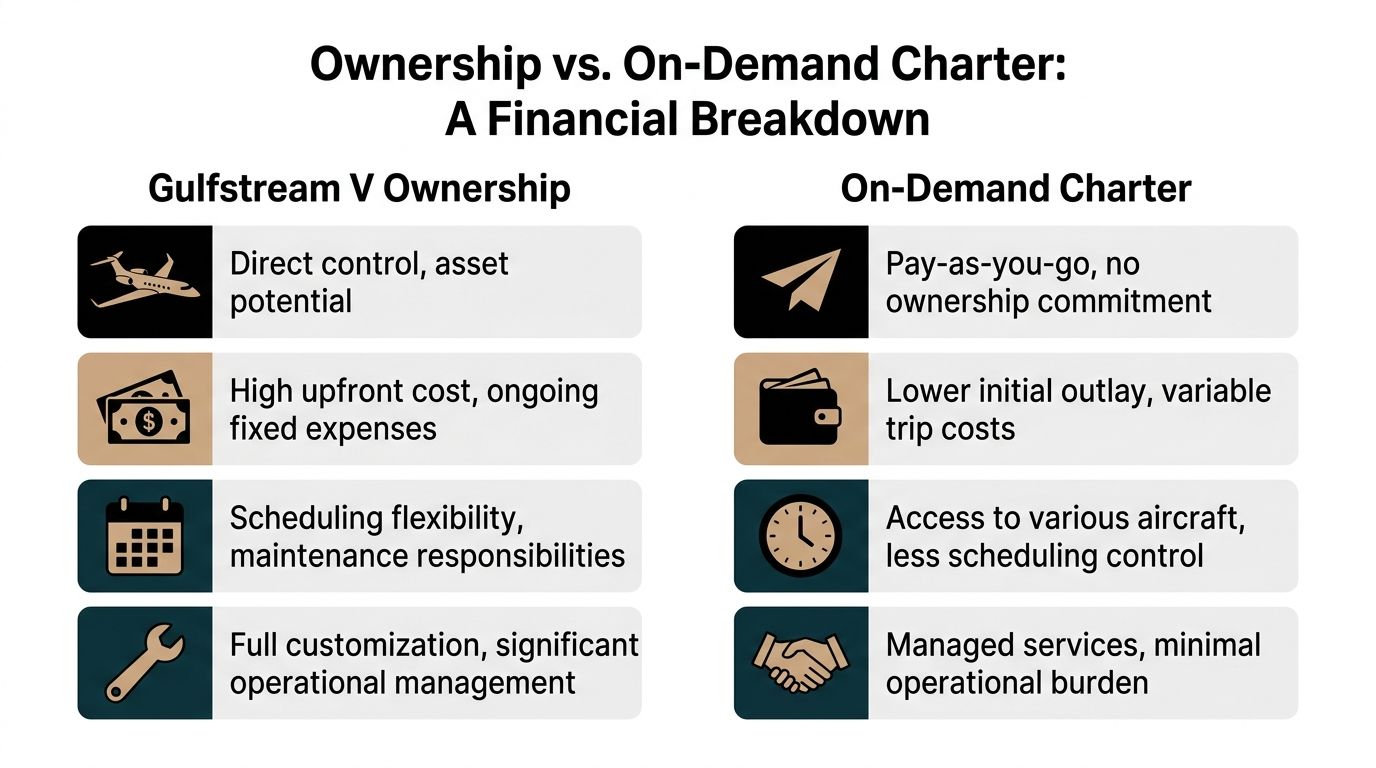
If you want a Gulfstream V available to you, you can either buy the asset and absorb the ongoing burden, or you can pay per mission and avoid that overhead. In the current market, that decision is shaped by two facts from Liberty Jet’s Gulfstream V ownership cost analysis: pre-owned GV values have risen 8% to 12% in recent years due to supply constraints, and ownership is often financially superior to charter only above the typical 250 to 300 hour annual break-even point. Liberty Jet also notes the capital tie-up of $9 million+, plus annual depreciation of 5% to 7%.
If you want a broader strategic look at the decision framework, this article on https://www.hautejets.com/journal/owning-vs-chartering-a-private-jet is useful context.
Ownership buys control, not efficiency
Owning a GV gives you direct access, branding control, cabin control, and scheduling authority.
What it doesn’t automatically give you is better economics. Once you commit capital, crew, insurance, hangar, and technical management, the aircraft has to work hard to justify itself.
Charter buys flexibility, not permanence
On-demand charter flips the equation.
You don’t control a single tail. You control your use of lift. That matters more than many clients expect, especially if they don’t fly with enough frequency to spread fixed costs effectively.
Side-by-side decision factors
| Access model | Financial reality | Best fit |
|---|---|---|
| Ownership | High capital commitment, recurring fixed burden, depreciation exposure | Buyers with heavy, predictable use and strong preference for full control |
| On-demand charter | Pay per mission, no capital lock-up, trip-specific pricing | Clients with variable schedules or lower annual utilization |
The break-even point matters more than ego
The typical 250 to 300 hour annual break-even range cited by Liberty Jet is the most important number in this entire conversation. It tells you when ownership may start to make economic sense relative to charter.
Below that level, many buyers are carrying a balance-sheet asset for emotional reasons, not financial ones. That’s fine if they know it. It’s a mistake if they think they’re saving money.
Decision test: If your annual flying is inconsistent, ownership usually gives you pride and convenience, not cost efficiency.
How I advise clients by utilization pattern
I don’t use a one-size-fits-all answer. I group clients by behavior.
Light and irregular flyers
If your schedule changes month to month, charter is usually the better answer. You avoid capital lock-up and don’t carry a large annual readiness bill during quiet periods.
Mid-range users near the break-even line
Here, buyers get tempted. They fly enough to want control, but not always enough to justify total ownership cost with confidence. This group should model actual mission patterns, not idealized ones.
Heavy users with predictable calendars
If your organization flies constantly, repeats the same long missions, and values having your own aircraft under direct control, ownership can become rational. Not cheap. Rational.
Don’t ignore capital opportunity cost
Liberty Jet’s point about $9 million+ tied up in the asset is more than an accounting note. It’s a strategic issue.
That capital could stay liquid or be deployed elsewhere. Once it sits inside an aircraft, you’ve chosen convenience and control over flexibility. Some principals want exactly that. Others realize they’d rather keep the money working and buy lift as needed.
My view on the 2026 decision
For most individuals and many family offices, on-demand access wins unless usage is reliably above the break-even range and the principal values direct control enough to pay for it.
For corporations with regular senior-executive movement, ownership can still make sense. But it should be justified with utilization discipline, not prestige logic.
The Haute Jets Advantage Finding Your GV On-Demand
The biggest inefficiency in Gulfstream V charter isn’t the aircraft. It’s the way many clients are forced to source it.
Traditional charter shopping often begins with an attractive hourly figure and ends with a much larger invoice because the jet is coming from the wrong place. That problem is operational, not cosmetic. If the aircraft is far from your departure city, the quote will usually reflect that one way or another.
Haute Jets built its model around fixing that issue. The company provides access to more than 3,500 owner-operated aircraft across 175 countries, and every operator in that network holds a Wyvern Wingman or Argus Gold/Platinum rating, according to Haute Jets. That matters because broad network access improves the odds of finding an aircraft that’s already near the trip origin, while the safety requirement keeps the sourcing disciplined.
Why local sourcing changes the economics
The GV is a serious long-range aircraft. It can absolutely perform the trip.
The question is whether you’re paying for your mission only, or for someone else’s inefficient positioning strategy. A broader owner-operator network gives the charter desk more ways to source closer to your departure point, which is exactly how you reduce the hidden pricing drag that affects many traditional bookings.
Why this model changes the buy versus charter discussion
A lot of ownership decisions are made out of frustration.
Clients get tired of inconsistent charter experiences, vague sourcing, changing aircraft, and unexplained cost inflation. If an on-demand platform can deliver access to the right category of aircraft with strong operator standards and better local sourcing discipline, the ownership argument weakens for anyone not flying at heavy annual utilization.
That doesn’t mean ownership stops making sense. It means charter becomes far more competitive when the sourcing model is efficient.
The better the charter sourcing model, the harder it is to justify carrying a Gulfstream V for occasional use.
Who benefits most
This approach is strongest for:
- Executives with shifting schedules: They need access, not fixed overhead.
- Family offices managing liquidity carefully: They can preserve capital instead of parking it in an aircraft.
- Advisors booking for principals across multiple cities: They need consistent sourcing discipline more than tail ownership.
My advice is simple. If you don’t need a GV under your exclusive control year-round, a wholesale-style on-demand model with strong operator screening is usually the smarter way to access the aircraft.
Making the Right Choice for Your Travel Needs
The right answer depends on two things.
First, how many hours you’ll really fly. Second, how much complexity you’re willing to own.
If you want the aircraft on your books, want control over scheduling and presentation, and expect enough annual use to justify a serious fixed-cost structure, ownership can work. But you need to enter with your eyes open. The purchase price is only the start, and the annual burden is real whether you fly often or not.
If your schedule is variable, if you care about preserving capital, or if you don’t want to manage crew, insurance, hangar, and maintenance obligations, on-demand charter is the cleaner answer. It gets even stronger when the sourcing model reduces the repositioning inefficiencies that often distort charter pricing.
This is the key takeaway on price gulfstream v in 2026. Don’t ask only what a Gulfstream V costs to buy. Ask what it costs you to access that capability in the way you travel. Those are two different questions, and the second one is the one that protects your money.
If you want Gulfstream V access without the capital tie-up and operational burden of ownership, Haute Jets is built for that exact use case. Its network includes 3,500+ Wyvern Wingman and Argus Gold/Platinum-rated owner-operated aircraft across 175 countries, with no memberships or jet cards required. If your priority is getting the right aircraft near your departure city at a wholesale rate, Haute Jets is the smart place to start.