
You've just closed on the aircraft, or you're close enough to feel the weight of it. The jet looks like freedom on paper, but the first real question is operational, who is watching the schedule, the crew, the maintenance, the invoices, and the days when you need the aircraft now, not later?
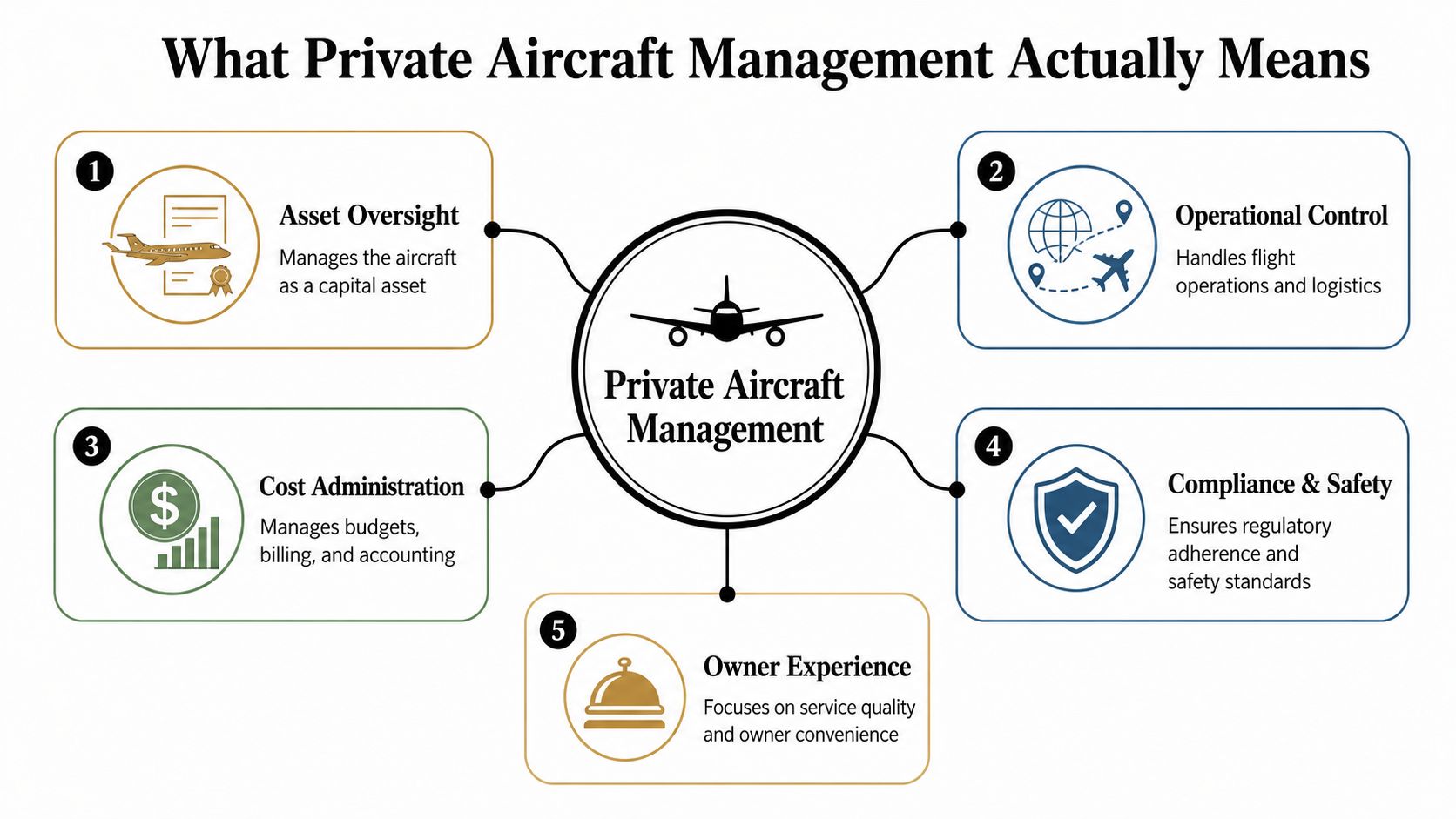
That is where private aircraft management enters the picture. It's not the jet itself, and it's not a membership product. It's the operating layer that keeps an owned aircraft safe, compliant, crewed, maintained, and ready to fly, while the owner keeps the asset and the management firm runs the day-to-day systems around it Guardian Jet, Amalfi Jets.
The reason this matters is simple. Business aviation sits inside a globally active fleet that needs constant coordination, and the economics of ownership can get complicated fast. Industry estimates put the worldwide business jet fleet at about 23,456 active aircraft in 2023, with global private jet flight hours ranging from roughly 1.2 million to 5.2 million depending on dataset, and North America remains the center of gravity for the market Wifitalents.
Defining Private Aircraft Management
A first-time owner often hears several labels at once, management, charter, fractional, jet card, and they can sound similar. They do different jobs. Private aircraft management is the outsourced operating function that supports an aircraft owner while the owner keeps the aircraft as the asset and the management company handles the work needed to keep it available and airworthy Guardian Jet.
The simplest way to define it
A third-party aviation services firm runs the aircraft's operating system. That includes crew coordination, maintenance planning, scheduling, compliance, records, and the financial plumbing behind every trip Atlantic Jet Partners, Amalfi Jets.
Practical rule: if a company is selling access to flying without ownership, you are looking at a charter, fractional, or card product. If you already own the jet and need someone to operate it, you are looking at management.
That distinction matters because the owner's problem after purchase is not just how to fly. It is how to keep the airplane productive without letting service quality, safety, and compliance slip. The economics sit right inside that question. Business aviation is material to the U.S. economy, and the NBAA fact book cites $150 billion annually in contribution and more than 1.2 million people employed in the U.S. aviation ecosystem NBAA fact book.
For a new buyer, the practical issue is priority. A managed aircraft can be used on the owner's schedule, but only if the operator is keeping crew, maintenance, records, and trip logistics aligned so the jet is not sitting idle when it should be flying. The owner is really paying for control of downtime, not just access to a tail number.
What it is not
Fractional ownership means buying a share of an aircraft. A jet card means prepaying access to flying. Pure charter brokerage matches a trip with an aircraft. Private aircraft management sits behind those models in a different way, because it answers who is operating the aircraft you already own, and how well that work is being done.
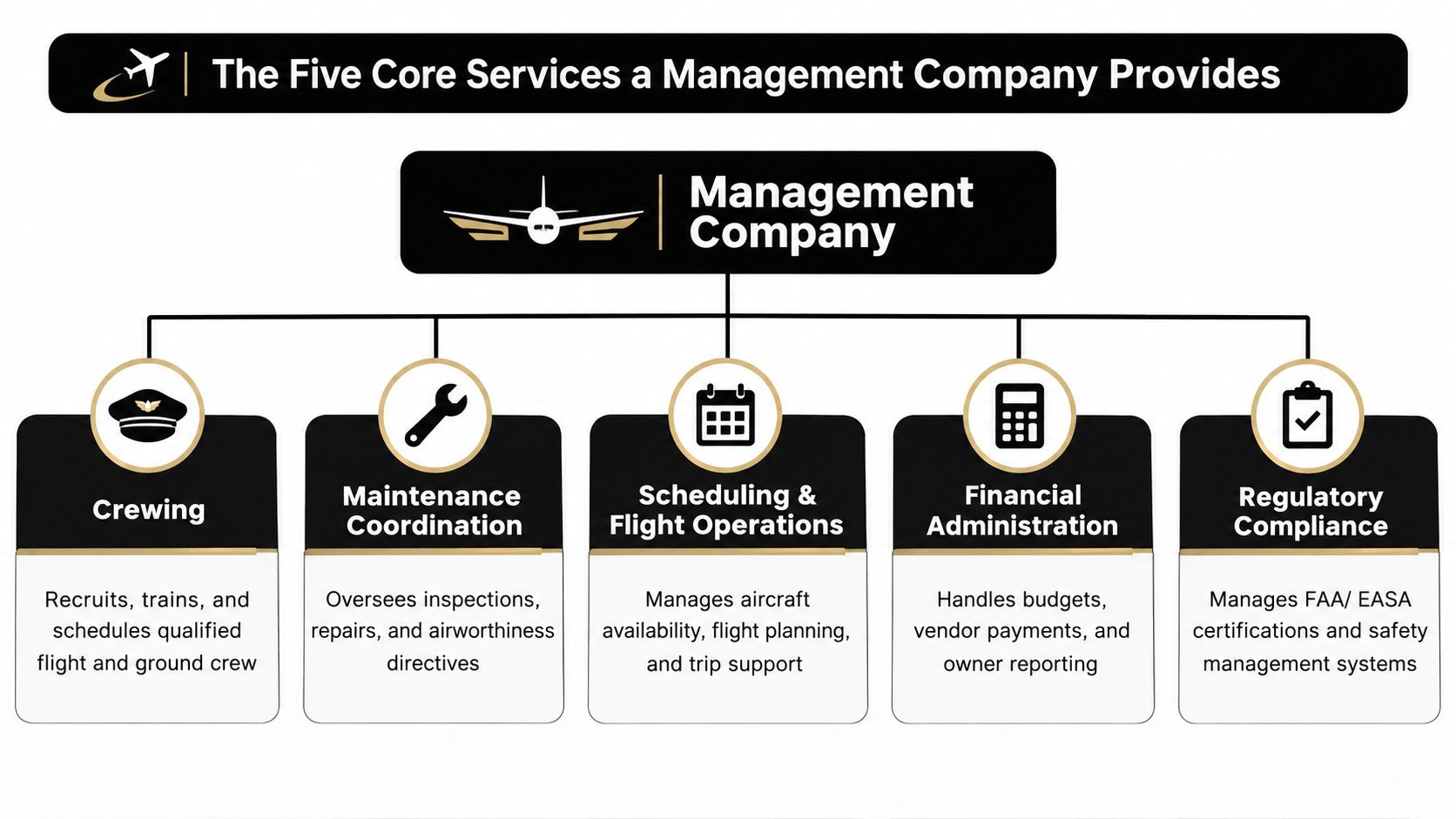
The Five Core Services a Management Company Provides
A good management contract is built on a few responsibilities that work together. If one weakens, the others feel it quickly. A delayed maintenance event changes dispatch plans, a crew issue can make the aircraft unavailable, and a compliance miss can create insurance or operational problems.
Crewing and duty coverage
The management firm hires, schedules, and oversees the flight crew, and often the cabin team when the aircraft requires one Guardian Jet, Amalfi Jets. This isn't just staffing on paper. The firm has to keep qualified pilots available, manage training cycles, and make sure the crew matches the aircraft, the mission, and the owner's schedule.
A weak crewing program tends to show up as slow trip confirmations, last-minute substitutions, or constant rescheduling. A strong one feels invisible because the same people keep the aircraft ready without the owner having to chase updates.
Maintenance and airworthiness
Maintenance coordination is where management becomes very operational very quickly. The firm schedules inspections, tracks repairs, manages technical records, and coordinates with shops and vendors so the aircraft stays airworthy Atlantic Jet Partners. In practice, this is the difference between a jet that sits when something small goes wrong and a jet that keeps moving because the manager has already lined up the parts, labor, and approvals.
Scheduling, dispatch, compliance, and charter
Scheduling and dispatch are the daily control center. Regulatory compliance covers the paperwork and procedures that keep the aircraft legal to operate. Charter management is the optional revenue piece, where the firm offers the aircraft to third-party users when the owner isn't flying it Guardian Jet.
Operational insight: every one of these services affects the others. If the aircraft is on charter, maintenance windows and owner access both need tighter discipline.
What It Costs to Run a Managed Aircraft
A new owner often discovers that aircraft ownership is not priced like a car and not even like a yacht. A jet has fixed commitments, variable flying costs, and timing issues that change the bill during the first year as the operation settles, vendors are tested, and reserves are adjusted.
The cost stack owners face
A managed aircraft usually carries fixed and variable costs together. Fixed items include the management fee, hangar, insurance, and crew-related overhead. Variable costs change with utilization, especially fuel, maintenance, landing fees, and flight support.
Hourly operating cost ranges give a practical starting point. Light jets are estimated at $1,500 to $2,500 per hour, mid-size jets at $2,500 to $4,000, and heavy jets at $4,000 to $8,000 Private Aviation Tech. Those figures do not replace a full pro forma, but they help a buyer see why an aircraft that sits too much becomes expensive in ways that are easy to miss on delivery day.
| Aircraft Class | Hourly Operating Cost (USD) | Typical Use Case |
|---|---|---|
| Light Jet | $1,500 to $2,500 | Short regional trips, family travel, quick business hops |
| Mid-Size Jet | $2,500 to $4,000 | Longer domestic missions, mixed business and leisure |
| Heavy Jet | $4,000 to $8,000 | Transcontinental and international travel, larger cabin needs |
A useful way to read that table is to separate the cost of having the aircraft available from the cost of flying it. Owners often focus on the trip cost and miss the quiet expense of readiness, crew coverage, parking, insurance, and the operational attention needed to keep the aircraft positioned for use.
Why the first year often surprises owners
An aviation management source says first-year operational cost overruns commonly reach 25% to 50%, and inadequate maintenance reserve planning can account for up to 40% of those overruns Private Aviation Tech. That is why reserve discipline matters more than polished sales language. If reserves are thin, every inspection and unscheduled event feels like a surprise instead of a planned operating cost.
The broader ownership picture points in the same direction. The global aircraft management market was valued at about $5.2 billion in 2023 and was projected to grow 5.8% annually through 2030 Private Aviation Tech. That suggests a mature service model with repeatable economics, not a one-off arrangement built differently for each owner.
A buyer who wants to compare these recurring costs with the purchase side of ownership can also review cost of private aircraft as a companion reference. For a broader financial planning view, Parkview Partners for high net worth individuals is a useful starting point for seeing how aircraft expenses fit inside the rest of an owner's balance sheet.
How Charter Revenue Offsets Ownership Economics
An owner who expects charter income to cover a large share of operating cost usually learns the hard part after the aircraft is delivered. The plane can earn money when it would otherwise sit idle, but every revenue trip has to fit around owner trips, cabin standards, crew readiness, and maintenance timing. The economics are real, yet they are controlled by operational limits, not wishful thinking.
The revenue offset has a real cost
Once a management company places an aircraft into charter service, it has to market the aircraft, screen trips, and keep the airplane ready for third-party use. That can create outside revenue, but it also changes how the aircraft is scheduled, because the calendar now serves both the owner and the charter client Priester Aviation. For an owner with flexible travel habits, that arrangement can make sense. For an owner who flies on short notice or on a fixed pattern, the added scheduling pressure can reduce the value of the revenue stream.
The key question is not whether charter can contribute to ownership economics. It can, if the aircraft, the mission profile, and the management program fit together. The harder question is whether the revenue still works after downtime, repositioning, and owner access are set aside. Many sales conversations stay vague at exactly that point.
Owners should ask one direct question, how much charter-hour generation is realistic after maintenance windows and my own trips are protected?
A concrete owner scenario makes the trade-off easier to see. If the aircraft is often available midweek and the owner mostly flies on weekends, charter can help absorb fixed costs during the empty days. If the owner travels unpredictably and wants the aircraft ready at all times, the same charter strategy can create friction every time a request has to compete with owner use.
What a serious owner should ask
The better guidance is practical, not promotional. Owners should ask about charter-hour generation, pricing, downtime minimization, owner-access priority, and reporting Priester Aviation. Those questions matter because charter income only helps if the operator can fit it into the actual rhythm of aircraft use, not an idealized schedule on a sales sheet.
A charter-heavy model may fit an owner who wants the aircraft to earn while it is not in private use. It is a weaker fit for someone who treats the jet as a purely private tool and does not want outside lift affecting readiness. For a practical look at the charter side of the equation, private jet charter cost helps frame what operators and travelers are paying for when an aircraft is booked by the hour.
The best management firms are honest about both sides of the ledger. They show where charter revenue can help, then they explain where that revenue reduces flexibility, adds wear, and requires more disciplined planning.
Comparing Management, Charter, Fractional, and Jet Cards
Buyers usually compare these models by asking the wrong first question. They ask which one is cheapest. A better question is which one fits the way they fly, because capital commitment, access, and flexibility all pull in different directions.
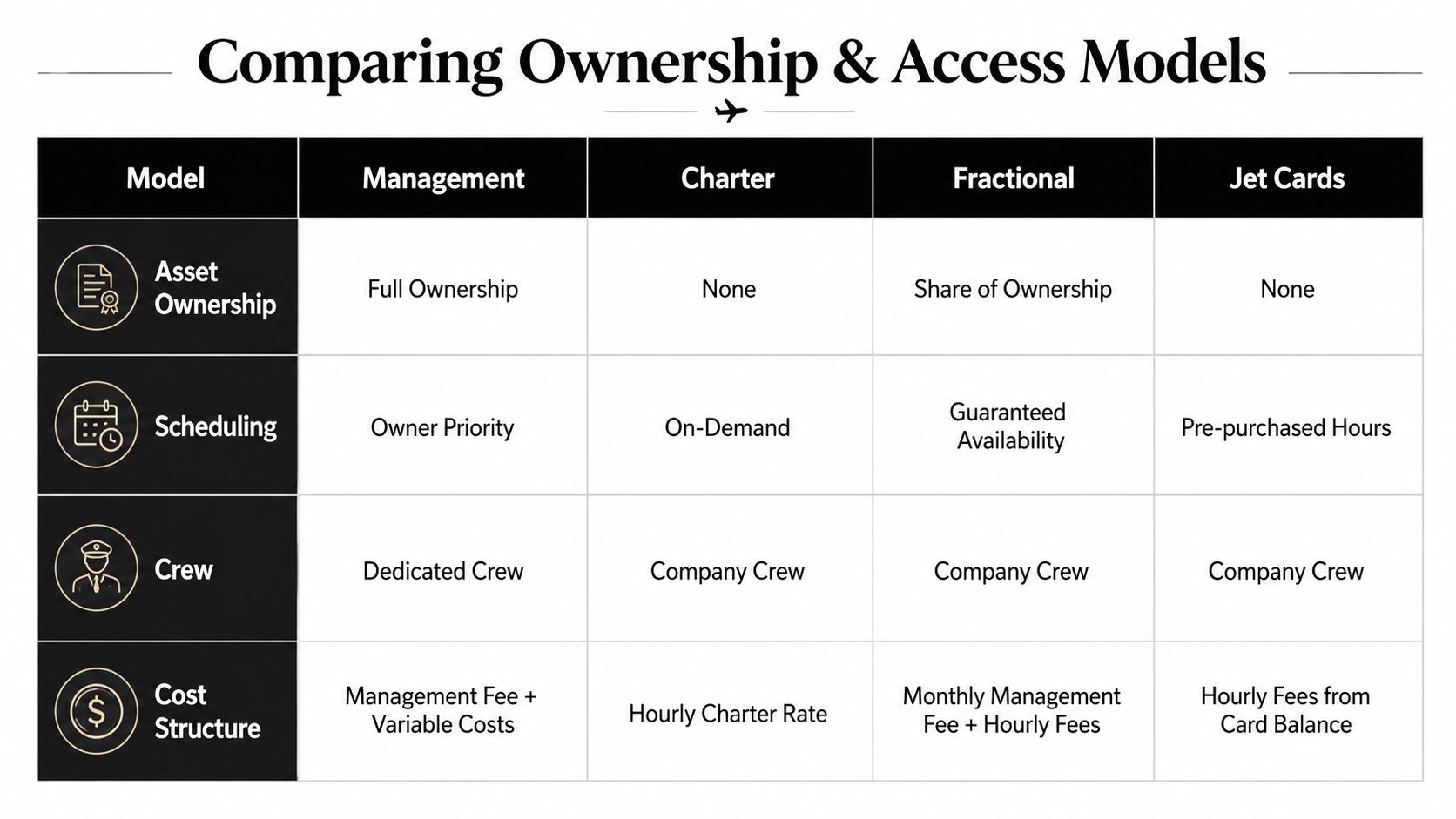
Four models, four very different trade-offs
| Model | Capital Commitment | Access Guarantee | Typical Cost Profile | Best Fit |
|---|---|---|---|---|
| Managed Ownership | High | Owner priority, subject to scheduling and maintenance | Management fee plus variable operating costs | Buyers who want control of the asset |
| On-Demand Charter | None | No aircraft-specific guarantee | Pay per trip | Travelers who value flexibility over consistency |
| Fractional Ownership | Shared capital commitment | High within the program structure | Share purchase plus recurring fees | Users who want access without full ownership |
| Jet Cards | None or low upfront commitment | Program-dependent access | Prepaid hours and program pricing | Users who want simpler trip planning |
A managed aircraft gives you the most control over the exact aircraft, the crew culture, and the cabin standard. Charter gives you the least capital commitment, but not the same control over aircraft identity or availability. Fractional and jet cards sit in the middle, because they promise more predictable access while giving up some of the specificity owners often want.
Why this comparison matters before you buy
Traditional charter can also carry repositioning inefficiency, which inflates what you pay if the aircraft has to travel to you before the trip even begins. That's one reason some buyers lean toward ownership or managed ownership, they want the aircraft based where they are and available on their terms. Jet cards and fractional programs solve parts of the access problem, but they usually do it by standardizing the experience rather than giving you a specific asset.
For a deeper comparison of cards and charter, this resource helps frame the difference, private jet cards vs charters.
The right choice depends on whether you care most about access, identity of aircraft, or simplicity. Once that order is clear, the model usually becomes easier to choose.
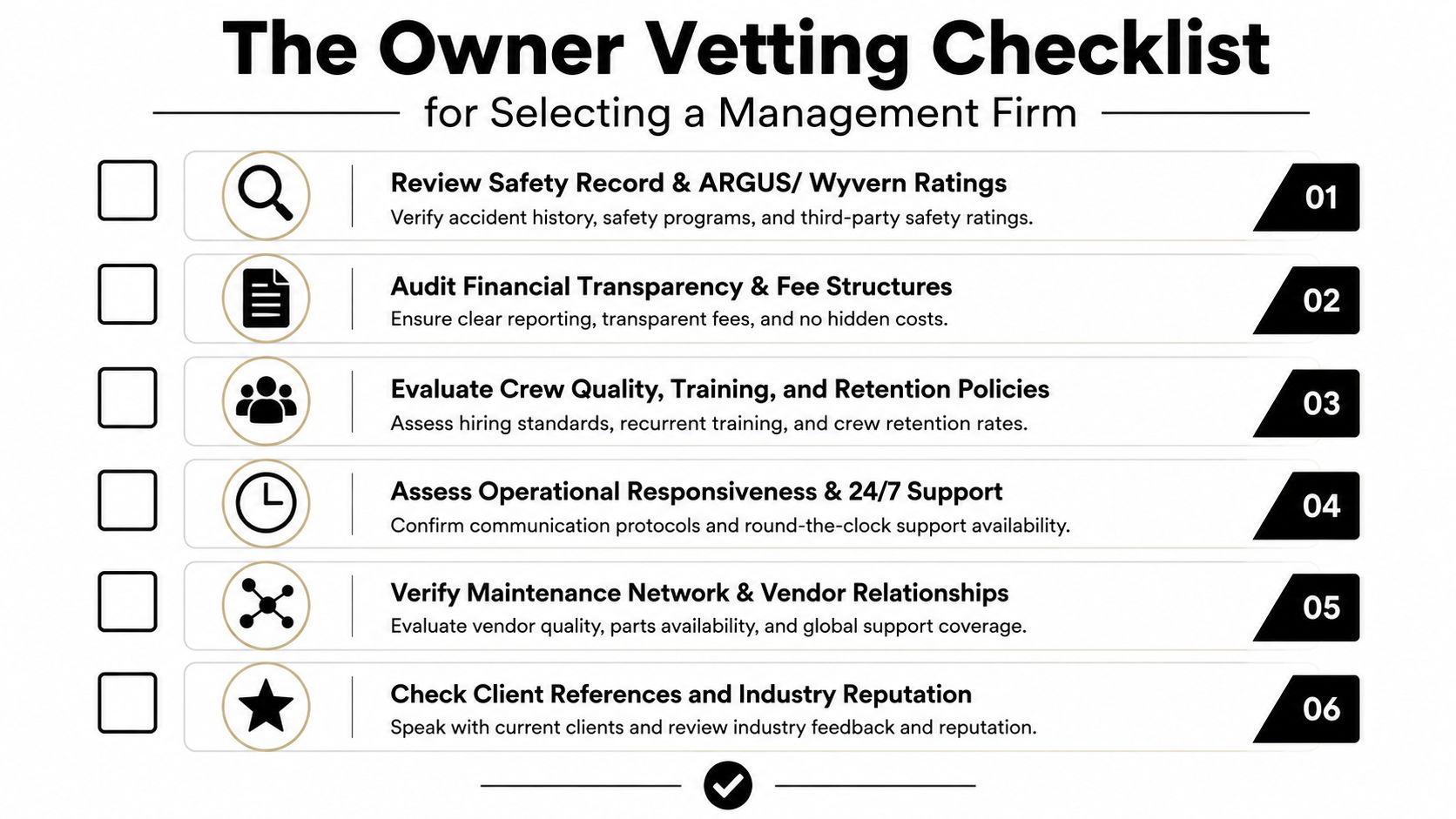
Selection Criteria and the Owner Vetting Checklist
A management firm should be judged the way you'd judge any safety-critical operating partner, by process, transparency, and response quality. A polished sales pitch doesn't tell you how the company behaves when a plane goes AOG, a crew member calls out, or a trip changes late in the day.
Start with safety and scale
Third-party safety ratings are a sensible floor. For operators that charter or manage actively, Wyvern Wingman and Argus Gold or Platinum are the kinds of ratings owners should ask about before moving forward. They don't replace diligence, but they do show that the operator has submitted to outside scrutiny.
After that, look at operational scale. Does the company manage aircraft similar to yours, in similar mission profiles, and in the region where your aircraft will live? A firm that understands long-range international use may not be the best fit for a light jet based on a domestic leisure schedule.
Demand reporting that lets you audit the operation
Monthly reporting should be specific, not decorative. You want utilization, maintenance reserve accounting, charter-revenue reconciliation if the aircraft is on charter, and a clear view of owner access versus third-party use. If the report makes it hard to see where the aircraft was, what it cost, and why a trip changed, the operation will probably feel opaque in real life too.
A strong contract also spells out the exit. Read the lock-in term, indemnification language, and owner-access clauses carefully. Ambiguity here usually shows up later as friction over scheduling priority or unexpected fees.
Practical rule: if you can't tell, from the paperwork, who gets the aircraft when two trips compete, the contract isn't clear enough.
Use a simple vendor checklist
- Review Safety Record: Ask for current rating status, audit history, and corrective-action process.
- Audit Financial Transparency: Confirm how fees are billed, what's pass-through, and what gets marked up.
- Check Crew Quality: Ask how the firm recruits, trains, and retains pilots and cabin staff.
- Test Responsiveness: Call after hours and see how quickly someone who knows the aircraft responds.
- Verify Maintenance Network: Learn which shops, vendors, and spares sources they rely on.
- Ask for References: Speak to owners with similar aircraft and mission profiles.
If you want one operator that can be compared against the rest of the market, Haute Jets offers aircraft sourcing and charter booking through its network, but the management decision itself still comes down to the firm you hire for operations. The checklist above is the same lens I'd use whether the aircraft is based in Florida, Texas, or Europe.
Two Owner Scenarios That Show How the Model Plays Out
A managed jet looks different depending on who owns it and why it exists. The same aircraft can be a family travel tool in one case and a corporate mobility asset in another, so the management style should match the mission, not the marketing brochure.
The Miami owner with a light jet
A high-net-worth buyer in Miami wants a light jet for family weekends, quick business hops, and occasional charter when the calendar opens up. The owner cares about priority access first, revenue offset second. That means the management company has to keep the aircraft close, staff it reliably, and protect the owner's schedule before it ever thinks about third-party trips.
In this setup, the owner would usually favor a firm that is disciplined about crewing and maintenance, but not aggressive about chartering every open hour. The aircraft still needs to earn when practical, yet the owner's use pattern determines the calendar. If the manager overcommits the jet to outside charter, the aircraft stops feeling private very quickly.
The corporate flight department with a super-midsize jet
A corporate flight department using a super-midsize jet faces a different pressure. The aircraft may move executives across multiple hubs, and scheduling rigor matters more than charter offset. The operation has to manage duty time, route planning, compliance, and dispatch reliability without dropping the ball when itineraries change.
In that case, the firm's value shows up in coordination. The crew needs to be ready, maintenance needs to be sequenced around business travel, and reporting has to be clean enough for internal finance and travel teams. Charter revenue may exist as a side benefit, but it's not the main event.
Both owners are buying the same basic thing, an outsourced operating system. They just measure success differently, one by access priority, the other by uptime and organizational precision.
If you're deciding whether ownership still makes sense after you factor in operations, downtime, and charter offset, Haute Jets can help you compare aircraft options and trip economics in a way that fits the way you fly. Visit Haute Jets to review charter access, aircraft sourcing, and the operating realities that matter before you commit to an ownership model.