

Private aviation cost in 2026 typically ranges from $2,300 per hour for turboprops to over $18,000 per hour for heavy jets, with VIP airliners reaching as high as $23,000 per hour. The hourly rate is only half the story, because positioning, crew, handling, taxes, and aircraft availability can determine the final invoice.
The popular advice is to compare hourly charter rates and choose the lowest quote. That approach is incomplete and often expensive. A low advertised rate can become a premium bill when the aircraft must reposition, the operator applies a daily minimum, or the route carries significant taxes and airport charges.
For a high-net-worth traveler, the right question isn't, “What does the jet cost per hour?” Ask instead, Which aircraft is already near my departure city, what does the quote include, and what mission am I buying? That shift from rate-shopping to mission planning is the foundation of sensible private aviation spending.
Understanding the True Cost of Private Aviation
An hourly rate multiplied by flight time does not establish the private aviation cost. It only sets a starting point. Charter pricing combines fixed operating expenses, including insurance, maintenance reserves, and crew infrastructure, with variable expenses, such as fuel, handling, and route-specific services. Fuel, landing fees, crew costs, and aircraft positioning can materially change the final invoice, as outlined in this private jet charter cost guide.
A regional light-jet mission often carries a hidden cost: the aircraft is based in another city, and the ferry legs land on your invoice. If the operator must fly the jet empty to collect you, you pay for passenger-free flight time. Traditional broker markups can add another layer, while an on-demand charter sourced through local operators may reduce unnecessary repositioning and intermediary costs. A larger aircraft also commands a higher hourly rate because its range, cabin, fuel burn, crew requirements, and operating complexity are greater.
Why distance is a weak budgeting tool
Distance says little about the actual mission. A short flight in a heavy aircraft can cost more than a longer trip in a light or midsize jet, particularly when the larger aircraft must reposition or remain away from base overnight. Aircraft availability near the departure airport can matter as much as the route.
Short sectors create another pricing trap. Operators often apply daily or minimum billable time, so a brief flight is not always priced as a simple hourly multiple. Independent charter-rate guidance identifies fuel, crew, landing, positioning, and daily minimums as costs that commonly sit outside the headline hourly figure.
Practical rule: Request an all-in mission quote, not a rate card. The quote should identify the aircraft, billable time, positioning, crew expenses, airport charges, taxes, and optional services.
The invoice follows the mission profile
A credible quote accounts for passenger count, luggage, range, departure and destination airports, timing, return requirements, and aircraft availability. International routes add handling complexity and route-specific taxes. UK-origin long-haul travel also faces a sharp Air Passenger Duty increase effective 1 April 2026, with long-haul private-flight APD listed at £1,141 per passenger and shorter long-haul band B at £1,097 per passenger in 2026 charter market coverage.
Use published ranges for benchmarking, not approval of a final quote. The Haute Jets private jet charter cost guide can provide an initial reference, but the aircraft's location and your exact itinerary determine whether the offer represents value or hides repositioning and service charges. Get the operator, aircraft, inclusions, and ferry legs in writing before you commit.
Key Factors That Drive Charter Pricing
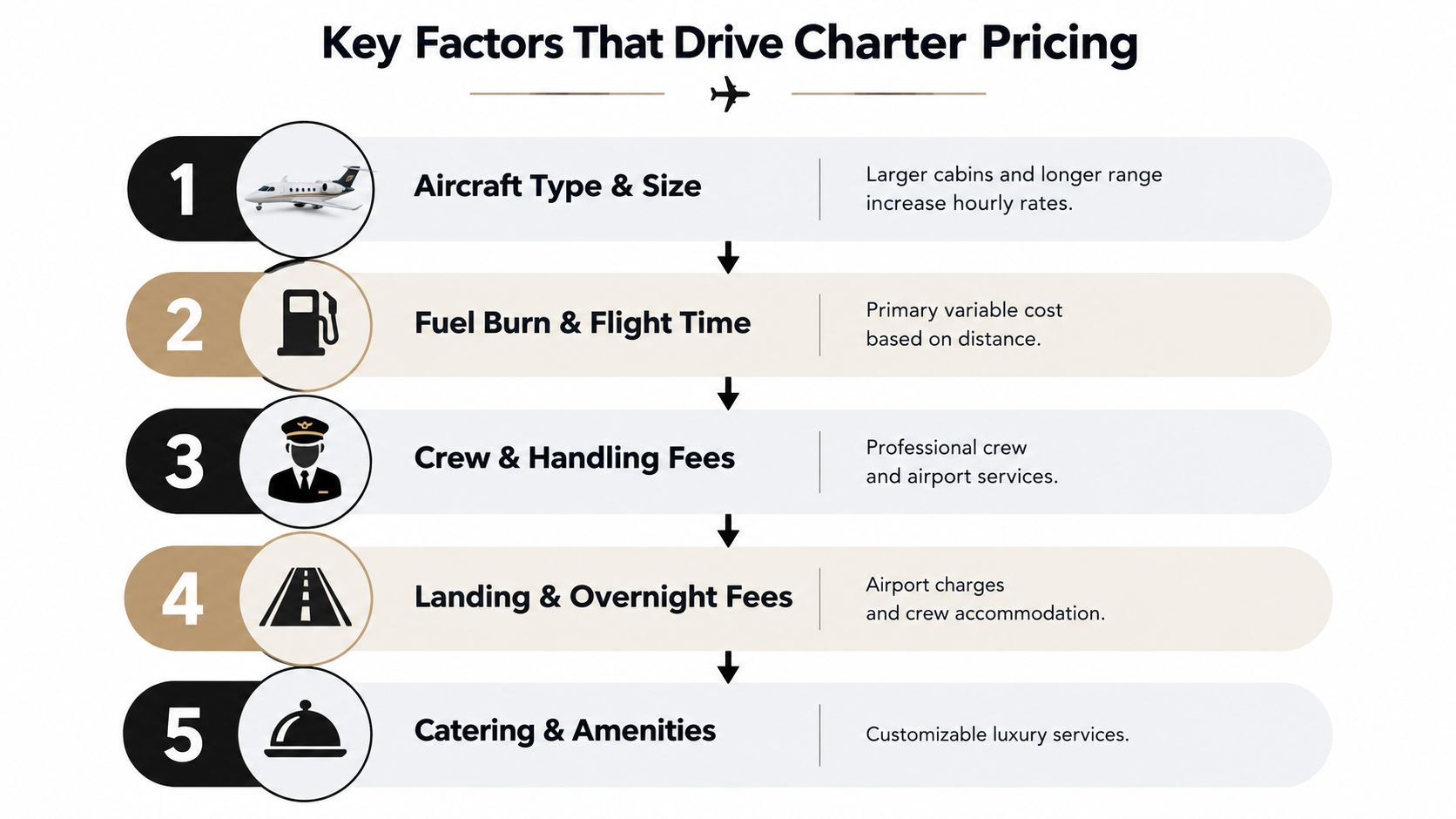
Private aviation pricing is an operating-cost calculation disguised as a luxury travel quote. Aircraft size establishes the baseline, then fuel, crew, airport services, taxes, and schedule requirements shape the final amount. Aircraft operating-cost benchmarks show all-in charter and operating costs rising from about $1,700 per flight hour for very light jets to more than $9,000 per hour for ultra-long-range aircraft. Midsize jets are typically around $3,400 to $4,400 per hour at 400 annual flight hours.
Aircraft and fuel establish the core rate
A turboprop or very light jet usually sits at the lower end because it carries less fuel, supports shorter missions, and has a smaller cabin. Super-midsize, heavy, and ultra-long-range aircraft require more fuel and generally carry higher maintenance reserves, insurance costs, crew costs, and fixed-cost amortization.
Fuel remains a major variable. Flight time, routing, weather, payload, and aircraft performance affect consumption, which is why two aircraft in the same broad category can still produce different economics. For a deeper explanation of the fuel component, review Haute Jets' guide to private jet fuel costs.
Crew, handling, and airport charges add layers
Professional crew costs don't disappear because a flight is short. A quote may also include landing fees, ramp access, ground handling, parking, hangar requirements, and crew accommodation when the itinerary keeps the aircraft away from its base. Deicing and international handling can apply when the route or conditions require them.
Catering, Wi-Fi, ground transportation, pet-related services, and specialized cabin requests may be included, excluded, or priced separately. Never assume that a premium cabin automatically includes every service your party expects.
Taxes and market conditions matter
International itineraries expose the difference between base charter cost and all-in cost. The same 2026 market coverage cites a projected 4% year-over-year rise in global non-fuel airline costs, while reporting that jet fuel declined by more than 8% in some markets during 2025. Lower fuel in some markets doesn't automatically translate into lower charter invoices when labor, maintenance, airport, and regulatory costs rise.
Business jet activity was roughly 3% higher in the first half of 2025 than in the same period of 2024, according to that same market source, indicating resilient demand. Clients should therefore separate negotiable items, such as aircraft sourcing and optional catering, from market realities, such as taxes and airport charges.
Typical Price Ranges by Aircraft and Route
Aircraft class sets the first useful private aviation cost range, but it does not determine the final invoice. Published 2026 guides place most aircraft between roughly $2,300 and $17,000 per billable flight hour, with VIP airliners around $18,000 to $23,000 per hour. Another 2026 breakdown lists light jets at about $3,000 to $5,000, super-midsize jets at $4,000 to $8,000, and heavy jets at $10,000 to $18,000 per hour. Review the 2026 private plane rate breakdown for the class comparisons.
| Aircraft Class | Hourly Rate Range | Example Route | Estimated All-In Cost |
|---|---|---|---|
| Turboprop | About $2,300 per hour | Regional hop | About $10,000 to $20,000 |
| Very light jet | Around $1,700 per operating hour benchmark | Short regional mission | About $10,000 to $20,000 |
| Light jet | About $3,000 to $5,000 per hour | Regional hop | About $10,000 to $20,000 |
| Midsize jet | About $3,400 to $4,400 per hour benchmark | Longer domestic mission | About $16,000 to $26,000 |
| Super-midsize jet | About $4,000 to $8,000 per hour | Transcontinental mission | Varies by route and positioning |
| Heavy jet | About $10,000 to $18,000 per hour | Transatlantic crossing | Can exceed $100,000 |
| VIP airliner | About $18,000 to $23,000 per hour | Long-haul group mission | Varies substantially by itinerary |
These are benchmark ranges, not guaranteed quotes. A short light-jet charter can total about $10,000 to $20,000, while a transatlantic heavy-jet trip can exceed $100,000. The aircraft's location, return schedule, airport restrictions, and passenger requirements can push a mission beyond its apparent class range.
Match the aircraft to the route
For a short regional hop, a turboprop or very light jet can offer the strongest value when speed, runway access, and cabin requirements permit. A light jet suits a small group that wants a faster regional trip with greater privacy.
Midsize and super-midsize aircraft fit passengers who need more cabin space, luggage capacity, or range. Heavy and ultra-long-range aircraft belong on long-haul missions. Booking one for a short route adds cost without improving the trip unless its cabin, schedule, or payload directly meets a requirement.
Why route examples can mislead
A city pair does not produce a universal price. Winds affect block time and fuel use. FBO fees vary by airport, while slot restrictions can limit departure and arrival options. International routes may also involve different handling requirements, and busy airports can impose operating constraints that change the quote.
Use the table to screen aircraft classes, then request an exact aircraft and a written all-in quote. Require the quote to identify flight time, airport and FBO charges, taxes, catering, and any schedule-related fees. That level of detail exposes traditional broker markups and makes a locally sourced, on-demand charter easier to compare with a rigid jet card.
How Repositioning Fees Inflate Your Invoice
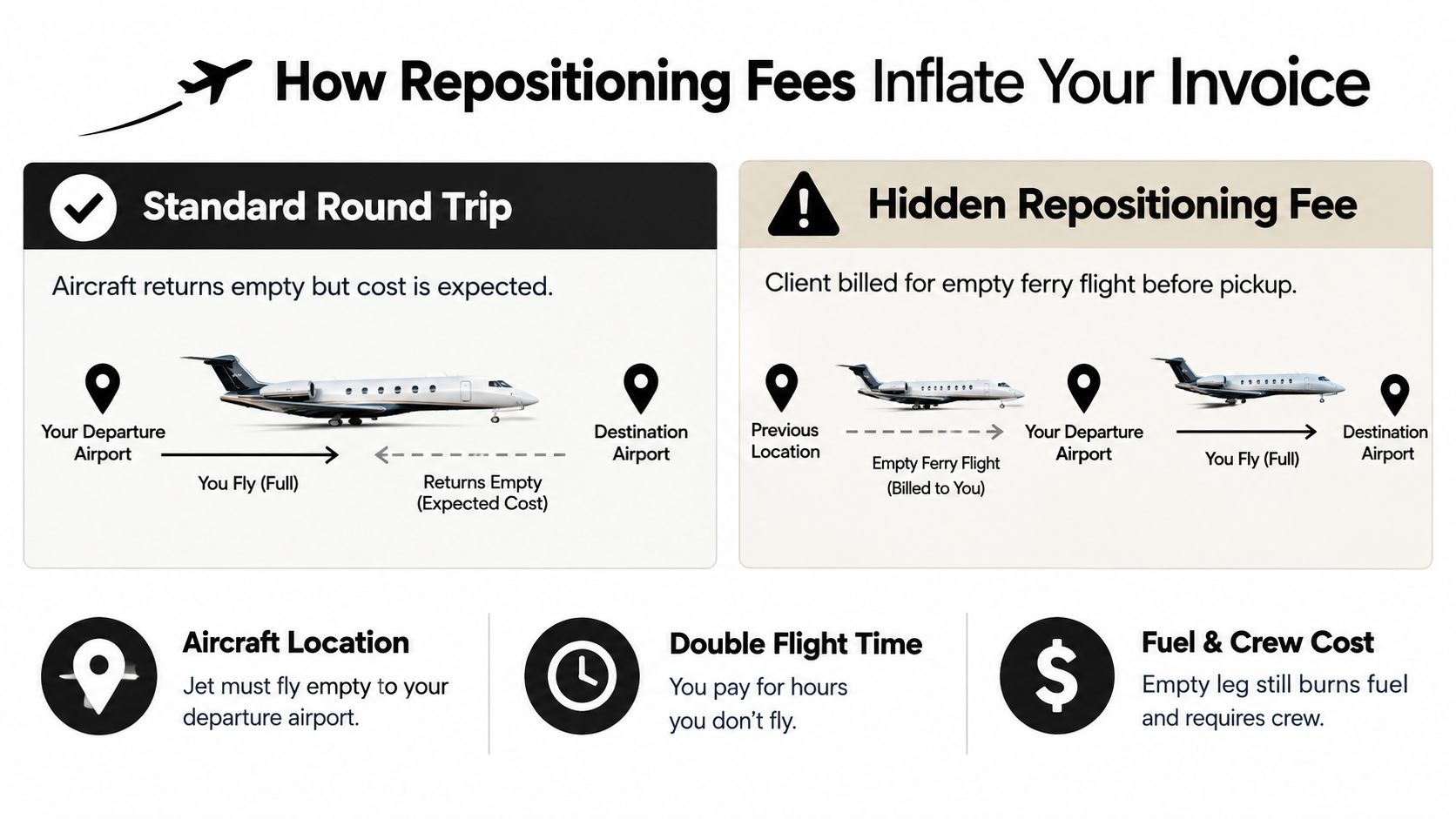
Repositioning is the cost most clients discover too late. If the aircraft isn't near your departure airport, it must fly empty to collect you, and the operator bills those ferry legs at the aircraft's hourly rate. You pay for aircraft movement that creates no passenger value.
Independent guidance places repositioning at 30% to 100% of the charter invoice, while local aircraft availability can reduce that surcharge to roughly 20% to 25% on short light-jet trips. On midsize-jet round trips, a single long empty leg can add $15,000 to $50,000, according to repositioning and deadhead fee guidance.
The traditional broker problem
A traditional broker may find an aircraft that fits your schedule but sits far from your departure city. The quote can still look competitive if the broker highlights only the passenger leg or presents the aircraft category without clearly showing ferry time.
The client then pays for fuel, crew, and aircraft hours before pickup. If the aircraft must also return empty after the passenger trip, the effective cost can approach twice the apparent passenger-flight economics.
Ask one direct question: Where is the aircraft positioned before pickup, and which repositioning legs appear on my invoice?
Local sourcing is the highest-leverage control
Aircraft location is one of the few major pricing variables a client can influence without compromising safety or service. Haute Jets states that it sources from 3,500+ owner-operators across 175 countries, allowing its team to look for aircraft near the departure city rather than defaulting to a distant operator. That local-sourcing model can remove avoidable ferry costs before they enter the quote.
This doesn't mean every local aircraft is suitable. The jet must still meet range, payload, maintenance, crew, insurance, and safety requirements. The correct process is to source locally first, then filter rigorously.
A broker markup and a repositioning charge aren't the same thing, but they can compound. Request the aircraft's current location, planned routing, empty legs, and all applicable fees in writing. If the provider can't answer those points clearly, you're not comparing prices. You're comparing incomplete invoices.
Comparing Jet Cards to On-Demand Charter
Jet cards solve a real problem, but they do it by exchanging flexibility for contractual structure. A 2026 comparison places fixed jet-card hourly rates around $8,500 to $16,500, while on-demand charter is market-priced at roughly $3,500 to more than $20,000 per hour, depending on aircraft type and mission. The jet card versus charter cost comparison makes the central trade-off clear: predictability can cost more than a well-sourced one-off flight.
What a jet card gives you
A jet card can suit a traveler with recurring demand, a preference for fixed rates, and a need for structured access. The program may define cabin categories, booking windows, service standards, and availability rules. That consistency can simplify corporate budgeting.
The cost is rigidity. Annual fees, prepaid hours, minimums, blackout dates, cancellation rules, and substitution policies can reduce the value of unused flexibility. A fixed hourly rate also doesn't guarantee that the program's aircraft category is the ideal aircraft for every mission.
What on-demand charter gives you
On-demand charter makes sense when routes, passenger counts, and aircraft needs change. You can choose a turboprop for a short regional mission, a light jet for a smaller group, or a heavy aircraft when range and cabin requirements demand it.
The drawback is variable pricing. Aircraft availability, positioning, demand, fuel, and airport charges affect each quote. That variability is manageable when your broker shows the full economics and sources locally.
| Access model | Best fit | Main advantage | Main concern |
|---|---|---|---|
| Jet card | Recurring, predictable travel | Fixed-rate structure | Prepaid commitment and restrictions |
| On-demand charter | Irregular or highly varied missions | Aircraft and route flexibility | Market-based pricing |
| Ownership or fractional access | Very high utilization | Greater control | Ongoing fixed operating obligations |
My recommendation is direct. Choose a jet card only when its access rules match your actual travel pattern, not because a fixed hourly rate sounds automatically cheaper. For occasional or varied flying, compare the full on-demand quote against the full card commitment, including unused hours and contractual restrictions.
Maximizing Value with Empty Leg Flights
Empty leg flights can produce strong value when your schedule can adapt. An empty leg occurs when an aircraft must move to its next assignment or return to base without passengers. Rather than selling the flight as a standard round trip, an operator may offer that one-way segment at a reduced price.
The trade-off is control. Departure time, route, aircraft, and availability are fixed by the aircraft's existing operational plan. If the primary charter changes, the empty leg may change or disappear. Empty legs work best for travelers who can accept uncertainty and don't need a guaranteed departure at a specific time.
A disciplined way to use empty legs
Start by giving your charter team flexible departure windows and preferred airports. Corridors such as Miami to the Bahamas, Miami to Turks and Caicos, New York to Aspen, or Miami to Aspen may produce opportunities when aircraft are repositioning for scheduled missions, but no route is guaranteed.
Then verify the economics. A discounted empty leg is useful only if the departure airport, timing, baggage capacity, and return plan work for your party. Buying a cheap outbound flight and then paying a premium for an inflexible return can erase the benefit.
Read this empty leg flight guide before committing to a one-way opportunity.
Safety screening remains a requirement. Use only operators with Wyvern Wingman or ARGUS Gold or Platinum ratings, and ask who operates the aircraft before discussing the discount.
An empty leg is a pricing opportunity, not a reason to lower standards.
Ask for the cancellation terms, confirmed aircraft, operator identity, and the conditions under which the flight could be withdrawn. A reputable team should explain those risks plainly rather than presenting the empty leg as an ordinary guaranteed charter.
Booking with Transparency and Safety in Mind
A fair private aviation quote has two qualities: it explains the cost, and it identifies the aircraft and operator responsible for the flight. Don't accept a generic “light jet” description when your luggage, Wi-Fi requirements, pets, cabin layout, or range needs matter.
The standards I require
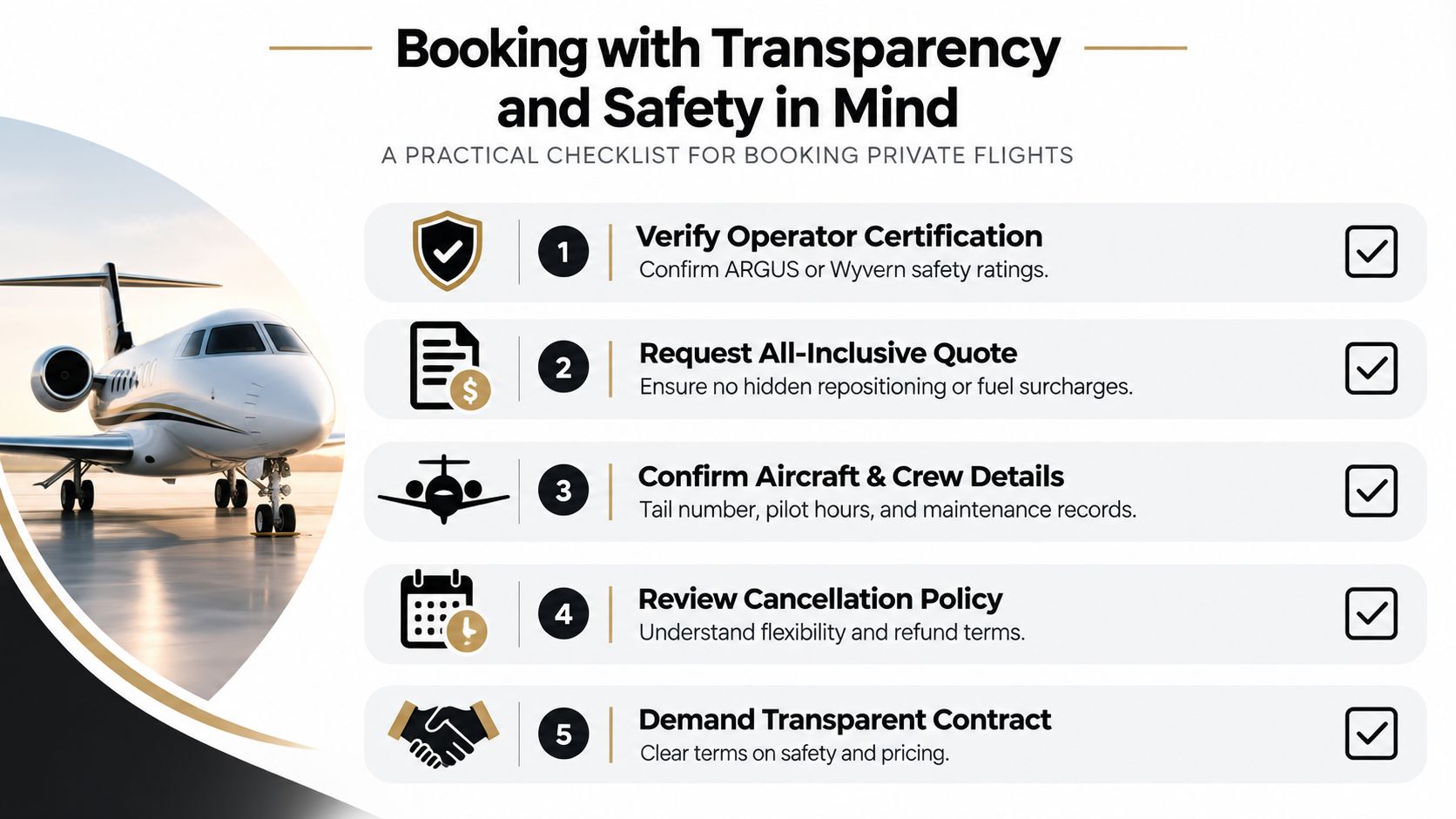
First, verify the operator's third-party safety rating. Require Wyvern Wingman or ARGUS Gold or Platinum status before you evaluate the price. Those ratings don't replace your own diligence, but they create an essential screening threshold.
Second, request an all-inclusive quote that separates included costs from variable costs. The document should identify fuel treatment, landing and handling charges, crew expenses, taxes, catering, ground transport, overnight requirements, and repositioning.
Third, choose the exact aircraft where possible. Ask for the year, make, model, cabin configuration, tail number, Wi-Fi availability, pet policy, and maintenance information. A category label isn't enough to guarantee the experience you expect.
Confirmation protects the day of travel
Demand a 24-hour pre-flight confirmation containing full flight details, the tail number, crew biographies, weather briefing, and passenger manifest. The confirmation should also identify the fixed-base operator, or FBO, where you'll depart. If the aircraft changes, the provider should tell you why and obtain your approval where the contract requires it.
Review cancellation, substitution, and refund terms before payment. A low quote with weak change protection may be poor value for a time-critical corporate itinerary.
Final booking test: If you can't identify the operator, aircraft, included charges, and cancellation terms before payment, you don't yet have a transparent quote.
Private aviation cost should buy control, not confusion. Compare mission economics, eliminate avoidable repositioning, and insist on a safety-qualified operator before you commit.
Haute Jets offers on-demand charter sourced from owner-operators across 175 countries, with exact-aircraft selection, wholesale pricing, and Wyvern Wingman or ARGUS Gold or Platinum-rated operators. Visit Haute Jets to request a transparent quote built around your route, aircraft requirements, and safety standards.