

The most popular advice about a private flight to Vegas is also the least useful: find the lowest hourly rate. That number tells you almost nothing about the invoice you'll pay or the time you'll spend on the ground. In Las Vegas, the better decision usually comes from choosing the right airport, sourcing an aircraft that's already nearby, and matching the cabin to the mission.
That matters because Harry Reid International Airport closed 2025 with nearly 55 million passengers, its third-highest annual total, after two record-setting years. It also handled 586,871 aircraft movements and connected Las Vegas with more than 170 markets, figures that explain why the city remains one of the busiest private-aviation destinations in the United States. Las Vegas airport statistics for 2026 provide useful context, but passenger volume alone doesn't tell you where your charter should land.
Why Headline Charter Rates Mislead Vegas Travelers
A cheap hourly quote can be an expensive trip. Charter invoices reflect more than airborne time. They can include the aircraft's location before departure, the cost of bringing it back afterward, airport and FBO arrangements, event-related operating constraints, and the ground journey from the chosen airport to your hotel.
The most damaging variable is often repositioning. If a broker finds a jet with an attractive rate but that aircraft is based in another state, you may pay for the empty flight that brings it to your departure airport. Independent industry guidance says repositioning or deadhead legs can add 30% to 100% to a charter invoice, while an empty leg can price about 25% to 75% below a standard one-way charter when the aircraft is already moving on a compatible route. Signature Aviation's Las Vegas FBO information helps illustrate why the aircraft's operating location and airport access deserve attention before you compare rates.
The quote must reflect the whole journey
A proper comparison should include:
- Aircraft base: Where is the aircraft located before your departure?
- Positioning: Is the operator charging for an inbound or outbound empty segment?
- Airport access: Does the aircraft fit the runway, FBO, and operating requirements of the selected Las Vegas gateway?
- Ground transfer: How long will it take to reach your hotel, meeting, or event venue?
- Event pressure: Are major conventions, races, or fights concentrating demand at the same time?
Las Vegas pricing becomes especially sensitive around major events. Ahead of the 2025 Grand Prix period, county officials reported 272 reservations to park at Henderson Executive Airport and 115 reservations at North Las Vegas Airport. That concentration shows why availability can tighten at secondary airports even when a generic online quote looks reasonable. Reporting on private-jet expansion in Las Vegas offers relevant event-demand context.
Practical rule: Compare total door-to-door economics, not the hourly rate in isolation.
A better way to judge value
A locally based aircraft with a higher apparent rate can be the better purchase if it avoids a long deadhead and lands at a less congested gateway. Conversely, a discounted aircraft can lose its advantage once positioning, waiting, and a longer vehicle transfer are added.
For a broader explanation of the variables behind charter pricing, review this guide to private jet charter cost. Travelers who want additional general ideas can also consult how to save on Vegas flights, but the private-aviation version of saving money starts with operational transparency.
Ask for the aircraft's base, the planned routing, every positioning leg, and the airport selected for Las Vegas. If the provider won't show those details, the quote isn't ready for approval.
Choosing the Right Las Vegas Airport for Your Itinerary
Las Vegas gives private travelers several gateways, but they don't offer the same operating profile. Harry Reid International Airport, Henderson Executive Airport, and North Las Vegas Airport each serve a different purpose, and the correct choice depends on your final destination, arrival time, aircraft, and whether customs is required.
Harry Reid International, or LAS, remains the most direct option for many Strip itineraries. It has two 24/7 FBOs, Signature Flight Support and Atlantic Aviation, on the south side of the airport. LAS also offers on-site customs, making it the practical choice for international arrivals unless another arrangement has been confirmed.
Henderson Executive, or HND, is often the more efficient gateway for domestic private aviation. It's a dedicated general-aviation airport close to the south Strip, Henderson, and Lake Las Vegas. The field operates 24 hours, but its published FBO hours are 05:00 to 22:30. After-hours service must be arranged in advance and usually carries a fee. HND doesn't have an on-site U.S. Customs facility, so international passengers generally clear at LAS. Henderson Executive Airport guidance should be reviewed before booking a late arrival or international itinerary.
Las Vegas Private Aviation Gateways Compared
| Airport | Distance to Strip | Customs | Best Use Case |
|---|---|---|---|
| Harry Reid International Airport, LAS | Closest major gateway to the Strip | On-site customs available | International arrivals, direct Strip access, 24-hour FBO operations |
| Henderson Executive Airport, HND | Close to the south Strip and Henderson | No on-site U.S. Customs facility | Domestic charters, south Strip resorts, reduced exposure to LAS congestion |
| North Las Vegas Airport, VGT | Convenient for northwest Las Vegas and Summerlin | Confirm arrangements before travel | Lighter aircraft, northwestern destinations, selected event overflow |
LAS is geographically convenient, but convenience doesn't guarantee the fastest total trip during a peak weekend. The airport handles substantial commercial and general-aviation activity, and high-volume operations can create pressure on ramps, parking, and arrival sequencing. HND often absorbs overflow during major conventions and fight weekends, which can make it the better choice when your hotel is south of the main Strip or your schedule is tight.
VGT deserves consideration when your destination is Summerlin, the northwest valley, or an event venue in that direction. It's not the default choice for every aircraft, so the operator must verify runway and handling compatibility before confirming the itinerary.
Airport advice: Choose the gateway that minimizes total friction, even if its landing fee or quoted flight rate looks slightly less attractive on paper.
For travelers whose itinerary specifically requires LAS, the Harry Reid International private terminal provides a useful starting point for understanding FBO access and airport logistics. Your broker should still confirm the exact FBO, operating window, customs plan, and ground vehicle arrangements.
Matching Aircraft Category to Your Mission Profile
The lowest hourly rate can produce the most expensive trip if the aircraft is too small, positioned elsewhere, or restricted from your preferred Las Vegas airport. Choose the aircraft around the mission, then test the total itinerary against the quote.
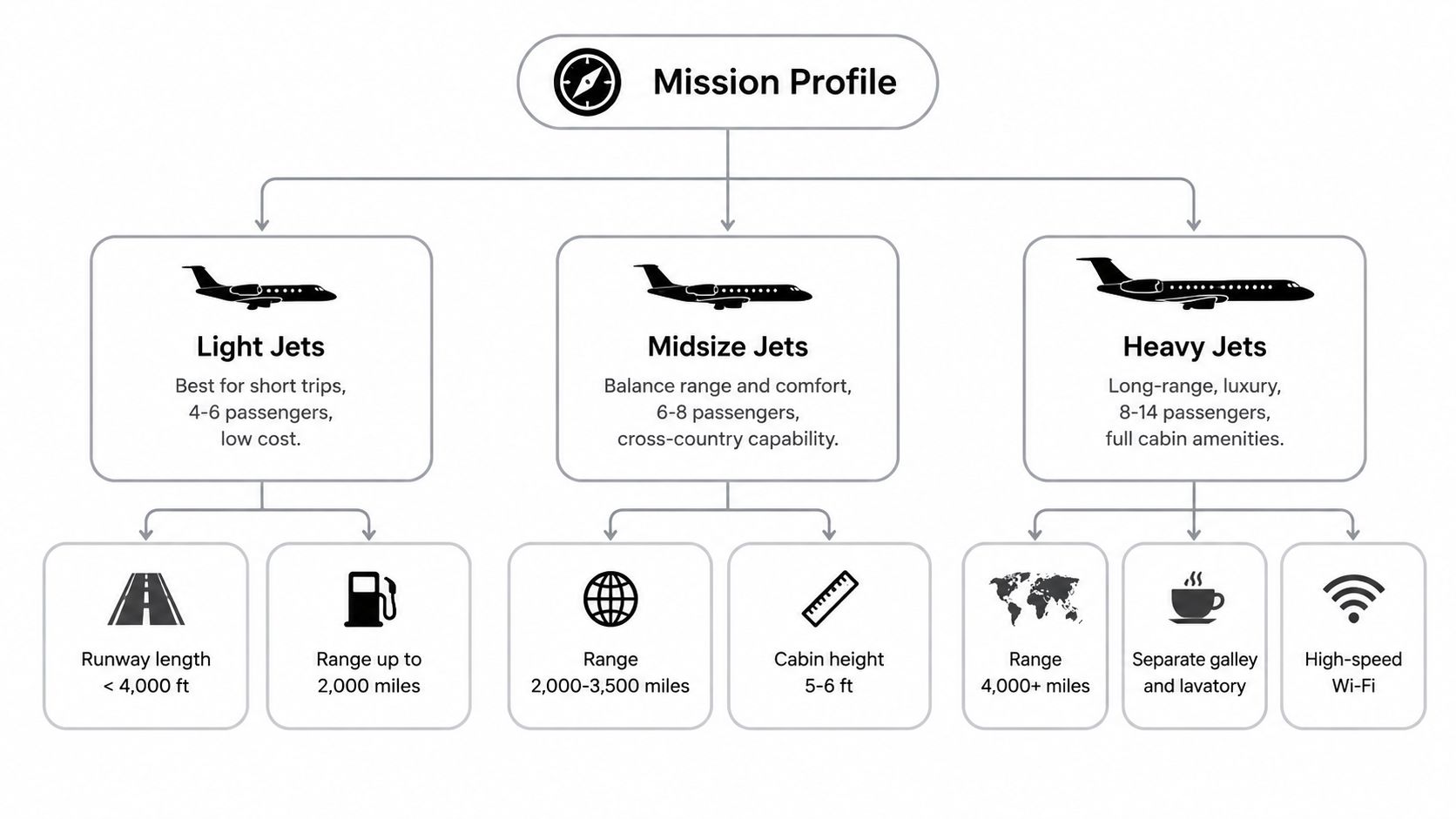
Confirm passenger count, baggage, route length, cabin comfort, range, and airport compatibility before comparing operators. A light jet can suit a short regional hop. A midsize or heavy jet earns its premium when you need greater range, stand-up space, additional baggage capacity, or more onboard amenities.
Start with passengers and baggage
Light jets are often the practical choice for shorter domestic missions and smaller groups. Their value disappears if the cabin cannot handle golf bags, trade-show materials, wardrobe trunks, or other oversized cases. Ask the operator to confirm usable baggage capacity, not just the published cabin category.
Midsize jets provide more cabin volume and baggage flexibility. Heavy jets add range, space, and amenities for larger groups or longer sectors. Operator quote data places standard charter hourly ranges at about $1,800 to $3,500 for turboprops and $13,500 to $18,500 or more for ultra-long-range heavy jets. Those are broad category benchmarks, not guaranteed prices. Aircraft position, schedule, availability, and airport restrictions determine the final figure.
Use this decision sequence:
- Count every passenger. Include staff, security, family members, and colleagues who may join later.
- List the baggage. Add golf bags, product cases, wardrobe trunks, and oversized equipment.
- Define the cabin requirement. Decide whether you need a compact cabin, workspace, a stand-up layout, or separate amenities.
- Check range and airport compatibility. The operator must confirm that the aircraft can complete the route and use your selected Las Vegas airport.
- Compare the all-in quote. A lower category rate has little value if it forces a different airport or adds a positioning leg.
Right-size without compromising comfort
For a short trip from Southern California, a light jet can preserve privacy and speed without charging for unused cabin volume. A transcontinental itinerary may justify a midsize, super-midsize, or heavy aircraft because range, comfort, and baggage capacity affect the entire travel day.
Review this comparison of light, midsize, and heavy private jets before requesting firm quotes. The right aircraft is the smallest one that properly handles your passengers, baggage, route, airport, and comfort requirements.
Sourcing Locally to Eliminate Repositioning Fees
A low hourly rate can hide the largest cost in a Las Vegas charter: getting the aircraft to you. Operators must position the jet, crew it, fuel it, and fit those movements into the wider schedule. An aircraft already near your departure airport can produce a cleaner quote. One based across the country may add a positioning flight before your trip starts and another after it ends.
Make aircraft location a first-order booking criterion. Ask the broker where the jet is based, where the crew is based, and whether the proposed itinerary includes inbound or outbound deadhead legs. Those details belong in the written quote before you select the aircraft.
Empty legs are useful, but they're not magic
An empty leg is a repositioning segment created when an aircraft moves for another scheduled mission. If your route and departure window align with that movement, the operator may sell the available segment at a significant discount. As noted earlier, the savings depend on the aircraft's existing mission and the route it already needs to fly.
Flexibility determines whether the opportunity is practical. The primary charter can change, taking the empty leg with it. Departure times may also suit the operator's schedule rather than your meeting, event, or return flight. Consider an empty leg only if you can adjust the departure time, accept the assigned aircraft, and tolerate less control than a dedicated charter.
What to demand from a broker
A serious quote should identify:
- Aircraft location: The proposed aircraft's current or scheduled base.
- Positioning legs: Every empty movement included in the calculation.
- Operator identity: The certificated operator responsible for the flight.
- Airport plan: Departure and arrival airports, FBOs, and operating-hour constraints.
- Cancellation exposure: The financial and scheduling result if the primary mission changes and the empty leg disappears.
Ask the broker to separate the aircraft's flight cost from positioning costs. A quote that combines both figures can make a distant aircraft appear competitive until the deadhead legs are added. Confirm whether crew travel, overnight requirements, and any changes to the primary mission can alter the final amount.
The right question is not, “What is the hourly rate?” Ask, “Where is this aircraft coming from, and what happens if that movement changes?”
For an occasional Las Vegas traveler, on-demand charter with transparent sourcing usually offers the cleanest structure. You pay for the itinerary you need instead of committing to prepaid hours or a rigid program that may not match your destinations.
Client standard: Do not approve a charter until the provider shows where the aircraft is coming from and which positioning costs are included.
Navigating FBO Logistics and Pre-Flight Requirements
Private aviation removes commercial-terminal friction, but it doesn't remove operational obligations. Las Vegas has specific requirements during high-volume periods, and a missed detail can delay a flight regardless of how quickly you arrived at the FBO.
At LAS, transient general aviation operates under a Prior Permission Required, or PPR, process during high-volume operations. Operators not based at LAS, VGT, or HND must obtain a PPR number from an FBO before landing, and FAA guidance says landing clearance may be denied without it. The PPR number must also be included in the flight-plan remarks for transient unscheduled general aviation flights. FAA safety guidance on LAS PPR procedures should be part of the pre-flight file.
Confirm the airport before you confirm the jet
If you choose HND, verify the FBO schedule rather than relying on the airport's 24-hour field status. The airport operates 24 hours, but published FBO hours are 05:00 to 22:30, and after-hours handling must be arranged in advance, usually for a fee. International travelers should also confirm the customs plan because HND has no on-site U.S. Customs facility.
At LAS, confirm which south-side FBO will handle your flight. Signature Flight Support and Atlantic Aviation are the two commonly used FBOs, and your provider should state the selected facility in writing.
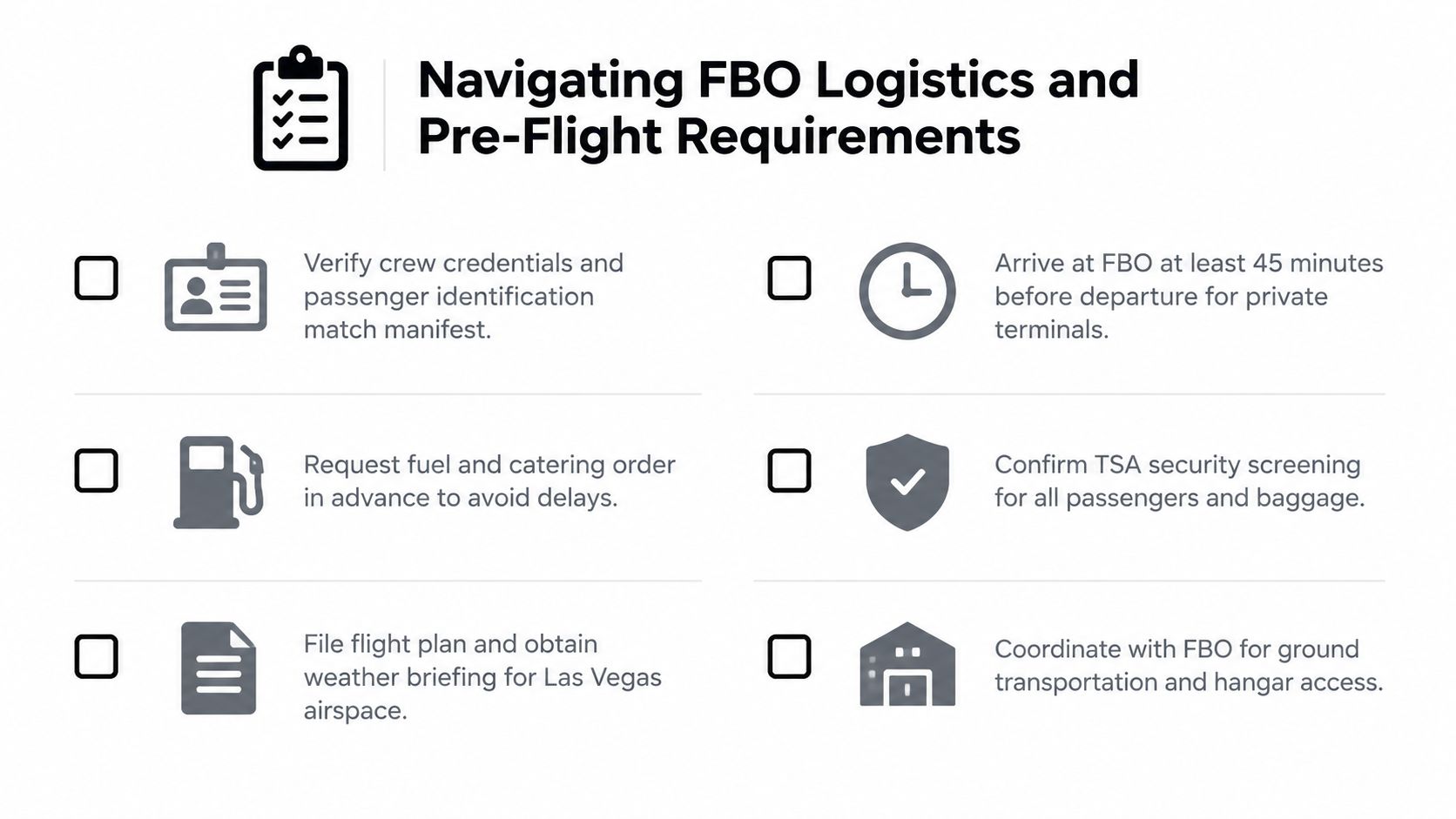
Your pre-flight checklist
Use a written confirmation process:
- Passenger manifest: Ensure every passenger's identification matches the manifest.
- Tail number: Confirm the exact aircraft, not just the category or model family.
- Crew details: Request crew names and biographies before departure.
- PPR status: Verify that the number has been obtained and entered correctly.
- Customs plan: Confirm clearance location for any international arrival.
- Catering and fuel: Approve special meals, beverages, and fuel arrangements in advance.
- Ground transport: Match the vehicle's arrival time to the aircraft's expected parking position.
- Weather briefing: Request the current briefing and contingency plan before departure.
Haute Jets' stated workflow includes a 24-hour pre-flight confirmation with the tail number, crew biographies, weather briefing, and passenger manifest. Whether you use that provider or another broker, demand the same level of specificity.
The FBO should also know whether you need hangar access, security coordination, special vehicles, or discreet handling. Luxury is not the aircraft interior alone. It's the absence of avoidable decisions after you've landed.
The On-Demand Advantage for Event-Driven Travel
Las Vegas schedules rarely stay static. A fight time changes, a convention meeting moves, a production call sheet expands, or a weekend itinerary acquires an extra stop. Those realities favor on-demand charter over a rigid travel program built around fixed rules.
Jet cards and fractional ownership can suit travelers with predictable, recurring requirements. They're less compelling when your destinations, passenger groups, and timing vary. A one-off Vegas trip shouldn't require prepaid hours, annual commitments, or accepting an aircraft category that doesn't fit the mission.
Flexibility still needs discipline
On-demand doesn't mean accepting the first aircraft offered. Require three things:
- Exact aircraft clarity: Review the year, make, model, cabin layout, baggage capacity, and onboard connectivity.
- Transparent economics: Separate flight time, positioning, airport costs, catering, and ground transport.
- Independent safety review: Use operators with recognized third-party audits, including Wyvern or ARGUS ratings, before approving the flight.
Haute Jets is one on-demand option that sources aircraft from owner-operators and states that its network is limited to Wyvern Wingman or ARGUS Gold and Platinum rated operators. Its model is built around pay-per-flight booking rather than memberships or jet cards, which fits travelers who want flexibility without a recurring program.
The strongest booking strategy for Las Vegas is simple. Select the airport that minimizes ground friction, match the aircraft to the actual passenger and baggage profile, verify the aircraft's location, and demand a complete pre-flight confirmation. That approach protects both time and value when event demand makes the market less forgiving.
Haute Jets can source on-demand private aircraft for Las Vegas through LAS, HND, and VGT, with options for one-way charters and empty legs when availability aligns. Visit Haute Jets to request an aircraft matched to your route, airport, schedule, and cabin requirements, without committing to a membership or jet card.